Over the last 30 years, medical and surgical treatments for CHD have substantially advanced. At present, 95% of babies born with a CHD survive well into adulthood.Reference Warnes 1 As a result, there has been a dramatic increase in the number of adults living with CHD. To date, medical knowledge of CHD far outweighs our understanding of the psychosocial impact of living with a CHD as an adult.
The small body of literature that does exist for this patient population suggests that living with a CHD as an adult increases the risk of depression and anxietyReference Bromberg, Beasley, D’Angelo, Landzberg and DeMaso 2 – Reference Kovacs, Saidi and Kuhl 4 and decreases quality of life.Reference Rose, Köhler, Köhler, Sawitzky, Fliege and Klapp 5 – Reference Simko and McGinnis 8 Many CHD adults recount an abnormal and limited childhood.Reference Jefferies, Noonan, Keller, Wilson and Griffith 9 Adults with a CHD can experience difficulty with employment;Reference Bromberg, Beasley, D’Angelo, Landzberg and DeMaso 2 , Reference Simko and McGinnis 8 , Reference Jefferies, Noonan, Keller, Wilson and Griffith 9 they have low rates of exercise;Reference Swan and Hillis 10 are less likely to be in a relationship;Reference Horner, Liberthson and Jellinek 3 and men, especially, can fear death during sex.Reference Vigl, Hager and Bauer 11 In addition, around half of this adult population feels limited in their choices to have a family, either because of the hereditary nature of CHDs, because of the decreased life expectancy, or for a few women because it is contraindicated.Reference Horner, Liberthson and Jellinek 3 , Reference Jefferies, Noonan, Keller, Wilson and Griffith 9 , Reference van Rijen, Utens and Roos-Hesselink 12
Disease severity does not appear to be strongly associated with psychosocial functioning in this group, with other factors possibly playing a role.Reference Kovacs, Saidi and Kuhl 4 , Reference Brandhagen, Feldt and Williams 13 The Common Sense Model of IllnessReference Leventhal, Meyer and Nerenz 14 proposes that individuals actively form a “lay” understanding about their illness, which involves a number of dimensions. This understanding has been shown to play an important role, in a number of illness groups, in determining outcomes such as levels of disability, treatment adherence, and health-related quality of life.Reference Petrie, Weinman, Sharpe and Buckley 15 – Reference Stafford, Berk and Jackson 20 Recent research in the area of CHD suggests that links exist between illness perceptions and quality of life.Reference Schoormans, Mulder and van Melle 21
This study aims to further explore the psychosocial experiences of adults with a CHD and examine the impact of cardiac disease severity and illness perceptions on quality of life, depression, and anxiety. We hypothesised that illness perceptions would be more strongly associated with these outcomes than disease severity and would predict outcomes 1 year later.
Materials and methods
Adults who attended a routine clinic visit at an Auckland District Health Board Congenital Heart Disease Outpatients Clinic between May and September, 2010 were approached to participate in this study. Eligible patients had a CHD, were 16 years of age or above, and were able to read and write English. Consecutive sampling was employed. There were 223 patients who had appointments, 52 did not attend their appointment, 20 did not meet the criteria, and seven were not asked. Of the 144 who were approached to participate, 110 agreed and completed the baseline questionnaire. Ethical approval for this study was granted on 25 March, 2010 by the Northern X Human Ethics Committee.
Procedure
Patients were seen by the cardiac nurse who briefed them about the study, gave them the information sheet, and invited them to participate. Once the patients had returned to the waiting room, the researcher approached those who had agreed to take part. Patients then gave their written informed consent and completed a questionnaire. The patients’ medical records were accessed to record key aspects of their medical history. A year later, patients were mailed a follow-up questionnaire that contained the same measures. Those patients who had not returned the questionnaire within 4 weeks were reminded via a telephone call. A replacement questionnaire was sent if they had lost or misplaced the original.
Measures
The Brief Illness Perception QuestionnaireReference Broadbent, Petrie, Main and Weinman 22 measures the patients’ cognitive and emotional representation of their condition. This measure has sound psychometric properties, with good test–retest reliability, predictive, concurrent, and discriminant validity. The first eight items on the Brief Illness Perception Questionnaire measure patients’ perceptions of their illness with regard to the consequences, timeline, personal control, treatment control, identity, concern, coherence, and how it affects them emotionally. The ninth item is designed to elicit beliefs around the cause of their illness. In the questionnaire, two items were reworded for this study following a pilot study that indicated the original wording was not appropriate for this population. The timeline item asked “how long do you think your heart will continue to function well?” The treatment control item asked only those on medication (44 patients) “… how much do you think your medication can help control your heart condition?”
Trait anxiety was measured using the trait scale of the State Trait Anxiety Inventory.Reference Spielberger, Gorsuch and Lushene 23 This measure has 20 items that are scored on a four-point scale; higher scores indicate greater anxiety. This State Trait Anxiety Inventory has been extensively used in a medical context and has sound psychometric properties.Reference Spielberger, Gorsuch and Lushene 23 , Reference Spielberger, Gorsuch, Lushene, Vagg and Jacobs 24 Scores above 40 indicate increased trait anxiety in cardiac populations.Reference Spielberger, Gorsuch, Lushene, Vagg and Jacobs 24
The 18-item cardiac anxiety questionnaire was used to assess specific aspects of heart-focussed anxiety.Reference Eifert, Thompson and Zvolensky 25 This measure has the following three subscales: fears and worries about heart-related sensations and help and reassurance seeking; heart-focussed attention and monitoring of cardiac-related stimuli; and avoidant behaviours related to activities believed to cause cardiac symptoms. The items are measured on a five-point scale, and higher scores indicate greater anxiety. This measure has good psychometric properties, with a Cronbach’s α of 0.83. Test–retest reliability is high, and it is sensitive to changes over time.Reference Hoyer, Eifert and Einsle 26
Depressive symptoms were measured using the Centre for Epidemiologic Studies Depression Scale-10.Reference Andresen, Malmgren, Carter and Patrick 27 Patients respond on a four-point scale that describes the frequency that each mood symptom occurred in the last week. A cut-off score of 10 or greater has been established for classifying persons as having depressive symptoms.Reference Andresen, Malmgren, Carter and Patrick 27 The scale has strong internal reliability and convergent validity and high test–retest correlations.
Quality of life was measured in two ways. A Linear Analogue Scale was used to measure an overall perception of quality of life. This was a horizontal 100-mm line, with anchors from 0 – worst imaginable quality of life – to 100 – best imaginable quality of life. Patients were asked to rate their overall quality of life by marking on the line that best represents their current quality of life. Moons et alReference Moons, Van Deyk and De Bleser 28 used this measure with CHD adults and showed that it was valid, reliable, and responsive. The CHD-TNO/AZL Adult Quality of Life Instrument (TAAQOL)Reference Kamphuis, Zwinderman and Vogels 29 was also used. This consists of the following three subscales: (1) symptoms in the past month; (2) worries during the past month; and (3) impact cardiac surveillance – measuring frequency of medical examinations over the last year. A higher score indicates poorer quality of life. Similar to previous researchReference Hulsergen-Zwarts, Plokker and Brunninkhuis 30 on illness perceptions and quality of life in this population, we included the worry and symptoms subscales separately in the analysis and excluded the surveillance subscale from the analysis. Overall quality of life was correlated with both the worry and the symptoms subscales (r=−0.43 and r=−0.38, respectively, p<0.001).
Demographic information was collected including age, gender, ethnicity, education, employment, marital status, and living situation. Cardiologists rated the patients’ disease severity based on categories outlined in the Task Force 1 of the 32nd Bethesda Conference of the American College of Cardiology.Reference Warnes, Liberthson and Danielson 31 There are three categories based on the initial diagnosis or specific type of operations – simple, moderate, and great complexity. Patients were classified further on the basis of their illness course. This was defined as follows: low – “maximum of one cardiovascular operation or one catheterisation procedure”; medium – “more than one cardiovascular operation or catheterization”; and high – “persistent cyanosis, <92% oxygen saturation at rest or single ventricle physiology”.Reference Moons, Van Deyk, De Geest, Gewillig and Budts 32 In addition, an open-ended question was included asking patients to describe any worries and concerns they had about the future.
Data analysis
The data were analysed using PASW version 18 software. Repeated measures t-tests were used to assess changes in anxiety, quality of life, and depression over time. Bivariate correlations were conducted to determine which medical indices, demographic variables, and illness perceptions were related to the psychosocial outcomes. Regression analysis was performed at baseline and follow-up using those variables that were significantly bivariately associated with the outcome measures. As only a small number of the patients were on medication and completed the treatment control perception item, this was left out of the regressions. An α level of 0.05 was maintained. Answers to the open-ended item were categorised into themes by two independent raters using content analysis, and frequencies were recorded. Initially there was 87% agreement, and after discussion 100% agreement was obtained.
Results
Demographic variables
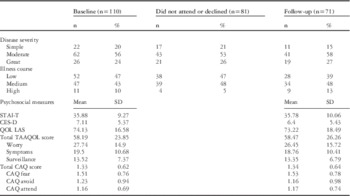
The baseline questionnaire was completed by 110 adults, 58 (52.7%) of whom were women. The mean age was 32 years (SD=12.85), with a range of 16 to 75 years. A total of 75 patients (68.2%) classified their ethnicity as European, 6% as Maori, 7% as Pacific Island, 10% as Asian, and 8% as other; 47% of the patients were in full-time employment, 16% in part time, 18% were students, and another 16% were either unemployed or on a sickness benefit. Just over a quarter of the patients (26%) had a university degree, 47% of the patients were married or in a de facto relationship and lived with their spouse, with or without children. Table 1 includes rates of disease severity and illness course. There were no significant differences in age, gender, illness course, or disease severity between those who participated at baseline and those who did not attend the clinic visit or declined to participate. Non-Europeans, however, were more likely to miss clinic or decline participation compared with Europeans (p<0.05). At follow-up a year later, 39 individuals (22 female) failed to return the questionnaire and were excluded from the second part of the study (65% follow-up rate). At follow-up, patients were more likely to have a worse illness course and to have had their first surgery at a younger age than non-patients (p<0.05), but did not differ in other ways. A total of 71 patients completed the entire study.
Disease severity and illness course at baseline, anxiety, depression, and quality of life scores at baseline and follow-up.

CAQ=cardiac anxiety questionnaire; CES-D=Centre for Epidemiological Studies-Depression; QOL LAS=Quality of Life Linear Analogue Scale; STAI-T=State Trait Anxiety Inventory-Trait subscale; TAAQOL=Congenital Heart Disease-TNO/AZL Adult Quality of Life Instrument
Five DNA or declined cases had missing data for disease severity and illness course
Open-ended concerns
Answers centred on the following five themes: (1) pregnancy and family life, including being pregnant, passing the condition on to children, not being alive to see family grow up, and concerns about being able to have a relationship (n=22); (2) future operations (n=12); (3) life expectancy (n=12); (4) future health problems (n=21); and (5) acceptance including taking things as they come, generally having good health, learning to deal with it, and trying not to worry (n=13). A total of 54 patients (49%) reported at least one concern from themes 1 to 4, and 56 patients (51%) reported no concerns and/or acceptance.
Levels of anxiety and depression
Psychosocial outcomes at baseline and follow-up are reported in Table 1. There were no significant differences between men and women on these outcomes. There were no significant differences in scores from baseline to follow-up. Based on the cut-off score for the Centre for Epidemiologic Studies Depression Scale-10, 23% of the patients had depressive symptoms at baseline; 30% of the patients scored above the threshold for increased trait anxiety in cardiac populations. A total of 40 patients had either depressive or trait anxiety symptoms, and 18 (45%) patients among them were experiencing both.
Relationships between illness perceptions, quality of life, anxiety, and depression at baseline
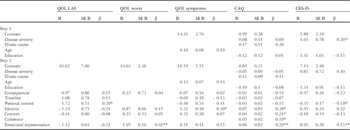
Demographic variables were not significantly correlated with overall quality of life, and thus were not entered into the regression. In all, six illness perceptions were significantly bivariately correlated with the outcome and entered into the regression. Together, they explained 27% of the variance in overall quality of life (adjusted R2=23%), F(6, 99)=6.23, p<0.001 (Table 2). Higher personal control was associated with better quality of life. Demographic variables were not significantly correlated with worry-related quality of life and were not entered into the regression; four illness perceptions were significantly bivariately correlated with worry and entered into the regression. Together, they explained 29% of the variance (adjusted R2=26%), F(4, 105)=10.07, p<0.001 (Table 2). Higher emotional representations were associated with more worry. Age was significantly correlated with symptom-related quality of life and was entered at Step 1. This explained 4% of the variance; six illness perceptions were significantly bivariately correlated and together explained 31% of the variance (adjusted R2=26%), F(7, 105)=6.35, p<0.001. These illness perceptions explained an additional 22% of the variance, F change (6, 98)=6.54, p<0.001. Perceptions of worse illness identity were associated with worse symptom-related quality of life.
Regression showing relationships between illness perceptions and psychological outcomes at baseline.

CAQ=cardiac anxiety questionnaire; CES-D=Centre for Epidemiological Studies-Depression; QOL LAS=Quality of Life Linear Analogue Scale; QOL symptoms=Congenital Heart Disease-TNO/AZL Adult Quality of Life Instrument (CHD-TAAQOL-symptoms subscale); QOL worry=Congenital Heart Disease-TNO/AZL Adult Quality of Life Instrument (CHD-TAAQOL-worry subscale)
*p<0.05, **p<0.01
Disease severity, illness course, and education (Step 1) explained 8% of the variance in total cardiac anxiety. After the entry of eight illness perceptions at Step 2, which were significantly correlated with anxiety in bivariate correlations, the total variance explained by the model as a whole was 48%, (adjusted R2=42%), F(10, 104)=8.54, p<0.001. These illness perceptions explained an additional 40% of the variance in cardiac anxiety, F change (7, 94)=10.05, p<0.001. Significant individual predictors in the model were identity, concern, coherence, and emotional representations; higher scores were associated with higher cardiac anxiety.
The medical and demographic variables in Step 1 accounted for 6% of the variance in depressive scores. When the five illness perceptions, which were significantly correlated with depression in bivariate correlations, were entered into the model at Step 2, they explained an additional 28% of the variance, F Change (5, 97)=8.19, p<0.001. The entire model accounted for 34% (adjusted R2=29%) of the total variance in anxiety, F(7, 104)=7.19, p<0.001. Significant individual predictors of depression in the model were lower personal control and higher emotional representations.
Relationships between illness perceptions, depression, anxiety, and quality of life at follow-up
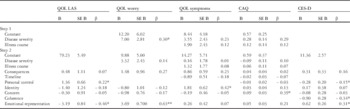
In order to assess the cross-sectional relationship between illness perceptions and psychological outcomes at follow-up, three regression analyses were conducted (Table 3). Medical and demographic variables were not significantly correlated with overall quality of life 1 year later, and therefore were not included in the model; five illness perceptions were significantly bivariately correlated and together explained 43% of the variance (adjusted R2=39%), F(5, 65)=9.18, p<0.001. Emotional representation was the strongest individual predictor in the model, with lower emotional responses related to better quality of life. Disease severity was correlated with worry-related quality of life, explaining 9% of the variance at Step 1; four illness perceptions were significantly bivariately correlated with worry and together explained 44% of the variance (adjusted R2=40%), F(5, 66)=9.61, p<0.001. These illness perceptions explained an additional 35% of the variance, F change (4, 61)=9.64, p<0.001. Similar to overall quality of life, lower emotional responses were related to better worry-related quality of life. Illness course and disease severity were both significantly correlated with symptom-related quality of life and entered at Step 1. They explained 10% of the variance; five illness perceptions were significantly bivariately correlated and were entered at Step 2. Together, they explained 59% of the variance in the model (adjusted R2=54%), F(7, 63)=11.34, p<0.001. The illness perceptions explained an additional 49% of the variance, F change (5, 56)=13.18, p<0.001. Identity was the strongest individual predictor in the model, with a stronger perceived identity related to worse symptom-related quality of life.
Regression showing relationships between illness perceptions and psychological outcomes at follow-up.

CAQ=cardiac anxiety questionnaire; CES-D=Centre for Epidemiological Studies-Depression; QOL LAS=Quality of Life Linear Analogue Scale; QOL symptoms=Congenital Heart Disease-TNO/AZL Adult Quality of Life Instrument (CHD-TAAQOL-symptoms subscale); QOL worry=Congenital Heart Disease-TNO/AZL Adult Quality of Life Instrument (CHD-TAAQOL-worry subscale)
*p<0.05, **p<0.01
The regression analysis found that illness course and disease severity (Step 1) significantly explained 14% of the variance in total cardiac anxiety; six illness perceptions that were significantly bivariately correlated with anxiety were entered at Step 2 and explained 55% of the total variance (adjusted R2=49%), F(8, 66)=8.95, p<0.001. These illness perceptions explained an additional 41% of the variance, F change (6, 58)=8.85, p<0.001. The only significant individual illness perception was concern, whereby higher concern was associated with higher cardiac anxiety.
The predictors of depression are also shown in Table 3. When the six illness perceptions that were significantly correlated with depression were entered into the model at Step 2, the entire model accounted for 44% (adjusted R2=38%) of the total variance in depression, F(6, 64)=7.48, p<0.001. In the model, the significant individual predictors were coherence and emotional representation, with lower coherence and higher emotional representation linked with depression.
Baseline predictors of depression, anxiety, and quality of life 1 year later
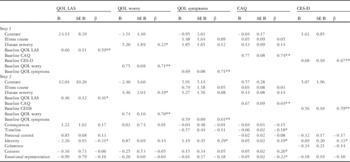
Baseline overall quality of life was significantly correlated with overall quality of life 1 year later, and explained 35% of the variance in the first step; five baseline illness perceptions were significantly bivariately correlated with follow-up overall quality of life, and when added to the regression at Step 2 the model explained 47% of the variance (adjusted R2=41%), F(6, 61)=8.90, p<0.001. The addition of illness perceptions explained the additional 12%, F change (5, 61)=2.63, p=0.03 (Table 4). Disease severity was significantly correlated with worry-related quality of life at follow-up, as was baseline worry. These significantly explained 59% of the variance at Step 1; four illness perceptions were significantly bivariately correlated with the follow-up quality of life worry subscale. Adding these to the model (adjusted R2=57%), F(6, 61)=15.67, p<0.001, did not signficantly improve the variance explained (61%), F change (4, 61)=0.65, p=0.63. Illness course, disease severity, and baseline symptom-related quality of life were significantly correlated with follow-up symptom-related quality of life and explained 59% of the variance; five baseline illness perceptions were significantly bivariately correlated with follow-up symptom quality of life and entered at Step 2. This model explained 67% of the variance (adjusted R2=62%), F(8, 56)=14.14, p<0.001. The addition of illness perceptions explained an additional 3% of the variance, F change (5, 56)=3.55, p=0.03.
Regression showing the prediction of psychological outcomes at 1-year follow-up from baseline predictors.

CAQ=cardiac anxiety questionnaire; CES-D=Centre for Epidemiological Studies-Depression; QOL LAS=Quality of Life Linear Analogue Scale; QOL symptoms=Congenital Heart Disease-TNO/AZL Adult Quality of Life Instrument (CHD-TAAQOL-symptoms subscale); QOL worry=Congenital Heart Disease-TNO/AZL Adult Quality of Life Instrument (CHD-TAAQOL-worry subscale)
*p<0.05, **p<0.01
A regression analysis found that illness course, disease severity, and baseline cardiac anxiety (Step 1) significantly explained 65% of the variance in total cardiac anxiety at follow-up; six baseline illness perceptions were significantly bivariately correlated with cardiac anxiety 1 year later and were entered at Step 2. The total model explained 74% of the total variance (adjusted R2=70%), F(9, 59)=18.78, p<0.001. The illness perceptions explained an additional 9% of the variance, F change (6, 59)=3.44, p=0.006 (Table 4).
The regression model for depression is also shown in Table 4. Baseline depression was entered in Step 1, significantly accounting for 44% of the variance in depressive scores; four baseline illness perceptions were significantly correlated with depression 1 year later, and were included in the model (Step 2). The entire model accounted for 59% (adjusted R2=55%) of the total variance in depression, F(5, 58)=16.59, p⩽0.001. The addition of illness perceptions to the model significantly explained a further 15% of the variance in depression, F change (4, 58)=5.03, p=0.002.
Discussion
In this study, 23% of CHD patients were classified as having depressive symptoms, and 30% were classified as having high trait anxiety. These rates are very similar to the rates of depressive and anxiety symptoms found in CHD patients in North America – 22% and 34%, respectively.Reference Kovacs, Saidi and Kuhl 4 Similar rates have been found in adults with other chronic illnesses such as cystic fibrosis where 29% scored above the cut-off for depression and 32% for anxiety.Reference Quittner, Goldbeck and Abbot 33 The mean score of 74 for overall quality of life in this study was similar to previous research with CHD patients (median score 80).Reference Moons, Van Deyk, De Geest, Gewillig and Budts 32
A number of illness perceptions had strong relationships with psychological outcomes cross-sectionally, at both baseline and follow-up. The strongest associations were with personal control, identity, coherence, concern, and emotional representations. Baseline illness perceptions also had significant bivariate associations with follow-up anxiety, depression, and quality of life, but the sizes of the associations were reduced in regression models controlling for baseline values. Other studies have found that illness perceptions are useful for predicting outcomes in cardiac patients.Reference Dickens, McGowan and Percival 34 – Reference Le Grande, Elliott and Worcester 36 In particular, a recent study found that perceptions about consequences, coherence, treatment control, timeline, and emotional representation of CHD patients were predictive of quality of life 2 years later.Reference Schoormans, Mulder and van Melle 21
Addressing anxiety and concerns about CHD may help patients to reduce cardiac anxiety in the future. Already interventions aimed at addressing illness perceptions have had good results for cardiac patients’ recovery and mental health.Reference Broadbent, Ellis, Thomas, Gamble and Petrie 37 From a clinical perspective, the common sense model of illness provides the care team with a theoretical framework within which to potentially affect positive psychosocial changes. The open-ended questions revealed that almost half of the patients reported being concerned about either the potential implications of future operations, their life expectancy, future health concerns, or family-related issues, whether it was being around long enough for the family they have or planning a family in the future. If patients could be provided support around these issues, it could help them reduce their levels of concern. An intervention should also try to increase feelings of control over the condition. Similar to previous research, personal control was lower in patients with depressive symptoms.Reference Stafford, Berk and Jackson 20
There are some limitations to this research. Europeans were more likely to participate than non-Europeans. People with a higher illness course and those who had had their first surgery at a younger age were more likely to return the follow-up questionnaire; thus, the results may not generalise to all patients with CHD. Second, previous research suggests that rates of anxiety and depression in this population are underestimated when using traditional questionnaires.Reference Horner, Liberthson and Jellinek 3 Thus, more in depth techniques such as interviews may be needed to accurately detect these levels. In conclusion, CHD patients’ illness perceptions are associated with their psychosocial functioning, particularly cross-sectionally. A greater degree of concern, greater emotional responses, and more symptoms most consistently predicted worse psychosocial outcomes over time. Future work could investigate the potential of an illness perception intervention to improve mental health and quality of life in these patients.
Acknowledgements
None.
Financial Support
This research received no specific grant from any funding agency, commercial, or not-for-profit sectors.
Conflicts of Interest
None.
Ethical Standards
The authors assert that all procedures contributing to this work comply with the ethical standards of the relevant national guidelines on human experimentation (Health and Disability Ethics Committees) and with the Helsinki Declaration of 1975, as revised in 2008, and has been approved by the institutional committees (Auckland District Health Board Research Review Committee).