Introduction
Lepidopteran species are among the most important insect pests that attack various plant organs and reduce crop yield (Manosathiyadevan et al., Reference Manosathiyadevan, Bhuvaneshwari, Latha and Dhanarajan2017). Those attacking reproductive structures are frequently more harmful than the species feeding on vegetative plant parts (Mapuranga et al., Reference Mapuranga, Chapepa and Mudada2015). The legume pod borer, Helicoverpa armigera (Hübner), belonging to the family of Noctuidae, is a multivoltine lepidopteran pest with ever-expanding distribution in tropical and subtropical parts of Asia, America, Africa, Australia, and Europe (Yadav et al., 2022; EPPO, 2025). As a highly polyphagous species, H. armigera has a broad host range, including more than 300 host plant species, particularly belonging to Fabaceae, Asteraceae, and Poaceae families (Razmjou et al., Reference Razmjou, Naseri and Hemati2014; Mapuranga et al., Reference Mapuranga, Chapepa and Mudada2015; EPPO, 2025). Whitin the Fabaceae family, mung bean (Vigna radiata L.) serves as a key host plant for many noctuid species (Makhmudova and Ergasheva, Reference Makhmudova and Ergasheva2021; Zamani Fard et al., Reference Zamani Fard, Hemmati and Shishehbor2023). It is grown on over 6 million hectares worldwide and provides a dietary protein source for households across many countries (Hou et al., Reference Hou, Yousaf, Xue, Hu, Wu, Hu, Feng and Shen2019). The mung bean plants are attacked by H. armigera at both vegetative and generative stages. However, the direct damage caused by larvae boring holes in the pods and feeding insatiably on grains, mostly during the milk ripening period, can bring about considerable yield loss (Mapuranga et al., Reference Mapuranga, Chapepa and Mudada2015; Makhmudova and Ergasheva, Reference Makhmudova and Ergasheva2021). Bore holes are usually visible, but otherwise it is crucial to cut open the pods to detect H. armigera in its larval stage (EPPO, 2025).
Insecticides are the most commonly used method to suppress insect pests’ population. However, under continuous selection pressure of these chemicals, H. armigera has developed resistance to various groups of conventional insecticides (Torres–Vila et al., Reference Torres–Vila, Rodríguez–Molina, Lacasa–Plasencia and Bielza–Lino2002; Tossou et al., Reference Tossou, Tepa–Yotto, Kpindou, Sandeu, Datinon, Zeukeng, Akoton, Tchigossou, Djègbè, Vontas, Martin, Wondji, Tamò, Bokonon–Ganta and Djouaka2019), which strengthens the necessity to work on alternative control measures to design an eco-friendly integrated pest management (IPM) programme. Host plant resistance is a safe and long-lasting alternative method to control insect pests, which is linked to morphological (trichome density, grain hardness, lignification, surface wax, and etc.) and/or biochemical traits of the plants (War et al., Reference War, Murugesan, Boddepalli, Srinivasan and Nair2017, Reference War, Hussain, Mishra, Munghate and Sharma2021; Mortazavi Malekshah et al., Reference Mortazavi Malekshah, Naseri, Ranjbar Aghdam, Razmjou, Fathi, Ebadollahi and Changbunjong2022; Naseri and Majd–Marani, Reference Naseri and Majd–Marani2022; Zamani Fard et al., Reference Zamani Fard, Hemmati, Shishehbor and Stelinski2022). Biochemical profile of host plants, such as carbohydrate, protein, and toxic metabolites (phenol, flavonoid, anthocyanin, tannin, and etc.), as major components of host plants nutritional qualities, can affect the fitness of herbivores by enhancing development and reproduction when nutrients are abundant, or by reducing feeding and survival when defensive metabolites are present (Awmack and Leather, Reference Awmack and Leather2002; War et al., Reference War, Hussain, Mishra, Munghate and Sharma2021). The nutritional qualities of the plants for plant-feeding insects usually differ within the same host plant species (Goudarzi Mohammadi et al., Reference Goudarzi Mohammadi, Hemmati and Shishehbor2024). Some studies have proven that the mung bean cultivars or varieties play a key role in determining its susceptibility or resistance to insect pests. For instance, Lambrides and Imrie (Reference Lambrides and Imrie2000) found that two wild mung bean accessions (ACC23 and ACC41) were resistant to several bruchid species due to their small seed size and thick seed coat. Zamani Fard et al. (Reference Zamani Fard, Hemmati, Shishehbor and Stelinski2022) reported that resistance in the mung bean cultivars Simite1 and Simite2 to Spodoptera littoralis (Boisd) were linked with enhanced concentrations of secondary metabolites. In another study, Zamani Fard et al. (Reference Zamani Fard, Hemmati and Shishehbor2023) demonstrated that the higher nutritional value of a mung bean variety (VC6173A) made it more suitable for S. littoralis.
Nutritional assays through studying the intake, digestibility, and efficiency of conversion of consumed food to body matter are used to compare insects’ nutritional performance on various host plants (Waldbauer, Reference Waldbauer1968; Goudarzi Mohammadi et al., Reference Goudarzi Mohammadi, Hemmati and Shishehbor2024). For instance, evaluating the food consumption and utilisation of H. armigera on various host plant species, genotypes, and cultivars have been targeted in several studies (Singh et al., Reference Singh, Kumar and Gupta2008; Soleimannejad et al., Reference Soleimannejad, Fathipour, Moharramipour and Zalucki2010; Hemati et al., Reference Hemati, Naseri, Nouri Ganbalani, Rafiee Dastjerdi and Golizadeh2012; Kouhi et al., Reference Kouhi, Naseri and Golizadeh2014; War et al., Reference War, Hussain, Mishra, Munghate and Sharma2021; Jafari et al., Reference Jafari, Hemmati and Habibpour2023; El-Refaie et al., Reference El-Refaie, Shaurub, Abd-Allah, Ebeid and Abouelnaga2024). The nutritional indices are also used to identify the physiological responses of insect pests to defence mechanisms of plants (Zamani Fard et al., Reference Zamani Fard, Hemmati, Shishehbor and Stelinski2022; Jafari et al., Reference Jafari, Hemmati and Habibpour2023). Since, various parts of plants produce not only toxic secondary metabolites but also different proteins with various specificities toward insects’ digestive enzymes, which interfere with digestion process of insects (Borzoui et al., Reference Borzoui, Bandani and Goldansaz2013). The chickpea protease inhibitors, for example, showed inhibitory activities against midgut proteases (trypsin and chymotrypsin) of H. armigera (Giri et al., Reference Giri, Harsulkar, Deshpande, Sainani, Gupta and Ranjekar1998). For this reason, the digestive enzymes of insect pests have been considered as targets for control of insect pests (Mehrabadi et al., Reference Mehrabadi, Bandani, Saadati and Mahmudvand2011). Proteases and amylases, secreted by the insect midgut, are key digestive enzymes. Proteases break down proteins into peptides and amino acids, needed for growth and survival (Terra et al., Reference Terra, Ferreira, Jordao, Dillon, Lehane and Billingsley1996), while amylases hydrolyse starch into sugars, required for development (Franco et al., Reference Franco, Rigden, Melo and Grossi-de-sa2002).
Although some studies have been recently investigated the effects of some mung bean cultivars on nutritional indices and population attributes of a noctuid species (S. littoralis) (Zamani Fard et al., Reference Zamani Fard, Hemmati, Shishehbor and Stelinski2022, Reference Zamani Fard, Hemmati and Shishehbor2023), but we have nearly a complete lack of information about the growth, consumption, and digestive physiology of H. armigera on mung bean varieties. Therefore, we aimed to compare the feeding performance and digestive enzymes activities of H. armigera on 10 mung bean varieties and characterised the seeds biochemical traits (starch, protein, anthocyanins, phenolics, and flavonoids) to determine their relationships with pest’s feeding and physiological performances.
Material and methods
Mung bean varieties
In this research, seeds of mung bean varieties, consisted of 2 local (Baghmalek and Veys) and 8 commercial (India, Omrani, Parto, Simite2, Simite1, VC3960, VC6368, and VC6371) varieties, were obtained from Safiabad Agricultural Research and Education and Natural Resources Center (Dezful County, Khuzestan Province, Iran). Selection of these varieties of mung bean was due to their importance as commonly cultivated for commercial purposes in Iran. They were sown in a local field at Veys District (31°26′42″ N, 48°59′01″ E), Bavi County, Khuzestan Province, Iran, during the 2024 growing season on ridges of 50 cm width with a spacing of 7 cm in the row. The only chemical used during the study in the field was a conventional fertilizer regime consisted of 50 kg ha−1 urea as N fertilizer (50% of the recommended dose at pre-planting phase and the other 50% at flowering phase), 100 kg ha−1 triple superphosphate as P fertilizer, and 200 kg ha−1 potassium sulfate as K fertilizer (full recommended doses of both ones at pre-planting phase), which was applied to the soil. The plants were irrigated twice a week during the growing season. When the grains were developed within pods, the fresh and green grains of each variety were utilised as a diet for H. armigera larvae.
Helicoverpa armigera colony
The legume pod borer egg masses were originally collected from numerous bean fields in Khuzestan Province, Iran, in August 2024. The eggs were divided into 10 groups and reared for one generation on each mung bean varieties at 25 ± 1°C, 65 ± 5% relative humidity, and a 16-h light: 8-h dark photoperiod prior to use in the experiments. Larvae were fed on fresh grains of mung bean varieties, whereas adults were nourished on a 10% water-based honey solution.
Feeding performance
The nutritional indices of H. armigera on the studied mung bean varieties were estimated using the third instar larvae, which were obtained by rearing the neonate larvae from F2 population on the related varieties. The newly molted third instar larvae (25 replicates per mung bean variety) were individually released into Petri plates (9 cm diameter, 1.5 cm height) with 2-cm-diameter holes in their lids covered by pieces of fine net for air circulation and humidity control, and supplied with weighted fresh grains of each mung bean variety as food. In order to avoid experimental errors in the study, enough food was daily provided so that at least 80% of the available grains were eaten during the assay (Schmidt and Reese, Reference Schmidt and Reese1986). The third instar larvae were weighted every day, before and after feeding on the studied varieties until they reached the non-feeding pre-pupal stage, as the body weight is an important fitness indicator of insect population performance. Moreover, the weights of the initial fresh food as well as the food and frass remaining at the end of each experiment were recorded daily in the tested treatments. The pre-pupae and pupae were also weighed on each variety. To determine the dry weights of offered diet along with the fresh larvae and their frass, samples of them (20 for each) on the related mung bean varieties were weighed separately, oven-dried at 60°C for 48 h, and then reweighed (d = 0.001 ct, Sartorius AG Germany GCA803S). To measure the amount of food consumed, the food remaining at the end of each trial was subtracted from the total weight of food provided in their dry forms. The nutritional indices were calculated by the following equations (Waldbauer, Reference Waldbauer1968; Scriber and Slansky, Reference Scriber and Slansky1981):
 \begin{equation*}{\text{Consumption index }}\left( {{\text{CI}}} \right) \!=\! \frac{{{\text{dry weight of food consumed}}}}{{{\text{ mean dry weight of larvae over time }}}}\end{equation*}
 \begin{align*}&{\text{Approximate digestibility }}\left( {{\text{AD}}} \right) \\ &\quad= \frac{{{\text{dry weight of food consumed}} - {\text{dry weight of frass}}}}{{{\text{dry weight of food consumed}}}}\end{align*}
 \begin{align*}&{\text{Efficiency of conversion of ingested food }}\left( {{\text{ECI}}} \right) \\ &\quad= \frac{{{\text{dry weight gain of larvae}}}}{{{\text{dry weight of food consumed}}}} \times 100\end{align*}
 \begin{align*}&{\text{Efficiency of conversion of digested food }}\left( {{\text{ECD}}} \right) \\ &\quad= \frac{{{\text{dry weight gain of larvae }}}}{{{\text{dry weight of food consumed}} - {\text{dry weight of frass }}}} \times 100\end{align*}
 \begin{align*}&{\text{Relative consumption rate }}\left( {{\text{RCR}}} \right) \\ &\quad= \frac{{{\text{dry weight of food consumed }}}}{{{\text{primary weight of larvae}}}} \times {\text{duration of feeding period}}\end{align*}
 \begin{align*}&{\text{Relative growth rate }}\left( {{\text{RGR}}} \right) \\ &\quad= \frac{{{\text{dry weight gain of larvae}}}}{{{\text{primary weight of larvae}}}} \times {\text{duration of feeding period}}\end{align*}
The ECI, ECD, and RGR are the main variables of nutritional indices, which the first two ones measure the efficiency with which the ingested and assimilated food is changed into body matter, respectively, and the last one shows the increase in herbivore’s biomass. Other nutritional indices like CI, RCR, and AD also indicate feeding rate and digestive efficiency (Waldbauer, Reference Waldbauer1968).
Chemicals
All of the chemicals used in enzymes assays and grains’ biochemical analysis were bought from Sigma Chemical Co. (St. Louis, MO).
Digestive activities
Preparation of larval midgut extract
Twenty H. armigera larvae at late instar, previously fed on each variety, were ice – immobilised and dissected in cold distilled water under a stereomicroscope (Stemi SV6 ZEISS, Germany). The midguts of larvae were cleaned by removing the irrelevant tissues and then, collected in micro tubes (1.5 mL) containing distilled water. After homogenisation with a glass homogeniser, they were centrifuged at 12,000 g for 10 min at a temperature of 4°C. The supernatants were gathered in new micro tubes and kept at −20°C for further enzymatic assays.
Proteolytic activity assay
Proteolytic activity of H. armigera larvae on the studied mung bean varieties was evaluated using azocasein (1.5%) as a protease substrate (Elpidina et al., Reference Elpidina, Vinokurov, Gromenko, Rudenshaya, Dunaevsky and Zhuzhikov2001). The reaction mixture, containing H. armigera larvae midgut extracts (50 μL) and protease substrate (80 μL) in universal buffer (50 mM, pH = 11), was incubated for 50 min at a temperature of 37°C. Proteolysis was finished by addition of trichloroacetic acid (30%, 100 μL). Precipitation was caused by chilling at the temperature of 4°C for half an hour and then, centrifugation at 16,000 g for 10 min. An equal amount of NaOH (2 M) was mixed with supernatant and then, the absorbance was recorded at 440 nm (S2100SUV, UNICO, USA). Assays were performed in 3 replicates for each mung bean variety. The blanks contained all reaction components except enzyme extract, which in them, trichloroacetic acid had been mixed firstly with the substrate. Unit protease activity was represented as a rise in optical density per mg protein of the enzyme sample per minute as a result of azocasein proteolysis.
Amylolytic activity assay
For determining the amylolytic activity in H. armigera larvae on various treatments, the DNSA (3,5-dinitrosalicylic acid) method using soluble starch (1%) as the substrate was used (Bernfeld, Reference Bernfeld1955). A quantity of 50 μL of H. armigera midgut extract was incubated with universal buffer system (250 μL, pH = 9) and soluble starch (20 μL) (1%) for 30 min at the temperature of 37°C. The reaction was then ended by addition of DNSA (50 μL) and then, reheating in a water bath at 85‒95°C for 10 min. The absorbance was quantified at 540 nm after centrifugation at 16,000 g for 5 min at the temperature of 4°C. All tests were replicated 3 times for each mung bean variety with blanks devoid of enzyme extract. Unit amylase activity was defined as the amount of enzyme needed to produce 1 mg of maltose in 30 min at 37°C under the assay conditions.
Measurement of biochemical contents of fresh grains
Starch content
To measure the starch content of the treatments, the grains of each variety were first pulverized in a mortar using liquid nitrogen. Then, 100 mg of the powdered grains of each mung bean variety were homogenized in 10 mL of hot ethanol (80%) for removing starch and the residue was precipitated by centrifugation at 12,000 g for 15 minutes. Next, the residue was mixed with reagent A (15 mL), which is consisted of 4 mL Na2CaO3, 8 g NaOH, and 20 mL distilled water, and centrifuged again at the same condition. The obtained residue was then mixed with HClO4 (52%, 6.5 mL) and distilled water (5 mL). The mixture was kept for 20 min at 0°C for extraction of starch. Afterwards, 1 mL of extract was pipetted and diluted with distilled water to a final volume of 10 mL, and then anthrone reagent (4 mL) was added to it. The absorbance was spectrophotometrically recorded at 630 nm (S2100SUV, UNICO, USA) and the amount of starch determined using a starch standard curve (Clegg, Reference Clegg1956). This assay was performed in three replicates.
Protein content
The quantity of protein in the tested mung bean varieties was assayed based on the Kjeldahl method (AOAC, 2008). The procedure involved three key stages: digestion, distillation, and titration. Initially, 25 mL of sulfuric acid (H2SO4), along with a catalyst tablet and boiling chips, was introduced into Kjeldahl tubes. Following this, the digested samples were transferred to a distillation unit. To convert ammonium (NH4+) in the ammonium sulfate into ammonia (NH3), an additional base solution (40% NaOH) was added. The released ammonia gas was then captured using a solution of 50 mL 4% H3BO3 and a methyl red indicator. The amount of ammonia in the distillate was quantified through titration, which was identified by a colour change. Ultimately, the protein content of the mung bean grains was calculated based on the total nitrogen content of the sample, using a conversion factor of 6.25. Experiments were tested in triplicate to ensure accuracy for each mung bean variety.
Anthocyanin content
Anthocyanin content in the tested mung bean varieties was measured according to the procedure described by Kim et al. (Reference Kim, Chun, Kim, Moon and Lee2003). Concisely, 200 mg of the fresh grains was crushed using a porcelain mortar and pestle on an ice-bath, and mixed with 3 mL acidified methanol. The mixture was centrifuged at 12,000 g for 15 min and then, allowed to pass through the Whatman filter paper (Grade No. 1), and heated at 80°C in boiling water for 12 min. Once the extracts cooled, the absorbance was measured at the wavelength of 270, 300, and 330 nm against a blank using a spectrophotometer (S2100SUV, UNICO, USA).
Total phenolic content
The amount of total phenol in mung bean varieties was measured using Folin‒Ciocalteu reagent (Slinkard and Singleton, Reference Slinkard and Singleton1977). One gram of fresh green grains was crushed in a porcelain mortar and pestle on an ice-bath and homogenised by slowly addition of methanol (80%, 10 mL) and then, passed through Whatman filter paper (Grade No. 1). The resulting solution was collected in micro tubes (1.5 mL) and centrifuged at 12,000 g for 15 min at the temperature of 4°C to separate the solid (precipitate) and liquid (supernatant) phases of the extract. The obtained supernatant (0.1 mL) was poured into the tube containing Folin‒Ciocalteu reagent (1.5 mL) (1: 10 v v−1). After addition of sodium carbonate (Na2CO3) solution (1 M, 1.4 mL) to the sample, the absorbance was recorded at 765 nm. Distilled water was used in blank. The total phenolic content of the studied treatments was expressed as mg gallic acid equivalents per gram of the fresh tissue using the gallic acid standard curve.
Flavonoid content
To measure the flavonoid content in the grains of mung bean varieties, 200 mg of the fresh grains was crushed using a porcelain mortar and pestle and then, combined with acidified ethanol (99 ethanol: 1 acid acetic) (3 mL). The mixture was centrifuged at 12,000 g for 15 min. The homogenates were filtered by Whatman filter paper (Grade No. 1) and heated at the temperature of 80°C in hot water bath for 12 min. As the extracts lost heat, the absorbance was measured at the wavelengths of 270, 300, and 330 nm (S2100SUV, UNICO, USA) (Kim et al., Reference Kim, Chun, Kim, Moon and Lee2003) and the flavonoid content was determined for each wavelength using molar extinction coefficient:
 \begin{equation*}A = {\varepsilon }bc,\end{equation*}
where A is the absorbance, ε is the molar extinction coefficient, b is the path length of the cuvette, and c is the concentration. The catechin was utilised as a standard.
Statistical analysis
Normality of the data was tested by Kolmogorove Smirnov test using statistical software SPSS v. 22.0 (IBM, Chicago, IL, USA). The data were analysed by ANOVA (one-way analysis of variance) followed by comparison of the treatments means with Tukey test at α = 0.01 using SPSS v. 22.0. Pearson’s correlation coefficients were calculated between feeding traits of H. armigera with its digestive enzymes as well as between feeding and physiological features of the pest with biochemical characteristics of the studied mung bean varieties using mean values per variety. A dendrogram of various mung bean varieties was made according to nutritional and growth indices and enzymatic activity of H. armigera reared on these plants after cluster analysis by Ward’s minimum–variance hierarchical clustering method (Ward, Reference Ward1963) in SPSS v. 22.0.
Results
Feeding performance
The nutritional indices differed significantly among mung bean varieties (consumption index (CI): F 9,240 = 11.492, P < 0.001; approximate digestibility (AD): F 9,240 = 6.231, P < 0.001; efficiency of conversion of ingested food (ECI): F 9,240 = 6.744, P < 0.001; efficiency of conversion of digested food (ECD): F 9,240 = 12.013, P < 0.001; relative consumption rate (RCR): F 9,240 = 8.779, P < 0.001, and relative growth rate (RGR): F 9,240 = 6.26; P < 0.001). The highest CI and RCR values were observed on Veys, while the lowest ones were obtained on Omrani (Table 1). The highest AD, ECI, and RGR values were obtained on VC6371, while the lowest values were found on Parto (Table 1). The larvae fed on VC6368 and VC6371 had higher values of ECD and those fed on Baghmalek and Parto had lower values of this index (Table 1).
Nutritional indices (mean ± SE) of the third to fifth instar of Helicoverpa armigera reared on various mung bean varieties

Means followed by different letters in each column are significantly different (Tukey, P < 0.01).
* CI, consumption index; AD, approximate digestibility; ECI, efficiency of conversion of ingested food; ECD, efficiency of conversion of digested food; RGR, relative growth; RCR, relative consumption rate.
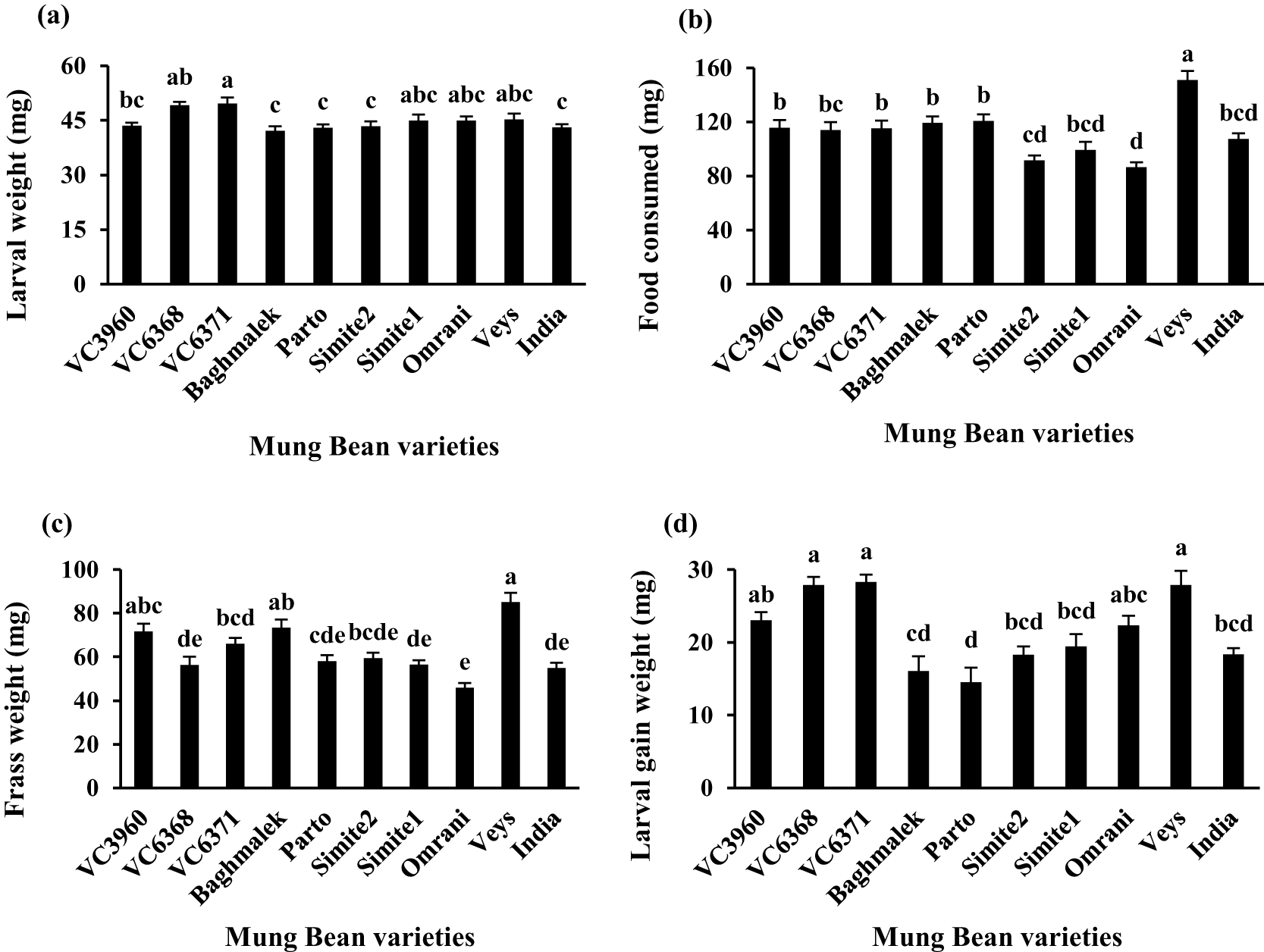
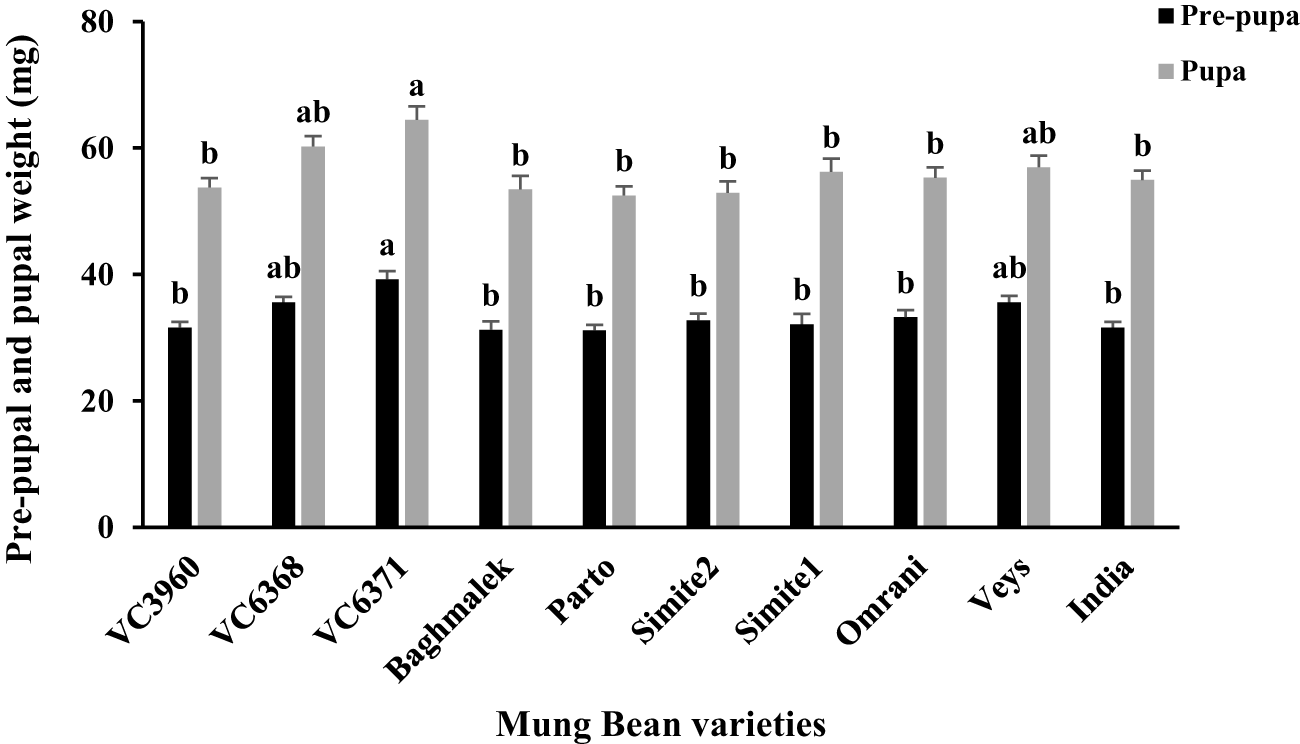
Larval weight (F 9,240 = 3.996, P < 0.001), food consumed (F 9,240 = 12.024, P < 0.001), frass weight (F 9,240 = 13.238, P < 0.001), larval gain weight (F 9,240 = 11.688, P < 0.001), pre-pupal weight (F 9,240 = 5.453, P < 0.001), and pupal weight (F 9,240 = 4.379, P < 0.001) of H. armigera differed significantly among mung bean varieties. The highest larval (fig. 1a), pre-pupal, and pupal (fig. 2) weights were achieved on VC6371 (figs. 1a and 2). In contrast, the lowest larval weights were obtained on Baghmalek, Parto, Simite2, and India (fig. 1a). The food consumed and frass weight were highest on Veys and lowest on Omrani (fig. 1b, c). Larval gain weight was higher on VC6368, VC6371, and Veys, and lowest on Parto (fig. 1d).
Mean (± SE) (a) larval weight, (b) food consumed, (c) frass weight, and (d) larval gain weight of Helicoverpa armigera reared on various mung bean varieties.

Mean (± SE) pre-pupal and pupal weight of Helicoverpa armigera reared on various mung bean varieties.

Digestive activities
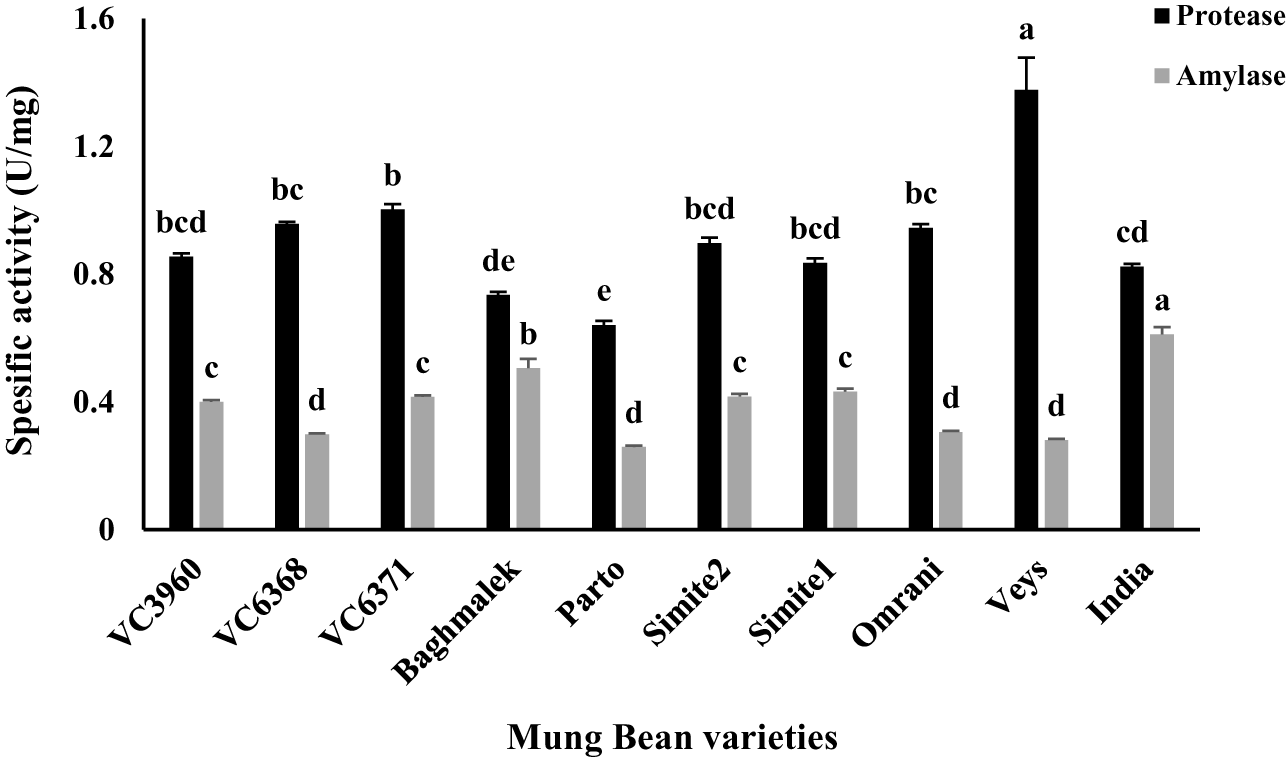
Proteolytic (F 9,20 = 3.829, P < 0.001) and amylolytic (F 9,20 = 3.829, P < 0.001) activities of H. armigera differed significantly among mung bean varieties. The highest and lowest levels of proteolytic activities were on Veys and Parto, respectively (fig. 3). The activity of α-amylase was highest on India. However, amylolytic activities were lower on VC6368, Parto, Omrani, and Veys (fig. 3).
Mean (± SE) general proteolytic and amylolytic activity of midgut extracts from Helicoverpa armigera reared on various mung bean varieties.

Biochemical contents of fresh grains
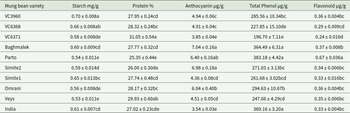
A significant variation was observed for starch content among mung bean varieties (F 9,20 = 32.761, P < 0.001), with levels of starch highest in VC3960, and lower in Parto and Veys (Table 2). The protein content significantly differed among mung bean varieties (F 9,20 = 18.044, P < 0.001); the highest and lowest values were found in VC6371 and Parto, respectively (Table 2). However, the flavonoid content showed an opposite pattern on these varieties (F 9,20 = 63.452, P < 0.001) (Table 2). The amounts of anthocyanin were significantly higher in Baghmalek and Simite2, and lower in VC6371 and India (F 9,20 = 61.973, P < 0.001) (Table 2). In addition, the content of total phenol was significantly varied among the studied mung bean varieties (F 9,20 = 66.097, P < 0.001), being highest in Baghmalek, Parto, and India, and lowest in VC6371 (Table 2).
Biochemical characteristics (mean ± SE) quantified from various mung bean varieties

Means followed by different letters in each column are significantly different (Tukey, P < 0.01).
Correlation analysis
There was a significant positive correlation between ECD and larvae midgut proteolytic activity (P ˂ 0.05; Table 3). A similar trend was observed between RGR and midgut protease activity (P ˂ 0.05; Table 3).
Correlation coefficients (r) of main growth and nutritional characteristics of Helicoverpa armigera with its digestive enzymes on various mung bean varieties

The numerals in the parenthesis are P-value. Significant correlations are shown in bold.
* ECI, efficiency of conversion of ingested food; ECD, efficiency of conversion of digested food; RCR, relative consumption rate; RGR, relative growth rate.
The larval weight and protease activity were correlated positively with protein content of the studied mung bean grains (P ˂ 0.05; Table 4), while correlated negatively with total phenolic content (P ˂ 0.01; Table 4). Pupal weight showed a significant positive correlation with protein content (P ˂ 0.01; Table 4), but negative ones with anthocyanin and total phenolic contents of the grains (P ˂ 0.05; Table 4). The ECI and ECD exhibited positive correlations with the protein content of the grains (P ˂ 0.05; Table 4). However, the mentioned indices negatively correlated with total phenolic (P ˂ 0.01; Table 4) and flavonoids contents (P ˂ 0.05; Table 4). There was a significant positive correlation between RGR and protein content of grains (P ˂ 0.01; Table 4). However, RGR was inversely tied to anthocyanin (P ˂ 0.05; Table 4), total phenolic (P ˂ 0.01; Table 4), and flavonoids (P ˂ 0.05; Table 4) contents of the grains.
Correlation coefficients (r) of main nutritional and physiological characteristics of Helicoverpa armigera with biochemical traits of various mung bean varieties

The numerals in the parenthesis are P-value. Significant correlations are shown in bold.
* ECI, efficiency of conversion of ingested food; ECD, efficiency of conversion of digested food; RCR, relative consumption rate; RGR, relative growth rate.
Cluster analysis
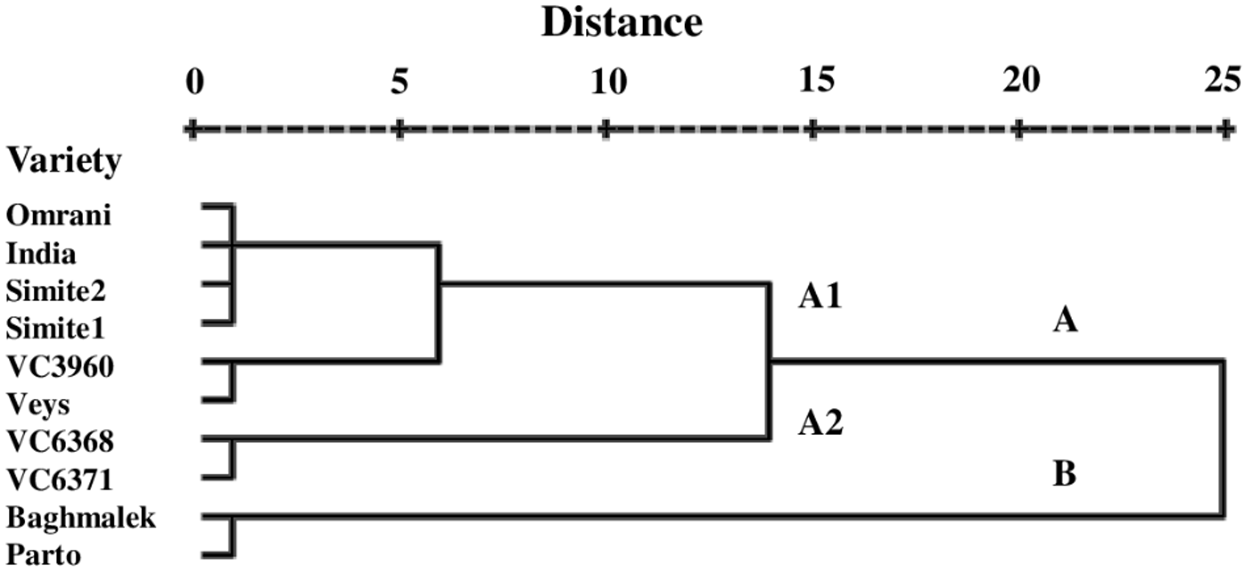
Degree of relatedness of mung bean varieties based on feeding indices and enzymes activities of H. armigera is illustrated in fig. 4. Based on the hierarchical cluster analysis, the studied mung bean varieties were grouped into two distinct clusters of A and B. Omrani, India, Simite2, Simite1, VC3960, and Veys grouped in sub-cluster A1 were intermediate mung bean varieties. VC6368 and VC6371 grouped in sub-cluster A2 were the most suitable varieties. Baghmalek and Parto in cluster B appeared to be less suitable varieties.
Dendrogram representing degree of relatedness of various mung bean varieties based on nutritional and growth indices and enzymatic activity of Helicoverpa armigera reared on various mung bean varieties (based on Ward’s method).

Discussion
The findings of the present study indicated the bottom-up impacts of mung bean varieties on both feeding and digestive performances of H. armigera, revealing that the various mung bean varieties had different nutritional values. These results are in line with other studies evaluating the effects of different plants on the same traits of H. armigera (Soleimannejad et al., Reference Soleimannejad, Fathipour, Moharramipour and Zalucki2010; Hemati et al., Reference Hemati, Naseri, Nouri Ganbalani, Rafiee Dastjerdi and Golizadeh2012; Kouhi et al., Reference Kouhi, Naseri and Golizadeh2014; War et al., Reference War, Hussain, Mishra, Munghate and Sharma2021; Zamani Fard et al., Reference Zamani Fard, Hemmati, Shishehbor and Stelinski2022; Jafari et al., Reference Jafari, Hemmati and Habibpour2023). The low AD of H. armigera feeding on Parto, and Baghmalek indicates the low digestibility of food, which can be linked to imbalanced nutrient, shortages of water and food, and the presence of crude fibre in the diet (Chapman, Reference Chapman1998). Mung bean grains contain high levels of defence metabolites, such as phytic acid and tannin, which may have interfered with food digestion of H. armigera. The phytic acid by binding to some divalent cations (zinc, iron, magnesium, and calcium) produces insoluble complexes, which can decrease the mineral absorption and utilisation (Sandberg, Reference Sandberg2007). Tannin also impairs iron absorption by forming an irreversible bond with iron. Furthermore, it reduces macronutrients digestion by forming tannin-protein complexes with numerous digestive enzymes, such as α-amylase, sucrase, maltase, and lactase, thus inhibiting the enzymes (Carmona et al., Reference Carmona, Borgudd, Borges and Levy-Benshimol1996). The AD values in our study were similar to those reported for S. littoralis on mung bean cultivars (Zamani Fard et al., Reference Zamani Fard, Hemmati, Shishehbor and Stelinski2022), higher than those for H. armigera on fresh natural foods (Singh et al., Reference Singh, Kumar and Gupta2008), and lower than those reported for H. armigera on various host plants (Hemati et al., Reference Hemati, Naseri, Nouri Ganbalani, Rafiee Dastjerdi and Golizadeh2012), indicating substantial diet-dependent variation in digestibility.
Larvae fed on Parto and Baghmalek showed the lowest ECI, ECD, and RGR, indicating poor suitability of these varieties for H. armigera. In contrast, larvae reared on VC6371 and VC6368 showed higher ECI, ECD, and RGR values, attributable to greater seed protein content and lower levels of secondary metabolites (anthocyanins, total phenolics, and flavonoids). These findings align with prior studies showing that protein enhances larval performance while phenolic compounds suppress growth (Hosseini Mousavi et al., Reference Hosseini Mousavi, Hemmati and Rasekh2023; Goudarzi Mohammadi et al., Reference Goudarzi Mohammadi, Hemmati and Shishehbor2024). The observed ECI and ECD values in this study were higher than those reported for other legume–insect systems (Zamani Fard et al., Reference Zamani Fard, Hemmati, Shishehbor and Stelinski2022; Jafari et al., Reference Jafari, Hemmati and Habibpour2023), likely due to differences in insect species, host plants, and plant nutritional quality. Positive correlations between nutritional indices and protein content, and negative correlations with anthocyanins, total phenolics, and/or flavonoids compounds, further support these conclusions. Pupal weights on VC6368 and VC6371 were comparable to those of S. littoralis on similarly suitable mung beans (Zamani Fard et al., Reference Zamani Fard, Hemmati, Shishehbor and Stelinski2022), reinforcing the nutritional suitability of these varieties for H. armigera.
Among the examined mung bean varieties, the highest values of consumption index (CI), relative consumption rate (RCR), and frass weight of H. armigera were obtained on Veys. Probably the fresh grains of Veys had low nutritive content (for example higher secondary metabolites content) for H. armigera larvae, and accordingly, the larvae had to eat large amounts of the grains to compensate for their poor access to nutrients (Hosseini Mousavi et al., Reference Hosseini Mousavi, Hemmati and Rasekh2023). Increased consumption usually leads to increased exposure to insect’s natural enemies (Hochuli, Reference Hochuli1996). In line with our results, the high content of secondary metabolites (phenol) in a cowpea cultivar (Mashhad) increased the food consumption and frass production in S. littoralis (Shishehbor and Hemmati, Reference Shishehbor and Hemmati2021).
The results indicated that various mung bean varieties significantly affected the enzymatic activities of H. armigera, particularly the activity of protease. According to correlation analysis, the proteolytic activity was correlated positively with ECD and RGR of the pest, emphasising that the amount of protein in the grains of the mung bean varieties was a key nutrient in influencing the feeding indices as well as the proteolytic activity of the pest (Zamani Fard et al., Reference Zamani Fard, Hemmati, Shishehbor and Stelinski2022). Moreover, the low proteolytic activity in larvae fed on the fresh grains of Parto might be correlated to the low protein content in this variety or high amount of defence metabolites (such as total phenol) and/or even the ingested protease inhibitors. Low protease activity limits amino acid availability, which can reduce larval growth, reproduction, and survival (Mahdavi et al., Reference Mahdavi, Ghadamyari, Sajedi, Sharifi and Kouchaki2013). As reported by Mardani–Talaee et al. (Reference Mardani–Talaee, Rahimi and Zibaee2014), the resistant host plants affect the digestive performance of insects, owing to differences in amounts of nutritional components and secondary metabolites, as well as possible inhibitors. Zamani Fard et al. (Reference Zamani Fard, Hemmati, Shishehbor and Stelinski2022) reported that the inhibitors in some mung bean plants influenced the digestive enzymes activities in H. armigera larvae. Plant inhibitors inhibit the activities of digestive enzymes, interfere with assimilation and absorption of nutrients, and stimulate hyper-production of the digestive enzymes, leading to slow growth or even death of insect (Lawrence and Koundal, Reference Lawrence and Koundal2002; Borzoui et al., Reference Borzoui, Bandani and Goldansaz2013). It is worth noting that the gut microbiota in H. armigera can contribute in its nutritional ecology by facilitating adaptation to various host plants, enhancing digestive efficiency, and aiding in detoxification of secondary substances and insecticides (Mason et al., Reference Mason, Ray, Shikano, Peiffer, Jones, Luthe, Hoover and Felton2019; Zhao et al., Reference Zhao, Wang, Zhang, Zhu, Li, Ji, Luo and Cui2023). These symbionts might also have affected the digestive activities and feeding performance observed in the current study, highlighting the necessity for further research on their role.
Cluster analysis clearly grouped the mung bean varieties into clusters that reflected their suitability for H. armigera. Baghmalek and Parto, which formed cluster B, were characterised by low protein content and higher levels of phenolics and flavonoids, traits associated with reduced digestibility and poor physiological performance. In contrast, VC6368 and VC6371 formed a separate sub-cluster (A2) due to their higher nutritional quality and lower defensive compounds, consistent with the higher ECI and ECD as well as better performance of the pest. The less suitable varieties (Baghmalek and Parto) hold promises for enhancing the effectiveness of chemical and biological control methods within IPM programmes. Furthermore, they could serve as valuable genetic resources in breeding programs, particularly for transferring resistance traits into transgenic crops. However, our laboratory findings require validation through field trials before definite conclusions can be drawn, because the complexity of field environments, such as temperature and humidity fluctuations, variation in plant traits, and natural enemies may alter larval performance and enzymatic responses.
Acknowledgements
This research was financially supported by Shahid Chamran University of Ahvaz, Ahvaz, Iran (Grant No. SCU.AP1403.39134), which is greatly appreciated.
Conflict of interest
The authors declare that they have no conflict of interest.