Introduction
First and foremost, this paper is a ‘gedanken (thought) experiment’. Many of the following ideas need to be tested by future experimental observations, and some of the ideas are indeed speculative, requiring further discussion and more formal mathematical models.
In the standard model of Big Bang cosmology, the matter and energy resources of our Universe are controlled, respectively, by dark matter (Weinberg, Reference Weinberg2008) – a nonbaryonic substance of undetermined nature – and dark energy (Riess et al., Reference Riess, Filippenko and Chalis1998) – a negative-pressure field of exotic physical origin. Over 30 years of searching for dark matter, the proposed exotic elementary particles such as weakly interacting massive particles (WIMPS) and AXIONS thus far have not been observed experimentally, even in the latest large underground xenon and MIT ABRACADABRA detectors, respectively (Akerib et al., Reference Akerib, Alsum, Araujo and Bai2017; Ouellet et al., Reference Ouellet, Salemi, Foster and Henning2019). Nor have the WIMPS predicted from supersymmetry theory been created in the CERN LHC or ATLAS detector. The dark energy believed to be responsible for the accelerating expansion of our Universe is usually considered to be a separate problem from dark matter and to be associated with zero-point-energy fluctuations of the cosmic vacuum. However, quantum field theory predicts a vacuum energy density that is too large by up to a factor of 10120 (Zeldovich and Krasinski, Reference Zeldovich and Krasinski1968; Weinberg, Reference Weinberg1989), which is the well-known cosmological constant problem. I propose that nanoclusters of water molecules ejected by cosmic rays from amorphous ice layers on ubiquitous cosmic dust produced from exploding supernovae (Matsuura et al., Reference Matsuura, De Buizer and Arendt2019), albeit at low density compared to elemental hydrogen and oxygen, excited to their diffuse Rydberg states (Herzberg, Reference Herzberg1987), are possible candidates for baryonic dark matter. The cut-off terahertz (THz) vibrational frequencies of such water nanoclusters are close to the νc ≅ 1.7 THz cut-off frequency of zero-point-energy vacuum fluctuations proposed to account for the small value of vacuum energy and cosmological constant (Beck and Mackey, Reference Beck and Mackey2005, Reference Beck and Mackey2007). Beck and Mackey (Reference Beck and Mackey2005) proposed laboratory measurements of dark energy, which were challenged by Jetzer and Straumann (Reference Jetzer and Straumann2005, Reference Jetzer and Straumann2006), to which Beck and Mackey (Reference Beck and Mackey2006) rebutted. In this paper, cosmic water nanoclusters are postulated to capture via the microscopic dynamical Casimir effect (Souza et al., Reference Souza, Impens and Neto2018) the high-frequency vacuum zero-point-energy virtual photons, leaving only the low-frequency ones to be gravitationally active. Water constitutes approximately 70% of our body weight, much of it as water nanoclusters called ‘structured’ water (Chaplin, Reference Chaplin2006; Johnson, Reference Johnson2012). This fact adds scientific and philosophical support based on the simplest anthropic principle (Weinberg, Reference Weinberg1987) to the proposal that water nanoclusters distributed as a low-density ‘dark fluid’ throughout our Universe are a possible common origin of dark matter and dark energy along with or instead of thus-far undiscovered exotic elementary particles.
Following a description of water nanocluster electronic structure and vibrations in the section ‘Water nanoclusters’, sections ‘Baryonic dark matter’, ‘Dark energy’, ‘Cosmology’, ‘Astrobiology’ and ‘The RNA world’ are devoted, respectively, to their possible relevance to dark matter, dark energy, cosmology, astrobiology and the RNA world.
Water nanoclusters
Cosmic implications
Since hypothetical WIMP and AXION elementary particles, after many years of costly experiments, have still not been found, and baryonic dark matter has been largely ruled out by standard cosmological theory, why would one expect water nanoclusters to exist in the cosmos, and why would they have anything to do with dark matter and/or dark energy? Hydrogen and oxygen are the most abundant chemically reactive elements in our Universe, oxygen slightly beating carbon. Water vapour plays a key role in the early stages of star formation, where it is an important oxygen reservoir in the warm environments of star-forming regions, and is believed to contribute significantly to the cooling of the circumstellar gas, thereby removing the excess energy built up during proto-stellar collapse (Bergin and van Dishoeck, Reference Bergin and van Dishoeck2012). For example, the star-forming region of the Orion nebula produces enough water in a day to fill up earth's oceans many times over (Glanz, Reference Glanz1998). The largest and farthest reservoir of water ever detected in the Universe has been reported to exist in a high-redshift (z = 3.91) quasar approximately 12 billion light-years away (Bradford et al., Reference Bradford, Bolatto and Maloney2011). The quasar water vapour mass is at least 140 trillion times that of all the water in the world's oceans and 100 000 times more massive than the Sun. It has been proposed recently that water could have been abundant during the first billion years after the Big Bang (Bialy et al., Reference Bialy, Sternberg and Loeb2015). In the section ‘Early star formation’ of this paper, the possible role of water nanoclusters as a coolant catalyst for rapid early star formation in high-redshift clouds is discussed.
On planet Earth, through hydrogen bonding between water monomers, stable water nanoclusters, both neutral and ionized, are easily formed in molecular beams (Carlon, Reference Carlon1981), occur naturally in the water vapour of earth's atmosphere (Aplin and McPheat, Reference Aplin and McPheat2005), and are produced from amorphous ice by energetic ion bombardment (Martinez, Reference Martinez2019). In the cosmos, therefore, a natural route to water nanocluster formation would be via the ejection from amorphous water-ice coatings of cosmic dust grains (Dulieu et al., Reference Dulieu, Amiaud, Congui and Fillion2010; Potapov et al., Reference Potapov, Jager and Henning2020), which are believed to be abundant in interstellar clouds because they are a product of supernovae explosions (Matsuura et al., Reference Matsuura, De Buizer and Arendt2019). As a prime example, cosmic ray ionization of H2 molecules adsorbed on amorphous ice-coated dust grains can lead to the reaction (Duley, Reference Duley1996):

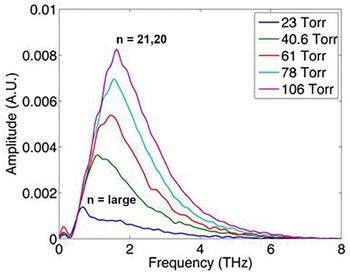
Interstellar population of protonated water-nanocluster ions released by this process has been estimated to approach 10−6 of the average atomic hydrogen population but could likely be significantly greater (Martinez, Reference Martinez2019). Due to their large electric dipole moments (≥10D) oscillating at THz frequencies, such water nanoclusters are believed to be responsible for the observed strong THz emission from water vapour into a vacuum under intense ultraviolet (UV) optical stimulation (Johnson and Zhang, Reference Johnson and Zhang2008) (Fig. 1) and therefore should be relatively stable under similar cosmic radiation.
Frequency dependence for a range of pressures of the THz wave generation amplitudes (in arbitrary units) from water nanoclusters produced from water vapour, described in publication (Johnson and Zhang, Reference Johnson and Zhang2008). For pressure less than 20 Torr, the data were taken from a cell containing water vapour, while at higher pressure (>20 Torr), the data were taken from the pulsed nozzle.

Although H3O+(H2O)n −1 nanoclusters ejected by ion bombardment from amorphous ice have been observed over a range of n-values (Martinez, Reference Martinez2019), the ‘magic-number’ n = 21 pentagonal dodecahedral H3O+(H2O)20 or equivalent protonated (H2O)21H+ nanocluster (Fig. 2) is exceptionally stable in a vacuum and is of potential cosmic importance because it can be viewed as a H3O+ (hydronium) ion caged (‘clathrated’) by an approximately pentagonal dodecahedral cage of 20 water molecules (Miyazaki, Reference Miyazaki2004; Shin et al., Reference Shin, Hammer, Diken and Johnson2004). Interstellar H3O+ has been observed recently (Lis et al., Reference Lis, Schilke, Bergin and Gerin2014) and its discovery points to the challenge of trying to identify spectroscopically larger cosmic water nanoclusters such as H3O+(H2O)20 because both spectra fall into the same THz region. The occurrence of stable pentagonal dodecahedral water nanocluster clathrate hydrates in the interstellar medium has recently been predicted (Ghosh et al., Reference Ghosh, Methikkalam and Bhuin2019). Studies by Miyazaki (Reference Miyazaki2004); Shin et al. (Reference Shin, Hammer, Diken and Johnson2004) and Lis et al. (Reference Lis, Schilke, Bergin and Gerin2014) could be the starting point for attempts to identify the cosmic presence of H3O+(H2O)20.
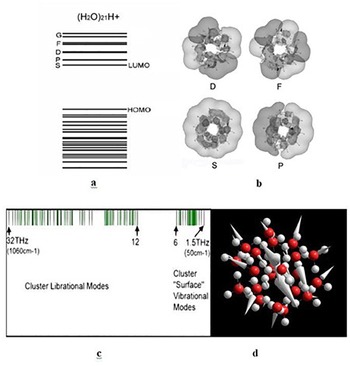
Molecular orbital energy levels, wavefunctions and vibrational modes of the (H2O)21H+ cluster calculated by the SCF-Xα-scattered-wave density-functional method (Slater and Johnson, Reference Slater and Johnson1972, Reference Slater and Johnson1974). (a) Cluster molecular-orbital energy levels. The HOMO–LUMO energy gap is approximately 3 eV. (b) Wavefunctions of the LUMOs. (c) THz vibrational spectrum. (d) Lowest-frequency THz vibrational mode and relative vibrational amplitudes. The vectors show the directions and relative amplitudes for the oscillation of the hydronium (H3O+) oxygen ion coupled to the O–O–O ‘bending’ motions of the cluster ‘surface’ oxygen ions.

Electronic structure and THz vibrations
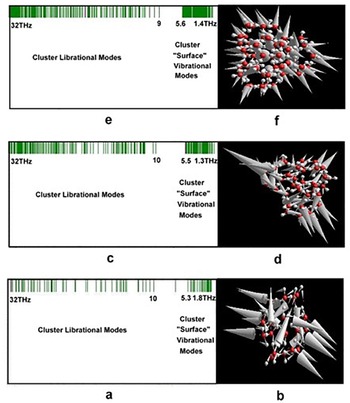
Figure 2 shows the ground-state molecular-orbital energies, wavefunctions and vibrational modes of the pentagonal dodecahedral (H2O)21H+ or H3O+(H2O)20 cluster computed by the SCF-Xα-scattered-wave density-functional method co-developed by the author (Slater and Johnson, Reference Slater and Johnson1972, Reference Slater and Johnson1974). Molecular dynamics simulations yield results qualitatively unchanged at temperatures well above 100°C, where the cluster remains remarkably intact. Similar calculations for the neutral pentagonal dodecahedral water cluster, (H2O)20 and arrays thereof have also been performed, yielding the THz vibrational modes displayed in Figs. 3 and 4.
(a) THz vibrational spectrum of a pentagonal dodecahedral (H2O)20 cluster calculated by the SCF-Xα-scattered-wave density-functional method (Slater and Johnson, Reference Slater and Johnson1972, Reference Slater and Johnson1974). (b) Lowest-frequency THz vibrational mode and relative vibrational amplitudes. (c) Calculated THz vibrational spectrum of a stable array of three dodecahedral water clusters. (d) Lowest-frequency THz vibrational mode. (e) THz vibrational spectrum of a stable array of five dodecahedral water clusters. (f) Lowest-frequency THz vibrational mode.

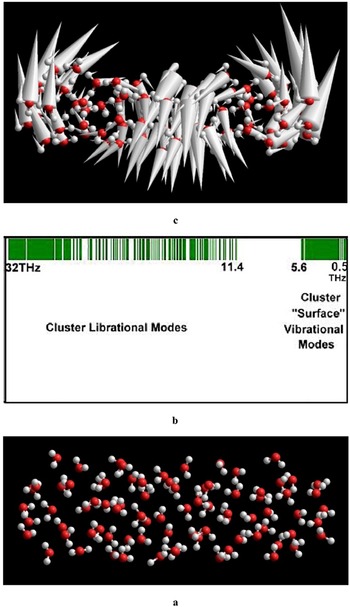
(a) Stable linear array of five pentagonal dodecahedral water nanoclusters. (b) THz vibrational spectrum calculated by the SCF-Xα-scattered-wave density-functional method (Slater and Johnson, Reference Slater and Johnson1972, Reference Slater and Johnson1974). (c) Lowest-frequency THz vibrational mode and relative vibrational amplitudes. Note the lower cut-off THz frequency as compared with Fig. 3(e) and (f).

These results are qualitatively similar to those shown in Fig. 2, but they indicate a gradual decrease of the cluster cut-off vibrational frequency with increasing cluster size. The latter trend correlates with the experimental studies of THz radiation emission from water vapour nanoclusters (Johnson and Zhang, Reference Johnson and Zhang2008), showing in Fig. 1 the shift in the cluster THz emission peaks towards lower frequencies and intensities – corresponding to a trend towards larger clusters – with decreasing vapour ejection pressure into the vacuum chamber where the radiation was measured. Relating this finding to equation (1) would suggest decreasing THz emission cut-off frequencies and intensities with the increasing sizes (increasing n-values) of water nanoclusters ejected from ice-coated cosmic dust.
Common to all these water clusters are: (1) lowest unoccupied (LUMO) energy levels like those in Fig. 2(a), which correspond to the diffuse Rydberg ‘S’-, ‘P’-, ‘D’- and ‘F’-like cluster ‘surface’ molecular-orbital wavefunctions shown in Fig. 2(b), and (2) bands of vibrational modes between 0.5 and 6 THz (Figs. 2–4), due to O–O–O ‘squashing’ (or ‘bending’) and ‘twisting’ motions between the adjacent hydrogen bonds. The vectors in Figs. 2–4 represent the directions and relative amplitudes of the lowest THz-frequency modes corresponding to the O–O–O ‘bending’ (or ‘squashing’) motions of the water-cluster ‘surface’ oxygen ions. Surface O–O–O bending vibrations of water clusters in this energy range have indeed been observed under laboratory conditions (Brudermann et al., Reference Brudermann, Lohbrandt and Buck1998). UV excitation of an electron from the highest occupied molecular orbital (HOMO) to LUMO (Fig. 2(a)) can put the electron into the Rydberg ‘S’-like cluster molecular orbital mapped in Fig. 2(b). Occupation of this orbital produces a bound state, even when an extra electron is added, the so-called ‘hydrated electron’ (Jordan, Reference Jordan2004). In contrast, a water monomer or dimer has virtually no electron affinity. Therefore, in space – especially within dense interstellar clouds – (H2O)21H+ or H3O+(H2O)20 and larger water-nanocluster ions ejected from ice-coated cosmic dust according to equation (1) are likely to capture electrons, forming electrically neutral water nanoclusters of the types shown in Fig. 3.
Baryonic dark matter
Rydberg matter
Stellar electromagnetic radiation can potentially stimulate electronic excitations from the HOMO of (H2O)21H+ (Fig. 2(a)) (or from the LUMO with a captured hydrated electron) to the increasingly diffuse ‘P’, ‘D’, ‘F’ and higher water cluster Rydberg orbitals in Fig. 2(b) (Herzberg, Reference Herzberg1987; Holmlid, Reference Holmlid2008). These states have vanishing spatial overlap with the lower-energy occupied ones, have long lifetimes that increase with increasing excitation energy and effective principal quantum number, and thus are candidates for Rydberg matter (RM) – a low-density condensed phase of weakly interacting individual Rydberg-excited molecules with long-range effective interactions (Badei and Homlid, Reference Badei and Homlid2002). RM can interact or become quantum-entangled over long effective distances, causing it to be transparent to visible, infrared and radio frequencies, and thus qualifies as baryonic dark matter (Badei and Homlid, Reference Badei and Homlid2002). Two water nanoclusters of the forms shown in Figs. 2 and 3(a), but each holding an excited or ‘hydrated’ electron in the Rydberg ‘S’ LUMO, are like giant hydrogen atoms, which for short distances between the clusters will form an overlapping ‘bonding’ molecular orbitals holding two spin-paired electrons in analogy to a giant hydrogen molecule. However, the approach of two water nanoclusters to each other in interstellar space should be a rare occurrence because of their relatively low density. For much larger distances between the clusters, the diffuse molecular orbitals of their highest-energy Rydberg states ‘overlap’ sufficiently to permit quantum entanglement of water nanoclusters over long distances in space, thus qualifying cosmic water nanoclusters as possible baryonic dark matter. These nanoclusters can be interpreted as a scalar field permeating space – a type of quintessence (Ratra and Peebles, Reference Ratra and Peebles1988; Steinhardt, Reference Steinhardt2003) leading to a time-dependent dark energy density (see section ‘Dark energy’).
The Bullet cluster and galactic halos
Can low-density, quantum-entangled water-nanocluster RM account for at least part of the dark matter estimated from inflationary Big Bang theory? The consensus of standard cosmology is that the unknown dark matter cannot be baryonic. Gravitational lensing observations of the Bullet cluster revealing the separation of normal luminous matter and dark matter have been said to be the best evidence to date for the existence of nonbaryonic dark matter (Clowe et al., Reference Clowe, Gonzalez and Markevich2004). Protonated water nanoclusters produced by equation (1) and shown in Fig. 2 for n = 21 are positively charged, although, as pointed out above, such clusters are likely to pick up a ‘hydrated’ electron (Jordan, Reference Jordan2004) from space once ejected from ice-coated cosmic dust, forming electrically neutral clusters like those pictured in Fig. 3. It is believed that nonbaryonic dark matter is uncharged. Nevertheless, it has recently been argued that a small amount of charged dark matter could cool the baryons in the early universe (Munoz and Loeb, Reference Munoz and Loeb2018). Although magnetic fields associated with celestial objects should interact with water nanocluster ions, which are motional sources of magnetism, the origin and relevance of intergalactic magnetic fields is still debated (Jedamzik and Pogosian, Reference Jedamzik and Pogosian2020). Magnetic fields may be important to the possible role of water nanoclusters in water vapour as a coolant catalyst for rapid early star formation, discussed in the section ‘Early star formation’ of this paper. The electrical charge of the ice-coated cosmic dust that is the postulated origin of cosmic water nanoclusters according to equation (1) may be key to the properties of the Bullet cluster dark matter (Clowe et al., Reference Clowe, Gonzalez and Markevich2004). Because much of the Bullet cluster normal matter is likely composed of positively charged cosmic dust (Mann, Reference Mann and Harris2001), its electrical repulsion of protonated water nanoclusters would enhance the ejection of water nanoclusters described by equation (1), thus explaining the observed separation of normal luminous matter and dark matter. Despite uncertainties about electric fields on the galactic scale (Bally and Harrison, Reference Bally and Harrison1978; Chakraborty, Reference Chakraborty2014), it is possible that such fields could cause cosmic water nanocluster RM to aggregate around the peripheries of galaxies, thereby possibly explaining galactic dark matter halos similarly to the Bullet cluster dark matter.
Dark energy
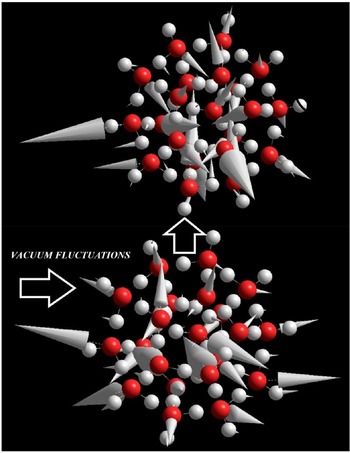
Quantum field theory predicts a vacuum energy density that is too large by a factor of 10120, which leads to the well-known cosmological constant problem (Weinberg, Reference Weinberg1989). It has been suggested that if the observed dark energy responsible for the accelerated expansion of the Universe is equated to the otherwise infinite cosmic vacuum energy density predicted by theory, then gravitationally active zero-point-energy vacuum fluctuations must have a cut-off frequency of νc ≅ 1.7 THz (Beck and Mackey, Reference Beck and Mackey2005, Reference Beck and Mackey2007). In other words, the virtual photons associated with vacuum fluctuations should be of gravitational significance only below this frequency to be consistent with the observationally small magnitude of dark energy. A νc ≅ 1.7 THz vacuum fluctuation cut-off frequency is the same order of magnitude as the cut-off vibrational frequencies of prominent water nanoclusters, although these frequencies decrease with increasing cluster size (Figs. 2–4) or increasing n-value in equation (1). Other molecules in space, such as hydrogen, water monomers, carbon buckyballs and various observed organic molecules do not have vibrational cut-off frequencies in this THz region. As low-density RM (section ‘Rydberg matter’), cosmic water nanoclusters can be viewed as constituting a quintessence scalar field Q of energy density, ρ = ½Q̇ 2 + V(Q) (Steinhardt, Reference Steinhardt2003), whose properties depend on the absorption of the virtual photons of vacuum fluctuations at frequencies greater than νc ≅ 1.7 THz via the microscopic dynamical Casimir effect (Souza et al., Reference Souza, Impens and Neto2018; Leonhardt, Reference Leonhardt2020). This process converts the virtual photons to real ones, leaving only the vacuum low-frequency photons to be gravitationally active (Fig. 5). The absorbed photons can then decay via emitted THz radiation (Fig. 1).
Microscopic dynamical Casimir absorption of zero-point-energy vacuum fluctuation ‘virtual’ photons between THz vibrational states of a cosmic water nanocluster. The fact that the nanocluster ‘mechanical’ THz vibrational frequencies are smaller than the optical transition frequencies leads to the emission of ‘real’ photons (Souza et al., Reference Souza, Impens and Neto2018).

To quantify this, we conventionally view the vacuum electromagnetic field (excluding other fields) as a collection of harmonic oscillators of normal-mode frequencies ν k, summing over the zero-point energies of each oscillator mode, leading to the following energy density

where the wave vector k signifies the normal modes of the electromagnetic field that are consistent with the boundary conditions on the quantization volume V. As V approaches infinity, one obtains the right-hand side of equation (2). The divergent integral in equation (2) can be avoided by replacing the upper limit by a cut-off frequency νc set by the Planck scale (Weinberg, Reference Weinberg1989). However, this results in a huge vacuum energy that exceeds the cosmologically measured value by 120 orders of magnitude. If instead we subtract from (2) the energy density

of the virtual photons of zero-point vacuum fluctuations captured by the water clusters through the microscopic dynamical Casimir effect (Souza et al., Reference Souza, Impens and Neto2018), the divergent integral in equation (2) is largely cancelled, leaving the finite quantity, equation (4) to be identified with the dark energy density

Due to the small nanocluster vibrational kinetic energies ½Q̇ 2 compared to their potential energy V(Q), which is elevated to higher-THz-frequency ‘surface’ vibrational modes (Figs. 2–4) by the capture of vacuum photons, as shown schematically in Fig. 5, it follows that the quintessence scalar field pressure, P = ½Q̇ 2 − V(Q) (Steinhardt, Reference Steinhardt2003) becomes more negative with increasing νc and therefore with ρ dark. The PLANCK observations have concluded that dark energy presently constitutes 68.3% of the total known energy of the Universe (Ade et al., Reference Ade, Aghanim, Arnaud and Ashdown2016), leading to ρ dark = 3.64 GeV m−3. Equation (4) then requires a cut-off frequency of νc = 1.66 THz, which is the same order of magnitude as the cut-off frequencies of the smallest pentagonal dodecahedral water clusters shown in Figs. 2(d) and 3(a). However, since ν c decreases with increasing water-cluster size (Figs. 3 and 4) or with increasing n-value in equation (1), a trend towards the ejection of larger water clusters from cosmic dust over time would imply a decrease of dark energy density over time according to equation (4), and therefore a decreasing acceleration of the Universe.
Cosmology
The CMB spectrum
The consensus of standard inflationary cosmology (Guth, Reference Guth1981, Reference Guth2007; Linde, Reference Linde, Lemoine, Martin and Peter2008) is that the measured cosmic microwave background (CMB) spectrum of the Universe has its origin at approximately 380 thousand years after the Big Bang (Bennett et al., Reference Bennett, Hinshaw, Larson, Komatsu and Spergel2013; Ade et al., Reference Ade, Aghanim, Arnaud and Ashdown2016). Is there a possible and credible additional contribution to the CMB that is consistent with its spectrum and the THz vibrational properties of water nanoclusters discussed in the previous sections? It was suggested long ago that the CMB might be attributable to thermalization by ‘cosmic dust’ in the form of hollow, spherical shells of high-dielectric constant or conducting ‘needle-shaped grains’ (Layzer and Hively, Reference Layzer and Hively1973; Wright, Reference Wright1982). Layzer and Hively (Reference Layzer and Hively1973) argued that a relatively low density of high-dielectric constant dust could thermalize the radiation produced by the objects of galactic mass at redshift z ≅ 10. Because of their computed large electric dipole moments and measured strong THz radiation emission (Johnson and Zhang, Reference Johnson and Zhang2008) (Fig. 1), optically pumped water nanoclusters in water vapour consisting of spherical ‘shells’ of water-cluster O–H bonds (Figs. 2 and 3) or ‘strings’ of water clusters (Fig. 4) satisfy the conditions proposed in Layzer and Hively (Reference Layzer and Hively1973) and Wright (Reference Wright1982). The thin amorphous water ice that coats the cosmic dust from which water clusters are ejected according to equation (1) can be viewed as disordered water nanoclusters of high-dielectric constant and could directly contribute. Astronomical observations have pushed back the epoch of protogalaxy formation and reionization to redshifts of z = 8.6 and z = 9.6, respectively, i.e. to corresponding times of 600 and 500 million years after the Big Bang (Lehnert et al., Reference Lehnert, Nesvadba, Cuby and Swinbank2010; Zheng et al., Reference Zheng, Postman, Zitrin and Moustakas2012), although more recently, the Hubble Space Telescope has found a galaxy at z ≅ 11, corresponding to just 400 million years after the Big Bang (Oesch et al., Reference Oesch, Brammer and Van Dokkum2016). At redshift z ≅ 10, the distinctive THz vibrational manifolds of water clusters (Figs. 2–4), as well as the laboratory THz emission peaks of Fig. 1 are red-shifted to the region of the measured CMB spectrum, suggesting water nanocluster THz emission originating at z ≅ 10, where the temperature T ≅ 30 K is compatible with the existence of such nanoclusters, could indeed contribute to the CMB in addition to photons from the ‘recombination’ period at z ≅ 1100, where the temperature is T ≅ 4000 K.
Laboratory measurements (Johnson and Zhang, Reference Johnson and Zhang2008) (Fig. 1) of the THz emission from water nanoclusters as a function of ejection pressure into a vacuum chamber indicate emission peaks that decrease in frequency and intensity with decreasing pressure and thus, according to Figs. 2–4, with increasing cluster size. The most intense emission peak at approximately 1.7 THz is assigned to water clusters of the ‘magic numbers’ n = 21 and 20 shown in Figs. 2(d) and 3(a), respectively, whereas the peaks decreasing in frequency and intensity with lower pressure to approximately 0.5 THz are due to larger clusters like those shown in Figs. 3(b), (c) and 4(a). The effective temperatures of the water nanoclusters scale with this pressure trend, with the smallest clusters emitting the ‘hottest’ radiation peaking around 1.7 THz. Applying this power spectrum to the red-shifted radiation from water nanoclusters ejected from ice-coated cosmic dust at z ≅ 10, the spectrum of the smallest versus larger water nanoclusters in particular regions of space might be similar to the measured CMB power spectrum (Bennett et al., Reference Bennett, Hinshaw, Larson, Komatsu and Spergel2013; Ade et al., Reference Ade, Aghanim, Arnaud and Ashdown2016), but is a subject for future investigation requiring more resources by this author. The laboratory ejection pressure dependence of the vacuum chamber power spectrum shown in Fig. 1 applied to the effective water-nanocluster ejection ‘pressures’ from ice-coated cosmic dust according to equation (1) further suggests a ‘pressure wave’ created at z ≅ 10, or around 500 million years after the Big Bang, in analogy to the CMB acoustic wave assigned to the ‘recombination’ period at z ≅ 1100 or 380 thousand years after the Big Bang (Bennett et al., Reference Bennett, Hinshaw, Larson, Komatsu and Spergel2013; Ade et al., Reference Ade, Aghanim, Arnaud and Ashdown2016). In other words, if one were to interpret simplistically the measured CMB power spectrum and its anisotropy as due at least partially to the red-shifted THz radiation from water nanoclusters ejected from ice-coated cosmic dust at z ≅ 10, this would suggest a relatively slow ‘classical’ process extending over billions of years compared to an inflationary hot Big Bang originating from a quantum singularity. Adding to the possible credibility of this scenario is the fact that z ≅ 10, or around 500 million years after the Big Bang, is near the first times of suspected early (population III) star formation, with most of these thus far hypothetical stars having short lives and becoming explosive supernovae that produce the cosmic dust from which cosmic water nanoclusters can be ejected according to equation (1).
Early star formation
Water vapour is a recognized coolant for star formation (Bergin and van Dishoeck, Reference Bergin and van Dishoeck2012). The report of a huge reservoir of water in a high-redshift (z ≅ 4) quasar, corresponding to a water vapour mass at least 140 trillion times that of all the water in the world's oceans and 100 000 times more massive than the Sun (Bradford et al., Reference Bradford, Bolatto and Maloney2011), together with the recent proposal that water vapour could have been abundant during the first billion years after the Big Bang (Bialy et al., Reference Bialy, Sternberg and Loeb2015) suggests the possibility of a significant population of stable water nanoclusters at redshift z ≅ 10 or around 500 million years after the Big Bang.
The rapidness at which some early stars were created from observed dense gas clouds at z ≅ 6.4 or 850 million years after the Big Bang (Banandos, Reference Banandos2019) can possibly be understood by the presence of water nanoclusters in the cloud's water vapour coolant. Studies of the infrared absorption by water nanoclusters in the laboratory and Earth's atmosphere (Carlon, Reference Carlon1981; Aplin and McPheat, Reference Aplin and McPheat2005), including both protonated cluster ions of the type shown in Fig. 2 and neutral clusters like those shown in Fig. 3, have established their extraordinary heat storage as due mainly to the nanocluster librational modes – especially those near 32 THz (1060 cm−1) – shown in these figures. The cooling effect of the star-forming gas clouds can consequently be achieved through the release of photons associated with the cluster surface modes in the 1–6 THz range (Figs. 2 and 3). These photons are the same ones that might contribute to the CMB, as described above. In other words, if one accepts a scenario where red-shifted THz radiation from cosmic water nanoclusters at z ≅ 10 contributes to the CMB spectrum, then the CMB also possibly contains information about early star formation.
The Hubble constant crisis
The present model suggests a possible resolution of the Hubble constant ‘crisis’, where the value of this constant deduced from observations of supernovae and cepheids has indicated the Universe is expanding significantly faster than the value concluded from measurements of the microwave radiation emitted immediately after the Big Bang. The ice-coated cosmic dust responsible for ejecting the water nanoclusters proposed herein to underlie dark energy and our accelerating Universe is a product of stellar evolution. Since the first stars were born only after the reionization phase following the recombination phase of hydrogen formation that began approximately 380 000 years after the Big Bang, there would be no significant cosmic dust and thus no cosmic water nanoclusters until many years after the Big Bang. This conclusion is supported by a recent observation of the oldest cosmic dust 200 million years after the birth of the first stars (Laporte et al., Reference Laporte, Ellis, Boone and Bauer2017). As the Universe expanded over 13.8 billion years, the amount of cosmic dust increased with the formation of more stars and galaxies until one reached the present era where there is enough dust and ejected water-nanocluster RM to account for the Hubble constant deduced from recent supernovae and cepheid observations, as well as the current coincidence of dark energy and matter densities. This scenario is consistent with studies of high-redshift quasars showing that dark energy has increased from the early universe to the present (Risaliti and Lusso, Reference Risaliti and Lusso2019). It is also somewhat consistent with a claim that baryon inhomogeneities explain away the Hubble crisis but disagrees that they are due to primordial magnetic fields (Jedamzik and Pogosian, Reference Jedamzik and Pogosian2020).
A cyclic cosmology
Inflationary cosmology (Guth, Reference Guth1981, Reference Guth2007; Linde, Reference Linde, Lemoine, Martin and Peter2008) leads to the conclusion that dark matter density should decrease faster than dark energy in an accelerating universe, so that eventually dark energy will become dominant, and the ultimate fate of the universe is that all the matter in the universe will be progressively torn apart by its expansion – the so-called ‘big rip’. In contrast, if we conceptually view cosmic water nanoclusters – ejected from ice-coated cosmic dust to form RM – as equivalent to a time-dependent quintessence scalar field (Steinhardt, Reference Steinhardt2003), as described in the section ‘Dark energy’, the present model suggests the following hypothetical cyclic dark-matter-dark-energy cosmology:
(1) As the universe expands and stellar nuclear fusion produces heavier elements, more water-ice-coated cosmic dust will be produced from the increasing explosive supernovae population. With the expanding volume of space and decreasing pressure, the growing dust presence over time will expel larger water clusters according to Fig. 1. A trend to lower vibrational cut-off frequency νc with increasing water-cluster size (increasing n-value in equation (1)) is suggested by the computed results shown in Figs. 2–4.
(2) With the increasing population of larger water clusters such as the one shown in Fig. 4 over astronomical time, there will be a trend to clusters having a much lower vibrational cut-off frequency approaching νc ≅ 0.5 THz (see also Fig. 1), resulting in a movement to a much lower dark energy density ρ dark approaching zero according to equation (4) over astronomical time and thus to a practically vanishing acceleration of the expanding universe. Possible time dependences of ρ dark in an expanding universe have been discussed by others (Linder and Jenkins, Reference Linder and Jenkins2003; Sola Reference Sola2014).
(3) At that point in time – likely billions of years from now – the gravity of remaining baryonic mass, consisting mostly of ice-coated cosmic dust produced by a declining supernovae population, will take over. The universe will stop expanding, begin to collapse, and slowly return – without ‘crunching’ the remaining baryonic matter – to the z ≅ 10 period around 500 million years after the Big Bang, where the size of the universe will be approximately 10% of the present one.
(4) As the latter takes place, pressure of the expelled water-nanocluster vapour expected to exist at z ≅ 10 (Bialy et al., Reference Bialy, Sternberg and Loeb2015) will increase again and, according to Fig. 1, smaller water nanoclusters – especially those with the magic numbers n = 21 and 20 and higher cut-off vibrational frequencies νc shown in Figs. 2(d) and 3(a), respectively – will again be favoured over larger ones. Those water nanoclusters will be available once more as a coolant catalyst for population III star formation, as described in the sections ‘The CMB spectrum’ and ‘Early star formation’, evolving again to explosive supernovae that produce the cosmic dust from which cosmic water nanoclusters can be ejected according to equation (1).
(5) This is a possible classical non-singular starting point for non-inflationary re-expansion, although further collapse towards the reionization period and decomposition of water vapour to supply hydrogen for star formation and non-inflationary re-expansion is also a likelihood. Multi-billion-year or longer cycle periods follow from the estimated dust-producing supernovae population cycles, although their magnitudes remain an open question to be addressed further. This cyclic universe model mimics ones proposed by others (Penrose, Reference Penrose2006; Ijjas et al., Reference Ijjas, Steinhardt and Loeb2017; Ijjas and Steinhardt, Reference Ijjas and Steinhardt2019) and likewise lowers the credibility of the multiverse theory that is an evolutionary part of inflation theory.
(6) This scenario does not seem to violate the second law of thermodynamics and leads to the conclusion that we are likely living at the ideal time in the expansion of the universe for life – as we know it – to exist, as described in the following sections devoted to astrobiology and the RNA World.
Astrobiology
The discovery of organic molecules, including prebiotic ones, in interstellar space, dust clouds, comets and meteorites over the past 50 years has been impressive (Kvenvolden and Lawless, Reference Kvenvolden and Lawless1970; Lacy et al., Reference Lacy, Carr, Evans and Baas1991; Iglesias-Groth et al., Reference Iglesias-Groth, Manchado and Rebolo2010). Although the significance of cosmic carbon compounds to the possible existence of life throughout the universe has most often been emphasized, it is ultimately water that is the key to the structures and functions of carbon-based biomolecules. The human body, which is approximately 70% water by weight, cannot exist without water, which is essential for the synthesis of RNA, DNA and proteins. Much of this water is attached to proteins, RNA and DNA as water nanoclusters, called ‘structured’ water (Chaplin, Reference Chaplin2006; Johnson, Reference Johnson2012). For example, proteins not containing nanostructured water will not fold properly and can lead to degenerative diseases such as Parkinson's, Alzheimer's and cataracts, while such structured water is also essential to RNA and DNA replication. How water nanoclusters interact with organic molecules in astrobiology can be investigated by first-principles quantum chemistry calculations using the SCF-Xα-scattered-wave density-functional method (Slater and Johnson, Reference Slater and Johnson1972, Reference Slater and Johnson1974).
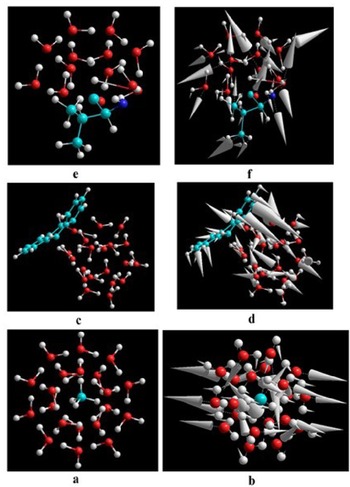
This method was first applied to proteins (Cotton et al., Reference Cotton, Norman and Johnson1973; Yang et al., Reference Yang, Johnson, Holm and Norman1975; Case et al., Reference Case, Huynh and Karplus1979). The resulting molecular structures and lowest THz-frequency vibrational modes of a pentagonal dodecahedral water nanocluster interacting with methane, anthracene and the amino acid valine, respectively, all of which have been found in interstellar space, dust clouds, comets or meteorites (Kvenvolden and Lawless, Reference Kvenvolden and Lawless1970; Lacy et al., Reference Lacy, Carr, Evans and Baas1991; Iglesias-Groth et al., Reference Iglesias-Groth, Manchado and Rebolo2010), are shown in Fig. 6. In all three examples, there is coupling of 1.8 THz water-cluster ‘surface’ oxygen motions to the carbon atomic motions, as represented by the vectors in Fig. 6. In the anthracene and valine examples there are carbon–carbon bonds, so that the water-cluster-induced carbon motions at 1.8 THz are ‘bending’ modes of the C–C bonds. In valine, there is also coupling between the water-cluster 1.8 THz vibrational mode to that of the nitrogen atom (Fig. 6(f)). Valine is an α-amino acid that is used in the biosynthesis of proteins by polymerization beginning with the nitrogen atom and ending with a carbon. The point here is that water nanoclusters and prebiotic molecules delivered by cosmic dust and meteorites to Earth could have jump-started life here and on exoplanets in the habitable zones of distant solar systems. This requires the first self-replicating RNA necessary for DNA and the synthesis of proteins from amino acids.
(a) Pentagonal dodecahedral CH4(H2O)20 methane clathrate. (b) 1.8 THz vibrational mode. (c) (H2O)20 cluster interacting with anthracene. (d) The vibrational coupling of the (H2O)20 1.8 THz vibrational mode to a THz ‘bending’ mode of anthracene. (e) Hemispherical pentagonal dodecahedral water nanocluster clathrating a valine amino acid residue. (f) Vibrational coupling of the water clathrate 1.8 THz vibrational mode to the valine amino acid ‘bending’ mode.

The RNA world
From prebiotic molecules to RNA
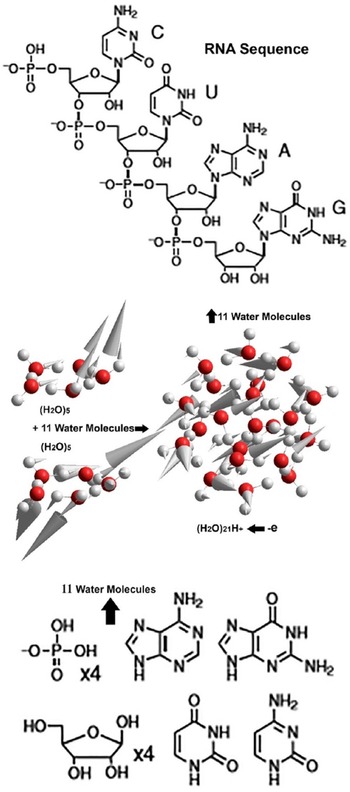
Compelling arguments for the so-called RNA world as the origin of life on planet Earth and possibly elsewhere in the universe (Joyce and Orgel, Reference Joyce, Orgel, Gesteland and Atkins1993) – preceding DNA- and protein-based life – has posed the fundamental problem of explaining how the first self-replicating RNA polymers, such as the RNA segment shown in Fig. 7, were created chemically from a pool of prebiotic organic molecules, nucleosides and phosphates. A recent paper (Totani, Reference Totani2020) based on polymer physics and inflationary cosmology proposed that extraterrestrial RNA worlds and thus the emergence of life in an inflationary universe must be statistically rare. Since the polymerization of long RNA chains in water has been demonstrated but not explained definitively (Costanzo et al., Reference Costanzo, Pino, Cicinello and DiMauro2009), it is proposed here that water nanoclusters comprising liquid water and water vapour can act as catalysts for prebiotic RNA synthesis, increasing the likelihood of RNA worlds and thus the emergence of life wherever water is present in a non-inflationary or cyclic universe of the type described in this paper.
Dehydration–condensation exchange of eleven water molecules between prebiotic nucleosides and phosphates to form an RNA sequence of four polymerized nucleobases, guanine, adenine, uracil and cytosine via a water nanocluster catalytic pathway for the water molecules. This may explain how the first self-replicating RNA polymers were created chemically from a pool of prebiotic organic molecules and thereby clarify the ‘RNA-world’ origin of life – preceding DNA- and protein-based life – on planet Earth and exoplanets in the habitable zones of developed solar systems wherever water is present.

Simply described, the chemical steps of combining the prebiotic molecules of Fig. 7 to yield an RNA sequence of four polymerized nucleobases, guanine, adenine, uracil and cytosine, require the effective loss of 11 water molecules from the initial reactants and their effective recombination in RNA. This is a dehydration–condensation reaction (Cafferty and Hud, Reference Cafferty and Hud2014). Cyclic water pentamers (Harker et al., Reference Harker, Viant and Keutsch2005) (Fig. 7) have been identified as being key to the hydration and stabilization of biomolecules (Teeter, Reference Teeter1984). Such examples indicate the tendency of water pentagons to form closed geometrical structures around amino acids (Fig. 6(e) and (f)) and nucleosides (Neidle et al., Reference Neidle, Berman and Shieh1980). Studies of supercooled water and amorphous ice have revealed the presence of cyclic and clathrate water pentamers (Yokoyama et al., Reference Yokoyama, Kannami and Kanno2008; Nandi et al., Reference Nandi, Burnham and Futera2017), suggesting the possible delivery of water pentamers by ice-coated cosmic dust and meteorites to the atmospheres of Earth and habitable exoplanets. At the opposite extreme temperatures and pressures of hydrothermal ocean vents (black smokers) arising from planetary volcanic activity, the expelled water can be in the supercritical phase, where the structure is neither liquid nor vapour but instead isolated water nanoclusters (Sahle et al., Reference Sahle, Sternemann and Schmidt2013). Therefore, at both temperature and pressure extremes, water pentamers interacting with prebiotic molecules could nucleate additional water molecules – 11 in Fig. 7 example – to form the more stable pentagonal dodecahedral cluster (H2O)21H+, which could then provide via its THz vibrations (Fig. 2(c) and (d)) the 11 water molecules necessary to yield the RNA sequence of Fig. 7. In other words, water nanoclusters delivered by cosmic dust or hydrothermally to planet Earth and habitable exoplanets could have provided a catalytic pathway for the dehydration–condensation–reaction mechanism of RNA polymerization.
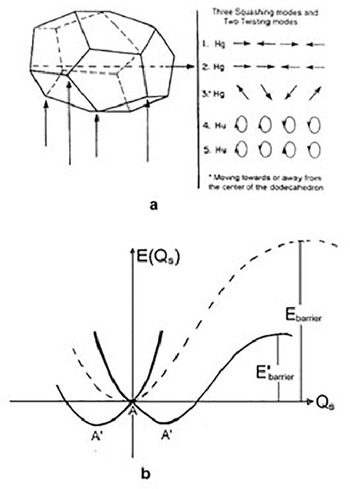
How a (H2O)21H+ cluster could expel water molecules or OH groups when interacting with prebiotic molecules to promote RNA chain growth deserves further analysis. As pointed out in the section ‘Electronic structure and THz vibrations’, this protonated water cluster readily takes up an extra electron into the LUMO (Fig. 2(a)) – a hydrated electron – as noted in Fig. 7. The proximity of the resulting electrically neutral (H2O)21H cluster occupied LUMO ‘S’ orbital to the lowest unoccupied, nearly degenerate cluster ‘Px,Py,Pz’ orbitals (Fig. 2(a) and (b)) suggests the possible coupling between the hydrated electron and the pentagonal dodecahedral cluster THz-frequency ‘squashing’ and ‘twisting’ modes shown in Fig. 8(a) via the pseudo or dynamic Jahn–Teller (JT) effect (Bersuker and Polinger, Reference Bersuker and Polinger1989).
(a) ‘Squashing’ and ‘twisting’ vibrational modes of a pentagonal dodecahedron, where Hg and Hu designate the key irreducible representations of the icosahedral point group corresponding to these modes. (b) Schematic representation of the double potential energy wells for a JT-distorted water pentagonal dodecahedral water nanocluster and the resulting reduction of the energy barrier for the catalytic reaction of the cluster along the reaction path defined by the normal mode coordinates Q s.

JT coupling in (H2O)21H leads to a prescribed symmetry breaking of the pentagonal dodecahedron along the THz-frequency vibrational mode coordinates Q s, lowering the cluster potential energy from A to the equivalent minima A′ shown in Fig. 8(b). Because of the large JT-induced vibrational displacements (large Q s) of water-cluster surface oxygen atoms, the energy barrier for expulsion of water oxygen or OH radicals and their oxidative addition to reactive nucleotides is lowered from E barrier to E′barrier (Fig. 8(b)).
RNA protocells
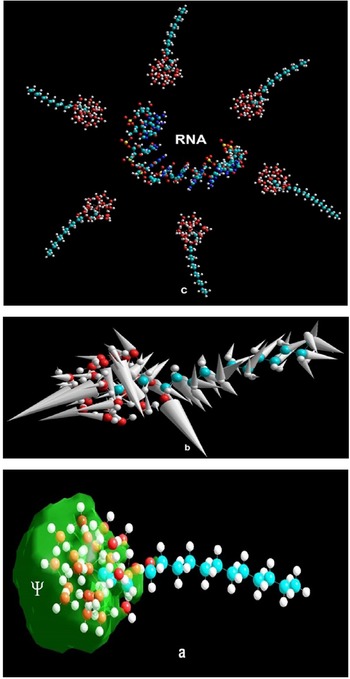
Laboratory investigations of the possible origins of life on Earth have successfully created self-assembling model protocell membranes, the simplest of which are fatty-acid vesicles capable of containing at least short segments of RNA (Oberholzer et al., Reference Oberholzer, Wick, Luisi and Biebricher1995; Chang et al., Reference Chang, Huang and Hung2000; Dworkin and Deaner, Reference Dworkin and Deamer2001; Hanczyc and Szostak, Reference Hanczyc and Szostak2004; Meierhenrich et al., Reference Meierhenrich, Filppi and Meinert2010). Fatty acids are amphiphilic molecules, which means that polar and nonpolar functional groups are present in the same molecule. Fatty acids are commonly found in experiments simulating the prebiotic ‘soup’ arising from Earth's early hydrothermal conditions (Milshteyn et al., Reference Milshteyn, Damer, Havig and Deamer2018) and the arrival of extraterrestrial material to the early Earth (Kvenvolden and Lawless, Reference Kvenvolden and Lawless1970). Quantum-chemical calculations by the SCF-Xα-scattered-wave density-functional method (Slater and Johnson, Reference Slater and Johnson1972, Reference Slater and Johnson1974) find that the polar (hydrophilic) end of the naturally occurring fatty acid glycerol monolaurate (‘GML/monolaurin’) C15H30O4 (Milshteyn et al., Reference Milshteyn, Damer, Havig and Deamer2018) attracts water molecules, forming a stable water-nanocluster-GML molecule, as illustrated in Fig. 9(a). These calculations reveal: (1) the polar end of the fatty acid donates an electron into the water-cluster LUMO, as shown by the computed molecular-orbital wavefunction Ψ in Fig. 9(a) and (2) the 1.8 THz vibrational mode of the water nanocluster described above resonates with the fatty-acid carbon-chain motions, as represented by the vectors in Fig. 9(b). This quantum-mechanical coupling of the fatty acid to water nanoclusters can promote their chemical reactivity with the prebiotic organic molecules and phosphates leading to RNA polymerization by the steps shown in Fig. 7. Once such couplings occurred naturally during Earth's early hydrothermal conditions and the arrival of extraterrestrial material to the early Earth, the water-nanocluster-fatty-acid molecules tended to aggregate around growing RNA segments, as shown in Fig. 9(c). The preferred orientation of these molecules around the RNA segment will be recognized as a primitive reverse micelle, the simplest self-assembling fatty-acid vesicle that has been demonstrated to be capable of containing at least short segments of RNA (Chang et al., Reference Chang, Huang and Hung2000). The laboratory-controlled synthesis of self-assembling water-nanocluster reverse micelles present in water-in-oil nanoemulsions has also been demonstrated (Johnson, Reference Johnson1998; Daviss, Reference Daviss1999).
(a) Water nanocluster attached to the polar end of the naturally occurring fatty acid glycerol monolaurate (‘GML/monolaurin’) C15H30O4, which donates an electron to the water-cluster LUMO represented by the computed molecular-orbital wavefunction Ψ. (b) The 1.8 THz vibrational mode of the combined water-nanocluster-GML molecule. Such quantum-mechanical coupling of fatty acids to water nanoclusters can promote their chemical reactivity with the prebiotic organic molecules and phosphates, leading to RNA polymerization by the steps shown in Fig. 7. (c) The aggregation of water-nanocluster-GML molecules around an RNA segment, forming a primitive reverse micelle.

This scenario, albeit rudimentary, provides at least one possible pathway to cellular life's beginnings on Earth and habitable exoplanets, including the earliest RNA viruses (Moelling and Broecker, Reference Moelling and Broecker2019), while suggesting contemporary applications to biomedicine, such as pharmaceuticals (Authelin et al., Reference Authelin, MacKenzie and Rasmussen2014) and RNA-interference antiviral drugs (Wu and Chan, Reference Wu and Chan2006; Setten et al., Reference Setten, Rossi and Han2019). RNA interference induced by small interfering RNA segments like the micellular one shown in Fig. 9(c) can inhibit the expression of viral antigens and so provides a novel approach to the therapy of pathogenic coronaviruses such as COVID-19.
Conclusions
Why pentagonal water clusters?
In the proposed roles of water nanoclusters in cosmology and astrobiology, emphasis has been placed on clusters consisting of pentagonal cyclic rings of water molecules. This is justified because a pentagonal geometry leads to the magic-number water nanoclusters most frequently observed experimentally and discussed in the section ‘Water nanoclusters’. The higher stability of these clusters is explained simply by the fact that the water molecule bond angle is roughly equal to a regular pentagon angle. Thus, the water molecule hydrogen bonds are only slightly deformed. That said, this scenario does not completely rule out the possible ejection of water nanoclusters of other topologies from cosmic dust according to equation (1). For example, the calculated cut-off THz vibrational frequency of an icosahedral ‘water buckyball’ is only slightly greater than that of a pentagonal dodecahedral one, and deforming the latter dodecahedron changes that frequency only marginally.
Can classical physics explain water nanoclusters?
In the section ‘The CMB spectrum’, it was pointed out that pentagonal dodecahedral water nanoclusters of the types shown in Figs. 2 and 3 might be viewed as spherical shells of the type originally proposed by Layzer and Hively (Reference Layzer and Hively1973) to be a primordial source of the CMB radiation according to classical electromagnetic theory. Likewise, viewing such nanoclusters as tiny spheres could allow one, in principle, to apply the theoretical approach of Gérardy and Ausloos (Reference Gérardy and Ausloos1983, Reference Gérardy and Ausloos1984) to model the infrared absorption spectrum of water-nanocluster arrays from solutions of Maxwell's equations. However, instead of the infrared, here we are focused on the unique THz spectra of such nanoclusters due to the ‘surface’ vibrational modes of the clusters' water-molecule shells.
Since the classical frequency of a thin vibrating spherical shell varies inversely with the radius of shell, it is therefore no surprise that the THz cut-off frequency of an approximately spherical water nanocluster decreases with increasing cluster size or with increasing number of water molecules in equation (1), as suggested by Figs. 2 and 3. Likewise, since the classical frequency (lowest harmonic) of a vibrating string is inversely proportional to its length, ‘strings’ of water nanoclusters like the one shown in Fig. 4 will tend to have cut-off frequencies decreasing with string length. The numerical values of these frequencies cannot be determined classically, but they can be computed quantum mechanically by the SCF-Xα-scattered-wave density-functional method (Slater and Johnson, Reference Slater and Johnson1972, Reference Slater and Johnson1974), as described in the section ‘Electronic structure and THz vibrations’.
The key frequency
My quantum-chemical findings that 1.8 THz water-nanocluster vibrational modes are key to their role in coupling with and activating prebiotic molecules is especially interesting because that frequency is very close to the cut-off frequency νc ≅ 1.7 THz which determines, according to the section ‘Dark energy’ and equation (4), the present dark energy density due to vacuum fluctuations, and that is consistent with the measured cosmological constant at the present time in the expansion of the universe. This result is also consistent with water nanoclusters containing the ‘magic-numbers’ of n = 21 and 20 water molecules (Figs. 2(d) and 3(a), respectively) to be dominant ones produced by ice-coated cosmic dust according to equation (1), because with increasing cluster size (Figs. 3(b), (c) and 4), the cut-off frequency νc and, according to equation (4), the dark energy density will be smaller than presently measured. Applying the cyclic cosmology in the section ‘A cyclic cosmology’ and the astrobiology in the section ‘Astrobiology’, I conclude that as the universe expands further and larger cosmic water nanoclusters become more dominant from ice-coated cosmic dust, those larger clusters will be less favourable to interact with prebiotic molecules, suggesting that life will become less probable over astronomical time. In other words, we are likely living at the ideal time in the expanding universe for life – as we know it – to exist, and water nanoclusters of the types shown in Figs. 2(d) and 3(a) created on cosmic dust could possibly be ‘seeds of life’ that catalyse the biomolecules necessary for life.
Evidence for quintessential cosmic water nanoclusters
As discussed in the section ‘Water nanoclusters’, there is strong experimental evidence for the existence of water nanoclusters and protonated water-nanocluster cluster ions in Earth's atmosphere (Aplin and McPheat, Reference Aplin and McPheat2005), produced in laboratory vacuum chambers (Johnson and Zhang, Reference Johnson and Zhang2008) (Fig. 1), and generated from amorphous ice by energetic ion bombardment (Martinez, Reference Martinez2019). The protonated (H2O)21H+ or H3O+(H2O)20 cluster (Fig. 2) is exceptionally stable, even at high temperatures and irradiation, and has been identified experimentally from its infrared spectrum (Miyazaki, Reference Miyazaki2004; Shin et al., Reference Shin, Hammer, Diken and Johnson2004). Because this species can be viewed as a hydronium ion (H3O+) caged by a pentagonal dodecahedron of 20 water molecules, the report of widespread hydronium in the galactic medium through its inversion spectrum (Lis et al., Reference Lis, Schilke, Bergin and Gerin2014) is key to the challenge of identifying the presence of H3O+(H2O)20 because both spectra fall into the same THz region. Recent extraction of the cosmic birefringence from the 2018 Planck polarization data (Minami and Komatsu, Reference Minami and Komatsu2020) may possibly support the proposed quintessence scenario due to the birefringence property of cosmic water nanoclusters. This is under further investigation.
Final conclusions
Although this paper is ‘out of the box’ of generally popular inflationary cosmology and multiverse theory (Guth, Reference Guth1981, Reference Guth2007; Linde, Reference Linde, Lemoine, Martin and Peter2008), it is not the only example. Other ‘cyclic-universe’ theories have been widely promoted (Penrose, Reference Penrose2006; Ijjas et al., Reference Ijjas, Steinhardt and Loeb2017; Ijjas and Steinhardt, Reference Ijjas and Steinhardt2019), while critiquing the multiverse scenario (Steinhardt, Reference Steinhardt2011). This author has offered a unified interdisciplinary approach to cyclic cosmology and the origin of life in the universe based on quantum astrochemistry, while still attempting to include complementary relevant astrophysics facts. Certainly, not all problems in cosmology are solved by cosmic water nanoclusters, but perhaps some. The proposal that cosmic water nanoclusters may constitute a form of invisible baryonic dark matter does not rule out nonbaryonic dark matter, such as WIMPS and AXIONS, although observational evidence for their existence is lacking (Haynes, Reference Haynes2018). Regarding dark energy, it is further proposed that cosmic water nanoclusters constitute a quintessence scalar field (Steinhardt, Reference Steinhardt2003) that permeates the vacuum of space and largely cancels via equation (3) the otherwise infinite vacuum energy density, equation (2), at this point in time. This scenario is consistent with the reported ‘web’ of dark matter permeating the cosmos (Heymans et al., Reference Heymans, Waerbeke and Miller2012). The report of a neutral hydrogen gas bridge connecting the Andromeda (M31) and Triangulum (M33) galaxies (Lockman et al., Reference Lockman, Free and Shields2012) suggests the possibility that water nanoclusters, albeit at lower density than pure hydrogen, might similarly be dispersed as intergalactic gas constituting Rydberg dark matter. The striking consistency of the THz cut-off vibrational frequencies of water nanoclusters with the zero-point vacuum energy THz cut-off frequency that produces a dark-energy density in agreement with cosmological data is possibly only coincidental. Nevertheless, a common origin of dark matter and dark energy outside the realm of conventional elementary-particle physics, which has yet to identify conclusively the origins of either dark matter or dark energy, is a tempting idea. Indeed, one might also conceptually view water nanoclusters in the vacuum of space as baryonic nanoparticles that break the real-space symmetry of the otherwise isotropic vacuum due to their physical presence. Surprisingly, their masses are within the range of those estimated for WIMPS. Again, there are no other identified baryonic substances in our Universe, including hydrogen, water monomers and organic molecules that exhibit all these characteristics, while possessing the Rydberg-excited electronic states of low-density condensed matter that qualifies also as dark matter. Fullerene buckyballs in planetary nebulae (Cami et al., Reference Cami, Bernard-Salas, Peeters and Malek2010) are also ruled out as candidates, even though Rydberg states have been observed in the C60 molecule (Boyle, Reference Boyle2001) because their vibrational frequencies lie beyond the required THz range. Planets, and moons, as well as water vapour in solar atmospheres (Bergin and van Dishoeck, Reference Bergin and van Dishoeck2012), nebulae (Glanz, Reference Glanz1998) and distant quasars (Bradford et al., Reference Bradford, Bolatto and Maloney2011) are widely present throughout the cosmos, and therefore should be included as possible sources of cosmic water nanoclusters. In fact, water clusters have been detected recently in the hydrothermal plume of Enceladus – a moon of Saturn (Coates et al., Reference Coates, Wellrock and Jones2013). Finally, from the quantum chemistry of cosmic water nanoclusters interacting with prebiotic organic molecules, amino acids and RNA protocells on early Earth and habitable exoplanets, this scenario is consistent with the anthropic principle that our Universe is a connected biosystem and has those properties which allow life, as we know it – based on water, to develop at the present stage of its history.
Acknowledgements
I am grateful to Franziska Amacher for introducing me to the RNA world research of Harvard Professor J. W. Szostak and for the continual support of Henry Johnson. I also thank the referees for their helpful suggestions.