INTRODUCTION
The faunal assemblages associated with drifting macroalgal rafts found at sea have been well characterized in recent decades (Thiel & Gutow, Reference Thiel and Gutow2005). Considerable attention has been given to rafting on detached macroalgae and other buoyant material as a possible alternative dispersal mechanism, especially for species lacking a pelagic larval phase within their lifecycles (Highsmith, Reference Highsmith1985; Ingólfsson, Reference Ingólfsson1995). A wide range of directly developing species are found in these floating habitats, yet fundamental questions remain as to the exact nature of the association between the organisms and the rafts (Thiel & Gutow, Reference Thiel and Gutow2005). More specifically, if we accept that an association with rafting material may increase the potential of a directly developing species to be transported to a new habitat then we must consider how such associations take place.
There are three potential mechanisms by which directly developing species can become associated with rafts: (i) the marooning of individuals along with algae that detaches from the shore; (ii) active/chance colonization events whereby free swimming individuals colonize rafts from the water column; and (iii) transfer of individuals from other previously colonized rafting material. The marooning of shoreline epifauna has been considered previously by Gutow et al. (Reference Gutow, Giménez, Boos and Saborowski2009), where they found that a range of intertidal species will immediately detach from algae once removed from shoreline canopy, but they also showed that many individuals of some species will remain attached to this newly drifting habitat. However, less attention has been paid to mechanisms of post-attachment colonization by intertidal organisms, which could be active or fortuitous. Ingólfsson (Reference Ingólfsson1998) considered the colonization of rafts by intertidal species by placing tethered algal fronds at sea off the Icelandic coast. This work showed that some non-swimming intertidal species could effectively colonize rafts at sea, and most interestingly the directly developing Littorina obtusata was able to attach to this floating habitat from the surrounding water column. Although as shown by Ingólfsson (Reference Ingólfsson1998) L. obtusata passively detaching from the shore along with the detachment of algae is the most likely cause for this species to be found drifting on rafts at sea. Results from Ingólfsson (Reference Ingólfsson1998) showed that the most common species with direct development colonizing rafts from the intertidal were those that had the ability to swim (e.g. Gammarus sp.).
The work presented here is a response to the gap in our knowledge whereby we consider the potential of free swimming Idotea to locate rafting material post-attachment from the shoreline using laboratory-based and in situ experiments. Isopod crustaceans of the genus Idotea represent an excellent group for investigation given their distribution throughout temperate shelf seas, and differential habitat choices exhibited by seemingly similar species (De Grave & Holmes, Reference De Grave and Holmes1998; Vetter et al., Reference Vetter, Franke and Buchholz1999; Salomon & Bucholz, Reference Salomon and Buchholz2000; Wares, Reference Wares2001; Franke et al., Reference Franke, Gutow and Janke2007). Furthermore, within rafting communities, the genus is abundant and often dominant. This has prompted a range of recent studies on habitat preferences, growth, food consumption and metabolic adaptations to rafting (e.g. Tuomi et al., Reference Tuomi, Jormalainen and Ilvessalo1988; Ingólfsson, Reference Ingólfsson1998, Reference Ingólfsson2000; Pavia et al., Reference Pavia, Carr and Aberg1999; Viejo, Reference Viejo1999; Hobday, Reference Hobday2000; Viejo & Aberg, Reference Viejo and Aberg2003; Sano et al., Reference Sano, Omori and Taniguchi2003; Gutow et al., Reference Gutow, Strahl, Wiencke, Franke and Saborowski2006, Reference Gutow, Leidenberger, Boos and Franke2007, Reference Gutow, Giménez, Boos and Saborowski2009; Vandendriessche et al., Reference Vandendriessche, Vincx and Degraer2006, Reference Vandendriessche, Vincx and Degraer2007). However, considering the colonization of rafts by shoreline Idotea spp. (Thiel & Gutow, Reference Thiel and Gutow2005), for example, it is not known whether these crustaceans actively seek rafting material or are simply marooned on buoyant substrata such as macroalgae when these become detached from the shoreline.
An Idotea species known to actively seek rafts at sea is Idotea metallica (Bosc); however, this species is found exclusively on drift material (Gutow & Franke, Reference Gutow and Franke2003) and is not associated with attached shore algal canopies. But yet, this insight may be important for understanding some of the processes involved with raft colonization by other Idotea species found along north-east Atlantic coasts, e.g. Idotea baltica (Pallas) a well known rafting species (Vandendriessche et al., Reference Vandendriessche, Vincx and Degraer2006; Franke et al., Reference Franke, Gutow and Janke2007). The known habitat choices of different Idotea species (e.g. rafts versus attached algal canopy) suggest that the process of rafting may not be entirely passive, although empirical data to support this model remain scarce (Franke & Janke, Reference Franke and Janke1998; Franke et al., Reference Franke, Gutow and Janke2007). Idotea granulosa is an abundant species found on intertidal regions around Europe (Healy & O'Neill, Reference Healy and O'Neill1984; Pavia et al., Reference Pavia, Carr and Aberg1999; Ingólfsson & Agnarsson, Reference Ingólfsson and Agnarsson2003) but has been shown to only be sporadically associated with rafting material drifting at sea (Gutow et al., Reference Gutow, Strahl, Wiencke, Franke and Saborowski2006). Idotea baltica is more common in the sublittoral zone (Healy & O'Neill, Reference Healy and O'Neill1984) yet has a strong association with rafting material at sea (Davenport & Rees, Reference Davenport and Rees1993; Gutow & Franke, Reference Gutow and Franke2003; Gutow et al., Reference Gutow, Strahl, Wiencke, Franke and Saborowski2006; Vandendriessche et al., Reference Vandendriessche, Vincx and Degraer2006).
To investigate how Idotea might colonize free-floating (detached) rafts a range of laboratory-based experiments and field trials were conducted to test three specific hypotheses. Firstly, we predicted that the initial orientation (i.e. direction of travel) of two different Idotea species released into choice chambers would reflect their known habitat preferences (raft or algal canopy). This experimental approach was based upon the concept of vanishing angles (see Papi, Reference Papi1992) whereby initial direction of travel can serve as a behavioural proxy for more protracted movements. In this case we were considering the direction towards a preferred habitat location (i.e. upwards towards the raft or downwards towards the algal canopy/seabed). We then proposed that known rafting species released into a choice arena and left undisturbed for several hours would become associated with rafts, whilst canopy species (i.e. I. granulosa which are dominant along the intertidal) would not show a strong preference, due to intertidal complexity of exposed and submerged algae. Moving our predictions to the field, the final part of the study was based on tethered algal rafts (previously cleaned of all vagile animals). We hypothesized that the rafts would be colonized not only by Idotea present on adjacent shores, but also by known rafters found beyond the intertidal zone. More specifically, we wanted to consider the potential of well-known ‘shoreline’ and ‘rafting’ species to colonize macroalgal rafts following the detachment of fronds from the shoreline.
MATERIALS AND METHODS
Choice of experimental species
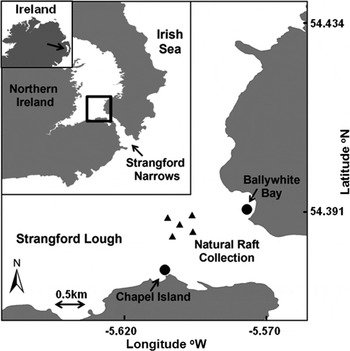
To select the ‘shoreline’ species for the laboratory-based choice experiments, attached algal canopies, predominantly Ascophyllum nodosum (L.) Le Jolis and Fucus vesiculosus L., were studied at mid-shore locations around south-eastern Strangford Lough, County Down, Northern Ireland (Figure 1) in April 2009. All Idotea were collected and identified to species (following Hayward & Ryland, Reference Hayward and Ryland2000). Idotea granulosa (Rathke) was the only member of this genus observed on intertidal fucoids in Strangford Lough, and because this species is only sporadically associated with seaweed rafts (Gutow et al., Reference Gutow, Strahl, Wiencke, Franke and Saborowski2006) was used to represent the shore species in experimental trials.
Locations of study sites (Chapel Island Bay and Ballywhite Bay) and natural raft collection within Strangford Lough, County Down, Northern Ireland.

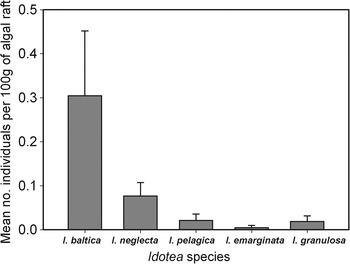
The ‘rafting species’ Idotea baltica (Pallas) which is common in the sublittoral zone (Healy & O'Neill, Reference Healy and O'Neill1984) and is not found along Strangford Lough's intertidal canopy algae, was chosen due to its well-known prevalence on rafting material at sea (Vandendriessche et al., Reference Vandendriessche, Vincx and Degraer2006; Franke et al., Reference Franke, Gutow and Janke2007). Twenty natural free-floating rafts were collected in the Strangford Lough narrows in January 2010 using a large dip net. Rafts were composed of Ascophyllum nodosum and Fucus vesiculosus, and ranged from 53 g to 1776 g wet weight. All Idotea individuals were collected and identified to species level. Idotea baltica was the most abundant isopod present, justifying our use of this species as ‘rafter’ in the choice experiments (see Figure 2). These data were not used in other analyses as they were collected in winter months as opposed to late summer months for tethered rafts, and comparisons might be affected by seasonal variations in densities and species composition.
Mean abundance of Idotea species (±SD) per 100 g of natural seaweed rafts (N = 20) in Strangford Lough, midway between Chapel Island and Ballywhite Bay (I. baltica N = 25, I. neglecta N = 9, I. pelagica N = 3, I. granulosa N = 3 and I. emarginata N = 1).

Sample collection for laboratory-based orientation and habitat choice experiments
Idotea granulosa was collected from Strangford Lough, by haphazardly sampling two areas of intertidal algal canopies of Ascophyllum nodosum and Fucus vesiculosus at low tide, close to Portaferry Marine Laboratory, in summer 2009. Idotea baltica was collected in summer 2009 and January 2010 (for Experiment 2) by boat in Strangford Lough, using a dip net (80 × 80 cm and mesh size 0.25 × 0.25 cm) to collect drifting macroalgal rafts and any free-swimming invertebrates in close proximity. All seaweed material (from the shore or rafts) was returned to the laboratory where Idotea spp. were collected by vigorous shaking of algal fronds over a white wet laboratory floor. Once removed from the algae, isopods from the shore and from rafts were identified to species and placed into two separate constantly aerated stock tanks within an enclosed wet laboratory at the Portaferry Marine Laboratory for one day before behavioural experiments were undertaken. Artificial lighting on a timer mimicked the ambient day/night light regimes for the time of year in Strangford Lough. All animals were studied within 24 hours of collection, and used animals were placed in further stock tanks before release back to field collection sites. It has been previously shown that the palatability and general attractiveness of an alga to a potential colonizer depends on how long it has been detached and what conditions it has been exposed to (Cronin & Hay, Reference Cronin and Hay1996). Consequently, the algae used in these experiments were freshly cut from the shore just prior to investigation. These fronds were then washed in fresh water to remove vagile organisms and then introduced to the tank which contains aerated seawater from Strangford Lough. Habitat choices in these experiments relate to a choice by individuals whether to ascend within the water column or descend to the bottom of the tank.
Initial orientation behaviour of Idotea granulosa and I. baltica under controlled conditions
The choice chamber consisted of a glass observation tank (90 cm long × 45 cm wide × 45 cm high) filled to a depth of 30 cm with 121.5 l filtered and UV-sterilized seawater which was vigorously aerated for 24 hours before experimental runs. Seawater temperature was maintained at ~14°C to match seasonal field values (www.afbini.gov.uk/) and illumination was from one large overhead fluorescent light timed to the natural light/dark cycle. The sides of the tank were covered with dark plastic sheets so light came only from above. This approach was intended to provide a clear directional cue (i.e. downwelling light) as to which way was up, as many marine organisms use light as an orientation cue (Cronin & Shashar, Reference Cronin and Sashar2001). By blocking out the sides of the tank in a uniform manner we aimed to avoid the issues of orientation towards defined silhouettes as previously documented by Miranda & Thiel (Reference Miranda and Thiel2008). In all experimental trials, care was taken to minimize the variability of extraneous factors which might alter behavioural responses, e.g. position of observer remaining constant and room locked throughout experiments to avoid other external light sources or disruption.
This study focuses on the very early stages of habitat selection, i.e. initial orientation or vanishing angle. This is a well established technique in animal behaviour that allows the initial orientation of animals under controlled conditions to serve as proxies of broader movements (Papi, Reference Papi1992). Therefore the release of an Idotea individual at 15 cm depth (mid-point of tank) was considered sufficient for this experiment. Sixty individuals from each stock tank (shore-collected I. granulosa or raft-collected I. baltica) were tested individually for their initial orientation upon release into the choice chamber. Following the experiment, individuals were moved to a different tank and later released back into the sea.
In Experiment 1, the choice chamber contained a sand substratum to simulate local intertidal conditions. Each animal was caught from the stock tank using a white plastic drinking cup and with one hand over the opening was transferred to the observation tank where it was lowered into the water column. Idotea were released into the middle of the tank at a depth of 15 cm and initial orientation was classified into three categories: (1) active ascent; (2) active descent; and (3) passive descent. Active ascent describes when the individual ascends within the water column by actively swimming; active descent is when the individual descends within the water column by actively swimming; and passive descent describes the movement of the individual sinking within the water column without swimming, curled up until passively reaching the tank floor.
In Experiment 2, in the choice tank A. nodosum was placed on the sand surface weighed down by rocks to prevent fronds from floating within the water column (‘attached’), and floating A. nodosum fronds were added to simulate the presence of algal rafts. The same observations were recorded as for Experiment 1 using new sets of individuals.
Longer-term habitat choice of Idotea granulosa and I. baltica
Building upon the initial orientation experiment we wanted to investigate habitat choices for different Idotea species over more protracted time scales. Ten individuals of shore-collected I. granulosa from the stock tank were introduced to the choice chamber which contained a sand substratum and a choice of attached or floating A. nodosum seaweed. After six hours the locations of all animals were recorded, e.g. floating seaweed, attached seaweed, sand and side of tank, with analysis focused on the number of individuals ending up on the raft as an indication of rafting potential. Six replicate trials were conducted with different sets of I. granulosa individuals. The same choice experiment was conducted for I. baltica collected from rafts in Strangford Lough. Unfortunately, adverse weather conditions during the late summer of 2009 prevented access to rafts so the sample size for this series of trials was reduced. Three runs of six individuals were undertaken later for this species in January 2010.
Field experiments to assess colonization of tethered macroalgal rafts
Experiments were carried out in the field to investigate the potential colonization of rafts by quantifying Idotea populations found on tethered rafts and also on shores adjacent to where these experimental rafts were deployed. We aimed to test whether rafting communities are influenced by active or fortuitous processes with individuals arriving from the surrounding water column, either by swimming onto rafts, or by movement from other, previously colonized rafts.
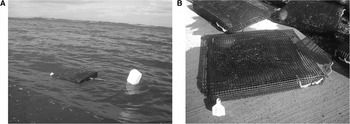
To determine which isopod species colonized tethered algal rafts (e.g. the shore species I. granulosa and/or some of the suite of rafting species including I. baltica) we constructed tethered rafts (Figure 3A, B) of the two most common naturally rafting seaweeds in Strangford Lough, Ascophyllum nodosum and Fucus vesiculosus. Seaweeds were freshly collected along the intertidal shore near to Portaferry Marine Laboratory at the south-eastern end of Strangford Lough in September 2009. Prior to deployment all seaweed used to make up the rafts was cleaned of all visible epiphytes and submerged in freshwater for at least five hours to remove all vagile organisms, then placed in aerated seawater for 24 hours; the process was repeated to ensure that all living vagile fauna were eliminated. The cleaned seaweed was then kept in aerated filtered seawater in large outdoor holding tanks at the marine laboratory until required for raft construction. Approximately 400 g of algal fronds following the previous work of Ingólfsson (Reference Ingólfsson1998) were weighed and placed in plastic lattice bags (45 cm × 45 cm × 10 cm, mesh size 1 cm × 1 cm), which are used for seeding commercial oysters. Seaweed placed into a plastic cage essentially mimicked a natural raft as it allowed the raft to float freely inside, although restricted in its movement at sea which is unavoidable. Cages used to house algal rafts undeniably served as a refuge for isopods and thus decreased predation risk via exclusion. However, given that our study focused purely on the colonization potential of Idotea individuals and not other aspects of raft population dynamics (i.e. post-colonization survivorship and competition) this experimental design did not compromise the validity of our findings.
Field experiments showing (A) deployed tethered raft in Strangford Lough and (B) close-up of seaweed raft in a specially designed oyster bag containing seaweed raft.

Two deployment sites for the tethered rafts were selected according to three criteria: (1) shallow (<10 m at high tide) and wave-sheltered; (2) with easy boat access for deployment and retrieval of rafts; and (3) isolated from other boat-based activities in the Lough (e.g. lobster potting). These were Chapel Island where the north-western end of the Strangford Narrows opens out into the southern basin, and Ballywhite Bay at the north-eastern end of the Narrows (Figure 1). Both sites represent relatively similar environments in the southern basin of Strangford Lough which receives daily influxes of seawater from the Irish Sea, although Ballywhite Bay is exposed to stronger currents due to its position relative to the Strangford Narrows and can be more affected by the action of prevailing winds coming from the south-west (Brown, Reference Brown1990). At each site 12 rafts were deployed, six of each algal species (i.e. six A. nodosum rafts and six F. vesiculosus rafts). Rafts were tethered individually to a plastic buoy attached to a concrete block at the seabed by a 10 m leaded line, spaced 10 m apart.
Tethered rafts were left in situ for a period of six weeks (44 days) to test whether post-detachment colonization by Idotea species was possible (i.e. a simple assessment of presence or absence). It was not our aim to consider the time-frame over which this process occurred given that this would be strongly affected by the direction and velocity of local currents; thus our results would be of limited value across the species range. Moreover, given that our rafts were tethered, the time-frame of colonization would not reflect that of a moving target (i.e. a free floating raft) which would be exposed to a greater range of potential colonization sites (i.e. other parts of the shoreline). Each raft was carefully collected using a large dip net (80 cm × 80 cm, mesh = 0.25 × 0.25 cm). It is possible that this method led to a slight underestimation in the absolute number of juveniles, but for all species it was found that juveniles were found in large numbers attached to the algal fronds themselves. The mesh was adopted as a compromise as finer mesh nets led to material being lost off the side of the net during removal from the sea, which would have led to an alternative bias of losing free-swimming adults. All rafts were taken back to the laboratory and processed by first removing the seaweed from the oyster bags and rinsing them under freshwater over a 0.5 mm sieve to remove all vagile organisms. Afterwards the oyster bag was soaked in a bucket of freshwater to remove any further animals from the cage. All Idotea were collected and preserved in 4% formalin–seawater, then identified to species level and measured for assignment to juvenile or mature state, to allow us to assess whether individuals actually colonized the rafts or if there was the potential for the release of brooded young by an adult after its colonization. All seaweed was separated by species, blotted dry, weighed and disposed of. Individuals of each species were classified as adult or juvenile according to the following criteria: I. granulosa juveniles <5 mm total length (TL) (Salemna & Ranta, Reference Salemaa and Ranta1991; Hull et al., Reference Hull, Winter and Scott2001), I. baltica juveniles <9 mm TL (Vetter et al., Reference Vetter, Franke and Buchholz1999), I. neglecta (Sars) juveniles <10 mm TL, and I. pelagic (Leach) juveniles <4 mm TL (Hayward & Ryland, Reference Hayward and Ryland2000). The abundances of Idotea on the shores adjacent to the tethered raft locations were assessed at the end of the deployment. At each site, samples of mid-shore rocky shore algal canopies were collected from six haphazardly placed 0.25 m2 quadrats, where all seaweed within the quadrat was bagged along with seaweed falling outside the quadrat that was attached within the 0.25 m2. The seaweed samples were returned to the laboratory where they were rinsed under freshwater to remove all vagile organisms, preserved in 4% formalin–seawater, and all Idotea were identified to species level and counted. Seaweed was blotted dry and a wet weight measurement taken. Investigatory analysis concentrated only on faunal assemblages for this study, but it is also appreciated that the interaction of algal on the shore to that of rafts will also be very important and needs due attention.
Data analysis
For data analysis, an Anderson–Darling test of homogeneity was performed on all untransformed data (Anderson & Darling, Reference Anderson and Darling1952). Datasets not showing homogeneity of variance were log-transformed and the Anderson–Darling test repeated to confirm homogeneity. A 2-way analysis of variance (ANOVA) was carried out on datasets where there were two independent ways of assigning observations into groups and where there was more than one observation per factor combination. For datasets where transformations were unable to produce homogeneous variances and comparisons between variables were required, Mann–Whitney U-tests were appropriate. Finally a Chi-squared (χ 2) test of association was used on choice experiments, where observations could be assigned to one of two or more categories in two variables. All data analysis was undertaken in SPSS (SPSS for windows, Version 17.0), and Minitab 15. All data are represented as means ± standard deviation.
RESULTS
Occurrence of Idotea species on shores and natural rafts
The only Idotea species observed in algal canopies on shores around Strangford Lough was I. granulosa. On natural rafts collected, five Idotea species were present, 41 Idotea individuals in total were collected on the 20 free-floating rafts. Expressed per unit raft seaweed weight, I. baltica was on average the most abundant Idotea species on natural rafts (72% of individuals found). In order of abundance of individuals on natural seaweed rafts within Strangford Lough the other species were I. neglecta (18% of individuals), I. pelagica (5%), I. granulosa (4%) and I. emarginata (Fabricius) (1%). The number of individuals of different species on natural rafts was standardized to a value per 100 g wet weight of algal raft. A Mann–Whitney U-test then allowed a comparison between the number of I. baltica and I. granulosa so that predominant rafting species could be elucidated, therefore backing up known rafting associations for each species. A significant difference was found between the numbers of I. baltica which had the greatest abundance, and those of the dominant shore species I. granulosa, which were found in low numbers on the natural rafts (Mann–Whitney U-test, U (18) = 118.5, Z = –2.649, P < 0.05) (Figure 2).
Initial orientation behaviour of shore-collected and raft-collected Idotea species
In Experiment 1, of the 60 shore-collected I. granulosa tested for initial orientation, 87% immediately ascended in the water column to the surface by actively swimming, whilst 13% descended. 72% of the 60 I. baltica individuals actively descended by swimming, 20% passively sank and 8% actively swam to the surface. A Chi-squared (χ 2) test of association was useful for investigating the observed orientation behaviours for each species of Idotea when placed into the experimental tank set up; this then exposed any behavioural differences between species. Idotea granulosa was significantly more likely to ascend by active swimming and I. baltica to descend actively (χ 2 = 74.774, d.f. = 2, P < 0.001). In Experiment 2 (with A. nodosum both floating on the surface and submerged), of the 60 shore-collected I. granulosa tested for initial orientation, 93% immediately ascended in the water column to the surface by actively swimming, whilst 7% descended. 72% of the 60 I. baltica individuals actively descended by swimming, 18% passively sank in a curled up behaviour and only 10% actively swam to the surface. Idotea granulosa was significantly more likely to ascend by active swimming and I. baltica to descend actively (χ 2 = 83.684, d.f. = 2, P < 0.001).
Longer-term habitat preferences
When I. granulosa was tested for habitat choice in tanks with floating and submerged A. nodosum in 6-hour experiments, 87% chose the raft on the water surface (mean = 8.7, SD± 1.2 N = 10), 10% were on the submerged seaweed (mean = 1, SD± 1.3, N = 10), and 3% selected other areas of the tank (mean = 0.3, SD± 0.8, N = 10). A Mann–Whitney U-test was used to compare the numbers of I. baltica and I. granulosa that ended up on the floating raft in the experimental tank set up, therefore testing for any preference differences between species which could have important consequences for known rafting associations. Idotea baltica was significantly less likely to end up on the raft (Mann–Whitney U-test, U (7) = 0, Z = –2.353 P < 0.05): 33% ended up on the raft, 33% on submerged seaweed and 33% were in various other positions around the tank (mean = 2, SD± 1.7, N = 6).
Colonization of tethered rafts
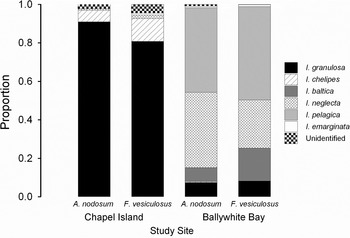
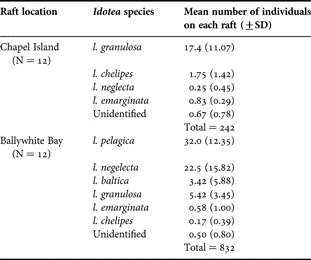
At both study locations the rafts remained in good condition over the 44-day deployment, and both fucoid species increased in wet weight by about 25% (A. nodosum increased by 83.14 ± 25.38 g, N = 12, and F. vesiculosus by 88.93 ± 68.59 g, N = 12). A total of six Idotea species were found attached to the tethered rafts at both locations (Table 1: Figure 4). A 2-way ANOVA was used to test the difference in the density of Idotea spp. between study locations and between the species of algae composing the rafts, i.e. A. nodosum and F. vesiculosus; this helped determine some potential factors important for the colonization of rafts at sea. When corrected for mass of seaweed raft, i.e. expressed per 100 g of raft algae, the interaction between location and seaweed did not have a significant effect upon the density (mean square (MS) = 276.2, P > 0.05) or species richness (MS = 16.4, P > 0.05) of Idotea spp. Both the density and species richness of Idotea spp. were significantly higher at Ballywhite Bay (abundance: 2-way ANOVA, F1,2 = 260.043, MS = 2.153, P < 0.01 (Chapel Island, mean = 4.64, ±SE = 0.77; Ballywhite Bay, mean = 14.3, ±SE = 1.71); richness: 2-way ANOVA, F1,2= 54.796, MS = 0.13, P < 0.05 (Chapel Island, mean = 2.08, ±SE = 0.27; Ballywhite Bay, mean = 4.2, ±SE = 0.23)). There was no significant difference between the two seaweed species for density or richness of Idotea (abundance: 2-way ANOVA, F2,20= 0.093, MS = 23.03, P > 0.05; richness: 2-way ANOVA, F2,20= 0.773, MS = 0.017, P > 0.05).
Relative abundances of different Idotea species on tethered rafts of Ascophyllum nodosum and Fucus vesiculosus at Chapel Island Bay and Ballywhite Bay, after a period of 44 days tethered in Strangford Lough, October 2009 (I. pelagica N = 384, I. granulosa N = 274, I. neglecta N = 270, I. baltica N = 101 and I. chelipes N = 23 in total across both locations).

Overview of Idotea species abundance on tethered rafts.

Mann–Whitney U-tests allow for comparisons of juveniles and adults for each species at each location to investigate whether the life history stage can influence raft colonization, which may have important consequences for understanding species persistence on rafts and ultimately dispersal potential. Assignment of Idotea individuals to juvenile or adult status by size showed that for I. granulosa there were significantly more adults (individuals >5 mm in length: Salemaa & Ranta, Reference Salemaa and Ranta1991; Hull et al., Reference Hull, Winter and Scott2001) than juveniles present on rafts at both sites (Chapel Island: Mann–Whitney U-test, U = 69(10), Z = –9.628, P < 0.001 (juvenile, mean = 1.75 (individuals), ±SE = 0.63; adult, mean = 15.67 (individuals), ±SE = 2.94); Ballywhite Bay: Mann–Whitney U-test, U (10) = 0, Z = –4.314, P < 0.001 (juvenile, mean = 0.58, ±SE = 0.19; adult, mean = 5.17, ±SE = 0.86)). At Ballywhite Bay there were significantly more adults of I. neglecta (>10 mm in length) than juveniles (Mann–Whitney U-test, U (10) = 0, Z =–6.298, P < 0.001 (juvenile, mean = 1.17, ±SE = 0.37; adult, mean = 21.08, ±SE 4.33)). Similarly, at Ballywhite Bay there were significantly more adult I. pelagica (>4 mm in length: Hayward & Ryland, Reference Hayward and Ryland2000) than juveniles (Mann–Whitney U-test, U (10) = 5.5, Z = –5.641, P < 0.001 (juvenile, mean = 0.92, ±SE = 0.38; adult, mean = 31.33, ±SE = 3.44)). By contrast, for I. baltica at Ballywhite Bay there were significantly more juveniles (individuals <9 mm in length: Vetter et al., Reference Vetter, Franke and Buchholz1999) than adults (Mann–Whitney U-test, U (10) = 0, Z = –8.641, P < 0.001 (juvenile, mean = 4.67, ±SE = 1.26; adult, mean = 4.08, ±SE = 0.84).
Abundances of Idotea granulosa on tethered rafts and adjacent shores
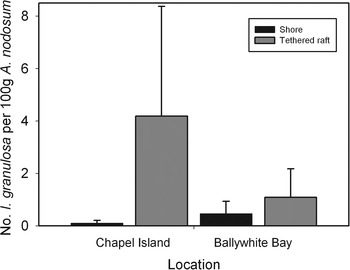
The only Idotea species found on the intertidal shores adjacent to the rafts was I. granulosa, so this species was compared between the shore and on tethered rafts, on a per unit seaweed basis of Ascophyllum nodosum (Figure 5), using Mann–Whitney U-tests to elucidate differences in I. granulosa density between both habitats. This helped to determine whether the colonization of rafts by this species is an active process or merely a passive marooning of individuals. So if I. granulosa numbers are higher (per unit of A. nodosum) on rafts at sea which were previously cleaned of all vagile organisms than that of the shore algae, then this may point to an active process of colonization from the water column. At Chapel Island there were significantly more I. granulosa on tethered rafts than on the shore (Mann–Whitney U-test, U (10) = 0, Z = –2.882, P < 0.05 (shore, mean = 0.11, ±SE = 0.03; raft, mean = 4.19, ±SE = 1.06)), but at Ballywhite Bay there was no significant difference (Mann–Whitney U-test, U (10) = 6, Z = –1.922, P > 0.05 (shore, mean = 0.47, ±SE = 0.26; raft, mean = 1.09, ±SE = 0.09)).
Mean number of Idotea granulosa (± SD) per 100 g of Ascophyllum nodosum from attached shore canopy (N = 12) and on tethered rafts (N = 12) at Chapel Island and Ballywhite Bay. Chapel Island rafts had significantly more individuals than on adjacent shores; Ballywhite Bay had more individuals found on rafts than on adjacent shores but was not significantly different.

DISCUSSION
Orientation behaviour of shore-dominant and raft-dominant Idotea species
The presence of Idotea granulosa as the major Idotea species in shoreline algal canopies at Strangford Lough, Northern Ireland is consistent with previous studies of this species in south-eastern Ireland, western Sweden and south-western Iceland that suggested a preference for attached littoral algal canopies (Healy & O'Neill, Reference Healy and O'Neill1984; Pavia et al., Reference Pavia, Carr and Aberg1999; Ingólfsson & Agnarsson, Reference Ingólfsson and Agnarsson2003). Idotea baltica, the most common species on natural macroalgal rafts in Strangford Lough, as well as in the Irish Sea and Belgian and German coastal waters (Davenport & Rees, Reference Davenport and Rees1993; Gutow & Franke, Reference Gutow and Franke2003; Gutow et al., Reference Gutow, Strahl, Wiencke, Franke and Saborowski2006; Vandendriessche et al., Reference Vandendriessche, Vincx and Degraer2006), is also common in the sublittoral zone (Healy & O'Neill, Reference Healy and O'Neill1984).
Initial orientation tests in the habitat-choice tanks revealed that most shoreline-collected I. granulosa swim immediately to the surface upon release. This result was initially unexpected as the species is more prevalent on shoreline algal canopies, and is thought to be only sporadically associated with seaweed rafts (Ingólfsson & Agnarsson, Reference Ingólfsson and Agnarsson2003; Gutow et al., Reference Gutow, Strahl, Wiencke, Franke and Saborowski2006). However, given that this species is largely confined to the intertidal, it is not surprising that an animal's response to finding itself in mid-water is to ascend. A position near the sea surface is more likely to bring it in contact with the shoreline (due to wind movement and wave-driven water movement) than swimming down to a benthic position, which could be in deep water. Also ascending in the water column may be a mechanism for locating suitable algal habitat whether it is attached (e.g. A. nodosum fronds floating at the surface of the water column during high tide) or detached from the shore, therefore, sometimes this ascension in the water column may connect individuals to rafting seaweed as opposed to attached surface floating algae. This is consistent with the results of the longer six-hour habitat choice experiments. Individuals tended to initially ascend and then showed a strong preference for surface floating algae when present. This strategy of ascending when released into the water column, and clinging to rafts, may facilitate dispersal to other sites as seen for other well-studied rafting species such as Idotea metallica and I. baltica (Gutow & Franke, Reference Gutow and Franke2001, Reference Gutow and Franke2003; Gutow Reference Gutow2003a, Reference Gutowb).
Our a priori prediction for I. baltica, often prevalent on floating algae at sea (Tully & Ó Céidigh, Reference Tully and Ó Céidigh1986; Thiel & Gutow, Reference Thiel and Gutow2005; Gutow et al., Reference Gutow, Strahl, Wiencke, Franke and Saborowski2006; Franke et al., Reference Franke, Gutow and Janke2007), was that it would show an initial pelagic search strategy, i.e. swim upwards. This hypothesis was not supported by our findings given that the majority of individuals actively swim downwards and later showed no particular association with any habitat. This suggested that I. baltica would be less likely to end up on rafting material if short-term orientation behaviour were the sole determining factor. However, although I. baltica is abundant on rafts, this may be a result of competition in the preferred subtidal habitat, and therefore could be a key element in driving behavioural observations in this study. Franke et al. (Reference Franke, Gutow and Janke2007) showed the importance of habitat segregation between two similar Idotea species and the role of competition in selecting a habitat. Indeed, Franke et al. (Reference Franke, Gutow and Janke2007) showed that I. baltica prefer bottom-decaying brown algae in the sublittoral zone. However, I. baltica are competitively displaced from bottom-decaying brown algae by I. emarginata, and are dominant on seaweed rafts (Gutow & Franke, Reference Gutow and Franke2001, Reference Gutow and Franke2003; Franke et al., Reference Franke, Gutow and Janke2007). This dominance is thought to reflect the species' ability to inhabit a wider range of habitats than I. emarginata. Their more generalist habitat use, results in greater distribution and abundance of I. baltica in coastal waters (Franke et al., Reference Franke, Gutow and Janke2007). This is consistent with our findings that no overriding habitat was selected in the choice experiment, which may in part reflect their known adaptability to different habitats (Franke et al., Reference Franke, Gutow and Janke2007).
Different behaviours during initial orientation experiments can lead to differences in the potential for individuals to end up on rafts (i.e. if an individual ascends to look for habitat it stands more chance of finding a raft than if it descends); although, interestingly this idea is not supported by the species that are more predominantly associated with rafts. Therefore the marked differences in orientation behaviours between I. granulosa and I. baltica are more consistent with their known habitat preferences and distributions as opposed to their known associations with rafting material.
One potential confounding factor in the results during the longer-term habitat association experiments is that groups of Idotea individuals released into the experimental tank set-up may not display independence, resulting in gregarious or antagonistic behaviours (see Underwood (Reference Underwood1997) for a more detailed consideration of this issue). Future studies of Idotea habitat associations could alleviate such confounding factors by individually testing species as opposed to releasing them in groups as and where research time and costs allow. But due to the marked differences in habitat associations between both I. granulosa and I. baltica these results still show species-specific behavioural responses that could play an important role in understanding their association with rafts at sea.
Colonization of tethered rafts
All Idotea found on rafts, whether adult or juvenile, can ultimately be traced to post-detachment colonization given that the tethered rafts were cleaned thoroughly prior to deployment at sea. Many Idotea spp. were able to colonize tethered rafts at sea, and significant differences were found between the tethered rafts at the two locations in terms of isopod species diversity and their relative proportions. For example, the species composition of the tethered rafts at Ballywhite Bay (Figure 4) had higher species richness with low numbers of I. granulosa and quite high numbers of other Idotea species. Conversely, at Chapel Island the major species on tethered rafts was I. granulosa, with very low numbers of other species present (Figure 4). At Chapel Island I. granulosa was more abundant on tethered rafts than on the adjacent shore (Figure 5) which conflicts with previous studies along north-west European continental coastlines that suggested the species is more typically associated with shoreline canopies, only sporadically found on seaweed rafts (Gutow et al., Reference Gutow, Strahl, Wiencke, Franke and Saborowski2006). The salient point here is that rafts can gain I. granulosa: I. granulosa living on algal rafts were probably not just marooned at the time when the algal frond detached from the shore and that colonization from the water column is possible. This contrasts with previous studies that highlight local variability in the colonization process which may reflect hydrographic processes and/or behavioural plasticity between different populations. Indeed, studies from Icelandic waters have also shown significant abundances of I. granulosa on algal rafts (Ingólfsson, Reference Ingólfsson1995).
Regarding the process of raft colonization itself (post-detachment), individual Idotea spp. may arrive independently from the water column (i.e. swimming or drifting) or via transfer from previously colonized rafting material (Gutow & Franke, Reference Gutow and Franke2003). We are not arguing for the predominance of such mechanisms over passive marooning, but rather making the point that colonization of rafts in inshore waters can occur in a number of ways. This interplay of colonization mechanisms was discussed previously by Ingólfsson (Reference Ingólfsson1998) who showed that L. obtusata, a species of gastropod with direct development was found on experimental algal fronds after tethering at sea. Beyond passive marooning it was suggested that the only other route for colonization of such non-swimming species could be from small floating pieces of algae drifting into the experimental rafts. However, as some intertidal gastropod species have been shown to also float passively at the water surface (i.e. not attached to any substrate) (Frid & James, Reference Frid and James1988) we cannot discount the idea that free floating individuals simply drift into rafts.
Tethering the rafts unavoidably altered the time-scale of colonization but not the processes themselves at a fundamental level. The one major caveat is that free-floating rafts transported in coastal currents will pass over an array of benthic habitats and thus stand a greater chance of attracting a wider range of rafting species (Ingólfsson, Reference Ingólfsson1998). Further consideration should also be given to the notion of competitive displacement amongst rafting species (Wares, Reference Wares2001; Franke et al., Reference Franke, Gutow and Janke2007). Whether inter-specific processes such as the competition between I. baltica and I. emarginata in decaying benthic seaweed (Franke & Janke, Reference Franke and Janke1998) also take place on rafts is poorly understood and requires further investigation, for example using a longitudinal temporal study of rafts.
A logical progression from this present study is to investigate the importance of developmental state and sex of Idotea individuals in relation to the colonization of rafts at sea. For example, wood-boring isopods such as Sphaeroma sp., have been well studied due to their erosive effects on marine habitats and coastal structures, and the colonization of wooden structures which includes decaying floating wood pieces. Research has shown that the colonization of boring-isopods onto wood pieces is greatly influenced by the life stage of individuals, with juveniles being the dominant colonizers (Brooks & Bell, Reference Brooks and Bell2001; Davidson et al., Reference Davidson, Rumrill and Shanks2008); therefore such processes for colonization may also have consequences for the subsequent dispersal of these isopod species. It is known that for some directly developing marine species dispersal will predominantly take place by juveniles and is also seen in reproductive females, displaying behaviours relating to migration (Miranda & Thiel, Reference Miranda and Thiel2008). But as shown by Miranda & Thiel (Reference Miranda and Thiel2008) for Limnoria sp., i.e. boring isopods associated with drifting kelp rafts off the Chilean coast, these known migratory behavioural traits of directly developing marine species do not always hold true. It is important that future studies into the colonization of rafts by Idotea sp. take such factors into consideration.
One last point for consideration is that Idotea spp. found on the tethered rafts represented both colonizers and their subsequent offspring. Most of the individuals found on rafts are likely to have colonized these habitats from the water column or free-floating rafts as indicated by the size-class data, showing that the majority of individuals of each species were adult. Taking into account known generation times of Idotea species (several months to maturity: Healy & O'Neill, Reference Healy and O'Neill1984; Tuomi et al., Reference Tuomi, Jormalainen and Ilvessalo1988) and the raft deployment time of 44 days at sea, the only likely route for the colonization of these rafts was through movement from the surrounding water column. Low numbers of juveniles were encountered for nearly all species, but their origin is unknown. The exception was I. baltica at Ballywhite Bay, which was represented by a greater proportion of juveniles than adults on the rafts which was more indicative of in situ reproduction. Idotea brood sizes are typically large (i.e. hundreds of juveniles can be released from a single brood, although first broods from young females have been shown to be relatively low in comparison: Abelló & Frankland, Reference Abelló and Frankland1997; Shacklock, Reference Shacklock2007). This inferred ability to reproduce in situ has marked implications in terms of overall dispersal ability as noted previously by Miranda & Thiel (Reference Miranda and Thiel2008) in their study of the rafting isopod genus Limnoria.
This study contributes to a poorly understood area of pelagic–benthic connectivity (Thiel & Gutow, Reference Thiel and Gutow2005), and further research into the rafting potential of Idotea spp. and other marine invertebrates could go some way to increasing the understanding of dispersal and distribution around coastal seas, and especially for species that lack a pelagic larval phase within their life history.
CONCLUSIONS
Pelagic–benthic connectivity was highlighted by Thiel & Gutow (Reference Thiel and Gutow2005) as a poorly understood aspect of rafting ecology. The present study was a direct response to this statement and focused on the initial processes which result in raft colonization. It was not our aim to consider the potential of rafts as dispersal agents for marine invertebrates as this matter has been comprehensively reviewed in recent years by Thiel & Gutow (Reference Thiel and Gutow2005) and Thiel & Haye (Reference Thiel and Haye2006). Bringing all the findings together we are able to draw a number of conclusions. The initial orientation and habitat choice experiments conducted under laboratory conditions yielded unexpected results, in that I. granulosa (considered a shoreline species) typically ascended and searched for a habitat in the water column whilst I. baltica (a well known rafter) descended to the bottom of the tank. These findings suggested that the process of habitat selection amongst Idotea spp, is complex and not-necessarily an innate preference for benthic or pelagic habitats (i.e. a binary choice). From our field studies we additionally show that the presence of Idotea spp. on macro-algal rafts does not result solely from individuals being marooned once a frond becomes detached from the shore and that colonization from the water column also occurs. We also provide anecdotal evidence that I. baltica has the capacity to reproduce whilst attached to rafts which greatly enhances its dispersal potential. A natural progression from this study would be to focus on colonization processes in free-floating rafts over more protracted time- scales which would allow inter-specific processes to be more readily assessed; with special attention placed upon the developmental stage and sex of colonizing individuals, to investigate whether Idotea species match expected migratory behaviours of many directly developing marine species.
ACKNOWLEDGEMENTS
Funding was provided by the Department for Employment and Learning (DEL) through Queen's University, Belfast. For help with experimental design, field sampling and deployment of equipment many thanks go to Philip Johnston (Queen's University Belfast Marine Laboratory), Patricia Breen and Sharon Doake. Special thanks are also given to Bob Elwood for behavioural experimental design and statistical analysis, and Martin Thiel for his constructive criticism of the first draft.