This study examines L2 French learners in a study abroad (SA) context in order to identify the linguistic and extralinguistic factors contributing to the acquisition, or the emergence of acquisition, of sociolinguistic competence in the target language. Sociolinguistic competence is defined here as the ability to use targetlike patterns of variation, where variation refers to the alternation between different elements or sounds whose meaning is the same (e.g., the alternation between working and workin’ in English), but whose use is governed in a probabilistic manner by social, stylistic, and linguistic constraints (Adamson & Regan, Reference Adamson and Regan1991; Bayley, Reference Bayley, Bayley and Preston1996; Bayley & Regan, Reference Bayley and Regan2004; Rehner, Mougeon, & Nadasdi, Reference Rehner, Mougeon and Nadasdi2003). Previous studies of the acquisition of sociolinguistic competence by L2 French learners have demonstrated that the length of time spent in a Francophone environment is the most influential factor in the learner’s development of sociolinguistic competence (Regan, Reference Regan and Freed1995, Reference Regan, Bayley and Preston1996; Regan, Howard, & Lemée, Reference Regan, Howard and Lemée2009; Sax, Reference Sax2003). Studies of Anglophone speakers in French immersion classrooms in Canada have also shown that time spent outside of class interacting with native French speakers is positively correlated with the use of mildly marked informal variants (Mougeon, Rehner, & Nadasdi, Reference Mougeon, Rehner and Nadasdi2004; Mougeon, Nadasdi, & Rehner, Reference Mougeon, Nadasdi and Rehner2010; Nagy, Blondeau, & Auger, Reference Nagy, Blondeau and Auger2003). At the same time, evidence suggests that the availability of target language (TL) classroom input does not lead to targetlike use of informal variants and that it may, in fact, hinder the use of informal variants due to the overuse of formal variants by immersion instructors (Mougeon et al., Reference Mougeon, Nadasdi and Rehner2010).
Although it is clear that access to TL input outside of the classroom is critical to a learner’s acquisition of sociolinguistic competence, it is unclear how L2 learners gain access to such input during a period of SA. Moreover, the general availability of higher levels of TL input during a period of SA cannot be solely responsible for the acquisition of sociolinguistic competence, as evidence from SLA research demonstrates that output, interaction, and negotiation of meaning are critical to the development of all forms of linguistic competence (R. Ellis, Reference Ellis1985; Long, Reference Long, Ritchie and Bhatia1996; Mackey, Reference Mackey1999; McLaughlin, Reference McLaughlin1987; Swain, Reference Swain, Gass and Madden1985; Swain & Lapkin, Reference Swain and Lapkin1998). For this reason, the current study examines how the experience of participating in TL interactions and engaging in negotiation of meaning with native speakers (NSs) during SA contributes to the L2 acquisition of sociolinguistic competence. Using naturalistic speech data gathered via sociolinguistic interviews (Labov, Reference Labov1966) and a mixed-effects model (Rbrul; Johnson, Reference Johnson2009), this study provides empirical evidence of the developing linguistic system of the L2 language learner and correlates the emergence of sociolinguistic competence in the TL with the strength and breadth of the social networks that learners are able to create with NSs during SA.
LANGUAGE VARIATION IN SLA
The current study is firmly situated in the variationist framework, in which empirical evidence in the form of natural language data is used to support the idea that variation in language is systematic and constrained by both internal (linguistic) and external (social) factors (Labov, Reference Labov1966, Reference Labov1972; Weinreich, Labov, & Herzog, Reference Weinreich, Labov, Herzog, Lehmann and Malkiel1968). The first applications of the variationist paradigm to SLA focused on interlanguage alternations between native and nonnative variants, or among more than one nonnative variant, such as a learner’s use of *Do you ate the sandwich? versus Did you drink the milk? (Dickerson, Reference Dickerson1974; R. Ellis, Reference Ellis1987; Tarone, Reference Tarone1988; Wolfram, Reference Wolfram1985; Young, Reference Young1991). A second strand of research soon emerged: the examination and quantification of variable TL structures in SLA (e.g., Type 2 variation; Rehner, Reference Rehner2002). Studies of Type 2 variation demonstrate that interlanguage variation is highly systematic and subject to linguistic and extralinguistic constraints that operate in a similar fashion to constraints operating on NS language (Bayley & Regan, Reference Bayley and Regan2004). At the same time, the studies show that the constraints themselves, or a constraint’s ranking relative to other constraints, may be similar to or different from the constraints operating on L1 speech, especially across L2 proficiency levels (Adamson & Regan, Reference Adamson and Regan1991; Bayley, Reference Bayley, Bayley and Preston1996; Bayley & Langman, Reference Bayley and Langman2004; Major, Reference Major2004).
SOCIAL NETWORK THEORY
Social network theory examines the relationships that an individual contracts with others in order to explain his or her language behavior. The research of J. Milroy and L. Milroy (Reference Milroy, Milroy and Trudgill1978) in working-class Belfast neighborhoods was the first to demonstrate the role of social networks in the maintenance of “indexical” phonological features of the local vernacular and resistance to outside pressures. In this study, Milroy and Milroy developed a (social) network strength scale (SNSS)Footnote 1 to assess each speaker’s social network and to quantify its impact on language use. The SNSS allowed for a quantitative analysis showing that those speakers with the highest scores also used the local variants to the highest degrees.
Since J. Milroy and L. Milroy (Reference Milroy, Milroy and Trudgill1978), various scholars have applied social network theory and the concept of the SNSS to examine all of the following: participation in neighborhood culture (Edwards, Reference Edwards1992), language shift (Lippi-Green, Reference Lippi-Green1989), language change (Bortoni-Ricardo, Reference Bortoni-Ricardo1985), and L2 acquisition in the TL community (Lybeck, Reference Lybeck2002). Similarly, the current study seeks to measure the strength of the social networks created by SA learners using an SNSS created specifically for the SA learning context (see the Methods section).
L2 ACQUISITION OF SOCIOLINGUISTIC COMPETENCE
Stays in the TL community have been shown to have a positive effect on the acquisition of sociolinguistic competence in both L2 French and Spanish. In a study of six Irish learners of L2 French, Regan (Reference Regan and Freed1995) demonstrated that students increased deletion of the negative particle ne from a probability of .19 to .80 after spending a year in France. Moreover, Regan et al. (Reference Regan, Howard and Lemée2009) showed that length of time abroad is the single most important factor in the L2 acquisition of four sociolinguistic variables in French: the deletion of ne, the use of on in place of nous, the use of the periphrastic future in place of the synthetic future, and the elision of /l/ in subject pronouns. Finally, Sax (Reference Sax2001, Reference Sax2003) looked at the use of on versus nous in L2 French learners and demonstrated that learners who had spent at least a year in France favored on over nous at a probability of .83.
Similar results have been found in studies of L2 Spanish during a period of SA. In a study by Geeslin, Fafulus, and Kanwit (Reference Geeslin, Fafulus, Kanwit, Howe, Blackwell and Quesada2013) on the acquisition of variable perfective past time reference (e.g., the alternation between the present perfect and preterit verb forms), L2 learners in both Spain and Mexico demonstrated movement toward local NS speech norms during a stay of 7 weeks in the TL community. In this study, learners in Spain demonstrated increased use of the present perfect form in hodiernal (relating to the present day) contexts, showing alignment with local speech norms. In Mexico, learners demonstrated the reverse trend by decreasing their use of the present perfect in hodiernal contexts, also showing alignment with local norms. Similarly, in a prior study on the L2 acquisition of variable perfective past time reference in Spain, Geeslin, García-Amaya, Hasler-Barker, Henriksen, and Killam (Reference Geeslin, García-Amaya, Hasler-Barker, Henriksen, Killam, Geeslin and Díaz-Campos2012) found that learners began to align with NS norms over the course of the SA period. The learners in this study decreased their overall use of the present perfect to rates closer to those of NSs, while at the same time becoming more sensitive to the linguistic constraint of “time of action” (e.g., today or last week), the only significant predictor of the use of the present perfect by NSs. Finally, a study by Knouse (Reference Knouse2013) demonstrated the emergent acquisition of a regional phoneme /θ/, Castilian theta, by L2 learners during a 6-week SA program in Spain. This study compared the acquisition of the regional phoneme by SA learners to acquisition by a group of at-home learners and found that the SA group used [θ] at a rate of 1.7%; in contrast, the at-home learners did not use it at all. The SA group also demonstrated a significant reduction in the production of nonnative sounds in contexts requiring the local variant [θ], whereas the at-home learners did not demonstrate a significant reduction. Overall, the studies of L2 Spanish acquisition during SA corroborate the findings of the L2 French studies: time in the TL community contributes to the L2 acquisition of sociolinguistic competence.
In addition to research on traditional SA programs, evidence from studies of French immersion students who have opportunities to interact with Francophone speakers in homestay programs indicates that increased contact with the TL leads to increased sociolinguistic competence. For example, Rehner et al. (Reference Rehner, Mougeon and Nadasdi2003) reported that contact with the L1 community via homestays increased immersion learners’ use of informal variants. Uritescu, Mougeon, and Handouleh (Reference Uritescu, Mougeon, Handouleh, Tatilon and Baudot2002) also found that those students who stayed with Francophone families displayed significantly higher rates of schwa elision than students who did not. Mougeon et al. (Reference Mougeon, Nadasdi and Rehner2010) further demonstrated that exposure to French outside of the immersion classroom, either through spoken French media, stays with Francophone families, or stays in a Francophone environment, led to immersion students’ increased use of mildly marked variants: the deletion of ne, the use of the word juste, the use of on versus nous, and the elision of schwa. Finally, in an examination of subject doubling in L2 French (e.g., ma copine, elle est grande “my friend, she is tall”) by L2 French speakers in a naturalistic setting, Nagy et al. (Reference Nagy, Blondeau and Auger2003) found that Montreal Anglophones followed a similar hierarchy of linguistic constraints on subject doubling but differed significantly in two social factors: the language used at work and the level of adult integration into the Francophone community. The researchers concluded that “subject doubling is only really acquired by people who actually speak French with Francophones” (2003, p. 92).
THE PRESENT STUDY
In this longitudinal study of 17 English-speaking learners of French, naturalistic speech data recorded via sociolinguistic interviews (Labov, Reference Labov1966) during the SA period provide empirical evidence for the incipient acquisition of a phonological variable that is characteristic of the informal variety of Standard Modern French (SMF): the elision of /l/ in third-person subject clitic pronouns (il vient [il vjɛ̃] ∼ [i vjɛ̃] “he comes/is coming”). For the purposes of this article, SMF refers to varieties (both European and Canadian) that do not display regional characteristics, such as those used by the national and international media, and that are typically the object of second language acquisition (Russell Webb, Reference Russell Webb2009). Examples of third-person subject clitic pronouns in which /l/ elision occurs in NS speech include the following:
-
(1) Il (3s. [third-person singular] impersonal subject pronoun “it”)
il fait beau
[il fɛ bo] ∼ [i fɛ bo]
“it’s nice outside”
-
(2) Ils (3p. [third-person plural] personal pronoun “they”)
ils sont là
[il sɔ̃ la] ∼ [i sɔ̃ la]
“they are there”
-
(3) Il (3s. personal pronoun “he”)
il est venu
[i le v(œ) ny] ∼ [ije v(œ) ny]
“he came”
-
(4) Elle (3s. personal pronoun “she”)
elle m’a dit
[ɛl ma di] ∼ [ɛ ma di]
“she told me”
-
(5) Elles (3p. personal pronoun “they”)
elles sont belles
[ɛl sɔ̃ bɛl] ∼ [ɛ sɔ̃ bɛl]
“they are beautiful”
Native speaker elision rates are shown to be near categorical in Canadian French in the case of impersonal il (Ottawa-Hull French: Poplack & Walker, Reference Poplack, Walker and Sankoff1986; Montreal French: Sankoff & Cedergren, Reference Sankoff, Cedergren, Boudreault and Mohren1976). In European French, the elision rates of /l/ in impersonal il are somewhat lower: 88% in Tours (Ashby, Reference Ashby and Pulgram1984) and 94% in Paris (Laks, Reference Laks1980). A more recent study of adolescents in Lorraine, France, showed the near categorical rates found in the Canadian studies (Armstrong, Reference Armstrong1996). Elision rates for the subject pronoun elle are much lower in the same studies, ranging from 15% to 33%. The hierarchy of elision rates for NSs in third-person subject clitic pronouns established by these studies is as follows (from highest to lowest levels of deletion): il 3s. impersonal “it” >> ils 3p. masculine “they” >> il 3s. personal “he” >> elle 3s. personal “she.”
Studies of L2 learners who have spent time in France demonstrate higher levels of /l/ deletion following SA (Howard, Lemée, & Regan, Reference Howard, Lemée and Regan2006; Regan et al., Reference Regan, Howard and Lemée2009). The results of Regan et al. (Reference Regan, Howard and Lemée2009) showed that after one year abroad, the overall rate of /l/ elision in subject clitic pronouns by Irish learners was 33%. In this study, learners elided /l/ most often with impersonal il, reflecting the use of lexicalized chunks (i.e., collocations), as well as in impersonal references with ils. Although the SA learners in Regan et al. (Reference Regan, Howard and Lemée2009) fell well short of NS elision rates (33% vs. 90+%), studies of classroom learners (Mougeon, Nadasdi, & Rehner, Reference Mougeon, Nadasdi and Rehner2001; Sax, Reference Sax2000) have demonstrated a very different pattern: the near categorical realization of /l/ in even the most favorable elision context for NSs (e.g., impersonal il).
METHODS
Participants
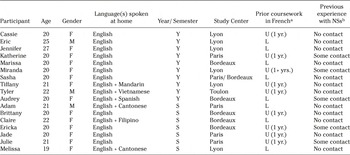
The 17 participants in this study are English-speaking university students of French who completed a semester (n = 7) or yearlong (n = 10) SA program in France. The participants ranged in age from 19 to 27 years and included 3 males and 14 females.Footnote 2 All but one of the participants spent the SA period in one of three cities in France: Paris, Lyon, or Bordeaux. The remaining participant spent the academic year in Toulon, France.
With regard to linguistic background, 11 of the 17 participants reported speaking only English at home. Another 6 participants spoke English and an additional language at home. The Appendix includes a complete summary of participant biographical information.
Data Collection Procedures
Data collection occurred on two or three occasions depending on the length of the SA period. The yearlong participants (n = 10) were recorded three times during the academic year: at the beginning of the SA period (August/September), midyear (January), and at the end of the academic year.Footnote 3 The semester students (n = 7) were recorded twice: at the beginning of the SA period and at the end of the semester. The majority of the interviews were conducted at the study centers in France.
Each interview lasted approximately 1.5 hr and included 40–50 min of recorded speech data. The speech data for each interview involved an informal, or “sociolinguistic,” interview (Labov, Reference Labov1966); a narrative retell task; a reading passage; and a word list. Results used in this study were drawn from the sociolinguistic interview only. All speech data were recorded on an Olympus WS-210S digital voice recorder. Each interview also included 20–30 min for written responses, including a biographical questionnaire (at Interview 1) and the SNSS for SA (at Interviews 2 and 3).
Results for both yearlong and semester-long students have been included in this study. The benefits of this approach include having a sample size that is relatively large for this type of longitudinal, ethnographic study and that allows for comparison with other studies on SA (Díaz-Campos, Reference Díaz-Campos2004; Hernández, Reference Hernández2010; Magnan & Back, Reference Magnan and Back2007; Segalowitz & Freed, Reference Segalowitz and Freed2004), all of which include the results of 20–30 semester SA students. Also, the inclusion of both semester and yearlong students allows for a comparison of time on task (e.g., semester vs. year in the TL community).
The Social Network Strength Scale for Study Abroad
The strength of each learner’s social network was measured using an SNSS created by the researcher and tailored to the SA context. A sample of the SNSS for SA is available online (in the Supplementary Material). The SNSS for SA includes two density measures and two multiplexity measures. As described by L. Milroy (Reference Milroy, Chambers, Trudgill and Schilling-Estes2002), dense ties are those that link many of the same people to one another, and multiplex ties refer to the number of relationships that an individual has with another individual. Density Measures 1 and 2 attempted to gauge the overall level of interaction that the learner had with native French speakers. Multiplexity Measures 1 and 2 attempted to gauge the richness of the learner’s TL interactions by investigating what the learner did and what the learner talked about with NSs.
Density Measure 1 asked the learner to list all of the native French speakers with whom he or she spoke French for at least 30 minutes each week. The learner received one point for each person listed and one point for each hour per week spent speaking French with this person (e.g., if the learner knew 5 NSs and spent 2 hr per week with each person, the learner received 10 points for this measure). So as not to double count hours, any hours spent with more than one NS at the same time were listed under only one person’s name.
Density Measure 2 asked the learner to draw his or her social network based on the NSs listed in Density Measure 1. The learner received one point for each line connecting the learner to the speakers and one point for each line connecting the NSs to one another.
Multiplexity Measure 1 asked the learner to classify the activities done with each of the NSs listed in Density Measure 1: learners received one point for each different weekly activity shared with a NS. In this measure, learners received 1.5 points per hour spent with more than one NS at a time because, in activities with multiple NSs, learners are exposed to unmodified TL interaction among NSs that is potentially richer than one-on-one NS–NNS interaction (Long, Reference Long1983). This question also asked learners to list the number of hours spent engaged in monthly activities such as “celebrating special occasions” and “going on weekend or day trips” (for which they received one point per hour) because these activities are not captured in the weekly calculation. A final section of Multiplexity Measure 1 asked the learners to estimate how many hours per week they spent engaged in conversation with NSs who were not listed in Density 1 (e.g., NSs with whom the student did not have an ongoing relationship, such as people they talked to in cafés, bars, or stores).
Multiplexity Measure 2 asked the learner what subjects he or she discussed with NSs, in order to assess the level of complexity and the potential for new vocabulary acquisition in the learner’s TL interactions. The learner received one point for each different topic discussed with NSs.
Data Coding: Independent Variables
Linguistic Factors.
Data coding for linguistic factors included the following factor groups: following phonological context, preceding phonological context, and token type (i.e., subject pronoun). Because of the importance of the phonological phrase in SMF, the data coding looked to the phrasal boundaries (rather than the morphological boundaries) to define the preceding phonological context of the subject clitic pronouns under study. The concept of a clitic or clitic group is especially important in French, where the phonological status of the (morphological) word is superseded by the importance of the phonological word and phonological phrase resulting from liaison and enchaînement (see Tranel, Reference Tranel1987, pp. 168–190, for an overview). Thus, for the purposes of this study, the preceding phonological context of a token of the pronoun il [il] “it,” as in mais il fait beau [mɛ i(l) fɛ bɔ] “but it’s nice out,” is not the [i] of il but the oral vowel of [mɛ]. Prior studies on /l/ elision in French have used similar data coding procedures for preceding phonological context (Regan et al., Reference Regan, Howard and Lemée2009).
Extralinguistic Factors.
The extralinguistic, or social, factors analyzed in this study included the following: period of SA/interview number (Interviews 1–3 for yearlong students and Interviews 1 and 2 for semester students), language(s) spoken at home, previous experience with French outside of the classroom, prior coursework in French, study center in France, and SNSS score (both midyear and final; on a scale of 0–99 points). Gender was not considered as an extralinguistic factor because only 3 of the 17 participants included in this study are male.
Data Coding: Dependent Variable
The dependent phonological variable in this study (/l/ elision in third-person subject clitic pronouns—referred to as “/l/ elision” from this point forward) was coded as a binary factor group with two possible variants: overt (0: fully realized, as in the most formal speech style) or null (1: fully elided, as in the most informal speech style). The researcher first coded each token of the dependent variable for its realization, using auditory impressionistic analysis. A random sample representing 8.5% of the total tokens was then verified by a French NS who was trained in the methods of analysis used in this study. Interrater reliability was achieved at 87%, which is consistent with previous studies using auditory impressionistic analysis for the presence or absence of specific segments, including the schwa in French (Bürki, Fougeron, Gendrot, & Frauenfelder, Reference Bürki, Fougeron, Gendrot and Frauenfelder2011, p. 282).
Data Transcription Protocol
Transcription for the variable under study included the preceding phonological segment, the pronoun token itself (where token refers to a site of potential elision), and the following phonological segment. The first 4 min of each sociolinguistic interview were excluded from the transcription, and the following 20-min segment was transcribed by the researcher. These first 4 min were excluded in order to allow the participants to become comfortable with the interview process, as well as to allow the interviewer time to guide the conversation toward topics that would elicit personal narratives, and the most natural speech style, from the participants (Labov, Reference Labov, Baugh and Sherzer1984).
Quantitative Analysis
Until recently, multivariate analysis using the Varbrul programs (e.g., GoldVarbX; Sankoff, Tagliamonte, & Smith, Reference Sankoff, Tagliamonte and Smith2005) has been the most widely used tool for quantitative analysis in sociolinguistics. The Varbrul programs allow for the simultaneous analysis of multiple potential influences on variation and are designed to handle the type of data normally collected in sociolinguistic research—data that have thousands of possible combinations of factors, “cells,” and that are not uniform with respect to cell size (Bayley, Reference Bayley, Chambers and Schilling2013). At the same time, because the “principle of multiple causes” (Young & Bayley, Reference Young, Bayley, Bayley and Preston1996, p. 253) assumes that it is a combination of factors, rather than a single factor, that predicts variation, one criticism of Varbrul is that it is difficult to test for interactions among factor groups and that interactions among social factors may lead to false conclusions of significance based on a multivariate analysis alone.
As a number of analyses have shown, interactions among linguistic factors are unlikely to yield differences in results when fixed-effects (e.g., Varbrul) and mixed-effects (e.g., Rbrul; Johnson, Reference Johnson2009) models are compared (Bayley, Reference Bayley, Chambers and Schilling2013; Gorman & Johnson, 2013; Roy, Reference Roy2011); however, interactions among social factors and the influences of individual speaker variation that are not revealed using a fixed-effects model such as Varbrul may lead researchers to falsely conclude that a particular social factor is a significant predictor of variation. As explained by Bayley (Reference Bayley, Chambers and Schilling2013), if “potential interactions among various social factors are a major interest of the investigation, Varbrul is not the most suitable tool” (p. 96). A mixed-effects model such as Rbrul achieves a more accurate result because, in addition to the fixed-effects predictors used in Varbrul, Rbrul allows for the inclusion of “continuous” variables (such as time) and for the incorporation of random effects, such as individual speaker variation. This is especially important for L2 learners who do not, as a group, meet the typical requirements of a “speech community” and who are expected to exhibit high levels of individual variation. For this reason, a mixed-effects model (Rbrul; Johnson, Reference Johnson2009) was selected as the most suitable tool of analysis for the current study.
RESULTS
Linguistic Factors
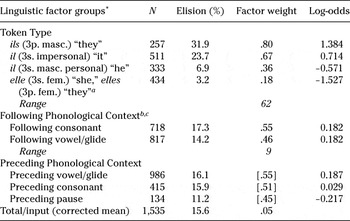
Table 1 includes the linguistic factor groups identified by Rbrul as significant at p < .05 (token type and following phonological context). Table 1 also presents the results for preceding phonological context, although this factor group was not identified as significant in the Rbrul analysis.
Rates of /l/ elision by linguistic factor group

Note. Factor groups not selected as significant are placed in square brackets.
a Includes 5 tokens of elles (3p. feminine).
b Excludes 15 tokens of a following pause.
c The factor group of following phonological context originally included five separate factors (nasal consonant, fricative, glide, vowel, and stop); however, an interaction between the factor group of token type and following phonological context was noted (97% of all following glides were associated with one subject pronoun—il 3s. impersonal). The five factors were thus collapsed into two factors only. NB: This factor group was found to be significant in both cases—with all five factors and with only two factors.
* p < .05.
Token Type.
Within the factor group of token type (i.e., subject pronoun), there is a high level of variation across the individual factors, indicating that the subject clitic pronoun containing the /l/ segment exerts a strong influence over the process of /l/ elision (see Table 1). Two token types are shown to be highly favorable to /l/ elision. First, the 3p. masculine pronoun ils “they” has the highest factor weight (.80) and shows the highest rate of elision (31.9%), indicating that it is very favorable to /l/ elision. This token type is followed by the 3s. impersonal pronoun il “it,” with a factor weight of .67 and an elision rate of 23.7%, also favorable to elision. In contrast, the 3s. masculine personal pronoun il “he” is not shown to be favorable to /l/ elision, with a factor weight of .36 and an elision rate of 6.9%. Additionally, the feminine subject pronouns elle “she” (3s. feminine) and elles “they” (3p. feminine) are very unfavorable to /l/ elision, with a factor weight of .18 and an elision rate of 3.2%. As can be seen in Table 1, the range for the factor group of token type is 62. This range represents the difference between the highest factor weight (3p. masculine pronoun ils “they” = .80) and the lowest factor weight (3s./3p. feminine elle “she”/elles “they” = .18). The size of the range supports the existence of a hierarchy of token types that may be used to predict /l/ elision rates by the learners in this study.
Following Phonological Context.
Following phonological context was also shown to be a significant predictor of /l/ elision by the learners in this study, although the range in the factor weights for this factor group (range = 9) indicates that the strength of this linguistic constraint is well below that of token type (range = 62). This result is corroborated by the ordering of significant factors in the Rbrul step-up/step-down analysis: individual speaker (random variable), token type, SNSS score (extralinguistic factor group; see Table 2), and following phonological context. Within the factor group following phonological context, a following consonant is shown to be somewhat favorable to /l/ elision, with a factor weight of .55 and an elision rate of 17.3% (see Table 1). At the same time, the factor group of a following vowel or glide is shown to be slightly unfavorable to /l/ elision, with a factor weight of .46 and an elision rate of 14.2%. A detailed examination of the collocations incorporating the following phonological context and favoring /l/ elision is provided in the Discussion section.
Rates of /l/ elision by extralinguistic factor group

Note. Factor groups not selected as significant in square brackets.
a The SNSS results include both midyear scores (for yearlong students) and final scores (for yearlong and semester students).
b The SNSS scores of 0 include Interview 1 results for learners who did not demonstrate any instance of /l/ elision at the first interview and the results for one semester learner who had no regular contact with NSs at the final interview (Jade).
c Tokens from the initial interviews were assigned SNSS scores based on group averages for Interviews 2 and 3. For example, if a learner elided at 1–9% during Interview 1, these tokens were assigned an SNSS score of 1. If a learner elided at 10–19% during Interview 1, these tokens were assigned an SNSS score of 2, and so on.
* p < .05.
Extralinguistic Factors
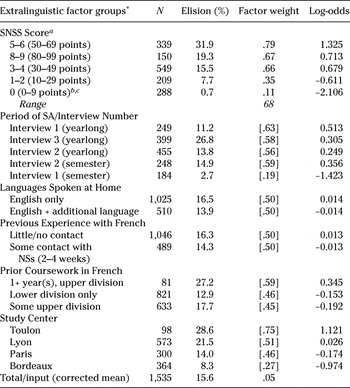
Table 2 displays the extralinguistic factor groups examined in this study. Only the extralinguistic factor group of SNSS score was found to be a significant predictor of /l/ elision (at p < .05). Table 2 also displays the results of the extralinguistic factor groups not selected as significant: period of SA/interview number, language(s) spoken at home, previous experience with French, prior coursework in French, and study center.
As explained in the Methods section, the SNSS seeks to measure the strength of each learner’s social network with NSs of French, and, according to social network theory (J. Milroy & L. Milroy, Reference Milroy, Milroy and Trudgill1978; L. Milroy, Reference Milroy1980), higher scores on the SNSS should be associated with higher levels of /l/ elision by the learners in this study. The results in Table 2 generally conform to this prediction: lower scores on the SNSS are associated with lower /l/ elision rates and lower factor weights, and higher scores are associated with higher /l/ elision rates and more favorable factor weights. Moreover, the range in the factor weights for this factor group (range = 68) indicates that the SNSS is a strong predictor of variation for these learners. At the same time, an anomaly does exist in the ordering of the SNSS scores and corresponding /l/ elision rates: the /l/ elision rate and factor weight for learners with a score of 5 or 6 on the SNSS are higher than the /l/ elision rate and factor weight for learners with a score of 8 or 9 on the SNSS. This anomaly is discussed in more detail in the following paragraphs.
As can be seen in Table 2, participants with scores of 5 and 6 on the SNSS demonstrated the highest rates of /l/ elision (31.9%) and had a correspondingly high factor weight (.79). Learners who scored a 5 or 6 on the SNSS are thus very likely to demonstrate, at least some of the time, targetlike patterns of variation. Learners with an SNSS score of 8 or 9 are also likely to demonstrate targetlike patterns of variation, although at a slightly lower rate: the /l/ elision rate for these learners was 19.3% and the factor weight was .67. The results for the learners with a score of 8 or 9 on the SNSS present an anomaly in that these scores would be expected to be associated with the highest level of /l/ elision and the highest corresponding factor weight. This anomaly may be attributed to the fact that only three learners had SNSS scores in this bracket (Miranda: midyear and final SNSS, Audrey: midyear SNSS only, and Claire: final SNSS) and that bracket included a low number of tokens as compared to other score brackets (the bracket of 3–4 = 549 tokens from seven learners; the bracket of 5–6 = 339 tokens from nine learners). Moreover, one learner in this bracket, Audrey, indicated on the midyear SNSS that she had an extensive social network with NSs (resulting in a midyear SNSS score of 9); however, Audrey had one of the lowest overall elision rates in the study (3.8%; see Tables 3 and 4). This anomaly is representative of the high level of individual variation that exists among L2 learners, which has been attested in prior studies on the L2 acquisition of sociolinguistic competence (see Regan et al., Reference Regan, Howard and Lemée2009).
Implicational scale showing /l/ elision by speaker/token type

Note. Index of reproducibility (IR; Guttman, Reference Guttman1944) = 100%.
Rbrul factor weights for /l/ elision and SNSS score by speaker

Note. In most cases, the score on the final SNSS is different from that of the midyear SNSS. In all but one case, the score increased from the midyear to the final interview as learners expanded their social networks over time; however, in one case (Audrey), the final SNSS score was lower than the midyear score. Anomalies to the group pattern are highlighted in gray.
As shown in Table 2, midrange scores of 3–4 on the SNSS are associated with an /l/ elision rate of 15.5%, which approximates the overall elision rate for the study (15.6%). These midrange scores are also associated with a factor weight that is favorable to /l/ elision (.66). At the lower end of the score range, SNSS scores of 1–2 are associated with an /l/ elision rate of 7.7%, which is well below the overall average of 15.6%, as well as an unfavorable factor weight of .35. Finally, midyear or final SNSS scores of zero are associated with a very low elision rate of 0.7% and a very unfavorable factor weight of .11.
Despite the anomaly in the 8–9 score bracket, the SNSS scores for the /l/ elision variable demonstrate a generally upward trend. That is, the higher the score on the SNSS, the more likely the participant is to demonstrate targetlike patterns of phonological variation with respect to /l/ elision. Moreover, this generally upward trend is strong enough to exert a statistically significant influence on the likelihood of /l/ elision by the learners in this study.
DISCUSSION
The Influence of Token Type
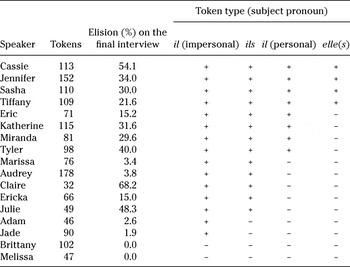
Both token type (i.e., subject pronoun) and following phonological context were shown to be significant predictors of /l/ elision for the learners in this study; however, the very high factor weights for certain token types and the large range (range = 62) in the factor weights between the most and least favorable token types warrant further analysis. Table 3, designed in the form of an implicational scale (Rickford, Reference Rickford, Chambers, Trudgill and Schilling-Estes2002), illustrates how striking the effect of token type is on the L2 acquisition of phonological variation.
In Table 3, a plus sign indicates that a learner demonstrated at least one instance of /l/ elision for the token type indicated at the top of the column, and a minus sign indicates that the learner did not.Footnote 4 As can be seen in Table 3, the results for /l/ elision by learner and token type form an implicational pattern demonstrating that phonological variation among learners occurs first in a specific token type (il 3s. impersonal “it”) and then spreads to other token types (il 3s. impersonal “it” >> ils 3p. masculine “they” >> il 3s. personal “he” >> elle 3s. personal “she”/elles 3p. personal “they”). Most importantly, the implicational scale for the /l/ elision variable achieves an IRFootnote 5 of 100% (no deviant cells): all learners in this study follow the same predictable pattern of incipient phonological variation based on token type.
Another interesting point is that the ordering of token types on the implicational scale in Table 3 does not conform to the hierarchy of factors in the factor group token type established by the Rbrul analysis (Table 1). Based on the Rbrul analysis in Table 1, a token type of ils 3p. masculine “they” is more favorable to elision (factor weight = .80; elision rate of 31.9%) than a token type of il 3s. impersonal “it” (factor weight = .67; elision rate of 23.7%); however, in the implicational scale shown in Table 3, these two positions in the hierarchy are reversed. This difference occurs because two participants, Adam and Jade, show /l/ elision in a single token type: il (3s. impersonal) “it.” At the same time, the results of the implicational scale do conform to the elision hierarchy established by Regan et al. (Reference Regan, Howard and Lemée2009) for both NSs and L2 French learners: il 3s. impersonal “it” >> ils 3p. masculine pronoun “they” >> il 3s. personal “he” >> elle 3s. feminine “she.”
The implicational scale in Table 3 reveals two additional nuances in terms of the SA learners in this study and their progression toward NS norms. First, the overall elision rate by the learner does not correlate perfectly with the number of contexts in which the learner elides. For example, Claire has the highest overall elision rate (68.2%) but only shows elision with two types of subject pronouns (il 3s. impersonal “it” and ils 3p. masculine pronoun “they”). Similarly, Julie has the third-highest elision rate (48.3%) but only shows elision in these same two subject pronouns. At the same time, the implicational scale does reveal that of the eight learners showing elision with at least three of the four subject pronouns, seven of these (Cassie, Jennifer, Sasha, Tiffany, Katherine, Miranda, and Tyler) have overall elision rates above 21%, indicating that overall elision rate is connected to the range of contexts in which learners demonstrate elision.
The second important nuance revealed in Table 3 relates to the length of time that the learners have spent in the TL community and the range of contexts in which the learners demonstrate elision. All eight learners demonstrating /l/ elision with at least three of the four subject clitic pronouns (Cassie, Jennifer, Sasha, Tiffany, Eric, Katherine, Miranda, and Tyler) stayed in the TL community for an entire academic year. At the same time, none of the semester students demonstrated /l/ elision in more than two contexts, and two of these students did not demonstrate elision at all. Although period of SA/interview number was not selected as significant in the Rbrul analysis (see Table 2), the results of this study demonstrate that the length of time spent in the TL community is positively correlated with the acquisition of targetlike patterns of variation.
Using Collocations to Predict Variation
An analysis of the collocations involved in the process of /l/ elision by the learners in this study reveals that collocations are an important factor for the token types showing high rates of elision (ils 3p. masculine “they” and il 3s. impersonal “it”). For example, within the token type of il 3s. impersonal “it,” a single collocation—il + y (a pronoun indicating “there”), as in il y a/avait [il i ja/ja vɛ] ∼ [i ja/ja vɛ] “there is/are, there was/were”—accounts for 68.7% of the data (352 of 511 tokens) for this token type. The elision rate for this collocation was 23.3% (82 of 352 tokens), and 11 of 17 learners demonstrated elision in this particular collocation. At a summary level, elision in the collocation il + y (a/avait) accounts for a full 34.1% of the tokens showing elision in the entire data set (i.e., 82 of 240 tokens showing elision).
A second collocation—il n’y, as in il n’y a pas/rien [il ni ja pa/ri jɛ̃] ∼ [i nja pa/ri jɛ̃] “there is not/nothing”—represents only 7.6% of the data (39 of 511 tokens) for the token type of il 3s. impersonal “it” but demonstrates the second-highest elision rate for any collocation in the data set, at 53.8% (21 of 39 tokens). In terms of learner participation, 10 of 17 learners demonstrated elision in this collocation. The high elision rate for this collocation (53.8%) is supported by the Rbrul analysis in Table 1, which shows that the following phonological context of a consonant is favorable to /l/ elision, with a factor weight of .55. This may be contrasted with the less favorable factor weight for a following vowel/glide (.46), which supports the lower elision rate (23.3%) for the much more frequent collocation of il + y (a/avait) discussed in the previous paragraph.
Within the token type of ils 3p. masculine “they,” the collocation of ils ont [i(l) zɔ̃] “they have (+ past participle)” comprises 33 tokens (of 257 tokens), of which 19 show /l/ elision. This is the highest elision rate of any single collocation (57.6%) within the entire data set, and 9 of 17 learners demonstrated elision in this collocation. Another collocation within this token type, ils sont (pas) [i(l) sɔ̃ (pa)] “they are (not),” comprises 71 tokens (of 257 tokens) and shows the third-highest rate of elision within the data set, at 53.5% (38 of 71 tokens). This collocation also has the highest level of learner participation, with 12 of 17 learners demonstrating elision in this collocation.
To summarize, the data set in this study included 1,535 potential sites of /l/ elision, and the overall elision rate by the learners in this study was 15.6%, or 240 tokens. An analysis of these 240 tokens showing elision reveals that four specific collocations account for 66.7% (160 of 240 tokens) of the tokens showing elision: il + y, il + n’y, ils ont, and ils sont (pas).
The Role of Social Networks in L2 Acquisition
One of the primary goals of this study was to provide empirical evidence in the form of natural language data to support the hypothesis that the creation of dense, multiplex, exchange-based networks by SA learners is essential to the acquisition of sociolinguistic competence in the TL. As presented in Table 2, the SNSS for SA was found to be a statistically significant predictor of /l/ elision by the learners in this study and was, in fact, the only statistically significant extralinguistic factor (at p < .05) for this variable.
Although the scoring procedure for the SNSS is described in the Methods section, it is helpful to understand what the SNSS scores mean in terms of social network ties and levels of interaction with NSs. A sample of four learners scoring a 5 on their final interviews shows that they listed between three and five NSs with whom they interacted in French for at least 30 min (consecutively) per week and that these contacts created a social network density of 6–10 ties. As a result of these network ties, the learners scoring a 5 on the SNSS were able to speak, on average, 10–20 hours of French with NSs each week.
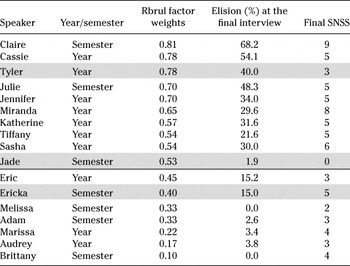
Table 4 displays the individual speaker results for the /l/ elision variable, showing the Rbrul factor weights for the individual, the /l/ elision rate at the final interview, and the final SNSS score. As shown in Table 4, 10 participants have favorable /l/ elision factor weights (above .50), and 8 of these also have SNSS scores of 5 points or above (Claire, Cassie, Julie, Jennifer, Miranda, Katherine, Tiffany, and Sasha). Moreover, all of these learners have elision rates above 20% at the final interview.
Two anomalies do exist among learners with favorable factor weights (highlighted in gray). First, Tyler has a very favorable /l/ elision factor weight (.78) but a low SNSS score of 3 points. This anomaly is likely due to the fact that, at Interview 1, Tyler already demonstrated /l/ elision at a rate of 22.2%. During the course of the academic year, Tyler’s elision rate increased to 40%, despite the fact that his social network with NSs was relatively small (final SNSS score of 3). For this reason, Rbrul attributes Tyler’s high elision rate to individual variation rather than to another contributing factor, such as the SNSS. Second, Jade has a favorable factor weight (.53) but has a score of 0 on her final SNSS. Because Jade demonstrated /l/ elision at a rate of 1.9% at the final interview but had a low final SNSS score, Rbrul attributes the occurrence of elision to individual variation and assigns a correspondingly high factor weight to the individual learner.
On the other end of the spectrum, seven learners have unfavorable /l/ elision factor weights below .45, and, of these, six participants also have SNSS scores below 5 points (Eric, Melissa, Adam, Marissa, Audrey, and Brittany). Only one participant (Ericka) has an unfavorable /l/ elision factor weight (.40) and an SNSS score of 5 points. This unfavorable factor weight is likely due to the fact that although Ericka scored a 5 on the final SNSS, her elision rate at the final interview was only 15%, which is below the overall average for the study (15.5%) and well below the elision rates of other learners scoring a 5 on the SNSS.
CONCLUSIONS
Social Network Theory
Tarone (Reference Tarone2007) argues that a sociolinguistic approach to SLA must focus on the impact of society, including the social context, on the development of interlanguage. Tarone further explains that whereas research in interlanguage variation shows that production, at various linguistic levels, may be significantly impacted by the task, topic, or interlocutor, many studies (Beebe & Giles, Reference Beebe and Giles1984; Tarone & Swain, Reference Tarone and Swain1995) have not allowed researchers to characterize a learner’s knowledge at a given point in time due to its inherent variability. In her article, Tarone calls for more longitudinal sociolinguistic studies that establish a link between social context and the acquisition of specific linguistic variants.
The current study provides the type of evidence that Tarone (Reference Tarone2007) calls for: data linking the acquisition of specific linguistic variants with the creation of social networks with NSs in the TL environment. Through the use of the SNSS for study abroad, the current study establishes a statistically significant link between social networks with NSs and the emergent acquisition of targetlike patterns of phonological variation in L2 French.
The current study also represents one of a handful of studies extending social network theory to L2 acquisition (Hansen Edwards, 2008; Lybeck, Reference Lybeck2002) and one of very few applying social network theory to the SA context (Isabelli-García, Reference Isabelli-García, DuFon and Churchill2006). Moreover, this study is the first to employ an SNSS designed for the SA context and to show a significant link between the results of the SNSS and the acquisition of targetlike patterns of phonological variation during SA. In this way, the results of this study make an important contribution to studies of language variation and change and, more specifically, to research focused on extending the uses and implications of social network theory—as it was originally conceptualized—beyond the purview of nonstandard L1 vernacular features.
Language Variation in SLA
The results of the current study provide empirical evidence in support of a predictable pattern of acquisition, in the form of an implicational scale (Table 3) that may be used to characterize variation among L2 French learners, and potentially among learners of other languages. The results of this study demonstrate that the emergent acquisition of phonological variation patterns is highly constrained by token type (i.e., subject pronoun) with the very first occurrence of variation among learners appearing in one third-person subject clitic pronoun type and then spreading to other third-person subject clitic pronouns.
By predicting where phonological variation will first appear among L2 learners, as well as the path that L2 variation will take across subject pronoun token types, the results of this study contribute to the growing body of research in SLA proposing a constructivist model of language acquisition. As explained by N. C. Ellis (2003, p. 2), constructivism is a “functional-developmental usage-based perspective on language” that assumes that what is commonly called a grammar is actually a compilation of statistical analyses conducted by the human brain over a lifetime of linguistic experiences. From a theoretical perspective, constructivists believe that language is acquired using generic learning mechanisms that rely on the process of chunking, or pattern recognition and the creation of hierarchical structures, which is inherent to the way the human brain processes not only language but all experience. The use of collocation analysis in language corpora to identify the “criterial features” of interlanguage at various levels of proficiency (Hawkins & Filipović, Reference Hawkins and Filipović2010) is one way in which constructivism is being applied to research on L2 acquisition. The data in the current study support the application of a constructivist theory to the L2 acquisition of targetlike patterns of phonological variation, whereby learners acquire variation in a predictable order through the use of language chunks, or collocations, containing specific subject pronoun token types.
Limitations and Future Directions
The results of this study demonstrate that learners’ social networks with NSs are a significant predictor of the L2 acquisition of targetlike patterns of phonological variation. At the same time, a more fine-grained analysis of the learners’ social networks would improve the research design. Although the SNSS tool aimed to accurately capture the depth and breadth of each learner’s network by restricting interactions to meaningful, ongoing relationships with NSs, the SNSS relied on self-reporting by the participants, which is prone to inaccuracies. To combat these inaccuracies, future research on the role of social networks in L2 acquisition should incorporate interactions with NSs into the data collection process. For example, learners could document (using audio or video recordings) their interactions with NSs over a period of time, which might provide for a more accurate quantification of the number of hours spent interacting with NSs. Moreover, a research design that incorporates interactions with NSs would provide a clearer picture of how these interactions actually shape L2 acquisition in terms of corrective feedback between NSs and learners and in terms of NS group interactions in which the learner participates. The current study establishes the important role that social networks with NSs play in the L2 acquisition of sociolinguistic competence in the SA context, and future research should continue to explore how L2 learners create, maintain, and benefit from their interactions with NSs while living in the TL community.
SUPPLEMENTARY MATERIAL
To view supplementary material for this article, please visit https://doi.org/10.1017/S0272263116000061.
APPENDIX
PARTICIPANT BIOGRAPHICAL INFORMATION