Introduction
The neoliberal discourse has had a significant impact on how we understand both educational institutions and subjects, but how and why this is the case is not always clear. The dominant metaphor for the student in western society has been the metaphor of the consumer, while education providers are seen as corporations or service providers. This implies that higher education should be considered in market terms. As Wielemans argues, ‘the metaphor of “the free market”, implying competition and the freedom of choice for consumers, has a strong normative impact’ where ‘economic considerations in particular are taking the lead, both in policy objectives (such as expenditure cuts and efficiency) and in the concepts adopted (such as management, productivity, etc.)’ (Wielemans, Reference Wielemans2000: 33).
The existing literature on students as consumers resonates with Wielemans's observations. Todd et al. (2017) organise the literature around students as consumers into two groups, where the first group ‘uses the notion of students as consumers in order to highlight the ways in which students are situated within a marketised system of higher education’ while the second ‘debates whether the notion of consumer is an accurate depiction of the role of students in higher education and offers alternative labels, concepts or strategies to more accurately reflect the relationship between post-secondary education and students’ (2017: 543–544). Le Grand (Reference Le Grand2003) sketches out different social policy metaphors that are of relevance to students, when he describes the general relationship between service users and those delivering services, describing service users as either ‘queens’ who are able to make qualified choices between providers, or as ‘pawns’, who passively receive services delivered. In addition to the consumer metaphors demonstrated in Le Grand's work, an alternative to this is the notion of seeing students as both human capital and as managers of their own human capital. Human capital theory has been, at least superficially, perceived as a reasonably viable policy discourse in the 1960s and 1970s where mass education explained rising access to higher education and a rise in white-collar jobs. Even if times have changed, the human capital theory has been adapted in contemporary times to legitimise rising inequalities pointing to elite degrees leading to elite wages (Marginson, Reference Marginson2017).
Neoliberal thinking is therefore more about adapting a relatively stable core to new contexts, or, as Marginson describes it, about creating powerful metaphors to describe the relationship between education and work (Marginson, Reference Marginson2017). The human capital metaphor highlights, on the one hand, a neglect of other aspects of education, but, on the other hand, it creates a strong belief that higher education degrees ‘both allocate individuals in the labour market and to serve as job requirements throughout the occupational structure’ (Baker, Reference Baker2011: 6). Some of the core assumptions behind neoliberal metaphors (students as human capital, students as consumers) is to motivate certain core policy measures such as mass higher education, transfer of costs to students and a focus on increasing quality through competition between providers of higher education (Tight, Reference Tight2013). We argue that the survival of neoliberal metaphors lies in understanding how neoliberal metaphors merge with the local contexts and policy debates.
These general policy metaphors can be applied in education policy to describe a neoliberal understanding of students. Nordensvärd (Reference Nordensvärd, Molesworth, Nixon and Scullions2010) in turn identifies three neoliberal roles that could be ascribed to students: students as consumers, students as managers of themselves and students as a commodity of human capital. Nordensvärd (Reference Nordensvärd, Molesworth, Nixon and Scullions2010) locates the social citizenship metaphor as a counter frame to the neoliberal metaphors but in his analysis the two metaphors remain siloed and separated from each other. Such analysis, we suggest, fails to reflect the discursive complexity of the education debates because it ignores the ways the metaphors, particularly in a neoliberal context, are in fact dynamic and highly integrated.
In order to address this complexity analytically, we start from the position that neoliberalism always exists in a variegated form as part of local welfare arrangements and never as a singular, universal entity. As Brenner et al. (Reference Brenner, Peck and Theodore2010: 332) argue, ‘neoliberalization tendencies can only be articulated in incomplete, hybrid modalities, which may crystallize in certain regulatory formations, but which are nevertheless continually and eclectically reworked in context-specific ways’. In a similar fashion, Peck (Reference Peck2010) identifies neoliberalism as ‘parasitical’, constantly borrowing and building on other approaches and political ideologies – including social democratic and nationalist approaches investigated here. A neoliberal metaphor does not conjure up singular policies but rather generates multiple policy alternatives depending on the merging process. In our case the metaphor of the student is merged with a local understanding of social citizenship and welfare. The success of neoliberal metaphors lies in how these can integrate local understanding of citizenship into an overall understanding of students.
We argue therefore that frame merging is essential to understand the hybrid modalities of neoliberal metaphors of students in a Swedish context that consists of merging competing discourses. Metaphors are subordinated to particular ways of framing policies. We have used the case study of introducing student fees for non-EU students in Swedish higher education, a shift from universal tax financing towards a more individualised fee paying solution. In Sweden, student fees were introduced for non-European Union (EU) and European Economic Area (EEA) citizens in 2011. The state relinquished control over admissions and funding of non-EU students to the individual universities, symbolising another step away from a Scandinavian social democratic model and towards partial privatisation. The reforms have meant a fundamental shift in policy whereby universities are able to determine the level of overseas tuition fees, administer fees and develop programmes of study for overseas students. This article will be one of the few that studies the discourse of introducing student fees for non-EU students.
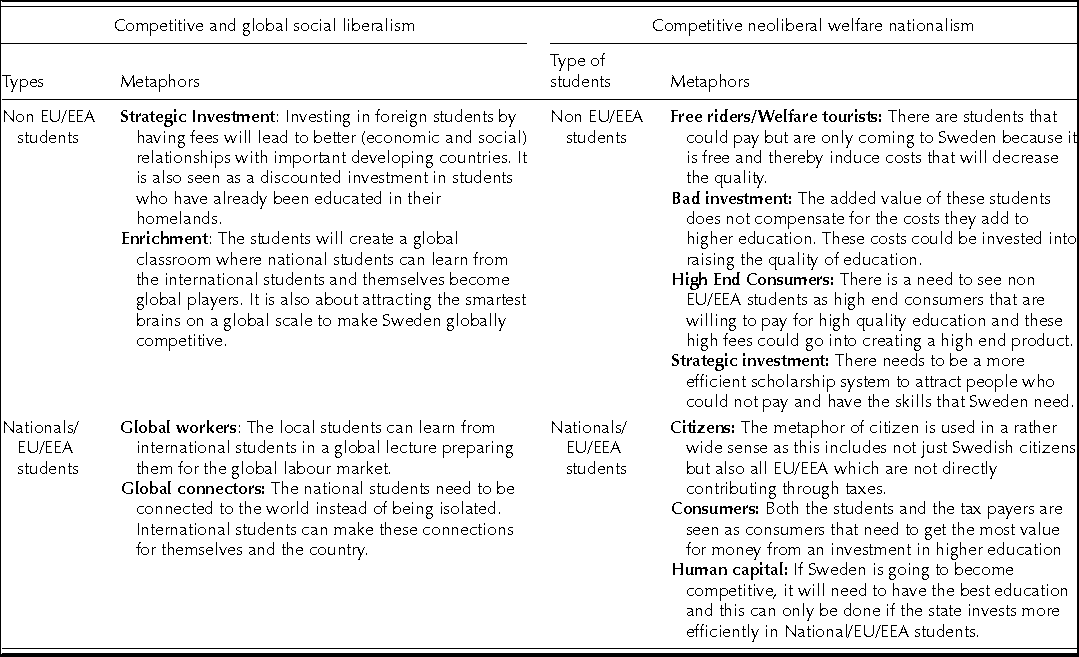
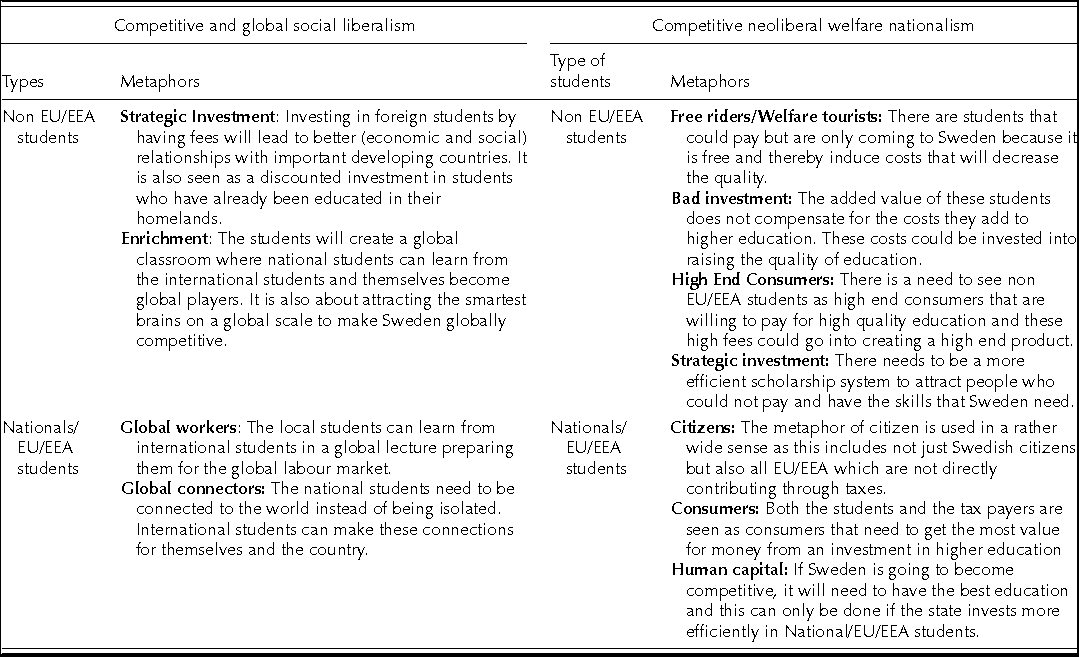
The rhetorical and ideational debates around this reform allude to the ubiquity of the neoliberal approach to merging of frames that generates variegated metaphors incorporating both social democratic and nationalist ideas in ways that are meaningful in the Swedish context. In the context of the article we propose two such merged frames: competitive global social liberalism (emphasis on openness, attracting the best talent of the world and creating the global lecture room) and competitive welfare nationalism (charging international students addresses the social costs associated with a larger quantum of (international) students). These two merged frames create different neoliberal metaphors that support a neoliberal view of the policy and the world. In the article we demonstrate how competitive global social liberalism uses metaphors such as Investment, Enrichment and Social Development Aid to describe non-EU/EEA students. The merged frame of competitive welfare nationalism uses metaphors such as Free riders/Welfare tourists, Bad Investment, High End Consumers and Strategic Investment to describe non-EU/EEA students.
However, importantly, we can see that the two merged frames and their associated metaphors support what Simons and Masschelein describe as a transformation from social citizenship towards entrepreneurial citizenship with a concomitant shift from a welfare state towards a managing state where society is addressed as a ‘complex of human and social capital in need of investment’ and addresses ‘fellow citizens as responsible learners and offers a learning infrastructure for enabling and facilitating learning.’ (Simons and Masschelein, Reference Simons and Masschelein2008: 406). We argue therefore that this discursive process is not an orthodox or pure process, but it is a process of merging frames and discourses to fit the local context and discourse. Pure neoliberal metaphors of students exist mainly in theory.
Framing and metaphors
In this article we are applying the method of interpretative social policy analysis to the strategies of framing neoliberalism as an approach to articulating policy problems and their solutions. Interpretative social policy analysis diverges from mainstream positivist policy analysis by focusing on how policy actors interact by addressing ‘the social meaning of policies and the practices in which this meaning is embedded’ (Durnova and Zittoun, Reference Durnova and Zittoun2011: 103). Moreover, such a perspective seeks to ‘develop a deeper, interpretative understanding of policy practices and policy process in general, having extended their scope over time to include perspectives on discourse, narration, governmentality and practice’ (Durnova and Zittoun, Reference Durnova and Zittoun2011: 103).
A discourse analysis approach tends to emphasise ‘the indexical or situated nature of social categories in linguistic interaction’ (Weatherall and Walton, Reference Weatherall and Walton1999: 481). A discourse analysis of policy could be understood to deconstruct texts to understand how texts are structured in a particular way and what social and political implications this will have (Jaworski and Coupland, Reference Jaworski, Coupland, Jaworskis and Couplands2000). Discourse analysis has an interest in how institutions and rules are spread through the use of language. A discourse does not primarily describe reality, but it constitutes it in a specific way (Keller, Reference Keller2004: 63). The ways discourse is used as a theme are connected to power and coercion (Keller, Reference Keller2005: 22). As Koller notes, ‘[d]iscourse is embedded in socio-cultural practice. Discourse constructs this context from a particular perspective and is, in turn, constructed by it’ (Koller, Reference Koller2005: 200).
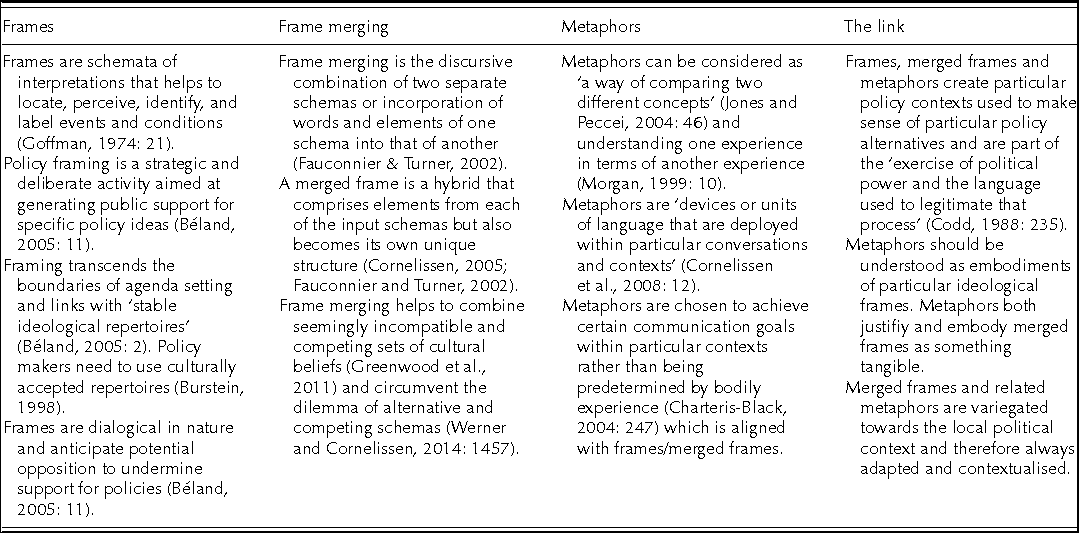
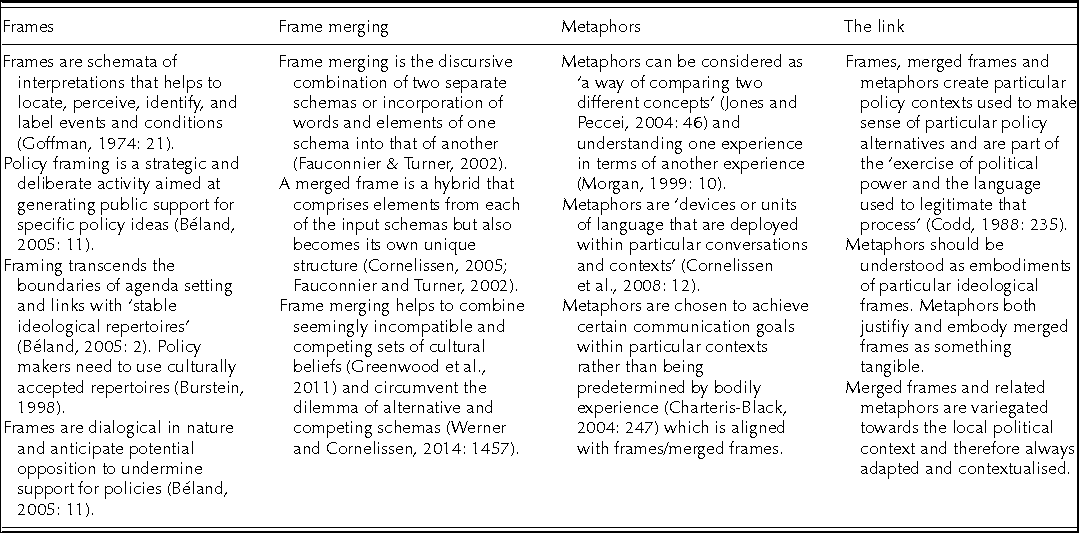
We will use a conceptual understanding of discourse in our analyses of frames, merged frames and metaphors. Metaphors need to be understood in the context of larger overarching frames. Frames, in turn, are seen as ‘schemata of interpretation’ that guide individuals ‘to locate, perceive, identify, and label’ events and conditions around them (Goffman, Reference Goffman1974: 21) and which is often used as a ‘strategic and deliberate activity aimed at generating public support for specific policy ideas’ (Béland, Reference Béland2005: 11). Merged frames are then hybrids that comprise elements of each of the input schemas, but contribute to a new frame that becomes its own separate and unique structure (Fauconnier and Turner, Reference Fauconnier and Turner2002; Cornelissen, Reference Cornelissen2005). Metaphors are utilised to reinforce particular frames through particular applications. Metaphors are seen ‘as devices or units of language that are deployed within particular conversations and contexts’ (Cornelissen et al., Reference Cornelissen, Oswick, Thøger, Christensen and Phillips2008: 12). This sensitivity to context makes the approach suitable to ‘informed interpretations about the specific uses of a particular metaphor in situ that may range beyond psychological or cognitive uses’ (Cornelissen et al., Reference Cornelissen, Oswick, Thøger, Christensen and Phillips2008: 12).
Metaphors are not independent discourses but should be understood as direct embodiment of particular ideological frames. We see metaphors as both justification and embodiment of merged frames as something tangible. Merged frames and their related metaphors are variegated towards the local political context and therefore always adapted and contextualised in locally meaningful ways. Metaphors can represent both frames and merged frames where the former are an embodiment of a purer neoliberalism and the latter assuming a more variegated form. We have chosen this framework as it shows very well how a frame such as neoliberalism is contextualised to create multiple understanding of students and social citizenship. We have mapped the relationship between the concepts in Table 1.
Frames, frame merging and metaphors
Higher education and national welfare policies
The neoliberal discourse of students has been adapted to the local understanding of education and its relationship with local social citizenship and welfare arrangements. Education has a rather complicated role within a social policy discourse – it is both a tool to construct citizenship and at the same time it is in itself a social service. Education, from a citizenship perspective is often perceived to create and defend hegemony on the one side, and to provide opportunity rights as well as the bases for self-improvement and social renewal on the other. This dual nature of the education discourse within social policy has been seldomly discussed outright.
For some scholars, the function of education is at the core of developing the nation state and, according to Green, education is both ‘a valuable source of national cohesion and a key tool for economic development’ (Green, Reference Green1997: 1). According to Sander (Reference Sander and Sanders2005) one can talk about the direct ideological aspect of education, legitimating and protecting an existing social and political order from critique. All citizens need to be educated in comprehending the nation state's ruling values, or as Gramsci (in Giroux) would have put it: ‘[e]very relationship of “hegemony” is necessarily an educational relationship’ (Giroux, Reference Giroux2003: 101). National education was a tool in ‘the formation of ideologies and collective beliefs which legitimate state power and underpin concepts of nationhood and national “character”’ (Green, Reference Green1990: 77).
The classical metaphors for students could be seen in national frameworks of students as citizens and as workers, with education as a cornerstone of progress and growth. McLaren suggests that schooling is an act of ritual performance, and highlights here two important rituals: the rituals of becoming a citizen and the rituals of becoming a good worker (McLaren, Reference McLaren1986) in a ‘disciplined and reliable workforce’ (Morrow and Torres, Reference Morrow, Torres, Burbules and Torres2000: 35–36). T. H. Marshall saw education as an important social right alongside welfare services (Marshall, Reference Marshall, Pierson and Castles2006: 30). Brown (Reference Brown2001) argues that ‘[t]he idea of public education as a form of welfare or entitlement remains curiously absent from public policy analysis in the social sciences, even though it is a critical component of state legitimacy and of credentialing systems’ (2001: 29).
There have been attempts to link higher education policy to the different welfare regimes (Pechar and Andres, Reference Pechar and Andres2011; Willemse and De Beer, Reference Willemse and De Beer2012) and research has compared education with other areas of welfare policy in terms of public sector funding (Heidenheimer, Reference Heidenheimer, Flora and Heidenheimer1981; Castles, Reference Castles1989; Hokenmaier, Reference Hokenmaier1998; Hega and Hokenmaier, Reference Hega and Hokenmaier2002). In relation to social democratic higher education it has been argued that, in cases such as Sweden, nations strive for ‘a delicate balance between individual rights and the collective order’ (Pechar and Andres, Reference Pechar and Andres2011: 31).
Human capital formation has been perceived to happen between welfare structures on the one side and labour market policies on the other side, resonating strongly with the social democratic model (Pechar and Andres, Reference Pechar and Andres2011: 31). Subsequently, there is ‘a certain degree of “social engineering” in balancing and adjusting supply and demand of higher learning opportunities by fostering the development of both general and specific skills’ through Numerus Clausus (Pechar and Andres, Reference Pechar and Andres2011: 47) on the one side and a commitment to de-commodification strategies which ‘results in resistance toward introducing tuition fees’ on the other, combined with high total expenditures for tertiary education (as a percentage of GDP) (Pechar and Andres, Reference Pechar and Andres2011: 47).
This shows an interesting twin commitment to both egalitarian values and high trust in what public administration can achieve. Indeed, it is the combination of these factors that leads to a willingness to accept high taxes (Pechar and Andres, Reference Pechar and Andres2011: 47). We need to understand the role of education within the Swedish welfare state in order to understand how neoliberal metaphors of students are adapted to these local contexts.
Neoliberal metaphors of students
Neoliberalism has a dialectical quality where, on the one hand, it is premised on rolling back the state, particularly by attacking the welfare state, while, on the other hand, alternative state institutions are reined in so as to manage the consequences of the earlier reductive policies. In short, this translates as exporting responsibility to the private sector while still funding and managing these activities. Although the increasingly privatised neoliberal government tends to ‘steer rather than row’ (Denhardt and Denhardt, Reference Denhardt and Denhardt2000: 549), it would appear that neoliberalism lives and regenerates itself through this contradiction, continually restructuring the state with the image of the small state as its aspiration, but never quite reaching that goal.
How are these contradictions resolved by the neoliberal logic? The present-day drive behind neoliberalism is about identifying successful hybrid forms, coexisting with others, as a purely neoliberal world can never exist. This is the argument put forward by Peck when he describes neoliberalism in this sense as parasitical – always requiring symbiotic relationships with other approaches, such as social democracy and nationalism – and identifies this as a key strength of neoliberalism (2010). What follows is that neoliberalism should be seen as a process that is associated with variegated forms, never to exist as singular (Peck et al., Reference Peck, Theodore and Brenner2009), that takes different forms and builds different alliances in each country context.
This process consists of a series of challenging partnerships, with no simple trajectory, no single linear project. Neoliberalism has an endless capacity to reproduce and recreate itself and can be best described as a continuous process of transformation that is never complete (Peck, Reference Peck2010: 7), constantly mutating in forms. We argue in this article that neoliberalism should be seen as a particular frame that is uniquely suited to hybridisation and frame merging as it guides our understanding and construction of policy and policy alternatives.
Neoliberalism gives individuals and groups a particular schema that is both clear but also open for interpretation. This has made neoliberalism attractive in the centrist discourse where both social democracy and conservatism have been able to unite within a neoliberal frame. It also allows, for example, contextual metaphors for students that combine neoliberal metaphors with local understanding of citizenship and social services. In contradiction to Nordensvärd (Reference Nordensvärd, Molesworth, Nixon and Scullions2010) neoliberal metaphors are not separate from citizenship metaphors but instead integrated and closely linked with local political debates and discourses.
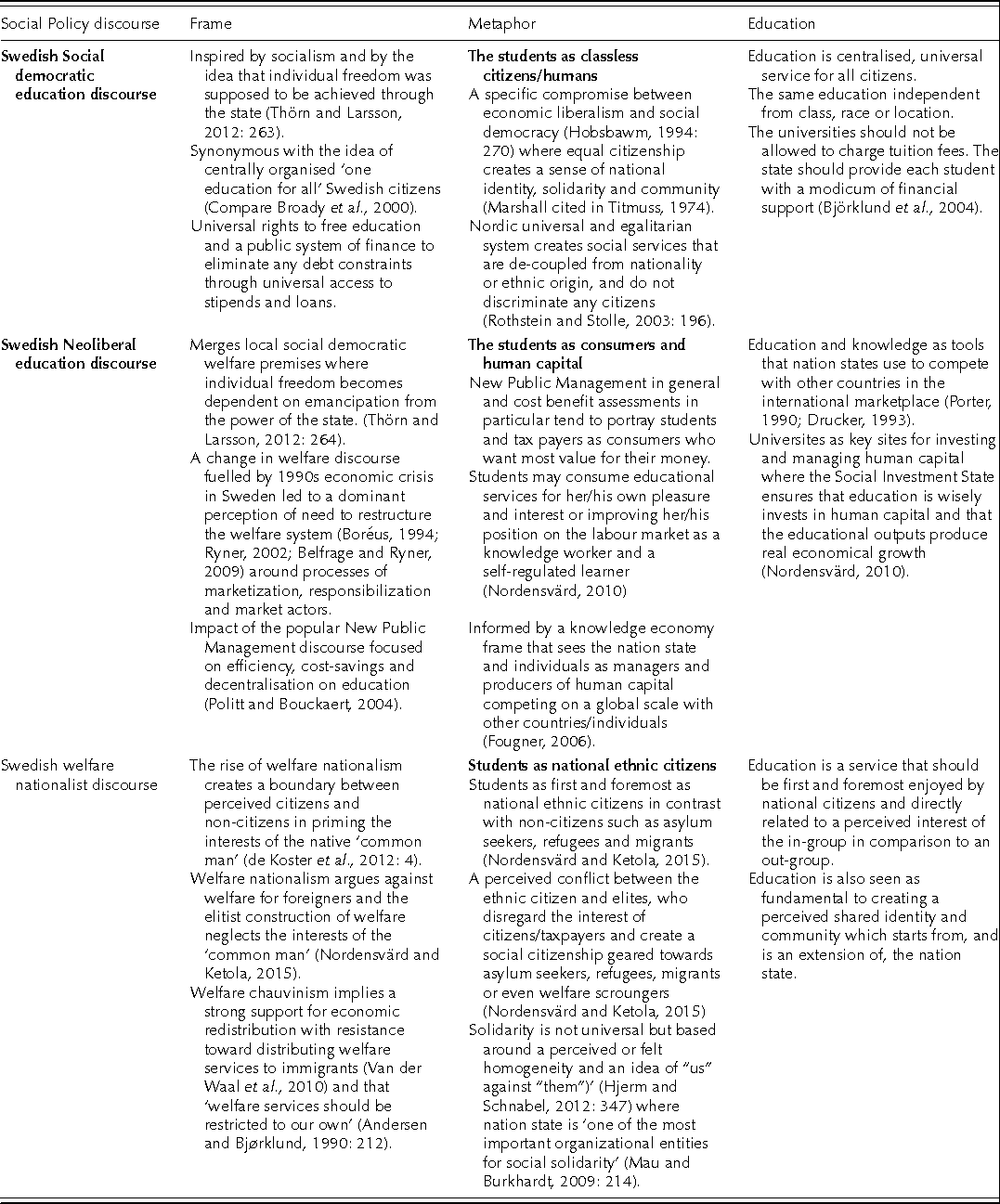
We can see here, adapted to the Swedish context, three distinctive frames: the social democratic education frame (the student as a classless citizen/human); the neoliberal education frame (students as consumers, managers and human capital); and the welfare nationalism frame (students as national citizens). Table 2 below offers summary of the three frames, the adjacent metaphors and the ideal education policy context associated with each.
Social policy frames and metaphors

Methodology
As a case study we have chosen the reforms of higher education in Sweden where student fees were introduced in June 2011 for non-EU/EEA students; this has led to both a commodification of education for overseas students and a decentralisation of the governance of higher education. The tuition fees are administrated by individual universities. Universities are responsible for attracting non-EU/EEA students and creating unique programs for them. This has meant, to some degree, a part-privatisation of universities where there is no room for a uniform higher education service for all citizens and talented overseas students. Higher education was chosen as a case study for the following reasons: admissions to higher education in Sweden are still largely centralised and higher education was, until the implementation of the reforms, free to all students (including those from overseas). Until 2011, Sweden was an exception to the norm in that overseas students could study in higher education without any fees. The discourse was that the amount of free movers from non-EU/EEA had reached unsustainable levels. In the academic year of 2010/2011 there were 19000 students (PhDs not included) from non-EU/EEA countries that did not belong to any organised exchange program (so-called free movers). Added to that were around 7000 free movers where origin was unknown. In the next academic year there were only 1350 paying students registered, which meant that only 29 per cent of students accepted their offer. The Swedish universities had accepted 4600 fee-paying students (Kahlroth, Reference Kahlroth2012).
The tuition fees for non-EU/EEA students were implemented in Sweden during a conservative government, but the initiative came from the preceding social democratic minority government of Prime Minister Göran Persson. The proposal was drafted and enacted through the subsequent centre-right government demonstrating a continuity of the policy discourse.
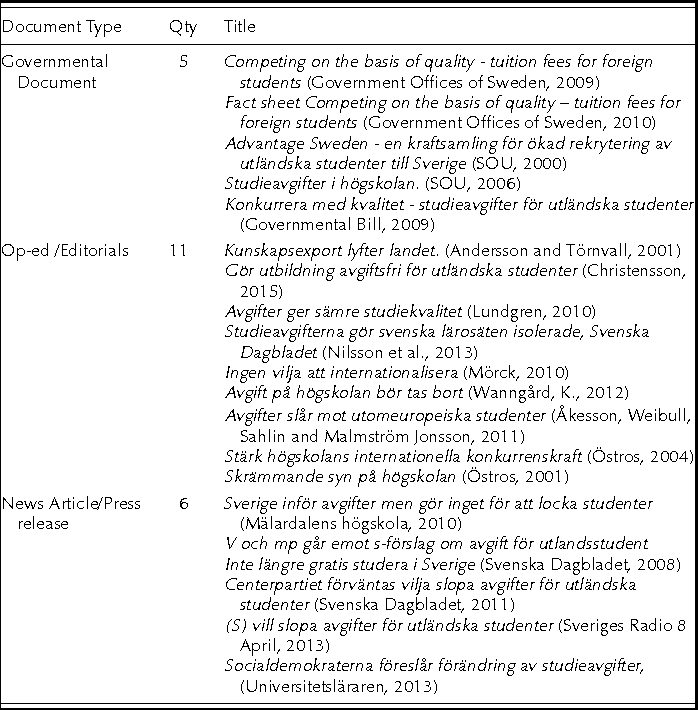
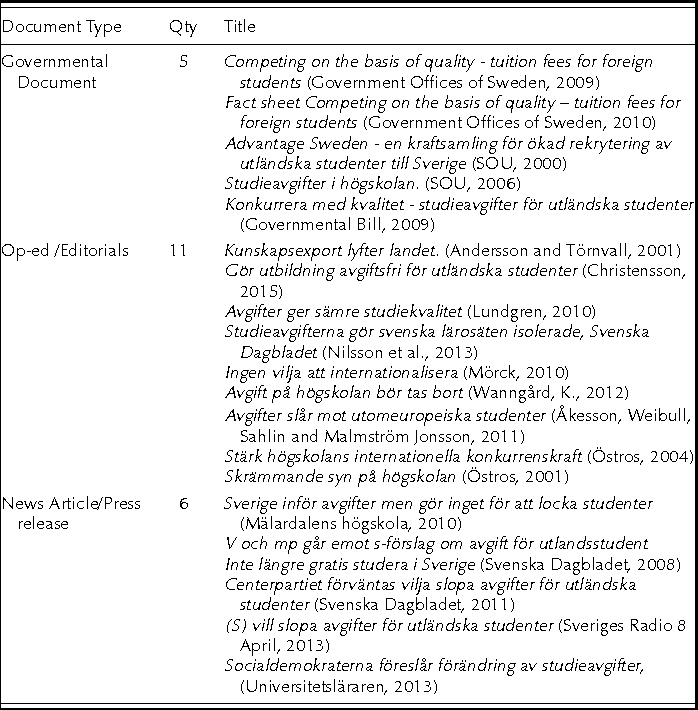
In researching the framing process around the introduction of student fees for international students, we have used three main data sources. These were: official documents and texts from the government such as ‘Competing on the basis of quality – tuition fees for foreign students’ (Government Offices of Sweden, 2009); the ‘Fact sheet Competing on the basis of quality – tuition fees for foreign students’ (Government Offices of Sweden, 2010); and recently published interviews, newspaper articles and opinion pieces from leading participants in the discussion that further clarify the different positions on student fees. The texts analysed can be found in Table 3.
Empirical material
We have done a discourse analysis using frames and metaphors as presented earlier. We used the following rationale in choosing the public documents for our main analysis. First, these are the public documents used by the education minister and the Department of Education in framing the proposed policy. These documents have been published on the homepage of the government webpages and therefore also represent the official framing of the proposed policy. Second, these documents therefore tell us what frames are used to legitimise a departure from tax-financed higher education in Sweden. Third, these documents are aimed at persuading the public about the importance of policy change and are, therefore, carefully crafted to highlight those frames that are seen to support policy change among the public.
An additional focus of the discussion has been on published interviews and opinion pieces from leading stakeholders in the debate concerning student fees for non-EU/non-EEA citizens. The criteria for selecting such documents for the analysis concern their relevance for demonstrating different positions to the introduction of student fees for the bespoke group and usage of discourse to motivate their position.
The selection has been based on capturing the dominant positions within the policy reform in question, and the selection we have used as a sample is presented in Table 3. In so doing, we have read through most publications, news article and publications on the topic until we have reached a limit on new perspectives, or a saturation point. A possible source bias in this research can be identified in our exclusion of private blogs, online discussions forums and other similar sources. In addition, the overall discussion available on this topic has been relatively limited, meaning there is a limited breadth of material and discussion available.
We have completed a text analysis by using the concepts presented in Tables 1 and 2, applying these to the material identified in Table 3. We are convinced that we have covered most of the different perspectives presented in the discussion, but there will always be room to create new merged frames and metaphors depending on how the discourse will develop the coming years. We remain convinced that by using our methodological concepts that a researcher will come to similar conclusions to those we make, and that our conclusions are representative.
Merged frames and applied metaphors
We find in the study that there are two diverging merged neoliberal frames that either support or oppose this particular policy. We argue that we can only understand the different applied metaphors in relation to the merged frame used. The frames in question are: 1. Competitive neoliberal welfare nationalism (we become competitive by charging international students who have become a financial burden, who have decreased the educational quality and have attracted international educational tourism); and 2. Competitive and global social liberalism (we become competitive by being open and attractive to the best talents of the world and creating the global lecture room). The first approach supports fees for non-EU students in Swedish higher education, whereas the second one opposes this. One could argue that neoliberalism is used as a ‘docking station’ where competing merged frames and applied metaphors could be locked in to support and oppose particular forms of policy change. The Swedish case shows how neoliberalism becomes the docking station for arguments located on both sides of the debate around international student fees. Each merged frame will produce different metaphorical understanding of the students showing both the complexity of how neoliberalism is understood in local context and its impacts on how we understand students from a neoliberal perspective. We have created an overview of our merged frames and applied metaphors, which can be seen in table 4.
Merged frames and applied metaphors
Merged frame: competitive neoliberal welfare nationalism
The government used the frame of competitive neoliberal welfare nationalism to support its proposed policy of student fees for international students. We can see a neoliberal frame that integrates both social democratic citizenship and welfare nationalism to steer our understanding of national and overseas students. This merged frame creates a particular focus on seeing students as either national students (citizens, consumers, human capital) or as international students (free riders/welfare tourists, bad investment and high-end consumers). The starting point here is defining the difference between EU and non-EU students, and this is done by using the metaphor of citizens and non-citizens. This is of course metaphorical as the students are not only Swedish citizens but also EU/EEA citizens who do not directly contribute through taxes. It is about widening the concept of national rights and duties to welfare to countries within the EU/EEA. It is important therefore for the government that the metaphor of national citizenship is not endangered through this policy change.
Hence we find reassurances that Swedish and European students will still enjoy ‘the rights to free education’. In the centre-right government bill entitled ‘Competing on the basis of quality – tuition fees for foreign students’ the government proposed that ‘higher education should [only] be free of charge for Swedish citizens and citizens of an EU/EEA state or Switzerland’ (Government Offices of Sweden, 2010: 1). This consensus in the debate echoes the overall importance of keeping higher education as a citizenship right for those seen as citizens.
The second metaphor used heavily is seeing the national student as human capital. The centre-right government (2006–2014) linked the reforms to the concept of Sweden competing in the knowledge economy with a need to invest radically into education and research in order to maintain high levels of economic growth and to improve Swedish welfare. The focus on Sweden's ability to maintain and develop welfare is, according to the government, dependent to a large extent on Sweden's ability to manage knowledge (Government Offices of Sweden, 2010). The government also opined that a ‘well-educated population is crucial for a country wanting to assert itself in the face of ever tougher global competition’ (Government Offices of Sweden, 2010). The knowledge economy frame is used as a starting point to identify priorities, such as the need to invest in human capital to be able to take advantage of the knowledge economy, and here tuition fees from non-EU/non-EEA students are framed as the central means that will help achieve this goal.
The metaphors used for understanding the non-EU students show how both the merged neoliberal frame adapted to particular policies but also to a particular understanding of neoliberalism expressed in the metaphor of non-EU students as free riders/welfare tourists. The government has used welfare nationalist arguments that discredit some international students as free riders and a burden that decreases the quality of the education. The centre-right government talked rather openly about the negative effects of free education: it referred to an enquiry among third country students according to which their main motivation to study in Sweden was the absence of student fees. This motivation, the government argues, has led to a far lower degree of academic quality among third country nationals. Following this logic, the introduction of fees would attract a higher calibre of overseas students and improve the quality of education in general, without increasing the burden on the taxpayer. Instead of recruiting people who do not want to pay for their education, the government argues, institutions can today recruit highly motivated and able third country students more effectively through tuition fees (Government Offices of Sweden, 2010). This argument can be interpreted as a variation on the theme of ‘welfare tourism’, which suggests foreign nationals are motivated by the fact that welfare services, such as education, are free.
Sometimes the metaphors for students are directly linked to each other. For example, when the government describes students from non-EU countries as bad investment, it also implies that national taxpayers and also national students are consumers. Interesting here is that EU citizens are left out of the national discourse as one could also see they would add costs to Swedish Higher Education (SHE). Moreover, there is a general understanding among tax payers that educating students is in the general interest of all tax payers (notwithstanding students as future taxpayers).
The government argues that the rise in international students in SHE has spiralled out of control. They argue further that the number of students applying to study across national borders has risen dramatically throughout the world over the past ten years. The number of students coming to study in Sweden has trebled since 1999, and these students currently make up just over eight per cent of the student population in Sweden (Government Offices of Sweden, 2010: 1). The international students are portrayed as an extra burden for the Swedish taxpayer (SOU, 2006). The costs involved in admitting these students have risen significantly given the sheer numbers of overseas students entering. The official report of the government, Studieavgifter i högskolan (SOU, 2006: 7, 9), suggested that a benefit of increased diversity through international students is not reason enough to offer free tax-financed education to international students (SOU, 2006: 7, 21; Government Offices of Sweden, 2010: 1).
The government therefore argues that Swedish tax revenues should primarily cover the educational needs of Swedish citizens (Government Offices of Sweden, 2010: 1), making students from non-EU countries a bad investment for the Swedish citizen consumers. The sensible way to improve the quality of non-EU students and the overall quality of education is to understand the fee-paying non-EU students as high-end consumers (Government Offices of Sweden, 2010: 1).
Competitive and global social liberalism
We have shown in the previous section that merged neoliberal frames also create adapted metaphors that are used to support a particular policy. This means, in other words, that neoliberal metaphors for students are far more complex, ambiguous and contextualised. When we look at the opposition to introducing fees for non-EU students we can find a competing merged neoliberal frame which we call ‘competitive and global social liberalism’. While this frames the issue differently, it needs highlighting that the initial idea to introduce student fees for international students in fact originates in Social Democratic education policy. The Swedish government and the education minister Thomas Östros enforced a compromise in pursuing fees for non-European students while arguing that fees for national/European students would enhance social biases in recruitment of students and be in opposition to egalitarian higher education financed through taxation (Östros, Reference Östros2001). The party has since then largely distanced themselves from student fees for international students and subscribed, at least in writing, to a neoliberal competitive and global social liberalism that concludes that, in terms of having free higher education for international students, the benefits outweigh the costs. In practice there have been few plans to lift the fees since the Social Democrats and the Green Party formed a minority government in 2014.
This merged frame agrees upon seeing the national student as a citizen but also applies a metaphor – national students as human capital in need of investment. The big difference is in the metaphor of non-EU students as strategic investment. Karin Wanngård from the Social Democratic Party in Stockholm argued before the electoral win of 2014 that the removal of overseas student fees should be a priority for any future social democratic government. She suggests that Sweden suffers from a natural competitive disadvantage compared to a country such as Australia (Australia is English-speaking, has a warmer climate and is closer to many of the desired Asian students) which challenges the attractiveness of the Swedish education product. According to Wanngård, the connections with the rest of the world that overseas students bring are vital for export-oriented countries such as Sweden. Overseas students should therefore be seen as an investment (Wanngård, Reference Wanngård2012). Such an argument implies that higher education increases Sweden's influence through soft power, where students start to identify with their host country and will influence their home country or home networks to be in favour of their host country (Lomer, Reference Lomer2017).
The party have since then moved, between wanting to abolish the system of student fees for international students and wanting just to reform the existing system (Sveriges Radio, Reference Radio2013). The main part of the Social Democratic Party has favoured a change of the fee system to make it more differentiated according to the needs of the nation state. Ibraham Baylan, educational spokesman for the party, said before the election of 2014 that it should be a priority for universities to gain attractive international students that would contribute both to Swedish Higher Education and the Swedish economy (Universitetsläraren, 2013).
Other actors highlight that overseas students are an investment in Sweden's competitiveness in the global market, in turn implying that the reformed education policy is a bad investment. Fredrick Federley from the Centre Party argues that this is all about achieving a multi-national environment in the higher education institutes and keeping the level of research and the academic discourse at a high level. He argues that Sweden is part of the global competition for ‘smart brains’ (Svenska Dagbladet, 2011). Christensson (Reference Christensson2015) argues that this is done through an international approach to higher education; there is therefore a need to remove student fees for international non-EU students.
The argument that student fees have stopped the process of internationalisation and made SHE isolated in a global world has also been put forward. In an op-ed Magnus Nilsson (from the Social Democratic student federation) and others argued that the introduction of student fees led to a decrease of 79 per cent of international students; and that the scholarship system set up to address this has been flawed and inadequate (Nilsson et al., Reference Nilsson, Danielsson, Ericson, Wanngard and Arroy2013). The authors focus on Sweden as being a small northern European country that needs to look outwards whereas the rest of Europe looks inwards (Nilsson et al., Reference Nilsson, Danielsson, Ericson, Wanngard and Arroy2013).
A second metaphor depicts the international student as an enrichment for local students, making them more competitive in the global knowledge economy. For example, the pro-directors from four of the largest SHE institutes, Lund, Göteborg, Uppsala and Royal Institute of Technology in Stockholm, have argued in the Swedish newspaper Sydsvenskan that overseas students will make native students more competitive in the global market. In an op-ed they argue that the Swedish students have now had the opportunity to be in a global classroom, which has prepared them for the international labour market (Åkesson et al., Reference Åkesson and Malmström2011). The argument that student fees have stopped the process of internationalisation and made SHE isolated in a global world has also been put forward.
Discussion and conclusion
We can see that neoliberalism and neoliberal metaphors are seldom as clear-cut as in Nordensvärd's typology (2010). By being adapted and contextualised they are transformed to fit the local context. For example, in the Swedish case both the merged neoliberal frames concur in seeing the national students first and foremost as citizens. One of the arguments against student fees for overseas students is based on the principle of education being a citizenship right and not a commodity. By introducing fees this will turn education into a marketised product. Mörck states that ‘education is a right, not a commodity’ (Mörck, Reference Mörck2010). The Left Party (Vänsterpartiet) and the Green Party (Miljöpartiet) highlight that education is a right for everyone (Universitetsläraren, 2013). Elin Rosenberg from the United Swedish Student Unions (Sveriges förenade studentkårer) specifically argued that the introduction of fees for overseas students turns education from a right to a commodity, suggesting that this will open up the possibility of fees even for Swedish students (Svenska Dagbladet, 2008).
This fear of student fees is shared by others in the debate, such as Lundgren (Reference Lundgren2010), perceiving the student fees for international students as a Trojan horse that could eventually introduce student fees for Swedish students as well. An overall linkage between quality and student fees was argued, in an on-going debate where some of those opposing the policy, such as the MP Yvonne Andersson and Professor Anders Törnvall, proposed that student fees should be applicable for all students (Andersson and Törnvall, Reference Andersson and Törnvall2001): the argument being that quality was falling behind other countries and student fees would lead to an increase in quality (2001). The rise of the Sweden Democrats might highlight a larger focus on welfare nationalism (Nordensvärd and Ketola, Reference Nordensvärd and Ketola2015) but there is no evidence that the success of the party will change the overall discourse of neoliberalism. It is to be assumed that it will strengthen the argument that non-EU students need to pay for education, in the context of the overall understanding of education as primarily something for nationals. The variegated forms of neoliberalism have been able to incorporate welfare nationalism into their discourses to different degrees and create different metaphors for understanding students in general, and international students in particular, in ways that are at the same time locally relevant as well as ambiguous.
In a neoliberal discourse where the state and private enterprise become interwoven in discursive and social practices, we see how images of students and images of citizens become interlinked. Alvesson (Reference Alvesson2006) points to the problematic discursive role of contemporary understanding of education, if proposed as being able to solve both economic and social problems. Alvesson frames these beliefs as a fundamentalism of education, as implying a naïve trust in education as a general problem solver, and an inherent good in which work skills are fostered in education; where low levels of education are regarded as an individual deficit. Alvesson means that the values and expectations of education are one of our most predominant myths with an almost fetishised notion of competence and knowledge (2006: 50–51). We argue here that the same discussion could be held about citizenship, as education and citizenship are closely intertwined.
We argue that market metaphors for students are intricately interlinked with our understanding of social citizenship. As stated earlier, education itself has always been linked to both construction and reproduction of national citizenship and a reliable workforce. Any change of our understanding of social citizenship will also have a direct impact of how we understand education and vice versa. We could therefore see in the Swedish case a more pronounced economic understanding of citizenship, as has also been argued by Simons and Masschelein (Reference Simons and Masschelein2008). They argue that education has become part of an economic citizenship where learning is a form of (employable) capital, as a responsibility, and as a domain of management. When we discuss higher education, we can now see it as part of an entrepreneurial self-government (of professionals, citizens, employees, organizations, societies) or autonomy, according to the ‘nomos’ of the permanent economic tribunal. We understand learning as a process aimed at producing human capital or adding value to the self (and for oneself as a consumer or for others; Simons and Masschelein, Reference Simons and Masschelein2008: 407–8). This leads to a government whose rationality is based on an ‘economization of the social’ and ‘the main horizon for governmental reflection is no longer social but economic’ (Simons and Masschelein, Reference Simons and Masschelein2008: 406).
What this article does is highlight that this process should not be seen as discursively uniform or straightforward, but as something that adapts to local citizenship both social and economic, due to the local mixed economy of welfare and the particular context of local welfare state arrangements. So even if we could see a general understanding of students through neoliberal metaphors, in practice and policy these metaphors are often contextualised in local discourses of welfare arrangements.
What this article therefore shows is that such processes have variegated starts and ends and restart points. There is not one homogenous way of creating this ‘economization of the social’ but myriad hybrids. In particular, it brings to the fore the role ‘impure’ hybrid logics play in the survival of the neoliberal consensus. As such we argue that frame merging is at its most persuasive when modelled as edification or reinterpretation of existing ideological positions. The alternative discourse on tuition fees in Sweden highlighted education either as a universal social right that problematised the view of education as a commodity, or as an exclusive social right limited to Swedish citizens.
The discussed variegated forms of neoliberalism have two ways to reframe the nation state as a key site for defining and re-defining citizenship in a world which is predominantly understood through both economic and nationalist terms. This means that neoliberal metaphors can in practice not be separated from citizenship metaphors/social policy; rather, they are merged to spawn contextual metaphors to fit the local social policy debates on higher education.