INTRODUCTION
Dispersal of individuals and colonization of habitat patches are limited by barriers made of unsuitable habitat. Consequently, the ability of animals to move between habitat patches becomes one of the most important factors driving population dynamics in heterogeneous landscapes (Zollner & Lima Reference ZOLLNER and LIMA1999a). Landscape connectivity – the degree to which a landscape facilitates or restrains movements between patches (Taylor et al. Reference TAYLOR, FAHRIG, HENEIN and MERRIAM1993) – becomes a key element for population persistence (Fahrig & Paloheimo Reference FAHRIG and PALOHEIMO1988). Species-specific characteristics are determinant of the functional connectivity of the landscape, which considers the behavioural responses of organisms to the spatial pattern of landscape units (Goodwin Reference GOODWIN2003).
A key physiological and behavioural aspect in understanding the response of organisms to landscape units is the ability of animals to perceive habitat at a distance, their perceptual range (Zollner Reference ZOLLNER2000). More precisely, perceptual range is the maximum distance at which a landscape element can be detected by an animal (Lima & Zollner Reference LIMA and ZOLLNER1996). It determines the ease with which individuals can locate habitat patches, and the time spent searching in the matrix (Zollner & Lima Reference ZOLLNER and LIMA1999b). Perceptual range has been studied in small mammals (Gillis & Nams Reference GILLIS and NAMS1998, Schooley & Branch Reference SCHOOLEY and BRANCH2005, Zollner Reference ZOLLNER2000, Zollner & Lima Reference ZOLLNER and LIMA1999b), reptiles (Caldwell & Nams Reference CALDWELL and NAMS2006, Yeomans Reference YEOMANS1995), and insects (Schooley & Wiens Reference SCHOOLEY and WIENS2003). Most of these studies were designed to determine the effect of distance on habitat perception, assuming mainly visual detection of habitat elements, but effects of environmental conditions were also detected and suggested as important during habitat search (Schooley & Branch Reference SCHOOLEY and BRANCH2005, Schooley & Wiens Reference SCHOOLEY and WIENS2003, Yeomans Reference YEOMANS1995).
A positive relationship between body mass and perceptual range was proposed by Mech & Zollner (Reference MECH and ZOLLNER2002) for rodents between 15 and 800 g based on four species of rodents. To quantify the relationship between body size and perceptual range, variables affecting perceptual range other than body size were controlled for in their study. Mech & Zollner (Reference MECH and ZOLLNER2002) also considered that the scaling of perceptual range with body mass should differ between animal groups depending on their life history traits.
The effect of environmental variables should be determined explicitly if the objective is to estimate functional connectivity based on perceptual range. If the effect of environmental variables is considered explicitly, it is possible to estimate the ‘realized perceptual range’ (Olden et al. Reference OLDEN, SCHOOLEY, MONROE and POFF2004), the actual perception according to the environmental conditions instead of the maximum possible perceptual distance. Also, environmental variables are likely to affect perceptual range, especially wind direction if species use odour cues for orientation (Schooley & Branch Reference SCHOOLEY and BRANCH2005, Schooley & Wiens Reference SCHOOLEY and WIENS2003). In this regard, estimates of perceptual range based only on distances will limit comparisons between individuals and species in different environments, and also the ability to infer functional connectivity, and sensitivity to habitat fragmentation.
Movements of small mammals in Brazil have been studied mainly in large continuous macrohabitats, such as scrubland or Atlantic Forest (Cáceres Reference CÁCERES2003, Cunha & Vieira Reference CUNHA and VIEIRA2002, Gentile & Cerqueira Reference GENTILE and CERQUEIRA1995, Gentile et al. Reference GENTILE, D'ANDREA and CERQUEIRA1997, Loretto & Vieira Reference LORETTO and VIEIRA2005). The few studies that focused on movements in the non-forested matrix around forest fragments detected individuals moving between forest fragments and visiting the matrix for other purposes (Lira et al. Reference LIRA, FERNANDEZ, CARLOS and CURZIO2007, Passamani Reference PASSAMANI2003, Pires et al. Reference PIRES, LIRA, FERNANDEZ, SCHITTINI and OLIVEIRA2002). Nevertheless, little is known about the behaviour of individuals while moving in the non-forested matrix, or the biotic and environmental variables that influence these movements.
We evaluated the effect of wind speed and direction, grass height, and distance to a forest remnant on the perceptual range of four species of didelphid marsupial of the Atlantic Forest of Brazil. We also tested if Mech and Zollner's equation could generate accurate predictions of perceptual range for two of the neotropical marsupials studied. This is the first study on the perceptual range of neotropical small mammals.
METHODS
Study site
Animals were captured in forest fragments in the Macacu River watershed, in the municipalities of Guapimirim and Cachoeiras de Macacu (22°21′–22°39′S, 42°40′–43°01′W), Rio de Janeiro State, Brazil. This region presents many forest fragments in a matrix of open areas used mostly for cattle grazing, but also for agriculture, with one major paved road and many secondary dirt roads, and rivers. Fragments are located on top of hills c. 200–300 m high, composed mostly of second-growth or disturbed Atlantic Forest (Cabral & Fiszon Reference CABRAL and FISZON2004). Release experiments were conducted in a pasture surrounding one single fragment of 68 ha. Only one release site was used to control for height of the forest fragment and matrix type. The release site was surrounded by the fragment, other pastures, and a paved road. The next nearest fragment was 1200 m away, and no animals were captured in the target fragment to avoid previous experience at the release site. Captures and orientation experiments were done from August 2005 to August 2006.
Studied species
The species of study were the most abundant marsupials (order Didelphimorphia) in forest fragments of the region, also known as opossums. The black-eared opossum, Didelphis aurita (Wied-Neuwied 1826) is semi-terrestrial, occasionally using the canopy (Cunha & Vieira Reference CUNHA and VIEIRA2002, Grelle Reference GRELLE2003, Passamani Reference PASSAMANI1995, Vieira & Monteiro-Filho Reference VIEIRA and MONTEIRO-FILHO2003). Movements between fragments and captures in the matrix were reported for this species in other areas of Atlantic Forest (Pires et al. Reference PIRES, LIRA, FERNANDEZ, SCHITTINI and OLIVEIRA2002). Due to its high vagility, and to its presence in fragments of different sizes and degree of disturbance, it is assumed to be tolerant to fragmented landscapes (Fernandez & Pires Reference FERNANDEZ, PIRES, Cáceres and Monteiro-Filho2006). It is the largest of the studied species (average body mass for captured individuals was 850 g). The grey four-eyed opossum, Philander frenatus (Olfers 1818), is semi-terrestrial as well, occasionally using the understorey, but rarely the canopy (Cunha & Vieira Reference CUNHA and VIEIRA2002, Vieira & Monteiro-Filho Reference VIEIRA and MONTEIRO-FILHO2003). Movements between fragments and captures in the matrix also were reported for this species (Lira et al. Reference LIRA, FERNANDEZ, CARLOS and CURZIO2007, Pires et al. Reference PIRES, LIRA, FERNANDEZ, SCHITTINI and OLIVEIRA2002). Average body mass for captured individuals was 395 g. The opossum Micoureus paraguayanus (Moojen 1943), is an arboreal species, but occasionally uses the understorey, and even the ground (Grelle Reference GRELLE2003, Passamani Reference PASSAMANI1995). It also was reported to cross open grassland matrix, but only movements of males were detected (Pires et al. Reference PIRES, LIRA, FERNANDEZ, SCHITTINI and OLIVEIRA2002). The average body mass of the individuals captured was 112 g. The grey catita Marmosops incanus (Lund 1840) is an arboreal species that uses mainly the understorey (Cunha & Vieira Reference CUNHA and VIEIRA2002). Information on its movements is limited although it is known to cross coffee plantations among forest fragments (Passamani Reference PASSAMANI2003). The average body mass of the individuals captured was 59 g.
Estimation of perceptual ranges
The method for estimating perceptual ranges was based on Zollner & Lima (Reference ZOLLNER and LIMA1997), using the ability of individuals to orient towards a forested habitat as a measure of their perceptual range. Animals are released at different distances from an unfamiliar fragment, using the distance when animals cease to orient themselves to the fragment as the perceptual range. This general experimental design was used in studies of small mammals and insects (Schooley & Branch Reference SCHOOLEY and BRANCH2005, Schooley & Wiens Reference SCHOOLEY and WIENS2003, Zollner Reference ZOLLNER2000, Zollner & Lima Reference ZOLLNER and LIMA1997, Reference ZOLLNER and LIMA1999a). One assumption of this kind of experiment is that animals would search for a refuge when released in an open area, which would be the nearest forested area (Zollner & Lima Reference ZOLLNER and LIMA1997). This is reasonable because an open area represents an unfavourable environment for the small marsupials studied, with high risk of predation by domestic dogs or raptors. This is true even for the large D. aurita which occasionally ventures into open areas.
Animals were captured in forest fragments using Sherman and Tomahawk live traps. After capture, animals were put into individual cages, fed with orange, banana and dog food, and left in a fresh place in the shade for 3–24 h before release. Animals were released using a standard mechanism, which consisted of an inverted box with a string attached to the bottom of the box. The string passed through two pulleys on top of a cross-shaped stake. The first pulley was at the end of one arm of the cross, positioned right above the box, and the second on top of the upper arm of the cross, from which the string was extended to a distance of at least 20 m (Forero-Medina & Vieira Reference FORERO-MEDINA and VIEIRA2007). The box could then be lifted by an observer at a distance, avoiding any influence on animal movements during release (Zollner & Lima Reference ZOLLNER and LIMA1997).
Before release, animals were equipped with a spool-and-line device (Cunha & Vieira Reference CUNHA and VIEIRA2002, Vieira & Loretto Reference VIEIRA and LORETTO2004), and the free end of the line was attached to the release mechanism. Bobbinless cocoons number 5 or 10 (Cansew Corp., Montreal, Canada) were used, weighing approximately 1.7 g and 4.5 g, and containing 175 m and 480 m of thread, respectively. To assemble the device, cocoons were wrapped in PVC film, and one or two rounds of masking tape used to guarantee adherence (Cunha & Vieira Reference CUNHA and VIEIRA2002). This tracking method has no significant negative effects on the survivorship of individuals (Steinwald et al. Reference STEINWALD, SWANSON and WASER2006).
When the box was lifted animals had almost 360° to choose a direction, because the stake of the release mechanism was only 2.5 cm wide, covering a very small part of the field of vision. Release sites were located on lines parallel to the border of the forest fragment, one line for each distance, and were placed 20 m away from each other to minimize possible olfactory interferences. All releases were done in the late afternoon, between 17h30 and 19h30, and no more than five animals were released at a time due to space limitation. Initial release distance for a species was established in preliminary tests. Depending on the orientation of the animals, this distance was increased or decreased. The maximum distance with significant orientation was the estimate of perceptual range for the species.
During release, the following variables were measured: wind speed (maximum speed) and direction using anemometer and compass, and pasture height (mean distance from the soil to the top of grass cover). The next day, the path of each animal was tracked and polar coordinates taken (distance between points where bearing changed at least 10°, and bearing between points).
To estimate perceptual ranges, first the mean vector for the first 20 m of the path was calculated. The mean vector was preferred over other methods to estimate oriented movement, such as the compass bearing from the release point to the final position (Zollner & Lima Reference ZOLLNER and LIMA1997), which loses information about the path followed, or from the release point to the initial movement (Schooley & Branch Reference SCHOOLEY and BRANCH2005). The use of only the first 20 m guarantees that directions taken correspond to initial orientations (Goodwin et al. Reference GOODWIN, BENDER, CONTRERAS, FAHRIG and WEGNER1999). The mean vector of this initial distance of 20 m represents a more accurate summary of the orientation decisions taken by the animal during the initial movements after release. Mean vectors and other circular statistic tests were calculated with Oriana 6.0 (RockWare Inc., Golden, USA). Orientation towards the woods was tested at each distance using V-tests (Batschelet Reference BATSCHELET1981, Zar Reference ZAR1984), which tested whether mean vectors of individuals released at a certain distance were non-random and grouped in the direction of the forest fragment. V-tests were also used to establish if there was any orientation towards the direction of the fragment where the animal was captured. To test for difference in orientation ability between males and females, the Mardia-Watson Wheeler test was used, which compares two circular distributions (Fisher Reference FISHER1993). To increase sample size in comparisons between sexes, distances were grouped into two categories, oriented and non-oriented.
Effect of body size, distance and environmental variables on orientation abilities
To determine if body size, distance and environmental variables affected the orientation abilities of the marsupials, we used a multiple regression design and a model selection approach (Burnham & Anderson Reference BURNHAM and ANDERSON2002). The dependent variable was the absolute difference between the direction of the forest fragment (near release point), and the direction of the mean vector of each individual. Although the original variables were angles – following a circular distribution – the difference between them is linear (Schooley & Branch Reference SCHOOLEY and BRANCH2005, Schooley & Wiens Reference SCHOOLEY and WIENS2003). All possible and coherent subsets of these independent variables were used to build models, and their fit to the data was compared by the modified Akaike Information Criteria (AICc), which is recommended when sample size divided by the number of parameters in the model is less than 40. Models were ranked using Δi (= AICci – minimum AICc). We used Δi ≤ 2 as an initial criterion to select the best models, but also considered models with 2 ≤ Δi ≤ 10, which have less support from the data but cannot be disregarded (Burnham & Anderson Reference BURNHAM and ANDERSON2002, p. 170).
The effect of wind direction on the orientation abilities was tested in two different ways. First, the angular difference between the directions of target fragment and the wind was included as an independent variable in the models described previously. The difference between directions was a linear variable, ranging from zero (wind coming from the fragment) to 180 (wind coming against the fragment). Second, using circular statistics, because anemotaxis can occur with individuals orienting either towards or against wind direction. Such bimodal responses would cancel each other in a linear analysis; hence the influence of wind direction could be hidden in the model selection analysis. Possible bimodal distribution of orientations, upwind or downwind direction, were tested using the doubling of the angle procedure coupled with a V-test (Batschelet Reference BATSCHELET1981, Fisher Reference FISHER1993, Schooley & Branch Reference SCHOOLEY and BRANCH2005).
Mech and Zollner's formula for predicting perceptual range
Mech & Zollner (Reference MECH and ZOLLNER2002) estimated perceptual range of each species as the regression slope of angular divergence (divergence between the direction taken by the animal and the direction of the forest) against distance to the forest. Regression slopes of each species were then regressed against body mass to determine the scaling of perceptual range with body mass. Finally, they proposed two equations, one to predict the slope of angular divergence against distance to the forest, an estimate of orientation ability (eqn 1):

where S is the predicted slope of the species regression and M is the mass of the species.
The second equation was to predict the perceptual range (eqn 2):

where ADcrit is the critical angular divergence value for perceptual range (63°–69°), 15.5 is the height (m) of the forest, and H is the height of the desired forest.
RESULTS
Perceptual ranges
Fifty individuals of P. frenatus (19 females, 31 males) were captured, released, and tracked successfully, 37 D. aurita (17 females, 20 males), and 19 M. paraguayanus (11 females, 8 males), in six different forest fragments. Five individuals of M. incanus were also released at 100 m to obtain a preliminary figure of its perceptual abilities. Also, these five individuals of M. incanus are at the low end of body range, hence important to determine the scaling of perceptual range to body mass. There was no evidence for a homing behaviour in these species as none of them oriented towards the fragment where individuals had been captured. Males and females showed similar orientation abilities.
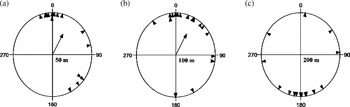
Individuals of P. frenatus oriented significantly towards the forest fragment at distances of 50 m (u = 2.76; P < 0.001; n = 16), and 100 m (u = 3.02; P < 0.001; n = 19) from the forest (Figure 1). However, there was no significant orientation at 200 m (u = −2.75; P = 0.10; n = 15) (Figure 1).
Angular orientations of Philander frenatus released at 50 m (a), 100 m (b) and 200 m (c) from the forest fragment. The centre of the circle indicates the release site and zero the forest direction. Each triangle represents the mean angle for one individual. Vectors indicate the mean angle and concentration of the group of animals and are only shown when there was a significant orientation to the forest.

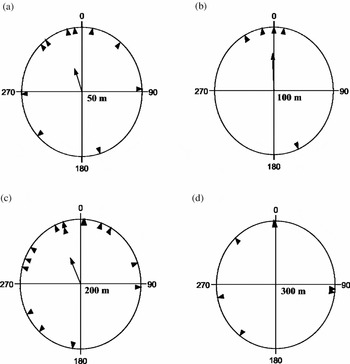
Individuals of D. aurita oriented significantly towards the fragment at 50 m (u = 1.62; P = 0.05; n = 10), 100 m (u = 1.84; P < 0.05; n = 5), and 200 m (u = 2.17; P < 0.05; n = 15) (Figure 2). At a distance of 300 m there was no more significant orientation for this species (u = 0.82; P = 0.21; n = 7) (Figure 2).
Angular orientations of Didelphis aurita released at 50 m (a), 100 m (b), 200 m (c) and 300 m (d) from the forest fragment. All symbols as in Figure 1.

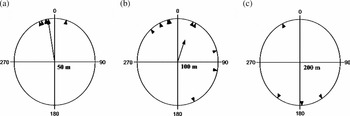
Individuals of M. paraguayanus oriented significantly towards the forest at 50 m (u = 3.34; P < 0.0001; n = 6), and 100 m (u = 2.15; P < 0.05; n = 9) from the forest, but there was no orientation at 200 m (u = −1.25; P = 0.89; n = 4) (Figure 3).
Angular orientations of Micoureus paraguayanus released at 50 m (a), 100 m (b) and 200 m (c) from the forest fragment. All symbols as in Figure 1.

Individuals of M. incanus were released only at a distance of 100 m from the forest. There was no significant orientation at this distance (u = −0.43; P = 0.66; n = 5).
None of the species presented a significant orientation to the fragment of capture, P. frenatus (u = −0.63; P = 0.73; n = 15), D. aurita (u = 0.77; P = 0.22; n = 7) or M. paraguayanus (u = −2.52; P = 0.99; n = 4). Circular distributions of males and females did not differ significantly in P. frenatus (W = 0.42; P = 0.81; females n = 15; males n = 20) or in D. aurita (W = 1.56; P = 0.46; females n = 16; males n = 14). The sample size of M. paraguayanus did not allow for the test of sexual differences in orientation.
Effect of body size, distance and environmental variables on orientation abilities
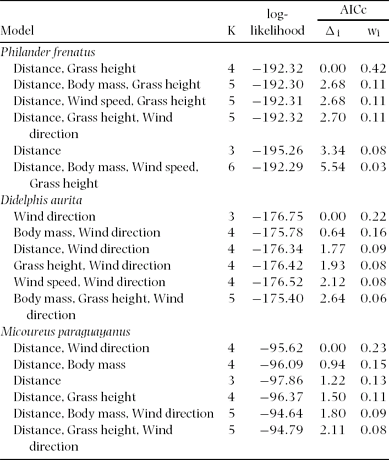
In P. frenatus, only distance to the fragment and grass height appeared as significant determinants of the orientation of individuals to the forest fragment (Table 1). The best model included only these two variables of the five variables studied (Δi = 0; wi = 0.42; K = 4). The second-best model, which included body weight, has Δi > 2 so it was not considered competitive. Distance to the fragment and grass height were also the only two variables that appeared consistently in most of the remaining models (Table 1). These variables were negatively related to orientation to the fragment, with larger distances and taller grass indicating a higher angular divergence (coefficient estimates: distance = 0.55; grass height = 3.30). The six models in Table 1 represented 85% confidence on the best model.
Model selection for orientation of three species of didelphid marsupial to a forest fragment. The dependent variable was angular distance. K = number of parameters (no. independent variables plus 2), Δi = AICci – minimum AICc, wi = Akaike weights.
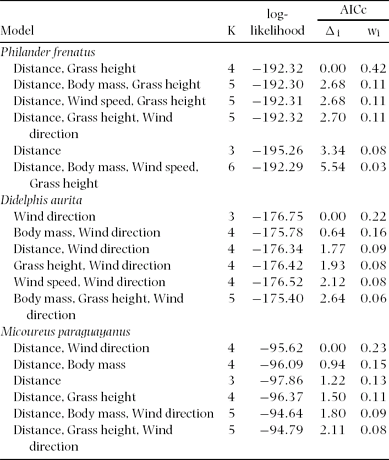
In D. aurita, wind direction was the most important variable determining orientation (Table 1). The best model included only this variable (Δi = 0; wi = 0.22; K = 3), which appeared consistently in all remaining models. However, the first four models had Δi < 2, hence cannot be discarded. The four best models also support body mass, distance to the fragment, and grass height as factors significantly affecting the degree of orientation to the fragment. Wind direction, the difference between the downwind direction and the fragment direction, is negatively related to orientation abilities: the larger the difference, the larger the angular distance (coefficient estimate = 0.58). The first six models in Table 1 represented 69% confidence in the best model.
In M. paraguayanus, distance was the most important variable determining orientation. It appeared consistently in all the models (Table 1), and the best model included this variable and wind direction (Δi = 0; wi = 0.23; K = 4). The first five models presented Δi < 2, therefore wind direction, body weight and grass height can also affect orientation significantly, with wind direction being the most important of these three (Table 1). Distance was negatively related to orientation, larger distances indicating larger angular distances (coefficient estimate = 0.92). The first six models in Table 1 represented 79% confidence in the best model.
Orientation using the wind
Philander frenatus and M. paraguayanus did not exhibit any tendency to move towards the wind (upwind direction) (V-test: P. frenatus u = −1.43; P = 0.92; n = 50, M.
paraguayanus u = 1.23; P = 0.11; n = 17), and they did not present a bimodal distribution indicating both upwind and downwind movements (doubling of the angles with V-test: P. frenatus u = 0.11; P = 0.46; n = 50, M. paraguayanus u = 0.13; P = 0.45; n = 17).
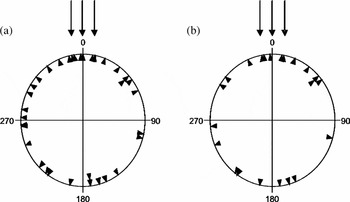
Didelphis aurita presented a different pattern. When data from all distances were analysed together, there was a marginally non-significant concentration of bearings upwind and downwind (u = 1.57; P = 0.06; n = 35), with less frequent crosswind movements. When only individuals released at the largest distances were analysed (200 m and 300 m), a bimodal distribution (u = 2.27; P < 0.05; n = 22) became clear, with movements significantly clustered either upwind (0°) or downwind (180°) (Figure 4).
Orientation of Didelphis aurita and wind direction during release. All individuals (a), individuals released at 200 m and 300 m (b). Arrows show wind direction.

Mech and Zollner's equation for predicting perceptual range
Slopes of the relationship distance-angular divergence were estimated for P. frenatus and M. paraguayanus because, according to the best models, they were the only species in which distance influenced perceptual abilities. Using Mech and Zollner's equations 1 and 2, and a forest height of 31 m (height of the nearest fragment), the expected perceptual range for P. frenatus was higher than 350 m, and that of M. paraguayanus higher than 250 m (Table 2). Clearly these equations overestimate the perceptual range of the marsupials studied based on the release experiments. Slopes estimated using our data were higher than the ones estimated by Mech and Zollner's equation 1 (Table 2). The higher the slope, the less the species is capable of keeping oriented as distance to the fragment increases. Accordingly, perceptual range was reduced when estimated from Mech and Zollner's equation 2 with slope estimated from our data. However, perceptual range was still overestimated compared with results from the release experiments (Table 2).
Mean body mass, regression slopes of angular divergence vs. distance to the fragment, and perceptual ranges for Philander frenatus and Micoureus paraguayanus. The equations of Mech & Zollner (Reference MECH and ZOLLNER2002) predict slope based on body mass, and perceptual range based on slope and body mass.

DISCUSSION
Perceptual range
Our results indicate that predictions of perceptual range for small mammals must also consider effects of wind direction, characteristics of the matrix such as grass height, and possibly other variables specific to the species and environment of study. A scaling relationship with body mass is likely to exist, but only after other effects are standardized can the relationship with body mass be established. The didelphid marsupials studied can detect and orientate to forest fragments while walking in an open matrix, but their perceptual abilities depend on wind direction, grass height, body mass and distance to the forest fragment.
The effect of body mass: Mech and Zollner's equation for predicting perceptual range
The relationship between body mass and perceptual range proposed by Mech & Zollner (Reference MECH and ZOLLNER2002) overestimated the perceptual range of P. frenatus and M. paraguayanus. As Mech & Zollner (Reference MECH and ZOLLNER2002) warned this is not surprising, for three reasons. First, because the equations proposed by Mech & Zollner (Reference MECH and ZOLLNER2002) were based on three sciurid and one muroid species. Sciurids are more diurnal than the marsupials studied and also more visually oriented than marsupials (Ahl Reference AHL1987, Derge & Yahner Reference DERGE and YAHNER2000, Thorson et al. Reference THORSON, MORGAN, BROWN and NORMAN1998). Indeed, the reasoning that perceptual range should be positively related to body size applies only for visually oriented animals (Gillis & Nams Reference GILLIS and NAMS1998, Mech & Zollner Reference MECH and ZOLLNER2002). Second, as stated by Mech & Zollner (Reference MECH and ZOLLNER2002), their equations were a starting point; they show that perceptual range tends to scale with body mass, but the exact shape and parameters of the scaling relationship depend on data for other species. Thus, the first equation underestimated the slope of the relationship distance–angular divergence in the two marsupials tested, i.e. overestimated their perceptual range. The second equation assumes that perceptual range increases continuously as forest height does, but this relationship must have a boundary, a limit where forest height increases but not perceptual range. That is the reason why at high forest heights the equation overestimates the real value of perceptual range.
Body size could be a major determinant of perceptual range, but only in interspecific comparisons involving body sizes of different orders of magnitude. For daily movements of the same didelphid species, body size becomes important when variation spans two orders of magnitude (Vieira & Cunha in press). Indeed, body mass spans two orders of magnitude when the four species of didelphid marsupial are considered: from c. 80 g in adult M. incanus to 1600 g in adult D. aurita. Accordingly, a relationship with body mass is apparent when the four species are compared: the largest perceptual range was of the largest species, 200 m for Didelphis aurita, and the shortest of the smallest species, less than 100 m for M. incanus. When comparisons are made within the same order of magnitude, other factors might be as important as body size, such as arboreal habits, wind direction, and type of matrix where habitat patches are inserted.
Perceptual ranges around 200 m for D. aurita, 100 m for P. frenatus and M. paraguayanus, and less than 100 m for M. incanus follow a similar order as the frequency of movements between fragments found by Pires et al. (Reference PIRES, LIRA, FERNANDEZ, SCHITTINI and OLIVEIRA2002) in another Atlantic Forest area. Didelphis aurita had the highest movement rate followed by P. frenatus and M. paraguayanus. This is consistent with the hypothesis that perceptual range influences the way animals use the landscape (Zollner Reference ZOLLNER2000). The ranking of perceptual ranges is also consistent with data for movements inside forested habitats. Didelphis aurita has larger daily ranges than P. frenatus (Vieira & Cunha in press). Species of Didelphis have large home ranges and high movement rates compared with other neotropical didelphids (Sunquist et al. Reference SUNQUIST, AUSTAD and SUNQUIST1987, Telford et al. Reference TELFORD, GONZALES and TONN1979).
Orienting mechanisms differed between species
Although P. frenatus and M. paraguayanus had similar perceptual ranges, it may be more difficult for M. paraguayanus to cross a matrix of pasture because of its arboreal habits. In another area of fragmented Atlantic Forest, individuals of P. frenatus use pasture matrix more often than individuals of M. paraguayanus (Pires et al. Reference PIRES, LIRA, FERNANDEZ, SCHITTINI and OLIVEIRA2002). Among the species studied, Marmosops incanus would be the most sensitive to fragmentation because of its short perceptual range. Open areas between fragments can represent barriers for M. incanus because it would have difficulty in perceiving favourable habitat across short distances. Indeed, in another fragmented landscape in the Atlantic Forest M. incanus was less abundant in the edge compared with the interior of the forest, and in non-forest compared with forested habitats (Pardini Reference PARDINI2004). Due to its low perceptual range, M. incanus might avoid the matrix and movements to other fragments.
Orienting mechanisms seem to differ among the three species of didelphid marsupials. For P. frenatus, the important variables were distance to the woods and grass height, which suggests an orienting mechanism with an important visual component. For M. paraguayanus, distance was also the most important variable, but wind direction was the second most important, suggesting an olfactory component in the orientation of individuals. For D. aurita, distance was not the most important variable determining orientation to the forest. Although we could detect a maximum distance where individuals were oriented, wind direction was the most important variable for orientation in D. aurita. Orientation, however, was not always towards the forest. At distances greater than 200 m there was a tendency of moving either upwind or downwind. This suggests that D. aurita might rely on vision at short distances because individuals can easily perceive the forest, but at greater distances, where visual perception of the forest becomes more difficult, it could use the wind to follow a straighter path. Anemotaxis, orientation with the wind, has been reported for insects locating pheromones, and recently for some rodents (Balkovsky & Shraiman Reference BALKOVSKY and SHRAIMAN2002, Schooley & Branch Reference SCHOOLEY and BRANCH2005, Schooley & Wiens Reference SCHOOLEY and WIENS2003). Anemotaxis might result not only from an olfactory search for resources, but also as a strategy for maintaining a straight path during habitat search (Schooley & Branch Reference SCHOOLEY and BRANCH2005, Schooley & Wiens Reference SCHOOLEY and WIENS2003). A predominantly straight path with a small degree of sinuosity is the most effective strategy to find habitat patches in heterogeneous landscapes (Zollner & Lima Reference ZOLLNER and LIMA1999b).
Perceptual abilities of didelphid marsupials differed among species, and depended on the environmental context, even for species that are more visually oriented, such as P. frenatus. Distance to a habitat patch can be an important variable determining orientation in a heterogeneous landscape, but characteristics of the matrix and environmental variables such as grass height and wind direction are also important. The effect of these variables on perceptual range must be considered in models of functional connectivity in fragmented landscapes.
ACKNOWLEDGEMENTS
This study was part of the MSc thesis of G. Forero-Medina in the Programa de Pós-Graduação em Ecologia, Universidade Federal do Rio de Janeiro, Brazil. Funding was provided by CAPES and CNPq through scholarships to G. Forero-Medina, and grants from IBIO, CNPq and PPGE. We thank graduate and undergraduate students of the Laboratório de Vertebrados, Universidade Federal do Rio de Janeiro, for their invaluable help and support during the field work, especially to Ana C. Delciellos, Marcelle Pacheco, Fernanda Pedroza, Raquel Lopes, Bernardo Papi, Marcos Figueiredo, Diogo Loretto, Paulo Almeida and Danilo Furtado. We also thank the important comments and suggestions from Fernando A. S. Fernandez, Renata Pardini and two anonymous reviewers.