I. INTRODUCTION
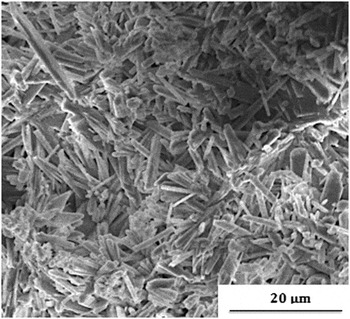
Gypsum (CaSO4·2H2O) is widely used in the building industry because of its unique microstructure of high porosity (49% of theoretical density (ρo = 2.31 g/cm3) 1,Reference Yu and Brouwers2 and characteristic submicrometer pores within a matrix of interlocking blade and needle shaped crystals. Reference Mahmoud, Rashad, Ibrahim and Abdel-Aal3,Reference Vekinis, Ashby and Beaumont4 As a result gypsum has good strength and excellent thermal and sound insulation properties. The microstructure and morphology of the gypsum crystals depends on the gypsum crystallization conditions, and the presence and type of chemical additives. The scanning electron microscopy (SEM) image of the gypsum microstructure in Fig. 1 shows that the plaster of Paris (CaSO4·½H2O) used in this study forms acicular and blade-shaped crystals of 10–20 µm in length by 1–2 µm in cross-section.
Microstructure of gypsum foamed from Hydrocal White gypsum (w/p = 0.6, mixing time = 1 min, mixing speed = 1000 rpm).

It is well known that both the thermal and sound insulation properties of a material can be improved by increasing the amount of porosity. Thus, numerous strategies have been explored for producing porous materials. The foaming process appears to be most amenable for making lightweight gypsum because a critical process step during gypsum formation is the production of a slurry containing plaster of Paris and water. Surfactant molecules are typically used to produce stable foams because they reduce the air–water interfacial energy and thus make it easier to form bubbles. Surfactants also serve as pore stabilizers by slowing foam collapse due to bubble coalescence. Reference Studart, Gonzenbach, Tervoort and Gauckler5–Reference Pugh and Holmberg7
Gypsum forms by the hydration of calcium sulfate hemihydrate; commonly known as plaster of Paris (CaSO4·½H2O). The reaction is exothermic and occurs as: Reference Vekinis, Ashby and Beaumont4
 $${\rm{CaS}}{{\rm{O}}_{\rm{4}}} \cdot {1 \over 2}{{\rm{H}}_2}{\rm{O}}\;{\rm{ + }}\;{{\rm{3}} \over {\rm{2}}}{{\rm{H}}_2}{\rm{O}}\; \to \;{\rm{CaS}}{{\rm{O}}_{\rm{4}}} \cdot 2{{\rm{H}}_{\rm{2}}}{\rm{O}}\quad.$$
It is generally understood that plaster of Paris dissolves in H2O by an endothermic process and gypsum crystallizes from a solution saturated with Ca2+ and SO4 2−. Reference Singh and Middendorf8
Plaster board is a commercial product produced by a foaming process but there are few peer reviewed papers about the effects of surfactants on the foaming process. Çolak studied the effect of anionic (sodium dodecyl sulfate) and nonionic (nonyl phenol ethoxylate) surfactants on the mechanical foaming of gypsum. Reference Çolak9 He found that foaming with a nonionic surfactant does not affect the bulk density, and that sodium dodecyl sulfate resulted in a 30–35% reduction in density. Reference Çolak9 Unfortunately, not many details, such as viscosity and pore structure, were provided to establish the processing-microstructure relationships of foamed gypsum. It is important to note that organic surfactant molecules can affect crystal growth, too. Mahmoud et al., showed that a cationic surfactant (cetyltrimethylammonium bromide) decreased the induction time for gypsum crystallization and increased the crystal growth rate by 45%. Reference Mahmoud, Rashad, Ibrahim and Abdel-Aal3 In contrast, the addition of an anionic surfactant (sodium dodecyl sulfate) increased the induction time and decreased the rate of gypsum crystal growth. Reference Mahmoud, Rashad, Ibrahim and Abdel-Aal3
In this paper we describe the factors affecting the formation of lightweight and highly porous gypsum with a homogeneous macropore size distribution. To achieve this goal, a direct-foaming technique with surfactants was studied. Since foams are usually unstable due to bubble coalesce and growth, it is important to stabilize the bubbles. The gypsum reaction can be used to stabilize macropores during foaming since the viscosity increases during the gypsum crystallization process. To quantify the reaction rate, we measured the viscosity and temperature of the plaster of Paris slurries during gypsum crystallization and correlated the consequent macrostructure, including pore size and density, with the process parameters of the foaming process. A limited number of experiments explored the effects of gypsum seed particles on gypsum crystallization and foam microstructure.
II. EXPERIMENTAL
A. Materials
Hydrocal White Gypsum Cement (United States Gypsum Company (USG), Chicago, IL) powder was used for this study. This plaster of Paris contains more than 99 wt% calcium sulfate hemihydrate and less than 1 wt% crystalline silica. We investigated the effects of (i) an anionic surfactant (sodium dodecyl sulfate, CH3(CH2)11OSO3Na2) (SDS) (Mallinckrodt Baker, Phillipsburg, NJ), (ii) a nonionic surfactant (polyoxyethylene sorbitan monooleate, C64H124O26) (referred to as P80 in this paper) (Tween 80, Sigma–Aldrich, Saint Louis, MO), and (iii) a cationic surfactant (benzethonium chloride, C27H42CINO2) (BC) (Alfa Aesar, Ward Hill, MA) on the macropore size and density of foamed gypsum.
B. Methods
1. Slurry foaming
A mechanical mixing method was used to directly foam the plaster of Paris slurry. This technique works by incorporating air into the plaster of Paris suspension during mixing and subsequently allowing it to set to maintain the structure of air bubbles created. Reference Mahmoud, Rashad, Ibrahim and Abdel-Aal3,Reference Studart, Gonzenbach, Tervoort and Gauckler5–Reference Pugh and Holmberg7,Reference Çolak9
Surfactant solutions were produced by mixing 0.1–1.7 wt% surfactant with deionized water at room temperature. For foaming, the dry plaster of Paris powder was mixed with a surfactant solution for 1 min at water to plaster ratios (w/p) of 0.5, 0.6, 0.7, and 0.8. To mix the dry powder with the surfactant solution, an electric blender (Model 9090, MiTutto, Miallegro Co., Doral, FL) fitted with an aerator blade was used. The mixing speed was varied from 300 to 1200 rpm. The foamed slurry was poured into a cylindrical silicone mold (14.3 mm diameter by 19.05 mm height), and allowed to set for 1 h in 60–70% relative humidity air at room temperature. After 1 h the samples were removed from the molds and dried under ambient conditions for 3 days.
2. Process monitoring
The temperature of each sample was recorded every minute for 1 h with a digital temperature probe after it was cast in the silicone mold. To determine how the rheology of the slurries changed as a function of process conditions we measured the slurry flow as a function of time using a Ford cup-type viscometer (Ford-4). 10,Reference Patton11 The measurement is based on recording the time required for the slurry to flow through a 4.12 mm diameter orifice in the bottom of the cup. Reference Patton11 For valid results the flow time has to be between 55 and 100 s and the kinematic viscosity must be in the range of 70–370 cSt (mm2/s). The kinematic viscosity in centistokes (cSt) was calculated from the flow time with Eq. (2).
 $$\nu = K\left( {t - c} \right)\quad,$$
where ν = kinematic viscosity (cSt), t = time of flow (s), K = 3.85 for a Ford-4 cup, c = 4.49 for a Ford-4 cup.
The dynamic viscosity (µ) was calculated from the kinematic viscosity by multiplying the kinematic viscosity times the fluid density (ρ):
 $$\mu = \nu \rho\quad.$$
3. Gypsum characterization
The macrostructure, the microstructure, and morphology of gypsum crystals were observed by scanning electron microscopy (FEI Quanta 200 Environmental SEM, FEI Company, Hillsboro, Oregon) after either carbon or gold coating a fracture surface of the sample cross section. The average pore size of the large pores (i.e., macropores) was determined by measuring the average intercept length of 200 pores and multiplying the average intercept length by 1.5. 12
The average bulk density (ρbulk) was determined for 5 samples after the gypsum samples were dried for 3 days, after which there was no further weight loss. The porosity (Φ) was calculated assuming a gypsum theoretical density of 2.31 g/cm3.
III. RESULTS AND DISCUSSION
A. Surfactant assisted foaming of plaster of Paris
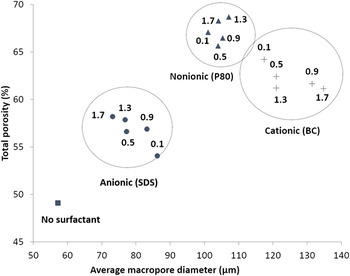
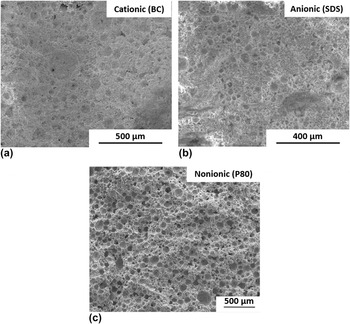
In a preliminary series of experiments we evaluated the effect of adding 0.1 to 1.7 wt% of the anionic, nonionic, and cationic surfactants on the foaming of plaster of Paris. When no surfactant was used (w/p = 0.6) the gypsum seen in Fig. 1 had a bulk density of 51% of theoretical or 49% porosity. In Fig. 2 we see that the total porosity of all foamed gypsums increased and that the 1.3 wt% P80 nonionic surfactant foamed gypsum had the highest porosity of 69%, or ∼20% additional porosity, relative to unfoamed gypsum. It is noted that in all cases the total porosity was not strongly affected by the surfactant concentration. When we compare the microstructures of the porous gypsums in Fig. 3, we see that the cationic and anionic foamed samples were composed of macropores of ∼120 and ∼77 µm average diameter, respectively, between the fine gypsum crystals and a few very large macropores of >100 µm diameter. In contrast the nonionic surfactant yields a porous gypsum consisting of nominally 100 µm, uniformly distributed macropores.
Effect of surfactant type and concentration on the total porosity and average macropore size of foamed gypsum (w/p = 0.6, mixing time = 1 min, and mixing speed = 1000 rpm).

Macrostructure of gypsum foamed with 1.3 wt% (a) cationic (BC), (b) anionic (SDS), and (c) nonionic (P80) surfactants (w/p = 0.6, mixing time = 1 min, and mixing speed = 1000 rpm).

Figure 2 shows the effect of adding 0.1 to 1.7 wt% of surfactant (i.e., P80) on the pore size of the foamed gypsum. The presence of as little as 0.1 wt% increases the porosity to 67% and the macropore size is 101 µm [Fig. 3(a)]. The porosity increases only a few percent and the macropore size is almost the same with the addition of more surfactant. Because there were not large differences as a function of surfactant concentration, we decided to use 1.3 wt% P80 in the following studies to investigate the effects of mixing speed, water/plaster ratio, mixing time, and rheology of the setting foam.
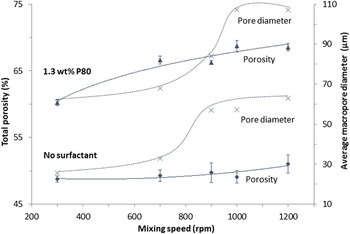
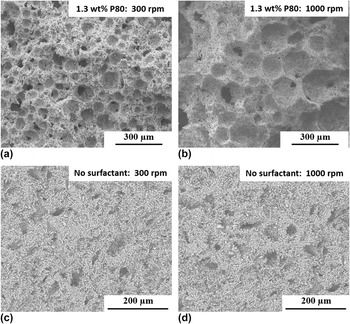
In Fig. 4 we compare the foaming of a slurry with w/p = 0.6 and 1.3 wt% P80 surfactant with a slurry with no surfactant as a function of mixing speed. Little macroporosity was incorporated into the gypsum at any speed when no surfactant was used (Fig. 5). In contrast the presence of 1.3 wt% P80 resulted in an increase of total porosity from 49 to 60% with only 300 rpm mixing speed and macropores of 61 µm were occluded in the gypsum. The maximum porosity of 69% and largest average macropore size of 107 µm were obtained by mixing at 1000 and 1200 rpm. Based on these results the mixing speed was fixed at 1000 rpm for subsequent studies.
Effect of mixing speed on the total porosity and average macropore size of foamed (1.3 wt% P80) and non-foamed gypsum (w/p = 0.6, mixing time = 1 min and mixing speed = 1000 rpm).

Macrostructure of (a, b) foamed (1.3 wt% P80) and (c, d) non-foamed gypsum mixed at 300 and 1000 rpm (w/p = 0.6 and mixing time = 1 min).

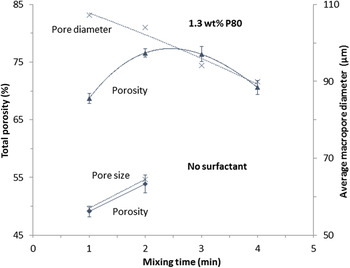
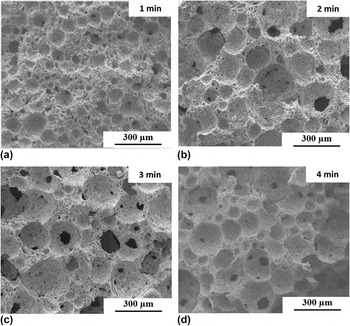
As seen in Fig. 6, increased mixing time had minimal effect on macropore size and porosity when no surfactant was used. When a w/p = 0.6 mixture with no surfactant was mixed at 1000 rpm for 2 min the slurry set and it was not possible to continue mixing. In contrast, the presence of 1.3 wt% P80 extended the setting time up to 4 min before it was no longer possible to stir the slurry. In the presence of the surfactant macropores of ∼107 µm were produced and the total porosity was 69% after one minute of mixing. The macropore size decreased to ∼90 µm after 4 min mixing time and the maximum porosity of ∼75%. The SEM micrographs in Fig. 7 show that as mixing time increases the macropore size distribution goes from a more uniform size distribution after 1 min of mixing to a broader size distribution of coarser macropores after 2 and 3 min of mixing. There appears to be a change from closed macropores after 1 min of mixing to interpenetrating open macropores with longer mixing time, which we attribute to bubble coalescence.
Effect of mixing time on the total porosity and average macropore size of foamed (1.3 wt% P80) and non-foamed gypsum (w/p = 0.6 and mixing speed = 1000 rpm).

Macrostructure of foamed gypsum using 1.3 wt% P80, mixing speed of 1000 rpm, w/p ratio of 0.6, and mixing time of (a) 1 min, (b) 2 min, (c) 3 min, and (d) 4 min.

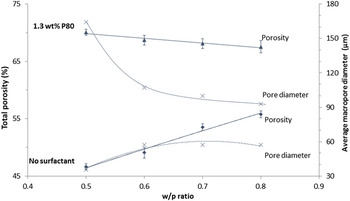
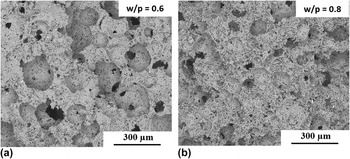
The effect of the w/p ratio on total porosity and macropore size is shown in Figs. 8 and 9. With increasing water content at high w/p ratio the fluidity of the slurry increases and the setting time is observed to increase. As a result we see that the total porosity decreases slightly with increasing w/p ratio but more interesting is the significant decrease in macropore size from 164 µm at w/p = 0.5–100 µm at w/p ≥ 0.6. This decrease in macropore size, as seen in Figs. 9(a) and 9(b), is attributed to the homogenization of the macropore structure as a result of the greater fluidity of the slurries with higher w/p ratios.
Effect of the w/p ratio on the total porosity and average pore size of foamed (1.3 wt% P80) and non-foamed gypsum (mixing time = 1 min and mixing speed = 1000 rpm).

Macrostructure of foamed gypsum using 1.3 wt% P80, mixing speed of 1000 rpm, mixing time at 1 min, and w/p ratio of (a) 0.5, and (b) 0.8.

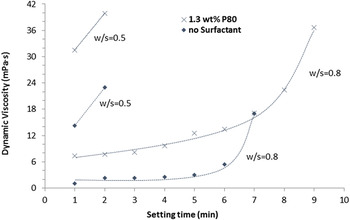
To quantify the effect of water content and surfactant on the fluidity and setting time of the slurry, we measured the viscosity of the slurries as a function of time (Fig. 10). The slurries were mixed for 1 min, with viscosity measurements made at 1 min intervals thereafter until the samples set. The viscosity of the slurry without surfactant with a w/p ratio of 0.5 is 14 mPa·s after the initial 1 min of mixing at 1000 rpm and in one more minute, without mixing, increases to 23 mPa·s at which point it can no longer be mixed. When a surfactant is added to the w/p = 0.5 slurry, the viscosity is 32 mPa·s after initial mixing and increases to 40 mPa·s in 1 min and the slurry sets up. At w/p = 0.8 the initial viscosities of the slurries with and without surfactant were 1.5 mP·s and 6.5 mPa·s, respectively, and the setting time in both cases was extended to 9 and 7 min with and without surfactant, respectively. The viscosities of both w/p = 0.8 slurries were 16 mPa·s after 7 min, but the slurry with no surfactant immediately set up whereas the slurry with the surfactant did not set for another 2 min.
Change in dynamic viscosity (µ) of foamed (1.3 wt% P80) and non-foamed gypsum (mixing time = 1 min and mixing speed = 1000 rpm) for slurries of w/p of 0.5 and 0.8.

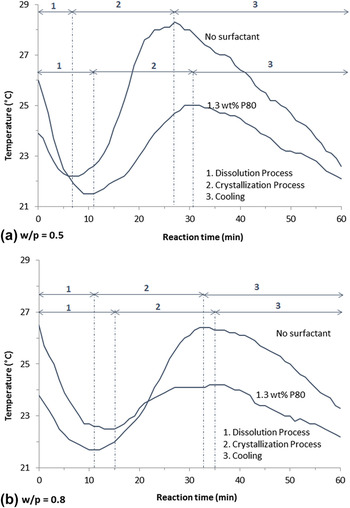
Gypsum crystallizes by the exothermic hydration of plaster of Paris. Thus, to monitor the formation of gypsum we continuously measured temperature after 1 min of mixing at 1000 rpm for plaster of Paris slurries with w/p = 0.5 and 0.8. Three distinct temperature zones are observed in Fig. 11: (i) a temperature decrease attributed to the initial endothermic dissolution of plaster of Paris, (ii) a temperature rise due the exothermic crystallization of gypsum, and (iii) a temperature decrease due to sample cooling. The minima and maxima temperatures indicate the net thermal balance of the nominally concurrent dissolution and crystallization processes, and thus are good indicators of the relative importance of each process during the reaction. In Fig. 11(a) it is observed that the surfactant results in a lower sample temperature and a significant decrease of ∼4 °C in the maximum temperature of the reacting system as well as a shift to longer time before the maximum temperature is recorded. These changes are consistent with the longer working time noted in Fig. 10. We see a similar effect for the slurry with w/p = 0.8 in Fig. 11(b). Here the maximum temperatures are lower for both samples relative to the w/p = 0.5 samples as a result of the increased amount of water involved in the overall system. Again, the maximum temperature, which is attributed to gypsum crystallization, is significantly less when the surfactant is present.
Change in foamed (1.3 wt% P80) and non-foamed gypsum temperature with reaction time. (a) w/p = 0.5 and (b) w/p = 0.8 (mixing time = 1 min, and mixing speed = 1000 rpm).

The above results in Fig. 11(a) indicate that the surfactant retards the rate of gypsum crystallization. The maximum temperature is observed after more than 20 min after the mixing stage but these samples are solid after only 1 min in the case of w/p = 0.5 and within 7–9 min for w/p = 0.8. Because the surfactant retards the rate of gypsum crystallization, the heat is generated over a longer period of time, and thus, the maximum temperature is lower than that when no surfactant is used. The extended working time results in a stabilization of a porous foamed gypsum that has a total porosity of 69% and a stabilized macropore size of 104 µm.
B. Gypsum seeding
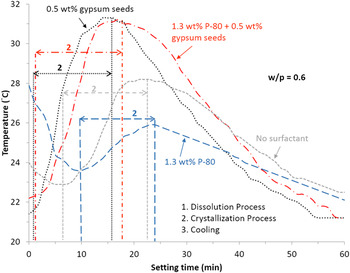
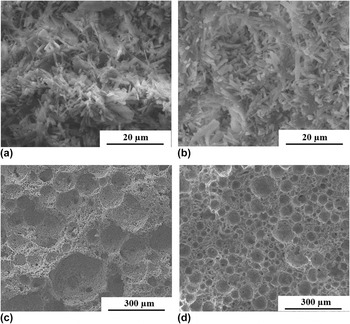
We analyzed the crystallization of gypsum in the presence of 1.3 wt% P80 and 0.5 wt% gypsum seed particles of 105 µm diameter. In the presence of gypsum seed particles, we observed that the first endothermic portion of the net reaction is no longer dominant and the induction time is much less (Fig. 12). Consequently, the gypsum crystallization process begins earlier, and it has a larger temperature difference in minimum and maximum temperature of 10 °C resulting in faster crystal growth, with a larger number of longer and thinner crystals (Fig. 13). The presence of the gypsum seed particles significantly accelerates gypsum crystallization relative to the plaster slurry with no surfactant and also when P80 is present. The only difference in these two cases is that in the presence of surfactant in the slurry, gypsum nucleation is slightly retarded with an induction time of 4 min. However, the 8 °C temperature difference during the exothermic crystallization reaction is still larger than for either unseeded slurry. Because of the similar thermal history of the two seeded slurries, they result in similar gypsum crystal size (Fig. 13).
Effect of gypsum seeding on reaction temperature for w/p = 0.6 (mixing time = 1 min and mixing speed = 1000 rpm).

Effect of gypsum seeding on foamed gypsum microstructure (a) no seeds (b) 0.5 wt% gypsum seeds, and gypsum foam macrostructure (c) no seeds and (d) 0.5 wt% gypsum seeds (1.3 wt% P80, mixing time = 1 min, mixing speed = 1000 rpm and w/p = 0.6).

In Fig. 13 we compare the macroporous structure of the gypsums foamed with 1.3 wt% P80 and the same slurry seeded with 0.5 wt% of gypsum seed particles. The porous structure obtained with the combination of P80 and gypsum seeds consists of homogenously distributed closed pores of 92 µm. In the case of the foam produced with P80 alone, the macropores are 104 µm and not as completely formed compared to the gypsum-seeded foam. The smaller macropore size of the seeded foam is likely a result of the more rapid rise in viscosity due to accelerated gypsum formation and thus less time for bubble growth.
IV. SUMMARY
This paper shows that a nonionic surfactant is effective in generating a lightweight gypsum foam during the mixing of a plaster of Paris slurry. The nonionic surfactant retards gypsum crystallization and thus extends the working time at higher w/p ratios. Gypsum foams with a bulk density of 0.73 g/cm3, or 32% relative density, and a relatively uniform macropore size of 104 µm were obtained. The porosity was increased by 40% relative to standard gypsum. Seeding the plaster slurry with only 0.5 wt% 100 µm gypsum particles was observed to significantly increase gypsum crystallization kinetics. Similar crystallization kinetics was observed when the plaster was both seeded and contained the surfactant. This combination of additives resulted in a highly stable macropore structure of closed spherical macropores of 92 µm.
ACKNOWLEDGMENTS
Elisabet Roch Isern's research was supported by the International Internship in Materials (IIM) program in the Department of Materials Science and Engineering at Penn State. She would like to acknowledge the advice and guidance of Dr. Elizabeth R. Kupp at Penn State and Dr. Guillermo Reyes Pozo of the University of Instituto Químico de Sarrià (IQS) in Barcelona (Spain) during her internship.