INTRODUCTION
Cancer has a huge impact on nearly every domain of people's lives due to its traumatic nature and severity. After being diagnosed with cancer, patients have to deal with a host of changes, not only ones with physical and psychological aspects, but also those related to the occupational, interpersonal, and spiritual realms (Aziz, Reference Aziz and Ganz2007; Lo et al., Reference Lo, Hales and Jung2014; Winger et al., Reference Winger, Adams and Mosher2015). The reason why cancer differs distinctively from other traumatic experiences lies in three factors. First, cancer patients suffer from a complex set of stressors (e.g., impaired health caused by the disease and treatments, changes in one's appearance, and decreased social participation), making it difficult to identify the specific source of stress (Sumalla et al., Reference Sumalla, Ochoa and Blanco2009). Second, due to the progressive nature of the disease, there is no clear onset and termination of the traumatic experience. Cancer patients are faced with ongoing uncertainty and an ever-present sense of threat to their lives (Murray et al., Reference Murray, Kendall and Boyd2004; White, Reference White2004). Third, compared with the experience of prior trauma, patients with cancer more often report having a “sense of a foreshortened future” (Bower et al., Reference Bower, Meyerowitz and Bernaards2005). Given the chronic threat, uncertainty, and vulnerability brought on by cancer, patients may feel that their beliefs and assumptions about the world have been shattered (Holland & Reznik, Reference Holland and Reznik2005). Under such circumstances, general coping strategies (e.g., problem coping, emotional coping) may not be sufficiently effective. Rather, individuals may be inclined to turn to meaning-focused coping for assistance (Park & Folkman, Reference Park and Folkman1997). Meaning-focused coping serves unique functions, beyond those of problem- or emotion-focused coping, in terms of adapting to traumatic disasters, including earthquakes (Gan et al., Reference Gan, Guo and Tong2012).
Numerous studies have demonstrated the essential role of fostering meaning in life in adjusting to and coping with cancer (Park, Reference Park2015). A recent metaanalysis revealed a negative association between meaning in life and distress in cancer patients, and this relationship is present across various medical and demographic groups (Winger et al., Reference Winger, Adams and Mosher2015). Interventions that facilitate meaning making in cancer patients can effectively alleviate psychological distress (Breitbart et al., Reference Breitbart, Rosenfeld and Gibson2010; van der Spek et al., Reference van der Spek, van Uden-Kraan and Vos2014a ; Reference van der Spek, Vos and van Uden-Kraan2014b ; Breitbart et al., Reference Breitbart, Rosenfeld and Pessin2015).
In the collectivistic culture of China, there has been increased attention to psychological nursing of individuals being treated for cancer. However, until recently, the psychological care provided has been limited to emotional support (Liu et al., Reference Liu, Mok and Wong2005). Most patients with cancer and their family members, even their doctors and nurses, deliberately avoid discussing the effects of the cancer on their belief systems and the way to cope with those effects. This practice is in part due to the social demand that patients must be resilient when coping with stress and show concern for others within the collectivistic culture (Tong et al., Reference Tong, Zhou and Yang2012). However, behind the facade of optimism there is a sense of hopelessness that resides deep in their hearts (Rustoen & Wiklund, Reference Rustoen and Wiklund2000).
Meaning-Making Process and Posttraumatic Growth in Cancer Patients
In the integrative meaning-making model, Park (Reference Park2010) posits that when a severe stressor violates an individual's beliefs or assumptions about the world and their personal goals, they will initiate meaning-making efforts to incorporate the current situation into their meaning systems so as to reduce such discrepancies. If the meaning-making effort is successful, individuals are able to find positive meaning in a traumatic experience. Therefore, the traumatic event can present an opportunity for positive change, which is termed a “meaning made.” One of the most important components of a positive meaning made is posttraumatic growth (PTG), including “improved relationships, enhanced personal resources and coping skills, and greater appreciation for life” (Tedeschi & Calhoun, Reference Tedeschi and Calhoun1996; Michael & Snyder, Reference Michael and Snyder2005; Phelps et al., Reference Phelps, Williams and Raichle2008; Gangstad et al., Reference Gangstad, Norman and Barton2009). It has been shown that posttraumatic growth improves the psychological health of cancer survivors. It has also been shown to buffer the impact of cancer diagnoses on adjustment, depression, and quality of life among breast cancer patients (Morrill et al., Reference Morrill, Brewer and O'Neill2008; Silva, Reference Silva2012).
Previous research in the field of oncology sustains the above-mentioned view of the meaning-making process. Many studies indicate that the effort of searching for meaning is prevalent in the context of cancer (Taylor, Reference Taylor1983; Tomich & Helgeson, Reference Tomich and Helgeson2002; Schroevers, Reference Schroevers2004; Kernan & Lepore, Reference Kernan and Lepore2009). On one hand, the meaning-making effort is associated with positive outcomes (e.g., adjustment, well-being, posttraumatic growth) when one attributes a positive meaning to the cancer experience (Baník & Gajdošová, Reference Baník and Gajdošová2014; Li et al., Reference Li, Yeh and Chen2015; Scrignaro et al., Reference Scrignaro, Bianchi and Brunelli2015). On the other, unsuccessful meaning-making efforts can lead to maladaptive rumination and increase psychological distress (Harper et al., Reference Harper, Schmidt and Beacham2007).
The intricate and inconsistent empirical findings reveal that the meaning-making effort by itself cannot be regarded as successful or unsuccessful. Rather, it is an individual's approach to the process that matters most. Individuals can thus expect positive outcomes from the meaning-making process only when they undergo this process in a reflective manner. However, the specific determinants of an effective meaning-making process are rarely investigated. Thus, exploring a specific strategy employed in the meaning-making process that promotes reflective meaning making and personal growth would be significant in terms of theory and practice.
Integrating Construal Level Theory into the Meaning-Making Process
Construal level theory (CLT) has been widely researched in the areas of social cognition and emotion regulation (Trope & Liberman, Reference Trope and Liberman2010; Kross & Ayduk, Reference Kross and Ayduk2011). According to CLT, people react to an event depending on its mental representation, whereby different levels of abstraction form corresponding levels of construal. High-level construal is relatively more abstract. Forming a high-level construal means transcending the “here and now” to adopt a broader and more comprehensive perspective. Numerous experimental studies have revealed that high-level construal can be primed by extending psychological distances along temporal, spatial, and social dimensions. Hypothetically, as mental distance increases, individuals will shift to a higher construal level and then focus on the core elements, enhancing coherence and consistency. Conversely, by decreasing psychological distance, individuals form low-level construal, whereby focus is directed toward subordinate information that is more concrete, complex, and dependent on the situation (Liberman & Trope, Reference Liberman and Trope2008; Reference Liberman and Trope2014; Soderberg et al., Reference Soderberg, Callahan and Kochersberger2015). It has been found that experiences of difficult or uncertain situations will prompt people to adopt high-level construal, which involves mentally stepping back from the situation and looking at the bigger picture (Marguc et al., Reference Marguc, Förster and van Kleef2011). For cancer patients, the event may seem to be extremely severe and beyond their comprehension. It is therefore difficult to integrate the event into their meaning systems by relying solely on their existing personal experiences. In order to adapt to this trauma or disease, comprehensive, novel, and alternative perspectives are needed.
There are several possible mechanisms for employing high-level construal in fostering adaptation to traumatic events. From the emotion-regulation perspective, when individuals adopt high-level construal by increasing psychological distance, they are more likely to inhibit negative emotion, focus less on the emotionally arousing details, and work through the event in a nonjudgmental and mindful way (Kross & Ayduk, Reference Kross and Ayduk2008; Watkins, Reference Watkins2008). This kind of cognitive processing directly reduces rumination and intrusive thoughts (Ayduk & Kross, Reference Ayduk and Kross2010). From the cognitive perspective, first, higher-level construal enables one to focus on essential information rather than concrete situational constraints in order to form a simplified representation of the event (Rim et al., Reference Rim, Hansen and Trope2013), which helps an individual to reevaluate the threats of the event more objectively, allowing them to view the problem as less difficult (Thomas & Tsai, Reference Thomas and Tsai2012), less threatening, and less uncertain (Namkoong & Henderson, Reference Namkoong and Henderson2014), which in turn will lead to enhanced coping efficacy and effective problem-focused coping (Ayduk & Kross, Reference Ayduk and Kross2010). Second, one's cognitive scope is expanded while gaining an elevated standpoint, which allows individuals to generate more creative ideas and resolutions to cope with their situations (Marguc et al., Reference Marguc, Förster and van Kleef2011), as well as to realize the resources and social support available to them, which are essential for personal growth. Given this context, we can assume that cancer patients may be better able to adjust to traumatic stress when employing high-level construal.
An in-depth look at a previous study demonstrating the effectiveness of high-level construal in emotion regulation and decision making in chronic trauma will help to further our understanding of coping with such severe long-term stress as is experienced with cancer. Galfin and Watkins (Reference Galfin and Watkins2012) found that palliative patients and their caregivers engage in more high-level construal thinking and experience more rumination than do age-matched controls. In addition, high-level construal thinking and rumination were correlated with patients' and caregivers' psychological distress. They claimed that abstraction may be a potential mechanism for increasing distress in palliative care. One problem with this research was its confounding of the concepts “abstraction” and “high-level construal.” In this context, dividing patients into different construal levels according to the content of their thoughts (i.e., how vs. why) is not sufficient. Instead, it is important to more clearly and specifically distinguish between the two concepts. For example, based on CLT's description of psychological distance adopted in meaning making, immersive abstract thinking corresponds with low-construal meaning making, while manners of self-distancing corresponds with high-level construal and meaning making. Going by this distinction, abstract thinking, which can be regarded as an attempt to search for meaning, can further develop in two directions. One possibility is that abstract thinking will induce a more maladaptive rumination. Another is that it will bring about a transcendent experience through self-distancing, leading to new insights into a situation.
The Present Study
The present study sought to determine the role of high-level construal in the meaning-making process among Chinese cancer patients and to explore whether detaching from a traumatic event and adopting a more abstract and high-level construal is an effective approach to finding positive meaning. The aforementioned possible mechanisms and outcomes of employing high-level construal in traumatic events provide the rationale for its use in the presently studied context. High-level construal could thus be a potential pathway between meaning-making effort and posttraumatic growth for integrating traumatic events into a patient's lives, for restoring coherence, and for strengthening the ability to find positive meaning in a traumatic experience. We therefore hypothesized that perceived discrepancies in meaning would be positively associated with meaning making and that high-level construal mediates the relationship between meaning making and posttraumatic growth.
METHODS
Participants and Procedure
The participants were 193 inpatients from the oncology department at Beijing Hospital. The criteria for inclusion were: (1) having been diagnosed with cancer, (2) having no other major disabling medical or psychiatric condition, and (3) being at least 18 years of age. Eligible cancer patients were identified by their doctors while they were receiving cancer treatment at the hospital. The potential participants were invited to join the study, and those who provided their consent to participate completed the questionnaires.
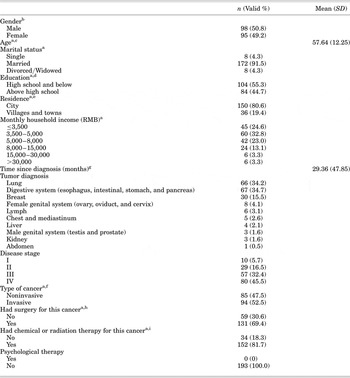
Institutional review board approval was obtained for the study protocol, and informed consent was obtained from all participants. Sociodemographic data on age, marital status, education, residence, and monthly household income were obtained by way of participant self-reports. We also collected cancer-related information from their doctors, including information on time since diagnosis, tumor location, and treatment history (see Table 1).
Demographics and clinical background of the sample

aVariable containing missing information: age (1, 0.5%); marital status (5, 2.6%); education (5, 2.6 %); residence (7, 3.6%); monthly household income (10, 5.2%); disease stage (17, 8.8%); type of cancer (14, 7.3%); had surgery for this cancer (3, 1.5%); had chemical or radiation therapy for this cancer (7, 3.6%).
bGender: 0 male, 1 female.
cAge, measured in years.
dEducation: 0 = high school and below, 1 = above high school.
eResidence: 0 = city, 1 = village and town.
fType of cancer: 0 = noninvasive, 1 = invasive.
gTime since diagnosis, measured in months.
hHad surgery: had surgery for this cancer: no = 0, 1 = yes.
iChemical or radiation therapy: had chemical or radiation therapy for this cancer: no = 0, 1 = yes.
Measures
Meaning Discrepancy
As in Park's (Reference Park2005) study, meaning discrepancy was assessed with scales designed to ascertain the extent to which patients appraised the disease as discrepant with their beliefs (e.g., “At present, how much does the disease interfere with the way you understand the world to work and the way things happen?”). The scale comprised five items, with response options ranging from 1 (not at all) to 5 (very much). The value of Cronbach's alpha for the scale was 0.75 in the present study.
Meaning Making
In the coping process of meaning making, individuals evaluate the meaning of an event or events. They grapple with answering such questions as “Why did this happen?” (Dollinger, Reference Dollinger1986) and “Why did this happen to me?” (Frazier & Schauben, Reference Frazier and Schauben1994). Accordingly, two similar items were designed specifically for our study to assess respondents' levels of searching for meaning (e.g., “I considered why the disease happened”). The respondents were instructed to rate their responses to the items on a scale from 0 (never) to 4 (all the time). The value of Cronbach's α for the four items was 0.87.
High-Level Construal in Meaning Making
Two items from the Meaning-Focused Coping Questionnaire (MFCQ; Gan et al., Reference Gan, Guo and Tong2012) were utilized to assess to what extent cancer patients had adopted high-level construal in their meaning-making process. These items were “I tried to consider the event from a broader point of view” and “I looked at the issue from a higher standpoint.” Items were rated on a 5-point Likert-type scale ranging from 0 (never) to 4 (all the time). The MFCQ was developed based on meaning-focused coping theory and has shown good psychometric properties in prior research on Chinese individuals who had experienced traumatic events (Guo et al., Reference Guo, Gan and Tong2011; Gan et al., Reference Gan, Guo and Tong2012). The value of Cronbach's α for these two items adopted from the MFCQ was 0.74 in our study.
Posttraumatic Growth (PTG)
The Posttraumatic Growth Inventory (PTGI) was used to assess perceived positive life changes as a result of cancer (Tedeschi & Calhoun, Reference Tedeschi and Calhoun1996). The 21 items were rated on a 5-point scale ranging from 0 to 5, with higher scores indicating greater PTG. The PTGI yielded a total PTG score and scores for five independent factors: strengthening of social relationships, new possibilities, perception of personal resources and skills, life appreciation, and spiritual development. The PTGI's Cronbach's α was 0.91 in our study.
All measures were administered in Chinese. The instruments were found to be psychometrically sound in Chinese. We followed a back-translation procedure to create the Chinese items.
Data Analysis
The data were analyzed with SPSS 19 and LISREL 8.8 statistical software. Descriptive statistics and frequencies were employed to characterize the sample. An independent samples t test was used to compare the differences between male and female patients on study variables. Pearson correlations were employed to determine associations between the study variables. We utilized the bootstrapping procedure recommended by Preacher and Hayes (Reference Preacher and Hayes2008) and the corresponding SPSS macro (model 6) to explore the multiple mediating role of meaning making and high-level construal in the relationship between meaning discrepancy and PTG. For this procedure, there were 5,000 bootstrap samples. The 95% bias-corrected bootstrap confidence intervals were generated for the indirect effects. A 95% confidence interval excluding zero indicated statistical significance at p < 0.05. Structural equation modeling (SEM) with maximum likelihood estimation was used to test the mediation model.
RESULTS
Descriptive and Intercorrelations
Table 2 presents the means, standard deviations, and correlations for the major variables measured in our study. The independent samples t test showed that male and female patients differed in terms of meaning making, high-level construal, and PTG. To be specific, women reported higher meaning making (M female = 7.06 ± 4.70, M male = 5.05 ± 4.39), high-level construal (M female = 3.80 ± 2.96, M male = 2.15 ± 2.34), and PTG (M female = 65.75 ± 20.43, M male = 55.14 ± 22.06) than men [t(191) = 3.07, p < 0.01, Cohen's d = 0.44; t(179) = 4.28, p < 0.001, Cohen's d = 0.64; t(191) = 3.46, p < 0.01, Cohen's d = 0.50].
Means, standard deviations, and correlations among variables (N = 193)

***p < 0.01.
A higher level of discrepancy in meaning was significantly related with more meaning making. Meaning making was positively associated with high-level construal. In addition, PTG was positively associated with meaning making and high-level construal, but it was not significantly correlated with meaning discrepancy.
Mediation Analysis
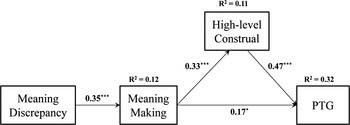
We performed a bootstrapping analysis to confirm the proposed model in which meaning discrepancy was associated with meaning making, and in which high-level construal mediated the relationship between meaning making and PTG (Figure 1). These results showed the significant indirect effect of meaning discrepancy on PTG via meaning making (β = 0.06, SE = 0.03, CI 95% = [0.01, 0.12]), and the indirect effect of meaning making on PTG through high-level construal and strengthening of beliefs was significant (β = 0.06, SE = 0.02, CI 95% = [0.03, 0.10]). These results did not change when the demographic variables (e.g., gender, age, time since diagnosis, disease stage) were controlled. Thus, high-level construal had a significant mediating effect on the relationship between meaning making and PTG.
Path model of the relationships among meaning making, high-level construal, strengthen global beliefs and PTG.

We then employed structural equation modeling (SEM) to test the mediation model. The fit indices were as follows: χ2 = 27.58, df = 17, χ 2/df = 1.62, RMSEA = 0.06, CFI = 0.99, GFI = 0.97, TLI = 0.98. According to the criteria for goodness of fit (Hu & Bentler, Reference Hu and Bentler1999), the proposed model fit the present data well.
DISCUSSION
The present study explored the meaning-making process among Chinese cancer patients. We focused on the role of a specific variable—high-level construal—in the meaning-making process to determine whether it served as a potentially effective function that helped participants find positive meaning in their experiences. In the final analysis, our hypotheses were supported by the results obtained.
As Frankl (Reference Frankl1963) has noted, individuals possess the need or desire to search for meaning in their suffering. Meaning-making theory also posits that individuals' beliefs are seriously impacted when a traumatic event occurs, and they will try to rebuild their meaning systems through the meaning-making process (Park & Folkman, Reference Park and Folkman1997; Park, Reference Park2010). This phenomenon was confirmed in our research. Cancer patients engaged in meaning-making efforts when they felt a discrepancy between their meaning systems and the current situation, which was in line with previous findings in the context of cancer (Park & Folkman, Reference Park and Folkman1997).
Consistent with our hypotheses, high-level construal mediated the association between meaning making and posttraumatic growth. In particular, meaning making prompted high-level construal, which in turn was positively associated with PTG. The results validated recent findings that meaning making results in positive outcomes when accomplished in an adaptive and constructive fashion (Park et al., Reference Park, Edmondson and Fenster2008; Boyraz et al., Reference Boyraz, Horne and Sayger2010; Park, Reference Park2010). This finding demonstrated that construal level theory can be tested on a population suffering from severe chronic trauma, and that shifting to high-level construal should be considered an important pathway between meaning-making efforts and positive meaning. Recent research has consistently identified the negative effects of avoidant coping strategies in adaptation to cancer. The more patients adopt avoidance coping, the greater their psychological distress and the less their personal growth (Roberts et al., Reference Roberts, Czajkowska and Radiotis2013; Baník & Gajdošová, Reference Baník and Gajdošová2014). In contrast, shifting to high-level construal allows people to continue analyzing their situation with less emotional arousal and to adopt more effective and proactive coping strategies (Kross & Ayduk, Reference Kross and Ayduk2008).
Researchers exploring the relationship between abstract thinking and distress have previously inferred that high-level construal may potentially function to increase distress in palliative patients (Galfin & Watkins, Reference Galfin and Watkins2012). However, this would represent only one side of the coin, because psychological distress and positive change often co-occur. Cancer patients have been reported to show both symptoms of traumatic stress and posttraumatic growth (Tedeschi & Calhoun, Reference Tedeschi and Calhoun2004; Jim & Jacobsen, Reference Jim and Jacobsen2008; Baník & Gajdošová, Reference Baník and Gajdošová2014). Indeed, experiencing some level of distress is necessary in order to realize personal growth after traumatic events (Kashdan & Kane, Reference Kashdan and Kane2011). Based on the abovementioned notions, our research provided a more comprehensive understanding of the role of high-level construal in coping with cancer by exploring its effects on positive change.
Thus, the current research suggests that high-level construal is an important process that bridges the gap between meaning-making efforts and posttraumatic growth. Assisting cancer patients to adopt higher-level construal may be beneficial in adapting to the cancer experience.
Implications for Practice
The present study integrated construal level theory into the meaning-making process with regard to the trauma of cancer. We chose to examine high construal level in meaning making, not only for novelty, but also for the rich implications of high construal levels in cancer care. To date, various meaning-based treatments—such as meaning-centered psychotherapy, dignity therapy, and managing cancer and living meaningfully (CALM) therapy—have been established and are recognized as effective interventions that address spiritual distress in advanced cancer patients and their families (Houmann et al., Reference Houmann, Chochinov and Kristjanson2014; Lo et al., Reference Lo, Hales and Jung2014; Breitbart et al., Reference Breitbart, Rosenfeld and Pessin2015). These existing meaning-centered interventions primarily emphasize the enhancement of meaning in life (MIL). By contrast, the factor of sense of coherence (SOC) has not received sufficient attention. Based on the findings of recent metaanalytic research, the relationship between SOC and distress is comparatively stronger than that between MIL and distress. This result may explain why meaning-centered interventions have a strong effect on MIL and a moderate effect on mental distress, and may shed light on the significance of newly targeting SOC in the current meaning-centered therapies (Winger et al., Reference Winger, Adams and Mosher2015).
According to a previous theoretical review, forming high-level construals would directly affect the ability to abstract and increase spiritual insights into the circumstances of life. Thus, incorporating such tactics in order to target SOC may enhance the benefits of meaning-centered interventions. High-level construal is a suitable target for intervention as it is easily practiced. Aside from the temporal distance traversed, which is somewhat similar to the “life history” component in the meaning-centered psychotherapy and dignity therapy (Breitbart et al., Reference Breitbart, Rosenfeld and Gibson2010; Houmann et al., Reference Houmann, Chochinov and Kristjanson2014), one can also mentally traverse spatial and social distances, or engage in counterfactual thinking (Liberman & Trope, Reference Liberman and Trope2014). It seems encouraging to know that adopting such a high construal level could be included as part of the psychological interventions provided when individuals are faced with such traumatic events as cancer. For cancer patients and their caregivers, the current study helps us to understand the beneficial nature of meaning making and its associated psychological growth processes.
LIMITATIONS AND DIRECTIONS FOR FUTURE RESEARCH
Some limitations of this study must be noted. First, its cross-sectional design limits a complete understanding of the mediation model of meaning making and the establishment of a causal relationship between high-level construal and posttraumatic growth. Further, it remains unknown as to whether high-level construal has long-term effects. A longitudinal study is required to determine its longer-term effects in addition to those of meaning making. Second, all of the measures were self-reported, and evaluations of meaning discrepancies were retrospective. Common method variance may explain some of the observed relationships and may have led to potentially misleading results. Following the recommendations of Podsakoff et al. (Reference Podsakoff, MacKenzie and Lee2003) to limit and assess common-method variance, we conducted Harman one-factor tests as a statistical remedy. The results of confirmatory factor analysis showed that the one-factor model did not fit the data well (χ2 = 88.74, df = 20, RMSEA = 0.13, CFI = 0.94, NFI = 0.92, GFI = 0.90). Therefore, common method variance did not appear to be a significant problem in our study. Third, the sample was composed of patients who were willing to answer the questionnaire and face their disease, which limits the generalizability of our results to those who are reluctant to participate in such a study. Thus, more prospective studies are needed in order to better understand the influence of high-level construal or self-distanced perspective on posttraumatic growth. Finally, considering the partial mediating effect of high-level construal on the relationship between meaning making and PTG, we infer that there might be other functions by which the meaning-making process can promote positive change that were not measured in our current study. Therefore, future research needs to examine other such concrete and effective factors.
ACKNOWLEDGMENTS
We wish to thank Xin Ma, Ying Feng, and Ying Li for their help with the data collection. Our work was supported by the National Natural Science Foundation of China (project number 31271094).