Introduction
In the UK sheep industry, the majority of lamb deaths occur within the neonatal period, and are associated with poor vigour, such as an extended time taken to stand after birth (Alexander, Reference Alexander1958; Owens et al., Reference Owens, Bindon, Edey and Piper1985; Slee and Springbett, Reference Slee and Springbett1986). Recent investigations in both humans and animals have examined the potential of using long-chain n-3 fatty acids (FAs) in maternal diets during late pregnancy, to improve neonatal vigour and vitality. Long-chain n-3 FAs, particularly docosahexaenoic acid (DHA; 22:6n-3), are required for many specific structural and metabolic functions in the body and are found in high concentrations in brain tissue (O’Brien and Sampson, Reference O’Brien and Sampson1965; Makrides et al., Reference Makrides, Neumann, Byard, Simmer and Gibson1994; Innis, Reference Innis2000; Carlson, Reference Carlson2001). DHA may be synthesised from its precursor, α-linolenic acid (LNA) via eicosapentaenoic acid (EPA), and is thought to be selectively transported across the placenta (Haggarty et al., Reference Haggarty, Page, Abramovich, Ashton and Brown1997; Dutta-Roy, Reference Dutta-Roy2000). It remains unclear whether endogenous synthesis of DHA is always adequate to meet the needs of the developing neonatal brain (Bowen and Clandinin, Reference Bowen and Clandinin2005).
The period of rapid brain growth in the ovine foetus occurs between 10 and 6 weeks prior to birth (Passingham, Reference Passingham1985; Turley et al., Reference Turley, Burns, Rosenfeld and Dietschy1996), suggesting that this might be the time when a readily available source of DHA would be most beneficial. Recent work has shown that feeding fish oil, as a source of long-chain n-3 FAs, during gestation improved the viability of the neonate in monogastric (Rooke et al., Reference Rooke, Sinclair and Edwards2001) and in ruminant animals (Dawson and Edgar, 2005; Capper et al., Reference Capper, Wilkinson, Mackenzie and Sinclair2006). However, the importance of period of inclusion of n-3 FAs in gestation diets has not yet been thoroughly explored.
Previous investigations in this area have mainly used fish oil as the source of long-chain n-3 FAs in livestock diets. Currently in the UK the use of fish oil in ruminant diets is permitted but there are concerns over the sustainability of using fish stocks for animal feeds (FIN, 2006).
This study sought to explore the effects on neonatal lamb vigour of feeding an algal source of n-3 FAs, with a relatively high level of DHA, to sheep at different times during late pregnancy. The study was structured to determine whether there is a specific time window in foetal development when more limited DHA supplementation would have comparable effects on lamb vigour to longer feeding periods.
Materials and methods
Animals and housing
In all, 48 North of England mule ewes, with known conception date and scanned as carrying twins, were chosen from a lowland flock. They were housed 10 weeks prior to expected lambing date, in an open-fronted strawed shed, in four treatment groups of 12 ewes. At parturition, ewes were moved to individual lambing pens, and remained there with their lambs for at least 24 h, until lambs were deemed strong enough to be moved with their mothers into group pens.
Experimental design and treatments
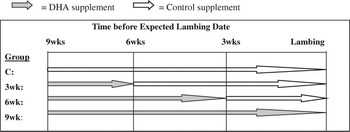
The 48 ewes were allocated between four treatments on the basis of conception date and breed of terminal sire at mating, balanced for weight and condition score. Ewes were fed a basal diet of silage and a commercial ewe concentrate feed, combined with either a control supplement or one containing algal biomass (spray-dried product from Crypthecodinium cohnii, provided by Advanced Bionutrition, MD, USA) to provide 12 g DHA/ewe per day. Ewes were given 7 days to acclimatise to basal forage and concentrate diet before being introduced to the experimental supplements. The four treatment groups were (Figure 1): ewes fed solely on the control supplement for 9 weeks prior to lambing (C); ewes fed the DHA supplement for the first 3 weeks of the trial (3 week) then the control supplement until lambing; ewes fed the DHA supplement for the first 6 weeks of the trial (6 week) and then the control supplement until lambing; and those receiving DHA supplement for 9 weeks until lambing (9 week). After parturition all ewes received the basal silage and standard concentrate diet.
Diagrammatic representation of treatment groups, showing periods of n-3 supplementation.

Diets
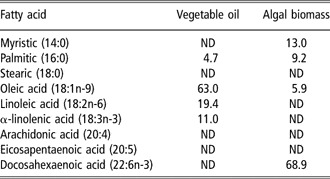
Ewes were offered grass silage ad libitum, with a dry matter (DM) of 25.5%, 68.7% digestibility, 13.8% crude protein and 11 MJ/kg DM of metabolisable energy. A standard concentrate ration was fed according to a scale ranging from 350 to 600 g/ewe per day fresh matter relating to stage of gestation. When feed increased to 600 g/ewe per day the concentrates were split between a morning (1000 h) and an afternoon feed (1600 h). The composition of the ewe concentrate feed, which was mixed on farm as follows: 27.5% barley, 25% sugar beet pulp, 22.5% soya, 15% maize, 7.5% molasses and 2.5% minerals. The DHA supplement consisted of algal biomass (64 g/ewe per day), to provide 12 g DHA and molasses (20 g/ewe per day) to balance carbohydrate and water, which were mixed with the standard concentrate for DHA treatment groups. Control diets consisted of standard concentrate plus vegetable oil (Vegetable oil, Tesco Ltd, Hertfordshire, UK; 32 g/ewe per day) to balance the lipid content. The major FAs present in each lipid source are listed in Table 1.
Fatty acid composition (g/100 g total fat) of vegetable oil and algal biomass

ND = not detected.
Experimental procedures
Silage feed intake measurements were taken daily during the experimental period by weighing the silage offered, and the amount remaining in the trough prior to the next feed. Samples of silage, concentrate and algal biomass were also taken weekly throughout the trial. Ewe blood samples were obtained prior to introducing the experimental supplements and on a 3-weekly basis thereafter. All blood samples were taken from the jugular vein, using heparinised vacutainers (Becton-Dickinson Ltd, Coventry, UK), and centrifuged for 15 min at 3000 × g for plasma collection. During the expected lambing period ewes were monitored on a 24-h basis. Ewes that failed to give birth within 1 h after the onset of labour were examined and assisted if necessary. The level of assistance given to an ewe at birth was recorded on a scale from 0 to 3 (no assistance, light, moderate and intensive assistance, respectively), depending on the extent of the problem and the force required to correct it. The time of each birth was recorded and a 10 ml colostrum sample was collected from the ewe. Lambs were monitored during the maternal bonding period and the time recorded when each lamb first stood (on all four feet for more than 10 s). After standing, each lamb was weighed and a blood sample (5 ml) was taken by jugular venepuncture. Lambs were then tagged for identification before being returned to their mother and allowed to suckle naturally. Blood samples (5 ml) were taken prior to the next concentrate feeding time from ewes that had lambed in the previous 24 h. At 24 h after birth, lambs were weighed and another blood sample was taken. Lamb weights were obtained at 2, 5, and 12 weeks after birth, and again at weaning.
Analytical procedures
FAs were extracted from supplements, plasma and colostrum samples using a modified version of a lipid isolation method (Sukhija & Palmquist, Reference Sukhija and Palmquist1988) in which the fats were extracted into a methanol/toluene solution containing an added internal standard (C:17). FAs were methylated using acetyl chloride at 100°C for 1 h. The supernatant was then separated after centrifugation at 1000 × g. FA profiles were obtained using gas liquid chromatography, using a 30 m BPX70 capillary column (SGE Europe Ltd, Milton Keynes, UK) on a Hewlett Packard 5890 Series 2 chromatograph (Hewlett Packard, Waldbronn, Germany). The initial temperature of the column was 100°C, where it was held for 2 min before being raised to 260°C where it was held for a further 1 min, and then returned to the initial temperature. FA concentrations were determined with reference to the internal standard concentration, expressed on a mass basis for each sample.
Statistical analysis
Treatment means were compared using analysis of variance (ANOVA). Level of assistance at birth was included as a factor in the general linear model to identify the effects of treatment on lamb latency to stand. Student’s paired t-tests were used to analyse differences between FA data from lambs at birth and 24 h later. Both ANOVA and Student’s paired t-tests were performed using Minitab v. 13 (Minitab Inc., State College, PA, USA). Correlations between ewe and lamb plasma FA concentrations at birth, and between ewe blood DHA concentrations and lamb time to stand after birth, were analysed using Minitab v. 13 (Minitab Inc.).
Results
Ewe silage intakes decreased towards lambing and averaged 3.9 kg of fresh weight per day during the 9 weeks prior to parturition, with no indication of effects of DHA inclusion. There was a trend towards increased gestation length with increased exposure to DHA (P = 0.08), compared with C ewes (Table 2). There were no significant differences in lamb birth weight between groups, either with or without the inclusion of gestation length as a covariate. Latency to stand was reduced in lambs from ewes receiving prolonged DHA supplementation (P < 0.05). There was an overall trend for lambs born from ewes with longer gestation lengths to stand more quickly; however, this was not significant (P = 0.08). Lamb growth rates to 5 weeks of age did not differ significantly between treatments.
Effects of the different feeding treatments on gestation length and measures of lamb viability

abcdValues in a common row with different superscripts are significantly different.
†With adjustment for level of assistance at parturition (P < 0.005).
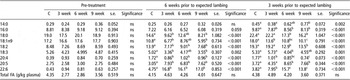
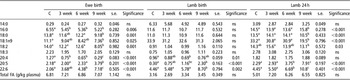
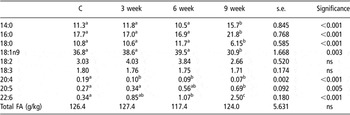
Blood plasma samples taken prior to dietary treatment showed no differences between treatment groups for total FA concentration or individual FA concentrations (Table 3). Three weeks after inclusion of dietary supplements (6 weeks prior to lambing), at which point all but the control group were receiving DHA, significant differences in plasma FA concentrations were found (Table 3). The concentration of EPA and DHA in plasma collected from ewes during gestation (Table 3) and at lambing (Table 4) was elevated in proportion to the length of time that the DHA diet had been fed. Ewes receiving the control diet during gestation tended to have higher plasma concentrations of the FAs associated with vegetable oil. Concentrations of palmitic, stearic, oleic, linoleic (LA) and arachidonic acids (AAs), were all elevated in ewes receiving the control diet, compared with those receiving DHA (Tables 3 and 4).
Fatty acid composition of Ewe blood plasma (g/100 g Total Fat) during gestation

14:0 = Myristic acid; 16:0 = palmitic acid; 18:0 = stearic acid; 18:1n9 = oleic acid; 18:2 = linoleic acid (n-6); 18:3 = α-linolenic acid (n-3); 20:4 = arachidonic acid (n-6); 20:5 = eicosapentaenoic acid (n-3); 22:6 = docosahexaenoic acid (n-3).
abcValues in a common row with different superscripts are significantly different.
Fatty acid composition (g/100 g Total Fat) of ewe blood plasma at birth and lamb blood plasma at birth and at 24 h

14:0 = Myristic acid; 16:0 = palmitic acid; 18:0 = stearic acid; 18:1n9 = oleic acid; 18:2 = linoleic acid (n-6); 18:3 = α-linolenic acid (n-3); 20:4 = arachidonic acid (n-6); 20:5 = eicosapentaenoic acid (n-3); 22:6 = docosahexaenoic acid (n-3).
abcValues in a common row with different superscripts are significantly different.
In accordance with the concentration of FAs in plasma, DHA and EPA concentrations in colostrum also showed graded increases in ewes fed DHA (Table 5). Lambs born to ewes from the 9-week group had elevated concentrations of DHA and EPA in their plasma at birth (Table 4). Lamb plasma total FA concentrations at birth were significantly lower than those taken at 24 h (mean birth = 3.2 g/kg total FA; mean 24 h = 6.4 g/kg total FA; s.e. = 0.46, P < 0.001). Lamb 24 h plasma DHA and EPA concentrations were higher for lambs born from the 6-week and 9-week groups (Table 4), and again corresponded with the length of time for which ewes received the DHA diet. At birth, significant positive correlations were found between ewe and lamb plasma DHA (r = 0.40, P = 0.012) and EPA (r = 0.83, P < 0.001) concentrations.
Fatty acid composition of ewe colostrum (g/100 g total fatty acid) after birth

14:0 = Myristic acid; 16:0 = palmitic acid; 18:0 = stearic acid; 18:1n9 = oleic acid; 18:2 = linoleic acid (n-6); 18:3 = α-linolenic acid (n-3); 20:4 = arachidonic acid (n-6); 20:5 = eicosapentaenoic acid (n-3); 22:6 = docosahexaenoic acid (n-3).
abcValues in a common row with different superscripts are significantly different.
There were no significant overall correlations between lamb or ewe plasma DHA concentrations at birth and lamb time to stand after birth. However, there was a tendency for ewes with higher DHA concentrations at 3 weeks pre partum to give rise to lambs, which stood more quickly after birth (r = 0.28, P = 0.074).
Discussion
The present experiment examined the effects of feeding DHA, from a sustainable algal source, to gestating ewes on measures of lamb viability. While DHA passage through the rumen, from an algal source, is known to occur (Sinclair et al., Reference Sinclair, Cooper, Chikunya, Wilkinson, Hallett, Enser and Wood2005), the efficiency of transfer remains unclear due to a lack of studies. Yet the effects of dietary treatment on extending gestation length, and elevating ewe plasma and colostrum EPA and DHA concentrations, confirm that significant amounts of n-3 FAs from the algal biomass were available to the maternal tissues. Also, corresponding elevations in ewe and lamb plasma DHA and EPA concentrations at birth suggest that transplacental transfer had taken place.
Extension of gestation length by feeding long-chain n-3 polyunsaturated FAs has been found in previous studies in sheep (Baguma-Nibasheka et al., Reference Baguma-Nibasheka, Brenna and Nathanielsz1999; Pickard et al., 2004) and other species (Olsen et al., Reference Olsen, Hansen, Sorensen, Jensen, Secher, Sommer and Knudsen1986), and is thought to be associated with a reduction in the synthesis of two series prostaglandins, due to increased EPA concentrations (Lands, Reference Lands1986; Abayasekara and Wathes, Reference Abayasekara and Wathes1999). However, studies of prostaglandin production following n-3 supplementation are not always consistent (Honstra et al., Reference Honstra, van Houwelingen, Kivits, Fischer and Uedelhoven1990; Trebble et al., Reference Trebble, Wootton, Miles, Mullee, Arden, Ballinger, Stroud, Burdge and Calder2003); therefore, further investigation into the causes of increased gestation length may be required.
Inclusion of DHA-rich algal biomass in the maternal diet resulted in an increase in the concentration of EPA and DHA in both maternal and neonatal blood plasma. This occurred despite the absence of EPA in the algal biomass and is likely to be the result of retroconversion of DHA to EPA as suggested by Barclay et al. (Reference Barclay, Abril and Abril1997). These elevations in blood EPA and DHA concentrations are in agreement with work by Cooper et al. (2002) who examined the effects of feeding a 50 : 50 mix of DHA-rich algae and fish oil to wether lambs. Their work showed that plasma DHA and EPA concentrations were increased to a greater extent when algal biomass was included, than by feeding fish oil alone; however, no quantitative data on DHA intake or transfer were provided.
Ewe plasma LA and AA concentrations at birth were significantly lower for ewes from the 9-week treatment group compared with ewes from the C group. This is attributable to the provision of approximately 6 g/ewe per day LA, a precursor of AA, via the vegetable oil, compared with none via the algal biomass. Elevated plasma concentrations of LA in the groups receiving vegetable oil (C, 3 week and 6 week) were associated with significantly higher AA concentrations, despite AA being absent from the vegetable oil. Elmes et al. (Reference Elmes, Tew, Cheng, Kirkup, Abayasekara, Calder, Hanson, Wathes and Burdge2004) also fed maternal diets differing in LA (3 v. 0.16 g/ewe per day) and showed significantly increased concentrations of AA in ewe and lamb plasma at the end of gestation at the higher inclusion rate. In the present study, while the ewes show a graded increase in plasma concentrations of LA and AA with increased periods of receiving vegetable oil, this trend was not mirrored in the lambs. There were no differences in lamb LA concentrations, and the concentration of AA in plasma pre-suckling differed only between the C and 6-week groups. It is doubtful whether ewes receiving DHA for an extended period were deficient in AA, rather that ewes in the C group were able to manufacture AA more readily from the control supplement. Ewe plasma and colostrum concentrations of stearic acid were also elevated in ewes from the C group, even though stearic acid was absent from the vegetable oil supplement. This is attributable to biohydrogenation of oleic acid, from the control supplement, generating increased concentrations of stearic acid.
Concentrations of EPA and DHA in sheep colostrum (Capper, 2005) and milk (Kitessa et al., Reference Kitessa, Peake, Bencini and Williams2003) have been significantly increased by supplementing the diet with fish oil, and in one previous study by feeding algal biomass for a 3-week period before lambing (Pickard et al., 2004). The proportion of DHA in colostrum was of a similar order to that described by Capper (2005), although the total fat content of colostrum was higher in the current experiment. This may be due to samples being taken immediately after birth in this experiment, compared with 12 h later in the study described by Capper (2005). In previous work, DHA supplementation from fish oil reduced milk yield, both in situations where fish oil supplementation ceased at parturition (Annett et al., 2004; Dawson and Edgar, 2005; Capper et al., Reference Capper, Wilkinson, Mackenzie and Sinclair2006) and extended into lactation (Capper, 2005). Capper (2005) also found that lamb growth rates to 4 weeks were reduced. However, this was not the case in the present study, where lipid supplementation ceased at the time of parturition and was not provided by fish oil. DHA and EPA appear to have been successfully transferred via colostrum since the concentrations of these FAs in lamb plasma at 24 h after birth were higher than those found in lamb plasma taken prior to suckling. Lamb weight gain within the first 24 h after birth was noticeably, although not significantly, lower in the 6-week group compared to the other treatment groups. There is no obvious reason why such an effect would occur and lamb growth rates in the 6-week group recovered by 5 weeks of age.
Ewes fed algal biomass for 9 and 6 weeks gave birth to lambs that stood more quickly after birth than those born to ewes in the 3-week and C groups. A similar effect was suggested, but not statistically demonstrated, in the study by Capper et al. (Reference Capper, Wilkinson, Mackenzie and Sinclair2006), who fed a fish oil-supplemented diet (providing approximately 4 g DHA and 4 g EPA/ewe per day) for 6 weeks prior to parturition. The mechanism responsible for this effect, and the optimal level of DHA for its expression, requires elucidation. The amount of DHA provided daily was greater in the current experiment than that of Capper et al. (Reference Capper, Wilkinson, Mackenzie and Sinclair2006), and subsequent work suggests that lamb vigour may be improved by feeding 6 g DHA/ewe per day (Gentle et al., 2006). A link between reduced time taken by lambs to stand after birth and increased gestation length, caused by supplementing maternal diets with n-3 FAs, has been suggested by Capper (2005). However, there are contradictory data (Pickard et al., 2004) where gestation length has been increased with no effect on lamb latency to stand. Study of lipid accumulation in prenatal monogastric brain tissues within the last trimester of pregnancy (Svennerholm, Reference Svennerholm1968; Green et al., Reference Green, Glozman, Kamensky and Yavin1999) shows that DHA concentrations increase rapidly during brain development. A study of rat brain lipids (Favreliere et al., Reference Favreliere, Barrier, Durand, Chalon and Tallineau1998) demonstrates that DHA is not evenly distributed throughout the brain, and is more concentrated in the cerebellum, the area of the brain responsible for autonomic motor neural activity. It is possible that DHA supplementation during gestation may be beneficial to the development of brain cell membranes within the cerebellum, and hence lead to improved locomotive behaviour. While the FA composition of neonatal tissues such as brain was not determined in this experiment, a difference in lamb plasma DHA concentrations at the time of birth indicates that transplacental transfer had taken place. Analysis by Capper et al. (Reference Capper, Wilkinson, Mackenzie and Sinclair2006) suggests that new-born lambs displaying increased plasma DHA concentrations also have elevated brain DHA concentrations.
Time taken to stand was not significantly decreased by the 3-week treatment in this experiment, or by supplementation for the 3 weeks immediately prior to lambing as reported in an earlier experiment (Pickard et al., 2004), suggesting that this limited period of DHA supplementation was insufficient to influence motor activity, even when focussed on a likely developmental window. This may be partially explained by the tendency for ewe blood DHA concentrations at 3 weeks prior to lambing to be inversely correlated with the time taken for lambs to stand after birth, while this was not the case at 6 weeks prior to lambing. Further studies are required to clarify whether this indicates that there is a later developmental period that may be sensitive to n-3 supplementation.
Conclusions
Dietary supplementation of ewe diets during late gestation with an algal source of DHA can improve lamb vigour, as reflected by a reduced time taken by lambs to stand after birth. There appears to be a threshold for this effect depending on either the total duration of supplementation or the specific time period. The mechanism by which n-3 FA supplementation influences vitality requires further investigation.
Acknowledgements
We thank the staff at Cockle Park Farm and the CEGS laboratory for technical assistance, and ABN (Europe) Ltd and the Yorkshire Agricultural Society for financial support.