I. INTRODUCTION
As device scaling has developed beyond the 0.25- to 0.18-μm node, Resistance-Capacitance (RC) delay in the backend interconnect has become an obstacle.Reference Bohr1 To alleviate this problem, copper was first implemented. Later, low-dielectric constant (low-k) materials such as carbon-doped oxide or SiLK (k = 2.6–3.0) were introduced.Reference Wang and Kumar2, Reference Martin, Godschalx, Mills, Shaffer and Townsend3 For dielectric with k < 2.5, which is required for 22-nm node and beyond,4 incorporation of porosity is a necessity to further reduce k-value. However, porous low-k thin film may encounter reliability issues such as (i) delamination and cracks during chemical–mechanical polishing (CMP) and other processes due to low mechanical strengthReference Mosig, Jacobs, Brennan, Rasco, Wolf and Augur5 and (ii) bias-temperature stressing failure due to noncontinuous side-wall coverage of barriers.Reference Abell and Maex6 To circumvent such reliability issues, a postintegration pore generator (porogen) removal approach in a material design using a high-temperature porogen and an integration scheme have been proposed to defer the formation of porous dielectric after the completion of a metal/low-k layer, followed by the thermal removal of the sacrificial, high-temperature porogen.Reference Calvert, Gallagher, Adams, Pandit, Prokopowicz, Sullivan and Zhen7–Reference Fayolle, Jousseaume, Assousa, Tabouret, Le Comec, Hamessera, Leduc, Feldis, Louveau, Passernard and Fusalbab9 Besides the reliability issues, the postintegration porogen removal approach can also be applied to reduce plasma-induced damage to porous low-k dielectrics because porogen can reduce effective pore size and limit the plasma radical diffusion inside pore.Reference Frot, Volksen, Magbitang, Miller, Purushothaman, Lofaro, Bruce and Dubois10, Reference Shi, Huang, Bao, Im, Ho, Zhou, Pender, Armacost and Kyser11 In our previous study, we demonstrated porous/hybrid low-k materials (k = 2.7–2.0) using an amphiphilic block copolymer, poly(styrene-b-4-vinylpyridine) (PS-b-P4VP), as a high-temperature porogen in the postintegration porogen removal scheme.Reference Che, Huang, Choang, Chen and Leu12 The hybrid films below a critical porosity (∼45 vol.%) possess higher modulus (>4.0 GPa) than their porous forms, meeting the minimum requirements for passing the CMP test in a copper damascene process.Reference Wetzel, Lin, Mickler, Lee, Ahlbum, Jin, Fox, Tsai, Mlynko, Monnig and Winebarger13
For porous dielectrics, there are additional concerns related to moisture uptake induced by processing steps such as CMP, postetch cleaning, post-CMP cleaning, or resist removal.Reference Hoofman, Nguyen, Arnal, Broekaart, Gosset, Besling, Fayolle, Lacopi, Baklanov, Green and Maex14–Reference Kodera, Takahashi and Mimamihaba16 The dielectric properties of porous low-k materials are significantly degraded if residual H2O (k water∼80) is adsorbed in the matrix and porogen.Reference Shamiryan, Abell, Iacopi and Maex17 In addition, moisture outgassing can destroy the diffusion barrier or etch-stop layer during the thermal process resulting in delamination or catastrophic fracture in the die.Reference Chang, Jangjian and Chen18 However, there is still little understanding of the moisture uptake, adsorption mechanism, and dielectric properties of the low-k matrix/porogen hybrid films for the postintegration porogen removal scheme.Reference Eon, Darnon, Chevolleau, David, Vallier and Joubert19, Reference Pfeifer, Engbrecht and Gallagher20
In general, block copolymers have been used as high-temperature porogens because they possess a distinct decomposition temperature and amphiphilic characteristics that improve the miscibility of matrix/porogen hybrids. Therefore, in this study, methylsilsesquioxane (MSQ) and two block copolymers, PS-b-P4VP and poly(styrene-block-butadiene-block-styrene) (PS-b-PB-b-PS), were used as low-k material matrix and high-temperature porogens. Moreover, three types of low-k films, including dense MSQ film, MSQ/porogen hybrid films, and their corresponding porous films, were used to examine the impact of porogen structures on moisture uptake, absorption behavior, dielectric property, and processing characteristics such as hybrid film cure temperature and porogen removal temperature (decomposition temperature and thermal stability).
II. EXPERIMENTAL
The low-k matrix, MSQ, was obtained from Gelest Inc. (Morrisville, PA) as clear white flakes. The molecular weight distribution of MSQ is from 6000 to 9000 g/mol, and its dielectric constant is about 2.9. High-temperature porogens, PS-b-P4VP (M w ∼ 137,000 g/mol; 10 wt% PS) and PS-b-PB-b-PS (M w ∼ 90000 g/mol; 28 wt% PS), were both obtained from Sigma-Aldrich Co. (St. Louis, MO). The chemical structures of MSQ and porogens are illustrated in Figs. 1(a)–1(c).
The molecular structure of (a) methylsilsesquioxane (MSQ) as the low-k matrix; (b) PS-b-P4VP, and (c) PS-b-PB-b-PS as the high-temperature porogens.

MSQ was dissolved in tetrahydrofuran (THF) to form a 5 wt% “solid-only” solution. For MSQ/porogen hybrid films, MSQ was first dissolved in THF (for PS-b-PB-b-PS) or n-butanol (for PS-b-P4VP). Then, porogen was mixed at various loadings to form a 5 wt% solution. The solution was filtered by a 0.20-μm PTFE filter (Millipore Inc., Billerica, MA), and then spun onto a (100) silicon wafer or an AT-cut quartz crystal (9 MHz; Mercury Electronics Co., Taipei, Taiwan) at room temperature, 2000 rpm for 60 s to prepare testing samples. To obtain films with better quality for subsequent tests after curing, it is necessary to remove the solvent slowly by heating. Therefore, the as-spun samples were cured in a quartz tube furnace under a nitrogen atmosphere at a heating rate of 2 °C/min up to various final temperatures to be used as the starting hybrid or porous dielectrics in the postintegration porogen removal scheme. The typical thickness of single-coat samples is between 110 and 250 nm.
The thermal decomposition temperature of porogen was examined under a nitrogen atmosphere by a thermal gravimetric analyzer using a TGA Q500 (TA Instruments, New Castle, DE) in both dynamic and isothermal modes. For the dynamic mode, the temperature scan speed was 10 °C/min and the temperatures ranged from 30 to 600 °C. For the isothermal mode, the temperature was rapidly increased to the target temperature from 30 °C and kept for 1 h. All of the film thickness and the density in the porous low-k films were measured by x-ray reflectivity (XRR). The measurements were performed using a beamline 13A1 provided by the National Synchrotron Radiation Research Center (NSRRC) in Taiwan. The XRR data were analyzed by LEPTOS simulation software using a genetic algorithm model.Reference van der Lee, Salah and Harzallah21
The quantitative analysis of moisture uptake of various low-k films (dense MSQ film, MSQ/porogen hybrid films, and porous MSQ films) was carried out using a quartz crystal microbalance (QCM). The QCM system consists of a vacuum chamber, a quartz oscillator, a frequency counter (HP 53131A), a temperature controller, and a water vapor bubbler. All QCM samples were used immediately after curing. Also, the low-k/quartz crystal sample was placed in the vacuum chamber, and then pumped down to a steady state (∼10−2 Torr) without an in situ heat treatment prior to testing.Reference Maex, Baklanov, Shamiryan, Iacopi, Brongersma and Yanovitskaya22 Therefore, the chemisorbed moisture, which is formed via chemical bonding such as hydrogen bonds immediately upon exposure to air, might not be eliminated completely in this study. All moisture-uptake measurements were carried out at 30 °C and ∼90% relative humidity condition.
The chemical makeup and structural transformation in the MSQ matrix were studied using a Fourier transform infrared spectroscopy (FTIR). The measurements were performed using a MAGNA-IR 460 (Nicolet Inc., Waltham, MA) in specular mode with 30° incident angle and 32 scans at 2 cm−1 spectral resolution. The thin film samples were spun onto an aluminum (Al)/silicon wafer substrate, where Al thin film was used as an infrared reflective mirror.
The dielectric constant (k) of the film was measured using capacitance–voltage (CV) dots based on metal–insulator–semiconductor configuration [Al electrode/low-k film/Si (10 ohm-cm)] by use of a Keithley 590 C-V Analyzer (Cleveland, OH) with a sweeping frequency of 100 kHz. The sample was placed in a dry nitrogen purge or a saturated moisture condition at room temperature. To accurately measure the dielectric constant by CV dot measurement, three circular aluminum dots with nominal diameters of 400, 800, and 1000 μm were used to minimize the edge effect. Aluminum electrodes with a thickness of 1 μm were coated on the dielectric surface by a ULVAC EBX-6D thermal evaporator through a shadow mask. Prior to CV dot measurement, the samples were kept in a small vacuum chamber, which was pumped to 10−2 Torr.
III. RESULTS AND DISCUSSION
A. Thermal stability and porosity
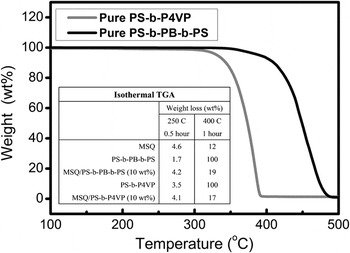
The decomposition temperatures of porogen and the thermal stability of various low-k films were first investigated to determine the processing temperatures for the MSQ/porogen hybrid films in the dual damascene processing and for removing the porogen when a Cu/low-k layer was completed in the postintegration porogen removal scheme. The dynamic thermal gravimetric analysis (TGA) curves shown in Fig. 2 indicate that the copolymer porogens, PS-b-P4VP and PS-b-PB-b-PS, have decomposition temperatures (T d), at which 5% weight loss occurred, of about 317 and 390 °C, respectively. In an N2 atmosphere, they are completely removed at 380 and 500 °C, respectively.
The dynamic thermal gravimetric analysis (TGA) curves of PS-b-P4VP and PS-b-PB-b-PS high-temperature porogens. Insert shows a table for the isothermal TGA data of each porogen and their hybrid form.

Since isothermal heating by hot plate or furnace is commonly used in semiconductor fabrication processing, it is important to understand the thermal stability of pure porogen at target temperature. For example, Cu-annealing temperature in the postintegration porogen removal approach was typically carried out at 200–250 °C.Reference Fayolle, Jousseaume, Assousa, Tabouret, Le Comec, Hamessera, Leduc, Feldis, Louveau, Passernard and Fusalbab9 Therefore, isothermal TGA of pure PS-b-PB-b-PS and PS-b-P4VP were carried out at 250 °C to further investigate their thermal stability. As shown in the table inserted in Fig. 2, the weight loss is only 1.7 wt% for PS-b-PB-b-PS and 3.5 wt% for PS-b-P4VP porogen when the temperature was kept at 250 °C for 30 min. Under the same condition, the weight loss of both hybrid films is below 4.2 wt%, which is close to the 4.6 wt% of pure MSQ. This indicates that the porogens exhibit almost no loss at such relative low temperature (250 °C). Thus, both hybrid films are sufficient for practical use as an interlayer dielectric (ILD) in dual damascene fabrication processes. Furthermore, it was confirmed that these high-temperature porogens can be fully removed at 400 °C isothermally for 1 h. As the result, for the remainder of this study, we focused on the MSQ/porogen hybrid films cured at 250 °C for use as the starting dielectric in the postintegration porogen removal scheme and porous MSQ low-k films after the removal of porogen at 400 °C.
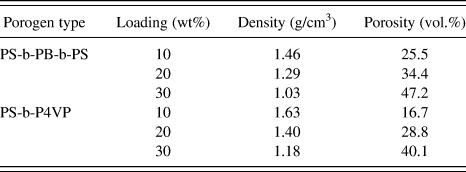
Next, the porosity of porous film was calculated by comparing the density of porous film with a dense MSQ film (1.96 g/cm3).Reference Si, Ono, Uchida, Nozaki, Morisaki and Itoh23, Reference Hong, Yang, Jo, Park and Choi24 All of the densities were obtained from XRR experiments. Table I summarizes the correlation between the porogen loading and porosity. The porosity of low-k films increased from 16.7 to 40.1 vol.% in the MSQ/PS-b-P4VP system and from 25.5 to 47.2 vol.% in the MSQ/PS-b-PB-b-PS system as the porogen loading increased from 10 to 30 wt%.
X-ray reflectivity analysis for porous methylsilsesquioxane (MSQ) using different high-temperature porogens.

B. Moisture uptake
The moisture uptake of such hybrid low-k dielectrics is a critical concern in backend processing steps such as wet clean, CMP, and post-CMP clean. To evaluate the applicability of using MSQ/porogen as the starting ILD through backend processes, moisture uptake was measured by the QCM system. The QCM measures the saturated moisture uptake of a low-k thin film according to Sauerbrey’s equationReference Lu and Czanderna25:

where Δm moisture is the mass load on unit area, f before and fafter are the resonant frequency before and after moisture uptake in a specific low-k thin film, respectively, ρ q is the density of quartz crystal (2.648 g/cm3), and μ q is the shear modulus of AT-cut quartz crystal (2.947 × 10¹¹ g/cm/sec2). QCM is extremely sensitive, measuring down to the nanogram level (i.e., ∼5 ng of weight change per cm2 for 1 Hz difference).
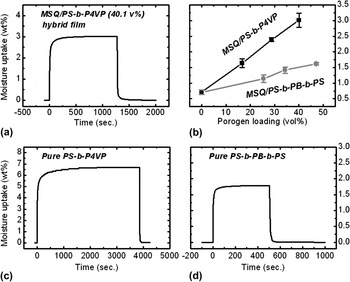
A typical QCM adsorption–desorption curve of a hybrid MSQ film is illustrated in Fig. 3(a), which includes three stages. The first is an “adsorption step,” which means the hybrid film starts to adsorb moisture. In this case, the adsorption curve reaches 90% of its equilibrium value in 60 s and 100% in <300 s. After that, the curve comes into an “equilibrium step,” at which the adsorption reaches saturation and the amount of moisture uptake remains constant [i.e., 3.01 wt% for Fig. 3(a)]. The last step is the “desorption step,” in which the adsorbed moisture starts to desorb upon pumping out. In our case, the 90% absorbed moisture can be desorbed in a short time (<30 s) and completely desorbed in ∼300 s. Such reversible characteristic shows that the moisture sorption at 30 °C is purely in the physical sorption (i.e., water adsorbed by Van der Waals force or Coulomb force) mode. Moreover, for semiconductor manufacturing, a short outgassing pretreatment step at room temperature or elevated temperature can be easily added to low-k processing steps, for example, prior to Si3N4 etch-stop deposition, to eliminate the trapped moisture in ILD, thus avoiding any blistering or delamination.Reference Maex, Baklanov, Shamiryan, Iacopi, Brongersma and Yanovitskaya22
(a) A typical quartz crystal microbalance (QCM) curve of MSQ/porogen hybrid film. (b) The moisture uptakes of MSQ/PS-b-P4VP and MSQ/PS-PB-PS hybrid films. The QCM curves of (c) pure PS-b-P4VP and (d) pure PS-b-PB-b-PS.

Next, the moisture uptakes of MSQ/PS-b-P4VP and MSQ/PS-PB-PS hybrid films as a function of porogen loading are shown in Fig. 3(b) to understand the effect of porogen structure on moisture uptake behavior. The moisture uptake of both hybrid films increases with increasing porogen loading. In addition, MSQ/PS-b-P4VP hybrid system adsorbs more moisture than MSQ/PS-b-PB-b-PS hybrid system at the same porogen loading. For example, with loading at ∼40 vol.%, the moisture uptake in MSQ/PS-PB-PS hybrid film is lower than 1.52 wt% as compared to ∼3.01 wt% in MSQ/PS-P4VP hybrid films. We supposed the high-temperature porogens in the hybrid films behave like typical polymer and absorb more moisture than dense MSQ film. The higher moisture uptake in the hybrid films is presumably due to the greatly increased amount of water sorption by the porogens. Therefore, the moisture uptake of each porogen was further studied and shown in Figs. 3(c) and 3(d). The moisture uptake of pure PS-b-P4VP and PS-b-PB-b-PS are 6.75 wt% and 1.78 wt%, respectively. PS-b-P4VP contains the polar pyridine group that has higher affinity with moisture, while PS-b-PB-b-PS consists of only a symmetrical linear molecular structure. Therefore, when choosing a high-temperature porogen, it is desirable to avoid the use of highly polar groups based on moisture uptake and the dielectric consideration. The moisture effect on k-value in hybrid films will be addressed in the dielectric constant section.
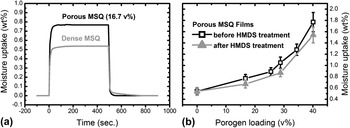
Subsequently, the porogen was removed by thermal decomposition at 400 °C. The adsorption–desorption curves of dense/porous MSQ films still exhibited a reversible behavior as illustrated in Fig. 4(a). The moisture uptake of dense MSQ (i.e., 0 wt% of porogen addition) cured at 400 °C is 0.54 wt%. Such relatively low moisture uptake can be attributed to the hydrophobic characteristics of MSQ and the limited free volume or surface area in the network- and cage-MSQ structures as shown in Fig. 1. In contrast, the moisture uptake of 0.71 wt% for the dense MSQ film cured at 250 °C is slightly higher than that (0.54 wt%) of the dense MSQ cured at 400 °C, which can be attributed to a lower degree of cross-linking and residual silanol (Si–OH) groups in MSQ cured at 250 °C.Reference Che, Huang, Choang, Chen and Leu12, Reference Wang, Zheng, Shen, Xu, Lim, Liu and Huan26
(a) The QCM curves of dense/porous MSQ low-k film and (b) the moisture uptake of porous MSQ films with/without hexamethyldisilazane (HMDS) treatment.

Moreover, the moisture uptake of porous films was investigated as a function of porosity as shown in Fig. 4(b). The moisture uptakes of porous low-k films is not affected by porogen types and increases from 0.54 wt% to 1.77 wt% as the porosity was raised from 0 to 40.1 vol.%. The moisture uptake deviates significantly from linearity when the porosity exceeds 25.5 vol.%. The increased moisture absorption may be attributed to the (i) increased surface area/free volume due to the porogen removalReference Rogojevic, Jain, Gill and Plawsky27 and (ii) increased Si–OH on the pore surface due to the incomplete cross-linking of MSQ matrix.Reference Che, Huang, Choang, Chen and Leu12 Therefore, to understand the effect of each factor on the overall moisture uptake, the porous MSQ low-k films were further treated with hexamethyldisilazane (HMDS) vapor at 70 °C for 24 h to passivate the residual surface Si–OH groups. From Fig. 4(b), the moisture uptakes of the HMDS-modified porous films are about 13 to 17% lower than those of the as-prepared ones depending upon their porosity. The difference between the moisture uptake before and after HMDS modification increases with increasing porosity. This showed that the hydroxy group (-OH) of the porous film was replaced by methyl group (-CH3) after HMDS treatment.Reference Chang, Mor, Liu, Tsai, Chen, Mei and Sze28 Similar to our earlier works on MSQ/PSP4VP hybrid systems,Reference Che, Huang, Choang, Chen and Leu12 the increased porogen loading enhanced the steric barrier for the MSQ molecular chains and thus reduced the collision probability of MSQ molecular chains to complete cross-linking reaction. Therefore, the amount of residual hydroxy groups increased with increasing porogen loading as confirmed by the moisture uptake using HMDS treatment.
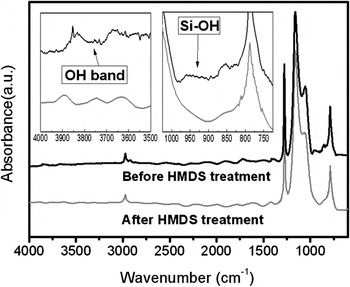
The specular reflectance FTIR technique was then used to examine the structural change in porous MSQ (16.7 vol.% porosity) before and after HMDS treatment, as shown in Fig. 5. For as-cured porous MSQ, major peaks include Si–O–Si stretching peaks at 1130 and 1030 cm−1 for the cage and network structures, 791 cm−1 for Si–C stretching vibration of Si(CH3)3, 2974 cm−1 for C–H stretching of SiCH3, 3000–3700 cm−1 for a broad OH band (O–H stretching in Si(OH) or water vapor), and the peak 940 cm−1 due to Si–OH stretching.Reference Wang, Shen and Zheng29, Reference Grill and Neumayer30 After HMDS treatment, the absorption peaks of Si–OH (940 cm−1) and O–H (3000–3700 cm−1) obviously decreased, confirming that the porous MSQ became hydrophobic after passivation by HMDS.
Fourier transform infrared spectra of porous MSQ (16.7 vol.% porosity) before and after HMDS treatment.

The moisture uptake tendency of HMDS-modified porous MSQ was still similar to the as-prepared ones, implying that the surface area/free volume of pores was the dominant factor for moisture uptake. High surface area can provide more sites for H2O adsorbents via the secondary chemical bonding such as Van der Waals force or Coulomb force (i.e., physical adsorption). In turn, adsorbed moisture would create extra polar sites on the pore surface to induce multilayered H2O adsorbents, also called “water cluster,” through the intramolecular hydrogen bonding.Reference Proost, Kondoh, Vereeche, Heyns and Maex31, Reference Kuroki and Kikkawa32 Thus, large amount of water clusters are formed when large surface area at high porosity are created after the removal of porogen at high loading, which cause the moisture uptake to deviate from linearity shown in Fig. 4(b) either with or without HMDS treatment. Hence, we postulated that the surface area/free volume of pores is the primary factor for the moisture uptake in porous films. However, it is well known that most of the isolated Si–OH groups can be passivated by HMDS treatment, but hydrogen bonded Si–OH and residual hydroxy groups cannot be eliminated completely.Reference Kim, Park and Choi33 These residual Si–OH groups might attract ambient water to form chemisorbed moisture, which is the case for our samples because there is no in situ heat treatment prior to HMDS passivation. The amount of chemisorbed moisture will be estimated and discussed in the following section.
C. Dielectric constant
To understand the effect of porogen structure on the dielectric constant of MSQ/porogen hybrid films, two different hybrid films were examined using a CV dot test under a dry nitrogen purge condition. The dielectric constants as a function of porogen loading are shown in Fig. 6. In the case of the MSQ/PS-b-P4VP hybrid films, the dielectric constant increased from 2.87 to 3.79 with increasing the loading of porogen to 40.1 vol.%. For MSQ/PS-b-PB-b-PS hybrid films, the dielectric constant increased from 2.87 to 3.42 as loading increased to 47.2 vol.%. The dielectric constant of hybrid film is increased by the addition of porogen due to (i) its high orientational polarization and (ii) possible adsorbed moisture.Reference Shi, Bao, Smith, Huang, Liu, Ho, McSwiney, Moinpour and Kloster34 However, the contribution of adsorbed moisture was minimal under the dry nitrogen purge. Therefore, the increase of k-value of hybrid film is mainly dominated by the high orientational (dipolar) polarization of porogens.Reference Kim, Hwang, Kim, Kim and Kee35 For example, the dielectric constant of MSQ/PS-b-PB-b-PS is lower than MSQ/PS-b-P4VP because PS-b-P4VP is a di-block copolymer consisting of a high polar functional group, pyridine. The distinct arrangement and components of styrene and 4-vinylpyridine induce high orientational polarization. On the other hand, PS-b-PB-b-PS is a tri-block copolymer with a symmetrical chemical structure. Also, there is no polar group inside butadiene and styrene segments, which lead toward lower orientational polarization. Hence, when mixed into the MSQ matrix, the PS-b-PB-b-PS hybrid films possess lower dielectric constant than MSQ/PS-b-P4VP hybrid films.
Dielectric constants of the hybrid films using PS-b-P4VP or PS-b-PB-b-PS as the high-temperature porogen under the dry nitrogen purge condition.

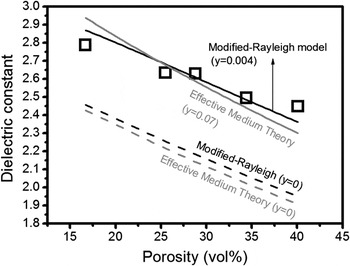
Next, the porogen was removed by thermal decomposition at 400 °C to investigate how porogen structure affects the dielectric constant of porous MSQ films. The correlation between the porosity and dielectric constant of porous MSQ films after removal of different porogens is shown in Fig. 7. Favorably, the dielectric constant is still a linear function of porosity, indicating that the porogen structure does not affect the final dielectric constant of porous MSQ film. The dielectric constant of porous MSQ film decreases from 2.89 to 2.45 with porosity increasing from 0 to 40.1 vol.%. Yet, the result cannot be accounted for using the ideal mixing rule in either parallel or series mode, which warrants further investigation.
Dielectric constants of porous MSQ films under the dry nitrogen purge condition.

It is known that the effective dielectric constant (k eff) is affected by pore geometry and distribution. Hence, we used two models, effective medium theoryReference Aspnes36 and modified-Rayleigh model,Reference Kikkawa, Kuroki, Sakamoto, Kohmura, Tanaka and Hata37 to examine the trend of final k eff. Effective medium theory assumes that pores are spheres and adsorbed water randomly distributes in the matrix (i.e., MSQ). The Clausiuss–Mossotti equation based on the effective medium theory can be described asReference Kittel38:

where x is the porosity obtained from XRR measurement in this study; y is the fraction of adsorbed water; k film is the effective dielectric constant of the film; and k MSQ, k water, and k air are the dielectric constants of MSQ, water, and air, respectively. On the other hand, the modified-Rayleigh model proposed by Kikkawa et al.Reference Kikkawa, Kuroki, Sakamoto, Kohmura, Tanaka and Hata37 is an inner surface coverage model, assuming that long pores (cylinder, rod, or worm-like) are randomly distributed in the MSQ and the moisture molecules are adsorbed on the pore surface (i.e., inner walls of pores). The k film can be expressed by the following equation:


where k pore is the dielectric constants of pores (including k air and k water).
When only the porosity and the dielectric constants of MSQ matrix (k MSQ = 2.89) and air (k air = 1.00) are considered, the ideal curves (y = 0) of the effective medium theory and modified-Rayleigh model represented by the dash lines show 17–23% deviation from experimental data as illustrated in Fig. 7. This implies that chemisorbed moisture exists in our samples. Hence, the fraction of adsorbed water (y) was introduced to simulate the effective dielectric constant, instead. Good match between model and data is also illustrated in Fig. 7, when the modified-Rayleigh model with y = 0.004 or the effective medium theory with y = 0.07 was used. However, the goodness of fit for the modified-Rayleigh model (80%) is better than the effective medium theory (28%). Also, based on the worm-like pore sizes created by the high molecular weight porogens in this study,Reference Che, Huang, Choang, Chen and Leu12 we believed the moisture is adsorbed on the pore wall as depicted by the modified-Rayleigh model, which leads us to three findings.
First, when samples are removed from the vacuum chamber, the ambient moisture is adsorbed within MSQ matrix immediately. Yet, such adsorbed moisture cannot be fully removed by dry nitrogen purge during the CV dot measurement. Thus, a small amount of chemisorbed moisture (i.e., y = 0.4 vol.%) might be attracted and trapped by the residual Si–OH groups. Second, based on the modified-Rayleigh model, the pore geometry is long and randomly distributed in the MSQ matrix and the moisture is adsorbed on the pore surface, not inside MSQ matrix. The finding is in good agreement with the large, irregular worm-like pore morphology of MSQ/PS-b-P4VP system in our previous study.Reference Che, Huang, Choang, Chen and Leu12 Finally, the effective dielectric constant could be affected significantly (17–23% increase) even though the amount of adsorbed water is very small. The deviation can be attributed to the adsorbed moisture, which possesses a high k-value close to 80.
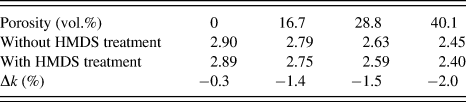
According to QCM analysis in previous section, the available pore surface area and residual Si–OH are accountable for the moisture uptake in the porous MSQ films. Hence, to understand the effect of surface residual Si–OH on the effective dielectric constant, the porous MSQ films were also treated with HMDS vapor. Table II summarizes the dielectric constant of porous constant changes before and after HMDS treatment. After HMDS treatment, the dielectric constants of porous MSQ films only slightly decrease (Δk = −0.3 to −2.0%) when surface hydrophilic, hydroxy groups of Si–OH were replaced by hydrophobic methyl groups. For example, the dielectric constant decreases from 2.63 to 2.59 for porosity at 28.8 vol.%. This slight change indicates that the number of polar Si–OH sites is much less than the total surface area of the porous MSQ films. This observation is in good agreement with our finding from the moisture uptake study by using QCM that the surface area is the dominant factor for the moisture uptake in hybrid/porous low-k materials.
Dielectric constants of porous MSQ films.

HMDS, hexamethlydisilazane.
IV. CONCLUSIONS
Two high-temperature porogens, PS-b-P4VP and PS-b-PB-b-PS, have been used to examine the effect of porogen structure on thermal stability, moisture uptake, and dielectric property in MSQ/porogen hybrid films and their corresponding porous films under a postintegration porogen removal scheme. Based on the dynamic and isothermal TGA data, both hybrid material systems are recommended to be cured at 250 °C for subsequent backend processes with a reduced thermal budget ≤350 °C, while the porogens are to be removed at 400 °C for 1 h after the completion of a metal/dielectric layer.
For the hybrid films, both moisture uptake and dielectric constant are strongly affected by the porogen structure. PS-b-P4VP porogen containing di-block structure and pyridine polar group leads to higher moisture uptake and dielectric constant as compared to PS-b-PS-b-PS porogen with symmetrical and nonpolar groups. Moreover, the moisture uptake behavior in both as-prepared hybrid films is in physical sorption mode according to their reversible adsorption–desorption curve measured by the QCM.
After the removal of porogen, the k-values of the corresponding porous films are favorably not influenced by porogen structures, and their moisture uptake was as low as 1.77 wt% even at higher porosity, 40 vol.%. However, based on the simulation of the modified-Rayleigh model, the porous films are found to possess 0.4 vol.% chemisorbed moisture on the pore surface, resulting in 17–23% deviation from the ideal k-values. Nevertheless, excluding the chemisorbed moisture, the moisture uptake behavior of as-prepared porous MSQ film is also in physical sorption mode. For semiconductor manufacturing, a short outgassing pretreatment step at room temperature or elevated temperature can be easily added to eliminate the trapped physical sorption moisture, thus avoiding any blistering or delamination.
ACKNOWLEDGMENTS
Beamline 13A1 support for x-ray reflectivity measurements from the National Synchrotron Radiation Research Center (NSRRC) in Taiwan is acknowledged. The authors appreciate the financial support in part by National Science Council of ROC under contracts: NSC98-2221-E009-177 and NSC99-2221-E009-177.