Introduction
The Gitanos or Calé of Spain are an ethnocultural minority akin to other Romani groups in Europe and America. All these groups may share a remote origin in one or more founder populations that moved westwards from the Indian subcontinent over a millennium ago (Mendizabal et al., Reference Mendizabal, Lao, Marigorta and Wollstein2012). Nevertheless, all Romani peoples have experienced marked transformations by their interaction with the peoples among whom they have lived. Today Romani peoples show much social and genetic differentiation and a gamut of living conditions and intercultural relationships (Fraser, Reference Fraser1992; Morar et al., Reference Morar, Gresham, Angelicheva and Tournev2004; Matras, Reference Matras2015).
Gitanos or Calé seem to descend from the first Romani migratory flows into the Iberian Peninsula documented in the 15th century. They are closely related to peoples known as Ciganos, Calon, Calós etc., who live in Catalonia, Portugal, Brazil and the south of France. The approximately 600,000 Spanish Gitanos reside today in over 1000 localities in all Spanish regions (Fundación Secretariado Gitano, 2016). Present Gitano/Calé populations result from a long interaction with Spanish-dominant majorities, marked by discrimination, segregation, persecution and a will to make them disappear as a distinct group (Leblon, Reference Leblon1985; Gómez Alfaro, Reference Gómez Alfaro1993; San Román, Reference San Roman1997; Pym, Reference Pym2007). However, in many local communities co-operation, cultural hybridization and peaceful co-existence have also been common. This is particularly relevant in Andalusia, where Gitanos have contributed decisively to some of its most cherished heritages, such as Flamenco music and dance (Leblon, Reference Leblon2003). Today most Gitanos consider themselves autochthonous Spaniards, particularly facing foreign immigrants, including Roma persons from Eastern European countries such as Romania or Bulgaria.
During their difficult history, Gitanos adopted and contributed to the language, music and lifestyles of the regions where they lived. Often it is not easy to distinguish Gitano persons from their non-Gitano neighbours. Endogamy has been a key factor in their permanence as a collective imbued with a strong sense of a shared and distinct identity. Mixed unions occurred already in the 16th century (Gómez Alfaro, Reference Gómez Alfaro1999), but endogamy remained a strong habitus and a key factor in the maintenance of boundaries with the dominant majority. In most Gitano communities marrying payos or non-Gitanos has been seen as contrary to Gitano law and the preservation of the group. Moreover, many Gitano families have shown a marked preference for marrying relatives by birth (or of the ‘same blood’, as they express it) both in their discourse and in their practice, although not without ambivalence (Lagunas, Reference Lagunas2005; Gamella & Martín, Reference Gamella and Martín2007). However, Gitano consanguinity remains understudied. There are references dispersed in the ethnological and medical literature, but there is a lack of detailed and comprehensive information.
One exception can be found in the work of Martínez-Frías and Bermejo (Reference Martínez-Frías and Bermejo1992), who studied consanguinity in their study of congenital malformations among newly born children in a long-term hospital-based, case-control project covering a long period (1976 to 1990). Data on relatedness were obtained by an interview of the parents following the birth of the child concerned. Levels of close consanguinity among Gitano parents ranged from 29.3% to 36.9%, compared with 1.5% to 2.3% among non-Gitano parents (Martínez-Frías & Bermejo, Reference Martínez-Frías and Bermejo1992, pp. 483 and 485). This level of parental consanguinity may have led to a high proportion of homozygotes for recessive alleles. Accordingly, the authors found that ‘the rate of well-known recessive syndromes among Gypsies [was] seven times that among non-Gypsies’ (Martínez-Frías & Bermejo, Reference Martínez-Frías and Bermejo1992, p. 485).
Another source of data is an epidemiological study on the prevalence of renal lithiasis made in south-eastern Spain in the early 1980s. In a household survey, the authors interviewed 11,871 Gitano and 4621 non-Gitano persons. They found that the rate of close consanguineous marriages among Gitano people, 27%, was over six times higher than among non-Gitano people, 4% (Ramirez et al. Reference Ramirez, Morales, Gómez, Alcaraz and Samper1984).
Some precise data on consanguinity is also found in a socio-anthropological survey of the Gitano population of the industrial town of Linares in Andalusia. The authors collected data on 803 Gitano couples, 23.1% closely related, 10.8% as first cousins and 12.3% as second cousins. The study did not consider cases of first cousins once removed or any other degree of relatedness. There was considerable variation among the different cohorts. The highest rates of consanguinity, about 32%, were found among respondents born from 1964 to 1973. There were also important differences among the neighbourhoods studied (Solana & Lorenzo, Reference Solana and Lorenzo2010, pp. 117–118, 225).
In sum, the available results point to a high rate of close consanguineous marriages (up to second cousins) among Gitano/Calé people of recent generations. In other Romani groups, endogamy and high consanguinity levels have been often reported in ethnographic and medical genetics studies. Few publications, however, provide concrete estimations (for some exceptions of different scope and validity see: Cohn, Reference Cohn1973; Williams & Harper, Reference Williams and Harper1977; Thomas et al., Reference Thomas, Doucette, Thomas and Stoeckle1987; Ferák et al., Reference Ferák, Sivakova and Sieglova1987). On the other hand, more recent genetic reviews have concluded that the Romani populations of Europe may be described as ‘a conglomerate of genetically isolated founder populations’ (Kalaydjieva et al., Reference Kalaydjieva, Gresham and Calafell2001) that show strong genetical differentiation both among and within countries (Morar et al., Reference Morar, Gresham, Angelicheva and Tournev2004).
In most Western societies, however, consanguineous marriage and inbreeding are widely seen as backward, undesirable and harmful (Bittles, Reference Bittles2012). Their association with health problems increases the negative view of the communities practising it, and may also contribute to their segregation and social introversion and, paradoxically, to an increase in intra-family marriages. Thus, studies showing high consanguinity levels may be used to reinforce stereotypical views of Romani groups and may have moral and political consequences. On the other hand, sidestepping these marriage patterns and their social and genetic consequences may also be a form of neglect and discrimination. Besides, the improvement of Gitano living conditions and their access to education are widening the marital choices of Gitano youth and facilitating mixed marriages. Hence there is nothing fixed or essential about the preference for consanguineous marriages in some Romani communities. Moreover, in the case of Spain consanguinity has been common also among mainstream populations. In fact, in the 20th century, several Spanish regions showed some of the highest rates of consanguineous marriage in Europe. These rates remained high up to the early 1960s and then fell rapidly. In the following decades, the marriage of persons closely related by birth became rare (Fuster & Colantonio, Reference Fuster and Colantonio2003, Reference Fuster and Colantonio2004; Calderón et al., Reference Calderón, Aresti, Ambrosio and González-Martín2009; Gamella & Núñez Negrillo, Reference Gamella and Núñez-Negrillo2018). Given the availability and quality of ecclesiastical records, consanguinity and inbreeding have been studied in Spain more than in any other European country, save Italy (Calderón et al., Reference Calderón, Peña, Delgado and Morales1998). These studies provide a good basis for comparing the results of the present study.
Therefore, this study analysed the frequency and structure of consanguineous unions in the Gitano/Calé population of an extended area of south-eastern Spain. The resulting average F (inbreeding coefficient) was estimated, considering the main or first degree of relatedness and all multiple relationships. Variation in Gitano consanguinity throughout the 20th century was also analysed. The rate and structure of cumulative consanguinity sustained through generations as revealed by genealogical methods was assessed. Finally, the results for Gitano consanguinity and inbreeding were compared with those found in other Spanish populations, particularly in the most endogamous regions. A comparison with other Romani populations will be the object of further publications. The differences between Calé consanguineous and non-consanguineous couples, and the causes and reasons for the preference of these unions as they are expressed by the families involved, will be the subject of future publications as well.
Methods
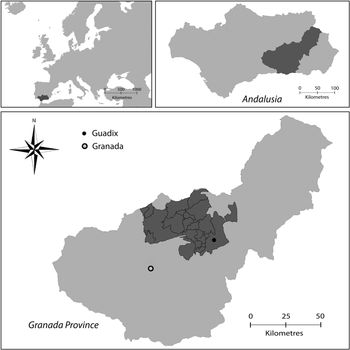
The family and genealogy reconstitutions used in this study concerned the whole Gitano population of 22 contiguous municipalities of the province of Granada in Andalusia (see Figure 1). These localities ranged from 400 to 22,000 people and included a variety of settlements, both rural and urban. By the end of the 20th century, the proportion of Calé people in some of these localities was among the highest in Western Europe (Gamella, Reference Gamella1996). Today around 6700 Gitanos live in the area, out of a total population of about 50,000 (13.5%).
Area of study: 22 contiguous municipalities of the Andalusian province of Granada in south-eastern Spain.

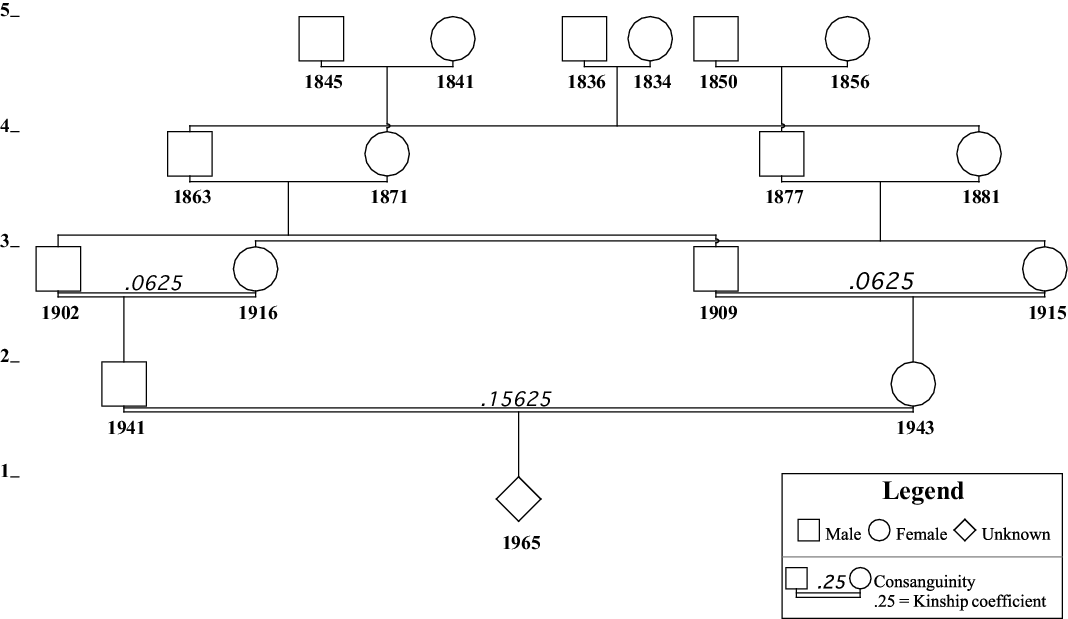
Pedigree of a Gitano consanguineous couple married in 1963.

In the parish registries of this region, some Gitano families have inscribed the births and deaths of their relatives at least since the 18th century. This practice increased with the establishment of the Spanish Civil Registry in 1871. However, during the Civil War (1936–1939) some of the parish and diocesan archives were destroyed. The study data therefore mostly came from the local civil archives, which included births, deaths and marriages from 1871 onwards. When parish archives could be consulted, the resulting genealogies could be traced back to the 18th century. Previous publications have explained the procedures followed in gathering and analysing data for the family and genealogical reconstitution (Martín & Gamella, Reference Martín and Gamella2005; Gamella & Martín, Reference Gamella and Martín2017).
Self-identification has been the main criterion for inclusion in this study. In almost all cases it coincided with the acknowledgment of filiation and descent (Scheffler, Reference Scheffler2018) from other persons also identified as Gitanos. Primarily, one becomes Gitano by birth from Gitano parents and grandparents, and Gitano identity commonly has a decisive genealogical component. The main problem with this ideology, however, derives from intermarriage and the birth of persons of mixed ancestry. In this population interethnic marriages have increased significantly in recent decades, and are generating new experiences of ethnic identification. The reconstituted genealogies include mixed marriages, as well as their descendants when they continued to live in the area and married within the Gitano population. In many cases they tend to identify with the minority group, but this is open to individual variation and to the heterogeneous forms of integration open to second and third generations of persons of mixed ancestry.
Data gathering and genealogical reconstitution
In all the localities studied, Gitano identity was a salient phenomenon, and part of public local knowledge. Most residents showed little confusion about the identity and ancestry of local Gitano people. This has been noted in other historical–demographic studies of Romani people, for instance in Hungary by the important work of Ladányi and Szelényi (Reference Ladányi and Szelényi2006, pp. 41–42). However, in most public records Gitanos are largely indistinguishable from other Spanish citizens, as references to ethnic identity are not allowed by Spanish law. Hence the demographic study of this minority or its comparison with other groups is not possible using official records only. It is necessary to use complementary sources of information. Thus, in each locality some Gitano neighbours provided help and co-operation in a prolonged ethnographic study that was initiated in 1993 and intensified in 2001 (Gamella, Reference Gamella1996, Reference Gamella2000, Reference Gamella2011; Martín & Gamella, Reference Martín and Gamella2005). This research generated a knowledge base of the local Gitano populations, their major family lines, and the more common surnames. Then the books registering births, marriages and deaths in the civil registries of the 22 studied localities were reviewed. Each entry in these books provides information about parents and grandparents – that is, seven or eight people from two or three generations. The Spanish naming system, in which each person carries both the father’s and mother’s first surname, is well suited for genealogical reconstitution. Old municipal censuses were also studied when available. The oldest of the censuses studied was the national census of Gitanos of 1783–1785, ordered by the last Pragmática (Royal Decree) that focused on Gitano people only (Gamella et al., Reference Gamella, Gómez Alfaro and Pérez2014).
Nevertheless, many records before 1900 identify some of the listed persons as castellanos nuevos – a euphemism to avoid the forbidden term Gitano. These ethnic labels confirmed the identities of whole lines of descendants. Records also included references to trades and occupations commonly associated with Gitanos, and also to streets and neighbourhoods where Gitanos were segregated at the time (such as the Cañada de Los Gitanos). Many relatives from one village or town could be traced in the registries of neighbouring towns and villages. Besides, as in other cases of intensely endogamous communities, the ‘merging and reconciling’ of independent sources of data often created ‘new ancestor–descendant paths not present in either source alone’ (Agarwala et al., Reference Agarwala, Schaffer and Tomlin2001, pp. 534–35).
Moreover, independent evidence was sought to confirm the data and links established in the genealogical networks. During ethnographic fieldwork in Gitano homes and public gatherings the validity and reliability of the archival data, as well as the whereabouts of the relatives who moved out of the region, were tested. After reviewing the data, about 1200 couples with the partners themselves or with relatives, less than 2% of errors or mismatches were found between the demographic records and the data provided by family members.
All the obtained information was used to locate people in a genealogical grid using GEDCOM (Genealogical Data Communication) programs, which generate files containing information about individuals in different formats, as well as metadata linking personal records according to their genealogical relationships. These programs (Reunion 9 and Reunion 11) made it possible to keep track of all bonds established, to merge all pedigrees that shared common ancestors, and to establish the consanguineous degrees among couples up to ten independent ties of relatedness. Once data were integrated into the genealogical grid, all personal and family names were eliminated to maintain the anonymity of the database.
The genealogical and family reconstitutions (Wrigley, Reference Wrigley and Wrigley1966) concerned the whole Gitano population of the localities studied and included data on over 19,100 persons born from about 1680 to 2009. The networks included both patrilateral and matrilateral links generally with the same depth, as both mother’s and father’s surnames appear equally in Spanish records. In some cases, the dense genealogical networks go back twelve to fourteen generations. For instance, Gregorio H. was a castellano nuevo baptized on December 26th 1722, four days after his birth, in the San Miguel parish in Guadix. In the National Census of Gitanos performed in 1785 Gregorio appears as a 66-year-old farm worker living in Guadix with his wife María F. and their seven children. Five of these children survived and remained in the study area, and their records and those of their descendants were included in the reconstitution. Overall, the genealogical database includes 3976 direct descendants of Gregorio H. and María F. in twelve generations that extend up to the 21st century. In turn, these descendants are linked by marriage and descent with thousands of other people in the grid. Therefore, the resulting sample is not formed primarily by an accumulation of individual pedigrees, but by large and complex genealogical networks that include descent lines with ‘multiple inbreeding loops’, and showing important founder effects (Newman et al., Reference Newman, Abney, McPeek, Ober and Cox2001, p. 1146). Most people in the reconstituted families have from 5000 to 11,000 consanguineous relatives in the genealogical database.
By including the entire local population extracted from registry records and by merging all related pedigrees (Agarwala et al., Reference Agarwala, Schaffer and Tomlin2001), most of the problems of genealogical reconstitution (Post et al., Reference Post, Van Poppel, Van Imhoff and Kruse1997; Zhao Reference Zhao2001) were avoided. Moreover, the registers were checked backwards and forwards to reduce the problems commonly associated with personal genealogies of known or important people (Bideau & Poulain, Reference Bideau and Poulain1984; Dupâquier, Reference Dupâquier1993). The process also tried to avoid the under-registration of people that had little relevance for family continuity (Hollingsworth, Reference Hollingsworth1976; Jette & Charbonneau, Reference Jette and Charbonneau1984). Thus, the reconstituted families and pedigrees included children who died at an early age (Gamella & Martín, Reference Gamella and Martín2017), as well as males and females who left the study area before marrying and having children.
Gitano marriages
The Gitano/Calé people have developed their own procedures and rituals to establish socially sanctioned unions. These procedures may be very elaborate and involve lavish ceremonies attended by hundreds of guests, but they may also be as simple as elopement followed by cohabitation (Gamella, Reference Gamella2000). However, Gitano common-law unions are not formalized until the couple marries in church or in the civil court.
Gitano common-law unions were increasingly officialized during the Francoist period, particularly between 1946 and 1975. In these decades many parish curates took an active role in marrying Gitano cohabiting couples, most of them with children. However, about 32% of the common-law unions in the study sample were never legalized nor registered by religious or civil authorities. Hence, in the family reconstitution couples were primarily identified by the birth records of their children and grandchildren, by the notes in their death certificates and by their presence in local censuses. The birth of the first known child (minus one year) was used as a proxy variable to estimate the beginning of cohabitation and of the union.
The study analysis included only those couples for which there was detailed information about the parents of both spouses. The resulting total sample of comparable marriages included 3056 couples formed between 1925 and 2006. For almost all these couples, genealogical information included data on three or more ascending generations. In the case of mixed marriages, however, the pedigrees of non-Gitano spouses rarely extend beyond their grandparents.
The family reconstitution generated a large number of variables for each couple, such as the date and place of birth of the spouses, and of their known children, the date and place of their deaths, the date, place and type of official marriage when they existed, the different households where they lived, and all the genealogical information that connected them to their forebears. From these direct variables, over 55 analytical variables were derived, such as the age of both spouses at the birth of their first and last child, their offspring size, total reproductive period, birth intervals, proportion of infant and child deaths, proportion of twins, distance between their places of birth and residence, prenuptial migrations and degrees of consanguinity.
Calculation of F values
The level of consanguinity was indicated by the coefficient of inbreeding (F). This parameter measures the probability that an individual is homozygous (more properly, autozygous) for an ancestral gene inherited from both parents. The inbreeding coefficient of the offspring of an uncle–niece couple is 1/8, that of first cousins 1/16, that of first cousins once removed 1/32 and that of second cousins 1/64. With each further degree of consanguinity, the chance is halved (Hartl & Clark, 2007; Bittles, Reference Bittles2012).
The mean inbreeding coefficient of a population, α, results from the average F values of all its members. It was calculated by applying the formula:
 $$\alpha = \sum {{p_i}\,{F_i}}$$
where Σ is the sum of the proportion of couples (p i) with each type of consanguineous relationship i regarding the total of marriages (Mt), and F i – the corresponding inbreeding coefficient (Bittles, Reference Bittles2012; Calderón et al., Reference Calderón, Hernández and García-Varela2018). This parameter indicates the probability of homozygosis by inbreeding in an individual taken at random from the population. It is commonly used for comparing populations.
Corresponding α values were calculated both for the main degree of consanguinity (α 1) and for all the known degrees between each couple (α t). These two parameters were also calculated considering degrees of consanguinity up to and including second cousins or equivalent (F ≤ 15.625 × 10⁻³) so that results could be compared with the most important Spanish studies (α 3). It is important to stress, however, that the genetic relationships are inferred mostly from public records that were generated by interactions between authorities and subordinated persons. Hence, these inferences must be considered as hypothetical.
Results
As can be seen in Table 1, about 54.8% of the 3056 couples studied were consanguineous. Of these, 877 couples (28.7% of the total) were related as second cousins or closer. The other consanguineous unions (26.1% of the total) involved more-distant relatives, such as second cousins once removed, third cousins, fourth cousins and so forth. The most common types of close relatives were C22 (first cousins), C23 (first cousins once removed) and C33 (second cousins). Uncle–niece or aunt–nephew unions (C12) are rare among Gitanos, who reject them intensely. The sample included only four cases over a century, all of them perceived as wrong and even incestuous by the couples’ relatives and neighbours interviewed in fieldwork.
Consanguineous and mixed unions in the Gitano population of 22 contiguous localities of Andalusia, Spain, 3056 couples (1925–2006)

Mt: total number of marriages; Mc: total consanguineous marriages; Mc≥C33: consanguineous marriages up to second cousins or equivalent (F ≤ 15.625); C22: unions among first cousins; C23: unions among first cousins once removed; C33: unions among second cousins. For all these data only the main degree of relatedness was considered.
Mixed: unions between a Gitano and a non-Gitano person.
α 3.1: average F values considering only the main degree of consanguinity and up to second cousins or equivalent.
α 3.m: average F values for second and other multiple degrees of consanguinity up to second cousins.
α 3.t: average F values considering all degrees of consanguinity found in the genealogical analysis up to second cousins.
α 1: average F values if only the main known degree of consanguinity is considered in all cases.
α m: average F values of all the other degrees of consanguinity but the closer one.
α t: average F values considering all degrees of consanguinity found in the genealogical analysis.
First cousin marriages (C22) amounted to 12.1% of all unions studied. First cousins once removed (C23) involved 5.5% of these unions. This intergenerational type of marriage was favoured by the long reproductive careers experienced by Gitano women until recently. It was common for mothers and daughters to have children simultaneously. Hence, many children grew up with aunts, uncles and the children of cousins of their age. About 9.5% of all marriages were among second cousins (C33). However, many couples who were first cousins or cousins once removed were second cousins as well. Thus, there were 409 couples with at least a tie of second cousins – 13.4% of all marriages. Some of these couples were second cousins twice or thrice, so the total number of C33 degrees found in the 3056 couples was 458.
Moreover, when C34 (second cousins once removed) and C44 (third cousins) degrees were included, as has been done in most studies of Spanish populations up to 1918, the rate of consanguinity rose to 43.5%. Beyond third cousins, neither the spouses nor their parents were aware of their relatedness. They might know they come from the same family or descent network, but they usually ignore the actual ties that connect them. The genealogical memory of Gitanos does not seem to be deeper than that of their non-Gitano neighbours. It rarely goes much beyond three ascending generations: that is, beyond a limited knowledge of great-grandparents. However, it commonly involves a wider knowledge of collaterals.
Overall, the sample included 28 different degrees of relatedness as the main consanguineous tie between the partners. In asymmetrical unions such as C23 or C34 (marriage with a first or a second cousin once removed) when the sex of the partner in ascending/descending generation was considered, the analysis found another fourteen types of union: that is, a total of 42 different degrees of kinship as the main relationship among partners. The closest main unions were between uncle–niece or aunt–nephew, and the more-distant unions were between sixth cousins once removed – a very tenuous relationship indeed.
Multiple consanguinity
The genealogical reconstruction revealed a complex set of multiple consanguineous marriages (MCMs) in which there was more than one degree of relatedness between the partners. These MCMs were more numerous and complex than those found in studies that used other sources of data, such as household- or hospital-based surveys, and ecclesiastical or civil records. Thus, when considering all the known kin ties, the sample included more than 400 different types of consanguineous marriages. If the sex of the person in the ascending/descending generation of asymmetrical unions (C12, C23, C34, C45, etc.) was taken into account, there were over 650 different types of unions.
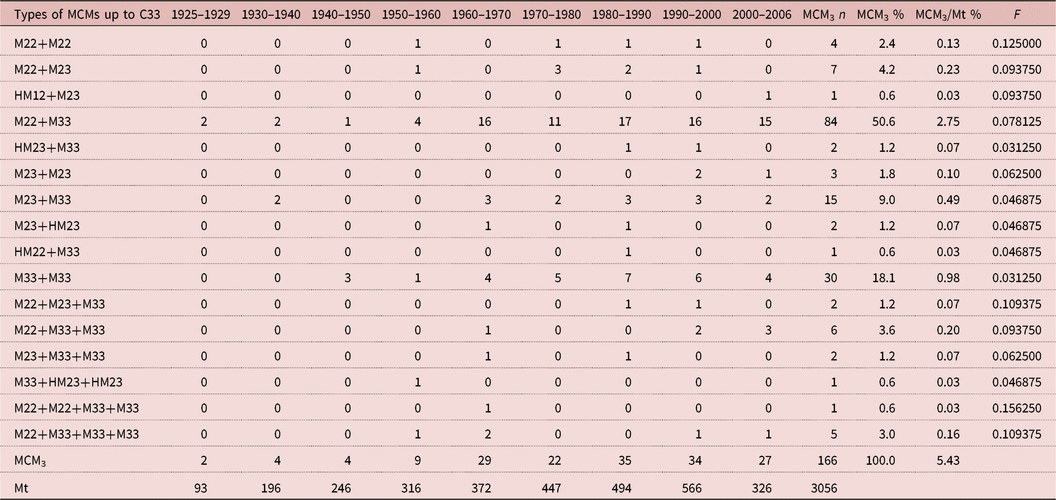
Over 62% of all consanguineous unions involved more than one known degree of consanguinity, including distant ties such as fourth cousins, third cousins twice removed, fifth cousins, etc. If the analysis was limited to the level of second cousins the proportion of MCMs on the total of marriages was 5.4%. If it was extended to the level of third cousins (C44), the proportion of MCMs was 17.2%. Table 2 offers a summary of the MCMs up to and including second cousins. This was a much larger sample of multiple degree types than those found in most studies of consanguinity, including those using ecclesiastical Catholic dispensation records and pedigrees (see Calderón et al., Reference Calderón, Peña, Delgado and Morales1998, Cavalli-Sforza et al., Reference Cavalli-Sforza, Moroni and Zei2004).
Multiple consanguineous marriages up to second cousin degree or equivalent (F ≥ 0.0156), 1925–2006

MCM3: multiple consanguineous marriages including degrees of kinship up to second cousins or equivalent (F ≥ 0.015625).
Mt: total number of marriages studied (N = 3056).
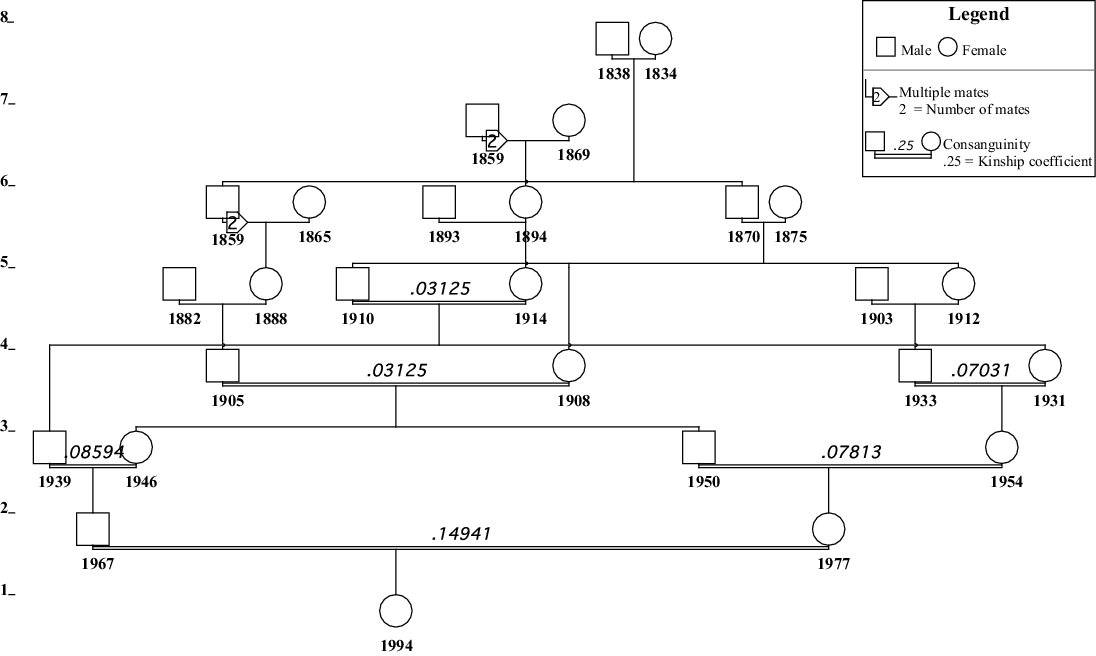
Even restricting the analysis to second cousins and closer degrees, there are cases of multiple consanguinity that are rare in other Spanish populations. For instance, Figure 2 shows the pedigree of a couple who eloped in 1963 and had their first child in 1965. They were double parallel first cousins and second cousins, as their parents were first cousins as well. Hence they shared their four grandparents, and had only six great-grandparents instead of the normal sixteen. Their inbreeding coefficient was one of the highest in the whole sample, F = 156.25 × 10⁻³.
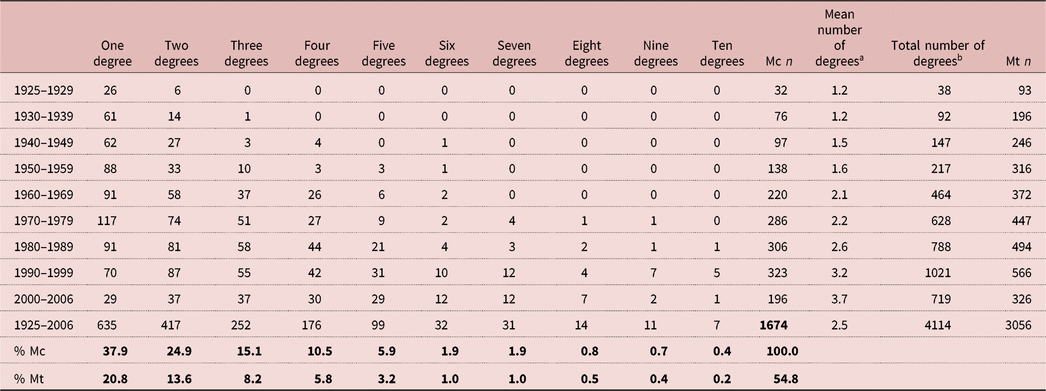
The programs used in the genealogical reconstitution recognized up to ten different links among the couples studied. They established 4114 different kin ties in 1674 consanguineous couples: that is, 2.5 degrees per consanguineous couple on average. As can be seen in Table 3, in 24.9% of the consanguineous couples there were two independent degrees; in 15.1% of these couples, three degrees, etc. The number of degrees found in the genealogical reconstitution increased throughout the 20th century. Thus, from 1990 to 2006, consanguineous couples shared 3.4 degrees on average, and 80.9% of them were multiple.
Number of independent consanguineous degrees found in 1674 consanguineous marriages in the Gitano population of 22 contiguous localities of eastern Andalusia, Spain; frequencies by decade of union, 1925–2006, N = 3056

Mc: total number of consanguineous marriages.
Mt: total number of marriages.
% Mc: percentages of all consanguineous marriages in which one, two, three… independent consanguineous degrees were found.
% Mt: percentage of all marriages in which one, two, three… independent consanguineous degrees were found.
a Mean number of degrees in each consanguineous marriage per decade.
b Total number of consanguineous degrees found in the 1674 consanguineous couples studied.
The genealogical program, however, seemed to underestimate the consanguinity that was obtained in the genealogical grid. Thus, revision by hand of some of the personal pedigrees found couples that shared fifteen or more independent kin ties. For instance, Figure 3 shows the simplified pedigree of a Gitano couple born in 1967 and 1977, who moved in together in 1993 and had their first daughter in 1994. The genealogical programs found nine independent kin ties among them, but the manual revision found eighteen independent ties! They were first cousins, first cousins once removed, second cousins, three times second cousins once removed, half third cousins, four times third cousins once removed, half third cousins once removed, twice third cousins twice removed and four times fourth cousins. Their inbreeding coefficient (F = 149.41 × 10⁻³) was one of the highest in the whole sample. If only ties up to second cousins had been considered, the resulting inbreeding coefficient would be 27% smaller.
Pedigree of a consanguineous Gitano couple married in 1993. Note that the person born in 1859 is represented twice in his marriages with women born in 1865 and 1869.

Average F values: α
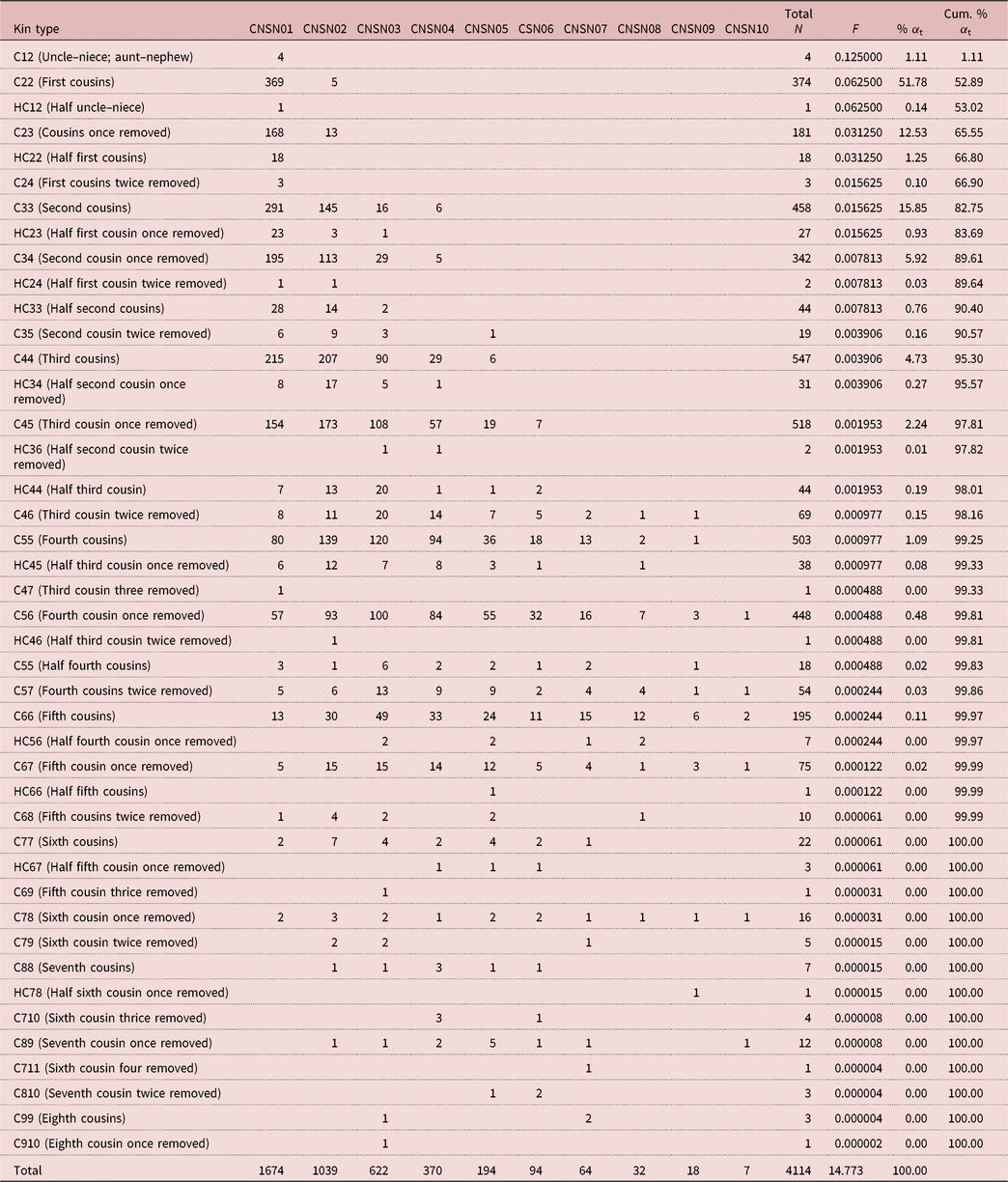
When all consanguineous degrees were considered the total average of F values was α t = 14.773 (×10−3) (see Table 1). As close consanguinity is more relevant both socially and genetically, as well as for allowing the comparison of these results with data from other Spanish sources, F values were calculated considering only consanguineous marriages up to second cousins or equivalent. This method resulted in α 3.1 = 11.253 × 10⁻³ for the main relationship, and α 3.t = 12.363 × 10⁻³ when considering all the known relationships up to the third degree.
Close consanguineous ties play a key role in the total levels of inbreeding. Two-thirds of the total α value resulted from the contribution of first cousins (51.8%) and first cousins once removed (12.5%) (see Table 4). Hence, there was a strong positive correlation between the yearly proportion of C22 marriages and the values of α t (R = 0.787). C23 couples also had a positive correlation, although smaller (R = 0.385). The proportion of C33 was not so strongly correlated with total average F values (R = 0.207).
Total number of cases by kin type in genealogical reconstitution by order of consanguineous tie and relative contribution of each type of kin tie to α t, 1925–2006

Nevertheless, second, third and successive degrees of relatedness increased average F values significantly. When only degrees up to C33 were measured, second and subsequent degrees of consanguinity increased α values about 9.9%. However, when all ties found in the genealogical reconstitution were considered, second and subsequent ties of consanguinity increased the total average inbreeding (α t) by about 20.5%. The accumulation of multiple degrees of distant relatedness, many of which had little social or biological importance in isolation, increased inbreeding levels significantly (see Table 4).
Subtypes of first-cousin marriage
Preferred patterns of first cousin marriage vary greatly among different cultures and populations (see Bittles, Reference Bittles2012, p. 80, table 6.3). The study of these subtypes has a long tradition in the cultural anthropology of kinship and marriage (see Lévi-Strauss, Reference Lévi-Strauss1947; Leach, Reference Leach1951; Barth, Reference Barth1986). In genetic terms, these subtypes are also important, particularly in respect to the expression of X-linked recessive alleles, due to ‘the significant number of clinically important genes located on the X-chromosome’ (Bittles, Reference Bittles2012, p. 78). There are some important studies of this topic in Spain (Calderon et al., Reference Calderón, Aresti, Ambrosio and González-Martín2009) and in many Arab and Muslim populations (for instance: Al-Gazali et al., Reference Al-Gazali, Bener, Abdulrazzaq, Micallef, Al-Khayat and Gaber1997; Saadat et al., Reference Saadat, Ansari-Lari and Farhud2004).
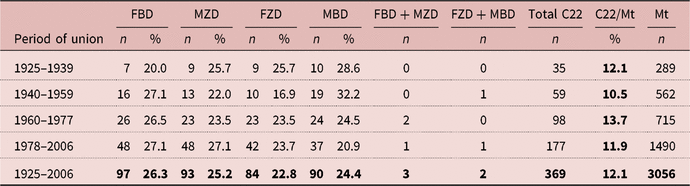
In the Gitano population studied the differences in the proportion of the four subtypes of first cousins were not statistically significant (p = 0.8) (see Table 5). Patrilateral parallel-cousin marriages – that is, marriages of a male ego with the father’s brother’s daughter (FBD) – were somewhat more common when the whole study period was considered. However, other patterns appeared as more common in some historical periods. Contrary to what was obtained in groups with strong patrilineal biases, Gitano families did not show a clear preference for any of the four patterns of first cousin marriage. In this sense, they seemed closer to other Spanish populations, although they did not show the matrilateral bias found by Calderón et al. (Reference Calderón, Aresti, Ambrosio and González-Martín2009, p. 190) in four dioceses that resulted in high F x /F ratios. In the Gitano/Calé group, patrilateral and matrilateral types were equally frequent (ratio 0.99), and the F x /F ratio for first cousins was 1.26 – very close to the expected value of 1.25.
Genealogical types of first cousin couples in the Gitano population of 22 contiguous localities of Granada province, Spain, 1925 –2006 (N = 3056)

1939: end of the Civil War (1936–1939); Franco’s dictatorship all over Spain.
1959: major economic reforms implemented; internationalization and growth of Spanish economy.
1977: first democratic elections after 1939; new democratic constitution approved in 1978.
FBD: the wife is father’s brother’s daughter of her husband. A parallel patrilateral cousin marriage; type 3 in Calderón et al. (Reference Calderón, Aresti, Ambrosio and González-Martín2009).
FZD: the wife is father’s sister’s daughter of her husband. Parallel-cousin marriage, type 1 in Calderón et al. (Reference Calderón, Aresti, Ambrosio and González-Martín2009).
MZD: the wife is mother’s sister’s daughter of her husband. Cross-cousin marriage, type 0 in Calderón et al. (Reference Calderón, Aresti, Ambrosio and González-Martín2009).
MBD: the wife is mother’s brother’s daughter of her husband. Cross-cousin marriage, type 2 in Calderón et al. (Reference Calderón, Aresti, Ambrosio and González-Martín2009).
Total C22: number of marriages in which the main degree of kinship is that of first cousins.
Mt: total number of marriages per period
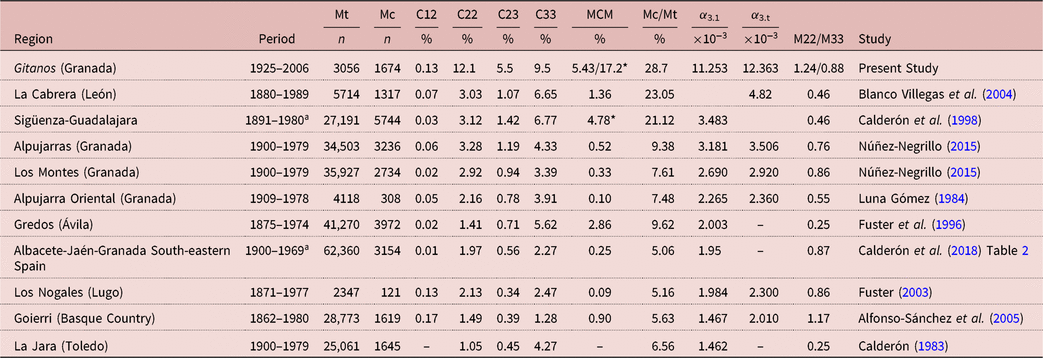
Consanguineous marriages in seven Spanish ‘isolates’ compared with those in the Gitano population of 22 contiguous localities in Granada province

Mt: total number of unions studied. Mc: total number of consanguineous unions up to second cousins.
C12: uncle–niece or aunt–nephew marriages. C22: first cousin couples; C33: second cousin couples; C23: first cousin once-removed marriages; all of these in SCM (Single Consanguineous Marriages). In the Gitano sample, however, these data concern the main degree of relatedness of both single and multiple consanguineous marriages.
MCM: proportion of multiple consanguinity marriages in the total sample of marriages. Most measures include only couples up to the C33 level; when C34 and C44 couples (or equivalent) are also included this is represented by the sign *.
α 3.1: α values considering only the main consanguineous relationship in consanguineous unions up to and including second cousins.
α 3.t: α values for all known relationships in consanguineous unions up to and including second cousins.
a When similar results were not included in these publications, the results were calculated with data offered in the respective papers.
In accordance with these results, the ethnographic fieldwork found that Gitano people do not seem to distinguish among the four types of first cousins. They categorize all of them as primos hermanos or first cousins and see little difference among them as relatives, although some of them may be emotionally closer if they had grown up together. The dominant norm of post-marital residence was that of patri-virilocality; that is, that the wife follows her husband to his place of residence, where his parents and brothers may reside as well. Hence there was a higher chance that patrilateral parallel cousins (type FBD) may have been raised in the same locality and had more opportunity to meet and mate in their teen years. As a counterpoint, growing up together often makes cousins see each other como hermanos: like siblings, more than as potential mates.
The structure of consanguinity
The structure of Gitano marriage showed a sustained preference for mating close family members. The proportion C22/C33 when calculated for the first or main degree was 1.27 – over five times the expected value of panmictic assumptions. However, when all ties in both SCM and MCM were analysed it resulted in 361 marriages having at least a degree of relatedness of C22, and 409 with at least one degree of C33, resulting in a C22/C33 proportion of 0.88. In every form considered, the C22/C33 ratio indicated the positive ‘preferentiality’ found in the sample of marriages studied. Another important factor in the structure of consanguinity in this population was the high rate of intergenerational marriages such as C23 and C34. This does not apply to C12 marriages, which are overtly rejected by Gitano people. The opportunity for finding partners of the right age for these asymmetrical marriages is always high due to the high fertility and long reproductive lives of Calé women. Before the recent fertility decline in this minority, it was common for Gitano women to begin having children in their teens and continue having them up to their 40s.
The historical evolution of Gitano inbreeding
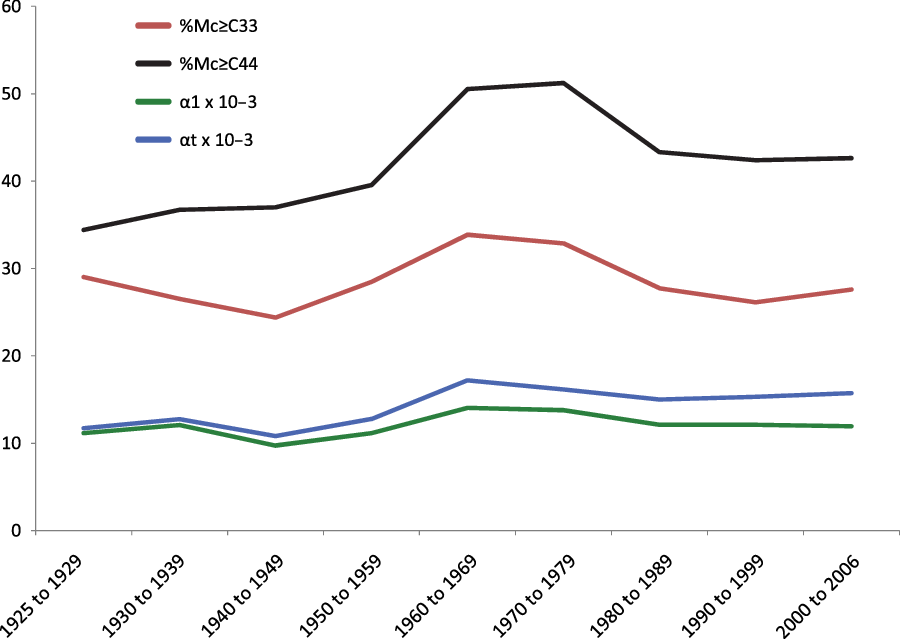
The main temporal trends of Gitano/Calé consanguinity can be observed in Table 1 and Figure 4. Throughout the 20th century consanguinity rates remained high, with over a quarter of all marriages being between relatives as close as, or closer than, second cousins. The data point to a small decrease in the consanguinity rate in the late 1930s and 1940s, particularly during the Civil War and the immediate post-war period (Figure 4). These were terrible times of hunger and deprivation for many Gitano families, who were often separated by the conflict and the post-war exile and dislocation. After the late 1940s consanguinity grew in parallel with the decline of infant and child mortality. The rising rates of surviving children generated a rise in the size of Gitano domestic families, and also in the expansion of kin networks with numbers of living siblings, cousins and other collateral relatives rarely attained before (Gamella & Martín, Reference Gamella and Martín2017). This may have facilitated the rise of consanguineous marriages in groups that maintained such preference. In the studied data this upward trend peaked from 1959 to 1979, when a third of all marriages were between close relatives, and the α value surpassed the 17 × 10−3 value. In the following decades, the generalized incorporation of Gitano people into public schools, health centres and mixed neighbourhoods facilitated the growth of intermarriage, while intra-family marriages decreased slightly. In the first decade of the 21st century the preference to marry ‘cousins’ remained strong, although it was compatible with the increase of mixed marriages (Table 1), particularly these involving Gitano women marrying non-Gitano men (57% of all mixed marriages in the study period).
The evolution of consanguinity and inbreeding in the population of 22 contiguous localities of southern Spain (1925–2006).

Local variations were very important in this new ‘mix’ of mating outcomes. In neighbouring towns there were different levels of social segregation of Gitano people, and very diverse educational and socioeconomic achievements by members of this minority. This was also evident in consanguinity and intermarriage patterns. In towns where intermarriage was growing faster, consanguinity was decreasing and it was perceived less favourably by Gitano residents. However, in some Gitano families both marriage patterns were obtained, with one child marrying a payo (non-Gitano) and another a first cousin. This points to the increasing heterogeneity and complexity of Gitano forms of integration into the dynamic and composite Spanish mainstream(s) (Alba & Nee, Reference Alba and Nee2003).
Discussion
The obtained results cohere with those of few previous studies containing precise information on consanguinity among Gitano groups, although more research is needed on this topic in other regions. In this sense, the present study may offer a baseline for new studies and comparisons involving both Spanish Gitanos and other Romani groups.
Nevertheless, to make sense of these results, one fundamental comparison is that of the Gitanos of Granada with their neighbours in this same area. Thus, the prevalence of consanguineous marriages in the Diocese of Granada, where a large part of the study area was located, has been investigated by the research team. The rest of the localities belong to the Diocese of Guadix, where most ecclesiastical records have been destroyed or lost (Gamella & Núñez-Negrillo, Reference Gamella and Núñez-Negrillo2018). Based on ecclesiastical records of over 15,400 marriage dispensations, Gamella and Núñez-Negrillo (Reference Gamella and Núñez-Negrillo2018) found a rate of consanguineous marriages up to second cousins of 5.5% in the period from 1900 to 1979. These rates of consanguinity resulted in values of α 3 = 2.044 × 10⁻³. The highest levels of consanguinity were found in the 1920s, when over 7% of all marriages were consanguineous and about 2.4% were among first cousins. Consanguineous marriages, however, decreased rapidly in the 1960s and 1970s, as in most Spanish regions, and since then they have become the exception (Núñez-Negrillo, Reference Nuñez-Negrillo2015; Gamella & Núñez-Negrillo, Reference Gamella and Núñez-Negrillo2018). In sum, consanguineous marriages were relatively high in the non-Gitano population of this region as well, but over five times less common than among Gitano families, even in the periods of highest endogamy. Moreover, Gitano consanguinity rates reached their maximum levels when they were plunging among their mainstream neighbours.
Other Spanish ‘isolates’
The intra-family marriage patterns of Gitanos also need to be compared with those found in the Spanish geographical ‘isolates’ with the highest rates of consanguinity and inbreeding. Table 4 summarizes the results of recent studies of the most endogamous of these regions. Most of them are comarcas –Spanish territorial divisions formed by a set of contiguous municipalities that share climate, ecology and cultural traditions as a result of their common historical adaptations. Some of these comarcas have maintained the highest levels of ‘reproductive isolation’ ever documented in Western Europe (Blanco Villegas et al., Reference Blanco Villegas, Boattini, Rodríguez Otero and Pettener2004, p. 193).
However, among the Gitanos of the study area, first cousin couples (C22) and first cousin once removed couples (C23) were about four to ten times more common than in the most endogamous regions (see Table 6). These differences were less significant for second cousins. Moreover, the structure and historical evolution of consanguinity also differed notably.
Across Spain, only two regions approach the level of consanguinity found among Gitanos: the diocese of Sigüenza-Guadalajara and the comarca of La Cabrera, both in the fringes of Central Meseta. The most endogamous of all known Spanish ‘isolates’ is that of La Cabrera – a mountainous comarca in north-western Spain secluded by steep mountains and a bad road network. Its population remained rather stable at around 9000 inhabitants up to the 1960s. Hereafter, the region suffered a quick depopulation as people migrated to industrial and urban areas in search of better jobs and living conditions. Blanco Villegas et al. (Reference Blanco Villegas, Boattini, Rodríguez Otero and Pettener2004) examined 5714 marriages held between 1880 and 1989 in the 37 parishes of this region. They found 23.05% consanguineous marriages up to and including third cousins (pp. 196–197, table 1). Accordingly, rates of inbreeding were among the highest recorded in Europe. The average F value up to second cousins, α 3, was 4.82 × 10⁻³ for the whole period studied. If marriages up to third cousins (C44) were considered, the corresponding α 4 value would be 6.78 × 10⁻³. Rates of inbreeding remained high from 1900 to 1959 and then declined rapidly (Blanco Villegas et al., Reference Blanco Villegas, Boattini, Rodríguez Otero and Pettener2004, p. 199). Multiple Consanguineous Marriages were also common. Thus, from 1880 to 1989 MCMs up to third cousins comprised 5.43% of all marriages (Blanco Villegas et al., Reference Blanco Villegas, Boattini, Rodríguez Otero and Pettener2004, pp. 196–197). By combining the analysis of MCMs and isonomy patterns, these authors concluded that the main causes of consanguinity and inbreeding in La Cabrera were geographic factors, particularly poor communications, together with the internal division of the rugged territory in small villages resulting in a strong Wahlund effect (Blanco Villegas et al., Reference Blanco Villegas, Boattini, Rodríguez Otero and Pettener2004, p. 206). In a subsequent publication analysing parent–offspring and marital migration matrices, these authors confirmed that reproductive barriers commonly coincided with geographic barriers and that there was a ‘dependence of the genetic structure on geographical distance’ (Boattini et al., Reference Boattini, Blanco Villegas and Pettener2007, p. 649).
The Diocese of Sigüenza-Guadalajara, on the eastern border of the Central Meseta, has offered another case of intense consanguinity sustained for generations. In the period from 1861 and 1980, Calderon et al. (Reference Calderón, Peña, Delgado and Morales1998) found a total consanguinity rate up to third cousins of 21.9%, resulting in an average inbreeding coefficient of 4.9 × 10⁻³ (Calderón et al., Reference Calderón, Peña, Delgado and Morales1998, pp. 549, 556). Multiple Consanguineous Marriages up to C44 were 5.24% of all marriages in the whole study period, and 8.14% between 1891 and 1920 (Calderón et al., Reference Calderón, Peña, Delgado and Morales1998, p. 549). These authors did a pioneering analysis of the weight of multiple consanguinity on total inbreeding levels, and found F t/F s rates of 1.51 from 1861 to 1980 (Calderón et al., Reference Calderón, Peña, Delgado and Morales1998 p. 556). Hence, MCMs increased the inbreeding values over SCM by over 50%.
However, applying the same calculation methods to the sample of Gitano/Calé people resulted in a total consanguinity rate up to third cousins of 43.5% and a F t/F s rate of 2.38 (the average inbreeding value for SCMs up to third cousins was 6.207 × 10³, and for equivalent total with MCMs it was 14.773 × 10⁻³). Thus, among Gitanos, the cumulative weight of multiple consanguinity was significantly higher than that of the most endogamous of Spanish populations.
Study limitations and strengths
The study has its limitations. The first is the relatively small size of the population studied, and the number of marriages analysed, particularly when compared with larger samples found in ecclesiastical records or large surveys. For Romani groups, however, there seem to be very few studies on marriage patterns that approach the sample size and temporal depth of the present one.
Secondly, the obtained sample did not represent the whole population of Spanish Gitanos. Therefore, the results presented should be considered as a baseline for comparing results from studies of Gitano/Calé couples in other regions. A third limitation was the under-registration of Gitano marriages, births and deaths. This trend decreased in the 20th century, especially since the mid-1920s. Thereafter the official records of Gitano births and deaths became more exhaustive and complete (Gamella & Martín, Reference Gamella and Martín2017). A major cause of under-registration results from the mobility and migration patterns of this population. People who were born, died or married away from the study area may be under-represented. However, the present sample involved many individuals and families who migrated seasonally or permanently to other regions or countries, particularly in the 1960s and 1970s, and who later returned to their birth places. The marriage and reproductive behaviour of these ‘leavers’ did not seem to differ from those of their relatives who remained in the study area. Besides, the problem of ‘escapes’ due to migration that affects all family reconstitution projects was mitigated here by the ‘extreme labour of reconstituting a large block of adjacent parishes’ (Wrigley, Reference Wrigley1994, p. 81).
Nevertheless, the family and genealogical reconstitution methods applied to this population were capable of establishing more and more distant degrees of kinship than most other methods, including those using ecclesiastical records of consanguinity dispensations. This applied even to those decades when Roman Catholic marriages became most common in this minority. For instance, in the period from 1925 to 1993, the ecclesiastical records of the Diocese of Granada (Núñez-Negrillo, Reference Nuñez-Negrillo2015; Gamella & Núñez-Negrillo, Reference Gamella and Núñez-Negrillo2018) included 127 Gitano consanguineous marriages in which at least one of the partners was born in one of the towns of the study area that belonged to this diocese. The genealogical reconstitution correctly identified 87% of these cases. Most of the other cases involved a local partner who married in a place away from the study area and did not return. On the other hand, the unions found in that exhaustive diocesan record only included 52% of all equivalent Gitano consanguineous couples found by the genealogical reconstitution.
Conclusion
This study shows that many Gitano/Calé families in eastern Andalusia, Spain, have maintained a culturally distinct preference for consanguineous marriage that remained ‘unbroken across generations’ (Bittles, Reference Bittles2012, p. 85). Consanguineous marriages were common among these people throughout the 20th century and remain common today. This contrasts with the processes found in most Spanish and European populations. Similar patterns, however, may be also found among other (but not all) Romani groups in Europe and America.
The structure of Gitano consanguinity is also different to that of their neighbours, as it includes preferential unions with first cousins and cousins once removed, as well as multiple degrees of relatedness to a level unknown in other Spanish populations. Therefore, average inbreeding values have remained much higher in the Gitano population than among their most endogamous neighbours. Distant kin ties, most of which may have little genetic or social relevance in isolation, when accumulated in multiple degrees of relatedness increased total inbreeding levels significantly. Most of these ties are commonly disregarded by other research methods. In this sense, the method of reconstituting families and merging genealogies followed in this study may be useful, particularly with populations that sustain consanguineous marriages through generations. An ethnographic and local approach is also useful when studying a population with independent procedures for establishing common-law unions that often are not formalized or registered. This is common practice in other Romani populations.
Among Calé groups, socio-cultural introversion and a strong preference for endogamy may have been more important than geographical barriers and limitations. Therefore, the great socio-political and demographic transformations of the second half of the 20th century have affected Gitano marriage patterns in a different and more complex form than their neighbours. Thus, in the 1960s and 1970s Spain experienced accelerated processes of industrialization and economic internationalization, resulting in an ‘exodus’ from rural to urban areas that broke up geographical barriers and increased the urbanization of the population (Shubert, Reference Shubert2003). In these decades many Andalusian Gitano families also migrated to more prosperous regions in the centre, east and north of Spain, and abroad. However, many of these families maintained strong preferences for interfamily marriages. Surprisingly, the highest rates of consanguinity appeared during this period. It seems that the rapid population growth brought about by the fall in infant and child mortality (Gamella & Martín, Reference Gamella and Martín2017) increased the size of Gitano households and the number of surviving collateral relatives, making family endogamy more likely. This confirms the importance of demographic transitions on patterns of inbreeding.
Even in the most recent period in democratic Spain, from 1978 to 2006, when most Gitano families experienced a generalized improvement of living conditions and opportunities, but also new problems such as drug dependence, urban decay and ghettoization, many of them have relied on the safety and certainty of intra-family marriage to face exclusion and multiple disadvantage. In many families, however, the secular pattern of endogamy is breaking down and the number of mixed marriages is increasing. Both the rejection of powerful majorities and a strong sense of ethnic distinction and separation have shaped a unique cultural and genetic profile that requires specific study designs that ‘acknowledge cultural tradition and self‐identity’ (Kalaydjieva et al., Reference Kalaydjieva, Morar, Chaix and Tang2005, 1084), as well as cultural and demographic transformations.
Acknowledgments
Elisa Martín Carrasco-Muñoz, a historian–demographer who died in 2009, was the heart and soul of the family and genealogical reconstitutions upon which this paper was based. She must be considered a co-author of any work deriving from this database. Mercedes Alba Maza, Mari Luz Flores Antiguedad, F. Antonio González Navarrete and Alejandro Quesada Garrido also contributed to the archival research in civil and parish registries. Jesús Martín helped with the map. Angel Heredia Amador has provided important advice over the years, and hundreds of Gitano friends in the localities studied shared their views and experiences with us, something for which we will always be grateful. Thomas Acton, Alan H. Bittles, María José Blanco Villegas, Alessio Boattini, Vicente Fúster, Daniel La Parra, Elena Marushiakova, Veselin Popov and one anonymous reviewer read prior versions of this paper and made important suggestions. The author, however, remains the only responsible for its shortcomings and for the views here expressed.
Funding
This research was completed within the Proyecto de Excelencia, P11.SEJ.8286 of the Junta de Andalucía, Spain.
Conflicts of Interest
The author has no conflicts of interest to declare.
Ethical Approval
The author asserts that all procedures contributing to this work comply with the ethical standards of the relevant national and institutional committees on human experimentation and with the Helsinki Declaration of 1975, as revised in 2008.