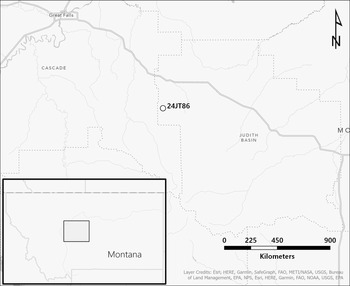
The Painted Coulee site (24JT86) is located on a private ranch on the north flank of the Little Belt Mountains, about 60 km southeast of Great Falls, Montana (Figure 1; Supplemental Figure 1). Twenty-two panels of rock art were identified at the site (Loendorf et al. Reference Loendorf, Castañeda, Kaiser, Willis and Steelman2022), dominated by red-painted figures with a lesser number of black figures. Multiple vertical stripes of red paint in horizontal rows, known as counter lines, extend across one-quarter of the site. These are intermixed with stick-figure anthropomorphs, a bighorn sheep, and a bear. None of these figures appear to be part of a biographic scene such as the one described below.
Map showing 24JT86 location.

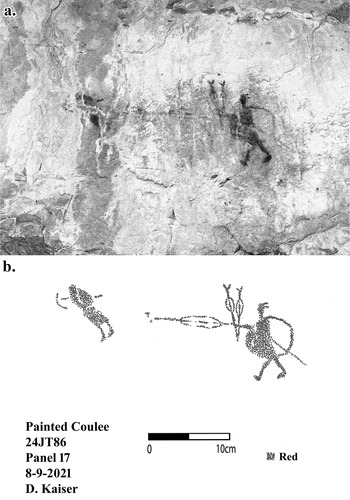
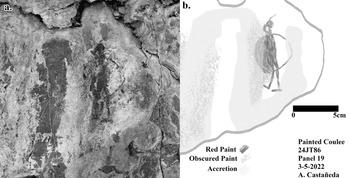
The focus of this report is on two specific panels that appear to be part of a biographic scene. One panel portrays a shield-bearing warrior (SBW) who is apparently wielding an atlatl to direct a dart at a fleeing archer (Figure 2; Supplemental Figure 2), and a second panel depicts a stand-alone archer with his bow in a drawn position (Figure 3; Supplemental Figure 3). The panels are about 8 m apart and 2 m above the ground surface. Figures were executed in red liquid paint that appears to have been at least partly applied with a brush or a thin piece of wood or bone. The limestone wall has a heavy mineral coating that hampers the ability to see all the figures.
Scene with the shield warrior wielding an atlatl and throwing a dart at a fleeing archer (a) DStretch enhanced photo and (b) illustration. Color version in Supplemental Figure 2. Paint sample 1 was collected from the body of the shield figure. Results are 1790 ± 50 RCYBP (cal AD 120–390).

Anthropomorph with a large bow, a possible coat, and probable shoes (a) DStretch enhanced photo and (b) illustration. Color version in Supplemental Figure 3. Paint sample 2 was collected from the right foot of the anthropomorph. Radiocarbon results are 1710 ± 45 RCYBP (cal AD 240–425).

This panel was originally described as a hunting scene where the SBW-hunter was “armed with an atlatl and this warrior (who is not assignable to any named style) is further unique in that he is the only shield bearer shown actually hunting an animal in a composed scene” (Keyser and Poetschat Reference Keyser and Poetschat2014:80–81).
Bamforth (Reference Bamforth, Clark and Bamforth2018:22) points out that although spears, atlatl and darts, and bows and arrows were useful in hunting or in war, shields have no other use than protection in combat. This makes it difficult to understand a shield in a hunting scene. However, a DStretch analysis (which was not available when the site was first recorded) shows more detail. What had originally been identified as a hunted animal is a human holding a bow and a projectile in its back. This fleeing archer indicates an altercation, and the presence of a shield makes more sense.
Unfortunately, the mineral coating makes it difficult to see details of the atlatl, but the linear red area is thought to represent an extended atlatl. It is clear the figure has two darts oriented upright as though they are in a hand. Extra darts like these are found with other rock art examples of warriors using atlatls, some in combat with other atlatl users (Geib Reference Geib2016:338–366). An excellent example (Supplemental Figure 4) is found at the Rocky Ridge site, near Manila, Utah, where an atlatl is clearly visible in detail that shows a weight and extra darts (Loendorf and Castañeda Reference Loendorf and Castaneda2021). The Painted Coulee figure's extra darts support the belief that the individual is also using an atlatl.
In the other panel (Figure 3), the lower half of the archer's bow has been lost due to microspalling, but DStretch enhancement shows that it was once complete. A significant feature with the stand-alone archer is the large feet, which may represent boots or snowshoes. The figure appears to be wearing a long coat, which supports the idea that the scene is in winter.
Methods
In order to learn about the chronology of this scene depicting the transition between atlatl and bow/arrow technology, we selected two pictographs for radiocarbon dating—the SBW (Figure 2; Supplemental Figure 2) and the stand-alone archer (Figure 3; Supplemental Figure 3). Steelman's laboratory (now located at Shumla) has radiocarbon dated pictographs worldwide, including a rigorous program of research between Loendorf with Rowe and Steelman to date pictographs in the western United States (see list of references in Rowe Reference Rowe2012; Steelman, Boyd, and Allen Reference Steelman, Boyd and Allen2021). We employed a custom-built plasma oxidation apparatus to convert organic material from binders/vehicles in the ocher-pigmented paint samples to carbon dioxide for accelerator mass spectrometry (AMS) radiocarbon dating. We followed the methods in Steelman and colleagues (Russ et al. Reference Russ, Pohl, von Nagy, Steelman, Hurst, Ashby, Schmidt, Padilla Gutiérrez and Rowe2017; Steelman, Boyd, and Allen Reference Steelman, Boyd and Bates2021; Steelman, Boyd, and Bates Reference Steelman, Boyd and Bates2021) for sample collection, processing, and measurement of paint and oxalate samples outlined in detail in Supplemental Text 1 (also see Supplemental Figures 5, 6, and 7). Our laboratory prepared samples of USGS coal as “dead” carbon blanks measured at Lawrence Livermore National Laboratory's Center for Accelerator Mass Spectrometry (CAMS) to calculate reported ages.
Results
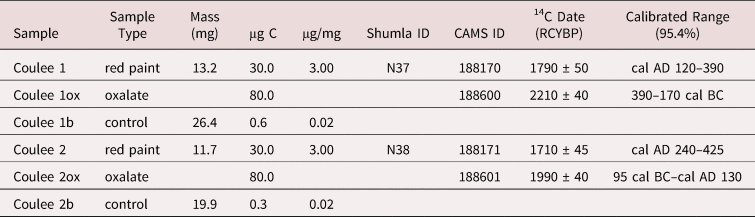
Radiocarbon dates are reported in Table 1. Radiocarbon results were calibrated using the OxCal computer program version 4.4.4 (Bronk Ramsey Reference Bronk Ramsey2009, Reference Bronk Ramsey2022) with IntCal20 curve data from Reimer et alia (Reference Reimer, Austin, Bard, Bayliss, Blackwell, Ramsey and Butzin2020). Control samples of the unpainted rock that were processed in the same manner as the paint samples contained negligible contamination (Table 1).
Sample Information and Radiocarbon Results from Painted Coulee (24JT86).

We did not measure the stable carbon isotope values for the dated carbon directly, due to small sample sizes (Table 1). Oxalate radiocarbon ages were calculated using a stable carbon isotope value of −11‰, the average value measured for oxalate samples associated with pictograph sites (Russ et al. Reference Russ, Loyd and Boutton2000). For the paint samples, the δ13C value was assumed to be −25‰, the value assumed by AMS radiocarbon laboratories in the absence of a direct stable carbon isotope measurement (Bowman Reference Bowman1990:21). For radiocarbon measurements at CAMS that measure the ratio of 14C to 13C, there is a shift of eight years with every per mil change from −25‰ (value of wood charcoal). Possible carbon sources of organic binders in the paint are assumed to be animal fat, blood, or egg, with values close to −25‰ and will not overly affect the age of the painting. Russ has observed δ13C values of −3‰ for organic material extracted from Texas pictographs (Russ et al. Reference Russ, Loyd and Boutton2000), which would shift the ages by only 16 RCYBP older.
We were also able to obtain maximum ages for the pictographs by dating oxalate minerals (Steelman, Boyd, and Bates Reference Mulloy2021). Radiocarbon ages of oxalate date the formation of mineral accretions. However, as multiple formation layers may be included, a radiocarbon determination for an oxalate accretion is a weighted average of the deposited layers’ ages. Even so, underlying oxalate layers will provide maximum ages for rock paintings given that the mixture of the underneath layers is still older than any overlying paint. For these two figures studied, there was negligible accretion formation overlying paintings. Consequently, the oxalate minerals in the collected powdered samples are from underneath the paintings and provide maximum ages for the pictographs. Most importantly, these oxalate dates are older than the associated direct paint dates, showing consistent chronology of the underlying minerals and paint layers in the correct stratigraphy order. This is a good check of our laboratory techniques to ensure that we are obtaining accurate and reliable results.
Discussion
Archer Pictograph
The date for the archer is 1710 ± 45 RCYBP, or cal AD 240–425. There is debate as to when and how bow-and-arrow technology first started in west central Montana (Davis Reference Davis1988; Reeves Reference Reeves1983), but the widely accepted hypothesis is that the bow and arrow were introduced by Avonlea phase hunters, but they were not in widespread use until AD 600 (Davis Reference Davis1988; Kornfeld et al. Reference Kornfeld, Frison and Larson2010; MacDonald Reference MacDonald2012; Rennie and Johnson Reference Rennie and Johnson2017Footnote 1). The date of cal AD 240–425 is early for use of the bow in the region.
There is no archaeological evidence regarding the type of bow first used in the region. Avonlea projectile point–tipped arrows have been recovered in regional archaeological sites, but only fragments of bows are known (Greer Reference Greer1978; Mulloy Reference Mulloy1958). Avonlea hunters made a thin, distinctly side-notched projectile point with a shoulder and neck width within the range of arrow points (Rennie and Johnson Reference Rennie and Johnson2017:27).
Shield-Bearing Warrior Figure
The date for the shield-bearing warrior is 1790 ± 50 RCYBP, or cal AD 120–390. The SBW motif is widespread across the western United States. The figures are especially common in Montana, with single sites that have as many as 850 examples (Keyser et al. Reference Keyser, Kaiser, Poetschat and Taylor2012). Prior to this study, the Montana SBWs were thought to date between AD 1200 and 1875.
The only directly dated example anywhere in North America is from the distant Oxtotitlán Cave in Guerrero, Mexico (Russ et al. Reference Russ, Pohl, von Nagy, Steelman, Hurst, Ashby, Schmidt, Padilla Gutiérrez and Rowe2017). The Oxtotitlán warrior is partially obscured by mineral deposits, but a profile head can be seen above a circular shield that appears to be adorned with feathers. Samples of the black paint used to make the figure were dated at 1980 ± 190 RCYBP. A second date on the oxalate coating covering the painting had an age of 1370 ± 30 RCYBP, providing a minimum age. These dates suggest that the figure was made between 500 cal BC and cal AD 600. The idea that the shield-bearing warrior motif had its origin in Mexico has long-standing support (Gebhard Reference Gebhard1966), and researchers have universally agreed that examples of the motif in Montana came with groups that migrated to the region from the south (Greer Reference Greer1995; Keyser Reference Keyser1975; Loendorf Reference Francis and Loendorf2004).
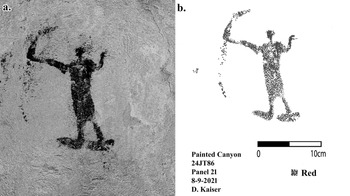
Prior to this study, the oldest rock art depicting a SBW north of the Rio Grande is at the McConkie Ranch site in northern Utah, where they are dated by superimposition to circa AD 900–1000 (Loendorf 2004). The direct radiocarbon age of AD 120–390 for the Painted Coulee figure is the oldest-dated SBW north of Mexico. Based on a very similar shield design, half infilled with red paint, a second SBW coated with minerals on an adjacent panel is probably the same age (Figure 4; Supplemental Figure 8). These two figures may represent the same warrior.
A second shield-bearing warrior approximately 2 m to the right of the atlatl wielding shield warrior (a) DStretch enhanced photo and (b) illustration. Color version in Supplemental Figure 8.

The important point is that although prior research indicates a southern origin for the SBW motif, the Painted Canyon figures show that this may be wrong. The oldest SBW is in the north, and examples at Fremont sites and Ancestral Pueblo sites may have come from northern origins. Or more likely, the motif has multiple points of origin.
Changing Technologies
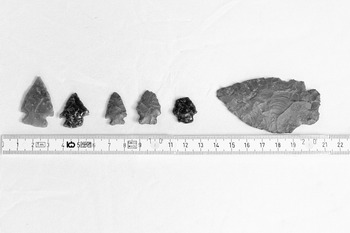
Projectile points and a back-hafted knife have been collected from a flat area adjacent to the canyon with the paintings (Figure 5; Supplemental Figure 9). These projectile points are Late Archaic Pelican Lake corner-notched points that were used with atlatls, and this typology overlaps with the time period that the shield-bearing warrior was painted (cal AD 120–390).
Late Archaic–age projectile points, often classed as the Pelican Lake type, and a back-hafted cutting tool, found on the flat above 24JT86. Color version in Supplemetal Figure 9.

The rock art depictions of a SBW and the archer were made when the two kinds of weaponry overlapped in time. The length of time the bow and atlatl were both in use is also debated, ranging from proponents of a rapid turnaround of less than 50 years for the bow to replace the atlatl to those who think it was several hundred years.
The radiocarbon dates for the pictographs suggest that the paintings were created soon after the bow was introduced to the region. Although speculative, the paintings and point types suggest that an outside group using the bow and arrow encountered a resident group using the atlatl. Prior to the introduction of the bow and arrow, scenes of warfare are rare in northwestern Plains rock art (Greer and Greer Reference Greer, Greer, Clark and Bamforth2018:64). Francis and Loendorf (Reference Francis and Loendorf2004:14) have suggested that there might have been conflict between the initial bow and arrow users and SBWs when there was a time of technological overlap. The process of this transition and any violence that accompanied it was likely memorable, so imagery capturing the time is perhaps to be expected.
An Early Example of Plains Biographic Pictographs
The Painted Coulee pictographs represent a very early example of biographic rock art. Biographic rock art, or pictorial storytelling, is well developed on the northwestern Plains (Keyser and Klassen Reference Keyser and Klassen2001:244–253), with most examples in the protohistoric and historic periods. There are some scenes in the Late Prehistoric period that are of fights between shield-bearing warriors using clubs, spears, and other weapons. Some appear to show coup counting, with a superior warrior touching a lesser figure with a coup stick (Keyser and Klassen Reference Keyser and Klassen2001:240).
If the Painted Coulee scene in Figure 2 is read in the usual manner for Plains biographic scenes—from right to left—the SWB is moving toward the retreating archer while casting a dart with an atlatl. The dart pierces the archer, who is stumbling or falling forward from the wound. The biographic scene was likely painted by the SBW or someone in the SBW's group to record the event.
The panel with the stand-alone archer (Figure 3) is to the right with about 8 m of heavy mineralized surface between it and the SBW. The figure seems to be too far removed from any biographic scene. However, surrounding and in between these two panels, there are red paintings that are obscured by the mineral accretion. One discernable image is the other SBW with the same shield design, which may represent the same person during an earlier part of the story. Although the most obvious biographic scene involves the atlatl-welding warrior and the fleeing archer in Figure 2, it may be possible that the figures to the right are the beginning of a larger narrative.
Conclusions
Rock art images of a SBW, using an atlatl to direct a projectile into a fleeing archer, and a stand-alone archer possibly wearing a winter coat and possibly using snowshoes, were radiocarbon dated by plasma oxidation to AD 240–425. The age is early for the bow and arrow on the northern Plains, which is generally thought to have come via Avonlea hunters.
The SBW with the atlatl and extra darts appears to have directed a projectile toward the body of a retreating archer. To the right of this panel, there is another SBW with the same shield design. This may be part of a larger biographic scene, but the mineral coating makes it difficult to demonstrate any association of other figures. It does, however, emphasize the fact that SBWs were present at the site and quite possibly were using Pelican Lake projectile points—like those recovered at the site—on their darts.
Now that the Painted Canyon example has been dated to the Late Archaic, there is a good possibility that more will be found. The question is, why does this region have such a long history of warfare? It may relate to the proximity of so many different language groups with speakers of Salish, Kutenai, and Sahaptin to the west; Algonkian to the north; Shoshone on the south; and Siouan speakers to the east. There may have been intergroup competition for prime hunting areas when game was scarce. There are other possibilities, but the Pained Coulee biographic scene suggests that the conflict has gone on for 1,700 years.
Acknowledgments
Thanks to the additional members of the 2021 field crew: Cobe Chatwood, Mark Willis, Laurie White, David Kaiser, Charles Koenig, Susan Hovde, and Garth Bontrager. Dr. Joseph Reibenspies of the X-Ray Diffraction Laboratory at the Department of Chemistry at Texas A&M University provided assistance collecting XRD data. Diana Radillo Rolón translated the abstract into Spanish. We thank the ranch family—especially Harry, Carol, and Sandra—for their willingness to let us access and study these important sites on their land. No permits were required for this work. Finally, our gratitude goes to Douglas Bamforth and two anonymous reviewers, who helped us to improve this report.
Funding Statement
This project was funded by Sacred Sites Research Inc.
Data Availability Statement
All documentation and data for 24JT86 is housed with Sacred Sites Research Inc.
Competing Interests
The authors declare none.
Supplemental Material
For supplemental material accompanying this article, visit https://doi.org/10.1017/aaq.2023.1.
Supplemental Text 1. Radiocarbon Dating Pictographs at Painted Canyon, Montana – Methods.
Supplemental Figure 1. Aerial view of Painted Canyon looking north toward the Highwood Mountains. Mark Willis's photograph from an unmanned aerial vehicle.
Supplemental Figure 2. (a) DStretch enhanced photo with color channel CRGB and (b) illustration of scene with the shield warrior wielding an atlatl and throwing a dart at a fleeing archer.
Supplemental Figure 3. (a) DStretch enhanced photo with color channel YRE and (b) illustration of anthropomorph with a large bow, a possible coat, and probable shoes.
Supplemental Figure 4. An example of an altercation between two individuals, one of whom is using an atlatl to thrust a spear at the other. This scene is from the Rocky Ridge site in Utah.
Supplemental Figure 5. Radiocarbon sample locations for sample 1 on (a) the shield-bearing warrior and (b) anthropomorph holding the bow. Yellow circles denote the paint sample, whereas blue circles identify where the background sample was collected.
Supplemental Figure 6. Powder XRD diffraction pattern of the mineral sample prior to acid treatment, confirming the presence of gypsum (red triangles), basanite (red circles), calcite (purple squares), and whewellite (green diamonds). The mineral whewellite is calcium oxalate that contains carbon that can be dated to determine a maximum age for the pictographs.
Supplemental Figure 7. FTIR spectra before (top) and after (bottom) phosphoric acid treatment to remove carbonates. Vibrational frequencies for sulfate functional groups associated with gypsum and basanite are denoted with red triangles, carbonate with purple squares, and oxalate with green diamonds.
Supplemental Figure 8. (a) DStretch enhanced photo with color channel LDS and (b) illustration of a second shield-bearing warrior approximately 2 m to the right of the atlatl-wielding shield warrior.
Supplemental Figure 9. Late Archaic–age projectile points, often classed as the Pelican Lake type, and a back-hafted cutting tool, found on the flat above 24JT86.