Implications
Heathlands present a low capacity to sustain productive grazing systems with large herbivores, such as cattle and horses, because of their low nutritive value. The great body weight losses observed at the end of summer, especially in lactating animals, involves the need for feed supplementation or the translation of animals to prevent starvation. Thus, other plant communities with better nutritive quality should be provided for most of the grazing season to maintain productive herds with acceptable offspring growth rates without excessively penalizing mother's condition and subsequent reproductive performance. Heathlands could be utilized for ranging animals with low requirements, such as dry mares.
Introduction
Heathlands cover large areas of the northwest of the Iberian Peninsula, mainly in the humid Cantabrian region, and fall mostly in less-favoured areas where the rural development is limited by harsh conditions (e.g. very poor soils) that restrict forestry exploitation and hinder profitability of livestock enterprises. Heathland vegetation is mostly composed of woody plants and coarse grasses of very low nutritive value (Hodgson et al., Reference Hodgson, Forbes, Armstrong, Beattie and Hunter1991; Celaya et al., Reference Celaya, Benavides, García, Ferreira, Ferre, Martínez, Ortega-Mora and Osoro2008) that limits the development of sustainable grazing systems. Nevertheless, grazing by domestic herbivores is recognized as a useful management tool to exploit efficiently these resources, obtaining high quality animal products, controlling excessive accumulation of combustible phytomass and fire hazard, and maintaining higher levels of biodiversity (Milne and Osoro, Reference Milne and Osoro1997).
Cantabrian heathlands have been traditionally managed with local breeds of small ruminants and beef cattle. However, in the last decades the censuses of sheep and, particularly, goats have been drastically reduced, whereas crossbred horses have increased considerably their presence because of their higher management easiness, lower predation risks and other social causes (Izquierdo, Reference Izquierdo2008). In addition, their distinguishable meat type, which contains less saturated fatty acids (Badiani et al., Reference Badiani, Nanni, Gatta, Tolomelli and Manfredini1997), regarded as beneficial for human health, might have promoted foal production. Nevertheless, at least in Spain, horse meat price for producers is still much lower than beef price, although regulations for sanitary management, slaughter and sale are more restrictive.
The development of adequate strategies for the management of horses on these vegetation communities, driven by production or environmental goals, requires the knowledge of the grazing behaviour and performance of this non-ruminant species and its comparison with other animal species that use these natural areas, like cattle. Cattle and horses are widely recognized as grazers, eating great proportions of grasses and other graminoids such as sedges (Salter and Hudson, Reference Salter and Hudson1980; Arnold, Reference Arnold1981). In general, both species prefer foraging on herbaceous communities such as grasslands (e.g. Duncan, Reference Duncan1983; Gordon, Reference Gordon1989; Menard et al., Reference Menard, Duncan, Fleurance, Georges and Lila2002) and show a high dietary overlap (e.g. Hubbard and Hansen, Reference Hubbard and Hansen1976; Krysl et al., Reference Krysl, Hubbert, Sowell, Plumb, Jewett, Smith and Waggoner1984; Lamoot et al., Reference Lamoot, Meert and Hoffmann2005a), implying a strong potential for competition. Horses are hindgut fermenters with a less efficient digestion of fibre and higher intake capacity than ruminants (Demment and Van Soest, Reference Demment and Van Soest1985; Cymbaluk, Reference Cymbaluk1990; Dulphy et al., Reference Dulphy, Jouany, Martin-Rosset and Thériez1994). As a result, horses spend more time grazing than other domestic herbivores (Arnold, Reference Arnold1981; Aldezabal, Reference Aldezabal2001) and select for tall and high herbaceous biomass patches (Duncan, Reference Duncan1983; Naujeck et al., Reference Naujeck, Hill and Gibb2005). However, horses, with both upper and lower incisors, are able to graze much closer to the ground than cattle, goats and sheep when available sward height declines (Fleurance et al., Reference Fleurance, Duncan and Mallevaud2001; Menard et al., Reference Menard, Duncan, Fleurance, Georges and Lila2002). In addition, as a result of their digestive and foraging strategy, horses are less affected by a low forage nutritive quality and they can more readily include fibrous grasses in their diet (Duncan et al., Reference Duncan, Foose, Gordon, Gakahu and Lloyd1990; Fleurance et al., Reference Fleurance, Fritz, Duncan, Gordon, Edouard and Vial2009), although in the case of shrubs, they seem to be more reluctant to select them (e.g. Aldezabal, Reference Aldezabal2001; Loucougaray et al., Reference Loucougaray, Bonis and Bouzilé2004; Lamoot et al., Reference Lamoot, Meert and Hoffmann2005a). Similarly in cattle, the physiological state of mares greatly determines their nutritional requirements (National Research Council, 2007), thus affecting their performance and feeding behaviour (Lamoot et al., Reference Lamoot, Vandenberghe, Bauwens and Hoffman2005b).
Differences in grazing behaviour and digestive physiology between cattle and horses could indicate a complementary use for an efficient management of semi-natural plant communities under mixed grazing (e.g. Loucougaray et al., Reference Loucougaray, Bonis and Bouzilé2004). However, little information is available comparing the grazing behaviour and performance of these herbivores on heathland vegetation. The objective of this study was to compare the diet selection and body weight (BW) changes of lactating and non-lactating cows and mares grazing together on mountain Cantabrian heathlands during summer, in order to assess their behaviour, productive potential and complementarity on these less-favoured areas.
Material and methods
Study site
The experiment was conducted during 2006, 2007 and 2008 on a plot of 59 ha located at 800 to 950 m above sea level in the experimental farm of SERIDA, Illano, Western Asturias (NW Spain, 43°19′N, 6°54′W). The climate is characteristic of medium altitude mountains in temperate humid areas under oceanic influence. Mean annual rainfall recorded at the site during the study years was 1469 mm, mostly occurring from October to March. Mean annual temperature was 9.8°C, with a minimum monthly mean of 4.6°C in January and a maximum monthly mean of 15.7°C in July. The bedrock consists of Ordovicic shales, which give rise to infertile and acidic soils.
The plot, scarcely grazed by beef cattle and feral horses for several years before the experiment, was fenced in a west-facing slope and used to assess animal behaviour and performance under the same natural conditions. Animals were managed at low stocking rates (around 0.25 adult animals/ha) as usually practised in the region. The vegetation was mostly composed of a mature heath community (Halimio alyssoidis–Ulicetum gallii) dominated by dwarf heather species, mainly Erica umbellata, E. cinerea and Calluna vulgaris. Tall heather shrubs up to 2 m high (E. australis subsp. aragonensis) were sparsely present. Other shrubs were Genistella tridentata, western gorse (Ulex gallii) and heath rockrose (Halimium alyssoides), among others. The herbaceous plants were mostly coarse grasses such as Pseudarrhenatherum longifolium and Agrostis curtisii.
Animals and management
A total of 20 beef cows (Asturiana de los Valles breed, 533 ± 16.8 kg BW) and 20 crossbred mares (312 ± 9.0 kg BW), either lactating or not, were managed together during the summer grazing season (from mid-June to September and October) of three consecutive years (i.e. 2006 to 2008). In 2007, only non-lactating animals were stocked (Table 1).
Grazing season, climatic conditions and number of animals managed in the three experimental years

T = mean temperature during the grazing season; P = rainfall during the grazing season.
Offspring were born in late winter–early spring and reared outdoors with their mothers on improved ryegrass–clover pastures with accessible heathland areas until the experimental grazing season began when they were 3 to 4 months of age.
All animals were drenched with ivermectin (Oramec®, Merial, Lyon, France) against gastrointestinal nematodes 2 weeks before turning out.
Vegetation measurements
Plant surface cover and height were assessed in July and September 2006, July and October 2007, and July 2008 using a Hill Farming Research Organization swardstick (Barthram, Reference Barthram1986) and recording 500 random contacts throughout the plot.
Samples of the main vegetation components (heather, other shrubs and herbaceous plants) were harvested in July and September for chemical analysis. Samples were analysed following the procedures of the Association of Official Analytical Chemists (AOAC, 2006) for ash and CP (N Kjeldahl × 6.25), and NDF, ADF and ADL were analysed by the methods of Goering and Van Soest (Reference Goering and Van Soest1970) and Van Soest et al. (Reference Van Soest, Robertson and Lewis1991).
Diet composition and animal performance
The composition of the diet selected by the animals was estimated using the n-alkane markers (Dove and Mayes, Reference Dove and Mayes1991). Faecal grab samples were collected during different periods (i.e. July and September) of each grazing season. At the same time, samples of the main plant components were collected, that is, leaves and/or green shoots of heather (including E. umbellata, E. cinerea and C. vulgaris), gorse and heath grasses (mostly P. longifolium). All samples were stored at −20°C and then freeze-dried and milled before analytical procedures. Alkanes (from C21 to C36) were extracted using the method of Mayes et al. (Reference Mayes, Lamb and Colgrove1986) and their concentrations determined by gas chromatography. The proportions of the plant components in the diet were estimated using an iterative least squares procedure that minimizes the discrepancies between the observed concentrations of each n-alkane (C25 to C33) in the faeces and the estimated proportions of plant components in the diet. For diet composition calculations, the alkanes C21, C23, C35 and C36 were not used due to their low concentrations in all plant species. Gorse was excluded from the calculations because its alkane profile had a high resemblance with that of grasses and thus it was not possible to discriminate it as an independent item. Faecal concentrations were previously corrected using faecal recoveries calculated in previous validation studies with cattle and horses (Ferreira et al., Reference Ferreira, Garcia, Rodrigues, Celaya, Dias-da-Silva and Osoro2007).
Every animal was weighed at the beginning (June), mid (early August) and end (September to October) of the grazing season. In view of the natural differences in BW existing between the cattle and horse breeds studied, daily BW changes (for the first and second half and for the whole grazing season) were calculated as percentages in relation to initial BW.
Statistical analyses
Diet composition data and BW changes of adult animals were subjected to a mixed model ANOVA to test the fixed effects of livestock species (Sp), lactating state (Ls), year (Yr), season (Ss) and the full interactions, except those involving Ls × Yr, including the random effect of individual animals. Herbage proportion in the diet was angular transformed before analyses to fulfil assumptions of normality and variance homogeneity. Daily BW changes of adult animals for each season (i.e. from June to August and from August to September and October) and for the whole grazing season were further analysed for the effects of Sp, Ls, Yr, and the interactions Sp × Ls and Sp × Yr.
BW gains of offspring were analysed for the effects of Sp, Yr (only 2006 and 2008), Ss, and their interactions, using a mixed model ANOVA. Similarly in dams, these data were also analysed for each season, testing the effects of Sp, Yr and Sp × Yr.
For significant interactions, differences between means were examined by the Tukey test. Partial correlations between diet composition and BW changes of adult animals were obtained using a GLM procedure, including the fixed effects of Sp and Ss. All analyses were performed using SAS System software (SAS Institute Inc., 1999).
Results
Available vegetation
Plant surface cover and height were roughly similar across the experimental years. Mean percent cover of live heather accounted for 65.0%, E. umbellata being the most abundant (29.3%) followed by E. cinerea (22.0%). Other shrubs and herbaceous plants accounted for 21.8% and 5.0% cover, respectively, and the remainder was dead matter (8.1%). Mean canopy height was 26.9 cm, being heather the tallest plant component (28.9 cm) followed by other shrubs (25.9 cm) and herbaceous plants (17.7 cm).
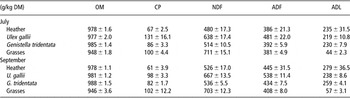
Chemical composition of the main plant species and groups revealed a low nutritive quality (Table 2). As expected, dwarf shrubs had high concentrations of lignin and fibre. Protein concentrations did not exceed 100 g CP/kg dry matter (DM), except for gorse in early summer (131 g CP/kg DM). The other woody legume, that is, G. tridentata, had lower CP concentrations as it has no true leaves but winged shoots. Most of the typical heath grasses have coarse leaves with high NDF and low CP concentrations. General increases in ADF, NDF and ADL concentrations, and decrease in CP concentration were observed from July to September, though less noticeably in the grasses (Table 2).
Chemical composition (mean ± s.e.) of the main plant components of Cantabrian heathlands in two periods (July and September) of the grazing season

DM = dry matter; OM = organic matter.
Diet composition
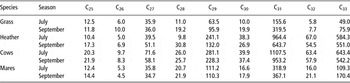
Data on n-alkane content of diet components and faeces of cows and mares are given in Table 3, and showed that plant components had different alkane profiles. Heather was characterized by higher concentrations for the majority of the alkanes in both grazing periods. Faecal alkane concentrations differed between animal species as a result of a different diet selection.
Mean alkane content (mg/kg DM) of diet components (grasses and heather) and faeces of cows and mares grazing in Cantabrian heathlands in two periods (July and September) of the grazing season

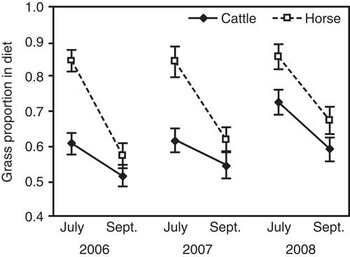
Estimated herbage proportion in the diet was higher (P < 0.001) in mares than in cows (0.739 v. 0.600), and in July than in September (0.752 v. 0.587). Differences between cattle and horses were higher in July (0.654 v. 0.849; P < 0.001) than in September (0.547 v. 0.629; P < 0.05), given the higher decrease in herbages selected by horses as the season advanced (Figure 1). As a result, an interaction (P < 0.01) between Sp × Ss was found. A trend was observed for an increase (P = 0.061) of the herbage proportion in diet from year to year (Figure 1). Ls of cows and mares did not affect their diet composition. All other interactions, except for Sp × Ss, were non-significant.
Grass proportion in the diet of cattle and horses during summer grazing on Cantabrian heathlands.

Animal performance
Daily BW percentage changes of dams were affected by the grazer Sp (P < 0.001), Ls (P < 0.05), Ss (P < 0.001), and the interaction Sp × Ss (P < 0.001). Cows had worse BW changes than mares in the two periods considered and throughout the whole grazing season (P < 0.001; Table 4). From June to August, cows lost BW (−0.10%/day in relation to initial BW), whereas mares gained BW at a rate of 0.14%/day (s.e.m. = 0.023; P < 0.001). Yr or Ls did not affect BW changes during the first period. However, there was a nearly significant trend for the interaction between Sp and Ls (P = 0.087), as the differences between suckler and dry animals were greater in cows than in mares (Table 4).
Daily BW changes (in relation to initial BW) of cows and mares according to their lactating state during the summer grazing season in Cantabrian heathlands (means of 3 years)

Sp = animal species; Ls = lactating state; Yr = year.
1From June to August.
2From August to September and October.
*P < 0.05; **P < 0.01; ***P < 0.001; ns (P > 0.1).
From August to October, differences between cattle and horses were reduced (P < 0.05), and both lactating cows and mares lost more BW (P < 0.01) compared with their non-lactating counterparts (−0.19 v. −0.10%/day in cows and −0.14 v. −0.05%/day in mares), with no interaction between Sp and Ls. For the whole grazing season, lactating cows had higher (P = 0.004) losses compared with dry cows (−0.16 v. −0.07%/day), whereas there were no differences (P = 0.623) between lactating and dry mares (−0.00 v. 0.03%/day).
Offspring BW gains did not differ between calves and foals but were affected by Ss (P < 0.001) and the interactions Sp × Ss (P < 0.05) and Yr × Ss (P < 0.01). From June to August, daily BW percentage gains were similar between calves and foals (0.83 and 0.90%/day, respectively), and were affected by Yr (P < 0.05). As indicated by the initial BW shown in Table 5, both calves and foals were older in 2008 and thus achieved lower growth rates than in 2006. However, during the second half of the grazing season, calves achieved higher (P < 0.05) BW gains compared with foals (0.37 v. 0.16%/day; Table 5). Overall (from June to October), BW gains were marginally higher in calves (0.67%/day) than in foals (0.56%/day).
Daily BW gains (in relation to initial BW) of calves and foals during two summer grazing seasons (2006 and 2008) in Cantabrian heathlands

Sp = animal species; Yr = year.
1From June to August.
2From August to September and October.
*P < 0.05; ns (P > 0.1).
Relationship between diet selected and performance
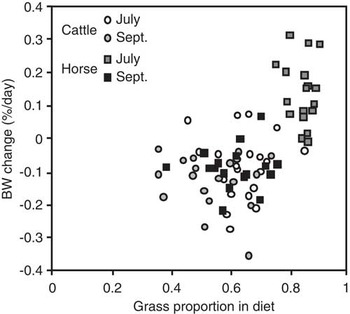
Analysing overall data, a positive correlation (r = 0.58, P < 0.001, n = 74) was found between herbage proportion in diet and BW percentage changes of adult animals. However, after including the effects of herbivore Sp and Ss, partial correlations between diet composition and BW change were non-significant, and thus, there were no relationships between diet selected and productive response within each species for each season (Figure 2).
Relationship between grass proportion in diet and daily BW percentage changes in cattle and horses during summer grazing on Cantabrian heathlands.

Discussion
Heathlands are characterized by low nutritive quality of the dominant woody plants and the most common herbaceous plants (i.e. grasses), as previously found in other studies (Celaya et al., Reference Celaya, Benavides, García, Ferreira, Ferre, Martínez, Ortega-Mora and Osoro2008; Mandaluniz et al., Reference Mandaluniz, Aldezabal and Oregui2009). Therefore, regardless of the available phytomass quantity, its low nutritive quality greatly limits the length of the grazing season if livestock performance is not excessively penalized.
Horses selected more herbaceous plants than cattle in both early and late summer, though more markedly in July. At this season, horse diets were estimated to consist of 0.85 herbage, when mean percent cover of green herbage, mostly grasses, was only 5.8%. This indicates a strong selective drive of horses for herbaceous plants, and a good ability to search for them while rejecting woody plants, at least when a great area is available. Duncan (Reference Duncan1983) argued that horses try to maximize intake of high-quality food, and several studies have shown their reliance on graminoids (e.g. Arnold, Reference Arnold1981; Krysl et al., Reference Krysl, Hubbert, Sowell, Plumb, Jewett, Smith and Waggoner1984; Fleurance et al., Reference Fleurance, Duncan and Mallevaud2001). When grasslands are available, horses spend most of their grazing time on grasslands and hardly utilize heathland vegetation (Putman et al., Reference Putman, Pratt, Ekins and Edwards1987; Gordon, Reference Gordon1989; Aldezabal, Reference Aldezabal2001). Cattle also reject heather and select for herbaceous plants when available (Grant et al., Reference Grant, Torvell, Smith, Suckling, Forbes and Hodgson1987; Celaya et al., Reference Celaya, Benavides, García, Ferreira, Ferre, Martínez, Ortega-Mora and Osoro2008; Fraser et al., Reference Fraser, Theobald, Griffiths, Morris and Moorby2009), but in these experimental conditions, they were less reluctant to browse on heather compared with horses, which is consistent with the results obtained by Putman et al. (Reference Putman, Pratt, Ekins and Edwards1987).
In this study, gorse proportion in diet could not be estimated and thus herbage component could consist partly of gorse, explaining in part those high herbage proportions found in the horse diets. Putman et al. (Reference Putman, Pratt, Ekins and Edwards1987) found increased use of common gorse (U. europaeus) by ponies during winter, when grass availability declined. Recent research in our experimental farm (Celaya R. et al. unpublished results) indicates that horses have better performances in gorse-dominated shrublands than in heather-dominated ones.
The results also showed that both cattle and horses increased heather consumption as season advanced. This could reflect a decrease in the nutritive quality of heath grasses, as previously found under similar conditions (Celaya et al., Reference Celaya, Benavides, García, Ferreira, Ferre, Martínez, Ortega-Mora and Osoro2008), though in this study only marginal increases in ADF and ADL concentrations were noted (see Table 2). Green herbaceous cover decreased from 5.8% in July to 3.9% in September, which could further explain such decrease in herbage consumption by animals, that is, because of higher difficulties in its search and prehension. The considerable decrease in herbage proportion in horse diets (i.e. from 0.85 to 0.63) compared with the subtle decrease in available herbage cover could indicate a narrow threshold around 4% to 5% cover below which horses would not be able to efficiently select such plants, forcing them to shift to the consumption of less preferred heather.
Neither Ls nor its interactions with herbivore Sp and Ss affected diet composition. Nevertheless, in September, lactating mares tended to select greater herbage proportions compared with non-lactating mares (0.682 v. 0.576; P = 0.205). Lamoot et al. (Reference Lamoot, Vandenberghe, Bauwens and Hoffman2005b) found that lactating mares modified their foraging behaviour to meet their higher nutritional requirements, increasing biting rate on grass compared with dry mares, but not grazing time.
Mares showed more favourable BW changes than cows across the grazing season, particularly during the first half, when mares achieved positive BW changes, whereas cows, both lactating and non-lactating, lost weight. The aforementioned ability of horses to select the more nutritive herbaceous plants while maintaining intake level could account for such differences in their productive responses. Despite the lower fibre digestive efficiency of horses compared with ruminants (Demment and Van Soest, Reference Demment and Van Soest1985; Cymbaluk, Reference Cymbaluk1990), they are well adapted to utilize fibrous graminoids thanks to their prolonged grazing times and faster food passage through the digestive tract (Duncan et al., Reference Duncan, Foose, Gordon, Gakahu and Lloyd1990). On the other hand, cattle are known to have depressed intake in heathland communities (Hodgson et al., Reference Hodgson, Forbes, Armstrong, Beattie and Hunter1991). Their muzzle and dental anatomy could be restricting their selective capacity (Grant et al., Reference Grant, Torvell, Smith, Suckling, Forbes and Hodgson1987; Gordon and Illius, Reference Gordon and Illius1988).
Overall, lactating cows had worse BW changes than dry cows. It is well known the effect of Ls on cattle performance, and the ability of suckler cows to mobilize body reserves in periods of food shortage (Russel and Wright, Reference Russel and Wright1983; Osoro, Reference Osoro1989). Differences in BW change between lactating and dry cows (−0.092%/day relative to initial BW, or −480 g/day) were similar to those observed in the same breed grazing from mid-June to mid-September on high mountain Calluna-dominated heathlands (−0.101%/day or −490 g/day; Osoro et al., Reference Osoro, Fernández Prieto, Celaya, Noval, Alonso and Castro1999). By contrast, the lactating mares tend to compensate their higher requirements mainly by increasing feed intake and not by mobilizing body reserves (Deichsel and Aurich, Reference Deichsel and Aurich2005), and thus, higher BW losses compared with non-lactating mares were only noted during the second half of the grazing season.
With regard to the offspring, calves achieved higher BW gains than foals in the second half of the grazing season, which could be partly related to the milk production of their mothers. It is known that milk intake by calves decreases as cow milk production steadily decreases after peak lactation, then progressively turning to herbivory (Le Du and Baker, Reference Le Du and Baker1979). Nevertheless, milk intake can still contribute to 20% of total energy intake of the calves at an age of 5 to 6 months (Bailey and Lawson, Reference Bailey and Lawson1981). Lactating cows seemed to maintain milk yields at the expense of mobilization of body reserves, thus buffering calf growth rates. However, because of the lower ability of lactating mares to mobilize body reserves (Deichsel and Aurich, Reference Deichsel and Aurich2005), they were unable to maintain milk production in these nutritionally poor conditions, at least in later lactation periods when herbage intake was reduced, thus negatively affecting foal BW gains. Reduced foal growths have been noted when mares energy intake was limited (Doreau et al., Reference Doreau, Martin-Rosset and Boulot1988).
In conclusion, the limiting nutritive quality of these heathlands restricts both cattle and horse performance, implying a short grazing season if no supplement is available, and the need for other vegetation communities with higher quality (e.g. grasslands) being available for the rest of the grazing season if reduced winter feeding costs are desired. Mares consumed heath grasses and rejected heather species more than did the cows, particularly in early summer. This foraging behaviour seemed to improve the productive responses of mares compared with cows. Lactating state affected cows and mares performance particularly during the second half of the grazing season, whereas foal growths were more penalized than calf growths in such period. If productive herds of cattle and horses are required to maintain sustainable grazing systems in these less-favoured areas, a flexible grazing management, alternating grazing periods on grasslands with short periods during early summer on heathlands at low stocking rates, could be advisable. Dry mares would be suitable to utilize heathlands during longer periods, although a tight monitoring of their BW and condition would be advisable in order to maintain a good body condition without affecting their subsequent reproductive performance.
Acknowledgements
We thank the staff of the SERIDA experimental farm for their help in animal management and field work. Financial support from INIA (Spanish National Institute for Agrarian and Food Research and Technology, project RTA2010-00136-00-00) is also acknowledged.