Problem behaviours in school-aged children are associated with risk of physical injury to self or others, exclusion from mainstream environments, and restricted access to learning opportunities (Matson & Wilkins, Reference Matson and Wilkins2007). Positive behavioural approaches, including function-based interventions, are considered best practice in addressing such behaviour. Interventions based on a functional behaviour assessment (FBA) have been found to be more effective than those designed without considering the function of the problem behaviour (Wood, Blair, & Ferro, Reference Wood, Blair and Ferro2009). FBA, premised on the notion that all behaviour serves a purpose (function) for the individual, is also an integral part of School-wide Positive Behaviour Support (Sugai et al., Reference Sugai, Horner, Dunlap, Hieneman, Lewis, Nelson and Ruef2000).
FBA is a systematic process used to identify the function of a given behaviour by describing inappropriate behaviour and identifying environmental events — those immediately preceding and following the behaviour in question — that trigger or maintain it. There are three generic methodologies that comprise a FBA: indirect descriptive assessments; direct descriptive observation; assessments and functional analyses (FA; Horner & Carr, Reference Horner and Carr1997). Although FBAs lead to more effective interventions for reducing problem behaviours, concern has been raised regarding the feasibility of conducting them in natural settings (e.g., classrooms). While indirect descriptive assessments are relatively easy to conduct, research has shown that such assessments on their own often provide insufficient information. Direct observation-based descriptive assessments can be time and labour intensive and still not provide accurate information. Many argue that FAs are required to accurately identify the function of a behaviour, but FAs have been reported to require high levels of training and clinical expertise, sometimes involve lengthy and troublesome processes, and can lack ecological validity, particularly when conducted under analogue conditions not closely resembling the settings in which the inappropriate behaviour typically occurs (Hanley, Iwata, & McCord, Reference Hanley, Iwata and McCord2003). There is, however, some evidence that these limitations can be overcome. For example, Iwata and colleagues (Reference Iwata, Wallace, Kahng, Lindberg, Roscoe, Conners and Worsdell2000) found that the basic skills required to conduct FAs can be acquired quickly by individuals who have little clinical experience. Regarding the time required to conduct FAs, several studies have supported the validity of brief FAs (Derby et al., Reference Derby, Wacker, Sasso, Steege, Northup, Cigrand and Asmus1992; Northup et al., Reference Northup, Wacker, Sasso, Steege, Cigrand, Cook and DeRaad1991; Sigafoos & Saggers, Reference Sigafoos and Saggers1995) in which exposure to each condition is short (e.g., 2, 5, or 10 minutes). In addition, recent studies have demonstrated that FAs can be successfully conducted under naturalistic conditions in classroom settings (Liaupsin, Umbreit, Ferro, Urso, & Upreti, Reference Liaupsin, Umbreit, Ferro, Urso and Upreti2006; Martens, Gertz, de Lacy Werder, & Rymanowski, Reference Martens, Gertz, de Lacy Werder and Rymanowski2010).
An important methodological challenge faced when conducting FBAs in school settings is the collection of direct observation data. Direct observation by external specialists can be an expensive and error-prone process (see e.g., Repp, Nieminen, Olinger, & Brusca, Reference Repp, Nieminen, Olinger and Brusca1988; Tarbox et al., Reference Tarbox, Wilke, Najdowski, Findel-Pyles, Balasanyan, Caveney and Tia2009). However, recently developed video-recording technologies may go some way to addressing these challenges.
Behavior Capture (https://www.behaviorimaging.com/html/capture.htm) is a laptop-based software program which enables the real time recording of behaviours and, importantly, both antecedents and consequences of the target behaviour. As a system, it facilitates the sharing and analysis of video-data at a distance via Behavior Connect, a secure web-based facility that enables interactive sharing of visual data. Limited research has demonstrated the value of using Behavior Capture in schools to enhance the accuracy of direct observations when determining the function of an inappropriate behaviour, as well as reducing the time and stress involved in the process (Hayes, Gardere, Abowd, & Truong, Reference Hayes, Gardere, Abowd and Truong2008). However, further research is required to assess the utility and feasibility of these tools in the process of conducting FBAs in schools.
Accordingly, the present study aimed to assess the utility and feasibility of using three functional behaviour assessment procedures in conjunction with the Behaviour Capture program when identifying the function of problem behaviour in a school and to inform development of a function based intervention.
Method
The University Human Research Ethics Committee and the Victorian Government Department of Education and Early Childhood Development Ethics Committee approved the project before data collection began.
Participant and Setting
Frank (pseudonym) was a 6-year-old male who had a diagnosis of autism spectrum disorder and a score of 33 on the Childhood Autism Rating Scale (CARS; Schopler, Reichler, & Rochen-Renner, Reference Schopler, Reichler and Rochen-Renner1988), indicating a mild-to-moderate level of autism. He attended a special development school for children with autism. Frank's class included three other boys, two girls, a teacher, and a teacher aide. Frank was referred by his teacher because he engaged in behaviour that was potentially dangerous for a girl in his classroom (pseudonym Emily). The teacher was also aware of Frank's lack of engagement during unstructured activities and free-play time in the classroom and playground. The teacher reported that Frank's vocal communication skills were not highly developed. His limited speech consisted of one-word utterances and echolalia. He did not initiate any conversation, and required prompting to say his classmates’ names as well as ‘Good morning’ and ‘Goodbye’.
The study was conducted in a classroom that contained a large carpeted area, a large window, three activity centres, a small trampoline, a computer and a table with six small chairs. The outdoor playground was mostly covered in grass and concrete, with a number of trees and bushes and two large water tanks. The children had free access to a large sandpit with toys, a climbing apparatus, a jungle gym with a slide, and four tricycles of different sizes.
Materials
The instrument used for the descriptive assessment was the Functional Assessment Interview (FAI; O’Neill et al., Reference O’Neill, Horner, Albin, Sprague, Storey and Newton1997). For the direct observations, Behavior Capture was used to record the participant's behaviour in the classroom and a flip camera was used for all observations in the outdoor playground. The Behavior Capture software was installed on a laptop computer with a web-camera attached, and a remote control. Data collected for the direct FBA were analysed using an ABC observation worksheet.
For the FA in the classroom, three cause-and-effect toys and two pull toys were utilised. In the playground, a tricycle with a large back passenger seat was used. The same tricycle was also used for the intervention.
Dependent Variables and Inter-Observer Agreement
Based on the FAI and review of the videos obtained for the direct assessment, operational definitions of problem behaviours were developed. Three inappropriate behaviours were identified and operationally defined: contact with Emily, non-engaged, and stereotypy.
Contact with Emily (CE) was defined as touching, hugging, poking, rubbing, pushing, hitting, hair pulling, shirt pulling, and tackling Emily. Non-engagement (NE) was defined as time spent looking out the window, hopping around the classroom, and wandering around the classroom and playground with no apparent purpose. Stereotypy (ST) was defined as an up-and-down shake of his left or right hand at eye-level, or twirling a small tube or stick with his right hand.
Interobserver agreement (IOA)
A second observer, blind to the phase in which the data were recorded, independently watched a sample of the videos (32%) of all sessions distributed evenly across all phases. IOA was calculated utilising the mean duration-per-occurrence technique (Cooper, Heron, & Heward, Reference Cooper, Heron and Heward2007). The mean IOA for the direct assessment was 93% (range 86–100%), for the FA the mean was 97% (range 90–100%) and for the intervention the mean was 96% (range 90–100%).
Experimental Design
A multi-element design was used for the FA, and an ABAB reversal design was employed to assess the effectiveness of the intervention.
Procedure
Phase 1: Descriptive assessment methods
The indirect assessment consisted of an interview with the participant's teacher using the FAI. For the direct observation-based assessment, the laptop with the Behavior Capture software and camera was set up in Frank's classroom. The teacher was shown how to operate the system and was instructed to press the remote button each time Frank engaged in a target behaviour. Ten videos, varying from 1 to 6 minutes in length, were uploaded to the Behavior Connect website.
Observations were also conducted in the playground. Four 20-minute videos were recorded. The 14 videos obtained in either the classroom or playground were viewed and analysed using the A-B-C recording procedure (Bijou, Peterson, & Ault, Reference Bijou, Peterson and Ault1968). For this analysis, each time Frank engaged in one of the target behaviours it was entered as one event. For each event, observed antecedents and consequences were recorded.
Phase 2: Modified Functional Analysis
The FA was based on the procedures described by Iwata et al. (1982, p. 199). In accordance with the findings of the indirect FBA, in consideration of the nature of Frank's inappropriate behaviours and the context in which they were more likely to occur, the procedures were modified as follows. First, situations were contrived where Frank typically engaged in the target behaviours in a normal school day. Second, given that the CE behaviour required Emily to be present, she was included in two experimental conditions (control, and teacher's attention). The FA was conducted within a multi-element design in which three conditions (control, escape from under-stimulation, and teacher's attention) were randomly alternated. All conditions were presented five times, each lasting 5 minutes. There was a 10- to 15-minute break between each condition in order to review the details of the next condition with the teacher, and to give Frank a break. In the control and teacher attention conditions, Frank was presented with new toys (cause-and-effect; pull toys) and a new activity involving a tricycle. Both were thought to interest and motivate him to engage in constructive play. It was also during these two conditions that Emily was included; she participated in six out of the ten sessions, three in the control and three in the teacher attention condition. The intervention was conducted in the outdoor playground. As Frank had never ridden a tricycle at school, his reaction to it was tested prior to commencing the FA. Frank was happy to sit on and push the tricycle as long as other children were involved. Consequently, when outside, peers were included as confederates to ride, push, and sit on the tricycle.
Control condition. In this condition Frank had access to attention, preferred items and activities, without demands. As Frank did not typically engage in any play or other activity on his own without teacher guidance, the teacher was instructed to give him attention in the form of verbal and physical prompts and encouragement to play with one of the new toys.
Escape from under-stimulation. This condition was designed to test if under-stimulation was the trigger (i.e., antecedent) to Frank's target behaviours, and involved observing Frank for 5 minutes during unstructured activities in the classroom and in the playground. He had free access to all toys and activities available but no instruction, assistance, or attention was provided.
Teacher attention. This condition was designed to test if Frank's target behaviours were maintained by positive reinforcement in the form of the teacher's attention. During this condition, the teacher directed Frank to play with one of the new toys, and then turned away and directed her attention towards the other children; she maintained a distance of 1 to 2 metres from Frank. Each time he engaged in any of the target behaviours, the teacher turned toward Frank and gave him attention by saying what she would normally say if he engaged in that particular behaviour. That is, if he engaged in NE or ST, she would encourage him to keep playing, and if he engaged in CE, she would provide a mild verbal reprimand (e.g., ‘Stop it, Frank’).
All sessions were recorded with a flip camera. For the NE and ST behaviours, the duration of each occurrence of the target behaviours was timed and summed for each session. The percentage of time spent engaged in each behaviour was calculated by dividing the time spent engaged in the target behaviour by the total duration of each session and multiplying the product by 100. For CE, each occurrence of the behaviour was reported as one event.
Phase 3. Intervention
After identifying the function of the target behaviours, an intervention was developed by applying the Function-Based Intervention Decision Model (Umbreit, Ferro, Liaupsin, & Lane, Reference Umbreit, Ferro, Liaupsin and Lane2007). When a suitable replacement behaviour was identified, two key questions were posed: ‘Can the student perform the replacement behaviour?’ and ‘Do the antecedent conditions reflect effective practice?’ (Liaupsin et al., Reference Liaupsin, Umbreit, Ferro, Urso and Upreti2006, pp. 578–579). Following the model led to the conclusion that the intervention should teach Frank a new activity that he enjoyed and which increased his opportunities for social interactions with peers. All sessions were conducted in the playground. Baseline and reversal phases were identical to the escape from under-stimulation condition of the FA. During the intervention phases, the teacher gathered three to five children, including Frank, and instructed them to play with the tricycle. One child rode the tricycle while one or two children sat in the passenger seat and the others pushed it. The teacher stayed close to the children and encouraged each child to participate. The sessions lasted between 5 and 10 minutes. Upon completion Frank was required to say ‘finished’ to have a break. Emily was present in the playground during three of the baseline sessions and participated in four sessions in each of the intervention phases. CE events were counted and summed for each intervention phase. All sessions were videotaped and percentage of time spent in NE and ST behaviours was calculated as for the FA.
Results
Phase 1: Descriptive Assessments
Indirect assessment
Results from the FAI indicated that the primary function of CE behaviour was gaining Emily's attention. Similarly, teacher reports indicated that the primary function of the NE behaviour was access to teacher attention. The teacher also suggested that sensory reinforcement could be a function for the NE behaviour because ‘pacing around and looking out the window appear(ed) to reduce his anxiety’. Frank's teacher noted that the target behaviours were more likely to occur during free-play, particularly in the outdoor playground. She did not raise Frank's ST behaviour as of concern.
Direct observation-based assessment
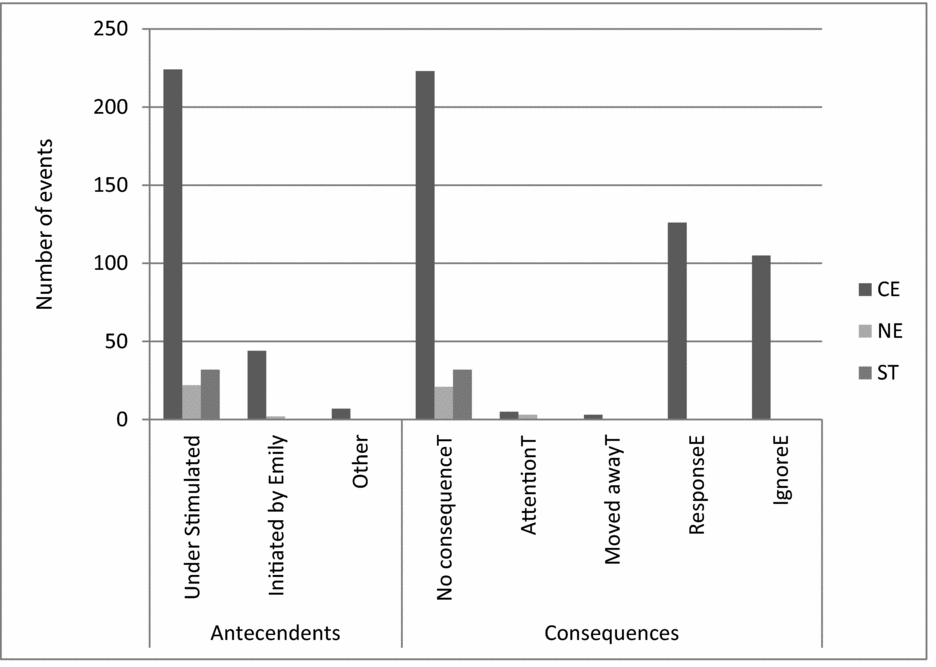
Figure 1 displays the results of the A-B-C analysis of CE, NE, and ST events in the 14 video recordings. The antecedent to the majority of CE events was Frank being under-stimulated. This occurred in two situations: group activities that were slow, long, and involved a lot of waiting with limited teacher attention; and unstructured activities where there was no guidance from the teacher. It was also noted that Emily initiated these events a number of times by talking to him, touching him, and grabbing his hands. The majority (36 out of 44) of Emily's initiations of CE events occurred in the classroom during group activities.
Antecedents and consequences for the CE, NE, and ST events during the direct assessment.

Observation showed that a small number of CE events were followed by teacher attention. In five of the 231 events she provided attention, mostly in the form of mild verbal reprimands; and on three occasions Frank was moved away from Emily. The majority of the events resulted in no response from the teacher. That is, either she ignored the event, or she was not present (e.g., in the playground). Emily's response to the events was variable. She responded on 126 occasions, either positively (e.g., laughing, touching him back, talking to him in a friendly manner, grabbing his hand) or negatively (e.g., screaming, running or walking away, pushing him, saying his name in a loud high-pitch voice, and reprimands such as ‘Get off me!’, ‘Let me go!’, ‘No!’, and ‘Go away!’). On the remaining 105 occasions she ignored him. NE occurred mainly while Frank was under-stimulated. In the majority of the events there were no consequences to this behaviour. All occurrences of ST behaviour had the same antecedents and consequences: under-stimulation and no consequences for this behaviour.
One interesting observation from the videos recorded in the playground area was Frank's approach to the tricycles. He touched and on several occasions pushed them, but he did not sit or ride on them. School personnel were never observed to prompt him to ride a tricycle.
The FAI suggested that the primary function of Frank's problem behaviour was gaining access to attention. However, the A-B-C analysis from the direct observations indicated that Frank's behaviour frequently elicited no response from either Emily or the teacher. These data also showed that the three target behaviours occurred mainly while Frank was under-stimulated and when there was limited supervision and guidance from the teaching staff. The conflicting results of the indirect and direct FBA do not allow a firm conclusion about the function of the problem behaviour. The antecedents suggest escape from under-stimulation, but apart from low levels of attention there was no clear evidence regarding the maintaining consequences of the problem behaviours. This suggests the possibility of automatic reinforcement.
Phase 2: Modified Functional Analysis
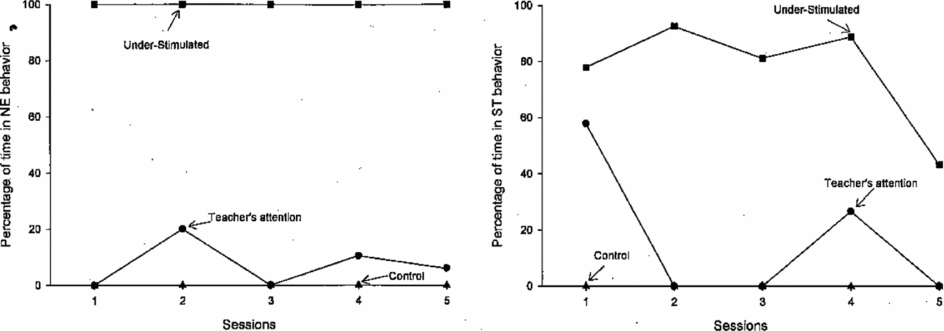
The percentage of time Frank engaged in NE behaviour per session is displayed in Figure 2. The FA indicated that Frank's NE behaviour occurred at the highest rate in the escape from under-stimulation condition (mean 100%). The other conditions occasioned NE behaviour at lower rates (teacher attention mean 7.3%, and control mean 0%).
Percentage of time engaged in NE and ST behaviour during the FA.
The percentage of time Frank engaged in ST behaviour per session is also presented in Figure 2. High levels of ST behaviour were consistently observed in the escape condition (mean 76.8%). The other conditions caused ST behaviour at lower rates (teacher's attention mean 16.9%, and control mean 0%).
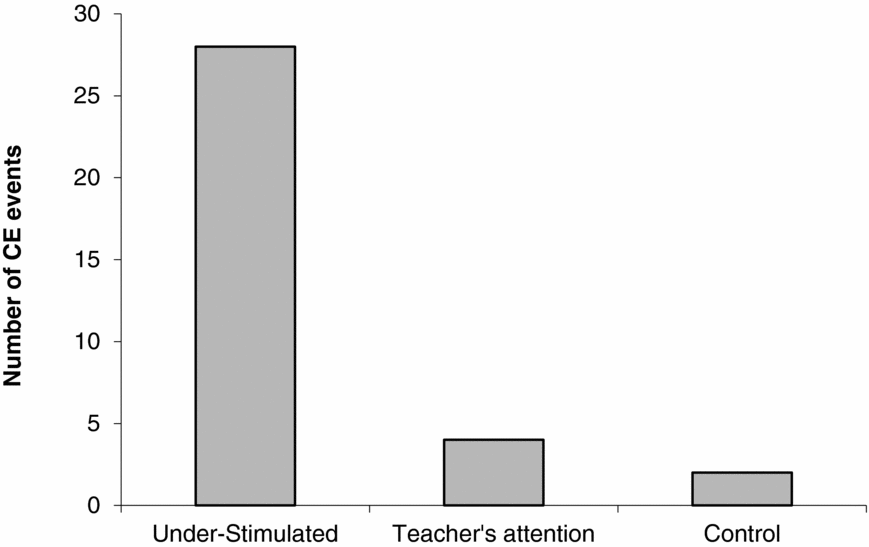
Figure 3 displays the number of CE events during each condition. Contact with Emily was highest during the escape from under-stimulation condition, compared to the teacher attention and control conditions.
Number of CE events during each condition of the FA.
Results from the FA suggest that Frank's NE, ST, and CE behaviours served either as an escape from under-stimulation, or that they were maintained by automatic reinforcement. In either case, it was predicted that if Frank was able to engage in an activity he enjoyed, the time spent in NE and ST behaviours would reduce, and that the number of incidences of CE behaviour would also reduce.
Phase 3: Intervention
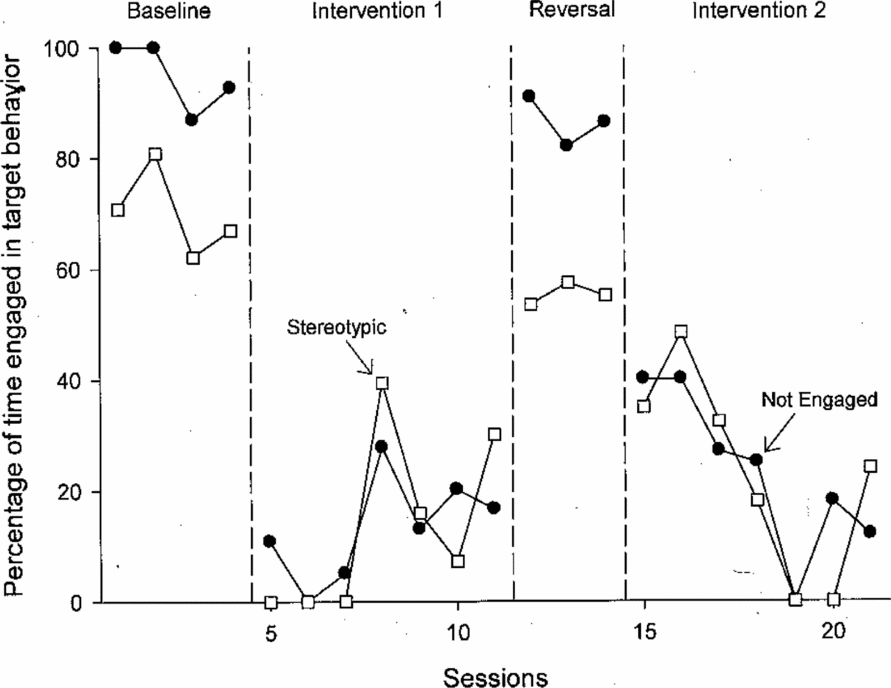
An intervention was designed to teach Frank how to engage in an activity he enjoyed. During the FA, it was confirmed that he enjoyed sitting on and pushing the tricycle, so the intervention consisted of teaching Frank how to use the tricycle with other children. Figure 4 displays the proportion of time he spent in NE and ST behaviours during each of the experimental conditions. Frank's response to the intervention was evident from the first intervention session. During baseline, NE behaviour occurred a high proportion of each session (mean 95%, range 87–100%) and then decreased markedly (mean 13%, range 0–28%) in the first intervention phase. To test the functional relationship between the intervention and the observed change in Frank's behaviour, three reversal sessions were conducted in which the NE behaviour returned to approximately baseline levels (mean 86%, range 82–90%). As predicted, this behaviour reduced as soon as the intervention was reintroduced (mean 28%, range 0–37%).
Percentage of time engaged in NE and ST behaviours during the intervention.
Similarly, ST behaviour significantly reduced when the intervention was implemented. During baseline, ST behaviour occurred for a large proportion of each session (mean 70%, range 62–81%). This decreased sharply (mean 13%, range 0–39%) during the first intervention phase, increased during the reversal condition (mean 55%, range 53–57%), before reducing again with the re-introduction of the intervention (mean 26%, range 0–48%).
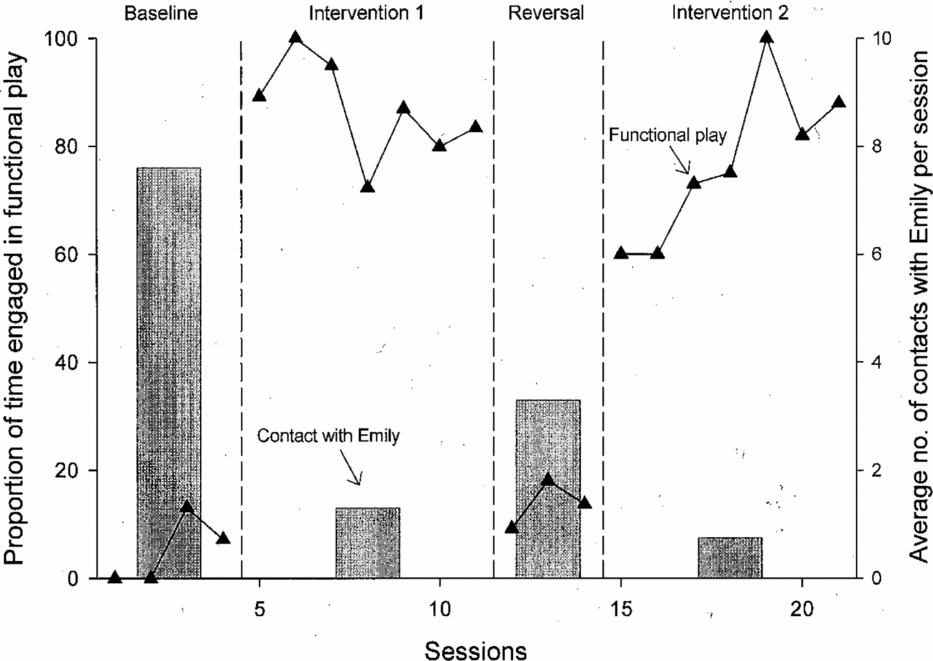
Figure 5 presents the number of CE events (bar graph) that occurred in each experimental phase and the proportion of time Frank spent engaged in functional play (line graph) during each session. The number of CE events reduced from an average of 7.6 events per session during baseline to an average of 1.5 events per session in the first intervention phase. As predicted, the number of such events increased to 3.3 during the reversal phase and decreased again to an average of 0.75 events per session when the intervention was reintroduced. Similarly, the time he engaged in functional play was significantly greater during the two intervention phases, compared to the baseline and reversal conditions. During baseline, Frank engaged in little functional play (mean 5%, range 0–13% of each session), this increased (mean 87%, range 83–100%) in the first intervention phase. During the reversal phase, Frank's functional play decreased again (mean 14%, range 9–18%), and during the re-introduction of the intervention, his functional play increased once more (mean 77%, range 60–100%). In incidental observations, other changes in his behaviour were noted through this period; he climbed the jungle gym for the first time, and once when Emily was also on the jungle gym when he climbed, he sat next to her and held her hand, without engaging in inappropriate behaviour.
Percentage of time spent in functional play (lines) and number of CE events (bars) during the intervention.
Incidental observations also suggested that his engagement in communication increased progressively from the first session of the first intervention phase to the second intervention phase, including the reversal phase. During the first sessions of the intervention phase, he did not engage in any communication, but he then started to repeat phrases said by his peers (e.g., ‘Rollercoaster!’, and ‘Pushing fast!’). During the second intervention phase, he engaged in vocalisations in all sessions. Some of the vocalisations were repetition of what other children said, but he also initiated several times (e.g., ‘Let's go!’, ‘Bike riding!’, ‘Watch out kids!’, and ‘Crashed the bike again!’).
Discussion
The purpose of this study was to test the utility and feasibility of using three functional behaviour assessment procedures in conjunction with the Behaviour Capture program, to identify the function of problem behaviours, and to inform a function-based intervention.
First, the three FBA procedures were successfully conducted in the school setting, and each provided valuable information for the development of an effective intervention. The indirect assessment provided information about the original target behaviour, such as the contexts in which it was most likely to occur. However, this information was not sufficient to identify the function of the target behaviour. The direct assessment provided further valuable information, including identification of an additional target behaviour. In conjunction, these data led to the development of hypotheses about the function of the problem behaviours, as well as information useful for the design of the intervention (i.e., identification of replacement behaviour). The modified FA successfully identified the function of the three target behaviours.
The Behaviour Capture system facilitated data collection in the classroom. The teacher was able to video-record Frank's inappropriate behaviours by using the remote button at the same time as conducting her class. A significant advantage of video data is that it allows the observer to slow down, pause, and rewind portions of the session, assisting with clearer observations such that aspects of the behaviour, or even a whole new behaviour, may become evident when viewing the videos. In the present study, viewing the videos enabled identification of a third target behaviour (ST) that was not reported by the teacher during the initial indirect assessment. A limitation of Behavior Capture was the requirement of a laptop computer, although a flip camera proved to be a useful alternative for continuous recording in the playground.
Conducting A-B-C analyses of the behaviours from the combined video data led to the development of more accurate hypotheses regarding the function of Frank's behaviours, compared to the hypotheses developed based on indirect assessment, primarily by identifying that in the main the antecedent to all three problem behaviours was under-stimulation. The modified FA successfully identified that all of Frank's inappropriate behaviours had the same function: Escape from under-stimulation or access to automatic reinforcement. This information was then used to design a successful intervention in the school setting.
An interesting challenge in the current investigation was that the target behaviour negatively affected another child. The fact that the behaviours mostly occurred during unstructured activities as well as free-play time, and that the CE behaviour required Emily to be present in order to test the function of such behaviour, clearly had implications for performing a functional analysis of the behaviour. Conducting the FA in Frank's classroom and in the playground area, as well as including Emily and others from Frank's class in the functional analysis, was an essential requirement in this case and increased the ecological validity of this study. It supports the findings of others that FBA should be conducted in the natural environment so that contextual factors that might be functionally related the target behaviours can be included in the analysis (Hanley et al., Reference Hanley, Iwata and McCord2003). The information obtained through the FA was used to design a naturalistic intervention, which was successful in teaching or facilitating a new play skill, and reducing the amount of time Frank engaged in NE, ST behaviours and the number of CE events.
Previous research has suggested that naturalistic interventions using less structured sessions of indirect teaching, allowing for natural variation in the conditions of training and using a variety of different stimuli present, are more effective for children with ASDs (e.g., Delprato, Reference Delprato2001; Iovannone, Dunlap, Huber, & Kincaid, Reference Iovannone, Dunlap, Huber and Kincaid2003) and more likely to achieve generalisation (Cowan & Allen, Reference Cowan and Allen2007). Peer-mediated interventions have also previously been used to increase functional play in the playground (Harper, Symon, & Frea, Reference Harper, Symon and Frea2008). Previously, researchers have reported that lower levels of adult and peer interaction are related to a higher frequency of inappropriate behaviours, such as stereotypies, aggressive/destructive, and self-injurious behaviours (Matson, Neal, Fodstad, & Hess, Reference Matson, Neal, Fodstad and Hess2010). Anecdotal reports showed that Frank's engagement in other appropriate activities during free-play time in the playground increased following the intervention program, and that he began to initiate vocal communication using more spontaneous and appropriate language with his peers, particularly with Emily.
Social validity was confirmed through conversations with Frank's teacher and by checking for a significant reduction of CE events and decrease of time spent in NE and ST. Second, the concomitant beneficial changes in untargeted behaviours (increase in functional play and verbal communication) provided evidence for the social validity of the outcomes. In addition, Frank's teacher positively appraised the utility of Behavior Capture, commenting that it is a user-friendly technology. When asked about the difficulty of conducting the FA and intervention in the course of her regular activities, she said she found the procedures acceptable.
Time limitations prevented us obtaining follow-up data to assess maintenance of the replacement behaviour and generalisation to other settings, although personal communications with Frank's teacher indicated that his CE and NE behaviours had maintained at lower levels. In addition, it should be noted that the purpose of this study was to test the feasibility of conducting FBA within a school, and to this end we selected the most parsimonious and least intrusive methods. Severely challenging or more complex case may require a more intense approach.
In conclusion, the present study illustrated that it was feasible to conduct three kinds of functional behaviour assessments in a school. In conjunction with Behavior Capture and flip cameras, both of which proved to be valuable for the collection of observational data, modified functional assessments were seen to lead to an effective behavioural intervention. Further research exploring the utility of new and emerging technologies in the functional assessment process is warranted.
Acknowledgments
This research was supported in part by a grant from the Faculty of Education, Monash University. The authors wish to acknowledge the Department of Education and Early Childhood Development (DEECD) for permission to conduct this research project. The opinions expressed herein do not reflect the views of the DEECD. We would also like to thank the school, the teachers, and most of all, the child, for their participation, their time, and for welcoming us into their spaces.