Social scientists have long emphasized the importance of critical junctures and path dependence in the process of development.Footnote 1 Path dependence arguments have been particularly common in reference to England, with a long tradition in what is referred to as Whig history: the view that England followed an ineluctable path towards liberal democracy and development. Yet in many of these accounts the specific theoretical mechanism that generated the path dependence is left unspecified. Furthermore, prominent historians have highlighted the possibility that this process began in the medieval period. For example, MooreFootnote 2 observes that ‘[a] good case can be made, I think, for the thesis that western feudalism did contain certain institutions that distinguished it from other societies in such a way as to favor democratic possibilities’.Footnote 3 But how this process was set into motion remains unclear.
In this article I develop a formal model that makes explicit one of the mechanisms that generated path dependence in English political development.Footnote 4 I focus on the expansion of the elite, which involved granting rights to new individuals; these rights included the ability to write contracts, to access the courts of law, and the protection of property. The initial extension of these elite rights lowered the cost of granting them to additional individuals, thus generating positive feedback and path dependence. I argue that in England this initial extension of rights took place when the adoption of feudalism led to the creation of a large baronial class in the aftermath of the Norman Conquest. The feedback mechanism described in the model then pushed the country along the early path towards democracy.Footnote 5
The feedback mechanism’s starting point is the baronial revolts frequently faced by the king.Footnote 6 In order to fight the barons, the king often needed the help of collaborators drawn from the masses, and these had to be compensated. In some instances making them members of the elite was a more cost-effective way of achieving collaboration than monetary payments or coercion.Footnote 7 This is because elite rights were essentially club goods, generating rents that were excludable but only partly rival.Footnote 8 These rights were an appealing form of compensation because their excludability made them available to elite members only, ensuring that the benefits of joining the elite were great for individuals drawn from the masses. In addition, when rents were largely non-rival, adding new members to the elite only partially diluted the rents received by existing members (including the king). This resulted in a wedge between the high value that new members derived from these rights and the low cost imposed on existing members. When this wedge was large, granting rights was cheaper than monetary payments or coercion.
The dilution of rights that follows from an expansion of the elite depends crucially on the elite’s size (that is, the number of barons). When the elite is small, the dilution of benefits to existing members is substantial, and in this case the king pays his collaborators a wage. But when the elite is large, dilution is limited and the king compensates them with elite rights.Footnote 9 This implies that the path followed by a society is determined by the size of its elite. If it is small, the society will follow a contracting path in which the elite shrinks over time as the king takes advantage of periods of peace to remove barons from it. If its elite is large, the society will follow an expanding path in which the elite tends to become larger over time as collaborators are incorporated into it. As the elite expands, the cost of future extensions is reduced, and so they become more frequent. This mechanism generates positive feedback and path dependence, with the specific path followed by a society being determined by the size of its elite at a critical juncture early in its history.Footnote 10 Furthermore, a society can switch from a contracting to an expanding path if it experiences a large exogenous increase in the size of its elite.Footnote 11
My account of historical events is as follows: the need to fight baronial and popular revolts in England, combined with the necessity to be abroad in his continental domains for a large fraction of the time, led William the Conqueror to create a large elite in England in the aftermath of the Norman Conquest in 1066. Evidence collected by historians suggests that the elite grew in size from four to about 200 individuals.Footnote 12 This was the critical juncture: prior to this point, through the reigns of Cnut and Edward the Confessor, the elite had been contracting. Following the Conquest and the expansion of the elite, the country entered the expanding path, and the elite continued to expand during the reigns of some of the period’s most important kings: Henry I, Henry II and John. In addition to this pre- and post-Conquest England comparison, I examine the evidence that is available for Normandy in the years leading up to and after the Norman Conquest.Footnote 13 The elite did not expand in Normandy, where power remained centralized in the hands of the duke and leading barons until the duchy was annexed by France. Finally, I discuss three alternative explanations, based on the frameworks in Acemoglu and Robinson, Lizzeri and Persico, and Bueno de Mesquita and Smith,Footnote 14 and argue that my model provides a better account of developments in medieval England.
This article presents a dynamic model of transitions based on a novel mechanism that emphasizes collaboration between social groups. In contrast to much of the existing literature, which has focused on conflict between or within groups, my framework has three social groups – the king, the barons and the peasants – and captures both conflict and co-operation between them. This is consistent with Moore’s focusFootnote 15 on the balance of power between the crown and barons and their relationship to the peasants. The mechanism also emphasizes the importance of mobility and social structure – here captured by changes in the size of the elite – in generating path dependence and pushing the development process forward.
My focus on the period following the Norman Conquest is motivated by the view that this was the crucial point at which England began to diverge – in terms of government institutions and individual rights – from the rest of the world. This article provides a rationale for seeing the Conquest and the adoption of feudalism as the critical juncture, and shows how the mechanism can explain the extension of rights in England in the period leading to Magna Carta. In doing so this article adds to our understanding of a period that many historians see as pivotal for the country’s development.
My argument is closest to Congleton’sFootnote 16 account of the emergence of Western parliamentary democracy. In his analysis, there are shocks that make Pareto-improving constitutional trades possible, and over time the accumulation of these small trades can lead societies to democracy. There are a number of crucial differences: I focus on a process of rights extensions that began much earlier than the nineteenth- and twentieth-century franchise extensions on which CongletonFootnote 17 focuses, and central to the process I describe are a feedback mechanism and path dependence that are not features of Congleton’sFootnote 18 analysis. Finally, I emphasize the economic calculation in the decision to extend rights, while CongletonFootnote 19 focuses on changes in ideology as the primary driver behind the franchise extensions.Footnote 20
My emphasis on the potential gains from collaboration is related to the focus in Galor and Moav, as well as Galor, Moav and Vollrath,Footnote 21 on the complementarity between capital and labor that resulted from the Industrial Revolution. My mechanism differs in that rights are a form of compensation for collaboration, and this is all part of a long path-dependent process that began with the adoption of feudalism. Finally, North, Wallis and WeingastFootnote 22 have developed a comprehensive theory of development in which access to elite privileges and institutions is crucial in determining whether a society is ‘open access’ or ‘limited access’. This article presents a model that formalizes some of these ideas, but differs in two ways: the extension of rights is seen as an economically motivated form of compensation, and it provides a mechanism that generates path dependence.
A MODEL OF THE EXTENSION OF ELITE RIGHTS
The Setting
I consider a society made up of barons and a king, who constitute the elite, and a large number of peasants, who constitute the masses. There are a total of N individuals in this society, with n of them being in the elite (including the king), with 1≤n≤N.Footnote 23 The rest of the individuals are peasants. The king receives crown income y and rents. Each baron derives income solely from rents, while peasants earn a wage  $$\underline{w} $$
. All individuals are otherwise identical.
There are an infinite number of periods indexed by t, where t∈{1,2,…}. The size of the elite at the start of period t is denoted by n t−1 (so that n 0 is the size at the start of period 1). Individuals live for one period, and they each have one offspring. Social class is inherited: the child of a baron is a baron, the child of a peasant is a peasant, and the king’s son inherits the throne unless the king is removed. Individuals only derive utility from their own income.Footnote 24
The outline of the period game is as follows: at the start of the period the barons decide whether to try to organize a revolt. If the barons successfully organize and revolt, the king fights back. He can choose to recruit collaborators from the masses and compensate them with either wages or elite rights; collaboration is therefore costly, but it increases the probability that the king will defeat the barons. A successful revolt removes the king, who goes back to being only a baron, and places a randomly chosen baron in the crown.Footnote 25 After a failed revolt, the king can try to renege on his promise to collaborators and take back their wages and rights. If there is no revolt, the king can attack the barons to expropriate their rents and reduce the size of the elite.
Rents
Rents are available to elite members only (that is, they are excludable) and shared equally between them. The king is a member of the elite and so shares the rents with the rest of the barons. The total amount of rents is given by R, and each individual elite member receives
 $${{n\, {\minus}\, \lambda \left( {n\, {\minus}\, 1} \right)} \over n}R,$$
where λ∈[0,1] measures the extent to which rents are rival. When λ=0 rents are non-rival, and all elite members benefit from R in rents. When λ=1 rents are private, and since they are divided equally between members of the elite, each receives  $${1 \over n}R$$
. This conceptualizes rents as a club good; the parameter λ captures congestion, which depends on the nature and source of the rents, for example whether they are derived from natural resources (λ high) or from access to legal institutions (λ low).
The King
The king maximizes his income, which is made up of crown income y and rents. If the king faces a baronial revolt, he defeats it with probability ψ, which captures the crown’s strength. He can defeat it with a higher probability if he recruits collaborators from the masses to help him fight; this was an avenue commonly pursued by medieval kings. I assume that he has the option to recruit zn t−1 collaborators and that this increases his probability of success to ψ e, where ψ e∼U(ψ,1). The value of ψ e captures exogenous factors, including the king’s personality and leadership skills, that affect the fruitfulness of the collaboration. The king must compensate the collaborators with a wage w or elite rights, with the latter causing the size of the elite to increase from n t−1 to (1+z)n t−1.
If the king defeats the barons he can try to renege and take back the wage or elite rights given to collaborators. If he does (r=1), he succeeds with probability ψ, which is the crown’s strength without collaborators, and his payoff is given by
 $$y{\plus}{{1\, {\minus}\, \lambda \left( {n\, {\minus}\, 1} \right)} \over n}R.$$
If he does not try to renege (r=0), he receives  $$y{\plus}{{n\, {\minus}\, \lambda \left( {n\, {\minus}\, 1} \right)} \over n}R$$
if he did not collaborate,
 $$y{\plus}{{n\, {\minus}\, \lambda \left( {n\, {\minus}\, 1} \right)} \over n}R\, {\minus}\, wzn_{{t\, {\minus}\, 1}} $$
if he collaborated and paid wages, and
 $$y{\plus}{{\left( {1{\plus}z} \right)n\, {\minus}\, \lambda \left( {\left( {1{\plus}z} \right)n\, {\minus}\, 1} \right)} \over {\left( {1{\plus}z} \right)n}}R$$
if he collaborated and granted elite rights.
The king’s payoffs are the same in the other two cases: when he defeats the barons and tries to renege (r=1) but fails, and when he is defeated by the barons.Footnote 26 In both cases the king is removed from office and one of the barons is chosen at random to be the new king. This new king expropriates y from the old king, who returns to being a baron and so receives  $${{n\, {\minus}\, \lambda \left( {n\, {\minus}\, 1} \right)} \over n}R$$
if he did not collaborate,
 $${{n\, {\minus}\, \lambda \left( {n\, {\minus}\, 1} \right)} \over n}R\, {\minus}\, wzn_{{t\, {\minus}\, 1}} $$
if he collaborated and paid wages, and
 $${{\left( {1{\plus}z} \right)n\, {\minus}\, \lambda \left( {\left( {1{\plus}z} \right)n\, {\minus}\, 1} \right)} \over {\left( {1{\plus}z} \right)n}}R$$
if he collaborated and granted elite rights.Footnote 27
If the barons do not organize a revolt, the king can attack them (s=1), expropriate their rents for that period, and expel some of them from the elite so that its new size is  $${{n_{{t\, {\minus}\, 1}} } \over {1{\plus}z}}$$
. Since in the absence of a revolt the barons are not organized, I assume that the king succeeds with probability 1.
The Barons
At the start of period t there are n t−1−1 identical barons (excluding the king) who each maximize their income from rents. The barons jointly decide whether to try to organize a revolt. If they try (a=1), they succeed in solving their collective action problem with probability σ, in which case there is a revolt (b r=1); with probability 1−σ they cannot solve their collective action problem and there is no revolt (b r=0).Footnote 28 If they do not try to organize (a=0), there is no revolt (b r=0).
If there is a revolt, the barons defeat the king with probability 1−ψ or 1−ψ e, depending on how the king responds. If the barons succeed, one of them is chosen at random to become the new king and expropriates y from the old king; all others remain as barons. If the revolt fails, they all remain as barons, reflecting the fact that rebellious barons often retained part of their armies even when defeated and so could not be fully expropriated.Footnote 29 This does not mean that rebelling is costless: it often leads the king to take actions that have an impact on payoffs. If the barons do not revolt (b r=0), they are disorganized and face the possibility of an attack by the king. If the king attacks them, he wins with probability 1, all barons have their rents for that period expropriated, and  $${z \over {1{\plus}z}}n_{{t\, {\minus}\, 1}} $$
of them, chosen at random, are excluded from the elite and become peasants (and so the elite now has size
 $${{n_{{t\, {\minus}\, 1}} } \over {1{\plus}z}}$$
).
The Peasants
Peasants maximize their income and receive a reservation wage  $$\underline{w} $$
; for example, this could be their wages when working on a farm. A peasant’s payoff depends on whether she collaborates. If she is not invited to collaborate or rejects an invitation to do so, she simply earns her reservation income
 $$\underline{w} $$
. If she is invited to collaborate and accepts, she is rewarded with either a wage, a share of the rents (if she is granted elite rights) or both. She receives this unless the king reneges successfully, in which case she receives 0.Footnote 30 The amount and form of compensation are determined as part of the equilibrium.
If given elite rights, she earns rents for that period and her offspring becomes a member of the elite. As a result, the size of the elite can change over time (that is, it is a state variable).
Timeline
There are an infinite number of periods indexed by t, and each period is divided into steps. Recall that the size of the elite at the start of period t is given by n t−1:
(1) ψ e is realized.
(2) Barons decide whether to try to organize a rebellion, a∈{0,1}. If they try (a=1), with probability σ they solve their collective action problem and rebel (b r=1), and with probability 1−σ they cannot solve their collective action problem and there is no rebellion (b r=0). If they do not try to organize, there is no rebellion (b r=0).
If there is a rebellion:
(3) The king decides whether to collaborate with zn t−1 individuals. If he decides to collaborate, he gives zn t−1 peasants a wage or elite rights, and the king defeats the barons with probability ψ e. If he does not collaborate, he defeats the barons with probability ψ.
(4) The outcome of the rebellion is realized. If the king is defeated, he goes back to being only a baron and one of the other barons is chosen at random to become the new king. If the king wins and there was collaboration, he decides whether to try to renege and take back the wages he paid or the rights he granted, and the outcome of this attempt is realized.
(5) The king, barons and peasants consume their income. If the king granted elite status and did not renege, or tried to renege and failed, the elite size increases from n t−1 to (1+z)n t−1.
If there is no rebellion:
(3) The king decides whether to attack the barons to expropriate their rents and shrink the elite, s∈{0,1}. If he does, the king succeeds and takes all rents for that period and reduces the size of the elite to
 $${{n_{{t\, {\minus}\, 1}} } \over {1{\plus}z}}$$
.
(4) The king, barons and peasants consume their income.

THE PERIOD GAME
This section proceeds as follows: (1) I consider the king’s decision to renege and take back compensation from collaborators following his victory over the barons. I also consider the king’s decision to attack the barons if the barons do not revolt. (2) I then derive the wages and elite rights the king must give potential collaborators in order for them to accept (keeping in mind that the king might later renege). Given these costs, I can (3) solve for whether the king collaborates, and if so, how he compensates the collaborators. And knowing that, I can then (4) solve for whether the barons revolt.
An equilibrium for the period t game needs to specify whether the barons attempt to solve their collective action problem, whether they rebel, whether the king attempts to collaborate and the compensation he offers, whether the peasants agree, whether the king reneges (if he defeats the baronial rebellion) and whether he attacks the barons (if there is no baronial revolt). This will be a function of ψ e, the rents R, the rivalry of rents λ, crown income y, crown strength ψ, the number of collaborators z, the probability that barons solve their collective action problem σ, the reservation wage  $$\underline{w} $$
, and the size of the elite n t−1 at the start of the period. All proofs are in the Appendix.
The King’s Decision to Renege
The following lemma establishes when the king will try to renege and take back the compensation paid to collaborators:
Lemma 1: Suppose that a revolt has taken place and the king has won. If he paid his collaborators a wage of w , he will try to renege if  $$n_{{t\, {\minus}\, 1}} \,\gt\,{{\left( {1\, {\minus}\, \psi } \right)y} \over {\psi zw}}$$
. If he granted his collaborators elite rights, he will try to renege if
 $$n_{{t\, {\minus}\, 1}} \,\lt\,{z \over {1{\plus}z}}{{\psi \lambda R} \over {\left( {1\, {\minus}\, \psi } \right)y}}$$
.
The king reneges on wages when they are costly, which is when the elite is large because in that case he requires a large number of collaborators. The king reneges on elite rights when they are expensive, which is when the elite is small: in that case the dilution that follows from extending the elite is large.
If there has been no revolt, the king can attack the barons to expropriate their rents and expel a fraction of them from the elite:
Lemma 2: If the barons do not revolt, the king always attacks them and succeeds.
This result follows directly from the assumptions, but is consistent with the historical record: throughout the medieval period the crown constantly sought to reduce the power of the barons and expropriate their income.
Compensating the Collaborators
I now turn to the amount of compensation the king needs to give the peasants in order to induce them to collaborate. This amount must take into account the possibility that, if successful against the barons, the king may try to renege and take back the compensation. Furthermore, note that compensation is costly and so the king never collaborates if there is no baronial revolt. The following will prove useful:
Assumption 1:  $$\underline{w} \,\lt\,\psi \left( {1\, {\minus}\, \psi } \right){R \over N}$$
.
This assumption states that the reservation wage is smaller than the minimum expected rents that a collaborator can expect to receive if the king has granted elite rights to her: even if all N individuals in society have elite rights and rents are rival (λ=1), the expected value of the rents she receives is greater than her reservation income. This expected value is given by R divided by the total population N, which is obtained with lowest probability when the king defeats the barons and tries to renege, which happens with probability ψ(1−ψ). This assumption ensures that collaboration is always possible if the king is willing to grant elite rights as compensation, and that there is no need to pay a wage on top of granting these rights:
Lemma 3: (1) Each collaborator is paid a wage or granted elite rights, but not both.
(2) All collaborators are paid in the same way: either they all get wages or they all get elite rights.
The next step is to determine the wage the king needs to pay to get the collaborators to accept, which will be affected by the possibility that he might renege:
Lemma 4: If the king pays wages, (1) he pays  $$w\, {\equals} \, \underline{w} $$
and does not renege (r=0) if
 $$n_{{t\, {\minus}\, 1}} \leq {{1\, {\minus}\, \psi } \over \psi }{y \over {z\underline{w} }}$$
, and (2) he pays
 $$w\, {\equals} \, {{\underline{w} } \over {1\, {\minus}\, \psi }}$$
and reneges (r=1) if
 $$n_{{t\, {\minus}\, 1}} \,\gt\,{{1\, {\minus}\, \psi } \over \psi }{y \over {z\underline{w} }}$$
.
If the elite is small, the king will not try to renege; this is because the risk of losing the crown income is too high relative to the savings from taking back the wages. In this case the king can offer the peasants their reservation wage. But if the elite is relatively large, the king will have to hire more collaborators, and the wage bill increases linearly with their number. In this case the king will want to renege since the possible savings are large relative to the potential loss of crown income; as a result, the king will have to pay higher wages in order to get the peasants to collaborate.
Finally, Assumption 1 ensures that even though the king might try to renege on the elite rights he has granted, their expected value is still high enough to ensure collaboration.
The King’s Collaboration Decision
I now establish how the king responds to a baronial revolt:
Lemma 5: Suppose that the barons have revolted (b r=1). (1) If compensation is in wages, the king collaborates, offers wages  $$w\, {\equals} \, \underline{w} $$
to collaborators and does not renege (r=0) if
 $$\psi ^{e} \,\gt\,\psi {\plus}{{zn_{{t\, {\minus}\, 1}} \underline{w} } \over y}$$
; the king does not collaborate if
 $$\psi ^{e} \leq \psi {\plus}{{zn_{{t\, {\minus}\, 1}} \underline{w} } \over y}$$
.
(2) If compensation is in elite rights, the king collaborates, offers elite rights and does not renege (r=0) if  $$\psi ^{e} \,\gt\,\psi {\plus}{z \over {1{\plus}z}}{{\lambda R} \over {n_{{t\, {\minus}\, 1}} y}}$$
; the king does not collaborate if
 $$\psi ^{e} \leq \psi {\plus}{z \over {1{\plus}z}}{{\lambda R} \over {n_{{t\, {\minus}\, 1}} y}}$$
.
This lemma establishes whether collaboration happens in response to a baronial revolt, conditional on the form of compensation. It also addresses the question of whether the king reneges. It turns out that in equilibrium the king never reneges, and the intuition is straightforward: a king will only collaborate and pay in wages if winning is valuable and paying wages is relatively cheap (that is, the elite is small). But in these circumstances the king will not find it worthwhile to renege: he might lose the valuable crown income in an attempt to avoid a small wage bill. Likewise, the king collaborates and gives away elite rights when the gain from doing so is large and rights are cheap to give away (that is, the elite is large). But in these circumstances the king will not want to renege; he would put the crown income at risk in order to save a small amount of rents. Although the model does not assume commitment, in equilibrium the compensation offers are honored.
I introduce an additional assumption:
Assumption 2:  $$y\,\gt\,{z \over {1\, {\minus}\, \psi }}\sqrt {{{\lambda R\underline{w} } \over {1{\plus}z}}} $$
.
This assumption ensures that for each elite size there will always be values of ψ e for which collaboration is optimal. It does this by requiring that crown income y be large enough. Since the cost of defeat is in losing the crown income, if y is large the king will be willing to collaborate for large values of ψ e, even if the cost of doing so is high. This assumption ensures that in equilibrium, values of ψ e close to 1 will always lead to collaboration (regardless of how the peasants are compensated).
I now consider the optimal choices made by the king when faced by a baronial revolt; the results are summarized in the following proposition:
Proposition 1: Suppose that the barons have revolted (b r=1).
(1) The king does not collaborate (NC) and succeeds with probability ψ if
 $$\psi ^{e} \leq {min}\left\{ {\psi {\plus}{{zn_{{t\, {\minus}\, 1}} \underline{w} } \over y},\psi {\plus}{z \over {1{\plus}z}}{{\lambda R} \over {n_{{t\, {\minus}\, 1}} y}}} \right\}.$$
(2) The king collaborates, pays a wage of
$$\underline{w} $$
, wins with probability ψ e and does not renege (CW) if(2)
$$\psi ^{e} \,\gt\,\psi {\plus}{{zn_{{t\, {\minus}\, 1}} \underline{w} } \over y}\ {\rm and}\ n_{{t\, {\minus}\, 1}} \,\lt\,\sqrt {{{\lambda R} \over {\left( {1{\plus}z} \right)\underline{w} }}} \,\equiv\,\widehat{n}.$$
(3) The king collaborates, pays by granting elite rights, wins with probability ψ e and does not renege (CE) if


 $$\psi ^{e} \,\gt\,\psi {\plus}{z \over {1{\plus}z}}{{\lambda R} \over {n_{{t\, {\minus}\, 1}} y}}\ {\rm and}\ n_{{t\, {\minus}\, 1}} \geq \sqrt {{{\lambda R} \over {\left( {1{\plus}z} \right)\underline{w} }}} \,\equiv\,\widehat{n}.$$
Figure 1 shows the king’s equilibrium actions in response to a baronial revolt. To understand what these results imply, first consider the condition for no collaboration. This says that the shock must be large enough to make it worthwhile to collaborate and pay in either wages or by extending rights. When the shock is large, if the elite is small (of size less than  $$\widehat{n}$$
), it is advantageous to pay in wages. When the elite is large (of size greater than or equal to
 $$\widehat{n}$$
), collaborators will be compensated with elite rights.
King’s actions in response to a baronial revolt (Proposition 1)

It is worth noting again that elite rights are generally not a costless form of compensation: the new elite members increase the total size of the elite, which reduces the rents received by each individual, including the king.Footnote 31 The extent to which this happens depends on the degree of rivalry λ. Since the king does not internalize the full cost of elite rights extensions, there is a wedge between the cost to the king and the benefits received by the collaborators. Since the value to the collaborators is greater than the value to the king, granting elite rights can be a cost-effective form of compensation.
The Barons’ Decision
Knowing how the king will respond, the barons must decide whether to try to organize a revolt. The following proposition incorporates this decision and presents the equilibria of the period game:
Proposition 2: (Equilibria) (1) Barons always choose a=1. (2) With probability σ they succeed in solving their collective action problem and rebel (b r=1). The king responds as outlined in Proposition 1. (3) With probability 1−σ the barons fail to solve their collective action problem and cannot rebel (b r=0). The king attacks the barons (s=1) and succeeds, expropriates all of the rents for that period, and  $${{zn_{{t\, {\minus}\, 1}} } \over {1{\plus}z}}$$
randomly chosen barons are expelled from the elite.
This proposition shows that conflict will be a constant feature of this society: the king will always seek to weaken the barons, and knowing this, the barons will always pre-emptively try to attack the king. Furthermore, they also stand to gain if they succeed, as one of them is chosen as the new king and expropriates y from the old king.Footnote 32 When the barons succeed in organizing a rebellion, the king must decide whether to bring in collaborators from the masses and how to compensate them. If he gives them rights the elite expands, and this decreases the cost of granting rights to additional individuals in the future. If the barons fail to revolt, the king attacks them, takes their rents, and reduces the size of the elite.
THE FEEDBACK PROCESS AND PATH DEPENDENCE
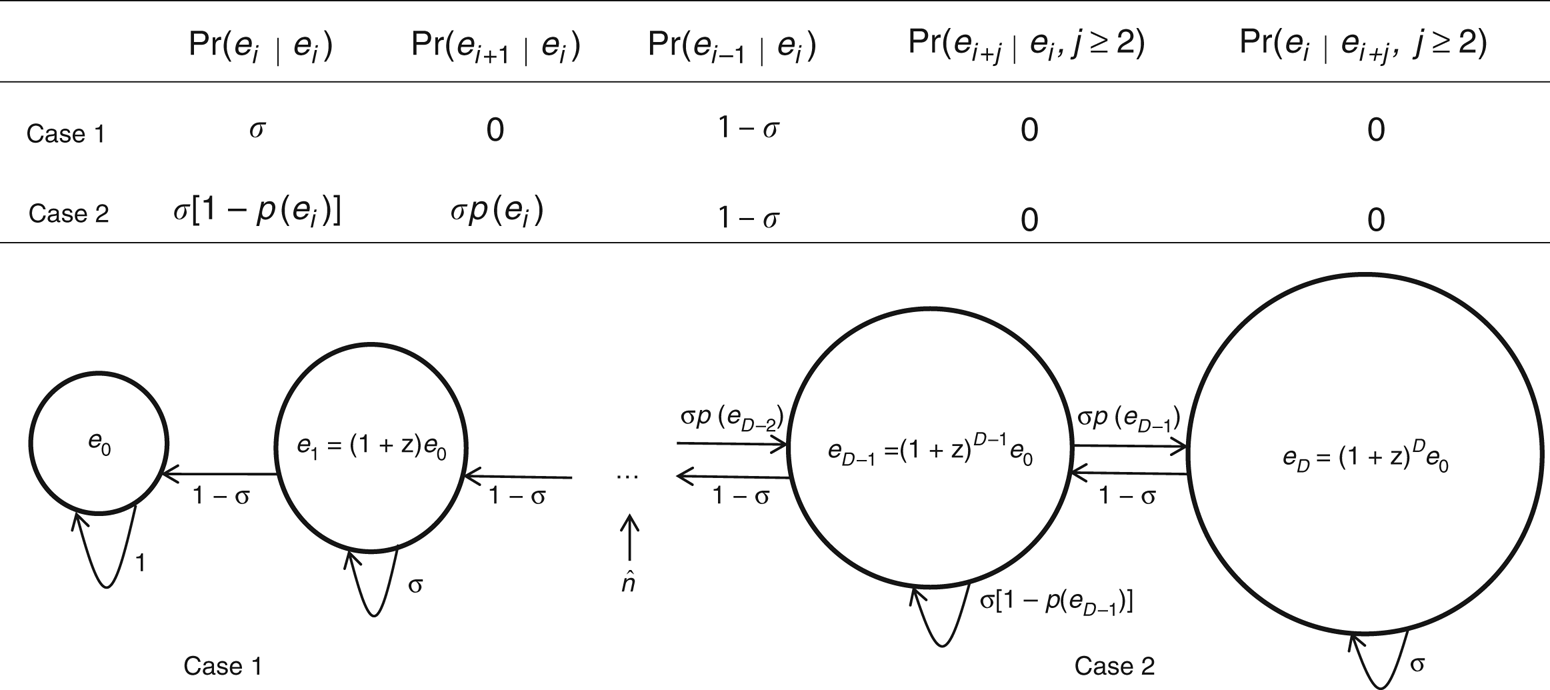
I now consider how the size of the elite evolves over time, and so examine the long-term implications of the mechanism just described. This requires the introduction of some additional notation. As before, I denote the size of the elite at the start of period t as n t-1, which takes a value in the set E={e 0,e 1,…e D}, with an element of this set denoted by e i. If the elite size at time t is n t=e i and there are no extensions or contractions, in the following period we have n t+1=e i; if there is an extension we have n t+1=e i+1, and if there is a contraction n t+1=e i−1. Furthermore, e i+1=(1+z)e i for i=0,…,D−1, and so every e i can be written as a function of e 0:  $$e_{j} \, {\equals} \, \left( {1{\plus}z} \right)^{j} e_{0} $$
.
To construct the set of all possible states, assume that the size of the elite at the start of the process is  $$\tilde{e}$$
. How much the elite can contract is bounded by 1 (the smallest elite size), while how much it can expand is limited by the size of the overall population N. The smallest elite size e 0 corresponds to the size that satisfies three conditions: (1) e 0≥1, (2)
 $${{e_{0} } \over {1{\plus}z}}\,\lt\,1$$
and (3)
 $$\tilde{e}\, {\equals} \, e_{0} \left( {1{\plus}z} \right)^{s} $$
for some s. To determine the value of D, I assume that all states
 $${N \over {1{\plus}z}}\,\lt\,e_{i} \leq N$$
are absorbing, and it follows that for each e 0 there will be a unique D such that
 $${N \over {1{\plus}z}}\,\lt\,e_{D} \leq N$$
, where
 $$e_{D} \, {\equals} \, \left( {1{\plus}z} \right)^{D} e_{0} $$
.Footnote 33
Suppose that we start observing this process at the beginning of period t, and that the elite size at that point is  $$\tilde{e}$$
. We need to consider two cases.
Case 1:
$$n_{{t\, {\minus}\, 1}} \, {\equals} \, \tilde{e}\,\lt\,\widehat{n}$$

There is a baronial revolt with probability σ, in which case the king collaborates and pays in wages (CW) if Condition 2 from Proposition 1 is satisfied; otherwise the king does not collaborate (NC). In either case the elite size remains unchanged. With probability 1−σ the barons fail to rebel and the king attacks them, expropriates their rents, and the elite size is reduced from  $$\tilde{e}$$
to
 $${{\tilde{e}} \over {1{\plus}z}}$$
.
Case 2:
$$n_{{t\, {\minus}\, 1}} \, {\equals} \, \tilde{e}\geq \widehat{n}$$

There is a baronial revolt with probability σ, in which case the king collaborates and grants elite rights (CE) if Condition 3 from Proposition 1 is satisfied; otherwise the king does not collaborate (NC). Given the distribution of ψ e, there is collaboration and elite rights are extended with probability
 $$\Pr \left( {\psi ^{e} \geq \psi {\plus}{z \over {1{\plus}z}}{{\lambda R} \over {\tilde{e}y}}} \right)\, {\equals} \, 1\, {\minus}\, {z \over {1{\plus}z}}{{\lambda R} \over {\left( {1\, {\minus}\, \psi } \right)\tilde{e}y}}\,\equiv\,p\left( {\tilde{e}} \right),$$
which is increasing in  $$\tilde{e}$$
. Assumption 2 and the fact that in this case
 $$\tilde{e}\geq \widehat{n}$$
ensure that
 $$p(\tilde{e})$$
is bounded between 0 and 1. In this case the elite increases from
 $$\tilde{e}$$
to
 $$(1{\plus}z)\tilde{e}$$
as a result of the extension of rights. With probability 1−σ the barons fail to rebel and the king attacks them, expropriates their rents, and the elite size is reduced to
 $${{\tilde{e}} \over {1{\plus}z}}$$
.
I can now lay out the dynamic structure implied by the model. This set-up generates a Markov chain, with states {e 0,e 1,…e D} where e i+1=(1+z)e i for i=0,…,D−1, and the transition probabilities between states are given by:
for all e 0<e 1<e D. For the corner case with elite size e 0, I assume that the state is absorbing,  $$\Pr \left( {e_{0} \! \mid\! e_{0} } \right)\, {\equals} \, 1$$
. For the case with elite size e D, I assume that
 $$p\left( {e_{D} } \right)\, {\equals} \, 0$$
, and so
 $$\Pr \left( {e_{D} \! \mid\! e_{D} } \right)\, {\equals} \, \sigma $$
and
 $$\Pr \left( {e_{{D\, {\minus}\, 1}} \! \mid\! e_{D} } \right)\, {\equals} \, 1\, {\minus}\, \sigma $$
. This Markov chain is shown in Figure 2.
Markov chain where states correspond to elite sizes Note: to the left of  $$\widehat{n}$$
case 1 applies, while to the right of
 $$\widehat{n}$$
case 2 applies.

The main result is established in the following proposition:
Proposition 3:  $$p\left( {e_{{i{\plus}1}} } \right)\,\gt\,p\left( {e_{i} } \right)$$
for all
 $$i\in\left\{ {0,1,2,...,D\, {\minus}\, 2} \right\}$$
such that
 $$e_{i} \geq \widehat{n}$$
, and so
in this range of elite sizes the probability of transitioning to a larger elite is increasing in the size of the elite. The one exception is at the end of the chain, where p(e D)=0.
There are two paths that a society can follow: a contracting path in which the elite shrinks over time, and an expanding path in which it can grow over time. The key determinant of the path followed by a society is the size of its elite: if  $$n\,\lt\,\widehat{n}$$
, it is in the contracting path; if
 $$n\geq \widehat{n}$$
, it is in the expanding path. The proposition establishes that in the expanding path the speed of growth increases with elite size: the first few extensions have a small probability associated with them, but as the elite becomes larger the probability of further extensions increases. This positive feedback process – from elite size to extensions, back to elite size – is what generates the path dependence. The probability that the barons will solve their collective action problem (σ) plays a central role in the expanding path: if
 $$1\, {\minus}\, \sigma \,\lt\,\sigma p(\tilde{e})$$
expansions will be on average more frequent than contractions, and over time the society’s elite will become larger; if the opposite holds, over time the elite will shrink and eventually switch to the contracting path.Footnote 34
The size of the elite is the key state variable and the one that generates the feedback that gives rise to path dependence. It follows from this discussion that a society may switch between the contracting and expanding paths as a result of exogenous shocks to the size of its elite. If an expanding elite suddenly collapses, it might enter the contracting path and start shrinking.Footnote 35 Likewise, if a contracting elite experiences a sudden increase in its size, it may enter the expanding path. I argue that the latter is precisely what happened in England in the aftermath of the Norman Conquest: the size of the elite increased considerably and as a result England switched from a contracting to an expanding path.Footnote 36
HISTORICAL EVIDENCE
Elite Rights in Medieval England
To illustrate the mechanism just described, I examine how English kings responded to baronial revolts in the period surrounding the Norman Conquest in 1066. I focus on the most important kings of the period: Cnut, Edward the Confessor, William the Conqueror, Henry I, Henry II and John.Footnote 37 I show that before the Conquest the size of the elite was small and shrinking in both England and Normandy and that there was a large increase in the size of the English elite in the post-Conquest years: from four to about 200 individuals. This transformed the way in which kings responded to baronial revolts: they began to grant elite rights to collaborators. I then show that there is no evidence of such a change in Normandy following the Conquest.Footnote 38
This set-up is analogous to a difference-in-differences study that uses two administrative units to examine the impact of an exogenous policy change that affects one of the units (the treated) but not the other (the control).Footnote 39 If we assume that the control is a valid counterfactual for the treated, we can estimate the impact of the policy change by comparing the response of the treated unit to that of the control. In my setting, the two administrative units are England and Normandy, and the Conquest increased the size of the elite in the former but not in the latter. Therefore I can estimate the impact of that initial increase in the English elite by comparing how the post-Conquest elites in both societies evolved over time.
The underlying assumption is that Normandy is a valid counterfactual for England: that in the absence of the Norman Conquest, the trend followed by the English elite would have been the same as the one followed by the elite in Normandy (see Figure 3). I show that prior to the Conquest, the elites in both societies were shrinking. Furthermore, the Conquest led to the introduction of Norman institutions into England, and so we would have expected the elites in both societies to evolve in the same way in the post-Conquest period. However they did not, and this must then be due to the modifications made to Norman institutions in the process of adapting them to the English context. I argue that the key change was the creation of a large elite in England, which was necessary because of the high risk of revolt by the local English population (that had just been invaded), the fact that England was to most Normans an unknown territory, and because William had to spend time away in his continental domains.
Elite trends before and after the Norman Conquest

There are a number of points worth noting. First, it is not necessary to show that both elites had the same size prior to the Conquest, only that their numbers were moving in the same direction (in this case downwards). Second, Normandy became a colonizing power in 1066; this was not random, and it may have affected the size of its elite. However, I find no evidence of the elite – or the process whereby it was extended or shrunk – having changed in Normandy in the aftermath of the Conquest, even if some of the Norman barons acquired lands in England.
Finally, there are two potential sources of bias. First, much less information is available for Normandy than for England, partly because Normandy was annexed by France in 1204 and most local records did not survive.Footnote 40 This differential availability of data should not introduce any bias unless it is correlated with the size of the elite, which seems unlikely. Second, there would be selection bias if the monarchs I focus on ruled for long periods of time thanks to their strategy of extending rights, while the ones who ruled for shorter periods did not employ that strategy. However, this seems unlikely (for example, William Rufus died in a hunting accident).
Cnut (1016–1035)
Cnut was the ‘first ruler of a really united England’Footnote 41 and came to power following the civil war that broke out towards the end of King Ethelred’s reign. The main challenge he faced as king was to consolidate his control over England.
Evidence from royal charters, which were typically signed by the earls, shows that there were eleven earls in the first ten years of Cnut’s reign. Seven had Scandinavian names, which is unsurprising given that Cnut was Danish.Footnote 42 There is little evidence from the five years that followed, as no charters survive from that period. In those years the king was fully occupied by war and pilgrimage to Rome, and it is likely that he was often absent and made few grants.Footnote 43 When records resume, the old earls have largely disappeared, and evidence points towards the existence of only four earls, corresponding to three of the families (Godwine, Leofric and Siward) that will continue to play a key role up to the Norman Conquest.Footnote 44
This suggests that Cnut removed some of his earls in the period for which records are absent. This is consistent with the framework I have presented: in the absence of a revolt, Cnut would have taken the opportunity to remove some members of his elite. The fact that after he became king Cnut collected Danegold, paid off his troops and sent them back to Denmark,Footnote 45 combined with the fact that the earls who disappeared were those of Scandinavian origin, suggests that Cnut was removing elite members who were no longer necessary to support his rule over England.Footnote 46
Edward the Confessor (1042–1066)
Edward the Confessor became king seven years after the death of Cnut, and the period between their reigns saw two kings and nearly continuous fighting. Following the pacification of the country, the main challenge Edward faced was the revolt by Godwine, the wealthiest and most powerful earl in the country.Footnote 47 Edward mobilized for war, and with help from the Normans and the Northern earls, he defeated the rebellion and forced Godwine to compromise.Footnote 48
Edward the Confessor’s behavior is consistent with a CW strategy: gaining collaborators without having to expand the elite. This can account for why the families that dominated politics in the eve of the Norman Conquest were the same that had done so towards the end of Cnut’s reign. These four families remained powerful, since Edward did not respond to Godwine’s revolt by expanding the elite.Footnote 49
William the Conqueror (1066–1087)
Following the death of Edward the Confessor and the coronation of Harold Godwinson in 1066, William of Normandy launched an invasion force to conquer England and claim the throne. The Norman invasion was the last time that England experienced a complete change in its ruling class, and thus represents a clear break in the country’s political development. This, I argue, was the critical juncture.
William introduced feudalism and rewarded the men who came with him to England with land and rights. Most of these soldiers were mercenaries,Footnote 50 ‘fellow speculators in the gamble, out for wages, booty, and land […] William’s army was, in short, an army of mercenaries and adventurers’, with many of them ‘counting on generous grants of territory’.Footnote 51 But feudalism was also introduced as a way to ensure that the crown could raise an army at short notice at a time when it was unusual to keep a large fighting force constantly mobilized.Footnote 52 The main goal was to protect the new order against internal revolt by former English nobles and thegns (a class in Anglo-Saxon society similar to that of the knights) and to fight off any foreign invasions.Footnote 53 As HowardFootnote 54 observes, ‘militarily speaking the Norman dynasty in England and their successors were hopelessly overstretched; not only keeping the native English in order and extending their frontiers into Scotland and Wales, but maintaining their own rights in the mainland of Europe’.
The resulting social structure involved 200 substantial tenants-in-chief: earls and barons holding land directly from the crown.Footnote 55 BrookeFootnote 56 puts the number of barons at around 180, while BarrowFootnote 57 speaks of ‘the two hundred or so barons who were the natural leaders of this small but dominant class’.Footnote 58 In short, the Norman Conquest transformed a small elite of four earls into a relatively large elite of about 200 barons.Footnote 59
Henry I (1100–1135)
Henry I assumed the throne in 1100 following the accidental death of his brother, King William Rufus. He immediately faced the prospect of a baronial rebellion aimed at putting his older brother, Duke Robert of Normandy, on the English throne.Footnote 60 During his coronation, Henry issued a Charter of Liberties that granted the English barons a number of rights aimed at protecting them from some of the most serious abuses they had suffered under William Rufus.Footnote 61 The threat posed by Robert and his allies meant that Henry had to earn the loyalty of both the English barons and the rest of the population, and this extension of rights can be interpreted as Henry following the CE strategy.
As part of his strategy to stay in power, Henry sought to develop a more effective royal government by introducing methods that helped bring the crown into check.Footnote 62 A central part of this process was the development of a legal system that gave the barons jurisdiction over the hundred courts, which provided them with income and increased their power and prestige.Footnote 63
Some of these were ‘new men’, that is ‘men whom the king had “raised from the dust”, and promoted over the heads of the hereditary nobles […] laymen, raised to baron’s rank and requiring fiefs to support them’.Footnote 64 This helped make the government more efficient, and crucially these men, who had been trained in combat, were loyal to Henry: ‘[t]he feudal aristocracy was certainly no caste. Henry himself was accused by Orderic of promoting men from the dust. But in practice his new barons were not yeomen or peasants; they had all, by definition, to be trained to knightly pursuits, to be brought up in the traditions of the feudal classes. Henry undoubtedly added to the number of the barons […] It no doubt gave Henry strength in his own and other men’s eyes that not all the great men of his court owed their place to his father or brother’.Footnote 65 This allowed Henry to remodel the elite into a group of barons loyal to him, in what has been described as a ‘reconstructed baronage’.Footnote 66
Many of these individuals joined the ranks of the elite: ‘[g]reatest among Henry’s lay officials were Aubrey de Vere and Richard Basset […] [i]n the next reign Aubrey’s son acquired an earldom, and the Veres were earls of Oxford until 1604’.Footnote 67 That is, many of these men ended up founding their own dynasties.Footnote 68
Henry II (1154–1189)
Henry II came to the throne at the end of the Anarchy, and his first challenge was to rebuild England and to protect and expand his territories in France.Footnote 69 But it was the rebellion of 1173 that represented the biggest crisis of his reign:Footnote 70 three of his sons, his wife, the king of France and a fraction of the barons joined forces to try to remove him from the throne.
Henry defeated this revolt with the help of ‘new men’ who had been chosen on the basis of their loyalty and military talent. Like his grandfather Henry I, Henry II promoted minor nobles to positions of authority in England,Footnote 71 although he ‘followed the advice of his mother, the old Empress, and trained such men as he would hawks, keeping them eager by keeping them hungry’.Footnote 72 Furthermore, Henry II then sought to address the weaknesses that he believed had contributed to the revolt by issuing the Assize of Northampton, which gave the authorities increased powers to deal with criminality and helped solidify the rights of tenants.Footnote 73 He made legal reforms that expanded the jurisdiction of the royal court, resulting in better legal protection for non-elites.Footnote 74 These changes, which included the legal reforms that are often considered to form the basis of English Common Law, are consistent with the CE strategy.
John (1199–1216)
King John assumed the throne following the death of his brother King Richard the Lionheart, and the most significant development in his reign was the issue of Magna Carta in 1215. The seeds of the conflict that led to Magna Carta date back to at least 1204, when John lost Normandy and most of his other continental domains to the French king Philip Augustus.Footnote 75 King John became obsessed with recovering his lost territories, and his attempts to raise an army relied on heavy taxation – much of it in new forms that created great resentment in the baronage and population.Footnote 76 The barons had little interest in John’s attempts to recover Normandy, as a large fraction of them no longer held lands on the continent.Footnote 77 When his French expedition collapsed in 1214 the English barons rebelled.Footnote 78 John was weak and at this point could no longer afford to fight; for example, raising income to hire mercenaries would have been prohibitively expensive for a king who was chronically short of money.Footnote 79 Through the mediation of the Archbishop of Canterbury, a truce was reached and Magna Carta was issued.
Magna Carta can be interpreted as a strategic move by John to gain time and potential allies for a future struggle; that is, John’s strategy is consistent with CE. This view is backed by the belief, held by some historians, that John did not intend to honor the concessions the charter made to the barons.Footnote 80 Additionally, John exhibited great cunning in the negotiations; for example, ‘[t]he Charter included an elaborate clause providing machinery for its enforcement by a committee of twenty-five barons, to be called into existence if the king broke the Charter’,Footnote 81 but John issued the charter before this provision, which greatly threatened his authority, could be finalized.Footnote 82 This suggests that John manipulated the charter to maximize his chances of survival. Finally, although the charter focuses mostly on concessions to the barons, there were provisions that benefited the population at large.Footnote 83 In short, the charter can be interpreted as an attempt by King John to follow the CE strategy to gain the support of important allies in expectation of his future struggle against the barons.Footnote 84
The war resumed soon after Magna Carta was issued, and although initially John had an advantage – partly as a result of earning the support of the Welsh and Irish marcher barons, who were the only ones able to raise a feudal armyFootnote 85 – this changed when the French crown joined the war and dispatched a large invasion force to England.Footnote 86 Many of John’s allies changed sides, and he died from dysentery soon after. The French eventually lost the war and John’s son became king, but the rights contained in Magna Carta continued to be at the center of a long struggle that extended through the reigns of Henry III and Edward I, and eventually yielded greater baronial power and England’s first parliament.
Elite Rights in Normandy
I now turn my attention to the duchy of Normandy in the period surrounding the Conquest of England. I show that despite sharing its feudal institutions and often its ruler with England, the Norman elite did not expand in the post-Conquest period. In fact, the available evidence suggests that it continued to contract.Footnote 87
Before the Conquest
In the period leading up to the Conquest, Normandy underwent changes similar to those taking place in England during the reigns of Cnut and Edward the Confessor: the elite shrank over time, with a small number of families becoming increasingly more powerful.
William became Duke of Normandy in 1035 while still a child, and during his minority feuds between his barons became common. Many of these fights were between powerful barons who sought to extend their domains at the expense of smaller landowners.Footnote 88 The result was the contraction of the elite, as ‘[t]here was a sense in which the expansion of estates meant the spread of the domination of stronger families over weaker ones’.Footnote 89 This anarchy ended when William became an adult and restored the ducal government’s role in peace-keeping, but the elite continued to contract and from about 1050 ‘the opportunity to make territorial acquisitions was closely controlled’.Footnote 90 In particular, ‘[a]fter 1050 Normandy also seems to have ceased to be a land which gave opportunity for immigrants to make their fortunes. In consequence, the aristocracy appear to have turned some of their energies into consolidations’.Footnote 91
After the Conquest
The impact of the Conquest on the size and power of the elite in Normandy appears to have been limited. The inquest of 1091, known as the Consuetudines at Iusticie, which aimed to describe the powers exercised by Duke William, demonstrated ‘a very strong continuity from Carolingian notions of authority’.Footnote 92 Furthermore, there appear to have been only about forty large vassals in Normandy during William’s rule;Footnote 93 that is, between a fifth and a fourth of the number in post-Conquest England. This appears to have been partly a result of William’s attempt to reduce the number of barons: ‘when William II rebuilt the prerogative control over fortifications, he did so, not by entrusting castles to social upstarts, but by granting them to those members of the leading families whom he felt he could rely on.’Footnote 94 This suggests that in Normandy, William did not employ the elite expansion strategy that he used in England.
Upon his death, William the Conqueror left Normandy to his son Robert and England to his son William Rufus, and the two territories had separate governments until Henry I brought them back together in 1106. Henry restored law and order and began to develop institutions similar to those that he was introducing in England. Although Norman institutions developed during his reign, they did not do so to the same extent they did across the channel.Footnote 95 By the time of Henry II’s reign, England and Normandy had already diverged considerably. Henry’s position in Normandy had been weakened by his predecessor Geoffrey of Anjou’s strategy of giving away ducal land to the barons,Footnote 96 and Henry had to spend much time in Normandy shoring up support. He extended his domains by claiming back land that had been alienated by his predecessors,Footnote 97 consistent with the shrinking of the elite and the expropriation of rents. Twelfth-century Normandy ‘was a highly centralized feudal principality, over which the duke maintained a control firmer than that exercised by any other secular ruler in western Europe’,Footnote 98 and it was ‘still more like the private fief of a great baron than an embryo state’.Footnote 99
Alternative Explanations for the Extension of Rights in Medieval England
I now consider three alternative explanations – drawn from three well-known frameworks used to explain institutional change – and discuss why my model provides a better account of the medieval period just discussed.
The threat of revolution
The threat of revolution argument, most closely associated with the work of Acemoglu and Robinson,Footnote 100 is a prominent example of a framework that focuses on the conflict between the masses and the elite. Their theory states that rights (in their case the right to vote) are extended to sections of the population to reduce their threat of revolution. In particular, voting rights are a credible commitment to future redistribution, while elites can renege on promises of future redistribution once the revolutionary threat has passed. Recent work has found empirical support for this mechanism in the period of the Great Reform Act of 1832.Footnote 101
This mechanism does not appear to be at work in the period considered in this article. In a strict interpretation of their model, the Acemoglu and Robinson framework implies that the king would make concessions to the barons to keep them from revolting, and that those concessions (for example, rights) would solve the commitment problem inherent in promising future concessions. Yet the medieval setting was very different: revolts happened, and were in fact very frequent; the extension of rights was not a concession aimed at defusing the threat from rebellious barons, but instead sought to secure the collaboration of other social groups (for example, the masses) in the fight against those barons; and these rights were not a device to commit the king, as he often violated or withdrew them.
My model is consistent with all of these facts. In my account the king buys the support of individuals who can help him fight the barons and stay in power. The extension of rights is in some sense voluntary, and it is motivated by economic calculation rather than because it helps the king to commit (in fact, my model does not assume commitment and the king can renege on his compensation offer). In contrast to the Acemoglu and Robinson framework, my model allows for social mobility in that peasants can become barons and barons can become peasants, a process that can generate path dependence.Footnote 102 Finally, my framework emphasizes the importance of collaboration between different social groups, in this case between the king and the masses, in the process of development.
Conflict within the elite
I focus on the version of this argument developed in Lizzeri and Persico.Footnote 103 In their account, politicians want to redistribute in a targeted way in order to gain votes, but when public goods are valuable many members of the elite will want them to be provided. The elite extends the franchise in order to induce politicians to provide these goods: since there are now more voters, it becomes too costly for politicians to gain votes by redistributing in a targeted way, and so they switch to public goods. This mechanism is then used to account for the largely peaceful extension of the franchise in England, where the growth of cities and their increased demand for local public goods provided the impetus for reform.
In accordance with my account, Lizzeri and PersicoFootnote 104 emphasize conflict within the elite, and argue that the positive benefits from the reforms – as opposed to just avoiding the costs associated with not reforming – played a key role in making them attractive. In a strict interpretation of their model, the barons would extend rights in order to induce the king to provide public goods. But in the medieval period rights were extended by the king, and he did so because it was a cost-effective way for him to earn supporters. Furthermore, medieval kings had limited state capacity and provided close no to public goods except the occasional enforcement of social order. There were no elections and the assemblies that existed at the time – the witanagemot or the council – had little power and their members were typically appointed by the king. My model accounts for all of these facts, and in addition allows for social mobility and provides a mechanism that can generate path dependence. Finally, my framework emphasizes the importance of collaboration between different social groups in the process of development. These important features of my argument are not part of the Lizzeri and PersicoFootnote 105 framework.
Selectorate theory
Bueno de Mesquita and SmithFootnote 106 show how the selectorate theory developed in Bueno de Mesquita et al.Footnote 107 can explain institutional change. It presents a framework that combines the struggle between the elites and the masses in Acemoglu and RobinsonFootnote 108 with the within-elite conflict and public goods aspects of Lizzeri and Persico.Footnote 109 The incumbent faces two threats: from the winning coalition (those whose support is essential for the leader to survive) and the population at large. The leader can employ both private and public goods, but faces a budget constraint that generates a trade-off between these two strategies. Crucially, the nature of the trade-off depends on the size of the winning coalition. The authors then examine when there might be cross-group support for an extension or contraction of the winning coalition and argue that in these instances we could expect moves towards or away from democracy.
There are a number of similarities between my framework and that of Bueno de Mesquita and Smith:Footnote 110 both look at three groups, allow for extensions and contractions of the winning coalition (the elite) and so allow for social mobility, and have the leader face a trade-off between different forms of compensation. However, their framework cannot fully account for the medieval events discussed in this article. With the exception of the early years of William the Conqueror’s reign, the threat of revolt by the masses was not a central concern. Instead, it was revolt by the barons that occupied most of the king’s time. And while in Bueno de Mesquita and SmithFootnote 111 the leader seeks to buy the support of members of the coalition in order to avoid defections (and in equilibrium there are no revolts), in medieval England the king frequently faced baronial rebellions and sought the help of individuals outside this group (for example, from the masses) in order to fight the barons. My framework accounts for these facts, but in addition differs from Bueno de Mesquita and SmithFootnote 112 in that it emphasizes the importance of collaboration between different social groups, in this case between the king and the masses, and in that the extension of elite rights changes the state variable (the size of the elite) and generates positive feedback and path dependence.
CONCLUSION
In this article I present a mechanism that generates path dependence and argue that the Norman Conquest was the critical juncture that set England on the path towards democracy. My framework emphasizes the importance of social structure, mobility and collaboration between social groups in the process of development.
There are three important issues that my analysis has not addressed. First, to what extent does the same mechanism apply later in English history? Preliminary research I have conducted suggests that this mechanism was at work in later periods, although the type of conflict motivating the collaboration was different: baronial revolts eventually came to an end, but trade competition and large international wars maintained the need for different social groups to collaborate. Second, to what extent was a similar mechanism at work in other Western European societies? And finally, can this mechanism help explain the Great Divergence between Western Europe and East Asia? These are all important questions, but each requires its own full-length study, and so I have deferred them to future work. These omissions notwithstanding, this article contributes to our understanding of the long-term process of political development, and I hope it will motivate future work in this fundamental area of research.