INTRODUCTION
Race and immigration have become so inextricably linked in the United States that one can no longer understand the complexities of race without considering immigration. Correlatively, one cannot fully grasp the debates in immigration without considering the role of race in U.S. society. Further complicating our ideas about race are rising rates in intermarriage and a growing multiracial population; along with immigration, these trends have contributed to unprecedented diversity. But exactly how are trends in immigration, intermarriage, and multiracial identification changing our ideas about race, group boundaries, and the color line in the twenty-first century?
Most obviously, today's immigrants have changed the United States from a largely Black and White nation to one composed of multiple racial and ethnic groups. Immigrants and their children account for about 23% of the U.S. population, of which 85% originate from Latin America and Asia, creating a society that is more racially and ethnically diverse than at any point in history. In 1970, Latinos and Asians made up only 5% and 1% of the nation's population, respectively, but by 2010, their populations more than tripled to 16% and 5%. Latinos have grown so rapidly that they have surpassed Blacks as the largest minority group, and while smaller in size, the Asian population is the fastest growing group in the country. Demographers project that these populations will continue to grow so that by 2050, Latinos will make up nearly one-quarter of the nation's population at 24%, and Asians close to one-tenth, at 8%.
Because the majority of contemporary immigrants are neither Black nor White, they have forced the scholarly debate about race and racial divides to move beyond the traditional Black-White binary (Alba Reference Alba2009; Bean and Stevens, Reference Bean and Stevens2003; Bobo Reference Bobo2011; Dawson and Merseth, Reference Dawson and Merseth2011; Foner and Fredrickson, Reference Foner and Fredrickson2004; Gans Reference Gans and Lamont1999; Hochschild et al., Reference Hochschild, Weaver and Burch2011; Hollinger Reference Hollinger2008; King and Smith, Reference King and Smith2005; Lee Reference Lee2011; Lee and Bean, Reference Lee and Bean2010; Lee and Zhou, Reference Lee and Zhou2004; Massey Reference Massey2011; Skrentny Reference Skrentny2001; Telles and Sue, Reference Telles and Sue2009; Waldinger Reference Waldinger2011). Consequently, social scientists have raised the question of whether today's new non-White immigrants and their children are following the assimilation trajectory of their European predecessors, or whether their experiences with race are more akin to those of African Americans (Foner Reference Foner2005; Glazer Reference Glazer1997; Haney-Lopez Reference Haney-Lopez1996; Jiménez Reference Jiménez2010; Kennedy Reference Kennedy2011; Patterson Reference Patterson1997; Richeson and Craig, Reference Richeson and Craig2011; Rodriguez Reference Rodriguez2007; Sears et al., Reference Sears, Fu, Henry and Bui2003; Warren and Twine, Reference Warren and Twine1997). Moreover, given that the Black-White color line no longer reflects America's racial reality, scholars have raised the question of what type of color line is taking its place, using measures such as economic mobility, residential segregation, intermarriage, racial and multiracial identification, public opinion and racial attitudes, discrimination, and friendship networks (Alba Reference Alba2009; Bobo Reference Bobo2011; Dawson and Merseth, Reference Dawson and Merseth2011; Gans Reference Gans and Lamont1999; Hochschild Reference Hochschild2005; Kennedy Reference Kennedy2011; Lee and Bean, Reference Lee and Bean2010; Massey Reference Massey2007; Quillian and Campbell, Reference Quillian and Campbell2003; Waters Reference Waters1999).
In this paper, I assess how the color line is changing by examining trends in intermarriage and multiracial identification. Following Kingsley Davis (Reference Davis1941) and Robert K. Merton (Reference Merton1941), I study patterns of intermarriage as a way to measure the decrease in social distance between groups. Also, in line with Milton Gordon (Reference Gordon1964), I posit that intermarriage is a marker of a minority group's incorporation into the majority group host culture. However, I add to this theoretical tradition by including patterns of multiracial identification in the analyses because, like intermarriage, it is also a measure of decreasing group boundaries; seeing and identifying oneself in multiracial terms reflects a jettisoning of the long-standing historical practice of the “one-drop rule” of hypodescent, in which racial categories were strictly bounded and mutually exclusive (DaCosta Reference DaCosta2007; Dalmage Reference Dalmage2000; Davis Reference Davis2001; Fields Reference Fields1990; Nobles Reference Nobles2000; Williams Reference Williams2006). In sum, intermarriage and multiracial identification speak volumes about race, and indicate where racial group boundaries are fading most rapidly and where they continue to endure.
More specifically, I examine how interracial couples identify their children. When parents share the same racial background, there is little discrepancy about how they will choose to identify their children, but when parents come from different backgrounds, the choice is less obvious. Will they prioritize one racial identity over the other, or will parents choose to combine both racial backgrounds and identify their children multiracially? These questions are especially relevant given the rising rates of intermarriage in the United States (Fryer Reference Fryer2007; Kalmijn Reference Kalmijn1998; Perlmann and Waters, Reference Perlmann, Waters, Foner and Fredrickson2004; Qian and Lichter, Reference Qian and Lichter2007; Root Reference Root2001; Rosenfeld Reference Rosenfeld2002; Sanjek Reference Sanjek, Gregory and Sanjek1994; Song Reference Song2009). In 1960, less than 1% of U.S. marriages were interracial, but by 2008, this figure rose to 7.6%, meaning that one out of every thirteen U.S. marriages was interracial (Jacoby Reference Jacoby2001; Lee and Edmonston, Reference Lee and Edmonston2005; Ruggles et al., Reference Ruggles, Sobek, Alexander, Fitch, Goeken, Hall, King and Ronnander2009). Among new marriages that took place in 2008, the intermarriage figure rises to 14.6%, translating to one out of every seven American marriages (Passel et al., Reference Passel, Wang and Taylor2010).
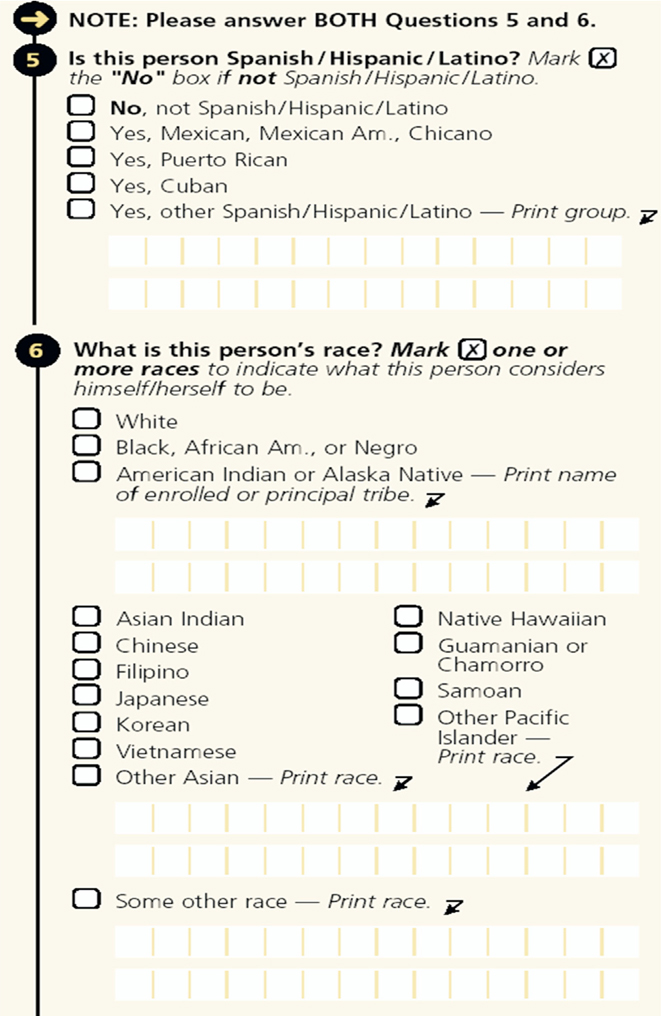
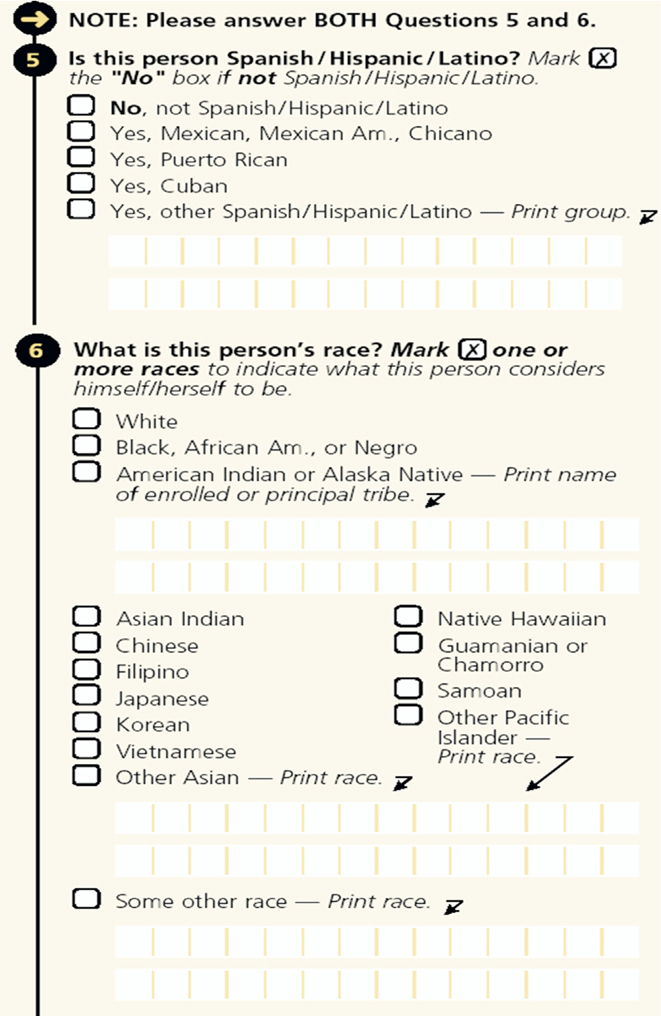
The rising trend in intermarriage has resulted in a growing multiracial population, which became highly visible in 2000 when, for the first time in history, the U.S. Census provided Americans the option to “mark one or more” races to identify themselves or members of their households (Fig. 1). In 2000, 2.4% of Americans identified multiracially; in 2010, the figure increased by 32% to 2.9% of the U.S. population (Humes et al., Reference Humes, Jones and Ramirez2011). Among Americans under the age of eighteen, the increase in the multiracial population was even greater, at 46%, making multiracial children the fastest growing youth group in the country. Demographers project that the multiracial population will continue to grow so that by 2050, one in five Americans could claim a multiracial background, and by 2100, the ratio could soar to one in three (Farley Reference Farley, Krysan and Lewis2004; Edmonston et al., Reference Edmonston, Lee, Passel, Perlmann and Waters2002; Lee and Bean, Reference Lee and Bean2010; Lee and Edmonston, Reference Lee and Edmonston2005).
U.S. Census Racial Background Questions
While social scientists view intermarriage as a sign of decreased social distance between groups and as a measure of assimilation, they have paid relatively little attention to whether the assimilative power of intermarriage works in the same manner for all groups (Moran Reference Moran2001). In other words, does intermarriage lead to a more rapid process of assimilation for all non-White groups? And, as a result, are group boundaries changing at the same pace for all groups through intermarriage, thereby contributing to a “postracial” America?
At first glance, trends in intermarriage and multiracial identification appear to portend that we are indeed moving into a cosmopolitan, “postracial” era, in which race is declining in significance for all Americans. The election of Barack Obama as President seemed to confirm this sentiment, as some journalists proclaimed that we have finally moved beyond race. A New York Times article by Nagourney (Reference Nagourney2008) which appeared the day after Obama's election focused on the collapse of the racial barrier, with a bold headline that read, “Obama Elected President as Racial Barrier Falls.” That Barack Obama is multiracial seemed irrelevant, as pundits openly cheered that having elected an African American to the highest office signified that race was no longer a barrier to opportunity and mobility. However, pointing to an exception as the rule is a specious argument, as is overlooking the vast intergroup differences in intermarriage and multiracial identification.
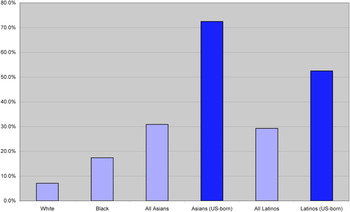
First, Asians and Latinos intermarry at much higher rates than Blacks. As Figure 2 shows, about 30% of Asian and Latino marriages are interracial, but the corresponding figure for Blacks is only 17%. However, if we include only U.S.-born Asians and Latinos in the analyses, we find that intermarriage rates are much higher: nearly three-quarters (72%) of married, U.S.-born Asians, and over half (52%) of U.S.-born Latinos are interracially married, and most often, intermarriage is with a White partner. While the intermarriage rate for Blacks has risen steadily in the past five decades, it is still far below that of Asians and Latinos, especially those born in the United States (Lee and Bean, Reference Lee and Bean2010; Ruggles et al., Reference Ruggles, Sobek, Alexander, Fitch, Goeken, Hall, King and Ronnander2009).
Intermarriage Rates (%)

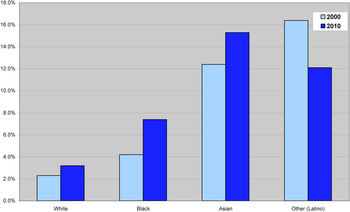
Second, the pattern of multiracial identification is similar to that of intermarriage (Fig. 3): Asians and Latinos report much higher rates of multiracial identification than Blacks. In 2010, 15% of Asians and 12% of Latinos reported a multiracial identification. The corresponding figure for Blacks is only 7%. Although the rate of multiracial reporting among Blacks has risen since 2000, it increased from a very small base of only 4.2% (Humes et al., Reference Humes, Jones and Ramirez2011).
Multiracial Identification by Census Racial Categories

What remains perplexing is that given the history of racial mixing, the Census Bureau estimates that about 75–90% of Black Americans are ancestrally multiracial, yet even today, only 7% choose to identify as such (Davis, Reference Davis2001; Lee and Bean, Reference Lee and Bean2010). Clearly, genealogy alone does not dictate racial identification. Given that the “one-drop rule” of hypodescent is no longer legally codified, why does the rate of multiracial reporting among Blacks remain relatively low? I aim to answer this question by providing a portrait of America's multiracial youth population, and then drawing on eighty-two in-depth interviews (forty-six with multiracial adults and thirty-six with interracial couples with children) to understand how interracial couples identify their children and how multiracial adults identify themselves.
AMERICA'S MULTIRACIAL YOUTH
In 2000, when the U.S. Census allowed Americans to mark “one or more races” to identify themselves and members of their households, 40% of interracial couples with children under the age of eighteen chose this option and checked more than one racial category. For instance, 49% of Black-White couples, 52% of Asian-White couples, and 25% of Latino-White couples identified their children multiracially (Tafoya et al., Reference Tafoya, Johnson, Hill, Farley and Haaga2005). However, when interracial couples were asked to choose only one racial category to identify their multiracial children, stark differences emerged; most Black-White couples choose Black, whereas most Asian-White and Latino-White couples choose White rather than Asian and Latino, respectively (Tafoya et al., Reference Tafoya, Johnson, Hill, Farley and Haaga2005). These findings mirror those reported by Harris and Sim (Reference Harris and Sim2002), who analyzed Add Health Data and found that when multiracial adolescents were asked about the single best race to describe themselves, 75% of Black-White multiracials chose Black, whereas 52% of Asian-White multiracials chose Asian (Farley Reference Farley, Krysan and Lewis2004; Saenz et al., Reference Saenz, Hwang, Aguirre and Anderson1995; Xie and Goyette, Reference Xie and Goyette1997).
In California—the state with the largest multiracial population—1.6 million people identified multiracially, accounting for 4.7% of its population, or one in every twenty-one Californians. Among Californians under the age of eighteen, the ratio rises to one in every fourteen, or 7.3% of young Californians. The greater proportion of young multiracials in California is, in part, a product of the rise in interracial marriages, especially among the young Asian and Latino populations, resulting in a growing multiracial population (Lee and Bean, Reference Lee and Bean2010). California has a high rate of intermarriage; at 18.1%, the intermarriage rate is two and a half times the national average, and second only to Hawaii. To help put the growth of multiracial Californians into perspective, the number of multiracial births already exceeds the number of Black and Asian births in the state (Tafoya et al., Reference Tafoya, Johnson, Hill, Farley and Haaga2005). In fact, so visible is the growth of California's young multiracial population that demographers Sharon Lee and Barry Edmonston (Reference Lee and Edmonston2005) note that “it would not be suprising if the average person were to conclude that intermarriage and multiracial and multiethnic children are the norm” (p. 33).
While California may be in the vanguard of social change, it is not unique with respect to the young age of its multiracial population; Americans under the age of eighteen account for 42% of the multiracial population, and this population is rapidly growing. Among American children, the multiracial population increased by 46% since 2000 (to 4.2 million), making multiracial children the fastest growing youth group in the country (Humes et al., Reference Humes, Jones and Ramirez2011).
Given the young age of the multiracial population, the parents are choosing their children's racial identification on official documents like the census form, so I turn to the interviews with the parents to ask how they identify their children and why they make the decisions they do. By interviewing interracial couples and multiracial adults in California, we get a preview of where the color line is changing most rapidly in the United States. The responses provide insight into the assimilative power of intermarriage, boundary change, and the placement of the color line in twenty-first century America.
ASIAN-WHITE AND LATINO-WHITE COUPLES AND THEIR CHILDREN
When I interviewed the interracial couples, I provided them with a copy of the 2000 Census form and asked how they would identify themselves and their children (Fig. 1). I found that while the vast majority of parents acknowledged their children's multiracial or multiethnic backgrounds, the meaning of multiraciality differed remarkably for the children of Asian-White and Latino-White couples on the one hand, and the children of Black-White couples on the other. For most Asian-White and Latino-White couples, the assimilative power of intermarriage is so strong that while they recognize their children's multiracial and multiethnic backgrounds, and may go to great lengths to instill this identity in their children, they believe (and in some cases, fear) that their children will soon identify as simply “American” or “White.” These couples often used these terms interchangeably, consequently inflating a national origin identity with a racial identity and denoting that from their perspective, American equals White.
Because the Asian-White and Latino-White children in the sample were born in the United States, are strongly influenced by American culture, and speak only English, the Asian and Latino interracial couples maintain that their children “act White.” These parents explain that regardless of how hard they try to instill a strong sense of their Asian or Latino ethnic ancestries, they have resigned themselves to the fact that their children will identify with the majority host culture—that is, as White or as American. For example, a second-generation Asian Indian woman married to a White man, in an interview with the author, agrees that their children will probably identify as White because “They were born here, and it's not like they're going to India.” Her husband then added, “I get the feeling that they'll probably identify themselves as White mostly because they probably won't speak Hindi. Plus, all of their friends are White, and you know, that will probably be the way they identify themselves.”
The Asian-White couples acknowledge that because their children are born in the United States, are English monolingual, and have little direct, sustained contact with the Asian parents' ethnic culture, they feel that their children will simply identify as White as they grow older. These patterns of identification are consistent with previous research that has shown that English monolingualism and little exposure to the minority parent's culture increases the likelihood that Asian-White and Latino-White children will adopt a White identity rather than an Asian or Latino one (Eschbach and Gomez, Reference Eschbach and Gomez1998; Harris and Sim, Reference Harris and Sim2002; Korgen Reference Korgen1998; Saenz et al., Reference Saenz, Hwang, Aguirre and Anderson1995; Stephan and Stephan, Reference Stephan and Stephan1989; Xie and Goyette, Reference Xie and Goyette1997).
The pattern of racial identification among the children of Latino-White couples mirrors that of Asian-White couples. For example, a White woman married to a first-generation Mexican man explains, “I would always identify them [her children] as White. I always considered them to be White. And to me, what does White mean? Caucasian is probably more specific.” Others relayed that outsiders identify their children and the family as White, which in turn shapes the way they see their children and their family unit. When I asked a Latino-White couple how outsiders react to them when they are together with their son, the second-generation Mexican husband added, “Just a regular American family.” When I asked how people identify their son, he responded simply, “White, Caucasian,” again revealing the interchangeable use of American, White, and Caucasian.
Because outsiders' ascription powerfully affects one's choice of racial identities, the Asian-White and Latino-White couples recognize that outsiders who identify their children as White strongly influence the way their children choose to identify. As sociologists have long noted, identity formation is a dialectical process—one that involves both internal and external opinions, processes, and constraints (Eschbach and Gomez, Reference Eschbach and Gomez1998; Lee and Zhou, Reference Lee and Zhou2004; Loewen Reference Loewen1971; Loveman and Muniz, Reference Loveman and Muniz2007; Nagel Reference Nagel1994; Rodríguez and Cordero-Guzman, Reference Rodríguez and Cordero-Guzman1992; Waters Reference Waters1999). These couples have nearly resigned themselves to the seemingly inevitable fact that their children will most likely identify as simply White or American, regardless of how hard they try to maintain the distinctive elements of their Asian or Latino ethnic cultural backgrounds. The findings point to the robust strength of the assimilative power of intermarriage for Asians and Latinos when they choose White partners.
Furthermore, some of the Asian-White and Latino-White couples consider their children's Asian and Latino racial and ethnic identities as symbolic and situational. In these cases, the parents will choose to identify their children as Asian or Latino when they believe that a racial minority status will accrue benefits. A Mexican-White couple underscored this point when they debated how they should identify their daughter, Ana, on the 2000 census form. The exchange between the White wife and the first-generation Mexican husband was recorded on tape, as the wife began deliberating:
- Wife:
I don't know for Ana. Would you say that Ana is Hispanic? I would say no, not Spanish.
- Husband:
I would say no, she's not Spanish, but it depends. If this was a college—
- Wife:
I would say she has a Spanish, Hispanic parent, but I don't think she is.
- Husband:
But would that make her Hispanic or not?
- Wife:
No.
- Husband:
But how are you defining Hispanic? Based on birth, yeah, because that's how I'm defining it. But if this was a college application we'd say yeah.
- Wife:
Oh yeah, we'd say yeah.
- Interviewer:
Why would you say yes if it was a college application?
- Husband:
Because she'd get into a better school because of it.
- Interviewer:
Why?
- Husband:
Because she's a minority. It would do more for her getting into a better college. I mean, opportunities.
While both the Mexican husband and White wife agree that their daughter is not Hispanic and choose not to mark her as such on the census form, they quickly note that they would identify her as Hispanic on a college application, where they believe she would benefit from her minority status. As they justify, by identifying their daughter as Hispanic, they are maximizing the opportunities that are available to her, even if they do not identify her as Hispanic in everyday life. They recognize and take full advantage of their daughter's multiracial background, which provides the option of privileging one identity over another depending on the context and the benefits associated with that choice. In essence, the parents' decision to shift their daughter's identity from White to Hispanic becomes a strategic and adaptive response to a specific situation (Okamura Reference Okamura1981; Saenz and Aguirre, Reference Saenz and Aguirre1991).
The optional and situational nature of Latino and Asian identities for multiracial Americans is also reflected in a Vietnamese White woman's response about her Asian ethnic background, which she claims to forget about entirely most of the time, as she explained:
Say we're in a room full of all White people and I'm like the only Asian, I almost always forget that I'm Asian, or half Asian. I consider myself White. I act very White as far as I'm concerned because that's all I know. So I don't have very much Vietnamese culture in me.
I don't like Asian food, I have no Asian traditions, and I know absolutely no Vietnamese. The only thing Asian about me is the fact that my mother is Vietnamese. Everything about me is White, except for my car; it's a Honda! [she laughs]
For this woman, her Vietnamese ethnicity is so nonconstraining that she forgets about it altogether, revealing its optional nature. However, when asked how she identifies on forms, she indicates that she marks both White and Vietnamese, or whatever identification will benefit her most at that time. For example, she explained that when she applied for a position as a flight attendant, she asked the human resources manager how she should mark her racial identification on the employment form. The manager confided that she should mark Vietnamese since there are relatively few Asians who work in the American airline industry, and therefore, an Asian ethnic identity would work to her advantage in the hiring queue. When I asked when she would identify as White, she explained that were she to apply to the University of California, Irvine (where over 50% of its undergraduate student body is Asian), she would mark White since she believes that her Vietnamese ethnicity would serve as a disadvantage in this case.
Both the Vietnamese White woman and the Mexican White couple reveal that they can turn their non-White ethnicities on and off whenever they choose; they can be ethnic when they wish to take advantage of race-based programs targeted for disadvantaged minorities, but then turn off their non-White ethnicities in their everyday lives. Critical to underscore is that their choices are not contested by others.
CLAIMING ETHNICITY THROUGH CULTURE—TAMALES, PIÑATAS, SUSHI, AND CHOPSTICKS
The choice and fluidity that Asian-White and Latino-White multiracials have at their disposal indicates that the Asian and Latino ethnicities for these multiracial Americans are what Herbert Gans (Reference Gans1979) and Mary Waters (Reference Waters1990) would describe as “symbolic”—meaning that they are voluntary, optional, and costless, as European ethnicity is for White Americans. They can be White and American, yet also be Mexican or Vietnamese just as European ethnics can be Irish, Italian, or German and also be White and American.
The Asian and Latino multiracial respondents also conveyed that they enjoy the celebratory nature of their ethnic backgrounds because it makes them feel special, unique, and because it adds “a little special sauce” to their lives by giving them “more culture” than if they were “just White,” which they view as ordinary, boring, and devoid of culture. Tapping into their ethnic culture, therefore, offered a solution to having “no culture” and provided a reprieve from the “boring lifestyle” associated with being just White, just as Waters (Reference Waters1990) noted in her interviews with later-generation White ethnics. For example, a Japanese White woman explains why she now wants to learn more about Japanese cultural traditions, even though she did not practice any while growing up:
I'm finding more desire to have more culture. Just because I think the way that I live today, there is no culture, and I think it's kind of a boring lifestyle. When I meet someone from a different country, I see all these really interesting things that they do. It's because of how they were brought up, and I think the way I was generally brought up was just kind of basic, you know, nothing really special to it. And I want to see, and maybe try more cultural things from the Asian descent to make it more interesting, to give my boyfriend and myself some more character.
As this woman states, there was “nothing really special” in the way that she was raised, but now, she would like to draw on “cultural things from the Asian descent” to make her life “more interesting.” She makes several striking points about her multiracial background. First, as someone who has identified and has been identified as White throughout her life, she feels that her lifestyle is ordinary and boring. Second, in order to make her lifestyle more interesting and appealing, she would like to add some distinctive cultural elements to it, yet these elements would come from her “Asian descent,” rather than her Japanese ethnicity more specifically. In other words, she lacks specific knowledge about her Japanese ethnic ancestry and conflates Japanese ethnicity with Asian racial identity. Third, she feels that she can adopt and try new “cultural things” to add an interesting dimension to her lifestyle, illustrating the belief that Asian ethnicity is something recreational and fun that can be easily acquired, learned, and adopted.
Similarly, when I spoke to a man born to a White mother and Asian Indian father who explained that while he identifies as “100% White” how he plans to identify his son, his wife (who is White and was eight months pregnant at the time) responded,
- Wife:
Personally I would still consider our child Indian, even though the Indian side is watered down considerably. I don't want to ignore that. I think it's still important.
- Husband:
I mean I wish I had a stronger identification with being Indian. I really like learning about it, and I wish I knew more. For me, it's important, and I really need to know about it, so I think it's important for our child to have that same thing.
While he does not identify as Indian, and neither he nor his wife have a sense of what it means to “be Indian,” both feel that it is important to learn more about it so that they are able to pass on the heritage to their child. This couple treats Asian Indian ethnicity as a foreign culture that can be learned and acquired rather than an ascribed identity that is lived, experienced, and passed down in everyday life.
While most of the Asian-White multiracials I interviewed expressed that they knew little about Asian ethnic cultural practices, some relayed that they felt particularly unique because they have been able to practice and enjoy distinctive cultural elements such as food, music, and entertainment. For example, a Korean White woman echoes this sentiment when she conveys that while she is proud to be White, she also enjoys being Korean because she is able to enjoy Korean food, music, and dances—all of which make her feel unique. She explains, “I'm White, but I also enjoy the fact that I'm Korean because whereas a lot of Caucasian people, they don't have any culture, I can enjoy the dances, the food, the music, the entire culture that my mother's side has to offer me—that uniqueness.” A Mexican White male echoed a similar sentiment by explaining that he feels that “it's more of a privilege to have an ethnic type background than just White. I feel like there's more to me because I'm Hispanic, because of the culture and stuff, instead of just being White.” The feeling of uniqueness was something that both the interracial couples and multiracial adults emphasized, that is, being “part Asian” or “part Hispanic” made them feel different and special, and set them apart from other White Americans, even if they knew very little or nothing about their Asian or Latino ethnic ancestries.
These multiracial respondents also stressed the fun, celebratory, and expressive function of their Asian and Latino ethnic identities. The Latino-White multiracials described that they celebrate their ethnicity by making tamales at Christmas, having piñatas at birthday parties, listening to Spanish music, and eating tacos on Tuesdays. For the Asian-White multiracials, celebrating their ethnicity meant eating with chopsticks; receiving money in red envelopes on Chinese New Year; eating sushi, pho, and Chinese food; and drinking boba tea. Their Asian and Latino ethnicities are symbolic, additive, and positive, and most critically, none of the respondents viewed their Asian and Latino ethnicities as constraining in any way. Hence, practicing ethnic cultural traditions allows Asian-White and Latino-White multiracials to feel ethnic without being ethnic in the same manner that White ethnics can experience their European ethnicity, that is, as a leisure-time activity without cost or consequence (Alba Reference Alba1990; Gans Reference Gans1979; Waters Reference Waters1990).
BLACK INTERRACIAL COUPLES AND THEIR CHILDREN
Unlike the Asian-White and Latino-White couples, none of the Black-White couples identified their children as simply White or American, nor did they claim that their children identify as such. While Black-White couples recognize and celebrate the racial mixture of their children's backgrounds, they tend to identify their children as Black rather than as White, non-Black, or American, which mirrors the way that outsiders view them. Furthermore, for the children of Black interracial couples, their Black identities are not voluntary, symbolic, or costless.
For example, when I spoke to a Black multiracial male whose mother is White and whose father is Black, he admitted that he identifies as “Black American—home grown, 100%.” His wife is White; together, they have two sons, and when asked how he chooses to identify them, he explains, “I would say that they're half and half on the purest level, but still, for some reason, I just look at them as Black.” Here, he notes that not only does he identify as Black, but he also identifies his children as Black, even though he could claim a multiracial identification for himself and his children. When asked whether he ever identifies his children as White or something other than Black, he candidly admits, “You know I've never had an occasion to do that. Maybe it's just the eyes that I'm looking through. I just haven't at all, and that's probably not a good thing.” When probed further, he and the other Black-White couples underscored the point that nobody would take them seriously if they tried to identify their children as White, reflecting the power of external ascription in determining how interracial couples choose to identify their children, and their belief that a non-Black identity would be contested by others.
The Black-White couples further explain that others' reactions (both subtle and not-so-subtle) to their unions and their multiracial families are palpable cues of other people's ambivalent feelings about their multiracial unions. For example, interracial Black couples explained that they often receive perplexed reactions from service workers in restaurants and stores who consistently assume that they are not together, and often ask to help one person before asking the other. Moreover, Black multiracial respondents described their friends' and strangers' puzzlement when they see them with their non-Black parent, as a twenty-six-year-old Black multiracial male explains:
I remember being with my Dad, even if we were standing in a line together, people would help him and then ask if I was next. They couldn't connect that we were together. It got to the point where I would almost not want to go with my Dad. I mean I got to deal with this—people looking at us funny? What's this White guy doing with this Black kid? I think a lot of the time people have no idea that my Dad is my Dad, and that did kind of bother me when I was younger. People would say, “Oh, who's that?” And I would say, “Oh, that's my Dad!”
Because people often fail to recognize an older, White man and younger, Black multiracial man as father and son, the multiracial Black male admits that he reached a point where he felt uncomfortable going out with his father altogether. When I asked whether he received similar reactions when he went out with his Black mother, he initially looked puzzled, as if the answer was so obvious that he did not understand why I had bothered to ask, but then simply answered, “No, not at all.”
From a parent's perspective, a Black parent of a multiracial child normally does not have to contend with the racial split between his/her child (regardless of how fair-skinned the child may be), but the same does not hold for a White parent of a multiracial Black child (Funderburg Reference Funderburg1994; Romano Reference Romano2003; Tizard and Phoenix, Reference Tizard and Phoenix1993; Wilson Reference Wilson1981). This is because historically the children born to Black-White unions stayed with the Black parent (usually the Black mother), so even today, while interracial marriage is on the rise for all groups (including Blacks), many Americans still find the pairing of White parents and multiracial Black children unusual and perplexing.
However, it is not simply Black and White pairings that cause confusion, but Black and non-Black pairings more generally. For example, a Black Chinese male notes that when he is with his Chinese grandfather, people often assume that he is doing some type of service work. He relays, “When I'm with my grandpa, especially now that he's older, people will ask if I'm doing some kind of community service. People always ask me, ‘Wow, are you doing some kind of community service?’ And I'm like, ‘No, that's my grandpa.’” He then added that when he is with his Black grandfather or father, “people don't say anything.”
The bewildered reactions, stares, and questions that Black interracial couples and Black multiracial families receive illustrate that for others, seeing certain racial combinations together is foreign, unfamiliar, and seemingly illogical, especially in the most intimate of relationships, pointing to what we refer to as “a racial disconnect.” From an outsider's perspective, there is a racial disconnect between Black and non-Black. Given the confused reactions they receive when they venture out with non-Black family members, the children of Black interracial unions have concluded that choosing a non-Black identity is a difficult option since it would generate confusion, questions, and challenges.
THE HISTORY AND CONSEQUENCES OF THE “ONE-DROP RULE”
The different patterns of identification between Asian and Latino interracial couples on the one hand and the Black interracial couples on the other, stem, in part, from the relative newness of the Asian and Latino multiracial populations, combined with the lack of historical rules that govern their choice of identities. Unlike Blacks, Asians and Latinos were not legally subject to the “one-drop rule” of hypodescent, which continues to constrain the racial options for Blacks in unique ways, despite its loss of legal legitimacy.
To give a brief history of the one-drop rule: it was first implemented during the era of slavery so that any children born to a White male slaver owner and a Black female slave would be legally identified as Black, and, as a result, have no rights to property and other wealth holdings of their White father. After the United States abolished slavery, Southern states including Tennessee and Louisiana legalized the rule of hypodescent in 1910, and other states soon followed suit. By 1925, nearly every state in the country had institutionalized the practice into law.
The U.S. Census soon followed suit, and in 1930 made a fateful decision that had an enduring impact on the way that Americans define Blackness. Prior to 1930, the U.S. Census acknowledged the racial mixture in the Black population, and counted mixed race Blacks as “mulattos,” “quadroons,” and “octoroons,” depending on the extent of racial mixture with Whites (Nobles Reference Nobles2000). While this practice stemmed from the desire to track racial mixing and police the Black-White color line, at the very least, the U.S. government recognized the multiraciality of the Black population. However, in 1930, census enumerators were instructed to classify all mixed-race Black individuals as “Negro,” with specific directions that read:
A person of mixed white and Negro blood should be returned to Negro, no matter how small the percentage of Negro blood. Both black and mulatto persons are to be returned as Negroes, without distinction (cited in Nobles
Reference Nobles2000, p. 188).The sheer paradox of the one-drop rule is self-evident: it is not a two-way street. One can be seven-eighths White (as Homer Plessy was, of Plessy v. Ferguson 1896), and not be White. But any trace of “Black blood” makes one Black. By adopting the one-drop rule of hypodescent, the United States refused to acknowledge the mixed racial backgrounds of Black Americans by legally assigning them a Black racial identity. It was not until 1967, in the case Loving v. Virginia when the U.S. Supreme Court overturned the final ban on interracial marriage, that the one-drop rule lost its legitimacy. While the rule is no longer legally enforced, its legacy remains culturally intact, and explains why 75–90% of Black Americans are ancestrally multiracial, yet only 7% choose to identify as such. The legacy of the “one-drop rule” has had enduring and fateful consequences in the way that Americans view race, and explains why we are so attuned to identifying Black ancestry in a way that we are not similarly attuned to identifying and constraining Asian and Latino ancestries (Lee and Bean, Reference Lee and Bean2010).
While Black interracial couples feel more constrained than their Asian and Latino counterparts in how they identify their children, it is also critical to underscore that Black racial identification also reflects agency and choice on the part of these couples and their children. Given the legacy behind the one-drop rule, and the meaning and consequences behind the historical practice of “passing as White,” choosing to identify one's children as White may not only signify a rejection of the Black community, but also a desire to be accepted by a group that has legally excluded and oppressed them in the past (DaCosta Reference DaCosta2007; Davis Reference Davis2001; Kennedy Reference Kennedy2003; Romano Reference Romano2003).
Furthermore, none of the Black-White couples choose to identify their children as simply American because as native-born Americans, they feel that the American label is already an implicit part of their and their children's identity. While the children of Asian-White and Latino-White unions in the sample are also native-born, because many of the Asian and Latino parents are either immigrants or the children of immigrants, the American label has not become as implicit a part of their identity, as it has for native-born Whites and Blacks (Lee and Zhou, Reference Lee and Zhou2004; Zhou and Lee, Reference Zhou and Lee2007). Unlike the Asian-White and Latino-White couples who equated American with White, the Black-White couples did not; for Black-White couples, American also equals Black. For all of these reasons, intermarried Black couples are less likely to identify their children as exclusively White or American. The findings indicate that the cultural persistence of the “one-drop rule” of hypodescent still strongly operates to keep the practice of identifying Americans with any trace of Black ancestry as racially Black (DaCosta Reference DaCosta2007; Davis Reference Davis2001; Hollinger Reference Hollinger2003; Lee and Bean, Reference Lee and Bean2004, Reference Lee and Bean2007; Roth Reference Roth2005).
CONCLUSIONS AND DISCUSSION
The multiracial population is young and rapidly growing, and may soon account for one-fifth of the U.S. population by the year 2050, and one-third of the country's population by 2100. Because the multiracial population is overwhelmingly young, the parents choose their children's racial identification on official documents like the Census form, and also help to shape the way that multiracial youth see and identify themselves. Based on the in-depth interviews, we find that while Asian-White and Latino-White couples recognize and identify their children as multiracial or multiethnic, they feel that their children will soon adopt a White or American identity, regardless of how hard they may try to instill a multiracial or multiethnic culture and identity. Black intermarried couples, however, feel differently. While interracial Black couples also recognize the multiracial backgrounds of their children, they are more likely to identify their children as Black—in part, they claim, because others identify them as such.
The divergent patterns of racial identification among these couples indicate that the assimilative power of intermarriage operates differently for Blacks than it does for Asians or Latinos. The assimilative power of intermarriage operates so strongly for the children of Asian-White and Latino-White couples that most identify and are identified by others as White and/or American. By contrast, the children of Black interracial couples are much more likely to adopt a Black racial identity, suggesting that these couples appear to be traversing a different pathway, and more specifically, incorporating into a racialized, minority status. The interviews illustrate that when marrying across the color line, interracial Black couples are the least likely, least able, and/or least willing to transfer a non-Black identity and status to their children.
In addition, the Asian and Latino multiracials articulate that their racial and ethnic status holds little consequence in their daily lives, and stress the symbolic and expressive nature of their Asian and Latino ethnicities. They celebrate their ethnicities through occasional cultural practices such as eating ethnic foods including tamales, rice cakes, and sushi, and enjoying the specific cultural traditions associated with ethnic holidays such as using chopsticks and breaking open piñatas. Like European, White ethnics, these multiracials can feel ethnic without being ethnic, reflecting the voluntary and situational character of their Asian and Latino ancestries. In many respects, Asian-White and Latino-White multiracials are similar to American Indian multiracials whose racial status exemplify racial fluidity and choice (Eschbach Reference Eschbach1995; Eschbach et al., Reference Eschbach, Supple and Snipp1998), and also resemble White ethnic Americans in the way that they express and celebrate their ethnic identities (Alba Reference Alba1990; Gans Reference Gans1979; Waters Reference Waters1990). Hence, based on these findings, Asian and Latino multiracials are much closer to Whites than to Blacks at this point in time, pointing to a pattern of Black exceptionalism in race relations.
Why does Black exceptionalism persist, even amidst the country's new racial/ethnic diversity? It persists because the legacy of slavery and the legacy of immigration are two competing (and strangely symbiotic) mythologies on which the United States was founded. If immigration represents the optimistic side of the country's past and future, slavery and its aftermath is an indelible stain in our nation's collective memory. Moreover, the desire to overlook the legacy of slavery becomes a reason to reinforce the country's immigrant origins. That Asians and Latinos are largely immigrants or the children of immigrants means that their understanding of race and the color line are born out of an entirely different experience and narrative from that of African Americans.
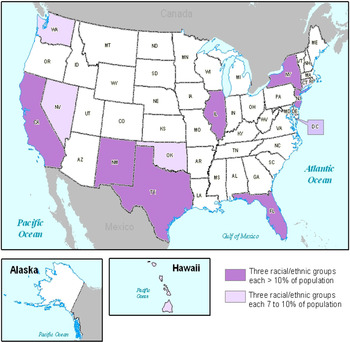
Hence, despite the increased diversity, race is not declining in significance, nor is the color line disappearing. However, diversity is helping to erode group boundaries. States that are more racially diverse—including California, New York, New Jersey, Illinois, Texas, and Florida (plus the District of Columbia)—exhibit the highest rates of intermarriage and multiracial reporting, revealing the positive effects of diversity on breaking down racial barriers, especially for Asians and Latinos (Lee and Bean, Reference Lee and Bean2010) (see Fig. 4).
New Diversity States

However, what is disheartening is that even in these new diversity states, patterns of Black exceptionalism continue to persist. So while diversity helps to break down some color lines, it does not break down all, and despite the increase in intermarriage and multiracial identification among Blacks, individual boundary crossing does not lead to boundary change at the group level, as it does for Asians and Latinos. That we continue to find a pattern of Black exceptionalism and the emergence of a Black–non-Black color line—even in the most racially and ethnically diverse parts of the country—indicates that we are far from a “postracial” society and instead points to the paradox of diversity in the twenty-first century.