Though democracy has generally been understood as a country-level variable, recent scholarship has identified significant intra-country variation in the design and performance of democratic institutions. This uneven, ‘patchwork’, ‘mosaic’ or ‘archipelagic’ character of democracy and democratic institutions stands out as a crucial scholarly and policy concern in the current literature on democratization, and a large literature has developed that addresses subnational variation in key political phenomena (see, for example, Cornelius Reference Cornelius1999; Gibson Reference Gibson2005, Reference Gibson2010; Giraudy Reference Giraudy2012; McMann Reference McMann2006; Moncada and Snyder Reference Moncada and Snyder2012; Snyder Reference Snyder2001). O'Donnell (Reference O'Donnell1993) highlighted how countries that are nominally democratic at the national level contain subnational ‘brown’ areas – predominantly rural and poor regions – where the state has little or no presence, resulting in situations where the state is present for some citizens and nearly totally absent for others, based only on where one happens to live. The uneven reach of state institutions within single countries is increasingly a key subject in the growing literature on the quality of democracy in the post-transition era. This challenges us to develop a better understanding of subnational regime dynamics and the way in which institutions and political processes at different levels of government interact.
So far, however, the empirical study of these phenomena has been hampered by the lack of adequate data, as well as conceptual and theoretical tools (Snyder Reference Snyder2001). Data limitations on local outcomes of interest abound. Further, there is a striking disconnect between the empirical evidence for intra-state variation and our ability to conceptualize, measure and analyse observed patterns. One key challenge is that conceptual tools developed for national-level analysis cannot be applied uncritically to subnational units. As Sartori (Reference Sartori2005: 73) points out, ‘Florida or Louisiana or Mississippi . . . are not states in the sense in which Mexico and Tanzania are such.’ Addressing basic analytic shortcomings in these areas requires more careful, systematic work in conceptualization and operationalization. Analyses of territorially uneven processes challenge us to account for the fact that a higher level of authority exists, that subnational units are linked to that authority, and that lower-level (that is, local) political processes or phenomena may overlap, intersect or coincide in key ways with higher-level processes or phenomena.
In federations and other political systems that have several levels or layers of government – that is, ‘multilevel’ systems – the danger of flawed measurement applies not only to the subnational level, but to the national level as well. The literature requires better system-wide measures that capture variation both across subnational units and across levels of government. Previous research has suggested that considerable analytic costs inhere in failing to address the challenges of intra-country variation. Invalid conclusions for national-level phenomena may be drawn, for instance, where cross-national research relies on national averages to operationalize a concept, or infers national values from ‘best-known cases’, for example, drawing conclusions about the whole of Brazil from states such as São Paulo (Hagopian Reference Hagopian1996: xiii; Lijphart Reference Lijphart1975; Snyder Reference Snyder2001). Beyond subnational variation, Snyder draws attention to cross-level variation in policy and institutional design. That is, the degree to which similar formal rules intersect or overlap across different levels of government is substantively important. In sum, unless the field develops a better understanding of subnational and multilevel institutional systems and incorporates them into research, substantial analytic risk attaches to our capacity to ‘see’ local politics and fully comprehend national politics.
In this article, we build on existing studies of subnational democratization and offer a methodological contribution to the research agenda on institutional unevenness within countries by conceptualizing and measuring system-wide institutional incongruence. Our substantive focus is on formal electoral rules, and we construct an index of properties of local electoral institutions. Notably, we offer two measures: (1) a measure of the subnational variation in institutional characteristics – this part complements other efforts to measure the unevenness of institutions within single countries; and (2) a measure of the congruence between the design of local institutions and their national counterparts – this second measure goes beyond studies of spatial unevenness, per se, to capture overall, system-wide, dissimilarity. We illustrate our measures on the basis of an original data set of party formation rules across Mexico's 31 states, the Federal District and the federal level of government. This new data set, then, comprises information about formation rules in 33 ‘party systems’ within a single country. We show how scholars can enhance the analytic leverage brought to bear on questions of institutional unevenness and performance. In doing so, we engage scholarship in two main areas: (1) subnational, territorial and multilevel politics; and (2) democratization and the development of democratic institutions.
The article proceeds as follows. First, we provide an overview of some of the primary methodological implications of the literature on subnational and multilevel politics. In this section, we review the literature on subnational politics, especially in Mexico, highlighting the need to measure institutional characteristics in a way that captures variation in these characteristics across territorial units and across levels of government (on the importance of interaction, see Snyder Reference Snyder2001). Second, using electoral rules in Mexico as an illustrative example, we show how this kind of variation can be operationalized in systematic ways. This step generates an index of institutional design – a ‘party barriers index’ – measuring institutional properties at the state and federal level. Third, utilizing both the state and federal metric, we generate a measure of system-wide dissimilarity or overall ‘institutional incongruence’. Lastly, we offer suggestions on how the steps above can be used to enhance studies of institutional unevenness across countries and across territorial units within a single country. In this section, we illustrate the usefulness of our measures on the basis of the emerging literature on subnational undemocratic regimes, highlighting how our concepts and data help meet many of the challenges for comparative research in multilevel democracies.
Democratic Institutions Beyond The Nation State
Even though many democratic regimes in the developing world have endured, alleviating fears of outright democratic breakdown, they often do not live up to the hopes of the transition period in terms of the quality or evenness of democracy. At the national level, checks and balances have often remained weak, so that accountability of elected officials to citizens is hampered, and the real effectiveness of rights and liberties is weaker in practice than in theory (see, for example, O'Donnell Reference O'Donnell1994). Also, democratization has coincided with a global trend towards more decentralized governance – in country after country, political, fiscal and/or administrative powers were transferred to subnational governments (see, for example, Hooghe and Marks Reference Hooghe and Marks2003; Montero and Samuels Reference Montero and Samuels2004). As a consequence, subnational and territorial politics have increasingly become an important field of study. While the tendency to conceive of politics primarily as a national-level phenomenon has been characteristic of the whole discipline, the strong centralist legacy in Latin America has led scholars of the region to be particularly wedded to the idea that the activity of politics is carried out in the national arena (on historic centralism, see Véliz Reference Véliz1980).
Comparativists have increasingly turned their attention to subnational comparative analyses, especially since Snyder's call (2001) for ‘scaling down’. Research agendas of this sort have been especially vibrant in Latin America's federal systems. In Mexico, this literature includes, among others, studies of the territorial unevenness of the decline of the hegemonic party (Cornelius Reference Cornelius1999; Lujambio Reference Lujambio2001; Wuhs Reference Wuhs2008). More recently, the literature has expanded to studies of uneven institutional development, such as subnational legislatures (Beer Reference Beer2003; Beer and Mitchell Reference Beer and Mitchell2004), electoral institutions (Eisenstadt Reference Eisenstadt2004; Monsiváis Carrillo Reference Monsiváis Carrillo2009), as well as courts and the judiciary (Beer Reference Beer2006; Ingram Reference Ingram2012a, Reference Ingram2012b). A common theme shared and amplified by these studies is the widespread empirical evidence that political practices in some regions of new democracies fall considerably short of democratic standards and that political processes at different levels of government interact with each other. Yet, the conceptual implications of these findings often remain unclear. More specifically, the research programme struggles with the question of how to ‘scale back up’ to examine the implications of variation in subnational institutions identified by the first generation of research for national categories. Acknowledging the interdependence of political arenas is important because the exclusive focus on either the national or the subnational level incurs the risk of overly simple or outright false classifications.
While institutional variation across levels occurs in old and new democracies, in new democracies this issue is particularly pressing because of greater institutional fluidity. Argentina, for instance, experienced a virtual whirlwind of electoral reforms after the return to democracy in 1983 (Calvo and Micozzi 2005). By 2003, 32 constitutional reforms and 34 electoral reforms had created a situation where no two provinces selected representatives using the same electoral formula. In their analysis of the determinants of these reforms, Calvo and Micozzi (Reference Calvo and Micozzi2005) show that reforms tended to strongly benefit incumbent elites seeking to safeguard their position vis-à-vis local challengers. There is thus evidence that dissimilarity may grow over time, making the development of accurate measures increasingly pressing.
Because subnational units with directly elected public officials possess political systems of their own, it is important to theorize about the ways in which political systems at different levels of government influence each other. In this regard, Gibson and Suarez-Cao's conceptualization (2010) of ‘federalized party systems’ is groundbreaking. The ‘federalized party system’ brings together party ‘subsystems’ that exist at different levels of government and are interdependent. Thus, while the dynamics of competition in each subsystem are governed by distinct electoral laws, dynamics of competition in local subsystems have repercussions for the national subsystem, and vice versa. Translating these insights to institutions beyond party systems has remained difficult, however.
In light of empirical evidence of unequal democratization and institutional variation, a second generation of research has emerged that seeks to identify the factors that explain the emergence and persistence of subnational undemocratic regimes.Footnote 1 Because these subnational regimes are embedded in national democracies, they must at least resemble electoral politics, and restricted contention generally takes the form of single-party dominance (Gibson Reference Gibson2005; Giraudy Reference Giraudy2010; Key Reference Key1949). Analysing such regimes poses considerable challenges. For instance, the literature is still grappling with the question of whether subnational regimes can indeed be considered ‘authoritarian’, even though the national regime is classified as democratic (on conceptualizations of subnational regime types, see Behrend Reference Behrend2011; Bland Reference Bland2011; Giraudy Reference Giraudy2012). In other words, do subnational political systems contain a sufficient degree of ‘boundedness’ to merit classification as regime types in their own right? And why does the problem of uneven democratization appear to be more pervasive in some countries than in others? Which role does the national context play? To advance the research agenda on subnational undemocratic regimes, it is crucial to gain a better understanding of how these regimes function within national democracies and, consequently, which strategies elites employ to maintain them over time. Yet, while the unevenness of democratic institutions has become a key concern in the literature on democratization, attempts to explain the persistence of subnational undemocratic regimes have so far been hampered by the lack of methodological tools to measure systematically institutions in multilevel systems, particularly the degree of unevenness, both across territorial units and levels of government.
In sum, while the literature on state and municipal politics is growing rapidly, the development of conceptual tools to study the relationship between different levels of government has lagged. The ‘world under investigation’ has become larger due to the increasing prominence of the subnational level, but it is not clear whether our conceptual, theoretical or methodological tools ‘travel’ adequately (Sartori Reference Sartori1970: 1034). Uncritically applying concepts developed for one level of government to multilevel contexts incurs the risk of conceptual stretching, however. The challenge is primarily two-fold. We need: (1) to develop new concepts for the study of subnational institutions and multilevel politics beyond the concepts developed for the national level; and (2) to rethink the degree to which national-level categories and measures change if subnational politics becomes more important.
Case Selection: Party Formation Rules in Mexico
Contributing to the conceptual and methodological debate outlined in the previous section, we propose measures to capture variation in institutional rules across territorial units and across levels of government. While the measures can be calculated for many types of formal institutions in multilevel settings, we illustrate them on the basis of party formation rules in Mexico. These electoral rules exemplify many of the challenges for studying institutions in multilevel settings in general and for the literature on subnational undemocratic regimes in particular.
Rules governing party formation are frequently mentioned in the literature on subnational politics as one of the ways in which subnational elites protect themselves from challengers (Calvo and Micozzi Reference Calvo and Micozzi2005; Giraudy Reference Giraudy2012). Even though case studies frequently mention within-country variation in party formation rules, this insight has not been taken up by the theoretical literature on party formation, which continues to treat formation rules as a national phenomenon. The cross-national literature on the emergence of new parties in particular has ignored subnational rules. Yet, considering only national-level institutional variables risks errors in internal validity, errors that eventually translate to mis-measurement and mis-specification of models. In causal analyses a national-level variable, such as signatures required to appear on the ballot, might not be significant either because it genuinely does not affect party formation, or because parties circumvented the high national barrier by taking advantage of lower barriers at the subnational level. They may then use this opening to build successively larger national organizations (see, for example, Chandler and Chandler Reference Chandler and Chandler1987: 91; Miragliotta Reference Miragliotta2012; Willey Reference Willey1998). So far, the literature on party emergence in new democracies has largely neglected such subnational dynamics and assumed that within single countries parties are subject to a uniform set of rules.
Empirically, this article draws on an original data set of party formation rules in Mexico. More specifically, we apply theoretical guidelines for measuring the openness of party systems to electoral codes from all 32 Mexican states and to the federal level. Mexico constitutes an instance of a new federal democracy. For most of the twentieth century, power in Mexico was tightly controlled by the Institutional Revolutionary Party (Partido Revolucionario Institucional – PRI), and, within the party, power was concentrated in the upper echelons of the organization. Exceedingly high barriers for new parties discouraged defections from the dominant party, as breaking away from the Institutional Revolutionary Party would effectively mark the end of one's political career. Electoral laws and specifically party formation requirements were tools skilfully used by the dominant party to limit space for the opposition (Crespo Reference Crespo2004). Political centralism meant that state laws tended to be drafted to mirror their national equivalent. Thus, the national electoral code – which sets high obstacles for the formation of new parties – would be copied across the states, setting similarly high bars at the local level. Democratization has reinvigorated federal dynamics, and states therefore have more room to craft their own electoral laws. This, however, has gone hand in hand with unequal democratization across states.
During the democratization process in the late 1980s and 1990s the federal electoral code was reformed to provide more space to the opposition. One key concern of the emerging opposition was that the organization of elections be removed from the government, which was controlled by the Institutional Revolutionary Party. The 1990 reform created a national electoral body, the Federal Electoral Institute (Instituto Federal Electoral – IFE), which governs all federal elections, and each subnational unit has since followed suit, creating its own equivalent organ or state electoral institute (instituto estatal electoral – IEE). These state institutions regulate state and local elections. Within each state, the legislature approves a local electoral law, and this law governs state and local elections, including the rules regarding the formation of state parties. Our analysis examines the most recent state electoral codes as of June 2010, to capture rules of party formation.
Deriving The Components of The Index: Barriers to Party Formation in Mexican States
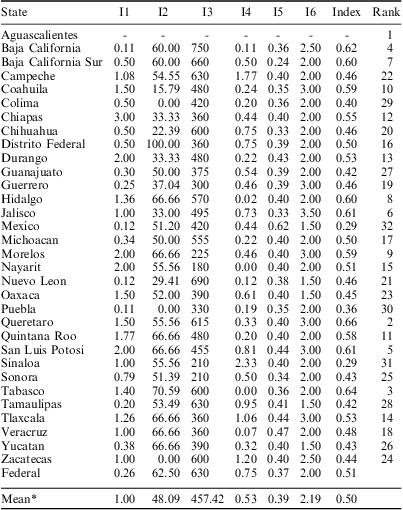
The categories of our measure of institutional barriers are grounded in the theoretical literature on party formation. Barriers to party formation can be grouped into two categories: ballot access requirements and ‘playing field’ characteristics. First, ballot access requirements refer to the formal administrative hurdles parties must overcome to appear on the ballot. In short, ballot access is the process of acquiring the party registration. Second, once parties have registered and secured a space on a ballot, they are confronted with the characteristics of the electoral playing field. New contenders may have institutional disadvantages vis-à-vis established parties, or they may compete on fairly equal ground. Thus, these characteristics of the playing field are triggered once the new party has met all requirements to register as a party. For each of the two dimensions, we identify three indicators. Table 1 reports data for all six indicators. It should be noted that one Mexican state – Aguascalientes – does not allow any state parties. Only nationally registered parties are allowed to compete in local elections, which means that there are no local rules governing party formation in the state.
Raw Values and Party Barriers Index

Notes: I1 = signature requirement (percentages); I2 = spatial requirement (percentages); I3 = length of formation process (in days); I4 = funding (in pesos per voter); I5 = electoral system (percentages); I6 = maintenance requirement (percentages).
* Excludes federal values.
Ballot Access Requirements
High formal requirements for party registration can hamper the formation of new parties. Indeed, while ‘the major parties prepare media ads, buy television time, and plan campaign strategy, third party candidates devote their scarce resources to getting on the ballot’ (Rosenstone et al. Reference Rosenstone, Behr and Lazarus1984: 24). We distinguish three key dimensions of ballot access requirements: signature requirements, spatial distribution and the length of the formation process.
Signature Requirement
A new party generally has to demonstrate that its application has a certain level of popular support from voters. The higher the required number of signatures backing the application, the harder it is for new parties to appear on the ballot (Hug Reference Hug2001). Some Mexican states report these requirements as minimum numbers of supporters, while others report minimum percentages of voting population. Where necessary, we converted the raw numbers to percentages of the voting population, providing comparable measurements across states. The state of Chiapas has the highest signature requirement at 3 per cent of the state's voting population. This is three times higher than the mean, which lies at 1 per cent for all included states. With a requirement of only 0.11 per cent of the voting population, the states of Baja California and Puebla have the lowest support requirement.
Spatial Distribution
Spatial distribution requirements, which mandate a certain level of territorial (that is, geographic) coverage for the nascent party organization, are another barrier to party formation (Birnir Reference Birnir2004). The higher the minimum number of territorial units within which a new party must have an organizational presence, the more difficult it will be to meet this requirement. We calculate spatial distribution by dividing the number of required territorial units within the state in which the group must have members (municipalities or districts) by the total number of units in the state. This yields a percentage that is comparable across states. States differ markedly in the degree to which they impose spatial distribution requirements on parties. While the Federal District mandates an organizational presence in all units, Colima, Puebla and Zacatecas have no specific spatial distribution requirements. The mean requirement across states is 48 per cent.
Length of Formation Process
The process of applying for party registration is necessarily subject to deadlines. Two timing characteristics affect party formation: deadlines for the application itself, and the time allowed for the state electoral institute to make its decision once the application is submitted. Combining the time periods for these two requirements yields the expected duration of the entire formation process. Restrictive rules make this a lengthy process and thus require very early applications, while more lenient rules allow applications closer to election day.
Regarding the time allowed for decisions, a group may submit an application, and the decision to allow or disallow its registration should be fairly procedural. In other words, either the group submitted the required documentation or it did not; there is very little room for interpretation. Thus, the decision should be fairly quick. However, some states allow as long as six months (Baja California and Nuevo Leon) for this decision. Delays in the registration decision can snowball into problems in other areas. For instance, if public financing hinges on party registration status, the delay period means the group is without funding for that time. If the election is approaching, this is time that the group could use to organize campaign events. Ultimately, if the local rules require that a party be registered by a given date prior to election day, delays can even cause a failure to be registered on time and therefore the organization might miss the election entirely.
This indicator is measured in days and the average length of the formation process across states is longer than a year (457 days). In Baja California, the process takes longer than two years (750 days), and in eight other states it takes 600 days or longer. In Nayarit, a state at the other end of the spectrum, the process of party formation can be completed in three months (180 days).
Characteristics of the Playing Field
Even after a party has met all registration requirements, it still cannot compete with established parties on equal footing. For instance, it may not have access to the same level of public funding as its peers with a longer trajectory. The electoral system can make it easier or more difficult to obtain votes. Further, there may be a vote threshold the party has to overcome to maintain its registry for the next election. While these barriers influence the fortunes of the new party only once it has ‘climbed over the fence’ of party registration, political actors are aware of these rules, so these costs are likely to enter into the calculus of party formation.
Public Funding
One key justification for public funding to political parties is the claim that funding from publicly monitored sources levels the electoral playing field (see, for example, Birnir Reference Birnir2005; Mainwaring et al. Reference Mainwaring, Gervasoni and España-Nájera2010; Tavits Reference Tavits2008). Yet, the introduction of subsidies has also been seen as a factor in the emergence of cartel parties, which collude against new contenders (Katz and Mair Reference Katz and Mair1995). Whether public funding indeed lowers barriers to entry depends on the conditions under which new parties can access such funds (Spirova Reference Spirova2007: 34). Across Mexican states, rules determining the amount of funding and conditions for eligibility vary substantially. We calculate the amount of public funding per registered voter in each state that would be available to a new party registering in 2010. This measure provides meaningful information about the level of financial support a new party can expect in each state, and a ‘per voter’ transformation makes the metric comparable across states.Footnote 2
The amount of funding a new party can expect varies considerably across states. The mean across states is 0.53 pesos per registered voter (in 2010 pesos; approximately 5 cents in US currency). Yet, while new parties in Sinaloa can expect much more generous subsidies of 2.33 pesos per voter, those forming in Nayarit and Tabasco are left without financial support. New parties in the last two states therefore have to fund their own activities while their established peers receive support from public coffers.
Electoral System
In proportional representation (PR) systems, small parties are more likely to obtain seats in the legislature than under plurality and majority formulas (Rae Reference Rae1971). Politicians as well as voters are likely to be aware of the way the electoral system influences the translation of votes into legislative representation. Therefore, proportional representation ‘acts as a poor brake against the formation and growth of new parties’ (Hauss and Rayside Reference Hauss and Rayside1978: 43). All Mexican states have mixed electoral systems, which combine proportional and majoritarian elements. However, the weight given to these elements differs substantially. In Baja California Sur only 24 per cent of seats (5 out of 21) are allocated according to proportional representation criteria. The respective percentage for the state of Mexico is 62 per cent (73 out of 118 seats). Such variation in electoral rules is important because it makes it easier or harder for new parties to win votes and thus meet the maintenance requirement discussed below.
Maintenance Requirement
This refers to the conditions a party must meet in order to preserve its registry. If a party fails to meet these requirements and therefore loses its registry, it must start the formation process anew, sometimes even having to wait a set period of time (for example, sit out the next electoral cycle) before reapplying. Therefore, this characteristic of the playing field influences whether a party will be able to survive to compete in the next election. Spreading the electoral message of the new party and building a reputation with voters is likely to take some time. New parties must therefore be prepared for the possibility of a relatively poor performance in the first contested election and hope to grow over time. If new parties have to obtain a high percentage of the vote to maintain their registry and survive, this imposes an additional barrier (Birnir Reference Birnir2004). On average, new parties must obtain 2.19 per cent of the vote to maintain their registry in Mexico's states. The most restrictive state is Jalisco, which mandates at least 3.5 per cent support. At the other end of the scale, we find Mexico State, Nuevo Leon, Oaxaca, Tamaulipas and Yucatan with 1.5 per cent.
Measuring Party System Openness: The Barriers Index
While the previous section discussed each of our six indicators separately, we now bring them together to create a comprehensive measure of party system openness. To ensure that scores on the different dimensions are comparable, each of the individual measures above was standardized on a scale from 0 to 1. The ‘barriers index’ is the sum of the standardized values of all six indicators, divided by six. Adding the indicators requires clarification. The first three indicators and the last are similar in that low numbers identify an open party system and high numbers indicate a closed one. For instance, low values of popular support mean an aspiring party needs to enlist fewer members in order to register. In contrast, higher values suggest open party systems in the fourth and fifth indicators – funding and electoral system. Thus, we inverted values for the latter two by subtracting the standardized values from 1 and taking the absolute value of the difference.Footnote 3
The resulting index ranges theoretically from 0 to 1. In practice, in our Mexican data, it ranges from 0.29 to 0.66 with a mean of 0.5. The most open rules exist in the State of Mexico (0.29), the most closed or restrictive rules in Queretaro (0.66). This index provides a new metric with which to analyse party system openness and it can be applied to other institutional rules, beyond the subnational level within Mexico, and beyond Mexico.
Measuring Institutional Incongruence: The System Dissimilarity Score
After ‘scaling down’ in the previous section, the following paragraphs provide a tool to ‘scale up’ and to examine the system-wide implications of subnational variation. This is important because, as outlined above, political arenas at different levels of government are interdependent. We propose a new measure to capture institutional variation across levels of government. The intuition behind this measure of institutional incongruence is straightforward: we are interested in capturing the degree to which local institutions diverge from the national standard. Further, we are interested in the average amount of this divergence across all subnational units. That is, we are conceptually interested in the differences between individual states and the national standard, and in the pooled differences that generate a system-wide level of dissimilarity.
Measuring institutional congruence between two levels of government and among multiple units at the subnational level poses several challenges, so that conventional indices used in the comparative politics literature are not readily applicable. First, widely used measures of proportionality in legislative studies (for example, Gallagher's Index, Saint-Lange Index) are inadequate because they depend on the fact that there can never be more than 100 per cent of votes available (or 100 per cent of seats), and the component measures of the index are reported in vote shares and seat shares. Even a straightforward party system dissimilarity index requires component measures to be in vote shares (for an example of such an index, see Stefuriuc Reference Stefuriuc2007: 55). This requirement is unproblematic with election results, but in measuring institutional dissimilarity more broadly, there is no upper bound equivalent to the 100 per cent maximum. Metrics of institutional design may come in various forms and local institutions are frequently more than 100 per cent divergent from the national standard. For instance, an aspiring party at the national level in Mexico may need a membership equal to 0.26 per cent of the population, but a state may require an aspiring local party to obtain a membership equal to 1 per cent (for example, Zacatecas), 2 per cent (for example, Durango), or even 3 per cent (for example, Chiapas) of the state's population (amounting to a divergence from the national norm of 285 per cent, 669 per cent and 1,054 per cent, respectively).
Gibson and Suarez-Cao (Reference Gibson and Suarez-Cao2010) come closest to the measure we aim for here, though we identify key differences, and gains, with our measure. They contribute a measure of party system congruence across the Argentine provinces based on the effective number of parties (ENP, measured nationally and locally). Capturing average differences between each state and the national ENP, as well as variance among the states, this measure is adequate for studying changes in party system congruence over time within a single country. Given the ENP's wide use and acceptance in comparative politics, the congruence measure is also useful for examining congruence within other single countries over time. However, for our purposes, the measure has three shortcomings: (1) because ENP is focused on measuring the number of parties, it is of reduced utility for studies of other institutional rules or dimensions; (2) because differences between local and central ENP are not comparable from one country to another, it is of decreased utility for cross-country comparisons; and (3) it does not intuitively communicate the degree of system-wide divergence from the national standard – that is, system-wide dissimilarity – in part because there is no upper bound, but also because the measure is not reported as a proportion of the national standard.
Building on the proportionality and dissimilarity indices above, as well as the insights from Gibson and Suarez-Cao (Reference Gibson and Suarez-Cao2010), we propose a straightforward measure of institutional dissimilarity that (1) lends itself to different types of measures; (2) can be applied to disparate dimensions of institutional design; (3) can exceed 100 per cent; and (4) offers an intuitive understanding of the degree of system-wide divergence from the national standard, stated in percentage terms. The calculation takes the absolute value of the difference between the national and subnational measures of the institution and divides by the national standard (yielding a proportion). This proportion is summed across all territorial units and divided by the total number of subnational units, generating a measure of average dissimilarity for that institutional dimension. The process can be repeated for additional dimensions, and the average across all dimensions yields the aggregate, system-wide measure of dissimilarity. The measure ranges theoretically from zero to infinity. Higher numbers reflect greater dissimilarity; lower numbers indicate congruence. The formula is shown below (where X is the variable for the institutional dimension of interest (for example, vote threshold) and N is the number of states or subnational units).Footnote 4
 $$ Dissimilarity\, = \,\frac{{\rm{1}}}{N}\,\ast\,\mathop{\sum}\limits_{i\, = \,{\rm{1}}}^N {\frac{{|{{X}_i}\,{\rm{ - }}\,{{X}_{national}}|}}{{{{X}_{national}}}}} $$
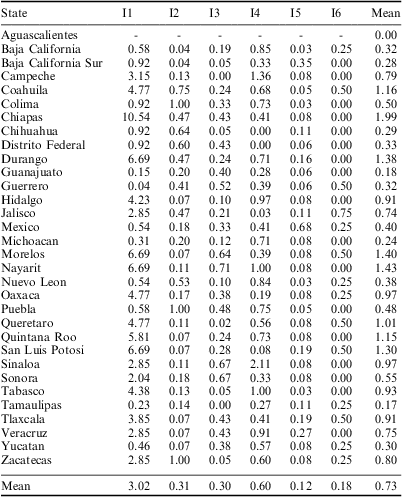
In Mexico, this formula yields the following dissimilarity scores across all states within each dimension: signature requirement (Indicator 1) = 3.02, or 302 per cent dissimilarity; spatial distribution (I2) = 31 per cent; length of formation process (I3) = 30 per cent; funding (I4) = 60 per cent; electoral system (I5) = 12 per cent; and maintenance requirement (I6) = 18 per cent (see Table 2). Averaging these measures yields the system-wide measure of dissimilarity: 73 per cent. That is, overall the electoral laws governing the emergence of new parties in the Mexican states are 73 per cent dissimilar from the national standard. Put simply, the federalized electoral laws are incongruent.
Dissimilarity Values
Note: I1 = signature requirement; I2 = spatial distribution; I3 = length of formation process (days); I4 = funding; I5 = electoral rules; I6 = maintenance requirement
Putting It All Together: Tools For Future Analysis
Analyses of politics in multilevel contexts have been hampered, as outlined above, by inadequate conceptual tools. In closing, let us therefore illustrate the value added by our measures for this literature. While the measures we propose are potentially relevant for many different areas of subnational comparative research, we illustrate the usefulness of our measure on the basis of the emerging literature on subnational undemocratic regimes (SURs). This is one of the most dynamic areas in the literature on new democracies and it exemplifies many of the challenges for research in multilevel settings.
Key questions in this literature examine how subnational undemocratic regimes are able to isolate themselves from national democratization and to maintain regimes that are juxtaposed to national regimes. To answer these questions, researchers have sought to identify the strategies employed by local elites to defend their position and, more specifically, the governors’ bases of power. There has been an implicit assumption that subnational undemocratic regimes within one country – but also across countries – are sustained by similar factors, and research has generally assumed unit homogeneity across subnational undemocratic regimes (Giraudy Reference Giraudy2012). However, in light of the large variety of authoritarianisms identified by the national-level literature on regime types (for example, Geddes Reference Geddes1999), this is likely to be an overly simple and ultimately untenable assumption. Just like their national counterparts, ‘subnational regimes can be differentiated in terms of the power bases of incumbents’ (Giraudy Reference Giraudy2012: 25). Indeed, extant literature on subnational undemocratic regimes emphasizes at least two different mechanisms through which subnational elites safeguard their position. Notably, these are from different ends of the formal–informal continuum. For one, elites have been found to use institutional engineering, specifically the design of subnational electoral institutions, to limit contestation and to discriminate against political rivals.Footnote 5 Second, clientelistic networks and regional political machines have been identified as important mechanisms sustaining subnational undemocratic regimes.Footnote 6 Yet, while the literature, which has drawn heavily on within-country comparisons and case studies, has found evidence for both types of strategies, not all subnational undemocratic regimes necessarily draw on them to the same degree. In fact, while studies of subnational undemocratic regimes in Mexico and Argentina tend to emphasize institutional engineering, the literature on Brazil focuses on clientelism. A closer look at the authority of governors in these three countries reveals that governors in Brazil do not control subnational electoral institutions. Formation rules are uniform across Brazil or, in our terms, there is no institutional incongruence with regard to party formation. All states are subject to the same national-level institutional framework. Thus, ‘the survival of less-than-democratic enclaves in Brazil has depended on contingent, informal, and unstable strategies designed to construct and maintain political monopolies that maximize the electoral returns of clientelism’ (Borges Reference Borges2011). There are, therefore, important differences in the power bases of subnational incumbents among Latin America's federations. Our dissimilarity measure taps into this by indicating not only whether provincial governments have the authority to manipulate local institutions, but also whether they use this authority in practice.
This does not mean, however, that all subnational undemocratic regimes in Argentina and Mexico are sustained by institutional engineering. In addition to inter-country differences, there are likely important differences within countries. While our dissimilarity measure captures institutional variation at the country level, in this case indicating that institutions in Brazil – contrary to Mexico and Argentina – are perfectly congruent, the barrier index indicates per state the degree to which specific provincial governments have drawn on this authority. Thus, the barrier index can be useful for identifying different types of subnational undemocratic regimes. For instance, Giraudy (Reference Giraudy2010) identifies Oaxaca, Puebla, Tabasco and Baja California, among others, as undemocratic. Yet, while the former two score low on the barrier index, thus indicating that the party system is relatively open to new contenders, the latter two have closed systems. This contrast provides a useful starting point for identifying different types of subnational undemocratic regimes. In undemocratic states with open systems, governors may not draw primarily on institutional engineering to limit contestation. Instead, they may survive through the control of particularistic benefits, thus indicating a more ‘Brazilian style’ of subnational undemocratic regime.
In sum, our measures can contribute to the literature on subnational undemocratic regimes by enabling more systematic measurement of formal institutions. The dissimilarity measure can shed light on the overall opportunity structure for subnational undemocratic regimes by highlighting important differences between national contexts. The differences between Brazil, for instance, and Argentina and Mexico may help answer the question of why subnational undemocratic regimes appear to be more common in some countries than in others. The barrier index can contribute to identifying different types of subnational undemocratic regimes, based on the strategy used by incumbents to safeguard their position. Developing a better understanding of different types of subnational undemocratic regimes is crucial to advance theories of subnational democratization. Different types of subnational undemocratic regimes are likely to be vulnerable to distinct challenges, which highlights why changes in the national environment are likely to threaten some subnational undemocratic regimes without necessarily affecting others. Both measures proposed in this article can be used as variables in comparative analyses. For example, statistical analyses could employ the barrier index as a dependent variable to explain variation in institutional design across territorial units. More generally, the measurement strategy employed above can be applied to capture cross-unit and cross-level variation of any formal institution. Overall, better conceptualization and measurement of institutional variation in multilevel settings promise to advance our understanding of democratic institutions beyond the nation state.
Acknowledgement
Previous versions of this article were presented at meetings of the American Political Science Association (2010), the Midwest Political Science Association (2011) and the European Consortium for Political Research (2011). For valuable comments, we thank panel participants, including Vasabjit Banerjee, Caroline Beer, Joerg Faust, Steve Wuhs and Adam Ziegfeld, as well as the journal's reviewers. All remaining errors are our own.