Introduction
One of the greatest barriers to the production and free commercialization of fresh fruits in the world is the presence of insect pests such as fruit flies (Diptera: Tephritidae) (Badii et al., Reference Badii, Billah, Afreh-Nuamah, Obeng-Ofori and Nyarko2015; Ekesi et al., Reference Ekesi, De Meyer, Mohamed, Virgilio and Borgemeister2016). The females cause damage even without ovipositing inside the fruit, that make tasting punctures which allow the larvae to feed on the fruit pulp, resulting in a decrease in the commercial value (Nunes et al., Reference Nunes, Boff, Santos, Franco, Wille, Rosa and Amarante2015). Braconids are considered the most effective natural enemies of fruit flies (Silva et al., Reference Silva, Bento and Zucchi2007). This family includes species such as Doryctobracon areolatus (Szépligeti), Diachasmimorpha longicaudata (Ashmead) and Fopius arisanus (Sonan). Several species of Figitidae are also reported as parasitoids of Tephritidae larvae, being natural controllers of these pests (Costa et al., Reference Costa, Silva, Marchiori, Amaral, Poletti and Torres2007), such as Dicerataspis flavipes (Kieffer), Aganaspis nordlanderi Wharton and Aganaspis pelleranoi (Brèthes) (Guimarães et al., Reference Guimarães, Zucchi, Diaz, Souza Filho and Uchôa1999).
Parasitoid search efficiency is important for successful biological control using parasitoids (Lewis and Martin, Reference Lewis and Martin1990). Plant volatiles are cues used by parasitoids to locate the host and its habitat (Vinson, Reference Vinson1976; Belda and Riudavets, Reference Belda and Riudavets2010, Benelli et al., Reference Benelli, Revadi, Carpita, Giunti and Raspi2013; Canale et al., Reference Canale, Geri and Benelli2014). Parasitoids, including Braconidae species, are usually responsive to herbivory-induced plant volatiles (Khan et al., Reference Khan, James, Midega and Pickett2008) that are activated by the defence genes responsible for producing secondary metabolic compounds such as alcohols, aldehydes, terpenoids, green leaf volatiles and aromatic compounds (Dicke, Reference Dicke2009).
D. longicaudata females prefer fruit infested by different species of fruit flies than uninfested ones (Carrasco et al., Reference Carrasco, Montoya, Cruz-Lopes and Rojas2005; Stuhl et al., Reference Stuhl, Sivinski, Teal, Paranhos and Aluja2011; Segura et al., Reference Segura, Viscarret, Ovruski and Cladera2012, Reference Segura, Nussenbaum, Viscarret, Devescovi, Bachmann, Corley, Ovruski and Cladera2016; Harbi et al., Reference Harbi, Pedro, Ferrara, Tormos, Chermiti, Beitia and Sabater-Munoz2019). Diachasmimorpha kraussii (Fullaway) (Hymenoptera: Braconidae), another parasitoid of fruit flies, responds to infested fruits but its response depends on the fruit fly that infest the fruit (Masry et al., Reference Masry, Clarke and Cunningham2018). Interestingly, the response was lower when the fruit was infested by its non-host Drosophila melanogaster (Meigen) (Diptera: Drosophilidae). Guimarães and Zucchi (Reference Guimarães and Zucchi2004) reported that A. pelleranoi initially uses fruit volatiles to locate oviposition sites and uses vibrotaxis to find the host.
Experience can affect the parasitoid's search process, as learning can decrease the time it takes to locate its host (Matthews and Matthews, Reference Matthews and Matthews2010). Learning can occur during the immature stage (preimaginal conditioning) and manifest in the imago (Corbet, Reference Corbet1985; Turlings et al., Reference Turlings, Wackers, Vet, Lewis, Tumlinson, Papaj and Lewis1993) or in the adult stage (Storeck et al., Reference Storeck, Poppy, Van Emden and Powell2000). Hyssopus pallidus (Askew) (Hymenoptera: Eulophidae) conditioned to apple juice extract during the preimaginal period became more attracted to this fruit in the adult phase than those that were unexperienced (Gandolfi et al., Reference Gandolfi, Mattiacci and Dorn2003). D. longicaudata females reared on Anastrepha fraterculus (Wiedemann) (Diptera: Tephritidae) larvae in mango (Mangifera indica L.) distinguished the volatiles of this fruit, unlike those from guava and artificial diet (Zadra et al., Reference Zadra, Sant'Ana, Redaelli and Tognon2018).
The South American fruit fly, A. fraterculus, is the most economically important species of the genus in Brazil (Malavasi, Reference Malavasi, Malavasi and Zucchi2000) and has been observed in native fruits such as Psidium guajava and Eugenia uniflora (Zucchi, Reference Zucchi, Malavasi and Zucchi2000) and other fruits such as peach (Prunus persica L.) (Nava and Botton, Reference Nava and Botton2010), grapes (Vitis vinifera L.) (Zart et al., Reference Zart, Fernandes and Botton2009), apple (Malus domestica Borkh) (Santos et al., Reference Santos, Redaelli, Sant'Ana and Hickel2015) and citrus (Ourique et al., Reference Ourique, Redaelli, Efrom and Pedrini2018). D. longicaudata, an Asian braconid, and A. pelleranoi, a Neotropical figitid, are two biological control agents for A. fraterculus. Although these parasitoids share hosts, they exhibit different foraging behaviour. A. pelleranoi often parasitizes larvae in fallen fruits (Ovruski et al., Reference Ovruski, Schliserman and Aluja2004) and is constantly found in Myrtaceae (Guimarães et al., Reference Guimarães, Zucchi, Diaz, Souza Filho and Uchôa1999, Reference Guimarães, Gallardo, Diaz and Zucchi2003), while D. longicaudata can parasitize larvae in fruits still on the plant (Sivinski and Aluja, Reference Sivinski and Aluja2003; Harbi et al., Reference Harbi, Beitia, Ferrara, Chermiti and Sabater-Muñoz2018), in native species such as guava (Silva et al., Reference Silva, Bento and Zucchi2007) and Brazilian cherry (Meirelles et al., Reference Meirelles, Redaelli, Jahnke, Ourique and Ozorio2016), as well as exotic species such as peach and persimmon (Diospyros kaki L.) (Meirelles et al., Reference Meirelles, Redaelli, Jahnke, Ourique and Ozorio2016).
The searching behaviour of parasitoids of fruit flies is affected by the host fruit of the fruit fly. Understanding how this occurs in two species of parasitoids, one exotic and the other native, can help in the use of these organisms in biological control programmes of fruit flies. Therefore, this study aimed to evaluate the chemotaxis and parasitism of A. pelleranoi and D. longicaudata from A. fraterculus larvae kept on artificial diet, guava or apple, in order to verify its preimaginal learning to fruit volatiles.
Materials and methods
The rearing and maintenance of the insects, as well as the bioassays, were performed in environmental chambers (25 ± 2°C, 70 ± 10% RH, 14 h photophase).
Anastrepha fraterculus rearing
Rearing of flies was based on the methodology proposed by Terán (Reference Terán1977), with certain adaptations. The adults were kept in wooden cages (45 × 30 × 30 cm), with front sleeve openings and covered with voile fabric on the sides. The insects received distilled water and food containing crystal sugar, brewer's yeast, soy extract (3:1:1) and vitamin complex (Centrum Select®), in the proportion of one macerated tablet for each 250 g diet, available in Petri dishes (9 × 1.5 cm) and changed once a week.
As oviposition substrate, a blue voile tissue pouch covered with a silicone layer (30 × 30 cm), was used according to the methodology described by Meirelles et al. (Reference Meirelles, Redaelli, Jahnke, Ourique and Ozorio2016). The eggs were removed daily and placed on blue voile (3 cm2) inside Petri dishes (9 × 2 cm) that contained bottom moistened filter paper, then conditioned for 48 h. After this period, these eggs were placed on an artificial diet consisting of peeled raw carrot (125 g), boiled carrot (125 g), brewer's yeast (25 g), cornmeal (150 g), sugar (125 g), distilled water (175 ml), nipagin (1.1 g), citric acid (3.6 g) and sodium benzoate (1.1 g) arranged in Styrofoam trays (18 × 24 × 2 cm). The egg trays were covered with another tray, wrapped in a newspaper sheet and placed in an environmental chamber (25 ± 2°C, 70 ± 10% RH) in a scotophase for 7 days. After this period, the trays were placed on sand in a large plastic container (51 × 30 × 20 cm) for pupation. The pupae remained in plastic pots (100 ml) with the lid opening (2 × 2 cm) protected with voile and contained sterile sand at the bottom, where they stayed for about 10 days.
Diachasmimorpha longicaudata and Aganaspis pelleranoi rearing
Adult parasitoids were kept in wooden cages (27 × 25 × 30 cm), covered with voile on the sides. They received water in plastic pots (100 ml) with perforated lid, containing strips of Spontex Resist® fabric. Their gelatinous diet [water (120 ml), honey (120 ml), agar (0.8 g), ascorbic acid (0.05 g) and nipagin (0.005 g)] was placed in Petri dishes (9 × 2 cm) and replaced weekly (Meirelles et al., Reference Meirelles, Redaelli, Jahnke, Ourique and Ozorio2016). Third instar A. fraterculus larvae (approximately 10 days old) reared on an artificial diet were exposed for 60 min in oviposition units made of a plastic plate (4 cm of diameter and 0.3 deep), wrapped in white voile as described by Altafini et al. (Reference Altafini, Redaelli and Jahnke2013). After this period, the larvae were placed in sand filled Gerbox®, with a voile-protected opening (9 × 9 cm) in the lid, where they remained until fly or parasitoid emergence.
Fruit infestation
Guavas (cv. Paluma) and apples (cv. Red delicious) were used to rear the host larvae. These fruits were sanitized with sodium hypochlorite (0.5%) for approximately 30 min. For artificial infestation, four perforations were made in the skin of the fruit and part of the pulp removed (1 g). In total, 10–15 second instar larvae of A. fraterculus from an artificial diet were placed in each opening, totalling 50 larvae per fruit. The uninfested fruits used in the tests also had their peel cut, but they were not infested. The infested fruits used in the bioassays were infested for 48 h prior to the tests. Artificial infestation with larvae from artificial diet was done to standardize the number and larval age in each fruit.
Preimaginal conditioning of parasitoids
The fruits (guava or apple) infested with second instar A. fraterculus larvae (5 days old) from artificial diet were packed in plastic pots (500 ml), covered with voile tissue containing sterile sand at the bottom, and remained there for approximately 5 days until the larvae reached the third instar. After this period, the larvae were removed (with a soft forceps) from the fruits, exposed to parasitism by D. longicaudata or A. pelleranoi, for 1 h (Altafini et al., Reference Altafini, Redaelli and Jahnke2013) and 4 h (Gonçalves et al., Reference Gonçalves, Nava, Pereira, Lisbôa, Grutzmacher and Valgas2013), respectively. After exposure, larvae were transferred to 100 ml plastic vials with sterilized sand until emergence.
Unexperienced parasitoids were defined as A. fraterculus larvae that developed on artificial diet and never had contact with fruit odours. Parasitoids (male and female) from larvae that developed on the three types of food were separated shortly after emergence. Groups containing ten paired females were kept in wooden cages (19.5 × 16.5 × 25.5 cm) and received capillary water and honey diluted in water (7:3), offered in Petri dishes (9 × 1.5 cm) with cotton wicks. It was tested the responses of 4-6-day-old females. Thus, we evaluate the responses of D. longicaudata preimaginal conditioned on artificial diet (Dl-art), on guava (Dl-G) and on apple (Dl-A), as well as, A. pelleranoi (Ap-art, Ap-G and Ap-A).
Olfactometry
The bioassays were conducted in a climatized room (25 ± 1°C, 70 ± 10% RH) during the photophase under fluorescent light (60 W, 290 lux). The tests were performed in a two-choice glass olfactometer (Y) for both D. longicaudata (6.5 cm diameter, 21 cm initial arena, bifurcated into 10 cm arms) and A. pelleranoi (1 cm diameter, 12 cm initial arena, bifurcated into 5 cm arms). These were coupled to a glass chamber (29.5 cm height × 12.5 cm diameter). An airflow, previously filtered with activated charcoal, was blown into the system with an air pump connected to a flowmeter and humidifier at a rate of 0.6 and 0.3 litres/min for D. longicaudata and A. pelleranoi, respectively. The olfactometer was inverted horizontally (180° rotation) every five repetitions and every ten repetitions it was washed with mild soap, ethyl alcohol and distilled water and dried in a sterilization oven at 150°C. Prior to the start of the experiments, the females were individualized, acclimatized for 30 min in the test room and individually placed in the arena.
The chemotaxis of D. longicaudata and A. pelleranoi females from larvae reared on either artificial diet, guava or apple were evaluated. The comparisons included uninfested apple vs. air; uninfested guava vs. air; apple infested vs. uninfested apple; uninfested guava vs. uninfested apple; infested guava vs. infested apple and infested guava vs. uninfested guava. The larvae were maintained in the fruits during the experiments.
Positive response (first choice) was recorded when the insect remained for at least 30 s at the end of one arm and not responsive was recorded when the insect did not move or did not reach one of the two arms of the olfactometer within 5 min. At least 40 repetitions were performed for each comparison.
Parasitism
Parasitism tests were performed on different days for each species of parasitoids. D. longicaudata and A. pelleranoi females (4–6 days old) from larvae reared on artificial diet, guava or apple (preimaginal conditioning) were individually exposed in a cylindrical plastic arena (29 × 12 cm) and given it the choice between three parasitism units, which were previously brushed with fresh apple pulp, guava pulp or with distilled water only (control). Exposure time was 1 h for D. longicaudata (Altafini et al., Reference Altafini, Redaelli and Jahnke2013) and 4 h for A. pelleranoi (Gonçalves et al., Reference Gonçalves, Nava, Pereira, Lisbôa, Grutzmacher and Valgas2013). Brushed voile fabric was compared with fresh apple or guava pulp, as well as voile fabric brushed with distilled water only (control). After exposure, the larvae were placed in 50 ml plastic pots containing sand and kept in a climate chamber until the emergence of parasitoids or flies was observed. Pupae in which no emergence was observed were dissected and counted. We observed response of each female of D. longicaudata (n = 40) and A. pelleranoi (n = 40) exposed, simultaneously, to three parasitism units, each one with ten third instar of A. fraterculus larvae.
We recorded the number of pupae formed, emerged parasitoids, parasitized pupae (emerged parasitoids from the puparia + dissected puparia with parasitoids presence) and emerged fruit fly.
Statistical analysis
The experimental design for all bioassays was completely randomized. For each two-choice assays, females' preference for infested or uninfested fruit (apple or guava) odours was analysed using a χ2 test with Yates correction. The other analyses were performed using generalized linear models (GLMs) in statistical software R 4.0.0 (R Development Core Team, Reference R Development Core Team2020). For the olfactometer bioassays, the frequency of the parasitoid choice for each arm was considered as a binomial response variable, and GLMs with a binomial error structure and logit link function were constructed. These data were analysed in a factorial scheme of two parasitoids (D. longicaudata and A. pelleranoi) by three types of diets (artificial diet, guava and apple) used in preimaginal condition, explanatory variables, to assess if the diet preference was affected by the type of food conditioning and parasitoid species. Parasitism data were assessed for normality (Shapiro and Wilk, Reference Shapiro and Wilk1965) and homogeneity of variance (Fligner and Killeen, Reference Fligner and Killeen1976). Also, descriptive analysis (density plot and qqplot) were performed (Ggplot2 package). The Gaussian distribution was used for emerged fruit fly (Dl-A, Ap-art and Ap-A) and parasitized pupae (Ap-art and Ap-A) variables; and the Poisson distribution was used for emerged fruit fly (Ap-G), emerged parasitoid (Dl-art), pupae (Dl-art, Dl-A, Dl-G, Ap-art, Ap-A and Ap-G) and parasitized pupae (Dl-art and Ap-G) variables. For the other data, zero-inflated Poisson regression was used (Lambert, Reference Lambert1992). Outliers were removed when necessary. Post-hoc tests were performed for pairwise comparisons of least-square means using the compact letter display (CLD) function (Multcompview package) and Tukey adjust (Tukey HSD test, α = 0.05%) (Piepho, Reference Piepho2004).
Results
Olfactometry
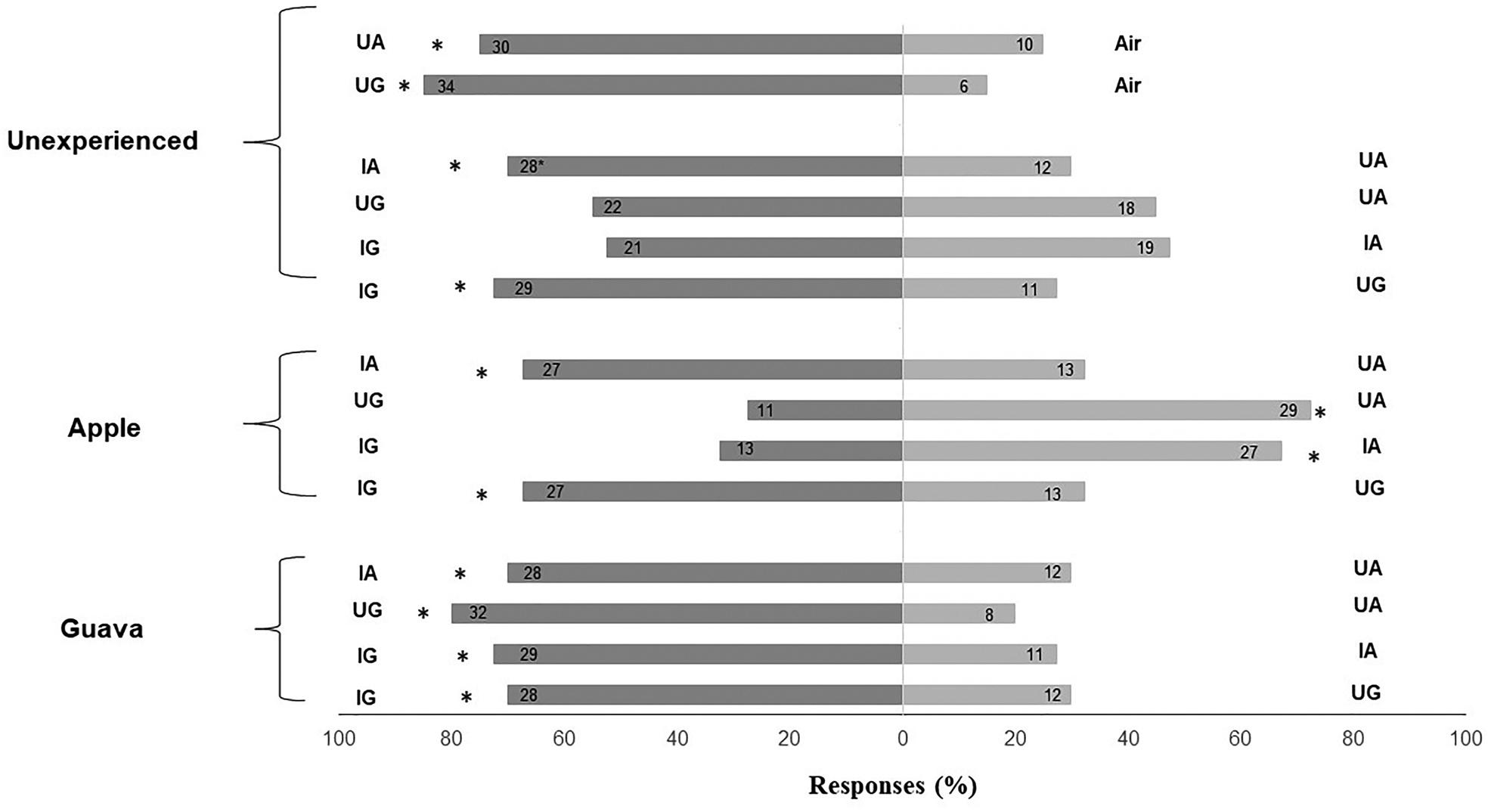
Unexperienced D. longicaudata (Dl-art) females went to uninfested guava or apple volatiles when contrasted with air (P < 0.05) (fig. 1). D. longicaudata females reared on artificial diet did not differ between the volatiles of infested guava and apple (χ2 = 0.200; df = 1; P = 0.8231) and between the odours of the same fruits uninfested (χ2 = 0.800; df = 1; P = 0.5023) (fig. 1). However, when the females were exposed to the volatiles of fruits infested (guava: χ2 = 16.2; df = 1; P < 0.0001 or apple: χ2 = 12.8; df = 1; P = 0.0008) with A. fraterculus larvae, they preferred the volatiles emitted by the fruits containing the larvae to those of non-infested fruits.
Chemotaxis responses of D. longicaudata females from A. fraterculus larvae reared on artificial diet (Dl-art) (inexperienced), apple (Dl-A) or guava (Dl-G), tested in double-choice olfactometer subjected to uninfested apple (UA) or guava volatiles (UG) in contrast with air, apple (IA and UA) or guava volatiles (IG and UG) (infested or uninfested). Numbers on the bars represent the responsive insects. Bars followed by asterisks differ significantly (χ2; P < 0.05).

D. longicaudata females from fly larvae reared in apple (Dl-A) were more attracted to apple than guava volatiles, regardless of the guava was infested (χ2 = 9.8; df = 1; P = 0.0037) or uninfested (χ2 = 16.2; df = 1; P = 0.0001) (fig. 1). When the assays contrasted odours from infested vs. uninfested apples (χ2 = 9.8; df = 1; P = 0.0037) or infested vs. uninfested guavas (χ2 = 9.8; df = 1; P = 0. 0037), a greater attraction to infested fruits was observed (fig. 1).
The same behaviour was observed in female parasitoids from fly larvae reared in guava (Dl-G) (fig. 1), which were more attracted to guavas than infested apples (χ2 = 16.20; df = 1; P = 0.001) or uninfested apples (χ2 = 28.80; df = 1; P < 0.001). When fruits of the same species were exposed, females preferred infested guava (χ2 = 12.80; df = 1; P < 0.001) and apple (χ2 = 12.80; df = 1; P < 0.001) (fig. 1).
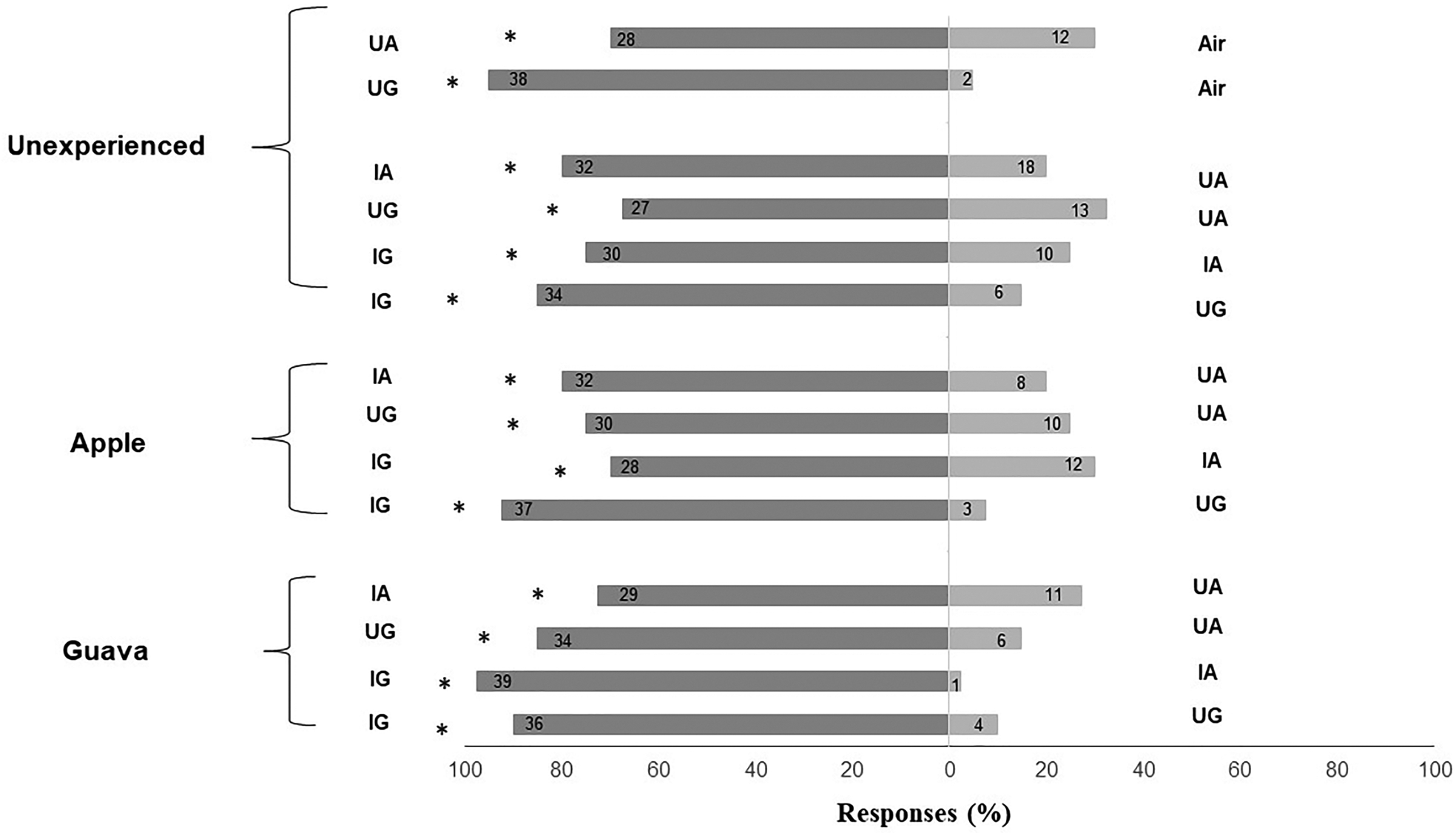
Unexperienced A. pelleranoi females reared on artificial diet (Ap-art) were more attracted to the apple and guava volatiles when contrasted with air (P < 0.050) (fig. 2). A. pelleranoi females from artificial diet responded more to volatiles of guava than volatiles of apples (χ2 = 20.00; df = 1; P < 0.001) and uninfested apples (χ2 = 9.80; df = 1; P = 0.037) (fig. 2). When volatiles of infested or uninfested guava (χ2 = 39.20; df = 1; P < 0.001) or apples (χ2 = 28.80; df = 1; P < 0.001) were compared, more A. pelleranoi responded to the infested fruit (fig. 2).
Chemotaxis responses of A. pelleranoi females from A. fraterculus larvae reared on artificial diet (Ap-art) (inexperienced), apple (Ap-A) or guava (Ap-G), tested in double-choice olfactometer subjected to uninfested apple (UA) or guava volatiles (UG) in contrasts with air, apple (IA and UA) or guava volatiles (IG and UG) (infested or uninfested). Numbers on the bars represent the responsive insects. Bars followed by asterisks differ significantly (χ2; P < 0.05).

A. pelleranoi individuals from larvae maintained on apples (Ap-A) did not change their behaviour, that is, they continued to prefer guava volatiles, both infested (χ2 = 12.80; df = 1; P < 0.001) and uninfested (χ2 = 45.00; df = 1; P < 0.001) (fig. 2). When comparing the A. pelleranoi female's attraction to infested fruits vs. non-infested ones regardless of the fruit (guava: χ2 = 20.00; df = 1; P < 0.001 or apple: χ2 = 28.80; df = 1; P < 0.001), we found that the females preferred those that contained the host's larvae.
When A. pelleranoi developed in fly larvae reared in guava (Ap-G), they preferred both infested (χ2 = 39.20; df = 1; P < 0.001) and uninfested guava (χ2 = 72.20; df = 1; P < 0.001) over apple (fig. 2). However, when subjected to odours of the same species, females preferred infested guava (χ2 = 16.20; df = 1; P < 0.001) and infested apple fruits (χ2 = 51.20; df = 1; P < 0.001) (fig. 2).
For the contrast, infested apple vs. uninfested apple there was no interaction between parasitoid species and diets used in preimaginal condition (GLM: χ2 = 0.62; df = 2; P = 0.7336). Also, there was no difference between the probability of choosing infested apple between the parasitoid species (GLM: χ2 = 2.22; df = 1; P = 0.1364), and this probability, regardless of the parasitoid species, was not altered by pre-imaginal conditioning (GLM: χ2 = 0.36; df = 2; P = 0.8352) (table 1). For infested guava vs. uninfested guava, there was no interaction between parasitoid species and diets used in preimaginal condition (GLM: χ2 = 1.37; df = 2; P = 0.5031). However, the probability of A. pelleranoi females choosing the infested guava fruits was higher than D. longicaudata (GLM: χ2 = 14.42; df = 1; P < 0.001), and this probability was not altered by pre-imaginal conditioning (GLM: χ2 = 0.39; df = 2; P = 0.8317) (table 1).
Effect of the type of pre-imaginal conditioning (artificial diet, apple and guava), the species of parasitoid (D. longicaudata and A. pelleranoi) and the interaction of these two factors in the preference of females to the volatiles of infested or uninfested fruits

IA, infested apple; UA, uninfested apple; IG, infested guava; UG, uninfested guava.
* Means followed by asterisks are significantly different in line (GLM, P < 0.05).
For the contrast, infested apple vs. infested guava there was no interaction between parasitoid species and diets used in preimaginal condition (GLM: χ2 = 2.73; df = 2; P = 0.2560). However, when evaluating the probability of choosing infested guava fruits between species (GLM: χ2 = 26.09; df = 2; P < 0.0001), it was observed that A. pelleranoi had more than 86% chance of choosing these fruits while for D. longicaudata this percentage was 53%, and that the type of conditioning has an influence on the choice of parasitoid (GLM: χ2 = 25.98; df = 2; P < 0.001) (table 1).
For the contrast uninfested apple vs. uninfested guava there was an interaction between the type of conditioning and the species of parasitoid (GLM: χ2 = 6.90; df = 2; P = 0.0318), that is, both the species parasitoid and imaginal conditioning has an influence on the choice of parasitoid. A. pelleranoi females have a 77% probability of choosing uninfested guava fruits and this percentage increases to 83% probability if females are previously conditioned to guava odours.
Parasitism
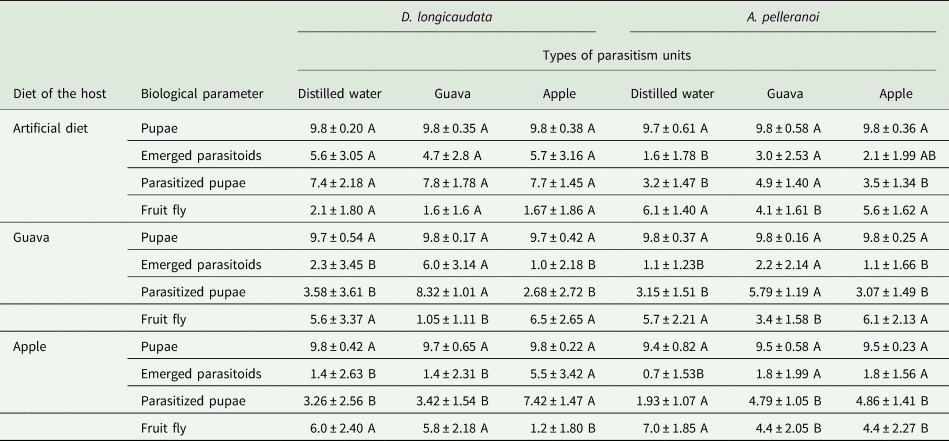
For D. longicaudata, the number of parasitized pupae and emerged parasitoids from larvae reared on artificial diet was similar among parasitism units brushed with water, apple pulp or guava (GLM: χ2 = 0.0635; df = 2; P = 0.9382) and (GLM: χ2 = 1.3464; df = 2; P = 0.2632), respectively (table 2). However, the number of parasitized pupae was always greater in units that contained the pulp in which the original host had developed, guava (GLM: χ2 = 7.0133; df = 2; P = 0.03) and apple (GLM: χ2 = 8.5304; df = 2; P = 0.0141). For A. pelleranoi females from A. fraterculus larvae that had developed on artificial diet, the number of parasitized pupae was higher only in guava-pulp-brushed units, compared to those with distilled water (GLM: χ2 = 11.9050; df = 2; P = 0.0026). In those from guava-fed larvae, the number of parasitoids was higher in the units brushed with guava pulp (GLM: χ2 = 11.8490; df = 2; P = 0.0027). When the source host was kept on apple, the emergence was higher in the units that contained either pulp, compared with water (GLM: χ2 = 6.6153; df = 2; P = 0.0366) (table 2).
Mean number (±SE) of D. longicaudata and A. pelleranoi emerged from A. fraterculus reared in three different diets and type of parasitism unit (n = 400, 10/larvae per unit) (brushed with distilled water, guava or apple pulp) (25 ± 2°C, 60 ± 10% RH)

Means followed by different letters within rows, in the same insect species, are significantly different (GLM, P < 0.05).
Discussion
Unexperienced D. longicaudata females did not differentiate apple volatiles from guava. The average number of pupae parasitized did not differ between units brushed with water, guava or apple pulp. In chemotaxis bioassays, unexperienced A. pelleranoi chose guava odours over apple odours; however, in parasitism assays they exhibited no preference between the parasitism units. The number of pupae formed was expected, considering that both species are koinobionts (Ovruski et al., Reference Ovruski, Aluja, Sivinski and Wharton2000; Cancino et al., Reference Cancino, Liedo, Ruiz, López, Montoya and Barrera2012), causing no immediate damage to the host.
The lack of significant response by unexperienced D. longicaudata to these fruit odours may be due to its generalist search behaviour, attaching larvae of several species of Anastrepha, Bactrocera and Ceratitis in different hosts (Leyva et al., Reference Leyva, Browning and Gilstrap1991; Alvarenga et al., Reference Alvarenga, Brito, Lopes, Silva, Alves, Matrangolo and Zucchi2005; Ovruski et al., Reference Ovruski, Wharton, Rull and Guillén2007). On the contrary, A. pelleranoi is mainly referred to as a parasitoid of Anastrepha species larvae (Guimarães et al., Reference Guimarães, Zucchi, Diaz, Souza Filho and Uchôa1999; Sivinski et al., Reference Sivinski, Pinero and Aluja2000; Costa et al., Reference Costa, Silva, Marchiori, Amaral, Poletti and Torres2007). In addition, it is often found in Myrtaceae, parasitizing tephritid larvae, suggesting, unlike D. longicaudata, a more direct association between A. pelleranoi and this plant family (Garcia and Corseuil, Reference Garcia and Corseuil2004).
Contrary to our results, other studies have observed that unexperienced D. longicaudata distinguish volatiles from different fruits. It was more responsive to fermented orange odours than fermented peach and mango (Leyva et al., Reference Leyva, Browning and Gilstrap1991). Its preference to fig volatiles over peach orange and apple volatiles was also observed by Segura et al. (Reference Segura, Nussenbaum, Viscarret, Devescovi, Bachmann, Corley, Ovruski and Cladera2016). Similarly, D. longicaudata was more responsive to mango volatiles than guava volatiles (Zadra et al., Reference Zadra, Sant'Ana, Redaelli and Tognon2018). The fruits evaluated in our study originate from Central America to southern Mexico (guava) (Morton, Reference Morton and Dowling1987) and central Asia (apple) (Juniper et al., Reference Juniper, Watkins and Harris1999), which are very far from the Indo-Australian origin of D. longicaudata (Stuhl et al., Reference Stuhl, Sivinski, Teal and Aluja2012). The absence of a direct relationship between the origin of the fruits and D. longicaudata could partly explain its similar responses to odours. Plants and animals from the same region can coevolve to increase their chances of survival (Del-Claro, Reference Del-Claro, Del-Claro and Torezan-Silingardi HM2012).
The preference for infested fruits exhibited by both parasitoid species may be related to the release of volatiles in response to phytophagous attacks (Turlings and Wackers, Reference Turlings and Wackers2004), which may serve as foraging clues for herbivores and natural enemies (Wäschke et al., Reference Wäschke, Meiners, Rostás, Wajnberg and Colazza2013). During the evolutionary process with insects, plants have developed a wide range of defence mechanisms to counter herbivore attacks. These mechanisms are categorized as constitutive (preformed) and induced. Both constitutive and induced defences may have direct or indirect action (Karban and Chen, Reference Karban and Chen2007). Indirect defences are defined by Dicke and Baldwin (Reference Dicke and Baldwin2010) as a set of characteristics that increase the efficiency of natural insect enemies, such as the emission of volatiles induced by herbivorous attack. In some species, producing larger volumes of floral nectar is a strategy to attract more parasitoids and predators (War et al., Reference War, Paulraj, Ahmad, Buhroo, Hussainm, Ignacimuthu and Sharma2012). However, most strategies are based on the emission of volatile compounds produced by a plant's secondary metabolism (Yuan et al., Reference Yuan, Kollner, Wiggins, Grant, Degenhardt and Chen2008; War et al., Reference War, Paulraj, Ahmad, Buhroo, Hussainm, Ignacimuthu and Sharma2012).
In this study, both D. longicaudata and A. pelleranoi were more attracted to the volatile of fly-infested fruits, indicating that the chemical profile of the host fruit might have changed, possibly signalling to the parasitoid the presence of fly larvae. Eben et al. (Reference Eben, Benrey, Sivinski and Aluja2000) obtained similar results, i.e., D. longicaudata preferred mango and grapefruit (Citrus paradisi Macfaden) volatiles infested by Anastrepha ludens (Loew) larvae over uninfested ones. The chromatographic analysis of mangoes showed qualitative and quantitative differences in compounds released by A. ludens-infested fruits in relation to uninfested and mechanically damaged fruits (Carrasco et al., Reference Carrasco, Montoya, Cruz-Lopes and Rojas2005). In addition, they found that infested mangoes were more attractive to D. longicaudata compared to other treatments. According to those authors, the different response is probably related to the presence of 2-phenylethyl, a substance present only in the infested mango. D. longicaudata female's attraction to infested fruits were also observed by Segura et al. (Reference Segura, Viscarret, Ovruski and Cladera2012) in oranges with C. capitata larvae compared to uninfested ones. Masry et al. (Reference Masry, Clarke and Cunningham2018) found that D. kraussii (Fullaway) preferred volatiles from nectarines (P. persica var. Nucipersica L.) infested with Bactrocera tryoni larvae over uninfested ones. The attraction of A. pelleranoi to guavas infested with A. fraterculus and C. capitata larvae was also reported by Guimarães and Zucchi (Reference Guimarães and Zucchi2004).
Our study showed that A. pelleranoi did not change its behaviour (chemotaxis and parasitism) in response to its host's diet, preferring guava odours over those from apple. For Bernays (Reference Bernays2001), the less plasticity in specialist insects can be partially explained by their greater sensitivity to the volatiles of their hosts. On the contrary, the host food substrate influenced the chemotaxis choice of D. longicaudata females and resulted in a higher number of parasitized pupae in units that contained the pulp in which the original host had been raised. A similar result was seen by Zadra et al. (Reference Zadra, Sant'Ana, Redaelli and Tognon2018), who found that D. longicaudata parasitism was higher in A. fraterculus larvae that contained the odours to which they had been conditioned (mango or guava).
The results observed for D. longicaudata can be explained through the Chemical Legacy Hypothesis, which postulates that the information obtained in the immature phase can be transmitted to the adult by chemical compounds present in the larval development environment (Corbet, Reference Corbet1985), which could be absorbed and stored on the haemolymph of insects or on the outer layer of the pupa. Changes in perception after the experiment may be associated with activation of genes responsible for the synthesis of binding proteins present in insect antennas (Zhöu, Reference Zhöu2010). Parasitoids with a wide range of hosts, including D. longicaudata, might optimize by learning the search behaviour for fruit hosts, thereby increasing their chances of survival.
The way females deal with the chemical complexity of the environment depends on their life history, and a higher degree of parasitoid specialization may influence the search for the host (Wäschke et al., Reference Wäschke, Meiners, Rostás, Wajnberg and Colazza2013). A. pelleranoi probably associates larvae of A. fraterculus with fruits of Myrtaceae, such as guava (Costa et al., Reference Costa, Silva, Marchiori, Amaral, Poletti and Torres2007). This may have influenced the choice of host; thus, a change in behaviour of parasitoids will require the development of more generations of larvae that feed on other fruits.
Understanding how the parasitoid locates the host and the strategies adopted to achieve this goal is important for applied biological control. Learning can be a relevant tool in improving host search, reducing host search time and increasing parasitoid fitness (Dukas and Duan, Reference Dukas and Duan2000). Our results found that A. fraterculus larval feeding influences search behaviour and parasitism of D. longicaudata. Thus, the conditioning of D. longicaudata to volatiles of plants for which the control is intended could help increase the efficiency of this parasitoid in the field.
Acknowledgements
Financial support and scholarships were provided by the Federal Agency for Support and Evaluation of Graduate Education (CAPES) for first author (88882.439605/2019-01) and the National Council of Scientific and Technological Development (CNPq) for the second (process no. 303758/2018-0) and third authors (process no. 306626/2019-5). We thank Dr Fábio Janoni Carvalho, Dra Natalia Alves Leite and MSc Carlos Diego Ribeiro dos Santos for their collaboration on statistical analysis. We also thank the two anonymous reviewers for constructive comments.
Conflict of interest
The authors declare no conflicts of interest.