Del Giudice presents a thoughtful overview, integration, and extension of the now copious literature on what is arguably the most influential developmental hypothesis in modern evolutionary psychology: Children infer environmental risk from cues within their families and adjust their development so that they are well adapted to the reproductive conditions they will face as adults. This is a case of adaptive phenotypic plasticity by conditional development, or adaptive developmental plasticity.
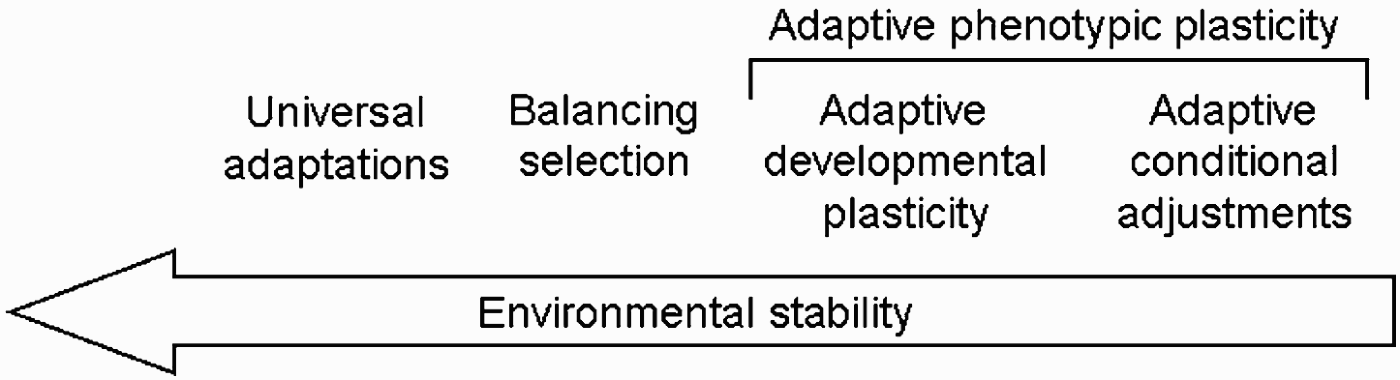
Theoretically, adaptive developmental plasticity is a perfectly plausible form of evolutionary adaptation (Pigullici Reference Pigliucci2005; West-Eberhardt Reference West-Eberhard2003). However, there are at least three other forms that are equally plausible, and they can all be aligned along a dimension of spatiotemporal environmental stability (Fig. 1).
Four forms of evolutionary adaptation. They should be understood as distinguishable points along a continuum, not as distinct categories: Balanced genetic variants can get fixated in the population and thus contribute to evolved adaptations, or they can underlie individual differences in either of the two forms of phenotypic plasticity (Belsky 2005; Pigullici 2005), which themselves only differ in how quickly they react to the environment. Which mechanism governs adaptation depends on the spatiotemporal stability of the adaptively relevant environmental features. Different aspects of complex adaptations like life history strategies can be influenced by different mechanisms.
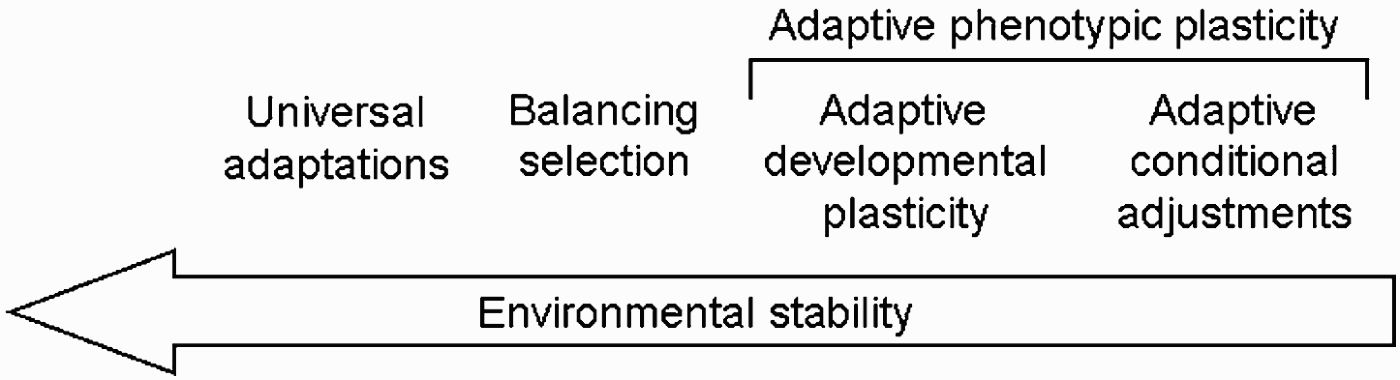
When fitness-relevant environmental features are stable over tens of thousands of years or longer, organisms can evolve universal adaptations that reliably develop every generation (Tooby & Cosmides Reference Tooby, Cosmides and Buss2005). Examples from the domain of human reproductive strategies include the romantic attachment system, which likely evolved in response to the high degree of parental care demanded by human offspring (Fraley et al. Reference Fraley, Brumbaugh and Marks2005), and sex differences in the desire for sexual variety, which are basically adaptive so long as women get pregnant and men do not (Schmitt et al. Reference Schmitt, Alcalay, Allik, Ault, Austers, Bennett, Bianchi, Boholst, Borg Cunen, Braeckman, Brainerd, Caral, Caron, Casullo, Cunningham, Daibo, De Backer, De Souza, Diaz-Loving, Diniz, Durkin, Echegaray, Eremsoy, Euler, Falzon, Fisher, Foley, Fry, Fry, Ghayur, Golden, Grammer, Grimaldi, Halberstadt, Herrera, Hertel, Hoffman, Hradilekova, Hudek-Kene-evi, Jaafar, Jankauskaite, Kabangu-Stahel, Kardum, Khoury, Kwon, Laidra, Laireiter, Lakerveld, Lampart, Lauri, Lavallée, Lee, Leung, Locke, Locke, Luksik, Magaisa, Marcinkeviciene, Mata, Mata, McCarthy, Mills, Moreira, Moreira, Moya, Munyea, Noller, Opre, Panayiotou, Petrovic, Poels, Popper, Poulimenou, P'yatokha, Raymond, Reips, Reneau, Rivera-Aragon, Rowatt, Ruch, Rus, Safir, Salas, Sambataro, Sandnabba, Schulmeyer, Schütz, Scrimali, Shackelford, Shaver, Sichona, Simonetti, Sineshaw, Sookdew, Speelman, Spyrou, Sümer, Sümer, Supekova, Szlendak, Taylor, Timmermans, Tooke, Tsaousis, Tungaraza, Vandermassen, Vanhoomissen, Van Overwalle, Vanwesenbeek, Vasey, Verissimo, Voracek, Wan, Wang, Weiss, Wijaya, Woertment, Youn and Zupanèiè2003b).
When the environment is less stable and tends to fluctuate, balancing selection by environmental heterogeneity can maintain more adaptive genetic variants at higher frequencies in the population (Penke et al. Reference Penke, Denissen and Miller2007b). For example, it has been argued that the phenotypic effects of the seven-repeat allele of the DRD4 polymorphism were more adaptive in societies in which reproductive success is dependent on social competition, whereas the four-repeat allele was likely more advantageous when environmental harshness demanded biparental cooperation (Harpending & Cochran Reference Harpending and Cochran2002). A similar logic might hold for the heritable components of traits related to reproductive strategies (e.g. Schaller & Murray Reference Schaller and Murray2008), including the polymorphisms affecting children's sensitivity to rearing environments in Del Giudice's model (Belsky Reference Belsky, Carter, Ahnert, Grossmann, Hrdy, Lamb, Porges and Sachser2005). However, it will likely not hold for the genetic foundations of the “K-factor,” which is far less plausible from an evolutionary genetic perspective (Penke et al. Reference Penke, Denissen and Miller2007a; Reference Penke, Denissen and Miller2007b).
Even less stable and more heterogeneous environments favor the evolution of adaptive phenotypic plasticity (Hollander Reference Hollander2008), which includes developmental plasticity, as discussed by Del Giudice, and much faster adaptive conditional adjustments of life history strategies to the current environment. Examples of the latter include adjustments of strategic mating decisions to momentarily faced environmental harshness, quality of available mates, or sex ratio and competition on the local mating market (Gangestad & Simpson Reference Gangestad and Simpson2000; Penke et al. Reference Penke, Todd, Lenton, Fasolo, Geher and Miller2007c; Lenton et al., in press). Importantly, romantic attachment styles also show considerable plasticity during adulthood and might even be relationship-specific (Lehnart & Neyer Reference Lehnart and Neyer2006).
These four different forms of adaptation are not mutually exclusive. I agree with Del Giudice that they will likely all contribute to individual differences in reproductive strategies in a probabilistic manner. However, the critical – and ultimately empirical – question is their relative importance. And this is where I find adaptive developmental plasticity hypotheses of reproductive strategies problematic. When the earlier models that predicted pathways from childhood stress to age of menarche in girls to adult reproductive strategy were empirically tested, hardly any evidence could be found (Ellis Reference Ellis2004; Hoier Reference Hoier2003; Neberich et al., in press). These results led some researchers to retract reproductive strategies altogether and to concentrate on the stress–menarche link (Ellis Reference Ellis2004).
Del Giudice's model, on the other hand, attempts to rescue the causal relationship between childhood stress and adult reproductive strategy by relying much more on attachment styles as the mediating factor and introducing some elegant theoretical refinements, including sex differences and children's attachment styles as disposable phenotypes. However, although there is abundant evidence that adult attachment styles relate to the construal and experience of romantic relationships (Birnbaum et al. Reference Birnbaum, Reis, Mikulincer, Gillath and Orpaz2006; Feeney Reference Feeney, Cassidy and Shaver1999), there seems to be surprisingly little evidence that romantic attachment styles actually relate to reproductive strategy-related consequential behavioral outcomes. This is a crucial point, because only consequential behaviors, not subjective experiences, are visible to natural selection and can thus be reasonably explained within an evolutionary framework.
To give an example, sociosexuality shows almost no relationship with attachment styles (Schmitt Reference Schmitt2005a). Strikingly, only restricted sociosexual attitudes, but not sociosexual behaviors, were related to attachment styles in a study by Jackson and Kirkpatrick (Reference Jackson and Kirkpatrick2007), but Penke and Asendorpf (in press) showed that attitudes were the only component of sociosexuality not related to a variety of behavioral outcomes, much like self-reported mate preferences are unrelated to actual mate choices (Todd et al. Reference Todd, Penke, Fasolo and Lenton2007). As another example, attachment styles are not predictive of romantic relationship stability once relationship duration is taken into account (Lehnart & Neyer Reference Lehnart and Neyer2006), and avoidant men and anxious women can have as stable relationships as securely attached people, no matter how satisfied they are with it (Kirkpatrick & Davis Reference Kirkpatrick and Davis1994). Even the sex differences in insecure adult attachment styles, which enjoy a prominent role in Del Giudice's model, are in fact quite modest in size (Schmitt Reference Schmitt2005a; Schmitt et al. Reference Schmitt, Alcalay, Allensworth, Allik, Ault, Austers, Bennett, Bianchi, Boholst, Borg Cunen, Braeckman, Brainerd, Caral, Caron, Casullo, Cunningham, Daibo, De Backer, De Souza, Diaz-Loving, Diniz, Durkin, Echegaray, Eremsoy, Euler, Falzon, Fisher, Fowler, Fry, Fry, Ghayur, Giri, Golden, Grammer, Grimaldi, Halberstadt, Haque, Hefer, Herrera, Hertel, Hitchell, Hoffman, Hradilekova, Hudek-Kene-evi, Huffcutt, Jaafar, Jankauskaite, Kabangu-Stahel, Kardum, Khoury, Kwon, Laidra, Laireiter, Lakerveld, Lampart, Lauri, Lavallée, Lee, Leung, Locke, Locke, Luksik, Magaisa, Marcinkeviciene, Mata, Mata, McCarthy, Mills, Mkhize, Moreira, Moreira, Moya, Munyea, Noller, Olimat, Opre, Panayiotou, Petrovic, Poels, Popper, Poulimenou, P'yatokha, Raymond, Reips, Reneau, Rivera-Aragon, Rowatt, Ruch, Rus, Safir, Salas, Sambataro, Sandnabba, Schleeter, Schulmeyer, Schütz, Scrimali, Shackelford, Sharan, Shaver, Sichona, Simonetti, Sineshaw, Sookdew, Speelman, Sümer, Sümer, Supekova, Szlendak, Taylor, Timmermans, Tooke, Tsaousis, Tungaraza, Turner, Vandermassen, Vanhoomissen, Van Overwalle, Van Wesenbeek, Vasey, Verissimo, Voracek, Wan, Wang, Weiss, Wijaya, Woertment, Youn and Zupanèiè2003a, being much smaller than in other mating-related dispositions (e.g., Schmitt Reference Schmitt2005b; Schmitt et al. Reference Schmitt, Alcalay, Allik, Ault, Austers, Bennett, Bianchi, Boholst, Borg Cunen, Braeckman, Brainerd, Caral, Caron, Casullo, Cunningham, Daibo, De Backer, De Souza, Diaz-Loving, Diniz, Durkin, Echegaray, Eremsoy, Euler, Falzon, Fisher, Foley, Fry, Fry, Ghayur, Golden, Grammer, Grimaldi, Halberstadt, Herrera, Hertel, Hoffman, Hradilekova, Hudek-Kene-evi, Jaafar, Jankauskaite, Kabangu-Stahel, Kardum, Khoury, Kwon, Laidra, Laireiter, Lakerveld, Lampart, Lauri, Lavallée, Lee, Leung, Locke, Locke, Luksik, Magaisa, Marcinkeviciene, Mata, Mata, McCarthy, Mills, Moreira, Moreira, Moya, Munyea, Noller, Opre, Panayiotou, Petrovic, Poels, Popper, Poulimenou, P'yatokha, Raymond, Reips, Reneau, Rivera-Aragon, Rowatt, Ruch, Rus, Safir, Salas, Sambataro, Sandnabba, Schulmeyer, Schütz, Scrimali, Shackelford, Shaver, Sichona, Simonetti, Sineshaw, Sookdew, Speelman, Spyrou, Sümer, Sümer, Supekova, Szlendak, Taylor, Timmermans, Tooke, Tsaousis, Tungaraza, Vandermassen, Vanhoomissen, Van Overwalle, Vanwesenbeek, Vasey, Verissimo, Voracek, Wan, Wang, Weiss, Wijaya, Woertment, Youn and Zupanèiè2003b). Indeed, it could be argued that their size, even in harsher environments, is too small to be theoretically meaningful (Hyde Reference Hyde2005).
To conclude, although the available evidence is clearly insufficient to fully evaluate Del Giudice's complex model, it suggests that adaptive developmental plasticity might not account for much variance in reproductive strategies. The theoretical reason for this could be straightforward: During human evolution, environmental changes in reproductive conditions over a few generations were probably less important for successful propagation than changes over much longer or shorter time spans, which lead to universal adaptations, polymorphisms under balancing selection, and adaptive conditional adjustments related to reproductive strategies. Still, I am confident that the myriad of intriguing ideas in Del Giudice's article will inspire future studies, which will hopefully confirm how big or small the contribution of adaptive developmental plasticity to reproductive strategies really is.
ACKNOWLEDGMENTS
The author is funded by the UK Medical Research Council. The UK Medical Research Council and the University of Edinburgh provide core funding for the MRC Centre for Cognitive Ageing and Cognitive Epidemiology, which supported this research. Thanks to Jaap Denissen and Michelle Luciano for helpful comments.