Intolerance of Uncertainty (IU) has shown to be a useful construct for predicting a range of psychopathology, especially the anxiety disorders (e.g., Carleton, Reference Carleton2012; McEvoy & Mahoney, Reference McEvoy and Mahoney2012). Koerner and Dugas (Reference Koerner and Dugas2008) originally argued high IU does not represent a pathological state in itself, but is a trait predictor for the development of psychopathology, especially pathological worry. Yet a number of researchers contend there is a lack of clarity about what constitutes IU and the mechanisms by which it contributes to psychopathology (e.g., Birrel, Meares, Wilkinson, & Freeston, Reference Birrell, Meares, Wilkinson and Freeston2011; Bredemeier & Berenbaum, Reference Bredemeier and Berenbaum2008; Dugas, Buhr, & Ladouceur, Reference Dugas, Buhr, Ladouceur, Heimberg, Turk and Mennin2004). One means to explicate the construct is to examine how different definitions of uncertainty can generate anxiety. For the purposes of this study, we were interested in whether IU increased anxiety through (1) ambiguity: more readily interpreting threat in ambiguous situations; or (2) unpredictability: anticipating a surprising and significant occurrence that is not necessarily related to threat.
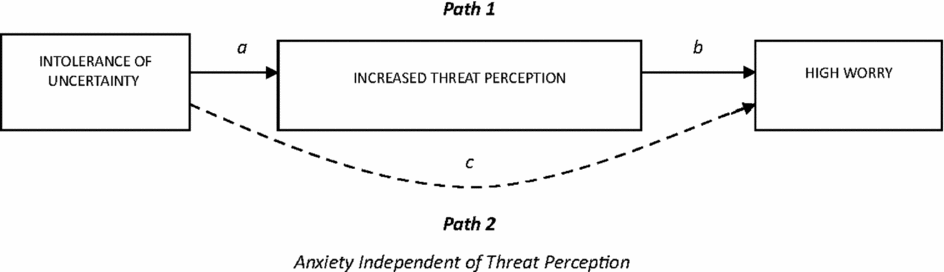
Researchers argue that higher IU is associated with inflated Threat Perception (TP) appraisals, as seen in Path 1 of Figure 1 (e.g., Dugas et al., Reference Dugas, Buhr, Ladouceur, Heimberg, Turk and Mennin2004). They argue inflated TP of individuals with higher IU will be more noticeable in situations that are ambiguous, as they will more readily interpret these situations as threatening. For this reason, Dugas and colleagues have argued that ambiguity has an important explanatory role between IU and worry (e.g., Koerner & Dugas, Reference Koerner, Dugas, Davey and Wells2006, Reference Koerner and Dugas2008). Individuals with higher IU do appear to make greater TP estimates, and this partially explains their greater levels of worry (Bredemeier & Berenbaum, Reference Bredemeier and Berenbaum2008; Dellerba, Gervais, & Dugas, Reference Dellerba, Gervais and Dugas2007). For example, Bredemeier and Berenbaum (Reference Bredemeier and Berenbaum2008) presented participants with possible negative life scenarios and found that TP estimates partially explained the relationship between IU and trait worry. Inflated TP in individuals with high IU is consistent with a threat-related ‘interpretive bias’ evidenced in individuals who worry excessively (see MacLeod and Rutherford, Reference MacLeod, Rutherford, Heimberg, Turk and Mennin2004, for a review).
Path 1 shows Intolerance of Uncertainty (IU) is associated with worry indirectly by increasing Threat Perception (TP). IU is associated with anxiety directly and independently TP.

IU may also generate anxiety through a perception of unpredictability that is not necessarily related to threat, as seen in Path 2 of Figure 1. Bredemeier and Berenbaum (Reference Bredemeier and Berenbaum2008) argue that because TP did not fully explain the relationship between IU and trait worry in their vignette methodology, IU must also be associated with anxiety independent of TP. Hence, Berenbaum, Thompson, and Pomerantz (Reference Berenbaum, Thompson and Pomerantz2007) describe IU as a ‘. . . non-threat-specific process . . .’ (p. 310). Factor analysis of the Intolerance of Uncertainty Scale (IUS; Freeston, Rheaume, Letarte, Dugas, & Ladouceur, Reference Freeston, Rheaume, Letarte, Dugas and Ladouceur1994) found items related to unpredictability were more specific to pathological worry (Berenbaum, Bredemeier, & Thompson, Reference Berenbaum, Bredemeier and Thompson2008; Carleton, Norton, & Asmundson, Reference Carleton, Norton and Asmundson2007; Sexton & Dugas, Reference Sexton and Dugas2009). The items identified in these analyses do not relate to threat; rather, they refer to a need to anticipate or predict what will occur in the future (e.g., item 19 of the IUS is ‘I can't stand being taken by surprise’). This anticipation is consistent with Barlow's (Reference Barlow2000) description of how an early stage of ‘anxious apprehension’ can be generated through a perception of unpredictability and uncontrollability of important events. Importantly, Barlow (Reference Barlow2000) does not specify that the unpredictable events need be aversive or threatening, only that they are salient and significant to the individual.
Koerner and Dugas (Reference Koerner and Dugas2008) published research demonstrating the role of ambiguity in explaining the relationship between IU and worry (supporting Path 1 in Figure 1). An undergraduate sample was asked to read a number of short vignettes that varied in valence and ambiguity, to imagine that what was described had happened to them, and rate their level of concern. Consistent with their hypothesis, they found concern ratings were significantly higher for individuals with high IU for ambiguous scenarios than (certain) positive or negative scenarios. As discussed, there is theoretical evidence that unpredictability may also be associated with anxiety in the absence of TP (supporting Path 2 of Figure 1). One means to examine this question is to replicate Koerner and Dugas's (Reference Koerner and Dugas2008) methodology and compare the effects of ambiguity versus unpredictability on worry and TP estimates. Unpredictability could be in the form of an unpredictable yet positive scenario — that is, a situation where a surprising and positive outcome is anticipated. For example, an ‘Unpredictable Positive Scenario’ may describe someone finding out they are about to be pleasantly surprised.
If unpredictability has a distinct, non-threat-related role to ambiguity in explaining the relationship between IU and worry, it would be hypothesised that:
1. The relationship between IU and worry will be stronger for both Ambiguous and Unpredictable Positive Scenarios than for (certain) Positive and Negative Scenarios; and
2. For Ambiguous Scenarios, the relationship between IU and worry will be explained by increases in TP. For Unpredictable Positive Scenarios the relationship between IU and worry will be independent of TP.
Method
Participants
Participants were 104 first-year psychology students recruited in 2009 at the University of Sydney, Australia (77 women and 27 men; mean age = 18.62 years, SD = 1.58). Participants predominantly described their ethnic origin as Anglo Saxon (n = 51), followed by East Asian (n = 17) or from other ethnic minorities/no data provided (n = 36).
Procedure
The procedure was divided into two sections completed in a 1-hour testing session. Participants were required to fill out demographic information, complete self-report measures and then self-report in response to a number of vignettes. The order in which tasks were completed was counterbalanced. Participants were tested in groups of one to three.
Self-Report Measures
Intolerance of Uncertainty Scale: The Intolerance of Uncertainty Scale (IUS; Freeston et al., Reference Freeston, Rheaume, Letarte, Dugas and Ladouceur1994). The IUS is composed of 27 items that assess the degree to which one experiences uncertainty as intolerable. The IUS has shown excellent internal consistency (α = .94) and good test–retest reliability over a 5-week period (r = .74; Buhr & Dugas, Reference Buhr and Dugas2002). Evidence of discriminant, convergent, content and criterion validity have been reported in multiple studies (e.g., Buhr & Dugas, Reference Buhr and Dugas2002; Carleton et al., Reference Carleton, Norton and Asmundson2007).
Vignettes: Vignettes adapted from Koerner and Dugas (Reference Koerner and Dugas2008) were used to assess participant appraisals. Participants were presented with 24 vignettes (written scenarios) that varied in certainty of outcome and emotional valence. All scenarios were written in the first person. There were four scenario types that could be described as: (1) (certain) Positive: the outcome is definitely good (e.g., ‘This morning my parents told me that whatever university course I choose, I will have their support and encouragement’); (2) (certain) Negative: the outcome is definitely bad (e.g., ‘My mother has not been well for several weeks now; the results of her blood test confirm that she has a serious illness’); or (3) Ambiguous: the outcome is unknown and could be interpreted as good, bad or neutral (e.g., ‘My lecturer called me to their office to discuss the quality of my work over the last few weeks’). These scenarios were taken from those developed by Koerner and Dugas (Reference Koerner and Dugas2008) and were pilot tested for valence and ambiguity to ensure the coherence of each scenario type.
In addition to these vignettes, a fourth type of scenario was developed for the current study: Unpredictable Positive. These vignettes describe scenarios where the exact nature of a necessarily positive outcome is unknown; for example, my friend ‘. . . gives me a letter. She tells me to open it, because it has the best news I am going to receive all year. I am sure it will be good news, but I cannot imagine what it is’. The unpredictable outcome was made to be one of a number of different but equally positive outcomes, so that the finality could not be construed as a potential (threatening) loss. A number of Unpredictable Positive items were pilot tested to ensure clarity and realism of the final items. As a manipulation check, the researchers ensured there were comparable levels of TP between the Positive and Unpredictable Positive Vignettes. The final items had a high level of face validity: the outcome could not be interpreted as threatening (unlike the Ambiguous Vignettes), yet the outcome was unknown and surprising (unlike the Positive Vignettes). Similar to Koerner and Dugas's (Reference Koerner and Dugas2008) study, there were an uneven number of vignettes in each category: four Positive and Negative vignettes and eight Ambiguous and Unpredictable Positive vignettes. The (certain) Positive and Negative Scenario types functioned primarily as control conditions.
Vignette Item Format: Participants were instructed to read the vignettes and imagine that what was described had happened to them. The researchers were primarily interested in worry scores for each vignette, so this was asked first. To ensure participants were making future-focused judgments, they were asked how much the vignette described would cause them to ‘worry’. More specifically, participants were asked to mark: (a) on an 11-point Likert scale how much the event described would cause them to worry (0 = not worried at all; 100 = extremely worried); then, similar to Berenbaum et al., (Reference Berenbaum, Thompson and Pomerantz2007), participants were asked to mark (b) on an 11-point scale how likely they thought something bad would result from the event described (0% = no chance; 100% = definite); and (c) on an 11-point scale how bad they think the event could be for them (0 = not bad at all; 100 = horrific).
Analysis Strategy
All IUS scores were treated as continuous for these analyses. A preliminary analysis examined the mean and standard deviation of worry and TP scores across all participants for each scenario type. Correlations between the IUS and worry scores were reported for Ambiguous and Unpredictable Positive Scenarios. As a manipulation check to examine whether TP had been minimised in the Unpredictable Positive Scenarios, a paired samples t test compared TP estimates between Unpredictable Positive and Positive Scenarios.
Hypothesis 1 examined differences in levels of self-reported worry (dependent variable) as predicted by IUS and scenario type (independent variables). This analysis was conducted using a multilevel model predicting worry by scenario type and IUS scores (with scenario type nested within participants). IUS scores were centred for this analysis. This was followed by pairwise interaction contrasts to further examine the interaction between IUS and scenario type. Specifically, interaction contrasts examined whether the Ambiguous and Unpredictable Positive Scenarios better predicted differing levels of worry for IUS than (certain) Positive and Negative Scenarios, as well as whether there was any difference in the extent to which Ambiguous versus Unpredictable Positive Scenarios predicted worry.
Hypothesis 2 examined the extent to which TP estimates explained the relationship between IU and worry for the Ambiguous and Unpredictable Positive Scenarios using a path analysis (as seen in Figure 1). For these analyses, cost and likelihood estimates were multiplied to produce an overall TP score.
Results
Preliminary Analysis
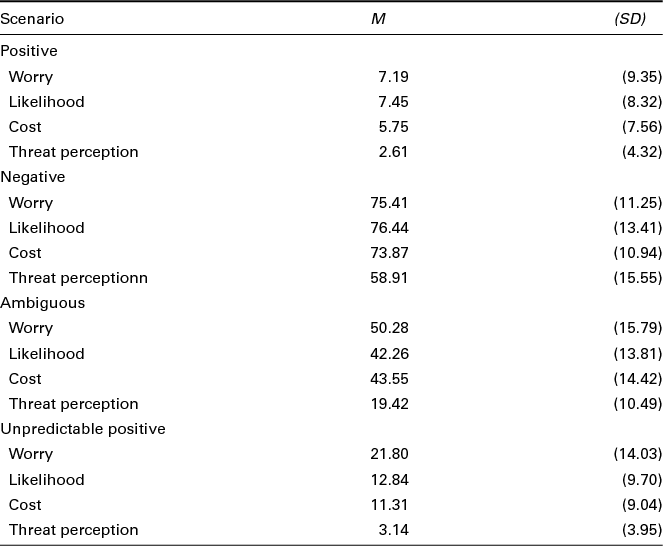
All vignette data was used. Table 1 shows the mean and standard deviation for all participants for each scenario type for Worry, Likelihood, Cost and TP estimates. The mean IUS score was 61.5 (SD = 18.3). The IUS correlated with worry scores associated with Ambiguous Scenarios at r = .45, p < .01, and with worry scores associated with Unpredictable Positive Scenarios at r = .47, p < .01. There was low TP in both the Positive (M = 2.61/100, SD = 4.32) and Unpredictable Positive (M = 3.14/100, SD = 3.95) Scenarios. There was no significant difference in TP for these conditions, t(103) = 1.55, p = .124, indicating TP had been minimised in the Unpredictable Positive Scenarios.
Mean and Standard Deviations for Participants by Scenario Type
Hypothesis 1
Hypothesis 1 predicted the relationship between IU and worry would be stronger for both Ambiguous and Unpredictable Positive Scenarios than (certain) Positive and Negative Scenarios.
The difference in worry level (dependent variable) for participants with varying levels of IU for each scenario type (independent variables) was analysed using multilevel modelling. This analysis yielded a significant interaction between IUS and scenario type, indicating that scenario type significantly moderated the relationship between IUS and worry, F(3, 306) = 5.69, p = .001. This analysis also yielded significant main effects for scenario type, F(3, 306) = 981.13, p < .001, and IUS, F(1, 102) = 37.27, p < .001.
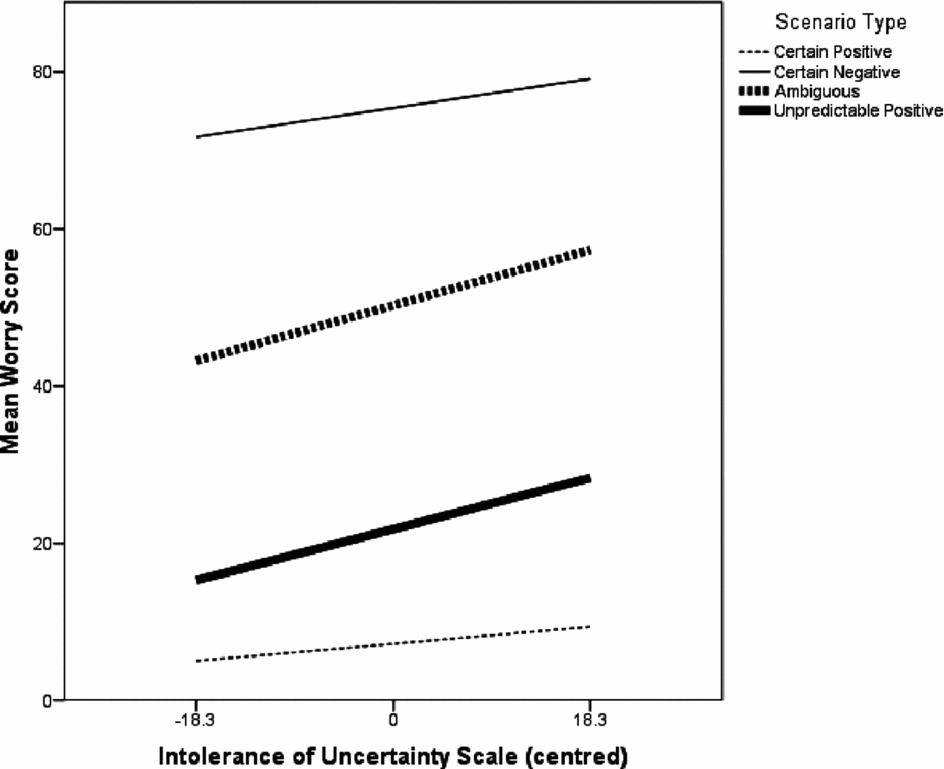
Pairwise interaction contrasts revealed significant interactions between Ambiguous versus Positive Scenarios and IUS, B = −.27, t(306) = −3.55, p < .001, and Ambiguous versus Negative Scenarios and IUS, B = −.18, t(306) = −2.44, p = .015. These results indicate that the relationship between IUS and worry was stronger for the Ambiguous Scenarios, B = .39, p < .001, than for either the Positive, B = .12, p = .061, or Negative Scenarios, B = .20, p < .01. There were also significant interactions between Unpredictable Positive versus Positive Scenarios and IUS, B = −.24, t(306) = −3.15, p = .002, and Unpredictable Positive versus Negative Scenarios and IUS, B = .15, t(306) = −2.05, p = .042. These results indicate that the relationship between IUS and worry was stronger for the Unpredictable Positive Scenarios (B = .36, p < .001) than for either the Positive or Negative Scenarios. There was no interaction between Unpredictable Positive vs. Ambiguous Scenarios and IUS, B = .03, t(306) = −.40, p = .690, indicating no significant difference in how either condition predicted worry. Figure 2 shows mean self-reported worry scores as predicted by IUS for each scenario type.
Mean self-reported worry scores as predicted by IUS (centred) for each Scenario Type at the Mean and one Standard Deviation above and below the Mean.
Hypotheses 2
Hypothesis 2 predicted for Ambiguous Scenarios the relationship between IU and worry will be explained by increases in TP, whereas for Unpredictable Positive Scenarios the relationship between IU and worry will be independent of TP.
In a path analysis for the Ambiguous Scenarios, IUS explains .45 (p < .01) of the total variance in worry level. Of this total effect, 61% of variance is explained by a moderate sized indirect effect through TP with β = .27 (the product of path a β = .37, p < .01, and path b β = .73, p < .01). The remaining 39% of variance is explained by a direct effect of IUS on worry (path c β = .18, p < .01).
For Unpredictable Positive Scenarios, IUS explains .47 (p < .01) of the total variance in worry level. Of this total effect, 28% of variance is explained by a small indirect effect through TP with β = .13 (the product of path a β = .28, p < .01, and path b, β = .48, p < .01). The remaining 72% of variance is explained by a direct effect of IU on worry (path c β = .33, p < .01).
Discussion
In support of Hypothesis 1, the relationship between IU and worry was stronger for Ambiguous and Unpredictable Positive Scenarios than for (certain) Positive and Negative Scenarios; however, there was no difference in the extent to which either Ambiguous or Unpredictable Positive Scenarios predicted this relationship. Indeed, the comparable simple correlations between the IUS and Ambiguous versus Unpredictable Positive worry scores indicate that both ‘uncertainty types’ are explanatory components within IU. ‘Ambiguous Worry’ associated with IU was predominantly indirect and explained by increases in TP, whereas ‘Unpredictable Positive Worry’ associated with IU was largely direct and independent of TP. This result supports Hypothesis 2, that ambiguity and unpredictability are differentially explained by TP and represent qualitatively different processes.
The path analysis for Ambiguous Scenarios suggests that the greater levels of worry for participants with higher IU were explained by their greater TP estimates. This supports Koerner and Dugas's (Reference Koerner and Dugas2008) assertion that greater worry in individuals with higher IU can be partly attributed to their tendency to more readily interpret threat in ambiguity. By contrast, the path analysis for Unpredictable Positive Scenarios suggests that the greater levels of worry for people with higher IU were largely independent of TP estimates. The low variance in TP for this condition (participants generally found these scenarios to be non-threatening) meant there was little opportunity for an interpretive bias. Hence, worry in this condition is not attributable to increases in TP, but rather is a result of a need to anticipate an unpredictable and important occurrence.
One can surmise that the anticipation in the Unpredictable Positive Scenarios may represent a preparatory state: it may instil greater vigilance, tension and arousal in an individual as they prepare for a surprising and significant outcome (e.g., ‘finding out they are about to receive the best news they have had all year’ as in one of the Unpredictable Positive items). The anticipation is not necessarily threat related, as noted by Barlow (Reference Barlow2000): the individual does not need to perceive or interpret threat in order to initiate this state. Yet this state may allow them to quickly respond to a surprising change in their environment. Hence, one can speculate that the anticipation may capture the tension and over-aroused ‘keyed up and on edge’ state that is present in individuals experiencing pathological worry. Similarly, IUS items referring to intolerance of ‘unpredictability’ and ‘surprise’ may better tap this state and be considered central to IU and pathological worry (e.g., Carleton et al., Reference Carleton, Norton and Asmundson2007; Sexton & Dugas, Reference Sexton and Dugas2009; Berenbaum et al., Reference Berenbaum, Bredemeier and Thompson2008).
These results should be considered in light of some limitations. First, a predominantly female undergraduate sample was used for this research, which may have implications for how results generalise to other populations. As IU is believed to be present in normal populations (Freeston et al., Reference Freeston, Rheaume, Letarte, Dugas and Ladouceur1994; Koerner & Dugas, Reference Koerner and Dugas2008), this is not considered a major shortcoming for the purposes of this experiment. Second, all variables in the path analyses were measured at a single point in time, similar to the study by Bredemeier & Berenbaum (Reference Bredemeier and Berenbaum2008). Third, in the vignettes the term ‘worry’ was used loosely to encompass an anxious response that is future-focused. Yet this term may not fully capture the non-cognitive nature of the anticipatory state; hence, this methodology can only be used for identifying a basic effect.
Future researchers may attempt to investigate this non-threat-specific, anxious response in a specific clinical sample using physiological, cognitive and self-report measures. A logical extension of this methodology may be to include an ‘Unpredictable Negative’ condition — for example, finding out you are about to be adversely surprised. The current results suggest ‘Unpredictable Negative’ scenarios will be associated with greater anxiety than (certain) ‘Negative’ scenarios, consistent with the findings of Seligman (e.g., Seligman, Reference Seligman1968). In summary, this study attempts to provide a process model explaining how IU contributes to anxiety. These preliminary findings suggest ambiguity and unpredictability represent different explanatory components within IU. Moreover, these results suggest IU is associated with a type of anxious response that can be generated in the absence of threat perception.
Acknowledgments
We would like to thank Emeritus Professor Kerry Byrne, Dr Sally Byrne, Professor Ronald Rapee, Dr Naomi Sweller, Dr Daniel Costa and Dr Lisa Lampe for their comments on this manuscript.