


Wh-words in Mandarin Chinese exhibit quantificational variability.Footnote 1 In addition to the typical interrogative reading, as in (1a) and (1b), wh-words such as shenme, “what,” and shei, “who,” can also have an indefinite reading, as in (2a) and (2b), or a universal reading, as in (3a) and (3b) (Cheng, Reference Cheng1991, Reference Cheng1994, Reference Cheng, Rathert and Giannakidou2009; Huang, Reference Huang1982b; Li, Reference Li1992; Lin, Reference Lin1996, Reference Lin1998).
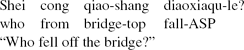
(1)

(2)
(3)
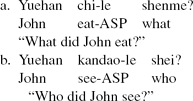
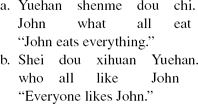
In Sentences (1a) and (1b), the wh-words shenme, “what,” and shei, “who,” are interpreted as interrogative words. Note that in both examples wh-words stay in situ. This is probably one of the most important typological features of Mandarin wh-questions, that is, unlike many other languages (e.g., English), which form their wh-questions by moving a wh-phrase to a clause-initial position, Mandarin wh-questions are formed by leaving a wh-phrase in situ. Therefore, Mandarin Chinese is known as a wh-in-situ language (Huang, Reference Huang1982a, Reference Huang1982b; Huang, Li, & Li, Reference Huang, Li and Li2009). In Sentences (2a) and (2b), the wh-words shenme, “what,” and shei, “who,” appear in the antecedent clause of if-conditionals, which is one of the licensing environments for existential wh-indefinites, and thus they are interpreted as existential indefinites something and someone, respectively. In addition, in Sentences (3a) and (3b), the wh-words shenme, “what,” and shei, “who,” are bound by the universal quantifier dou, thereby rendering the combination of shenme + dou and shei + dou as universally quantified noun phrases (NPs) everything and everyone, respectively.
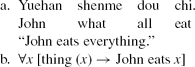
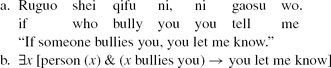
The above examples illustrate that the interpretation of wh-words in Mandarin Chinese is sensitive to the linguistic environments in which they occur. Wh-words in Mandarin Chinese are normally interpreted as interrogative words, but when they occur in certain linguistic contexts (e.g., in the antecedent clause of if-conditionals, in the scope of universal quantifiers), they are interpreted noninterrogatively. This quantificational variability depending on the linguistic environments is the well-known property of indefinites (Heim, Reference Heim1982). On Heim's analysis, indefinites are open predicates. Mandarin wh-words shenme, “what,” and shei, “who,” can be analyzed as thing (x) and person (x), respectively. The variable x can then be bound by some other operators. For example, in Sentence (3a) the wh-word shenme, “what,” is bound by the universal quantifier dou, as in (4b); therefore, shenme, “what,” is interpreted as having a universal reading. In Sentence (2b), the conditional operator ruguo, “if,” licences the wh-word shei, “who,” as a polarity item, and shei, “who,” gets the existential reading by being bound by an existential operator introduced by existential closure, as indicated in (5b).
(4)
(5)
The aim of the present study was to find out whether or not young Mandarin-speaking children are sensitive to the quantificational variability of wh-words. More specifically, we want to know whether young Mandarin-speaking children are sensitive to the licensing environments for the noninterrogative use of wh-words. In learning the interpretation of wh-words, what children learn is that the same word functions as an interrogative word in certain linguistic contexts but is interpreted as a noninterrogative indefinite in other linguistic contexts. Mandarin Chinese is a wh-in-situ language where wh-words always stay in situ regardless of whether they occur in questions or statements (i.e., wh-scope is not signaled on the surface structure). This feature of Mandarin makes the early acquisition of the distinction between the interrogative use of wh-words and the noninterrogative use of wh-words especially important, because it involves the acquisition of two different speech acts, that is, whether a wh-word is used to ask a question or it is used to make a statement. Consider Sentences (1a) and (2a), for example. In both sentences, the wh-word shenme, “what,” stay in situ. However, shenme, “what,” in (1a) functions as a question word, whereas the same wh-word functions as an existential indefinite in (2a). For a child to understand the illocutionary meanings of the two sentences, that is, the speaker is asking a question using (1a) but he is making a statement using (2a), he/she has to have the knowledge of how the interpretation of wh-words is connected with the linguistic environments in which they occur. We expect that this knowledge of the interaction between semantics and syntax should be acquired early in the course of language development, because it is important for the development of general communication skills, for example, making a statement, asking a question, and so on. The findings of the current study could also contribute to our understanding of children's acquisition of logical form properties, like operator-variable binding. The early availability of variable binding knowledge has been reported in children's acquisition of verb phrase-ellipsis constructions (e.g., Foley, del Prado, Barbier, & Lust, Reference Foley, del Prado, Barbier and Lust2003; Guo, Foley, Chien, Chiang, & Lust, Reference Guo, Foley, Chien, Chiang and Lust1996). In the present study, we were interested to see whether young Mandarin-speaking children exhibit adultlike knowledge of operator-variable binding in their acquisition of wh-quantification. We will also discuss the current findings in connection with data from Japanese-speaking children. The investigation of different operator-variable binding phenomena from a cross-linguistic perspective will shed light on the nature of variable binding mechanism at the initial stage of language development.
More specifically, the research question we asked is: how do young children establish the connection between the semantic interpretation of wh-words and the linguistic contexts in which they occur? As far as we know, few studies have looked at children's knowledge of the licensing conditions for the noninterrogative use of wh-words in Mandarin Chinese. The present study consists of two experiments investigating Mandarin-speaking children's sensitivity to the two noninterrogative uses of wh-words: the existential indefinite reading and the universal reading.
THE INDEFINITE READING OF WH-WORDS
As we saw in Example (2), the antecedent clause of if-conditionals licenses the existential indefinite reading of wh-words. There are other linguistic environments that also license the indefinite reading of wh-words. For example, wh-words are also interpreted as existential indefinites when they appear in the scope of the epistemic adverb keneng, “possibly,” as in (6); in yes–no questions, as in (7); in the predicate phrase of the negative quantificational expression meiyouren, “nobody,” as in (8); and in A-not-A questions, as in (9). For detailed discussion about the contexts in which wh-words function as existential indefinites, see Lin (Reference Lin1998) and Xie (Reference Xie2007).
(6)
(7)
(8)
(9)




Footnote 2 There has been a lot of discussion about the distribution of existential wh-indefinites and the properties of their licensing environments. Existential wh-indefinites are generally analyzed as polarity items and therefore are subject to the licensing conditions for polarity items (Cheng, Reference Cheng1991, Reference Cheng1994; Huang, Reference Huang1982b; Li, Reference Li1992; Lin, Reference Lin1996, Reference Lin1998). There is continuing controversy about the licensing conditions for polarity items. Some linguists use downward entailment to define the semantic properties of the licensing environments for polarity items (e.g., Ladusaw, Reference Ladusaw1979; von Fintel, Reference von Fintel1999). However, some linguists use nonveridicality to define the licensing environments for such items (e.g., Giannakidou, Reference Giannakidou1998, Reference Giannakidou2006, Reference Giannakidou, Maienborn, von Heusinger and Portner2011). The precise formulation of the semantics of these licensing conditions is not our concern. Readers are referred to Xie (Reference Xie2007) for a comprehensive review of the two proposals. There is a general consensus, however, that the existential indefinite reading of wh-words in these licensing environments is derived by being bound by existential closure (Cheng, Reference Cheng1994; Li, Reference Li1992). In the present paper, we are interested in the fact that existential wh-indefinites, as polarity items, are licensed in some linguistic environments but not others. For example, when the wh-phrase shenme shuiguo, “what fruit,” appears in the predicate phrase of the negative quantificational expression meiyouren, “nobody,” as in (8), repeated here as (10a), it is interpreted as a (negative) polarity item like English any. However, when the same wh-phrase shenme shuiguo, “what fruit,” appears in the predicate phrase of the positive quantificational expression meigeren, “everybody,” it cannot be interpreted as a polarity item like English some, as in (10b). Rather it is interpreted as an interrogative phrase, as indicated in (10c).Footnote 3
(10)
Notice that wh-words serve dual semantic functions here. In the predicate phrase of meigeren, “everybody,” they serve as interrogative words and turn the sequence of words into a question, for example, (10c). By contrast, when they appear in the predicate phrase of meiyouren, “nobody,” wh-words function as polarity items, for example (10a). This means that the sequence of words becomes a statement rather than a question. This interpretational difference is schematically represented in (11).
(11)

As shown by the schema, a minimal pair arises in the interpretation of sentences with the negative quantificational expression meiyouren, “nobody,” that is (11a), versus the positive quantificational expression meigeren, “everybody,” that is (11b). This type of minimal pairs provides a good testing ground for investigating children's knowledge of the licensing mechanisms of wh-indefinites and therefore forms the basis of the experiments we conducted with Mandarin-speaking children. The basic idea is that if children were sensitive to the licensing environments for the existential indefinite reading of wh-words, then they would be expected to interpret sentences like (11a) as statements, as compared to sentences like (11b), which they should interpret as questions.
EXPERIMENT 1
In this experiment, we investigated whether Mandarin-speaking children are sensitive to the linguistic environments that license the existential indefinite reading of wh-words, using minimal pairs as in (11).Footnote 4
Method
Participants
We tested 30 monolingual Mandarin-speaking children between the ages of 3 years, 6 months (3;6) and 4;9 (mean age = 4;3). The child subjects were recruited from the kindergarten at Beijing Language and Culture University. In addition, 20 Mandarin-speaking adults were tested as controls, all postgraduates at Beijing Language and Culture University.
Procedures
In order to evaluate the experimental hypotheses, we used an experimental technique called the question–statement task (Zhou & Crain, Reference Zhou and Crain2009). The experimenter acted out stories in front of the child subject using toy characters and props, and a puppet who appeared on a laptop computer screen watched the stories alongside the subject. After each story, the puppet attempted to explain to the subject what he thought had happened in the story, using a test sentence. The test sentences were prerecorded and were presented to the subject through the laptop computer connected to an external speaker to make it appear that the puppet was talking. It was made clear to the subject that the puppet did not always pay close attention to the story and thus was sometimes unsure about the outcome of the story. If that was the case, the puppet would make a guess about what happened in the story or ask the subject a question. On each trial, the subject's task was to decide whether the puppet made a statement about what happened in the story or asked a question about the story. Whenever the puppet said what happened in the story, the subject was instructed to judge whether the puppet was right or wrong. However, if the puppet asked a question about the story, the subject was instructed to answer the question.
The subjects were introduced to the task individually and were tested individually. In order to familiarize the subjects with the task, they were given two practice trials before the actual test session. On one practice trial, the puppet made a statement informing the subject about what had happened in the story, and on the other practice trial, the puppet asked the subject a question. Only those subjects who correctly judged that the puppet had made a statement on the first practice trial and had posed a question on the second trial were permitted to advance to the main session. Adult controls were tested on the same task.
Materials
There were six test stories. For each, two types of test sentences were created. One contained the wh-word shenme, “what,” in the predicate phrase of the negative quantificational expression meiyouren, “nobody,” as in (12), and one contained the wh-word shenme, “what,” in the predicate phrase of the positive quantificational expression meigeren, “everybody,” as in (13). A typical story is used to illustrate.
This story is about three pandas that went to have breakfast. They had four choices, including three types of fruit (lemons, pears, and strawberries) and eggs.Footnote 5 They came to the lemons first. None of them picked one, because they were too sour. Then they came to the eggs and each of them took one. Then they came to the pears. Two of them didn't like pears, but the third panda chose one big pear. Finally, they came to the strawberries. They all liked strawberries, so each panda took one.
Figure 1 illustrates the scene at the end of the story. When the story concluded, the puppet produced either Test Sentence (12) or Test Sentence (13).
(12)
(13)


For the presentation of the test sentences, the subjects were divided into two groups. One group (15 child subjects and 10 adult subjects) heard Test Sentence (12). The other group (15 child subjects and 10 adult subjects) heard Test Sentence (13). Altogether, there were six test trials. Each group was presented with only one type of test sentence for each story, and the two types of test sentences were counterbalanced so that each group was presented with three each of the two sentence types. The test sentences were produced by a female native speaker of Beijing Mandarin, and she was asked to produce the test sentences in a child-directed manner. In addition, she was asked to produce the test sentences using the same intonation pattern (i.e., level intonation), in order to control for the effect of the intonation on subjects’ judgments. The recording was conducted in a sound-attenuated laboratory at Beijing Language and Culture University. A postrecording survey was conducted to make sure that the test sentences were produced successfully. Fifteen Mandarin-speaking adults participated in this survey, where they were presented with each recorded sentence and were asked to judge whether the sentence has level intonation or rising intonation. The finding is that all the test sentences were judged to be in level intonation.
The last scene of the story in Experiment 1. [A color version of this figure can be viewed online at http://journals.cambridge.org/aps]

In addition to the test trials, each subject witnessed four control trials. On two of these control trials, the puppet produced the questions in (14) and (15). These trials were included to see whether subjects understand simple wh-questions. On the other two control trials, the puppet produced the simple statements with the universal quantifier mei, “every,” in (16) and (17). These control trials were included to verify that subjects could understand the universal quantifier mei, “every.” The control trials were also used to counterbalance the “yes” and “no” responses throughout the trials. The statements in the test trials were all false in the relevant stories, so Statements (16) and (17) were true depictions of the stories. The test and control trials were presented in a pseudorandom order.
(14)
(15)
(16)
(17)



Before we report the results, let us look at the experimental hypotheses. If children are sensitive to the licensing environments for the existential indefinite reading of wh-words (e.g., they know that the predicate phrase of the negative quantificational expression meiyouren, “nobody,” licenses the existential indefinite reading of wh-words but the predicate phrase of the positive quantificational expression meigeren, “everybody,” does not), then they would be expected to interpret sentences like (12) as statements, as compared to sentences like (13), which they should interpret as questions. If, on the other hand, children are not sensitive to the licensing environments for wh-indefinites, then they would be expected to interpret both types of sentences as questions. In the story under consideration, if children know that the wh-word shenme, “what,” is licensed as a polarity item like English any when it appears in the predicate phrase of the negative quantificational expression meiyouren, “nobody,” whereas the same wh-phrase is interpreted as an interrogative phrase when it occurs in the predicate phrase of the positive quantificational expression meigeren, “everybody,” then they were expected to reject the puppet's statement in (12) and to justify their rejections by pointing out the fact that every panda ate some fruit. By contrast, they should respond to the puppet's question in (13) by providing an answer “strawberry,” because every panda ate a strawberry. In addition, if children do not know that the predicate phrase of meiyouren, “nobody,” licenses the wh-word shenme, “what,” as a polarity item, then they would be expected to interpret shenme, “what,” in the predicate phrase of meiyouren, “nobody,” as marking a wh-question. In short, children would be expected to respond to both (12) and (13) by offering an answer, that is, “lemon” to (12) and “strawberry” to (13).
Results and discussion
We recorded the responses of the subjects to the two types of test sentences. All the subjects responded correctly to the control trials. The main finding was that both children and adults responded to test sentences with a wh-word in the predicate phrase of meiyouren, “nobody,” by rejecting the puppet's statements 100% of the time. In the example story, both children and adults said “no” to the puppet's statement in (12), and they justified their rejections by making reference to the fact that every panda ate some fruit. By contrast, both children and adults responded by providing an answer to test sentences with a wh-word in the predicate phrase of meigeren, “everybody,” 100% of the time, though children's answers were different from adults. For example, in the given story, adults consistently produced the answer “strawberry,” whereas the majority of the children pointed out the fruit that was eaten by each individual panda, that is, the first panda ate a pear and a strawberry, the second panda ate a strawberry, and the third panda ate a strawberry. The reasons for children's nonadult answers are not critical for our purposes.Footnote 6 We are interested in the fact that children interpreted the wh-word as an interrogative word when it appears in the predicate phrase of meigeren, “everybody,” whereas they interpreted the same wh-word as a polarity item when it occurs in the predicate phrase of meiyouren, “nobody.” This is compelling evidence that 3- to 5-year-old Mandarin-speaking children know that the predicate phrase of the negative quantificational expression meiyouren, “nobody,” licenses the existential indefinite reading of wh-words. Young Mandarin-speaking children are sensitive to the licensing environments for existential wh-indefinites.
In the following sections, we turn to the other noninterrogative use of wh-words, the universal reading, to see if young Mandarin-speaking children are sensitive to the linguistic environments that license the universal reading of wh-words.
THE UNIVERSAL READING OF WH-WORDS
Example (3) illustrates that wh-words shenme, “what,” and shei, “who,” are bound by the universal quantifier dou, thereby rendering the combination of shenme + dou and shei + dou as universally quantified NPs everything and everyone, respectively. In this section, we will discuss the quantifier dou and wh-words. We begin with dou.
Dou is a universal quantifier
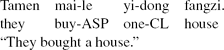
Despite continuing controversy about the syntax and semantics of the quantificational expression dou, there are some generally acknowledged characteristics of dou. Here we focus on its most discussed property, that is, dou is a distributive universal quantifier that quantifies over expressions that precede it (Cheng, Reference Cheng1995; Lee, Reference Lee1986; Pan, Reference Pan2006). Consider the sentences in (18) and (19). Without dou, as in (18), the sentence means that the entire group of individuals denoted by tamen, “they,” collectively bought a house. The sentence could be true, moreover, even if it turned out that one or two of the individuals in the group denoted by tamen, “they,” did not contribute to the purchase. In (19), by contrast, dou quantifies over the entire set of individuals, thereby giving the sentence a distributive reading. Thus (19) means, roughly, that each of the relevant individuals bought their own house.Footnote 7 The sentence is false, moreover, if even a single individual failed to purchase a house. These two examples illustrate that dou is interpreted as a distributive universal quantifier, quantifying over plural noun phrases that precede it.
(18)
(19)

Dou and wh-words
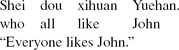
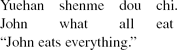
As noted, wh-words in Mandarin Chinese can be quantified by dou. When this happens, they are no longer interpreted as interrogative words. Instead, they are interpreted as having a universal reading (Cheng, Reference Cheng1991, Reference Cheng1994; Huang, Reference Huang1982b; Li, Reference Li1992; Lin, Reference Lin1996, Reference Lin1998). The examples in (20) and (21) illustrate this. In both examples, dou binds a wh-word to its left, shei, “who,” in (20), and shenme, “what,” in (21). The combination of dou and the wh-word yields a universally quantified NP, corresponding to English everyone in (20) and everything in (21).
(20)
(21)
The experiment that follows was designed to find out whether or not Mandarin-speaking children know that wh-words are interpreted as having a universal reading when they occur on the left of dou.
EXPERIMENT 2
In this experiment, we investigated whether Mandarin-speaking children know that wh-words can be bound by dou. The experiment contrasted minimal pairs of sentences, namely, sentences with dou and ones without dou. A typical minimal pair of test sentences is illustrated in (22) and (23).
(22)
(23)
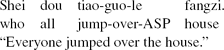
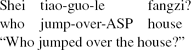
In (22), dou quantifies over the wh-word shei, “who,” thereby rendering the combination shei + dou as the universally quantified NP everyone. Without dou, the wh-word shei in (23) marks the sentence as a question, asking “Who jumped over the house?” Therefore, the experimental hypothesis is that if children know that the universal quantifier dou binds the wh-words to its left, then they were expected to interpret sentences like (22) as statements, but they should interpret sentences like (23) as questions. In contrast, if children do not know that dou binds the wh-words to its left, then they were expected to interpret sentences like (22) as questions, just like sentences such as (23).
Method
Participants
We tested 28 monolingual Mandarin-speaking children between the ages of 3;7 and 4;8 (mean age = 4;3). The child subjects were recruited from the kindergarten at Beijing Language and Culture University. In addition, 20 Mandarin-speaking adults were tested as controls, all postgraduate students at Beijing Language and Culture University. None of the subjects had participated in Experiment 1.
Procedures
In order to evaluate the experimental hypotheses, we used the question–statement task, as in the first experiment. The subjects were introduced to the task individually and were tested individually. In order to familiarize children with the task, they were given two practice trials before the actual test session. On one practice trial, the puppet made a statement informing the subject about what had happened in the story, and on the other practice trial, the puppet asked the subject a question. Only those subjects who correctly judged that the puppet had made a statement on the first practice trial and had posed a question on the second trial were permitted to advance to the main session. Adult controls were tested on the same task.
Materials
There were six test stories. For each, two types of test sentences were created. One contained the wh-word + dou, as in (22), and one contained the wh-word alone, as in (23). An example of a typical story is as follows.
A white horse, a black horse, and a yellow horse are having a jumping contest. In the contest, they try to jump over two things: a house and a fence. They start with the easy one: the fence. All three horses clear the fence (as illustrated in Figure 2). Now they come to the house. It is much taller than the fence. The white horse and the black horse are really good. They jump over the house easily. The yellow horse has trouble. Each time he gets close to the house, his legs start to shake. So he decides not to jump. (Figure 3 illustrates the scene at the conclusion of the story.)
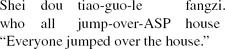
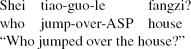
When the story concluded, the puppet either produced Test Sentence (22) or Question (23), repeated here as (25) and (26). In order to make the test sentences sound more natural, each test sentence was preceded by a short context. For example, Sentences (25) and (26) were preceded by a context, as in (24).
(24)
(25)
(26)
The first half of the story in Experiment 2. [A color version of this figure can be viewed online at http://journals.cambridge.org/aps]
The second half of the story in Experiment 2. [A color version of this figure can be viewed online at http://journals.cambridge.org/aps]
For the presentation of the test sentences, the subjects were divided into two groups. One group (14 child subjects and 10 adult subjects) heard Test Sentence (25). The other group (14 child subjects and 10 adult subjects) heard Test Sentence (26). Altogether, there were six test trials. Each group was presented with only one type of test sentence for each story, and the two types of test sentences were counterbalanced so that each group was presented with three each of the two sentence types. The test sentences were produced by a female native speaker of Beijing Mandarin, and she was asked to produce the test sentences in a child-directed manner. In addition, she was asked to produce the test sentences using the same intonation pattern (i.e., level intonation), in order to control for the effect of the intonation on subjects’ judgments. The recording was conducted in a sound-attenuated laboratory at Beijing Language and Culture University. A postrecording survey was conducted to make sure that the test sentences were produced successfully. Fifteen Mandarin-speaking adults participated in this survey, where they were presented with each recorded sentence and were asked to judge whether the sentence has level intonation or rising intonation. The finding is that all the test sentences were judged to be in level intonation.
In addition to the test trials, each subject witnessed five control trials. On two of these control trials, the puppet produced the questions in (27) and (28). On the other three control trials, the puppet produced the simple statements with dou in (29), (30), and (31). These control trials were included to verify that subjects could understand simple statements with dou. The control trials were also used to counterbalance the “yes” and “no” responses throughout the trials. The statements in the test trials were all false in the relevant stories, so Statements (29), (30), and (31) were true depictions of the stories. The test and control trials were presented in a pseudorandom order.
(27)
(28)
(29)
(30)
(31)
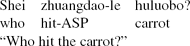
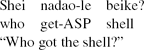



Before we report the results, let us revisit the experimental hypotheses. If children know that the universal quantifier dou binds the wh-words to its left, then they would be expected to interpret sentences with a wh-word + dou as a statement. By contrast, they should interpret sentences with a wh-word alone, without dou, as a question. In the story under discussion, children who know that the wh-word shei, “who,” is bound by dou should reject the puppet's statement in (25) and should justify this response by pointing out that the yellow horse did not jump over the house. In addition, children should provide an answer to the puppet's question in (26), offering as an answer that the white horse and the black horse jumped over the house. In contrast, if children do not know that dou binds the wh-words to its left, then they would be expected to interpret sentences with a wh-word + dou as having the same meaning as the counterparts to these sentences with a wh-word alone. In the story, children would be expected to respond in the same way, by offering answers to both (25) and (26), that is, pointing out that the white horse and the black horse jumped over the house.
Results and discussion
We recorded the responses of the subjects to the two types of test sentences. All the subjects responded correctly to the control trials. The main findings were that children responded to test sentences with a wh-word + dou by rejecting the puppet's statements 95% of the time.Footnote 8 Adults rejected them 100% of the time. A Mann–Whitney test showed that there was no significant difference between children and adults (Z = 1.32, p = .6). In addition to overtly rejecting the test sentences, by saying “Bu dui” (“No”) or “Ni shuode bu dui” (“You're wrong”), both children and adults pointed out that one of the characters did not perform the action mentioned in the test sentence. In the example story, children and adults rejected the puppet's statement in (25) by making reference to the fact that the yellow horse did not jump over the house. Children either explicitly mentioned the yellow horse (“No, the yellow horse didn't”) or they pointed to the yellow horse.
Another main finding concerns the responses of children and adults to the test sentences with a wh-word alone. Both children and adults consistently responded by providing an answer to the puppet's question, that is, they responded with an answer that mentioned that two of the characters performed the action mentioned in the test sentences (children: 100% vs. adults: 100%; Z = 0, p = 1). In the example story, they answered the puppet's question (26) in one of two ways. One response, by 3 of the 14 child subjects, was to point to the white horse and the black horse. The remaining 11 children overtly mentioned the two horses that jumped over the house, saying “Baima he heima” (“The white horse and the black horse”). The responses of each child on this trial are provided in Appendix B.
The results of this experiment clearly show that children know that the quantifier dou turns sentences like (25) into statements. This stands in contrast to their counterparts without dou, such as (26), which children correctly interpreted as questions. This is evidence that 3- to 5-year-old Mandarin-speaking children have the knowledge that the quantifier dou licenses the universal reading of wh-words. Young Mandarin-speaking children are sensitive to the licensing environments for the universal reading of wh-words.
GENERAL DISCUSSION AND CONCLUSION
The present study investigated whether Mandarin-speaking children are sensitive to linguistic environments that license the noninterrogative use of wh-words: the existential indefinite reading and the universal reading. We focused on two linguistic environments: the predicate phrase of the negative quantificational expression meiyouren, “nobody,” and the universal quantifier dou, among which the former licenses the existential indefinite reading of wh-words and the latter licenses the universal reading of wh-words. Two experiments were conducted. Experiment 1 examined if children know that wh-words function as existential indefinites when they occur in the predicate phrase of meiyouren, “nobody.” Experiments 2 explored whether children know that wh-words are interpreted as having a universal reading when they appear on the left of the quantifier dou. It was found that 3- to 5-year-old Mandarin-speaking children are sensitive to these licensing environments for the noninterrogative use of wh-words. Our study established that (a) children know that wh-words are interpreted as existential indefinites in the predicate phrase of the negative quantificational expression meiyouren, “nobody,” but as interrogative words in the predicate phrase of the positive quantificational expression meigeren, “everybody,” and (b) children know that wh-words are interpreted as having a universal reading when they occur on the left of the quantifier dou but not in the corresponding sentences without dou. These results attest to the early mastery of adultlike linguistic knowledge of wh-quantification in child Mandarin.
Now the question becomes, how do young children make the connection between the semantic interpretation of wh-words and the linguistic contexts in which they occur? One possibility that people can think of is that children use distributional cues in the input to learn the semantic interpretation of wh-words. Can they? It might be possible to use distributional facts to account for how children acquire the licensing environments for the Mandarin negative polarity item renhe, “any.” For example, if children are extremely good record keepers, they might keep track of the fact that renhe, “any” appears in the predicate phrase of the negative quantificational expression meiyouren, “nobody” (e.g., Juhuishang meiyouren chi renhe shuiguo, “Nobody ate any fruit at the party”) but not in the predicate phrase of the positive quantificational expression meigeren, “everybody” (e.g., Juhuishang meigeren dou chi *renhe shuiguo, “Everybody ate *any fruit at the party”). However, note that in learning the interpretation of wh-words, what children learn is that the same wh-word functions an interrogative word in certain linguistic contexts but it is interpreted as a noninterrogative indefinite in some other linguistic contexts. It is not the distribution of the wh-word that is at issue for children but its interpretive properties. Therefore, children would be hard-pressed to use distributional cues to establish the connection between the semantic interpretation of wh-words and the linguistic contexts in which they occur.
It is also worth considering whether there are relevant triggering data in the adult input that enables children to distinguish the interrogative use of wh-words from the noninterrogative use. For example, if statements containing shenme, “what,” in the predicate phrase of meiyouren, “nobody,” and questions containing shenme, “what,” in the predicate phrase of meigeren, “everybody,” are available in sufficient quantity in the adult input, then children might be able to use the input to converge on the adult interpretation. In order to test this possibility, we did a corpus analysis. In a survey of 43,289 parental utterances in three Mandarin corpuses on the Child Language Data Exchange System (CHILDES) database (the Beijing 2 corpus, the Zhou 1 and Zhou 2 corpuses),Footnote 9 no exact matches were found where shenme, “what,” appears in the predicate phrase of meiyouren, “nobody,” and only two instances of the construction were found in which shenme, “what,” occurs in the predicate phrase of meigeren, “everybody” (e.g., Shuaya yihou, meigeren dou zai mang shenme ne? “What is everybody doing after brushing their teeth?”). Such low frequencies of relevant input make it unlikely that children learn the different interpretations of wh-words by merely relying on the input data.
However, other input-based accounts might be proposed to explain children's knowledge of the different interpretive patterns of shenme, “what.” For example, one might ask whether there is sufficient input attesting to the correlations that (a) negative quantificational expressions like meiyouren, “nobody” are associated with statements and (b) positive quantificational expressions like meigeren, “everybody,” are associated with questions. If this was the case, children could just pick up the frequency bias of the interpretive patterns of these two types of quantificational expressions, without the need to consider the semantic interpretation of shenme, “what.” To test this possibility, we searched the three Mandarin CHILDES corpuses using the target words meiyouren, “nobody,” and meigeren, “everybody” (without the wh-word shenme, “what”), and we found that there are only three instances of meiyouren, “nobody” (two statements and one question) and seven instances of meigeren, “everybody” (four statements and three questions). This finding suggests that there is no such hypothesized correlation between the two types of quantificational expressions and the corresponding interpretive patterns in the input. To further rule out this possibility, we then searched the corpuses using the negative marker meiyou, “not,” and the universal quantifier mei, “every,” as the target words. This time, we found a reverse pattern than would be predicted by the hypothesized correlation, that is, the presence of meiyou, “not,” is related with more cases of questions, whereas the occurrence of mei, “every,” is associated with more cases of statements. More specifically, out of a total of 472 adult utterances with the negative marker meiyou, “not,” 278 are questions and 194 are statements; and out of a total of 60 adult utterances with the universal quantifier mei, “every,” there are 45 statements and 15 questions. Based on these findings, it seems quite unlikely that there would be sufficient input attesting to the correlations between negative quantificational expressions and statements, and positive quantificational expressions and questions.
It remains to be determined whether both the interrogative and the noninterrogative uses of wh-words are abundant in the adult input, such that children could learn the different interpretations of wh-words based on the input. There were a total of 8,452 adult utterances containing the wh-word shenme, “what,” in the three corpuses. Out of these 8,452 utterances, 8,194 are questions and 258 are statements. The noninterrogative use of shenme, “what,” occurs significantly less frequently than its interrogative use in the adult input. Based on this frequency difference, the input-based account would predict that children should master the interrogative interpretation of wh-words earlier (or better) than the noninterrogative interpretation, or they might easily fail in assigning the noninterrogative interpretation to wh-words, because of such a low frequency of occurrence. However, our studies show that young Mandarin-speaking children have mastered well both the interrogative use and the noninterrogative use of wh-words. On the basis of this corpus data, it seems highly implausible that input data alone can explain the early mastery of the different interpretations of wh-words. Given this, we propose that the licensing mechanism for the noninterrogative use of wh-words is innate in child language.Footnote 10
More specifically, we propose the following learning scenario. Wh-words are treated as variables in child Mandarin; therefore, the interpretation of wh-words is governed by a variable-binding relation. When wh-words occur in linguistic environments like yes–no questions, the predicate phrase of the negative quantificational expression meiyouren, “nobody,” and A-not-A questions, and so on, they are licensed as polarity items and get the existential indefinite reading by being bound by existential closure. In this case, the binder is the existential operator introduced by existential closure. When they appear on the left of the universal quantifier dou, they are bound by dou, and thus are interpreted as having a universal reading. In this case, the universal quantifier dou is the binder. We propose that this variable-binding mechanism is innate in child language. More specifically, whether a wh-word is existentially bound or universally bound is decided by this innate variable-binding mechanism. Children do not need to learn how these linguistic environments license the noninterrogative use of wh-words, that is, whether an existential indefinite reading is licensed or a universal reading is licensed in certain linguistic contexts. The innate variable-binding mechanism will help children access the proper interpretation automatically. What children need to learn are the semantic properties of these different linguistic environments, for instance, they need to learn what a yes–no question is, what negation is, what an A-not-A question is, and what the property of dou is. Once children acquire the semantic properties of these different linguistic environments, they can draw on the innate variable-binding mechanism to get the different interpretations of wh-words. For example, once children know that meiyouren, “nobody,” is a negative quantificational expression, the innate variable-binding mechanism will automatically compute existential closure, thereby rendering the relevant wh-word being existentially bound. Likewise, if children know that dou, “all,” is a universal quantifier, the relevant wh-word will be universally bound by virtue of the innate variable-binding mechanism. Children draw on the innate variable-binding mechanism to establish the interpretation of wh-words and the linguistic contexts in which they occur. The early availability of this variable-binding mechanism has also been observed in children's acquisition of verb phrase-ellipsis constructions in both English and Mandarin Chinese (e.g., Foley et al., Reference Foley, del Prado, Barbier and Lust2003; Guo et al., Reference Guo, Foley, Chien, Chiang and Lust1996).
However, one reviewer pointed out that in order to show that this variable-binding mechanism is innate, evidence also needs to be presented to demonstrate that, in addition to being sensitive to lexical information (i.e., the meaning of licensors and the meaning of wh-words), children are also sensitive to structural information in determining the interpretations of wh-words. For example, evidence needs to be presented to show that children have knowledge that wh-words are interpreted noninterrogatively when they occur in the scope of a licensor (i.e., in the c-command domain of a licensor) but the the same wh-words are interpreted interrogatively when they are not in the scope of a licensor. We wanted to note that previous studies have shown that Mandarin-speaking children are sensitive to the interaction between structural information and the interpretation of wh-words. We use one study reported in Zhou (Reference Zhou2010) to illustrate. As discussed, the Mandarin universal quantifier dou binds a wh-word to its left. In other words, the scope of dou is the elements to its left. When a wh-word occurs to the right of dou, it cannot be bound by dou, and thus is interpreted as a question word. Consider Sentences (32) and (33), for example. Sentences like (32) are referred to as dou-conditionals (Cheng & Huang, Reference Cheng and Huang1996), in which dou quantifies over the wh-word shei, “who,” in the antecedent clause, and thus the sentence expresses a statement, meaning “Whoever Mr. Crocodile went to bite, Mr. Owl asked Spiderman for help.” The dou-conditionals like (32) were contrasted with sentences like (33). Example (33) differs from (32) in that the wh-word shei, “who,” occurs in the consequent clause. Because it resides outside the scope of dou (i.e., it occurs to the right of dou), shei, “who,” functions as a question word, and thus (33) is used to pose a question, asking “Who did Mr. Owl ask for help when Mr. Crocodile went to bite Mr. Pig?”
(32)
(33)

Forty-two monolingual Mandarin-speaking children were tested using the question–statement task (mean = 4;3, range = 3;5–5;0). On a typical story, the experimenter acted out the following story.
This story is about a small village. There are four guys living in this village. One is the village head, Mr, Owl, and there are three villagers: Mr. Rabbit, Mr. Pig, and Mr. Cat. The villagers lived a happy life until last week, when a bad guy started coming to the village. His name is Mr. Crocodile. Mr. Crocodile always came at night to try to bite the villagers. When the village head, Mr. Owl, found out about this, he came up with an idea. He asked two of his super friends, Mr. Spiderman and Mr. Batman, to protect his villagers. The next night Mr. Crocodile came to Mr. Pig's house. Mr. Owl found out, and called Mr. Spiderman. Just when Mr. Crocodile was about to bite Mr. Pig, Mr. Spiderman came down from the roof and ran Mr. Crocodile out of the house. As a reward, Mr. Owl gave Mr. Spiderman a purple shell. The next night Mr. Crocodile came to Mr. Pig's house again. He wanted revenge. Mr. Owl found out, and called Mr. Spiderman again. When Mr. Crocodile jumped toward Mr. Pig, Mr. Spiderman came out from behind the door and ran Mr. Crocodile out of the house. Mr. Owl rewarded Mr. Spiderman with another purple shell. The following night, Mr. Crocodile decided not to try to bite Mr. Pig, because Mr. Spiderman always came to help. So he went to Mr. Rabbit's house. Mr. Owl found out again and, this time, he called Mr. Batman. When Mr. Crocodile broke into the house, he found Mr. Batman standing right in front of him. Again Mr. Crocodile was run out of the house. Mr. Owl gave Mr. Batman a white shell as a reward. After that, Mr. Crocodile left the village and never came back.
When the story concluded, children were presented either with (32) or with (33). Zhou found that 37 out of 42 children consistently interpreted sentences like (32) as statements, for example, they rejected (32) by pointing out that Mr. Batman also came to help; and all 42 children interpreted sentences like (33) as questions, for example, they answered “Mr. Spiderman” in response to (33). This finding provides evidence that young Mandarin-speaking children know that when a wh-word occurs in the scope of a universal quantifier, it has a universal reading, whereas the same wh-word is interpreted as a question word when it is outside the scope of the universal quantifier. Children are sensitive to structural information in deciding on the interpretations of wh-words.
As discussed in the introductory section, the early acquisition of this special property of wh-words is important for a wh-in-situ language like Mandarin Chinese, because it involves the development of general communication skills, for example, making a statement, asking a question, and so on. Therefore, it is not surprising that young Mandarin-speaking children have already mastered this property of wh-words. We predict that children's early mastery of wh-quantification will be observed in other wh-in-situ languages as well (e.g., Vietnamese and Japanese). Some studies of Japanese-speaking children's knowledge of wh-quantification seem to support this prediction (see, e.g., Sano, Shimada, & Kato, Reference Sano, Shimada, Kato, Crawford, Otaki and Takahashi2009; Yamakoshi, Reference Yamakoshi, Brugos, Micciulla and Smith2004). In Japanese, wh-words, like dare, “who,” and nani, “what,” can combine with additional particles to form negative concord items (Watanabe, Reference Watanabe2004). For example, in sentence (34a) the combination of the wh-word dare, “who,” and the focus particle mo yields a universally quantified NP, corresponding to English everyone. With negation, as in (34b), dare, “who,” and mo form a negative concord item, which has a meaning close to the English negative polarity item anyone, and thus the sentence means “No one cried.” Sano et al. (Reference Sano, Shimada, Kato, Crawford, Otaki and Takahashi2009) and Yamakoshi (Reference Yamakoshi, Brugos, Micciulla and Smith2004) found that 4-year-old Japanese-speaking children already know that wh-word + mo is a negative concord item in Japanese.
(34)
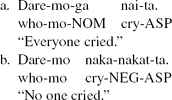
Of course, further cross-linguistic studies are required in order to see whether this variable-binding mechanism is innately specified. In addition, we will also need to look at children's acquisition of other structures involving operator-variable binding. Investigations of different operator-variable binding phenomena from a cross-linguistic perspective will shed light on the nature of variable binding mechanisms at the initial stage of language development. This is a necessary next step in the development of our proposal.
APPENDIX A: CHILDREN'S NONADULT ANSWERS IN EXPERIMENT 1
This finding is interesting, though it is not critical for our purposes. The interaction of wh-words and quantifiers in questions has long been assumed to exhibit a subject/object asymmetry regarding the availability of pair-list answers (May, Reference May1985). A pair-list answer is available for object questions with a subject quantifier, like (i) “Who did everyone kiss?” but not for subject questions with an object quantifier, like (ii) “Who kissed everyone?” In other words, sentences like (i) are ambiguous, allowing both a pair-list answer (e.g., John kissed Mary, Bill kissed Janet, and Nick kissed Sarah) and a single answer (e.g., Everyone kissed Mary), whereas sentences like (ii) typically allow a single answer only (e.g., John kissed everyone). One could assume that the different responses between children and adults in this experiment might be related to this subject/object symmetry. This asymmetry would predict that both pair-list and single answers are available for sentences like (iii), Meizhi xiongmao dou chi-le shenme shuiguo? “What kind of fruit did every panda eat?” We found that 26 out of 30 children consistently provided pair-list answers (e.g., pointing out that the first panda ate a pear and a strawberry, the second panda ate a strawberry, and the third panda ate a strawberry), and 4 out of 30 children provided single answers (e.g., pointing out that every panda ate a strawberry). Adults, by contrast, consistently provided single answers (20 out of 20 adults). The interesting question then is, why did children tend to give pair-list answers, whereas adults tend to give single answers? We suspect that this difference might be because of the different representations of the quantifier dou, “all” in the two groups. More specifically, we propose that in child Mandarin, the quantifier dou is analyzed as a distributive universal quantifier, whereas in adult Mandarin, it is not only a distributive universal quantifier but also a focus-sensitive operator (Zhou & Crain, Reference Zhou and Crain2009). Consider the following sentence, for example.
(iv)
In child Mandarin, the quantifier dou is analyzed as a distributive universal quantifier, and thus the sentence has a meaning similar to the English counterpart, “What kind of fruit did every panda eat?” In adult Mandarin, however, because dou is analyzed as a focus-sensitive operator that induces cleftlike structures, the representation of the sentence is similar to an English cleft like “What kind of fruit was it that every panda ate?” This representation requires a single answer. On this analysis, the difference between children and adults can be explained.
In order to see whether the difference is due to the property of the quantifier dou, we conducted a survey of 16 Mandarin-speaking adults. In the survey, subjects were first presented with a picture as in Figure 1 and were then presented with a question as in (v), which is exactly like (iv) but with dou removed. Their task was simply to answer the question based on the picture.
(v)

The basic idea is that if the single answers of adults are because of the presence of dou, then the removal of dou should encourage them to access the pair-list answers. This is exactly what we found: 14 out of 16 adults provided pair-list answers to Sentence (v), pointing out that the first panda ate a pear and a strawberry, the second panda ate a strawberry, and the third panda ate a strawberry. In short, the findings from the survey support our analysis of the difference between children and adults.
APPENDIX B
Children's responses on the example trial in Experiment 2
ACKNOWLEDGMENTS
This research was supported by a Macquarie University Research Fellowship to the author. I am grateful to Stephen Crain and three anonymous reviewers for their insightful comments and suggestions on an earlier version of the paper. I am also thankful to Dr. Yi (Esther) Su for her assistance in analyzing the CHILDES data and the language acquisition group of Beijing Language and Culture University headed by Professor Liqun Gao for their assistance and support in running the experiments.




