Current methods used by the National Healthcare Surveillance Network (NHSN) and the Centers for Disease Control and Prevention (CDC) for central-line–associate bloodstream infection (CLABSI) risk adjustment consist solely of adjustment by the type of intensive care unit.Reference Dudeck, Horan and Peterson 1 There are numerous criticisms of this risk adjustment methodology for CLABSI and for other healthcare-associated infections (HAIs).Reference Moehring and Anderson 2 , Reference Roy, Herwaldt, Embrey, Kuhns, Wenzel and Perl 3
Comorbid conditions have been shown to increase risk for surgical site infectionsReference Olsen, Higham-Kessler and Yokoe 4 , Reference Xue, Qian, Yang and Wang 5 and the acquisition of antibiotic-resistant bacteria.Reference McGregor, Perencevich and Furuno 6 These findings led us to postulate that patients with certain comorbid conditions may be at greater risk for CLABSI than other patients.
METHODS
We performed a retrospective longitudinal study of intensive care unit (ICU) patients, age 18 years and older, who had had central venous catheters. Patients were treated between July 1, 2010, and December 31, 2012, at 1of 6 ICUs at the University of Maryland Medical Center: surgical, medical, cardiac care, and 3 trauma.
The outcome, CLABSI, was defined according to guidelines set by the National Healthcare Safety Network (NHSN)/CDC. The diagnosis of CLABSI was made by infection preventionists as part of routine infection prevention practice at UMMC. 7 Validation of the infection preventionists’ classification was performed by a senior infection preventionist and then reviewed by a physician hospital epidemiologist.
Eligible patients had to have had a central line for at least 48 hours and no prior CLABSI. The daily presence or absence of a central line was obtained from daily nursing records. No data were available to determine whether patients had multiple simultaneous central venous catheters.
Two different composite comorbidity scores and their individual components were evaluated: the Chronic Disease Score (CDS) and the Charlson Comorbidity Index (CCI).Reference Von Korff, Wagner and Saunders 8 , Reference Charlson, Pompei, Ales and MacKenzie 9 A major advantage of these scores is that they are available through common hospital electronic medical and billing records.
To determine the CDS, pharmacy records of patient medications ordered during the first 24 hours of a hospital admission are used as indicators for comorbid conditions. The components of the CDS used in this study have a range of 0–35. The CCI is calculated using ICD-9-CM discharge codes (International Classification of Diseases, 9 th Revision, Clinical Modification) and has a range of 0–37.Reference Deyo, Cherkin and Ciol 10 Because both scores measure comorbidity, separate analyses were performed for each composite comorbidity score as well as for the individual components of each of these measures. Other risk factors analyzed included age, sex, hospital, ICU length of stay prior to CLABSI, and ICU type. Bivariate and multivariable analyses were performed.
Multivariable logistic regression (ie, generalized estimating equations) was used when patients had multiple visits to account for correlation.
RESULTS
A total of 4,011 subjects with a total of 32,577 central-line days were included in this study. Among the 4,011 subjects, 76 CLABSIs were identified, yielding a CLABSI rate of 2.33 per 1,000 central-line days. The mean age of the patients in the cohort was 57.3±16.4 years (mean±SD); 2,846 patients (59%) were Caucasian; 1,686 (35%) were African American; and 2,052 (41%) were female (Table 1).
Baseline Characteristics for All Study Subjects

NOTE. IQR, interquartile range; SD, standard deviation.
a Student’s t-test.
b Wilcoxon rank sum test.
c χ2 test.
Patients with a CLABSI had more central-line days than those without a CLABSI (P<.0001); patients with a CLABSI had a median of 5.5 central-line days (interquartile range [IQR], 4.0–12), while those with no CLABSI had a median of 4 central-line days (IQR, 2.0–7.0). The median ICU length of stay for those with a CLABSI was 25.3 days (IQR, 11.6–36.7) compared with 8.8 days (IQR, 4.8–18.6) for those with no CLABSI (P<.0001). Length of stay refers to the number of ICU days from admission to positive culture date for those with a CLABSI and number of ICU days from admission to ICU discharge for those without a CLABSI.
The median composite CCI score was 2.0 (IQR, 1.0–4.0). Patients with a CLABSI had a median CCI of 3.0 (IQR, 1.0–4.5), while those without a CLABSI had a median of 2.0 (IQR, 1.0–4.0), (P=.26). The mean composite CDS for those with a CLABSI was 9.0±4.0, and for those without a CLABSI it was 9.1±3.9 (P=.83) (Table 1).
Bivariate analyses for the individual components of the CCI and CDS were performed. For the CDS components, patients who had a CLABSI were more likely to use beta-blockers, diuretics, and beta-adrenergic agonists; they were less likely to be on cholesterol-lowering agents and anti-hypertensives (including calcium channel blockers).
Two components of the CCI, myocardial infarction and peripheral vascular disease, occurred less frequently in those who developed a CLABSI compared with those who did not. Patients who developed a CLABSI were more likely to have renal disease, liver disease, and cerebrovascular disease.
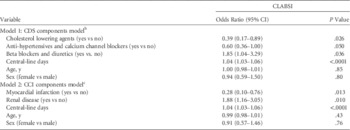
The multivariable CDS individual components model controlling for age and sex (Table 2) showed that medication use including cholesterol-lowering agents (OR, 0.39; 95% CI, 0.17–0.89) and antihypertensives, including calcium channel blockers (OR, .60; 95% CI, 0.36–1.0), had decreased risk for CLABSI. The use of beta blockers (OR, 1.85; 95%CI, 1.04–3.29) and a greater number of central-line days (OR, 1.04; 95% CI, 1.03–1.06) were associated with increased risk for CLABSI.
Multivariable Logistic Regression model Predicting Central-Line–Associated Blood Stream Infections (CLABSI) Predicted by (1) Chronic Disease Score (CDS) componentsFootnote a or (2) Charlson Comorbidity Index (CCI) componentsFootnote a

a Adjusted for age, sex, and central-line days.
b Model 1: CLABSI=Anti-lipid medications+antihypertensives+beta blockers+line days+age in years+sex. Generalized estimating equations were used to account for the non-independence of multiple data points from a given individual.
c Model 2: CLABSI=Myocardial infarction+renal disease+line days+age in years+sex. Generalized estimating equations were used to account for the non-independence of multiple data points from a given individual.
The multivariable CCI individual components model controlling for age and sex (Table 2) showed that myocardial infarction lowered risk for CLABSI (OR, 0.28; 95% CI, 0.10–0.76), while kidney disease (OR, 1.88; 95% CI, 1.16–3.05) and a greater number of central-line days (OR, 1.04; 95% CI, 1.03–1.06) were associated with increased risk for CLABSI.
DISCUSSION
We found that individual comorbid conditions obtained electronically by ICD-9 codes and admission medications can be used to identify factors for increased risk for CLABSI. The composite CDS and CCI scores were not risk factors. Additionally, we found that the number of central-line days was a predictor of CLABSI, consistent with other studies. It is important to remember that the study revealed statistical associations that may not imply causality. The risk factors identified should always be supported by biological plausibility or research that confirms these results.
This study has several limitations. First, it was performed at a single site, and we considered a relatively small number of CLABSI events (n=76). These study parameters limit the number of important comorbid conditions that can be identified and affect the generalizability of the results. Data regarding certain patient-level factors, such as line placement location and line care practices, were not available but have been associated with CLABSI in the literature. Additionally, the impact of multiple central venous catheters in place simultaneously was not taken into account.
Hospital electronic record capabilities are expanding, allowing healthcare workers to document the presence and or absence of central venous catheters on a daily basis. Hospital databases are becoming more readily accessible to hospital epidemiologists and infection preventionists. These hospital databases readily contain ICD-9 and ICD-10 codes and admission medications, which facilitates computation of the CCI, the CDS, and their components. Larger studies involving multiple U.S. hospitals could further our knowledge of risk factors for CLABSI and could ultimately lead to improvements in the current CDC NHSN risk adjustment methodology. The identification of risk factors for CLABSI can also lead to hospital epidemiology interventions aimed at preventing CLABSI among high-risk patients.
Acknowledgments
Financial support: J.D.S. received support from the Baltimore VA Medical Center Geriatric Research, Education, and Clinical Center (GRECC), and The University of Maryland Claude D. Pepper Older Americans Independence Center, NIA P30 AG028747; A.D.H. was supported by National Institutes of Health grant 5K24AI079040-05 and Agency of Healthcare Research and Quality(AHRQ) grant 5R01HS022291-02; and K.A.T. by National Institutes of Health grant 1K23AI082450-03.
Potential conflicts of interest: All authors report no conflicts of interest relevant to this article.