Maltreatment during childhood (i.e., abuse and/or neglect) is common and among the largest risk factors for adverse outcomes. By age 18, over 37% of children in the United States are investigated for maltreatment by child protective services (CPS); a third of these cases are substantiated (Kim, Wildeman, Jonson-Reid, & Drake, Reference Kim, Wildeman, Jonson-Reid and Drake2017). Consequences are severe and broad. Those who were abused/neglected have vastly increased odds and earlier onsets of later stress- and age-related disease and dysfunction (e.g., psychopathology, cardiovascular disease, and obesity; Batten, Aslan, Maciewjewski, & Mazure, Reference Batten, Aslan, Maciejewski and Mazure2004; McLaughlin et al., Reference McLaughlin, Greif Green, Gruber, Sampson, Zaslavsky and Kessler2012; Shields et al., Reference Shields, Hovdestad, Pelletier, Dykxhoorn, O'Donnell and Tonmyr2016). Further, each case of nonfatal childhood maltreatment is estimated to cost society $210,000 (in 2010 $; Fang, Brown, Florence, & Mercy, Reference Fang, Brown, Florence and Mercy2012). Given the widespread prevalence and consequences of childhood maltreatment, it is critical to understand factors associated with its expression so that strategies and policies may be put in place to mitigate its burden.
Intergenerational Transmission of Childhood Maltreatment
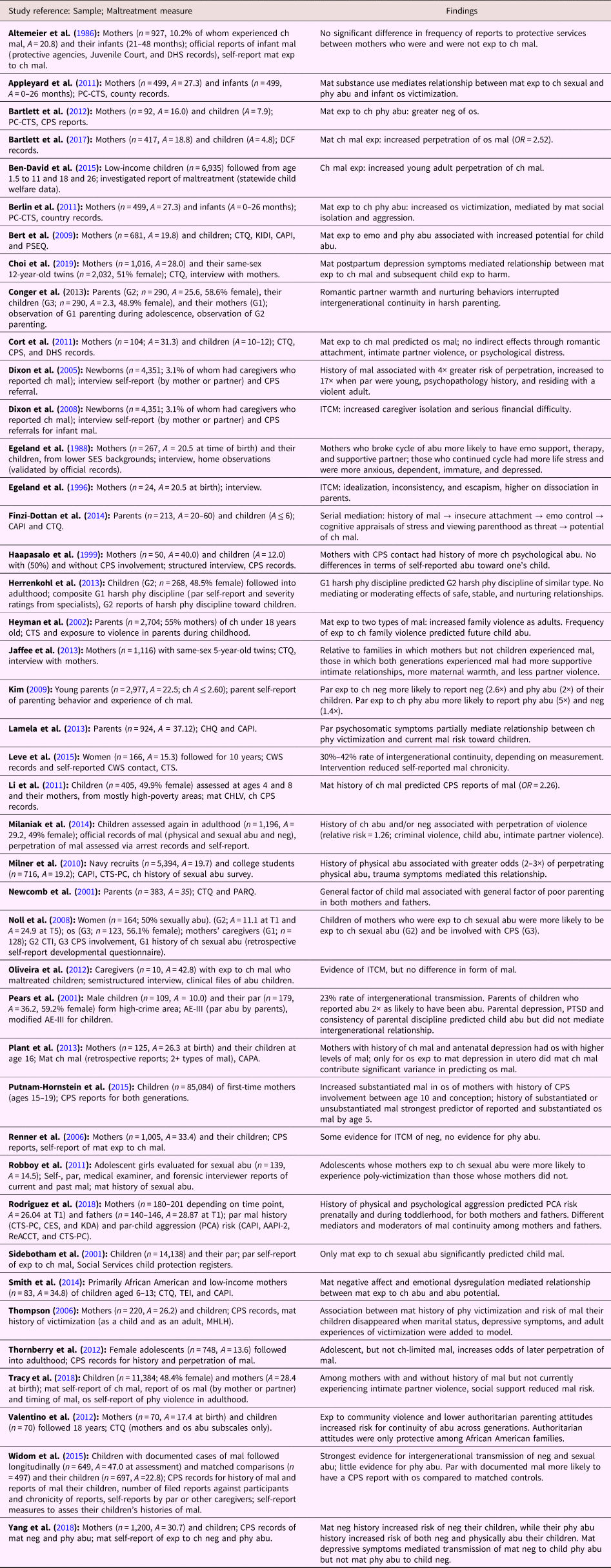
Maltreatment during childhood tends to aggregate within families (see Table 1 for a summary of research). Much of this work has focused on the intergenerational transmission of childhood maltreatment (ITCM) in vulnerable populations (e.g., young mothers, low socioeconomic status [SES], and criminality). For instance, in the largest study of ITCM, adolescent first-time mothers (n = 85,084) who were maltreated as children were more likely to be investigated for the perpetration of maltreatment by the time their children were 5 years old (substantiated hazard ratio: 3.19; unsubstantiated hazard ratio: 2.19; Putnam-Hornstein, Cederbaum, King, Eastman, & Trickett, Reference Putnam-Hornstein, Cederbaum, King, Eastman and Trickett2015). Comparably less work has been conducted in community and general population samples, but findings are similar. For example, in a sample drawn from a birth registry of British twins, children were more likely to be physically maltreated if their mother had experienced maltreatment (Jaffee et al., Reference Jaffee, Bowes, Ouellet-Morin, Fisher, Moffitt, Merrick and Arseneault2013). Parental history of childhood maltreatment is among the most potent risk factors for children to be maltreated, with evidence that its effect is even larger than other well-documented risk factors including poverty, criminality, and mental health conditions (Ben-David, Jonson-Reid, Drake, & Kohl, Reference Ben-David, Jonson-Reid, Drake and Kohl2015). This robust evidence (Table 1) suggests that understanding childhood maltreatment requires an intergenerational family-based perspective. However, there has been limited work evaluating whether ITCM is general and/or specific to unique forms of maltreatment and what potential factors may contribute to its continuity.
Prior studies of intergenerational transmission of childhood maltreatment

Note: AAPI-2, Adult Adolescent Parenting Inventory—2 (Bavolek & Keene, Reference Bavolek and Keene2001). AE-III, Assessing Environments—III questionnaire (Berger, Knutson, Mehm, & Perkins, Reference Berger, Knutson, Mehm and Perkins1988). CAPI, Child Abuse Potential Inventory (Milner, Reference Milner, Hilsenroth and Segal2004). CES, Compliance Expectations Scale (Rodriguez, Smith, & Silvia, Reference Rodriguez, Smith and Silvia2016). CHLV, Caregiver's History of Loss and Victimization (Hunter & Everson, Reference Hunter and Everson1991). CHQ, Childhood History Questionnaire (Milner, Robertson, & Rogers, Reference Milner, Robertson and Rogers1990). CIDI-SF, Composite International Diagnostic Interview—Short Form (Kessler, Andrews, Mroczek, Ustun, & Wittchen, Reference Kessler, Andrews, Mroczek, Ustun and Wittchen1998). CPS, Child Protective Services. CTQ, Childhood Trauma Questionnaire (Bernstein & Fink, Reference Bernstein and Fink1998). CTS, Conflict Tactics Scale (PC, primary caregiver; Straus, Reference Straus1979). CWS, Child Welfare Services. DCF, Department of Children and Families. KDA, Knowledge of Discipline Alternatives (Rodriguez et al., Reference Rodriguez2016). KIDI, Knowledge of Infant Development Inventory (MacPhee, Reference MacPhee1981). MHLH. Mother's History of Loss and Harm (Hunter & Everson, Reference Hunter and Everson1991). PARQ, Parental Acceptance-Rejection Questionnaire (Rohner, Reference Rohner1991). PSEQ, Parenting Style Expectations Questionnaire (Bavolek, Reference Bavolek1984). ReACCT, Response Analog to Child Compliance Task (Rodriguez, Reference Rodriguez2016). Mat, maternal. Exp, exposure. Abu, abuse. Neg, neglect. Ch, childhood. Mal, maltreatment. Os, offspring. Phy, physical. Emo, emotional. Par., parent. A, mean reported age, if not available, range is reported. Reported in years unless otherwise noted.
ITCM: Maltreatment Specificity
Theoretical models pioneered by McLaughlin, Sheridan, and Lambert (Reference McLaughlin, Sheridan and Lambert2014) speculate that distinct forms of childhood maltreatment may be associated with unique pathways to both shared and distinct outcomes. These models postulate that threat experiences (e.g., abuse) disrupt social and emotional processing, while deprivation (e.g., neglect) alters cognitive development to increase risk for psychopathology. However, whether ITCM represents continuity of nonspecific childhood maltreatment or is associated with specific types of maltreatment remains uninvestigated.
Research on ITCM has evaluated broad dimensions of maltreatment (e.g., all abuse and all neglect), multiple specific subtypes (e.g., physical and emotional abuse and neglect and sexual abuse), or only one specific subtype (e.g., physical abuse) independently. Generally, this work provides evidence for the intergenerational transmission of homotypic (i.e., association of the same subtype of maltreatment across generations) and heterotypic (i.e., association of different subtypes of maltreatment across generations) childhood maltreatment (Table 1). For example, in the Add Health study, young parents (n = 2,977) who were neglected and/or abused as children were more likely to endorse being abusive and/or neglectful to their infants/toddlers (Kim, Reference Kim2009). While some work has examined whether ITCM is characterized by nonspecific and maltreatment type specificity in the context of a single study (e.g., Widom, Czaja, & DuMont, Reference Widom, Czaja and DuMont2015), no studies, to our knowledge, have examined whether specific forms of childhood maltreatment exert unique patterns of association across generations above and beyond nonspecific maltreatment. We are aware of only one study that has tangentially tested this question; in that study, Newcomb and Locke (Reference Newcomb and Locke2001) found evidence that increased childhood maltreatment as assessed using a general latent factor was linked to poor parenting, but that maternal history of neglect was associated with poor parenting over and above the latent general maltreatment factor.
Borderline Personality Pathology: A Potential Mediator of Intergenerational Childhood Maltreatment
Borderline personality pathology (BPP), which is characterized by pervasive emotion dysregulation, impulsivity, distress intolerance, inconsistent appraisals of others, feelings of isolation, and unstable interpersonal relationships, is a promising potential contributor to ITCM. Both retrospective and prospective data reveal that maltreatment during childhood is strongly associated with BPP and that this relationship remains even after accounting for other forms of psychopathology (e.g., depression) related to both early life stress and BPP (Gratz, Tull, Baruch, Bornovalova, & Lejuez, Reference Gratz, Tull, Baruch, Bornovalova and Lejuez2008; Hernandez, Arntz, Gaviria, Labad, & Gutiérrez-Zotes, Reference Hernandez, Arntz, Gaviria, Labad and Gutiérrez-Zotes2012; Ibrahim, Cosgrave, & Woolgar, Reference Ibrahim, Cosgrave and Woolgar2018; Joyce et al., Reference Joyce, Mckenzie, Luty, Mulder, Carter, Sullconwayivan and Robert Cloninger2003; Stone, Reference Stone1981). For example, Zanarini et al. (Reference Zanarini, Williams, Lewis, Reich, Vera, Marino and Frankenburg1997) found that 90% of patients with borderline personality disorder were exposed to childhood maltreatment and that they were more likely to be exposed than patients with other personality disorder diagnoses.
A comparatively small literature suggests that parents with BPP are more likely to be investigated for perpetrating childhood maltreatment by CPS, even after accounting for their own maltreatment (Bools, Neale, & Meadow, Reference Bools, Neale and Meadow1994; Laporte, Reference Laporte2009; Perepletchikova, Ansell, & Axelrod, Reference Perepletchikova, Ansell and Axelrod2012). These findings are buttressed by evidence that BPP is associated with factors that mediate ITCM or have been associated with risk for maltreatment exposure in one's children (e.g., young parenthood, single parenthood, substance use disorder, depression, interpersonal stress and violence, stress exposure, familial instability, and domestic violence; Chan, Reference Chan2011; Conway, Boudreaux, & Oltmanns, Reference Conway, Boudreaux and Oltmanns2018; Daley, Burge, & Hammen, Reference Daley, Burge and Hammen2000; De Genna, Feske, Larkby, Angiolieri, & Gold, Reference De Genna, Feske, Larkby, Angiolieri and Gold2012; Grant et al., Reference Grant, Chou, Goldstein, Huang, Stinson, Saha and Pickering2008; Hopwood, Donnellan, & Zanarini, Reference Hopwood, Donnellan and Zanarini2010; Liebke et al., Reference Liebke, Bungert, Thome, Hauschild, Gescher, Schmahl and Lis2016; Martín-Blanco et al., Reference Martín-Blanco, Ferrer, Soler, Salazar, Vega, Andión and Pascual2014; Radtke et al., Reference Radtke, Schauer, Gunter, Ruf-Leuschner, Sill, Meyer and Elbert2015; Skodol et al., Reference Skodol, Stout, McGlashan, Grilo, Gunderson, Shea and Oldham1999; Smith et al., Reference Smith, Cross, Winkler, Jovanovic and Bradley2014; Weinstein, Gleason, & Oltmanns, Reference Weinstein, Gleason and Oltmanns2012; Wilson, Stroud, & Durbin, Reference Wilson, Stroud and Durbin2017). For example, individuals with BPP are more likely to end long-term relationships and voluntarily or involuntarily lose custody of their children (Zanarini et al., Reference Zanarini, Frankenburg, Reich, Wedig, Conkey and Fitzmaurice2014), and single parenthood is associated with heightened risk for childhood maltreatment (Gelles, Reference Gelles1989; Schneider, Reference Schneider2017). Moreover, BPP and childhood maltreatment exposure also share similar associations with other outcomes (e.g., impulsivity, emotional instability, relationship issues, substance use, and epigenetic signatures within the glucocorticoid receptor gene NR3C1; Dammann et al., Reference Dammann, Teschler, Haag, Altmüller, Tuczek and Dammann2011; Geiger & Crick, Reference Geiger, Crick and Ingram2001; Martín-Blanco et al., Reference Martín-Blanco, Ferrer, Soler, Salazar, Vega, Andión and Pascual2014; Rogosch & Cicchetti, Reference Rogosch and Cicchetti2005; Weaver et al., Reference Weaver, Cervoni, Champagne, D'Alessio, Sharma, Seckl and Meaney2004). Collectively, these convergent data suggest that BPP may plausibly contribute to the propagation of childhood maltreatment across generations.
Influential biosocial developmental models of BPP provide a framework for understanding how BPP might contribute to ITCM (Crowell, Beauchaine, & Linehan, Reference Crowell, Beauchaine and Linehan2009; Linehan, Reference Linehan1993). These theoretical models postulate that genetically driven vulnerability for dysregulated emotion and environmental sensitivity interact with an invalidating environment characterized by maltreatment to promote the development of BPP. Accordingly, the moderate heritability of BPP (Reichborn-Kjennerud et al., Reference Reichborn-Kjennerud, Ystrom, Neale, Aggen, Mazzeo, Knudsen and Kendler2013) may be passed from parents to offspring, leading to the expression of related prodromal temperamental traits in children (e.g., dysregulated emotion and stress sensitivity) that may evoke childhood maltreatment and inconsistent caregiver practices, especially among caregivers with BPP traits. This invalidating early environment may then potentiate BPP development in offspring already at risk by encouraging dysregulated and volatile emotion by inconsistently reinforcing and punishing emotional expression (Crowell et al., Reference Crowell, Beauchaine and Linehan2009; Gunderson & Lyons-Ruth, Reference Gunderson and Lyons-Ruth2008; Linehan, Reference Linehan1993).
Consistent with this model, emotion dysregulation, a core component of BPP, among parents has been associated with their invalidation of adolescent emotion expression (a tenet of emotional abuse), which is further linked to BPP-related characteristics (e.g., poor emotion regulation; Buckholdt, Parra, & Jobe-Shields, Reference Buckholdt, Parra and Jobe-Shields2013). Further, dysregulated emotion is associated with the propagation of maltreatment across generations (Smith et al., Reference Smith, Cross, Winkler, Jovanovic and Bradley2014) and indirectly links childhood emotional abuse to unhealthy relationship characteristics, such as intimate partner violence (Berzenski & Yates, Reference Berzenski and Yates2010), which, in turn, indirectly links maltreatment across generations (Rodriguez, Silvia, Gonzalez, & Christl, Reference Rodriguez, Silvia, Gonzalez and Christl2018). Together, theoretical work supported by empirical data raise the intriguing possibility that BPP may indirectly link childhood maltreatment across generations. Such an indirect effect might reflect a behavioral mechanism underlying ITCM and/or common factors associated with exposure to childhood maltreatment (in both generations) as well as BPP expression.
The Current Study
Among a representative community sample (n = 937) of older parents (n = 364, age: 66.68 ± 3.01) and their adult children (n = 573, age: 38.67 ± 7.39 years), we tested whether ITCM is general and/or specific to certain forms, and whether parental BPP mediates this continuity. Based on work suggesting general maltreatment continuity and heterotypic associations across distinct forms of child maltreatment, we hypothesized that nonspecific childhood maltreatment would be transmitted across generations with little evidence that unique specific forms of maltreatment are. Further, because BPP is associated with both exposure to childhood maltreatment and risk factors for its perpetuation, we expected that it would mediate childhood maltreatment continuity across generations.
Method
Participants and procedure
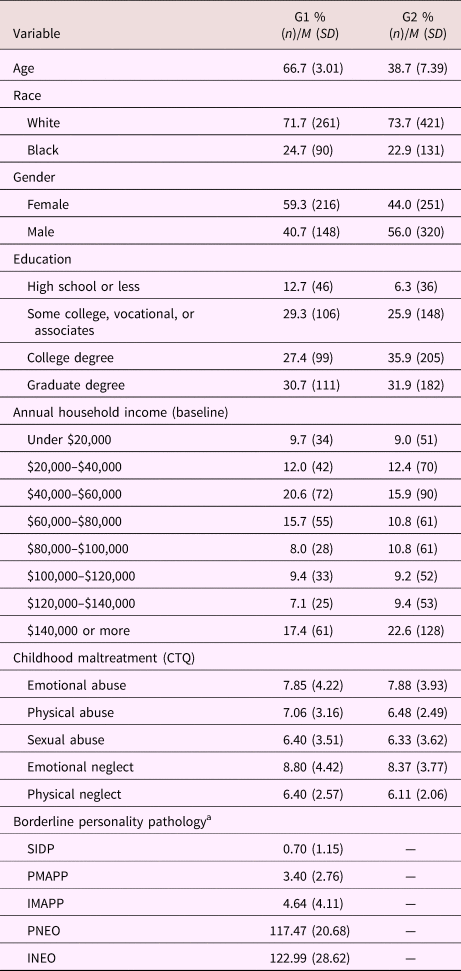
Participants (n = 937; Table 2) included 364 parents (G1; age 66.68 ± 3.01 years, 59.44% female, 71.70% White) and 573 of their biological adult children (G2; age 38.67 ± 7.39 years, 43.96% female, 73.73% White). These families were recruited from the St. Louis Personality and Aging Network (SPAN) study, which examines personality, health, biomarkers, and aging in later life (Oltmanns, Rodrigues, Weinstein, & Gleason, Reference Oltmanns, Rodrigues, Weinstein and Gleason2014). Of the original 659 SPAN participants (G1) who reported having biological children, 543 (82%) provided permission to contact their G2 offspring (465 provided contact information for all of their children, 78 provided contact information for some of their children). G2 participants were called or e-mailed up to five times inviting them to participate in our study. Of the potential 855 G2 participants, 610 (71%) completed questionnaires (through mail or online surveys) about themselves as well as their children (G3).Footnote 1 Data from G1 participants were drawn from SPAN. In cases where G1 participants had insufficient or missing maltreatment reports, observations were excluded from analyses. Participants provided informed consent to a protocol approved by the Washington University in St. Louis Institutional Review Board. G2 participants were compensated $30 for returning questionnaires. G1 participants received $60 for completing each in-person SPAN session.
Demographic and study characteristics of G1 and G2 generations

Note: G1, parents. G2, children. CTQ, Childhood Trauma Questionnaire. SIDP, Structured Interview for DSM-IV Personality. PMAPP, participant-rated Multisource Assessment of Personality Pathology. IMAPP, informant-rated Multisource Assessment of Personality Pathology. PNEO, participant-rated Revised NEO Personality Inventory. INEO, informant-rated Revised NEO Personality Inventory. aTotal scores, averaged across the three time points.
Measures
Childhood maltreatment
Self-reported childhood maltreatment experienced by G1 and G2 participants was assessed using the 28-item Childhood Trauma Questionnaire (CTQ; Bernstein & Fink, Reference Bernstein and Fink1998). It is composed of five subscales, which had good to excellent internal consistency across both generations in our sample, sexual abuse: αs = 0.92 (G1), 0.94 (G2); emotional neglect: αs = 0.91, 0.88; emotional abuse: αs = 0.89, 0.87; physical abuse: αs = 0.81, 0.73; and physical neglect: αs = 0.76, 0.67.
Given evidence that CTQ subscales represent a general factor of childhood maltreatment (Spinhoven et al., Reference Spinhoven, Penninx, Hickendorff, van Hemert, Bernstein and Elzinga2014; Pezzoli, Antfolk, Hatoum, & Santtila, Reference Pezzoli, Antfolk, Hatoum and Santtila2018), we used Mplus v. 7.3 software (Muthén & Muthén, Reference Muthén and Muthén1998–2012) to conduct confirmatory bifactor analyses of G1 data using mean and variance-adjusted weighted least squares and G2 data, nested by family, using maximum likelihood estimation with robust standard errors. Variances of the general and group specific factors were set to 1 and correlations between factors to 0, producing a general factor on which all items are permitted to load (representing shared variance among indicators) as well as second factors representing unique variance among sets of items with similar content. Thus, we modeled a single global factor of childhood maltreatment, as assessed by all CTQ items (n = 25) contributing to the five subscales, as well as five group-specific factors, as assessed by the five CTQ items composing each subscale. Model fit was acceptable to excellent in both G1 and G2: root mean square error of approximation = 0.05 (G1), 0.05 (G2); comparative fit index = 0.99, 0.94; Tucker–Lewis index = 0.98, 0.85. However, one item (Item #14; family members saying hurtful or insulting things, part of the emotional abuse subscale) was removed from G1 data because it resulted in negative residual variance. Factor loadings on the general factor were moderate to large in both generations (G1: M = 0.70, range = 0.44 to 0.91; G2: M = 0.50, range = 0.22 to 0.78). Subscale-specific factor loadings were generally lower (G1: emotional abuse M = 0.18, range = 0.047–0.33; physical abuse M = 0.51, range = 0.38 to 0.65; sexual abuse M = 0.75, range = 0.63 to 0.81; emotional neglect M = 0.43, range = 0.32 to 0.55; physical neglect M = 0.37, range = 0.22 to 0.59. G2: emotional abuse M = 0.34, range = 0.16 to 0.52; physical abuse M = 0.43, range = 0.35 to 0.57; sexual abuse M = 0.78, range = 0.61 to 0.87; emotional neglect M = 0.42, range = 0.24 to 0.62; physical neglect M = 0.34, range = 0.14 to 0.6). Following evidence that a general single latent factor represented these data well, we also constructed CTQ total scores (with and without log-transformation), consistent with prior work (MacDonald et al., Reference MacDonald, Thomas, Sciolla, Schneider, Pappas, Bleijenberg and Wingenfeld2016; Schmidt, Narayan, Atzl, Rivera, & Lieberman, Reference Schmidt, Narayan, Atzl, Rivera and Lieberman2018), so that our results would be more readily combined with and interpreted alongside other studies.
BPP
As described in our prior work (Conway, Boudreaux, & Oltmanns, Reference Conway, Boudreaux and Oltmanns2018; Di Iorio et al., Reference Di Iorio, Boudreaux, Winstone, Chang, Michalski, Cruitt and Bogdan2018) borderline pathology was assessed in G1 participants dimensionally from multiple perspectives (i.e., clinician, self, and informant ratings) across time. Because many people exhibit at least some personality pathology symptoms (Oltmanns et al., Reference Oltmanns, Rodrigues, Weinstein and Gleason2014) and subthreshold borderline personality disorder symptoms are associated with psychosocial impairment (Ellison, Rosenstein, Chelminksi, Dalrymple, & Zimmerman, Reference Ellison, Rosenstein, Chelminski, Dalrymple and Zimmerman2016; Zimmerman, Chelminksi, Young, Dalrymple, & Martinez, Reference Zimmerman, Chelminski, Young, Dalrymple and Martinez2013), scores were treated continuously to retain variation at subthreshold diagnostic levels. Borderline pathology was assessed using multiple sources and methods to improve our coverage of subthreshold presentations. Informant reports were included because they add unique information about an individual's personality that the participant may be unable or unwilling to report (Oltmanns & Turkheimer, Reference Oltmanns, Turkheimer, Krueger and Tackett2006) and are predictive of health outcomes over and above self-report (Cruitt & Oltmanns, Reference Cruitt and Oltmanns2018). Interviewer ratings of BPP were acquired using the Structured Interview for DSM-IV Personality (SIDP-IV; Pfohl, Blum, & Zimmerman, Reference Pfohl, Blum and Zimmerman1997); self-reports and informant reports were collected using the Revised NEO Personality Inventory (NEO PI-R; Costa & McCrae, Reference Costa and McCrae1992) and the Multisource Assessment of Personality Pathology (MAPP; Oltmanns, Turkheimer, & Strauss, Reference Oltmanns, Turkheimer and Strauss1998). Interviewer ratings and self-reports were collected at three in-person sessions from participants: baseline (the initial session), and the first and second in-person follow-up session (IPFU1 and IPFU2, respectively). IPFU1 occurred 0.72–6.65 (M = 2.83) years following the baseline session; IPFU2 occurred 0.29–6.33 (M = 3.93) years following IPFU1. Informant reports were collected at these same times through mail or email.
Clinical interview
The SIDP-IV is a semistructured interview in which trained interviewers rate 80 items corresponding to criteria of the 10 personality disorders on a scale of 0 (no pathology present) to 3 (pathology strongly present). SIDP scores were treated continuously by summing responses across the 9 borderline personality disorder (BPD) criteria at each assessment (range: 0–4; n = 67; 18.41% met at least one criterion at one or more assessments; M ± SD: baseline: 0.140 ± 0.457; IPFU1: 0.123 ± 0.448; IPFU2: 0.122 ± 0.468). Trained full-time staff members, graduate students in clinical psychology, or undergraduate research assistants conducted all interviews. Interrater reliability ratings from a selected subsample of 265 video-recorded baseline interviews show excellent agreement (intraclass correlation coefficient: 0.77; Oltmanns et al., Reference Oltmanns, Rodrigues, Weinstein and Gleason2014).
Self-report and informant report
In addition to self-report, we also acquired informant-report of G1 personality. Most (95%) participants had an associated informant consent to the SPAN protocol and report on their (i.e., the participant's) personality at the baseline assessment (informant n = 344; age: M = 59.81, SD = 12.15; 65.41% female, 72.30% European American, 24.78% African American). Informants knew the participant for an average of 32.86 years (SD = 13.10) at the baseline SPAN assessment. Most were a spouse or romantic partner (54.65%, n = 188), other family member (29.07%, n = 100), or friend (14.53%, n = 50), with the remainder consisting of neighbors, co-workers, or other acquaintances (1.74%, n = 6). Informants completed questionnaires about their associated participant through the mail or online at baseline, IPFU1, and IPFU2 sessions and received $30 remuneration.
The NEO PI-R (Form S for self; Form R for informant) consists of 240 items assessing the five domains of neuroticism, extraversion, openness, agreeableness, and conscientiousness, as well as six lower-order facets within each domain. NEO PI-R borderline scores were generated independently for self-report and informant report by summing anxiety, angry hostility, depression, impulsiveness, vulnerability, openness to feelings, openness to actions, compliance (reverse scored), and deliberation (reverse scored) facet scale scores within each assessment (self-report: range 57.80–225.00, baseline: 117.70 ± 21.79; IPFU1: 115.80 ± 21.41; IPFU2: 118.90 ± 22.53; informant-report: range 44.00–252.00, baseline: 123.60 ± 29.68, IPFU1: 123.70 ± 30.03; IPFU2: 121.470 ± 30.66; Miller, Reynolds, & Pilkonis, Reference Miller, Reynolds and Pilkonis2004). The MAPP is an 80-item measure of personality pathology based on lay translations of DSM-IV personality disorder diagnostic criteria. Self and informant MAPP BPD scores were calculated by summing responses across the 9 BPD items (self: range: 0–5; n = 117; 32.14% met at least one criterion at one or more assessments; baseline: 0.225±0.559; IPFU1: 0.156 ± 0.461; IPFU2: 0.278 ± 0.619; informant: range: 0–8; n = 161; 44.23% met at least one criterion at one or more assessments; baseline: 0.417 ± 0.850 IPFU1: 0.462 ± 1.08; IPFU2: 0.438 ± 0.966).
We performed an exploratory structural equation modeling analysis on BPP scores derived from clinician-based interview (SIDP-IV) and self-report and informant-report (NEO PI-R and MAPP) data across all assessment times (baseline, IPFU1, and IPFU2) using maximum likelihood estimation in Mplus 7.3 (Muthén & Muthén, Reference Muthén and Muthén1998–2012). We hypothesized a one-factor model to account for the correlations among the 15 BPP measures (i.e., self-report and informant report and clinician ratings at baseline, IPFU1, and IPFU2 sessions), which fit the data well (mean square error of approximation = 0.056, comparative fit index = 0.976, Tucker–Lewis index = 0.955) with factor loadings ranging from 0.45 to 0.70. Estimated factor scores were used to represent BPP in all subsequent analyses.
Other relevant covariates
Race, ethnicity, and gender were assessed via self-report. Participants were asked to choose from eight options to identify their race (e.g., “White, Caucasian,” or “Black, African American,” “Other”), and were further asked to indicate whether they were Hispanic. Due to the low prevalence of races other than White and Black and endorsement of being Hispanic (Table 2), the present study formed one dichotomous variable indicating status as White/non-White and did not consider Hispanic/non-Hispanic. Gender was assessed via self-report. SES was formed as a composite measure of household annual income and level of education, each assessed via self-reported choice from nine and eight ranked options, respectively, and standardized prior to being summed.
Statistical analyses
As the sample contains parents and one or more of their offspring, linear mixed-effect models were used to nest data according to family (random factor), when examining G1–G2 associations, to account for the nonindependence of measurement across generations using the lme4 R package (Bates, Maechler, Bolker, & Walker, Reference Bates, Maechler, Bolker and Walker2015). The following fixed-effect covariates were included in models: G1 age, sex, race (White/non-White), SES (in all analyses); G2 age and sex (in all analyses involving G2). We first tested whether CTQ subscale summary scores (i.e., emotional abuse, physical abuse, sexual abuse, emotional neglect, and/or physical neglect) show evidence of intergenerational association before examining whether childhood maltreatment factors unique to these subscales have generational continuity. To correct for the 25 associations tested, each of these analyses was subjected to Benjamini and Hochberg (Reference Benjamini and Hochberg1995) false discovery rate correction.
Given evidence of nonspecific association across CTQ subscales and limited evidence that unique subscale-specific factors showed intergenerational continuity (see Results section), we examined relationships between G1 childhood maltreatment (i.e., CTQ summed scores), G1 borderline personality pathology (factor score), and G2 childhood maltreatment (i.e., CTQ summed scores) using false discovery rate adjustment to account for these three comparisons. Subsequently, we evaluated our hypothesized mediational model by testing whether G1 BPP indirectly links childhood maltreatment experienced by G1 to childhood maltreatment experienced by G2 in a 2–2–1 multilevel mediational model clustered by family using Mplus v. 7.3 software (Muthén & Muthén, Reference Muthén and Muthén1998–2012). As with the linear mixed-effects models, demographic variables were included as covariates on G1 BPP (m; G1 age, sex, race, and SES) and G2 childhood maltreatment (y; G1 age, sex, race, SES, and G2 age and sex).
Results
Childhood maltreatment: General and specific associations across generations
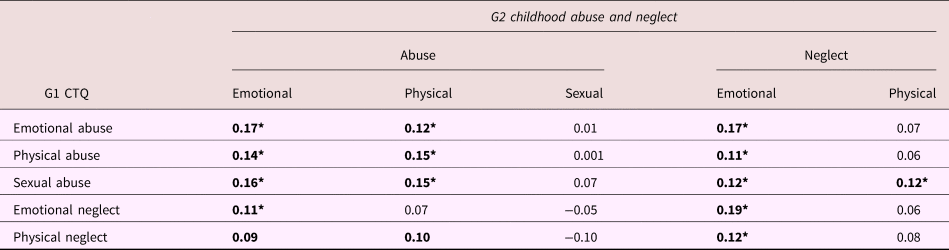
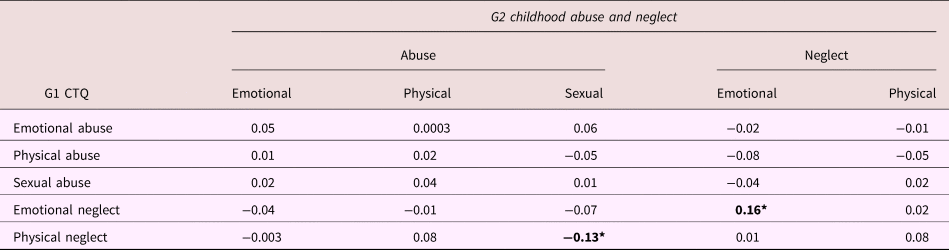
Associations between CTQ summed subscales and unique CTQ subscale factors are summarized in Tables 3–4. Broadly, with the exception of sexual abuse in G2, specific CTQ subscale total scores (i.e., emotional and physical abuse and neglect) showed evidence of homotypic and heterotypic association across generations (Table 3). However, unique subscale-specific factor scores orthogonal to a general CTQ factor revealed little evidence of intergenerational association, with the only exceptions being heterotypic associations of G1 physical neglect and G2 sexual abuse (p = 3.69 × 10⁻³; p fdr = .0461), and homotypic associations of childhood emotional neglect across generations (p = 2.05×10⁻⁴; p fdr = 5.13 × 10⁻³; Table 4).Footnote 2 Post hoc analyses revealed no evidence that BPP mediated the association between the homotypic emotional neglect association across generations (indirect effects b = 0.013, 95% CI [–0.005, 0.032], p = .159) or the association between G1 physical neglect and G2 sexual abuse (indirect effects b = 0.024, 95% CI [–0.002, 0.029], p = .096). Unlike unique subscale factors, exposure to general childhood maltreatment, as measured using the general latent factor, was positively coupled across generations (b = 0.0233, SE = 0.00817, p = 4.50×10⁻³).
CTQ subscale summary score associations across generations

Note: N = 568; k = 362, where k = number of families. CTQ, Childhood Trauma Questionnaire. *p fdr < .05. G1 and G2 age, sex, and race, and G1 socioeconomic status were included as covariates. All estimates reflect standardized values.
Unique CTQ subscale factor score associations across generations

Note: N = 568; k = 362, where k = number of families. CTQ, Childhood Taruma Questionnaire. *p fdr < .05. G1 and G2 age, sex, and race, and G1 socioeconomic were included as covariates. All estimates reflect standardized values.
BPP: A mediator of ITCM
The experience of childhood maltreatment (i.e., total CTQ scores) was positively coupled across generations (without fixed-effect covariates: b = 0.203, SE = 0.0368, p = 8.34 × 10⁻⁸, p fdr = 1.25 × 10⁻⁷; with fixed-effect covariates: b = 0.126, SE = 0.0375, p = 9.21×10⁻⁴, p fdr = 9.21 × 10⁻⁴). Further, parent BPP was positively associated with their own prior exposure to maltreatment during childhood as well as their children's exposure (G1 without covariates: b = 0.0206, SE = 0.00235, p < 2.22 × 10⁻¹⁶, p fdr = 6.66 × 10⁻¹⁶ with covariates; b = 0.0198, SE = 0.00320, p = 1.60 × 10⁻⁹, p fdr = 4.80 × 10⁻⁹; G2 without fixed-effect covariates: b = 2.714 SE = 0.613, p = 1.28 × 10⁻⁵, p fdr = 1.28 × 10⁻⁵; with fixed-effect covariates: b = 2.162, SE = 0.600, p = 3.62 × 10⁻⁴, p fdr = 5.43 × 10⁻⁴).
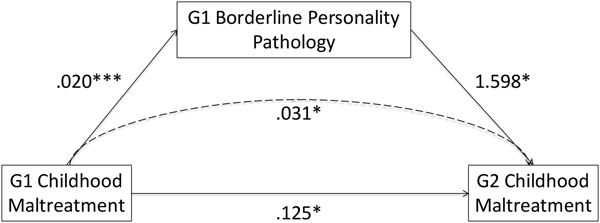
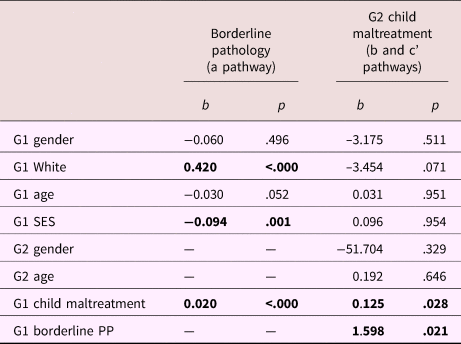
G1 BPP indirectly linked nonspecific childhood maltreatment (i.e., CTQ total scores) experienced by G1 to nonspecific childhood maltreatment experienced by G2 (Figure 1; Table 3; b = 0.031, 95% CI [0.003, 0.060], p = .030). G1 childhood maltreatment was positively coupled with G1 BPP (a pathway: b = 0.020, 95% CI [0.013, 0.027], p < .001), which was associated with G2 childhood maltreatment (b pathway: b = 1.598, 95% CI [0.241, 2.955], p = .021) and indirectly linked G1 to G2 childhood maltreatment (c’ pathway: b = 0.125, 95% [CI 0.013, 0.236], p = .021; c pathway: b = 0.142, 95% CI [0.055, 0.230], p = .001). Results of the mediational model were consistent when using log-transformed CTQ total scores (indirect effect: b = 0.038, 95% CI [0.007, 0.069], p = .015; c’ pathway: b = 0.116, 95% CI [0.028, 0.205], p = .010; c pathway: b = 0.153, 95% CI [0.059, 0.247], p = .001).
Parental borderline personality pathology indirectly links childhood maltreatment across generations. G1 childhood maltreatment is associated with G1 borderline personality pathology (path a), which is associated with G2 childhood maltreatment (path b). The association between G1 and G2 childhood maltreatment (path c: b = 0.142, p < .001) is attenuated by the inclusion of G1 borderline personality pathology as a mediator (path c’). G1 and G2 childhood maltreatment represent latent general factors of childhood maltreatment generated from all CTQ items. G1 borderline personality pathology represents a latent borderline personality pathology factor gleaned from borderline personality scores on the SIDP, participant- and informant-rated MAPP, and NEO-PI-R Personality Disorder Count Scores. This mediation model includes the following covariates: G1 and G2 age, gender, race/ethnicity (White, Black, and Hispanic), and G1 socioeconomic status (a summed score of standardized education level and annual household income). * p < .05 *** p < .001.

Discussion
We evaluated whether ITCM is nonspecific and whether parental BPP mediates this continuity. Three primary findings emerged. First, we replicated a wealth of literature showing that childhood maltreatment is shared across generations (Table 1). Second, we found homotypic and heterotypic maltreatment type associations across generations (Table 3) with evidence that ITCM is largely shared across forms of maltreatment. Further, with the exception of a homotypic association of emotional neglect and a heterotypic association of G1 physical neglect and G2 sexual abuse, no specific forms of childhood maltreatment showed unique evidence of continuity across generations (Table 4). Third, parental borderline pathology partially mediated the association of global childhood maltreatment across generations (Figure 1; Table 5). Collectively, these data suggest that childhood maltreatment, broadly defined, is shared across generations and that parental BPP may represent a shared risk factor associated with ITCM and/or a putative behavioral mechanism.
Mediation model statistics: G1 borderline personality pathology indirectly links childhood maltreatment across generations

Note: b, unstandardized beta regression coefficient. p, p value of association. SES, socioeconomic status. PP, personality pathology. c'pathway: b = 0.125, 95% CI [0.013, 0.236], p = .021; c pathway: b = 0.142, 95% CI [0.055, 0.230], p = .001. Table represents model in which CTQ was not transformed. Excluding G2 sex does not change other associations; further, with the log transformed outcome this beta is within the expected range (b = −0.264).
The intergenerational transmission of broad-spectrum childhood maltreatment
The vast majority of childhood maltreatment research, including that on ITCM, has examined specific forms of maltreatment independently. While this approach is intuitively appealing, it does not account for common exposure to multiple forms of maltreatment and provides limited information with regard to the specificity of associations with distinct forms of childhood maltreatment.Footnote 3 Most individuals maltreated during childhood are exposed to multiple forms of abuse and neglect, and evidence indicates that a single general latent factor characterizes overall exposure well (Green et al., Reference Green, McLaughlin, Berglund, Gruber, Sampson, Zaslavsky and Kessler2010; Kristjansson et al., Reference Kristjansson, McCutcheon, Agrawal, Lynskey, Conroy, Statham and Nelson2016; Pezzoli et al., Reference Pezzoli, Antfolk, Hatoum and Santtila2018; Spinhoven et al., Reference Spinhoven, Penninx, Hickendorff, van Hemert, Bernstein and Elzinga2014). Further, while limited studies have adopted such an approach, available evidence suggests that a general indicator of early life stress is associated with psychopathology, while unique aspects of specific forms of maltreatment are not (Green et al., Reference Green, McLaughlin, Berglund, Gruber, Sampson, Zaslavsky and Kessler2010). Building on these findings, we find that broad exposure to childhood maltreatment is transmitted across generations with little evidence of unique distinct homotypic continuity. However, it may be that disentangling homotypic and heterotopic patterns of ITCM unique to specific forms of maltreatment requires much larger samples due to observed small effects.
Of note, unique aspects of emotional neglect unshared with the general childhood maltreatment factor showed evidence of homotypic continuity across generations (Table 4). While this finding was not hypothesized, the association survived correction for multiple testing and is broadly consistent with one prior study, in which maternal history of emotional neglect during childhood predicted poor parenting over and above a general maltreatment factor (Newcomb & Locke, Reference Newcomb and Locke2001). Measurement and construct definitions of emotional neglect may contribute to this finding. With respect to measurement, emotional neglect is assessed on the CTQ entirely with reverse-scored items (e.g., “I felt loved” and “My family was a source of strength and support”), which might constitute a relatively indirect measure of maltreatment that is conceivably more commonly endorsed outside of exposure to other forms (e.g., abuse; Spinhoven et al., Reference Spinhoven, Penninx, Hickendorff, van Hemert, Bernstein and Elzinga2014). As a construct, some evidence suggests that neglect may be more specifically transmitted across generations than abuse; for example, Yang, Font, Ketchum, and Kim (Reference Yang, Font, Ketchum and Kim2018) found that parental history of neglect (broadly conceived) was associated with neglect but not physical abuse in the next generation, while physical abuse was associated with both neglect and physical abuse. However, it is possible that differential endorsement rates between neglect and abuse could underlie these differential associations. Emotional neglect may be the most difficult form of maltreatment to define; unlike abuse, emotional neglect is often more chronic and less easily traced to specific instances, and there is a lack of consensus about what constitutes healthy emotional support (Stowman & Donohue, Reference Stowman and Donohue2005).
Finally, we observed a heterotypic association between unique aspects of physical neglect in G1 and unique aspects of sexual abuse in G2 that was negative (Table 4). This diverges from prior evidence documenting that neglect in one generation is positively correlated with sexual abuse in the subsequent one within documented cases of maltreatment (Widom et al., Reference Widom, Czaja and DuMont2015). While our unanticipated finding survived multiple testing correction and had a similar directional pattern of association in subscale tests (i.e., subscales not orthogonal to general childhood maltreatment; Table 3), it should be noted that physical neglect and sexual abuse were the least highly endorsed subscales in this sample and further that physical neglect had the lowest internal consistency (see Methods section), which may contribute to imprecise estimates of association.
BPP: A putative mediator of childhood maltreatment generational continuity
Clinical and subclinical forms of BPP are associated with exposure to abuse and neglect in childhood and the perpetration of offspring maltreatment in parents (e.g., Ibrahim et al., Reference Ibrahim, Cosgrave and Woolgar2018; Perepletchikova et al., Reference Perepletchikova, Ansell and Axelrod2012). Our study critically extends this literature by showing that parental BPP mediates ITCM. Multiple, non-mutually exclusive pathways may contribute to this observation.
Consistent with theoretical models (e.g., Linehan, Reference Linehan1993) hypothesizing that childhood maltreatment plays a causal role in the development of BPP and associated evidence relating stressful family environments and predispositions for emotion dysregulation to the development of BPP, our findings show that maltreatment is associated with BPP development. In turn, the expression of BPP is associated with a heightened likelihood that one's children are exposed to abuse or neglect. A series of observations arising from epigenetic studies are consistent with theoretical models suggesting that childhood maltreatment may play a causal role in the development of BPP, which may, in turn, contribute to maltreatment in the subsequent generation. Studies in rodents have shown that maternal care affects later adult parenting behavior through epigenetic regulation of the glucocorticoid receptor gene (NR3C1) to influence stress-related cortisol function (Weaver et al., Reference Weaver, Cervoni, Champagne, D'Alessio, Sharma, Seckl and Meaney2004). Specifically, cross fostering studies in rats show that pups raised by mothers who provide less maternal care (i.e., less licking and grooming and arched back nursing) are characterized by epigenetic changes resulting in an impaired ability to return to homeostasis following stress exposure. These changes persist throughout the rat's life span and promote stress-sensitive behavior and reduced maternal care of the subsequent generation; hence, less caring mothers beget relatively stress-sensitive pups that become less caring mothers through experience-dependent mechanisms. However, this generational continuity can be disrupted; a pup born to a less caring mother who is subsequently raised by a more caring mother is characterized by epigenetic signatures associated with stress-resilience and increased maternal care in a subsequent generation. A human postmortem study suggests that this mechanism may be conserved across species (McGowan et al., Reference McGowan, Sasaki, D'Alessio, Dymov, Labonté, Szyf and Meaney2009). Differential NR3C1 methylation patterns in peripheral blood have been linked to both BPP and childhood maltreatment, suggesting that maltreatment-induced epigenetic signatures in stress-responsive systems may contribute to the expression of BPP and the continuity of maltreatment (Dammann et al., Reference Dammann, Teschler, Haag, Altmüller, Tuczek and Dammann2011; Martín-Blanco et al., Reference Martín-Blanco, Ferrer, Soler, Salazar, Vega, Andión and Pascual2014; Perroud et al., Reference Perroud, Paoloni-Giacobino, Prada, Olié, Salzmann, Nicastro and Malafosse2011; Radtke et al., Reference Radtke, Schauer, Gunter, Ruf-Leuschner, Sill, Meyer and Elbert2015; Steiger, Labonté, Groleau, Turecki, & Israel, Reference Steiger, Labonté, Groleau, Turecki and Israel2013; Teschler et al., Reference Teschler, Bartkuhn, Künzel, Schmidt, Dammann, Dammann and Kiehl2013).
Attachment theory offers further insight into the relationship between BPP and childhood maltreatment. For instance, evidence suggests that parents with BPP may be more likely to engage in inconsistent parenting styles that unpredictably oscillate between sensitivity and care to punishment (Stepp, Whalens, Pilkonis, Hipwell, & Levine, Reference Stepp, Whalen, Pilkonis, Hipwell and Levine2011). Theoretical models postulate that mothers with BPP are more likely to misperceive and invalidate their children's emotions, interfering with healthy emotional development and contributing to emotional dysregulation (Stepp et al., Reference Stepp, Whalen, Pilkonis, Hipwell and Levine2011). Such parenting styles are associated with the development of insecure, and more specifically disorganized, attachment, which may impair children's capacity for distress regulation (Crowell et al., Reference Crowell, Beauchaine and Linehan2009). Together with dysregulated emotion, insecure attachment, which is common among individuals with BPP and a history of childhood maltreatment (Fonagy et al., Reference Fonagy, Steele, Steele, Leigh, Kennedy, Mattoon, Target, Goldberg, Muir and Kerr1995), indirectly links parental exposure of childhood maltreatment to parental potential for abuse (Finzi-Dottan & Harel, Reference Finzi-Dottan and Harel2014).
Other non-mutually exclusive pathways challenging conventional wisdom that childhood maltreatment contributes to the development of BPP may also explain our observed mediation. For instance, it is plausible that the early expression of BPP-like characteristics in children evokes childhood maltreatment from parents and others. In this sense, the moderate heritability of BPP (Reichborn-Kjennerud et al., Reference Reichborn-Kjennerud, Ystrom, Neale, Aggen, Mazzeo, Knudsen and Kendler2013) may be transmitted from parent to offspring, with resulting child behavior evoking maltreatment from those in the environment. As such, childhood maltreatment may travel alongside BPP, while not contributing to its expression. It is also possible that childhood maltreatment evoked by prodromal BPP-like traits may further potentiate the development of BPP (Gunderson & Lyons-Ruth, Reference Gunderson and Lyons-Ruth2008). Finally, childhood maltreatment may not mechanistically contribute to BPP, and BPP-like behavioral expressions in children may not evoke maltreatment. Instead, unmeasured familial factors may correlate with both childhood maltreatment and BPP. Twin research shows that BPP and related characteristics, as well as the perpetration of violence and likelihood of being exposed to maltreatment, have a moderate genetic component (Pezzoli et al., Reference Pezzoli, Antfolk, Hatoum and Santtila2018; Reichborn-Kjennerud et al., Reference Reichborn-Kjennerud, Ystrom, Neale, Aggen, Mazzeo, Knudsen and Kendler2013) with a recent genome-wide association study identifying variation within genes linked to BPD (Witt et al., Reference Witt, Streit, Jungkunz, Frank, Awasthi, Reinbold and Rietschel2017). While the genetic correlation between BPP and exposure to childhood maltreatment has not been estimated, to our knowledge, it is possible that common genetic influences on child maltreatment (both exposure for oneself and one's child) and BPP may account for their co-occurrence.
Strengths and limitations
Our study is relatively large (n = 937; Table 1) for a parent–child study and is characterized by multiple design recommendations for the study of ITCM (e.g., representative sample and independent reports of childhood maltreatment in both generations; see Thornberry, Knight, & Lovegrove, Reference Thornberry, Knight and Lovegrove2012) and a thorough assessment of BPP (e.g., repeated evaluation over time, and use of dimensional measurement and multiple sources of information). Further, unlike many ITCM studies, which focus on younger parents, our sample of older parents from the broader community allowed us to assess childhood maltreatment dimensionally throughout the entirety of childhood in both parents and their adult children, as opposed to only severe forms experienced during young childhood. However, our study has limitations to consider when interpreting results.
First, much like the majority of ITCM and parent–child studies, parental exposure to childhood maltreatment and BPP were assessed with regard to one parent only, which prevented us from evaluating additive and interactive effects across parents/caregivers or other possible moderating factors (e.g., social support from other sources). Relatedly, our broad assessment of childhood maltreatment did not include details of who perpetrated the abuse/neglect. Given that BPP is associated with aggression as well as familial instability, it is possible that child maltreatment may be perpetrated by parents with BPP and/or may arise from other caregivers or nonrelatives. However, even if such measures were available, our sample size likely does not provide sufficient power to investigate these potentially complex interactive or specific effects.
Second, the CTQ is a retrospective and subjective measure of childhood trauma that may be susceptible to memory errors and reporting biases. For example, despite evidence that the CTQ shows convergence with clinician-rated childhood maltreatment interviews as well as strong test–retest reliability (Bernstein et al., Reference Bernstein, Fink, Handelsman, Foote, Lovejoy, Wenzel and Ruggiero1994, Reference Bernstein, Stein, Newcomb, Walker, Pogge, Ahluvalia and Zule2003), a recent study found that retrospective self-reports of maltreatment on the CTQ have slight to fair agreement with prospective informant (i.e., caregiver, researcher, or clinician) reports and that the CTQ was associated with a relative underreporting of maltreatment and increased correspondence to psychopathology (Newbury et al., Reference Newbury, Arseneault, Moffitt, Caspi, Danese, Baldwin and Fisher2018). Thus, it is possible that G1 with higher levels of BPP were more likely to retrospectively report more childhood maltreatment; however, other evidence suggests that current psychopathology does not inflate the association between such retrospective reports and psychopathology (Fergusson, Horwood, & Boden, Reference Fergusson, Horwood and Boden2011). Relying on documented reports of childhood maltreatment also introduces problems, particularly for studies of ITCM, due to potential surveillance or detection bias. More specifically, among participants who self-report childhood maltreatment, those whose parents have a documented history of exposure to childhood abuse and neglect themselves are more than twice as likely to have a CPS report than maltreated individuals whose parents have no documented history (Widom et al., Reference Widom, Czaja and DuMont2015). As such, relying on documented cases of maltreatment may lead to an overestimation of intergenerational continuity, even while official records tend to underestimate exposure to maltreatment (Widom et al., Reference Widom, Czaja and DuMont2015), and in particular exposure to multiple different forms (Kim, Mennen, & Trickett, Reference Kim, Mennen and Trickett2017). While there is clearly no current gold standard for the assessment of childhood maltreatment, our study would have benefited from a multisource assessment of childhood maltreatment (e.g., Widom et al., Reference Widom, Czaja and DuMont2015) similar to our approach for characterizing BPP.
Third, our assessment of BPP among parents was conducted during later life and was temporally disconnected from the time these individuals were parenting their children. While BPP is relatively stable (Bornovalova, Hicks, Iacono, & McGue, Reference Bornovalova, Hicks, Iacono and McGue2009), there is evidence that it “matures out” with age (Shea et al., Reference Shea, Edelen, Pinto, Yen, Gunderson, Skodol and Morey2009; Zanarini, Frankenburg, Reich, & Fitzmaurice, Reference Zanarini, Frankenburg, Reich and Fitzmaurice2012). Thus, it is plausible that associations between G1 BPP and G2 childhood maltreatment may be imprecise, as some parents may have expressed BPP while their children were young, but do not express it or express it with less severity in later life. More broadly, the lack of our ability to establish temporality with regard to relationships between BPP and both G1 and G2 childhood maltreatment limits the inferences that can be generated from our mediational model (Maxwell, Cole, & Mitchell, Reference Maxwell, Cole and Mitchell2011).
Fourth, though our study shows evidence that BPP indirectly links childhood maltreatment across generations, BPP is a heterogeneous construct. It is unclear what aspects or correlates of BPP may contribute to its association with ITCM. Given evidence that negative affectivity and emotion dysregulation mediate the relationship between parent and child experiences of maltreatment (Smith et al., Reference Smith, Cross, Winkler, Jovanovic and Bradley2014), it is entirely possible that these facets of BPP are responsible for the current finding. Consistent with this speculation, maltreated children who score highly on measures of borderline symptomatology exhibit more intense emotional lability/negativity and are further rated by peers as being more disruptive, aggressive, and disliked, relative to children who did not experience maltreatment (Cicchetti, Rogosch, Hecht, Crick, & Hetzel, Reference Cicchetti, Rogosch, Hecht, Crick and Hetzel2014). This evidence indicates that affective instability, inappropriate anger and impulsivity, and unstable relationships may be the most important features of BPP in the context of ITCM. However, disarticulating these specific aspects of BPP would require a large clinical sample; the levels of BPP in the present sample do not have sufficient variability (see descriptive statistics provided in Methods section).
Fifth, a substantial portion of individuals exposed to maltreatment during childhood experience multiple different forms of abuse/neglect (Kim, Mennen, et al., Reference Kim, Mennen and Trickett2017). This represents a major challenge to research attempting to evaluate associations of specific forms of childhood maltreatment. As such, it is possible that there are unique specific aspects of childhood maltreatment that show generational continuity, but that we are unable to detect them due to our assessment and/or the common occurrence of multiple different types of abuse/neglect that would require larger samples to detect.
Sixth and finally, we evaluated childhood maltreatment across only two generations. Despite recent calls advocating for studies across three generations (Cheng, Johnson, & Goodman, Reference Cheng, Johnson and Goodman2016), only a handful of studies to date have done so (e.g., Bailey, Hill, Oesterle, & Hawkins, Reference Bailey, Hill, Oesterle and Hawkins2009; Doumas, Margolin, & Jon, Reference Doumas, Margolin and John1994; Lev-Wiesel, Reference Lev-Wiesel2007). In order to identify the most enduring factors that contribute to ITCM, it will be important to extend this work to more than two generations.
Conclusions
Limitations notwithstanding, our study adds to a large literature documenting ITCM by replicating this relationship among a sample of older adults and their adult children and showing that childhood maltreatment is non-specifically transmitted across generations. The intergenerational transmission of nonspecific maltreatment may be partially attributable to parental BPP, which may plausibly reflect a behavioral mechanism underlying ITCM and/or emerge due to common risk contributing to exposure to childhood maltreatment, the expression of BPP, and the likelihood that one's child is exposed to maltreatment. Providing treatment for BPP in the context of parenting and development may help interrupt the continuity of childhood maltreatment and related health problems across generations.