Introduction
Psychotic disorders are severe mental health disorders that can produce reality distortion, delusions and hallucinations; disorganised thoughts or language; and sometimes abnormal psychomotor behaviour such as stupor or mutism (Heckers, Reference Heckers2009). Psychosis can occur as part of several illnesses, including psychiatric, neurodevelopmental, neurologic and medical conditions (Arciniegas, Reference Arciniegas2015). It can be a traumatic experience for both patients and their loved ones and not infrequently leads to other psychiatric co-morbidities (Rodrigues & Anderson, Reference Rodrigues and Anderson2017).
The Early Intervention in Psychosis Programmes (EIP) aim to engage patients who are experiencing their first episode of psychosis as well as those who are at risk of developing psychosis in early treatment. Emerging evidence suggests that people with prodromal symptoms or early psychosis can be helped and their symptoms and lifestyle improved by phase-specific early interventions (Marshall & Rathbone, Reference Marshall and Rathbone2011; McFarlane et al. Reference Mcfarlane, Levin, Travis, Lucas, Lynch and Verdi2015). These interventions include psychological work with patients and their families when possible, management of medications and support with overall functioning based on their needs. The duration of untreated psychosis (DUP) is one of the few potentially modifiable predictors of long-term outcomes. The association between longer durations of untreated psychosis and poorer outcomes (socially and globally) has been suggested by multiple studies (Marshall et al. Reference Marshall, Lewis, Lockwood, Drake, Jones and Croudace2005; Pentillä et al. Reference Pentillä, Jääskeläinen, Hirvonen, Isohanni and Miettunen2014; Cavalcante et al. Reference Cavalcante, Ortiz, Noto, Cordeiro, Coutinho, Ota, Belangero, Bressan, Gadelha and Noto2018; Lloyd-Evans et al. Reference Lloyd-Evans, Crosby, Stockton, Pilling, Hobbs, Hinton and Johnson2018). The National Clinical Programme describes the fundamental components of EIP as early detection with rapid assessment leading to multiple interventions (HSE, 2011). The interventions include behavioural family therapy for psychosis (BFTp), a collaborative treatment plan, cognitive behaviour therapy for psychosis (CBTp) and an occupational therapy plan (HSE, 2011).
The need for EIP teams is even more apparent when the literature regarding mortality in patients with psychotic illnesses is reviewed. People with schizophrenia have approximately 15–20 years shorter life expectancy when compared to the general population (Laursen et al. Reference Laursen, Nordentoft and Mortensen2014; Wahlbeck et al. Reference Wahlbeck, Westman, Nordentoft, Gissler and Laursen2018). Several modifiable factors contribute to this fact, including excessive smoking, poor diet, a sedentary lifestyle and medication side effects, which can lead to poor glucose control, a high lipid profile and weight gain (Barnes et al. Reference Barnes, Bhatti, Adroer and Paton2015). It was estimated that twice the number of patients with psychotic illnesses died secondary to natural causes such as cardiovascular disease, when compared to the general population. This increased to 13-fold when deaths from unnatural causes were included (Reininghaus et al. Reference Reininghaus, Dutta, Dazzan, Doody, Fearon, Lappin, Heslin, Onyejiaka, Donoghue, Lomas, Kirkbride, Murray, Croudace, Morgan and Jones2015). It is as important to mention the concept of ‘diagnostic overshadowing’ within this patient group, which is a process by which physical symptoms are frequently misattributed to mental illnesses, resulting in less effective and less thorough investigations and treatment procedures (Jones et al. Reference Jones, Howard and Thornicroft2008; Thornicroft, Reference Thornicroft2011). Findings such as this also highlight the vulnerability of this patient group (Auquier et al. Reference Auquier, Lancon, Rouillon and Lader2007; Wahlbeck et al. Reference Wahlbeck, Westman, Nordentoft, Gissler and Laursen2018).
The primary aim of an early intervention programme is to improve functional outcomes in patients at risk of or who are experiencing psychosis through individualised and intense medical, occupational and social intervention. In addition to offering patients the chance of improved outcomes, EIP programmes potentially save costs when compared to traditional treatment (Ising et al. Reference Ising, Smit, Veling, Rietdijk, Dragt, Klaassen, Savelsberg, Boonstra, Nieman, Linszen, Wunderink and Van Der Gaag2014; Randall et al. Reference Randall, Vokey, Loewen, Martens, Brownell, Katz, Nickel, Burland and Chateau2015; Perez et al. Reference Perez, Jin, Russo, Stochl, Painter, Shelley, Jackson, Crane, Graffy, Croudace, Byford and Jones2015). Savings of £4031 annually per patient engaged in an EIP service, as opposed to traditional treatment, were reported (Tsiachristas et al. Reference Tsiachristas, Thomas, Leal and Lennox2016). The primary contributor to this cost saving was a shortening of non-elective admissions to hospitals. Studies suggest that nearly 70% of patients experiencing their first episode of psychosis require hospital admission at some stage, despite the best efforts of community teams (Byrne, Reference Byrne2007).
Aims
We will describe the North Lee Mental Health EIP service as well as its structure and activities. We will also describe services offered to patients and outcomes regarding engagement with the treatments offered and engagement with the 3-year programme. Finally, we will describe patient demographics and identify any predisposing risk factors for psychosis as suggested in other studies (Cantwell et al. Reference Cantwell, Brewin, Glazerbrook, Dalkin, Fox, Medley and Harrison1999; Read et al. Reference Read, Van Os, Morrison and Ross2005; Geoff & Michael, Reference Geoff and Michael2011).
Method
Two clinicians reviewed all EIP clinical notes, which provided patients’ demographics data, referral, outcome and discharge pathways. We recorded the data with a pre-set number of criteria using Excel Office sheet. We adopted a retrospective descriptive study design to review the EIP programme, patient demographics and treatments offered by North Lee Mental Health Services over a 5-year period (2012–2017). Data were analysed using R version 3.4.0 for Windows.
North Lee Mental Health EIP-service description
The EIP programme was launched in 2012 in the North Lee Mental Health Services as an extension of the local Home Based Crisis Team (HBCT), and it currently provides services for a population of 100,000. The team structure has expanded only slightly over the years and still does not have the full staff required for the population. When established in 2012, it consisted of one full-time clinical nurse specialist (CNS) and one part-time occupational therapist (OT). In July 2016, the service had two full-time CNSs and one full-time OT. A social worker, part-time psychologist, family therapist and junior and senior psychiatrists from the HBCT have been providing ongoing services for EIP patients. At least one-quarter of the EIP patients also had keyworkers from the HBCT.
Cognitive behavioural therapy for psychosis (CBTp) was provided by the HBCT psychologist on a part-time basis, and BFTp by the three full-time EIP team members. A dietician was also appointed to the team on a part-time basis in 2017.
This service, albeit with limited resources, has been offering intense multidisciplinary input and support for patients during the 3-year period, after which their community mental health teams would take over care. The EIP team retained clinical responsibility for the patients in the community for 3 years, while inpatient treatment, when required, was provided by local community teams.
Results
A total of 189 patients were referred to the EIP service over the 5-year period. All referrals were interviewed using a structured clinical interview (SCID) for DSM-4 (Blanchard & Brown, Reference Blanchard, Brown, Bellack and Hersen1998; Castillo et al. Reference Castillo, Carlat, Millon, Millon, Meagher, Grossman, Rowena, Morrison and Association2007). Further assessments using SKID-II personality assessment for DSM-4 were used when deemed necessary (Spitzer et al. Reference Spitzer, Williams, Gibbon and First1990; Segal et al. Reference Segal, Hersen and Van Hasselt1994). Where there was no Axis I diagnosis made, but prodromal symptoms were suspected, a structured interview for prodromal symptoms (SIPS) was used (J Miller et al. Reference Miller, Mcglashan, Rosen, Cadenhead, Cannon, Ventura, Mcfarlane, Perkins, Pearlson and Woods2003).
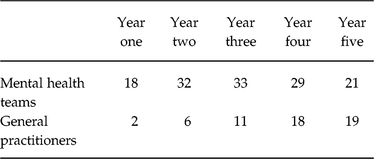
Community mental health teams referred the majority of patients [71% (n = 98)], and half underwent hospital admission under the community team prior to being referred to the EIP. The remainder of referrals came from local general practitioners (GPs) [29% (n = 55)]. Overall, every year the majority of referrals come from community teams (Table 1).
Referral trend over the 5-year period

Of these patients, 74% (n = 139) met the criteria for psychosis and were accepted into the programme, and two patients met the criteria for prodromal psychotic symptoms. The majority were males [64% (n = 89)], and 36% (n = 50) were females. The mean DUP was 8 months (Median = 2.5, SD = 15.3). The mean age of onset was 30 years (Median = 28, SD = 9.9). No statistically significant difference was found between males and females for either DUP or age of onset.
Demographics and background history upon initial assessments
Of the patients accepted, 79% were Caucasian Irish (n = 110), 18% (n = 25) were Caucasian non-Irish and 3% (n = 4) were of Asian and African descent. On initial assessment, 66% (n = 92) were single, and 34% (n = 47) were in a relationship. Primary education was completed by 16% (n = 22), 80% (n = 111) completed secondary education and 4% (n = 6) completed tertiary education. Regarding employment, 24% (n = 34) held full- or part-time jobs, whereas 76% (n = 105) were employed and supporting themselves with the help of government benefits.
A family history of affective disorders was present in 20% (n = 28) of patients and of psychotic illness in 14% (n = 19) of cases, and 10% (n = 14) were unaware whether a history of mental illness existed in their families. Early life trauma was reported by 36% (n = 50).
Physical health co-morbidities were present in 24% (n = 33) of patients; more than half presented with different types of chronic pain. Other co-morbidities included epilepsy, irritable bowel syndrome, hypothyroidism, diabetes, hypertension and asthma. Some aspects of forensic history, with or without custodial sentence, were present in 17% (n = 24) of patients.
A co-morbid history of affective disorders was present in 25% (n = 36) of patients; personality disorders in 14% (n = 20) of patients; and mild learning disabilities in 4% (n = 6) of patients. The majority of male patients, 58%, abused various substances on occasion or on a regular basis throughout their life, in comparison to 14% of females. Alcohol and cannabis were the most commonly abused (35% and 38%, respectively), and 23% of patients used multiple substances.
EIP services offered
By July 2017, the 3-year programme was completed by 23% (n = 32) of patients; 41% (n = 57) are currently taking part in the programme, and 36% (n = 50) disengaged before completing the full 3 years. The mean treatment period for the disengaged group was 6.5 months (SD = 5.8). No statistically significant difference was found between the demographics, past psychiatric history, past medical history or the services offered to the two groups. One-third of the disengaged cohort stated relocation to another geographical area as their reason for discontinuing treatment with the EIP programme. People who relocated to another geographical area were referred to their local mental health teams, but we have no information on whether they continued to engage with mental health services after the transfer of care.
Rapid assessment
Of all referrals, 88% (n = 123) were assessed within 72 hours. The rest of the referrals were assessed within 2 weeks, mainly due to patient unavailability to attend earlier assessment. Each patient was assessed by two staff members using structured clinical assessments. If accepted for the EIP treatment, a key worker was assigned, and an initial individual care plan was devised.
Medical review
Each patient accepted into the programme was reviewed by a psychiatrist within a week to optimise psychotropic medication when required and to discuss any crisis issues. Prescribing was completed in accordance with BNF prescribing guidelines (BNF, 2011). Each medical review was discussed with the assigned key worker, and targeted specific interventions were suggested based on the patient’s individual needs and current mental state.
A total of 91% of the cohort reported compliance with medications during their last review. None of the patients had first-generation antipsychotics prescribed at any stage of treatment in the community. Of the atypical antipsychotic medications, 31% were prescribed paliperidone, 25% olanzapine, 22% aripiprazole, 5% risperidone and 2% clozapine, and 1.5% were on both quetiapine and asenapine. Polypharmacy was present in 6% of patients, primarily with one antipsychotic and one antidepressant medication. Only one patient had benzodiazepine prescribed during the last review. A total of 9% of the cohort declined treatment with medications.
While working with the EIP team, 12% (n = 16) of patients required hospital admission over the 5-year period, accounting for a total of 522 hospital days.
Cognitive behavioural therapy for psychosis (CBTp)
Each patient who was under the care of the EIP team at the time was offered CBTp intervention. A total of 29% (n = 40) expressed interest to engage further and engaged for up to six sessions afterwards, while 12% (n = 17) completed 10 sessions or more. A new part-time psychologist for the EIP team was temporarily appointed in 2017.
Occupational therapy (OT)
A total of 68% (n = 88) had OT input at various stages of treatment. All patients initially completed an occupational therapy self-assessment questionnaire, followed by an interview with the OT. The most appropriate interventions were devised based on their needs. The rest of the cohort expressed no interest in having OT input, or no need existed.
Behavioural family therapy for psychosis (BFTp)
BFTp was offered to all EIP patients who had families available and expressed interest in attending. Of the patients, 32% (n = 45) attended one initial session, 13% (n = 18) engaged in three sessions on average and one family completed the full BFTp programme (12 sessions).
Other services
The team also conducted several carer support groups, during which informal educational sessions on psychosis were provided, access to social work was offered when indicated and the mainstream family therapy suggested if the family was unable to engage in the standard BFTp.
All patients were offered blood tests after their initial assessment, which involved a full blood count; liver and renal function; fasting glucose; and a lipid profile. Eighty-eight percent (n = 122) agreed to have the blood test done, and 17% (n = 21) of patients had their height, weight and body mass index (BMI) recorded. While they were under the EIP team, 7% (n = 10) received input from a dietician (allocated to the team in 2017 on a 1 day per week basis), while 19% (n = 27) were linked with local addiction services.
Discussion
This study has provided details on the North Lee Mental Health EIP service, its evolving structure and activities. Over the last year, the team has expanded, with additional staff being trained in BFTp as well as the appointment of a new part-time psychologist and part-time dietician.
A significant number of patients did not have their height, weight and BMI recorded before beginning antipsychotics. However, a metabolic screen form, based on the National Institute for Clinical Excellence guidelines (NICE, 2014), was developed and implemented in May 2017, and a training workshop for the entire staff was provided.
DUP in our cohort was shorter than in other studies we reviewed, where the mean DUP reported ranged from 1 to 3 years (Scully et al. Reference Scully, Quinn, Morgan, Kinsella, O’Callaghan, Owens and Waddington2002; Baldwin et al. Reference Baldwin, Browne, Scully, Quinn, Morgan, Kinsella, Owens, Russel, O’Callaghan and Waddington2005; Clarke et al. Reference Clarke, Mclaughlin, Staunton, Kerins, Power, Kearney, MCcguinness and Whitty2017), while the mean age of onset was very similar to our group. A shorter DUP in our study might be explained by easy access to services in Cork in general via emergency departments, in which every person with acute mental health needs can be assessed within hours, although this often results in an inpatient admission as described earlier. However, we have no clear indication as to whether the reason for admission was due to psychosis or some other mental health difficulty. In addition, several campaigns in Ireland are tackling the mental health stigma and are promoting awareness that might have contributed to this. However, 8 months is still a long duration in terms of DUP. Some research suggests promoting awareness via various educational campaigns for early intervention services can promote quicker access to the same, give pathways description and reduce stigma (DETECT, 2011; Lloyd-Evans et al. Reference Lloyd-Evans, Crosby, Stockton, Pilling, Hobbs, Hinton and Johnson2018). Our EIP service has not had a funding for public campaigns granted thus far.
The study also provided information on patient demographics and the important history of substance misuse and early life trauma as potential risk factors for psychosis, but no reliable data on abstinence from substances or engagement with addiction services was gathered. The EIP team provided ongoing intense support and monitoring of medication for patients, which might have had an impact on high medication adherence. Although this was self-reported, some studies suggest that closer monitoring of medication might result in better adherence (Osterberg & Blaschke, Reference Osterberg and Blaschke2005; Higashi et al. Reference Higashi, Medic, Littlewood, Diez, Granstrom and De Hert2013). The hospital admission rate was low for our patient group, which is encouraging given overall admission rates for psychosis. The low admission rate could also be an effect of adherence to medications, resulting in more stable mental states. More work is required to promote engagement with BFTp and CBTp as evidence exists that they too can reduce hospital admission rates (Bird et al. Reference Bird, Premkumar, Kendall, Whittington, Mitchell and Kuipers2010). The referral pathway has been changing, and more patients are being referred by primary care, particularly over the last 2 years, although community mental health teams still refer the majority of patients.
Limitations
We had access to 100% of patients’ clinical notes, but as with any retrospective data collection, we could not avoid incomplete or missing data within the clinical notes. Some patient records were lacking specific patient information or had unclear and unknown types of information. We had no clear data on deliberate self-harm on file or the reasons behind the low engagement with BFTp and CBTp documented. Several patients reported their families found one informal family session sufficient and expressed no interest in further engagement with BFTp. However, we could not find many studies regarding engagement with this form of therapy, so we could not compare our rates with other services, particularly in Ireland.
A significant number of patients had substance misuse history, but their engagement with addiction services was often self-reported, and we had no funding for random drug or alcohol testing to confirm this. Most of the hospital admission for the 12% of the patients was during crisis and was unplanned, with the two-thirds having co-morbid diagnosis of personality disorder and learning disabilities.
Apart from moving out of the area, we had no information on other reasons for disengaging from the programme. Some data, for example, DUP and compliance with antipsychotics, were self-reported and not always validated by collateral history. DUP was not assessed using standardised instruments. We also had no clear information on the potential prodromal period before the onset of the first clear symptoms of psychosis.
Conclusions
The EIP team, together with the HBCT – despite its limited resources – has been providing consistent and reliable support for patients experiencing their first episode psychosis. With appropriate professional and family support, several different types of psychosis can be successfully supported and treated in the community, but adequate staffing and services are required. The EIP team is constantly working on improving their work and standards of practice, but as the demand increases adequate resourcing for early intervention services is essential to provide internationally recognised evidence-based treatments in the early phases of psychosis.
Acknowledgments
The authors would like to thank the North Lee’s HBCT and EIP teams for their work hard work and supports with this study, despite their limited time and resources.
Ethical standards
The authors assert that all procedures contributing to this work comply with the ethical standards of the relevant national and institutional committee on human experimentation with the Helsinki Declaration of 1975, as revised in 2008. The authors assert that ethical approval for publication of this perspective piece has been provided by University College Cork Research Ethics Committee in February 2017.
Financial support
This research received no specific grant from any funding agency, commercial or not-for-profit sectors.
Conflict of interest
The authors have no conflict of interest to disclose.