INTRODUCTION
Historically, mentoring has been identified as an important element of a successful academic career with many academic programmesReference Sambunjak, Straus and Marusić1–Reference Cho, Ramanan and Feldman3 encouraging mentorship to facilitate career development and attainment of professional goals. The traditional mentor modelReference Kalén, Ponzer and Silén4 utilises an experienced mentor to aid a less experienced learner usually in a one-to-one relationship. The role of the mentor in this model is primarily to support the mentee’s professional development and not to teach or assess. Building on the foundational and historical precedent of traditional dyadic mentoring, new models such as peer mentoringReference Pololi and Knight5–Reference Lord, Mourtzanos, McLaren, Murray, Kimmel and Cowley7 have emerged in recent years. These studies have consistently demonstrated the value of peer mentoring for professional development of junior professionals. Furthermore, mentors frequently gain improved professional development skills while ensuring a sustainable model of support.
Complementary to the well-established role of peer mentors for professional development across a range of professional groupsReference Cho, Ramanan and Feldman3, Reference Hodges8–Reference Rodis, Backo, Schmidt and Pruchnicki12 there is relatively little published data concerning mentoring in regard to clinical technical skills development for health professional students. With these students frequently needing to gain skills using highly complex and specialised software and equipment, it was postulated that peer mentoring would have specific value. In the context of this paper, peer learning refers to the use of teaching and learning strategies in which students learn with and from each other without the immediate intervention of a teacher. Examples of peer learning include student-led workshops, study groups, team projects, student-to-student learning partnerships and peer feedback sessions in class. Such approaches may be established and monitored by staff, and may even occur in their presence, but staff are not involved directly in teaching or controlling the class.
This study aimed to determine the potential role and establish best practice guidelines for implementation of skill-based peer mentoring in radiotherapy. Undergraduate radiotherapy students at Queensland University of Technology, like pre-registration students in a number of health disciplines, are required to gain a wide mix of skills during their training. All health professional students must develop a range of high-level skills in areas such as interpersonal communication, literature use, reflection and of course technical competence with relevant techniques, equipment and software. The chosen scope for the pilot study was radiotherapy planning software that is used during training to apply academic learning to real-life clinical situations and also to prepare for clinical use of the software while on placement. The reported project aimed to determine the benefits and challenges of peer mentoring for educators, mentors and mentees, as well as establish guidelines for future use of the initiative.
METHODS
All Year 2 and Year 3 students in the cohort were invited to enrol for a voluntary peer mentoring programme as mentees and mentors, respectively. A half-day training session covering mentoring and feedback provision was undertaken with the prospective mentors and a weekly 2-hour mentoring class was booked for the groups to meet in an unsupervised capacity for 4 consecutive weeks.
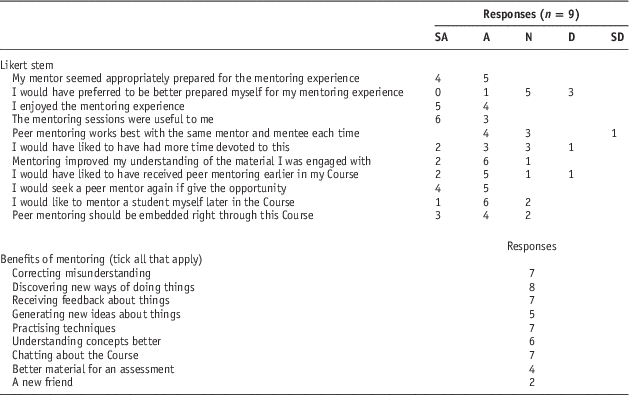
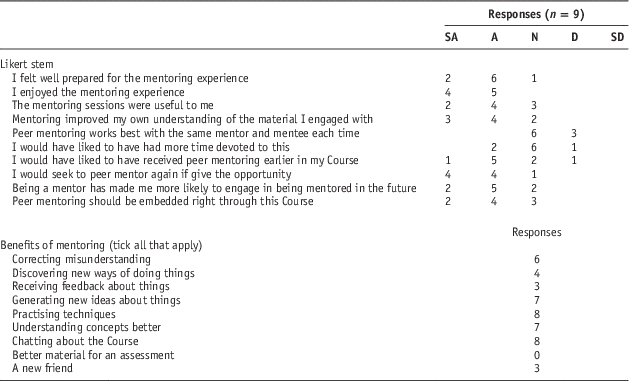
At the end of the final mentoring session, participants were invited to complete a short online questionnaire relating to the impact of the initiative. The tool contained a mixture of Likert-style questions concerning student enjoyment and perceived usefulness of the initiative as well as more qualitative open questions that gathered perceptions of the peer mentoring process, implementation methods and potential future scope. Tables 1 and 2 illustrate the questions used in the survey tool. Descriptive data analysis tools were used within Microsoft Excel to establish cohort-level indications of the questionnaire responses. Qualitative thematic analysis techniques were applied to the open-ended questions to derive themes relating to specific benefits and challenges of the initiative. Further thematic analysis of the data aimed to establish guidelines to support future facilitation and use of peer mentoring.
Quantitative question mentee responses

Quantitative question mentor responses
The study received University Research Ethics Committee clearance as part of an ongoing ‘Course Development and Evaluation’ project.
RESULTS
There was a reasonable uptake of the mentor training programme with 13 of the 26 Year 3 students attending. Because of the unsupervised nature of the programme, the exact numbers of mentees were not collected but informal feedback from mentors suggests a similar response rate of around 50% with roughly 20 out of the 37 Year 2 students attending. Response rates to the evaluation tools were disappointingly low with only nine mentors and nine mentees providing feedback. These relatively poor responses limit the extent to which feedback can be interpreted but along with the qualitative comments do provide a reasonable indication of the value of the programme.
All of the respondents reported that they enjoyed participating and that they felt that the training had prepared the mentors well. Although all of the mentees found the programme to be useful, only six of the nine mentors agreed, with the other two being undecided. When students were asked whether a ‘single partner’ model was optimal there was a range of responses. Most (13 of the 18) students agreed that the programme should be embedded throughout the course, and all of the mentees stated they would seek a mentor in the future. Out of the nine mentors, eight wished to repeat the experience and seven of the nine mentees expressed an interest in participating as a mentor in the future.
Thematic analysis of the qualitative data arising from the open questions was performed by categorising responses relating to enjoyability, usefulness, challenges arising and potential future uses of the initiative. It was clear that the responses triangulated well with the quantitative data as both groups had gained enjoyment and value from the mentoring. Tables 1 and 2 highlight the agreed benefits of the programme; although there was a distinct difference in the benefits perceived by mentors and mentees, both groups felt that they had increased their learning and had enjoyed the social interaction. Future use of mentoring for practical and clinical skills training was also supported by both groups. More detailed analysis of the themes arising is presented in the ‘Discussion’ section.
DISCUSSION
Several emerging discussion themes were derived from coding of the qualitative data and collated into subcategories relating to benefits to each stakeholder group, challenges arising, improvements and potential future directions. There are a couple of key limitations associated with the collected data from this small scale pilot study. First, the low response rate limits the validity of the findings with the self-selection bias from the volunteers potentially skewing responses. Second, the data collection tool provided positive Likert stems only which may also cause further skewing. To reduce this effect where possible, the thematic analysis findings were triangulated with the quantitative data. The following subheadings address the identified emerging themes individually.
COMMON BENEFITS
The most common theme arising from the study was the level of enjoyment and perceived value of the mentoring from both sides with 100% of respondents enjoying their engagement. This was supported by typical comments from both cohorts:
‘It is a good program, if it continues in the future I will definitely come again’
(Mentee A).
‘I think the mentoring initiative is a really great idea and have immensely enjoyed my time’
(Mentor A).
Both mentors and mentees particularly enjoyed the social aspect of the mentoring and it was clear that this had enabled improved communication between the year groups; this is often problematic due to conflicting placement schedules but is clearly valued. In particular, it was evident that the students’ common experiences made for highly relevant and useful encounters:
‘Their extra knowledge and experience allows them to provide information relative to my level in a more simple explanation’
(Mentee B).
‘Meeting some of the other students was interesting as we talked about clinical experiences that we could easily relate to’ .
(Mentor B)
There are clearly wider potential benefits of mentoring beyond skills acquisition. One of the three themes relating to mentoring established by KalénReference Kalén, Ponzer and Silén4 pertained to creation of a ‘free space’ alongside academic study, where participants could discuss personal and professional concerns. Although this was not part of the remit for this study, it is apparent that the creation of this space free from assessment and teaching had facilitated wider discussion.
Another common finding from the qualitative data was the extent to which both mentors and mentees had gained deeper understanding of theoretical principles and their application; 100% of mentors reported better understanding and consolidation of concepts. This was surprising as the aim of the sessions was to assist with practical skills development rather than theoretical teaching. It was clear that the mentees appreciated the mentors explaining concepts in their own words and that the mentors felt the sessions had provided consolidation of their knowledge.
‘Mentors explanations are easy to understand – most likely because they’ve been through what we are doing now therefore they explain in ways it is most easy to comprehend’ .
(Mentee C)
‘Being a mentor also assisted with my learning. By helping and explaining a technique to another student it solidified my learning’ .
(Mentor C)
It was encouraging to see that both mentors and mentees expressed interest in repeating their experiences with mentees wishing to mentor in the future, and this bodes well for sustainability of the programme. Both groups found the experience to be enjoyable as a social activity while gaining valuable learning and confidence with their skills and knowledge. It was noted that ‘making new friends’ was only reported by five of the students. Although this was not an expected outcome of the initiative, the two year groups rarely interact normally and this provided a unique potential opportunity for friendships to be forged. It is possible that this finding reflected the small number of mentoring sessions. It is likely that a more consistent approach would provide more opportunity for bonding to occur and further study into this is ongoing. Each group additionally perceived their own specific benefits arising from their roles and some common themes are presented below.
BENEFITS TO MENTEES
A common theme arising highlighted how the informality of the mentoring classes had encouraged questioning compared with the normal academic classes.
‘I felt very comfortable asking the peer mentors questions (especially silly questions) as it was a relaxed, easy going environment rather than a formally structured lesson’
(Mentee D).
Mentees valued the additional support and the opportunity to gain a new perspective on their work. They used the opportunity to practice evaluating their work and gain insight into the practicality of their suggestions. The mentees in particular gained a wealth of practical tips and techniques from the more experienced students.
BENEFITS TO MENTORS
One student mentor interestingly commented that they had also learned some tips from the mentees and their peers as part of the process. The big gains for the mentors, however, came from the consolidation of their skills and knowledge combined with their evident satisfaction of the role. All mentors reported increased understanding and most of the students added qualitative comments relating to how they had gained confidence in their understanding as a result of mentoring. In addition, Kalén’s ‘transition’ themeReference Kalén, Ponzer and Silén4 suggests that mentoring helps engender a sense of professional identity with associated increases in self-confidence. It was also encouraging to see mentors gaining as much enjoyment from the other side of the learning process as educators do:
‘It’s really satisfying when you see their light-bulb moment – when they start to understand what they have learned being put into practice’.
(Mentor D)
For one individual at least, this experience had clearly nurtured a desire for education in their own professional career:
‘Teaching is something I would like to pursue in the future – the process helped to confirm this as a potential interest/pathway for the future’.
(Mentor E)
This is particularly interesting as these teaching methods have long been reportedReference Candy, Crebert and O’Leary13 as having the potential to nurture a reflective approach to lifelong learning. In addition, with radiation therapy’s strong team environment, the cooperative nature of the peer mentoring approach has the capacity to reduce the potentially competitive nature of academic study in favour of engendering respect for the varied experiences and backgrounds of peers.
BENEFITS TO EDUCATORS
Financial pressure on university funding has generally lead to staff teaching more studentsReference Bradley, Noonan, Nugent and Scales14 and this has prompted a search for teaching and learning strategies to enable staff to cope without increasing their overall load. Peer learning has considerable promise as it has potential to increase the level of student learning without more input from staff. It was clear that the educational value of the mentoring had been identified by both cohorts of students. One of the main issues with increasing class sizes and pressure on time in academia is a reduction in one-to-one feedback provision. The comments from the students indicated that they had recognised this issue:
‘Unfortunately due to class numbers the tutors can’t give you the same opportunity/time to discuss your plans with you’.
(Mentee E)
Although mentoring by students cannot replace the experience and pedagogical approach of a teacher, this provision does mean that time can be utilised in the most effective manner. As a result of this initiative, educator time was used for explaining application of theories and developing technical skills and understanding as opposed to describing how to use software. One of the interesting findings of the study was that mentees did not feel that the process had provided a distinct advantage to assessment performance. It is encouraging to see that this opportunity was not used to gain direct advantage and engage in plagiarism or other unfair academic practice.
One of the challenges of any health professional training programme is ensuring that graduates are prepared not only for safe professional working but also for lifelong development. This programme has facilitated enthusiastic final year students to practice high level professional skills, with one student commenting:
‘Great initiative particularly as mentoring is a professional requirement once we start working and it’s something that we haven’t really had an opportunity to work on while at uni’ .
(Mentor D)
When students were asked if they had made new friends from the programme the responses indicated that this had not been a common finding, suggesting perhaps that the mentor relationship that had been forged had adopted an objective professional model. Benefits to educators, then, arise from the increased learning combined with the professional development that the students are able to experience, and more efficient use of time for core teaching activities without sacrificing student support and feedback provision.
CHALLENGES ARISING
Despite all the benefits, there were still some challenges that the students identified. A common theme related to lack of certainty and guidance about expected roles. It was clear that some mentees wished for firmer direction, whereas the mentors frequently reported difficulty finding the balance between helping and completing the task themselves. The role of training in this case is unclear as none of the mentors reported feeling unprepared and only one mentee wanted to be better prepared. The potential for positive reporting bias in this case can be explored from the qualitative responses. There was some evidence that the programme had provided mentees with a useful learning opportunity and they had learned how to provide non-directive guidance with clinical technical skills:
‘Sometimes they were very vague with what to do in certain situations, as there is no definitive method in planning. Knowing different techniques to fix a problem would have been helpful, but knowing they shouldn’t tell us what to do, is understandable’.
(Mentee F)
While this acknowledgement displayed a mature and professional approach to the sessions it was clear that this had not been utilised by all mentors. There was some reported variability in commitment of the mentors with some individuals clearly using the time to do their own work; this was noticed by both cohorts. One of the potential dangers of peer mentoring is sharing and nurturing of misinformation and misunderstandings. Some isolated comments suggested that mentors did not always know the answers or occasionally contradicted each other. While this would be a potential issue with content-heavy topics, for the clinical skills development there is valuable learning provided by this. Clinical judgment is frequently fraught with contradiction and sometimes there are no ‘right’ or ‘wrong’ answers. Trouble-shooting is an important high-level clinical skill and this initiative provided mentors with an opportunity to practice this. It is important that mentees learn about the role of clinical judgement and that mentors understand the value of developing an informed opinion as well as the importance of admitting a lack of knowledge. The latter is particularly important with regard to ‘Fitness to Practise’ domains of professional standards.15 Further training with regard to roles and expectations, including the differences between facilitation and teaching should aim to highlight the value of this to both groups.
FUTURE DIRECTIONS
Students were asked for their suggestions regarding wider use of the mentoring programme and provided a small number of recommendations. Interestingly, students did not suggest mentoring as a means of supporting traditional content-rich learning but instead focussed on clinical technical skills development. The main suggestions were for provision of a similar mentoring programme for the Virtual Environment Radiotherapy Training (VERT) 3D Simulator that offers training in clinical treatment skills; and for peer mentoring support on clinical placement, including reflection mentoring.
Informal observations in the VERT suite reveal that students frequently share clinical experiences with their fellow class mates. While VERT has clear value to educators in preparing students for improved clinical learning, extending this to include a mentorship model could facilitate valuable student-led teaching and learning.Reference Nisbet and Matthews16 The idea of collaborative learning through the use of VERT has already been evidenced by workbook approaches but these take on more traditional pedagogical approaches.Reference Nisbet and Matthews16 One of the problems with large-scale simulation hardware such as VERT is the resource-intensive nature of the teaching sessions. A VERT mentorship programme has the potential to move away from these traditional teacher-centred approaches and toward a less demanding pedagogy that benefits a wider range of stakeholders.
The other perceived avenue for further peer mentoring concerns clinical reflection. Reflection is an integral part of becoming a professional but is something that students generally struggle with as novices. A lack of mentoring has been identified as a barrier to reflective practice.Reference Findlay, Dempsey and Warren-Forward17 Goal setting for clinical placements is a large part of the reflective process and this may be made easier with support and encouragement from final year students in the peer mentoring role who ‘have been there and done that’. As peer mentoring has been shown to benefit both the mentor and mentee, perhaps it would also be useful to consider expanding this relationship to the clinical setting when students are on placement. Demand for clinical placements is high and this places an additional burden on the clinical staffReference Bridge and Carmichael18 whose primary focus is the patient. This burden could potentially be alleviated by spreading the mentoring loadReference Copley and Nelson10 by pairing students in a mentor–mentee relationship while on clinical placement. Although this model challenges the accepted single-student rostering approach, it does allow final year students to develop mentoring skills while ensuring that beginning students gain from the support of peers with similar experiences.Reference Lattanzi, Campbell, Dole and Palombaro9
EFFECTIVE FACILITATION
A number of key recommendations can be derived from the study to improve facilitation of peer mentoring for clinical technical skills development. The importance of good training is evident; the mentors in this study received useful training and felt well prepared. Despite this, some comments suggest that further clarification of their role and an outline of the mentees’ progress to date would be useful. It would also be interesting to measure the effectiveness of brief training to the mentees to prepare them for their role. Timing of sessions was reported by the students to be critical for success and with a dependence on voluntary attendance care must be taken to book mentoring sessions at times that are mutually convenient.
There was a range of responses relating to the model of mentoring adopted, with some students preferring the same partner and others a more ad-hoc approach. The loose and informal approach adopted here would seem to facilitate both systems and ensure students benefit from their most appropriate support model.
Peer mentoring is an effective tool for supporting clinical technical skills development in radiotherapy planning and it is recommended for use with pre-clinical simulation activities and clinical placement support.
CONCLUSION
Although derived from small respondent numbers, this paper demonstrates that peer mentoring has a valuable and enjoyable role to play in radiotherapy planning skills acquisition for beginning learners and consolidation of theoretical understanding for more experienced students. The social aspects of the initiative and informal format encouraged questioning and further learning in some mentees, while all mentors reported acquisition of valuable mentoring skills and gains in knowledge that will better prepare them for their professional careers.
Although mentors felt well prepared, it is suggested that further training is provided particularly in regard to mentee expectations and expected limitations of peer facilitation. An informal approach allows for students to adopt the most appropriate mentoring model for their needs while providing them with a free space to engender additional discussion and professional development. Student feedback indicates the value of mentoring for pre-clinical skills training, particularly in regard to simulation and reflection; as such this would be ideal for a range of medical education programmes. The results of this pilot study have provided useful direction for future peer mentoring activities and planned larger-scale evaluation aims to determine the impact of this programme on student learning and achievement.
Acknowledgements
The authors would like to acknowledge the support and input from the Queensland University of Technology Student Success & Retention Team for their invaluable mentor training provided as part of the Peer Program Strategy.