INTRODUCTION
The veined squid Loligo forbesi constitutes an important fishing resource, exploited throughout its distribution range, across the north-east Atlantic (Roper et al., Reference Roper, Sweeney and Nauen1984; Porteiro, Reference Porteiro1994). It is the only loliginid that inhabits the Azorean waters (Martins, Reference Martins1982), where it is subjected to a distinctive artisanal jig fishery (Hanlon, Reference Hanlon1987), targeting maturing and mature specimens, on island slopes between 150 and 300 m deep, during daytime, mainly between October and February. Fishery statistics in the Azores show substantial inter-annual variation in the yields (Porteiro, Reference Porteiro1994). Despite some preliminary data on the seasonality of the reproduction of this species in the Azores (Porteiro & Martins, Reference Porteiro and Martins1992), adequate biological information for stock management of this species is still needed, namely to understand the relationship between fishing spots and the species spawning grounds.
Recently, Pham et al. (Reference Pham, Carreira, Porteiro, Gonçalves, Cardigos and Martins2009) suggested various features of the reproduction of L. forbesi in the Azores: (i) the depth at which spawning activity takes place is likely to exceed the previous recorded range of 20–144 m; (ii) preference may exist for eggs to be laid within cavities; and (iii) spawning aggregation areas are likely to exist in the Azores, which may coincide with some of the areas that are traditionally exploited.
If the latter suggestion is true, the formation of spawning aggregations would be a pattern shared between L. forbesi and many other loliginids elsewhere (e.g. L. vulgaris reynaudii according to Augustyn (Reference Augustyn1990); L. opalescens according to Forsythe et al. (Reference Forsythe, Kangas and Hanlon2004)). However, there is still no direct evidence for the existence of such mass spawning aggregations on this deep-water loliginid squid. For that reason, Pham et al. (Reference Pham, Carreira, Porteiro, Gonçalves, Cardigos and Martins2009) based their assumptions on indirect evidence: (i) that the sexual behaviour of these squid, while in captivity, presents traits that are typical of species that form spawning aggregations; (ii) more than 80% of the specimens caught on the squid fishing grounds are mature or in spawning condition; and (iii) multi-paternity within egg strings has been shown for this species elsewhere (Shaw & Boyle, Reference Shaw and Boyle1997). Despite the suggestions that spawning aggregations of L. forbesi occur in the Azores, egg masses have never been directly observed in the field. In the Azores, these have been recovered mostly accidentally from traps and elsewhere on other artificial substrates (such as ropes) or attached to stones (depths ranging from 25–740 m), as reviewed by Pham et al. (Reference Pham, Carreira, Porteiro, Gonçalves, Cardigos and Martins2009). This paper describes the first observation of an egg mass of Loligo forbesi in the field.
MATERIALS AND METHODS
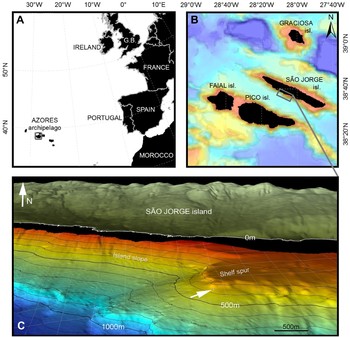
On 21 October 2009, a loliginid egg mass was observed while performing a dive with the remotely operated vehicle ‘Luso’. The egg-strings were found at 373 m depth hanging from the underside of a large rocky block (4–5 m length; 3–4 m height) positioned at the base of a shelf spur protruding over the southern slope of São Jorge Island, 2300 m from the coast (38°36.6492′N 28°5.9192′W; Figure 1).
Location of the observation: (A) north-east Atlantic; (B) São Jorge Island in central Azores; (C) 3-D perspective of the site, highlighting the exposed location on the island slope. No vertical exaggeration. (Multibeam bathymetry in C and D is from the Mitchell et al., Reference Mitchell, Schmitt, Isidro, Tempera, Cardigos, Nunes and Figueiredo2003 survey).

RESULTS AND DISCUSSION
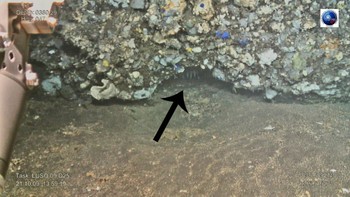
The egg mass was composed of about 20 to 30 egg strings and corresponded to the descriptions of eggs capsules in Loligo forbesi made by several authors (Holme, Reference Holme1974; Segawa et al., Reference Segawa, Yang, Marthy and Hanlon1988; Porteiro & Martins, Reference Porteiro and Martins1992; Pham et al., Reference Pham, Carreira, Porteiro, Gonçalves, Cardigos and Martins2009) (Figure 2).
Eggs of Loligo forbesi observed off the São Jorge Island through the remotely operated vehicle ‘Luso’. (Image courtesy of EMEPC.)

The entrance of the underside crevice containing the egg mass presented a width of ~1 m and height of 30 cm, oriented 225° from the north. The bottom of the crevice was composed of sandy sediment and the block was heavily encrusted with well developed bathyal sponges and lace corals (family Stylasteridae) (Figure 2), which suggested it to be in place for at least several decades. One cardinal fish (Epigonus constanciae) was observed swimming just in front of the crevice and approaching a small depression scoured on the sediment right at its entrance, without interacting with the egg strings. The location of the site, which was just off the base of a steep protruding cliff (Figure 1), suggests the area is subject to considerable along-slope currents. However, the opening of the crevice to the south-west, places it roughly perpendicular to the along-channel currents which are steered between the islands of São Jorge and Pico along a west-north-west–east-south-east direction. Coincidentally, this was the flow direction at the time of the footage, where particles suspended in the water were observed flowing along the face of the block, perpendicular to the entrance axis, on a 300° bearing. A small depression is visible on the sediment at the entrance of the crevice, which may indicate currents scouring through the sediment under the rocky block. This would suggest a good water flow through the crevice that would favour oxygenation of the embryos.
This first field observation of a naturally-laid egg mass by this species shows that, in the Azores, L. forbesi can spawn at depths greater than 300 m, thus confirming a previous suggestion by Pham et al. (Reference Pham, Carreira, Porteiro, Gonçalves, Cardigos and Martins2009). This is not surprising considering that egg masses of L. forbesi have been recovered from 730 m in the Aegean Sea (Salman & Laptikhovsky, Reference Salman and Laptikhovsky2002). It is also important to note that squid fishing grounds in the Azores are commonly located at depths of 250–300 m.
The location of this egg mass also confirmed the previous suggestion by Pham et al. (Reference Pham, Carreira, Porteiro, Gonçalves, Cardigos and Martins2009) that eggs in the Azores are likely to be deposited within cracks and crevices (see also Porteiro & Martins, Reference Porteiro and Martins1992), which are common features on volcanic areas. In fact, all the eight egg masses of L. forbesi that were previously collected in the Azores were mostly recovered from inside fishing traps (Porteiro & Martins, Reference Porteiro and Martins1992; Pham et al., Reference Pham, Carreira, Porteiro, Gonçalves, Cardigos and Martins2009). Furthermore, the way the strings attached to the substrate, glued to the roof of the crevice, and suspended, is very similar to information gathered from spawns of Loligo vulgaris commonly found in Madeira (see Wirtz, Reference Wirtz1994; http://www.thecephalopodpage.org/Lvulgar.php). In fact, it seems intriguing that L. vulgaris in European shelves (Villa et al., Reference Villa, Quintela, Coelho, Icely and Andrade1997), or the L. vulgaris reynaudii inhabiting the southern hemisphere, seem not to show any preference for crevices to lay eggs (Sauer et al., Reference Sauer, Smale and Lipinski1992), while this seems to be a feature apparently shared between L. forbesi in the Azores and L. vulgaris in Madeira, two volcanic archipelagos. One possibility is that loliginid squid around oceanic islands spawn within crevices not only due to the availability of this microhabitat, but also because such locations provide additional shelter and protection against predators. These suggestions enhance the need for further studies on the spawning locations preferred by these loliginids.
Considering that females, while in captivity, are known to lay about 31 to 64 egg strings in a single spawning event (Pham et al., Reference Pham, Carreira, Porteiro, Gonçalves, Cardigos and Martins2009), this egg mass is likely to belong to a single female. However, we cannot exclude the possibility of the observed egg mass belonging to several females, given that Shaw & Boyle (Reference Shaw and Boyle1997) showed that off the UK multiple females of L. forbesi can be responsible for as few as 15 egg strings. Although the latter observation cannot confirm the existence of spawning mass aggregations of L. forbesi in the Azores, it does not exclude that possibility. In fact, it is known that species that naturally form spawning mass aggregations elsewhere can occasionally also perform isolated spawns, as this is the case of L. vulgaris reynaudii (P.W. Shaw, personal communication) off South Africa. We thus suggest that further efforts should be allocated to study the reproductive ecology of L. forbesi in the Azores, using underwater vehicle technology, which proved determinant in this study. The assessment of the exact location of preferred spawning grounds of L. forbesi in the Azores remains a major concern, as it is still unknown whether fishing grounds coincide with spawning aggregations, an issue that should be considered in the fishery management strategy for this species.
ACKNOWLEDGEMENTS
We thank the Portuguese Task-Group for the Extension of the Continental Shelf (EMEPC) for the invitation to DOP/UAz to participate in the 2009 mission on-board NRP ‘Almirante Gago Coutinho’ and for making remotely operated vehicle ‘Luso’ imagery available for the current paper. G.P.C. was supported by the FCT grant SFRH/BD/6897/2001 and BANGEN project (RedBANGEMAC, FEDER, MAC/1/C070), funded by FEDER (75%) and the University of the Azores (15%). F.T. was supported by Project CoralFish (EC/FP7:ENV/2007/1/213144 ‘Assessment of the interaction between corals, fish and fisheries, in order to develop monitoring and predictive modelling tools for ecosystem based management in the deep waters of Europe and beyond’). We would like to thank both Dr Peter Wirtz (Madeira) and Dr Paul W. Shaw (Royal Holloway, University of London), who shared their knowledge on the field ecology of squid (both Loligo vulgaris and L. forbesi), which was of great help during the preparation of this paper.