Introduction
A disaster is defined as ‘A serious disruption of the functioning of a community or a society at any scale due to hazardous events interacting with conditions of exposure, vulnerability, and capacity, leading to 1 or more of the following: human, material, economic, and environmental losses and impacts.’ 1,Reference Mao, Fung, Hu and Loke2 The increase in the number of global disasters and the expanded scope of disasters has a huge impact on people’s lives, property, and spirit. Reference Liu, Ren, Chen, Li and Jiang3 After a disastrous event, emergency medical teams (EMTs) at every level immediately advance to the front lines to perform emergency rescue tasks. As the largest group in the medical and health fields, nurses play an important role in the 3 main stages of disaster care (disaster preparedness, response, and reconstruction) and serve as educators, rescuers, caregivers, managers, researchers and other roles. Reference Cheng4 In response to the 1995 Great Hanshin-Awaji Earthquake (GHAE), the 9/11 terrorist attacks in the United States (2001), the Wenchuan earthquake in Sichuan Province, China (2008), and public health emergencies (SARS in 2003 and COVID-19 in 2020), nurses showed their importance in disaster relief and recovery, and their role was highly praised by the government and the public. Sociologists and medical scientists have become increasingly aware that a team without nurse rescuers, cannot carry out emergency medical rescue successfully. Reference Jose, Dhandapani and Cyriac5–Reference Liao, Li, Gao, Zhang, Zhang and Liu7 In China, Sichuan Province is a disaster-prone area and has experienced many natural disasters, such as the Wenchuan earthquake (2008), the Ya’an earthquake (2013), and other disasters. Therefore, Sichuan University collaborated with Hong Kong Polytechnic University and established the Institute for Disaster Management and Reconstruction (IDMR) in 2013. They also trained many graduate students of disaster nursing, which promoted the development of disaster nursing and demonstrated the importance of rescue nurses.
When a disaster occurs, the affected people and rescuers (including medical staff, firefighters, volunteers, etc.) may have different degrees of psychological crises. Reference Stanley, Hom and Joiner8–Reference Noda, Asano, Shimizu and Hirano11 Studies have shown that as rescuers, medical staff are often more prone to psychological crises. Reference Berger, Coutinho and Figueira12 The survey results showed that, Reference Liao, Li, Gao, Zhang, Zhang and Liu7,Reference Zhen, Huang, Jin, Deng, Zhang and Wang13 after a disaster occurs, nursing staff experience long-term anxiety and varying degrees of PTSD. Therefore, it is necessary for disaster rescue nurses to have good psychological flexibility and proficiency in certain methods for self-psychological adjustment. Studies have shown that disaster rescuers with good coping self-efficacy and psychological resilience, are less likely to experience PTSD symptoms and psychological problems when faced with disasters, such as the earthquake in Haiti. Reference van der Velden, van Loon, Benight and Eckhardt10
In the past few decades, people’s knowledge and understanding of the concept of resilience has increased. Reference Ghodsi, Sohrabizadeh, Khani Jazani and Kavousi14 Resilience research began with a focus on poor children and then expanded to adults and chronic diseases (including patients and their informal caregivers), general college students and nursing students, school teachers, and disaster survivors and rescuers (including those deployed to disaster and emergency management officers). Reference Mao, Wang, Hu and Loke15,Reference Yu, Raphael, Mackay, Smith and King16 Resilience is defined as ‘the process of adapting well in the face of adversity, trauma, tragedy, threats, or major sources of stress, such as family and relationship conflicts, serious health problems, or workplace and financial stressors.’ Reference Association17 This definition implicitly indicates that people may ‘rebound’ regardless of various adversities and challenges. Psychological resilience is a personality attribute that can alleviate the negative effects of adverse events and promote adaptation or adjustment. Resilience can be perceived due to a lack of functional psychopathology or dysfunction after adverse events. In recent years, resilience has been regarded as a key factor in reducing disaster risk; it is the individual’s ability to survive accidents and the ability to resist disasters, recover and reorganize to deal with disasters. Reference Yu, Raphael, Mackay, Smith and King16,Reference Khatri Kc, Fitzgerald and Poudyal Chhetri18,Reference Mao, Fung, Hu and Loke19
The disaster management principles comprise 4 phases: prevention, preparedness, response, reconstruction, and recovery (PPRR). The World Health Organization (WHO) divides the entire disaster process into 3 stages: pre-disaster (disaster prevention, disaster preparedness), during a disaster (response during a disaster), and after a disaster (reconstruction and recovery). At present, research on the psychology of rescue nurses mainly focuses on the disaster response and post-disaster reconstruction stages, and less research focuses on the psychological conditions of EMT nursing and rescue personnel in the disaster preparedness stage. Reference Wei, Xie and He20 Therefore, researchers conducted an investigation on the rescue nurses of the EMTs in the disaster preparedness stage to assess the resilience and coping style in relation to anxiety and depression, and other influencing factors. This study might guide the selection of rescue nurses in the emergency stage and empower them at the training for EMTs.
Research questions
This study was designed to answer the following questions:
-
1) What are the current situation of resilience, coping style, anxiety, and depression among rescue nurses on EMTs during the disaster preparedness stage?
-
2) What factors influence the resilience, coping style, anxiety, and depression of rescue nurses and their relationship?
-
3) Are there any differences among distinct categories of rescue nurses in resilience, coping style, anxiety, and depression?
Methods
Design
A descriptive cross-sectional survey was used.
Sample
In this study, convenience sampling was used to conduct a questionnaire survey of rescue nurses from 4 national EMTs in Sichuan Province, China. The inclusion criteria were as follows: members of the National Emergency Medical Team; registered nurses; and those engaged in nursing work for at least 1 year, agreed and voluntarily participated in this research. The exclusion criteria were as follows: nonclinical nursing workers; and those who suffered major stress events in the past 3 months at the time of the investigation. All inclusion criteria should be satisfied, and with written informed consent that was approved by the IRB. If any exclusion criteria exist, they did not participate in the survey.
Instruments
The research team designed the general information questionnaire. There are 14 items in this questionnaire: gender, age, marital status, childbirth, only child or not, the highest degree of education, working years, technical title, working position, department, night shift, income, disaster experience, and emergency rescue experience.
-
1) Chinese version of Connor-Davidson Resilience Scale (CD-RISC) Reference Yu and Zhang21 : The original scale was compiled by Connor and Davidson. Reference Connor and Davidson22 The scale has 25 items divided into 3 dimensions: resilience, strength, and optimism. For the Chinese version, the internal reliability is 0.81 and the Cronbach’s α coefficients of the total scale was 0.83. Each item is scored with a 5-point Likert scale ranging from 0 ‘not at all’ to 4 ‘almost always like this.’ The total score is the sum of the scores of each item. The higher the score, the better the resilience.
-
2) The Simplified Coping Style Questionnaire (SCSQ) was compiled by Xie. 23 It has 20 items, including active coping (the first 12 items) and passive coping (the last 8 items). Each entry is scored from 0 ‘not taken’ to 3 ‘often taken.’ The Cronbach’s α coefficients of the total scale was 0.90, the Cronbach’s α coefficients of positive coping part was 0.89, and the Cronbach’s α coefficients of passive coping part was 0.78.
-
3) Anxiety Self-Rating Scale (SAS) Reference Zung24 : This scale was used to evaluate the subjective feelings of anxiety patients. The scale consists of 20 items; Item 5, Item 9, Item 13, Item 17, and Item 19 are reverse scored. Scores from the 20 items are summed to obtain the total rough score. The total rough score was multiplied by 1.25 to obtain an integer to obtain the standard score. Higher scores indicate higher levels of anxiety, and the cutoff value is 50.
-
4) The Self-Rating Depression Scale (SDS) Reference Zung25 : The scale can effectively reflect the symptoms and changes of the depressive state. It consists of 20 items; Item 2, Item 5, Item 6, Item 11, Item 12, Item 14, Item 16, Item 17, Item 18 and Item 20 are reverse scored. Scores from the 20 items are summed to obtain the total rough score. The upper normal limit is 41 out of a possible 80. Higher scores indicate higher levels of depression. The standard score is divided into the integer part of the total rough score multiplied by 1.25. An SDS standard score ≥ 50 is used as a cutoff to indicate depressive symptoms.
Data collection
The researchers used an electronic questionnaire to conduct the study. After obtaining the consent of the person in charge of the EMT, the questionnaire link was distributed through WeChat. Before the survey, a unified instruction was used to explain the purpose, method, requirements, precautions, and obligations to follow the ethical requirements for scientific research commitments. The researchers downloaded questionnaires and checked them item by item. A total of 200 questionnaires were distributed in this survey, and 197 valid questionnaires were returned, with a 98.5% response rate.
Ethical considerations
The West China Hospital Medical Ethics Committee in China (ID 20191022) approved this study. All subjects were informed about the objectives, methods, risks, and benefits of the research, and provided written consent to participate. All information was kept confidential. In addition, participants were able to quit at any time of the study. Confidentiality and voluntary participation were ensured in accordance with the Helsinki Declaration.
Data analysis
Excel was used to enter the original data, and Statistical Package for Social Science (SPSS), version 24 (IBM Corp, Armonk, NY) was used for statistical analysis. Count data are described by frequency and composition ratio (%); measurement data are described as the mean and standard deviation. Between-group comparisons were conducted using t-tests and analysis of variance. The influencing factors of resilience were analyzed using univariate and multiple linear regression analysis. Pearson correlation analysis was used to determine the correlations between mental resilience and coping style, anxiety, and depression. Cluster analysis was used to divide data into clusters with elevated within-cluster homogeneity and between-cluster heterogeneity. A 2-step clustering was applied to cluster rescue nurses in this study. Differential tests for continuous variables were performed using ANOVA, Bonferroni, or Dunnett T3 for pairwise comparison. P < 0.05 indicated statistically significant results.
Results
The mean age of rescue nurses on the EMT was 31.8 ± 4.7years old, and the ages ranged from 22 to 47 years old. Most of the sample was female (78.8%) and married (69.5%). Most of the nurses had a bachelor’s degree (78.6%) and held junior technical titles (70.6%). The mean working duration was 10.3 ± 5.3 years. Most nurses participated in rotating night shifts (75.6%), had disaster experience (65.5%), and had emergency rescue experience (66%).
Resilience, coping style, anxiety, and depression status of rescue nurses
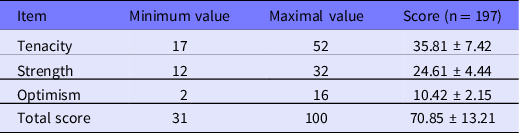
The total resilience score of rescue nurses of EMTs was 70.85 ± 13.21 points (Table 1). The average score of active coping was 2.27 ± 0.43 points, which was higher than the Chinese norm (1.78 ± 0.52 points) (t = 16.21, P = 0.00). Reference Wang, Wang and Ma26 The average score of passive coping was 1.20 ± 0.53 points, which was lower than the Chinese norm (1.59 ± 0.66 points) (t = -10.06, P = 0.000). EMT rescue nurses had an anxiety score of 38.41 ± 8.70 points, which was higher than the Chinese norm (29.78 ± 10.07 points) (t = 13.912, P = 0.000). Reference Wu, Sai, Zhang, Li, Gao and Li27 The difference was statistically significant. Among them, 15 people (7.6%) had mild anxiety (50 - 59 points), and 6 people (2.5%) had moderate or severe anxiety (≥ 60 points). The depression score of rescue nurses of EMTs was 40.22 ± 9.58 points, which was higher than the Chinese norm (33.46 ± 8.55 points) (t = 9.890, P = 0.00). Reference Wu, Sai, Zhang, Li, Gao and Li27 The difference was statistically significant. Among them, 36 people (18.3%) were mildly depressed (50 - 59 points), and 3 (1.5%) were moderately severely depressed (≥ 60 points).
Resilience scores of rescue nurses of EMTs in various dimensions (mean±SD)

Univariate analysis of resilience, coping style, anxiety, and depression scores of rescue nurses
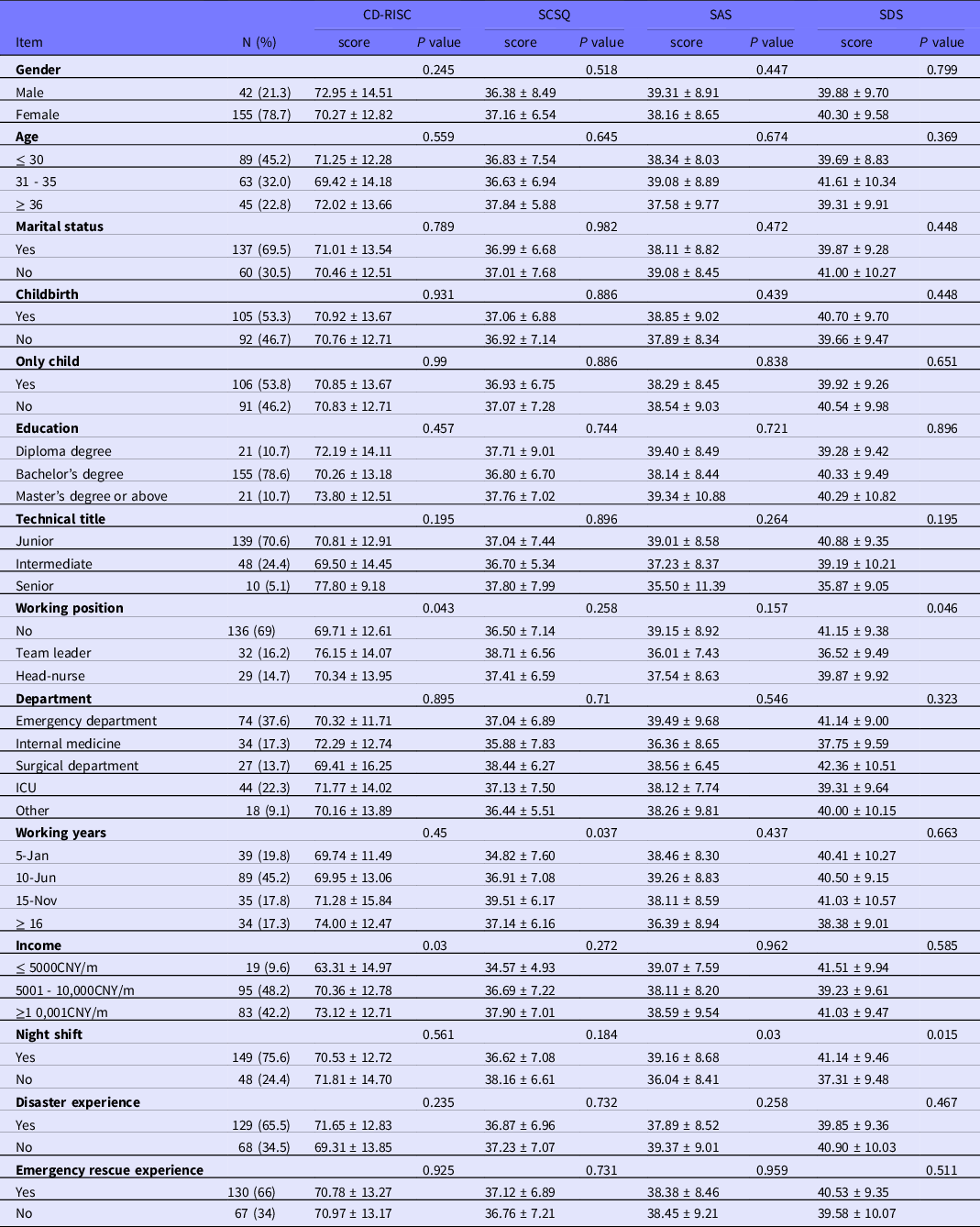
General demographic data grouping variables were used to compare the resilience, coping style, anxiety, and depression scores of EMT rescue nurses. Among them, the statistically significant grouping variables are position, working years, average monthly income, and whether to rotate night shifts (Table 2).
Univariate analysis of resilience, coping style, anxiety, and depression scores of rescue nurses of EMTs (n = 197, mean ± SD)

Multiple linear regression analysis of the influencing factors of resilience among rescue nurses
Taking the CD-RISC total score as the dependent variable and using 2 statistically significant variables in single-factor analysis and correlation analysis, position, average monthly income, anxiety, depression, and coping style, as independent variables, multiple linear regressions were performed. The results showed that average monthly income, depression level, and coping style were influencing factors of resilience among rescue nurses (P < 0.05), explaining 41.1% of the total variance in the dependent variable (Table 3).
Multiple linear regression analysis of the influencing factors of resilience among rescue nurses

RReference Mao, Fung, Hu and Loke2 = 0.426, Adjusted RReference Mao, Fung, Hu and Loke2 = 0.411, F=28.391, P < 0.001.
Correlation analysis of resilience and coping style, anxiety, and depression among rescue nurses
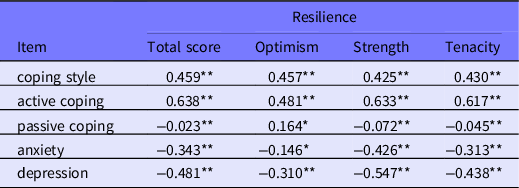
The results of Pearson correlation analysis showed that the total resilience score was positively correlated with the active coping score (P < 0.01) and negatively correlated with the total score of anxiety and depression (P < 0.01) (Table 4).
Correlation analysis of resilience and coping style, anxiety, and depression among rescue nurses on EMTs

** At level 0.01 (two tail), the correlation was significant.
* at level 0.05 (double tail), the correlation was significant.
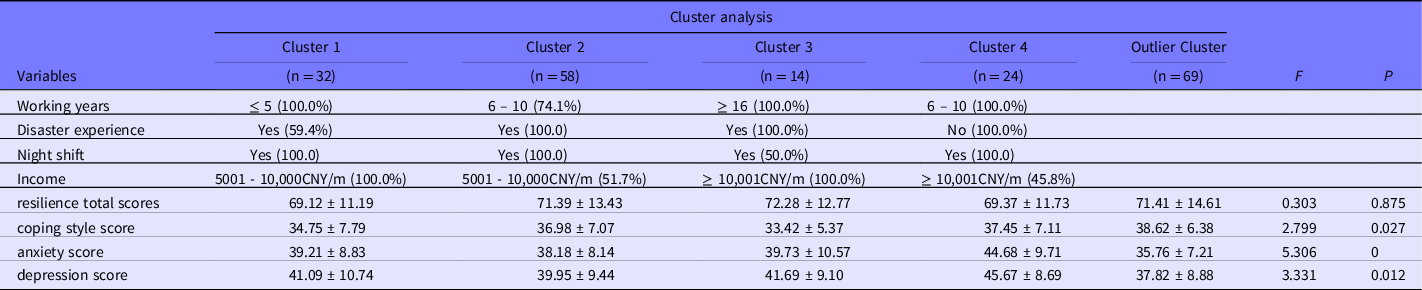
Characteristics of the clusters and scores for resilience, coping style, anxiety, and depression by cluster analysis

2-step cluster analysis of resilience and coping style, anxiety, and depression among rescue nurses
Income, working years, disaster experience, and night shift were included as variables in the cluster analysis. The results of 2-step cluster analysis showed that 4 clusters were identified. There were significant differences in SCSQ and SAS and SDS scores among Clusters (P < 0.05). The mean scores for SCSQ were significantly lower for Cluster 3 than Outlier Cluster (P < 0.05). whereas the mean scores for SAS and SDS were significantly higher in Cluster 4 than Outlier Cluster (P < 0.05). The mean scores for SAS was significantly higher in Cluster 4 than Cluster 2 (Table 5).
Discussion
In recent years, increasing attention has been devoted to psychological problems among rescue nurses. Many researchers believe that there is a significant positive correlation between resilience and mental health. Higher levels of resilience lead to improvements in mental health. Reference Yasien, Abdul Nasir and Shaheen28 Due to the special nature of the work, the physical and mental health problems of rescue nurses may be more prominent and thus require more attention. Reference Miller and Pescaroli29,Reference Turner30
This study showed that the CD-RISC score of rescue nurses on EMTs was 70.85 ± 13.21, which was lower than the CD-RISC score of nursing staff assisting Liberia’s medical team (73.50 ± 10.01), Reference Xu, Zhang, Zhang, Li, Ren and Song31 but higher than that reported in the literature. The CD-RISC score of emergency nurses was 54.94 ± 12.04, Reference Yin, Xu, Zhou, Gu and Zhai32 and the CD-RISC score of clinical nurses was 56.14 ± 11.93. Reference Lin, Li and Chi33 Studies have suggested that ‘self-psychological adjustment’ is indispensable in the core competence index system of disaster rescue nurses. Reference Cheng4 Resilience is considered to be an individual’s potential and skill, which can be encouraged and improved through training. Therefore, the rescue nurses of the EMTs may have received relevant training in the early stage, join the EMTs voluntarily, and have a certain degree of psychological preparation. Reference Hao, Zhang and Gao34
The results of this study also show that EMT rescue nurses have higher anxiety and depression scores, which is consistent with the survey results of Wu. Reference Wu, Sai, Zhang, Li, Gao and Li27 In the disaster preparedness stage, in addition to completing busy clinical nursing work, rescue nurses need to continuously learn emergency rescue knowledge and skills, and participate in various emergency drills and training. These various pressures may lead to mental health problems among rescue nurses. This may be the cause of anxiety and depression. Reference Mao, Fung, Hu and Loke2 Therefore, even if rescue nurses have better resilience and coping styles, their anxiety, depression, and other psychological problems still exist. The results of cluster analysis show that the anxiety and depression scores of rescue nurses who have worked for 6 - 10 years, without disaster experience, rotate night shift, and have high income is higher than those rescue nurses who are without this feature. This may be due to the fact that this category of rescue nurses are often the main force and the core of nursing work; they play a key role both in their work and family life, and their sources of stress may be more complex. Hence, disaster management personnel must pay special attention to the psychological problems of this category of rescue nurses, especially when disaster rescue nurses have psychological crises/ problems and provide professional psychological intervention. Reference Umeda, Chiba, Sasaki, Agustini and Mashino35
The researchers analyzed the resilience, coping style, anxiety, and depression scores of EMT rescue nurses. The results showed that night shift is an influencing factor of anxiety and depression. The anxiety and depression scores of rescue nurses who rotate night shifts are higher than those of non-rotation nurses. This may be related to the night shift work content, working hours, and schedule. In terms of job analysis, the nursing managers had the highest psychological resilience score and the lowest depression score because compared to the general nurse, with the accumulation of work experience, the nursing team leaders had stronger coping abilities. Additionally, compared with nursing managers, general nurses bear less management-related pressure. The main factor that affects coping style is working years. The results shows that rescue nurses who have worked for 11 - 15 years have the highest coping style scores. The results of cluster analysis show that the coping style scores of this category of rescue nurses who have worked for ≥ 16 years, have disaster experience, rotate night shift, and have high income, is lower than those rescue nurses who do not have this feature. This may be due to the rich work and life experience of rescue nurses who have long work years, facilitating stronger coping strategies, but also because of other comprehensive factors such as rotating night shift, leading to decreased coping ability. Reference Ren, Zhou, Wang, Luo, Huang and Zeng36 For rescue nurses, the higher the average monthly income, the higher their resilience score, which is similar to the research results of Liao Jingping et al. Reference Liao, Li, Gao, Zhang, Zhang and Liu7 At present, there are few direct studies on economic status and psychological resilience, but previous studies have shown that economic stress is the most important risk factor for post-traumatic stress disorder and overall mental health for disaster survivors, which indirectly reflects that good economic conditions are helpful in improving psychological flexibility. Reference Yuan, Ruo Yao and Zhen Yu37,Reference Chen, Keith and Leong38
The results of the correlation analysis show that psychological resilience is positively correlated with positive coping styles and negatively correlated with anxiety and depression. Before an emergency event occurs, that is, during the disaster preparedness stage, the nursing and rescue personnel are trained in resilience, which can effectively improve their coping ability, reduce anxiety and depression, and prevent the emergence of psychological crises in the face of emergencies. Reference Miller and Pescaroli29 Therefore, EMTs can carry out emergency drills in various forms of virtual simulation scenarios during the disaster preparedness stage, regularly monitor their psychological conditions, and formulate personalized intervention plans to promote psychological adjustment and improve the psychology of rescue team members.
Limitations
The sample size of this study is small. The researchers only investigated the resilience, coping style, anxiety, depression, and other influencing factors of the rescue nurses of some EMTs in the Sichuan area. The causal mechanism of resilience can be explained and further explored by qualitative research.
Conclusion
In summary, rescue nurses of EMTs in the disaster preparedness stage have normal resilience and good coping styles, but their anxiety and depression levels are high. We should pay more attention to the psychology of diverse types of rescue nurses in their daily work and develop effective intervention programs for them to relieve and reduce anxiety, depression and psychological pressure. Additionally, in the future, in the selection of EMT personnel, and the establishment of team building indicators, resilience, coping styles, and anxiety coupled with depression, the characteristics of diverse types of rescue nurses, and other factors can be included as indicators to improve the disaster response ability of rescue teams.
Funding statement
This research was supported by a program of West China Nursing Discipline Development Special Fund Project, Sichuan University (HXHL19060). The funders had no role in the study design, data collection and analysis, decision to publish, or preparation of the manuscript.
Conflict of interest
The author has no conflict of interest to declare.
Abbreviations
CD-RIS,: Connor-Davidson resilience scale; EMT, Emergency Medical Teams; SAS, Self-rating Anxiety Scale; SCSQ: Simple Coping Style Questionnaire ; SDS, Self-rating Depression Scale; WHO, World Health Organization