Introduction
In recent years, there have been several social and cultural developments that have encouraged an understanding of popular music as intangible heritage. The ratification by UNESCOFootnote 1 of its Convention for the Safeguarding of Intangible Cultural Heritage, in 2003, is perhaps a milestone in this respect. Meanwhile, the digital revolution in the music industry has simultaneously motivated very current debates on the ethical, aesthetic and philosophical dimensions to sound-related phenomena within the realms of several overlapping academic fields, such as science and technology studies and, most significantly for purposes of this article, popular music studies, ethnomusicology and sound studies. Additionally, as the advent of popular music (i.e. of mass-produced urban music, as distributed by the phonographic industry from the 1950s onwards; see Castelo-Branco and Cidra Reference Castelo-Branco, Cidra and Castelo-Branco2010, p. 878) becomes ever more historically remote, this has prompted an interest from both academics and museum professionals in popular music as a site of memory.
Popular music is now recognised as heritage worldwide, by means of various types of initiative carried out by both public and private actors, such as: classic live albums; websites and blogs; national biographical dictionaries; memorial plaques; statues celebrating idols; key national texts and legislative documents; numerous DIY personal and institutional actions engaged in the preservation and uses of popular music; and musical and other live events (Bennett Reference Bennett2009; Brandellero and Jassen Reference Brandellero and Janssen2014; Cohen et al. Reference Cohen, Knifton, Leonard and Roberts2015; Roberts and Cohen Reference Roberts and Cohen2013). Similarly, museums around the world have started to signal popular music as heritage, not only by hosting temporary exhibitions but also by assigning specific museums to the subject.Footnote 2 Notwithstanding some specific attempts, such as the David Bowie Is exhibition (an exciting example of practice which I discuss more fully shortly), a more ambitious project to effectively and playfully address popular music's affective, symbolic and performative dimensions, along with efforts to acknowledge the value of exhibiting musical sound itself, still seems, however, to be considered overly innovative and beyond the scope of current practice.
This seeming lack of ambition aside, I would like to draw attention to both the exhibition of popular music as a growing phenomenon and the new reasoning underlying this emerging development, which has occurred from within the profound reconfiguration that the museum's concepts, roles and assumptions have undergone in the wake of postmodernism. Indeed, the museum has become an exciting space driven not only by new forces such as the interests, resonances and actual learning possibilities of its visitors, but also by new social aims – such as extending identity recognition and inclusiveness to members of different groups and communities, and even to returning collected objects to indigenous peoples. At the same time, postmodern relativity has ensured the meanings of objects are understood as conceptually situated and contextual rather than inherent (Macdonald Reference Macdonald and Macdonald2011, p. 2), and this has prompted the blossoming of multiple, significant narratives rather than the pursuit of some absolute truth. As a result, the longstanding conflict between high and low cultures has gradually been dismissed, resulting in new opportunities and interests for museums wishing to host exhibitions on popular culture, and thus, in practice, reaching an exciting and important moment in their development.
In addition, there is the argument that museums can be considered particularly valuable sites for the public dissemination of research conducted by scholars of popular music; ultimately, studying popular music also comprises undertaking significant stewardship for communities by bringing the findings of research to the public. Furthermore, should one be asked to provide evidence to justify or substantiate the particular interest in celebrating popular music in a social device/facility such as the contemporary museum, remarkable research testifying to the importance of popular music in people's lives abounds. Some accounts particularly stand out in this regard: the author David Hesmondhalgh (Reference Hesmondhalgh2013) describes aesthetic and emotional experiences as fundamental to adding value to human well-being. He does this to stress the importance of musical practices across four domains, ranging from private to public: the individual self; in our intimate relations with others; in experiences of sociability and community; and in experiences of solidarity, commonality and publicness. Within a similar vein but applying an empirical methodology, Tia DeNora (Reference DeNora2000) has substantially highlighted the supportive role music plays in people's everyday lives and experiences. Thomas Turino (Reference Turino2008), in turn, stresses the relevance of music to processes of the self and the social at a macro-level, thereby contributing to the very maintenance of our species. Moreover, this author introduces a framework for understanding music-making on the basis of four distinct fields: participatory performance; presentational performance; high-fidelity recording; and studio art recording (Turino Reference Turino2008, Reference Turino2009). Participatory performance practices mean that there is no formal artist–audience distinction; presentational performance refers to situations where the audience is provided with music previously prepared by other groups of people; high fidelity, in turn, encapsulates a practice in which the making of recordings represents live performances, such as concerts, festivals or field recordings, thus requiring special recording techniques; and studio audio art refers to the creation and/or manipulation of sounds to make an art object and thus is not intended to represent real-time performances. Meanwhile, the pleasures of popular music as text – text that is in some way beautiful, meaningful, gratifying, exciting or moving, and which carries cultural capital – also often gets referenced (Shuker Reference Shuker2001, p. 12). In addition, new technologies are essential to current production and consumption processes, and there is the argument that today they constitute an unprecedented means of providing musical remembrance (Bijsterveld and Dijck Reference Bijsterveld and Dijck2009).
However, while deploying popular music's meaningful contents for museumgoers to engage with represents one important dimension of practice, the reality of effectively exhibiting in this way within museum settings remains underexplored and untested – hence there exists the need to reflect on certain theoretical and practical issues much more deeply than hitherto has been the case. In line with this, this article strives to reinforce a new agenda for museums and popular music scholars to work together towards an effective address of popular music themes. More specifically, I am attempting not only to contribute to the international debate about this subject, but also to move the practice of exhibiting popular music forward. I thus begin by examining some issues currently plaguing the quest for successfully exhibiting popular music, issues which are then explored in more depth in the context of an illustrative discussion of a specific case study (originally part of a larger study conducted upon popular music heritagisation practices in Portugal at the beginning of the 21st century).
Context: Issues around exhibiting popular music in museums – representation and display
The roots of the public museum can be traced back as far as the late 18th century, and hence it is an institution charged with tradition. Moreover, museums have long been endowed to exhibit ordered sequences of authentic objects of material culture for visitors to become instructed by means of contemplative and – importantly – silent behaviour. In this context, the act of exhibiting both popular music discourses and popular music itself emerges as a significant challenge for contemporary museums to face. Over the last two decades, a generation of new voices, coming from the fields of both museum studies and popular music studies, have addressed a wide range of significant debates concerning the exhibition of popular music. In recent years, this body of work has grown enormously, with the corresponding issues tackled by authors undertaking cross-disciplinary approaches and thereby resulting in a complex of assorted contributions. I would propose that this has now reached the point of requiring some sense of organisation. As such, in my view, two major sets of issues stand to the fore even while they are clearly intertwined: that of representational issues, or the nature of the discourse on popular music fostered by an exhibition's narrative; and that of display issues – in other words, the practical strategies adopted to actually address popular music in the museum, specifically the choices over exhibiting material and/or immaterial culture, and the particular approaches by which these are portrayed.
The literature on representational issues discusses some past exhibitions as fostering more comprehensive understandings of the complexities of popular music by the general public (Holton Reference Holton2002; Leonard Reference Leonard2007; Reference Leonard2010; Roberts and Cohen Reference Roberts and Cohen2013; Cohen et al. Reference Cohen, Knifton, Leonard and Roberts2015; Juchartz and Rishoi Reference Juchartz and Rishoi2006). Generally, they observe that these narratives do not draw upon the perspective of how music has been publicly received, which means that the private and public dimensions of musical experience (i.e. the social meaning and the value of music) have not been fully considered. Among these, the work of Leonard, concerning museums in the UK, stands out for specifically discussing, by means of empirical research, the nature of the underlying narratives to popular music exhibitions. The author's analysis finds that the narratives applied to mobilising popular music worldwide for museums and exhibition audiences tend to fall into the canonical versions of the history of popular music's localities, genres, venues or scenes (Leonard Reference Leonard2007). Three approaches predominate, with none in line with the contemporary popular music studies approach to popular music: one is based on a quantification rationale that turns to sales as the framework for reference and critical appreciation; a second interweaves music and art by means of exhibiting material works of art; the third, meanwhile, restricts popular music to a subject of social and local history. Elsewhere, as with the UK, this calls for scrutiny of museum discourses and the nature of popular music narratives, at least within Western social contexts.
The specific heritage processes that museums perform also enter into this discussion, as they clearly entail the drawing of an array of external influences and meanings into the representation of popular music. Comprehensive studies on heritage have led to the casting of some light on the dynamics of museums in the process of constructing heritage (Kirshenblatt-Gimblett Reference Kirshenblatt-Gimblett1995, Reference Kirshenblatt-Gimblett2004; Macdonald Reference Macdonald2013; McDowell Reference McDowell, Graham and Howard2008), and particularly on constructing popular music heritage (Bennett Reference Bennett2009; Brandellero and Jassen Reference Brandellero and Janssen2014; Cohen et al Reference Cohen, Knifton, Leonard and Roberts2015; Roberts Reference Roberts2012; Roberts and Cohen Reference Roberts and Cohen2013). In sum, this work, coming from a broadly social constructionist perspective, argues that there is no such thing as ‘intrinsic heritage’ for us to pursue and rescue; rather, heritage ‘exists’ by virtue of the application of the label (of heritage) to particular selected objects – objects that are brought to the fore, culturally speaking, through the power of having ascribed to them a distinctive value and meaning. Indeed, cultural phenomena only become heritage through the discursive practices – such as attributing meaning and value – that occur through exhibitions in museums and other authorised modes of representation. As museums are now facing new social and economic pressures and requirements, which raise tensions between those controlling their agendas and those deciding on their fundamental purposes, the selection of popular music heritage proves highly susceptible to individual politics and interests. To make matters worse, museums are prestigious institutions and, thus, the discourses they deliver gain particular acknowledgement by audiences; therefore, they perhaps especially deserve the attention of social scientists.
In addition, within the context of increasingly multicultural societies, heritage becomes a key element for achieving a balance between cultural difference and common humanity. Music, it can be argued, particularly holds the power to publicly present the deepest feelings of both a group and an individual; it plays a crucial role in human survival in that it is key to enabling processes of social integration that make us a whole (Turino Reference Turino2008). Developing new curatorial interpretative values and assumptions to face these challenges represents a primary responsibility for the fields of museum studies and popular music studies, in order that popular music may be effectively exhibited.
The second set of issues in the literature concerns the display strategies adopted for exhibiting popular music. The starting point for this discussion stems from the belief that addressing popular music in a museum entails the exhibition of immaterial culture, namely the displaying of musical sound as a sonic artefact. Indeed, I firmly believe that only when exhibiting musical sound, together with a compelling narrative, have museums reached the point of comprehensively addressing popular music. This does not mean discarding material culture but rather working towards an effective balance in which the importance of exhibiting sonic objects is attributed significant weight. Moreover, beginning with the argument that if music affects us then it is, in fact, material (Clarke Reference Clarke, Clayton, Herbert and Middleton2012; O'Keeffe Reference O'Keeffe2013; Straw Reference Straw, Clayton, Herbert and Middleton2012), the idea that museums exist to hold objects and specimens, or that ‘the material arrives in museums as a result of practices’ (Pearce Reference Pearce1994, p. 1), is one which only serves to confirm my assumption. Put simply: given that today we have the technological resources to exhibit musical sound, why ground an exhibition of music mainly in pictures or in musical instruments?
This involves challenging both the ethical assumptions and the technical constraints that have long prevented sound from being exhibited within museum settings. In practice, sound became recognised as problematic for logistical reasons, e.g. because of its ethereal and intrusive state of being, with curatorial gestures for popular music therefore mainly grounded in the traditional practices of exhibiting material culture. Likewise, as mentioned earlier, museums have traditionally been acknowledged as institutions of attentiveness in which silence is paramount. In line with this, the literature specifically addressing or encouraging the exhibition of sonic artefacts has only recently started to emerge. Edge (Reference Edge2000), Holton (Reference Holton2002), Leonard (Reference Leonard2007, Reference Leonard2010, Reference Leonard2014, Reference Leonard, Cohen, Knifton, Leonard and Roberts2015), Bubaris (Reference Bubaris2014) and Mortensen (Reference Mortensen2012; and Mortensen and Vestergaard, Reference Mortensen and Vestergaard2013), for example, feature deliberate attempts to tackle the issue of exhibiting sound (including music). Edge (Reference Edge2000) discusses the topic by outlining the deterrent factors: financial restrictions; ruling class ideologies opposed to public noise; and traditional visual-centric museum practices, with Shepherd and Wicke putting forward the idea that vision is more easily controlled and therefore ‘safer’ than sound (Edge Reference Edge2000, p. 4). Leonard's (Reference Leonard2014) paper, ‘Staging the Beatles: ephemerality, materiality and the production of authenticity in the museum’, specifically discusses the successful use of music in combination with objects to restage a moment in history, and expresses enthusiasm about what this offers museum curation. Mortensen (Reference Mortensen2012), on his side, applies the case study of the Media Museum in Denmark to build up the concept of music as an artefact in its own right, thus encouraging its use in museological exhibitions. As exhibitions reflect one means of disseminating knowledge largely through sensorial experiences, the sonorous artefact becomes a fundamental exhibit: it can motivate the visitor to draw on multiple individual and collective memories that allow for a plural interpretation of meanings and relationships (in accordance with a postmodern perspective on museum practice). Bubaris (Reference Bubaris2014), for his part, lends support to a trend that considers sound as an organic element in an exhibition, and expands on the possibilities of exhibiting it in museums. He also builds a typology of sound design for museums, based on the distinction between the use of diegetic and non-diegetic sounds, borrowed from the field of film sound design. Holton (Reference Holton2002), respectively, insightfully criticises the longstanding ocularcentrism of museums by exploring the successful combination of sights and sounds in an exhibition on the popular music genre Fado, that went on display in Lisbon in 1994; the exhibition not only illustrated Fado's social history but also embodied spectatorship by enacting emotional and sensual engagement through the display of musical sound.
As early as 1966, Pierre Schaeffer, the founder of musique concrete, had conceptually materialised sound and thus rendered it possible to treat as an object. In his article Acousmatics (Reference Schaeffer, Cox and Warner2005 [Reference Schaeffer, Cox and Warner1966]), Schaeffer introduced the concept of the sound object where sound and music can be considered to have become objects through both radio and recording. Indeed, these technologies have enabled sound to be disconnected from its source and to be fully appreciated through attentive and repeated listening. This is in direct opposition to past experiences of watching a performance or concert, when arguably people experienced music in a fleeting way and encountered greater difficulties in building longstanding affective relationships with it. As a commodity, music fulfils identity processes, facilitating the attribution of individual meanings and significance. In line with this, music enables self-affirmation, by people displaying both special knowledge about and control – or ownership – of ‘their’ music.
Lastly, I firmly subscribe to the assumption that musical sound in fact lies at the heart of a museum's resources for audiences engaging and interacting with exhibitions, which is nowadays of great interest within the museum studies realm. More specifically, I draw on the assumption that the immersive abilities of sound – namely, its ability to provide the scope to actively construct experiences, as well as promoting participation guided not only by cultural conventions but also by personal histories filled with their emotions and memories – necessarily foster a more democratised relationship with visitors (Bubaris Reference Bubaris2014; Mortensen Reference Mortensen2012).
The aforementioned discussions have not developed in theoretical isolation, with some museums and exhibitions recently making major contributions – both to the practice of addressing popular music and to the exhibition of musical sound itself – following their effective realisation of some of these issues. Within the framework of recent popular music exhibition practices emerging from considering musical sound as an inductor of emotional experience – music as an artefact – mention must be made of the David Bowie Is exhibition. This took place in 2013 at the Victoria & Albert MuseumFootnote 3 in London. Having had the opportunity to visit it, I believe that its importance derives from the fact that it both introduces and affirms new practices for the representation of music. The particularly innovative aspect of this event incorporated the concomitant exhibition of several sonorous objects, i.e. in different places inside the exhibition perimeter and without clashing with each other. This makes the exhibition a landmark in the scope of its deployment of technology to exhibit musical sound: each visitor received a Bluetooth audio guide system able to automatically operate a sonorous object, according to where the visitor was located. This kind of system furthermore proves able to establish an audial relationship between the sonorous object and the visitor, comparable with the visual relationship that (s)he has with the physical objects characteristic of the traditional museological approach. The pathway through the exhibition space becomes fluid and versatile, allowing the visitor to decide which objects (s)he wants to ‘contemplate’.
The David Bowie Is Footnote 4 exhibition unambiguously opens the path to exhibiting sonorous artefacts inside museums, as isolated objects – as done in some exhibitions that make sound accessible through fixed headphones but without allowing freedom of movement (as is the case with London's British Music Experience, The Beatles Story or the Liverpool Museum that holds sporadic music exhibitions) – but especially as one possible object among others, and without losing its specific contours. I believe this exhibition represents a remarkable step in this quest. Mention also can be made of some other recent initiatives, like: Pink Floyd Exhibition: Their Mortal Remains in the Victoria and Albert Museum, London, 2017; Exhibitionism: The Rolling Stones in Saatchi Gallery, London, 2016; Europunk, Great Black Music and Velvet Underground: New York Extravaganza in Cité de la Musique in Paris, 2013–2016; and Bjork and Making Music Modern in MoMA, 2015. Although each addresses specific topics and different approaches, these exhibitions together represent an attempt to restore a balance between the senses of sight and hearing, and to open up new paths to sonification practices – in line with my interests in the current paper.
Importantly, despite these specific instances of sonic exhibition, I see the need for truly reflective resources to ensure that coherent choices are made in the near future, whether in the selection and conservation of interpretative documentation, the management of collections of both material and immaterial culture, or in resulting exhibition practices and narratives. There is therefore a need for Western popular music scholars to theorise and map exhibition spaces, and to analyse current practice within these spaces, as a way of moving towards achieving such reflective resources. With this in mind, and having summarised the general issues which, I believe, impact on the effective exhibition of popular music in museums, I now turn to focus on one specific case study of an exhibition space and its particular practices of representation and display. This exhibition took place in the Portuguese context but the issues that it raises have a wider applicability; thus, I hope, through the analysis here, to contribute to ongoing international debate on how to effectively, sonically, exhibit popular music.
Analysis
Studying popular music exhibitions in Portugal: towards an effective practice
While several features of the above-mentioned exhibitions and museums together build a broader cultural claim for the significance of popular music and the exhibition of musical sound as an artefact, it is true to say that, globally speaking, popular music has not been traditionally exhibited or even acknowledged in museums. Therefore, as I argued earlier, established expertise on how to effectively exhibit it is lacking, as are time-tested practices in this area. However, correspondingly, this means plenty of space for music studies and museum studies to analyse and learn from the exhibitions that have been staged, in addition to them exploring the possibilities for future innovative and significant contributions, and opening up and taking imaginative risks in order to shape compelling narratives. Ultimately, we are motivated by problems and the need to solve them.
Thus motivated, I felt the need, in terms of my own research interests, to critically examine current museum practices with regard to popular music heritagisation in Portugal; thus, I carried out a study to map and analyse the popular music exhibitions that took place in the country between 2007 and 2013. The issues surrounding the exhibiting of popular music discussed throughout the previous section set the stage for this inquiry. The study was completed in two stages: in-depth interviews with all of the popular music curators and other professionals at museums hosting the surveyed exhibitions;Footnote 5 and in-depth analysis of two particular case studies.
Preliminary analysis of my data suggested two kinds of curatorial approach: one adopted by curators with academic backgrounds in music studies; and the other by curators who are music lovers and record collectors. This led to my decision to critically analyse one example from each group, where I sought to ascertain the group's prevailing patterns of knowledge about popular music and identify the issues of representation, agendas and interests underlying their particular heritage discourse; alongside this, it enabled me to gain as comprehensive a view of the Portuguese scenario as possible. I also nourished an interest in examining up to what point there was a significant difference between the curatorial approaches of the two curator types by comparing their respective narratives. (As I encountered no curator with an academic background or professional practice in museum studies, this group was not considered.)
This paper gives an account of the second type of curatorial approach: that of ‘music lover and record collectors’, an approach which my data revealed to be predominant in popular music exhibitions in Portugal. I discuss below, then, analysis of the exhibition A Magia do Vinil, a Música que Mudou a Sociedade [‘The Magic of Vinyl, the Music that Changed Society’], curated by a music lover and record collector, which originally went on display in 2008 in Portugal. My goal here involves understanding how this ‘music lover and record collector’ group of curators may shape popular music through their exhibitions and perform related acts of cultural heritage and remembrance.
Methodology
In accordance with the issues discussed earlier, of representation and display, my original research placed emphasis on a multi-modal analysis. More specifically, it entailed both focusing on textual narrative by means of discursive analysis and the examination of curators’ exhibitive practices for staging the theme of popular music, particularly the attention paid to musical sound as an artefact, analysed as constituting a sonic narrative. Lastly, I focused on visual narratives, with a view to determining to what extent they proved innovative or were otherwise simply inherited from conventional museum practice. I also attempted to ensure that my analytical approach of these three different narrative levels did not develop in isolation but rather in a constant dialogue between the three strands. In addition, the analysis encompassed an ethnographic approach, in that it included in-depth interviews with the curators and the executive producers of the exhibitions mapped.
Several heritage studies led me to the viewpoint that discourses are based on particular views, conveying somebody's interests, and are socially constituted while also socially constitutive. In this vein, I emphasised discourse analysis of the panel texts as a way to grasp the curators’ field of expression. Now, prior to setting out the analysis, I believe that, for the sake of clarity, discourse analysis and its analytical concepts first require some elaboration.
Discourse analysis and its analytical concepts
As a site of discursive practices, museums create speaking and thinking habits about subjects that lead to ideologies that, in turn, feed the circulation of power in societies. According to Ravelli (Reference Ravelli2006), communication always fosters contents and meanings from particular standpoints, and so requires approaching from a critical perspective. Indeed, some discourse analysis tools specifically draw upon usages of language in social contexts,Footnote 6 in an approach that is clearly distinct from understanding the language process exclusively through the study of its grammar. In other words, the distinctive feature of discourse analysis stems from the assumption that linguistic systems are structured by their respective purposes (Gouveia Reference Gouveia, Mateus, Pereira and Fischer2008) and so discourses must be analysed in terms of their functions in the social structure. This has led to an analytical framework that establishes relationships between texts and contexts, with two tools at the core of these analytical processes: genre and register.
Genre
Genres are culturally distinctive text types that reflect the social purposes of texts. They are well established in systemic–functional linguistics, particularly following the work of Halliday and, separately, Martin (Halliday and Hasan Reference Halliday and Hasan1985; Eggins and Martin Reference Eggins, Martin and van Dijk1997). Ravelli (Reference Ravelli1996, Reference Ravelli2006, Reference Ravelli2007) understands textual genre as the identification of a relatively stable shape or available convention that resides in all writing, giving it body and structuring social occasions. Ultimately, genre is an invisible operative agent employed both by the producer and by the reader to ensure their convergence within a given textual object. Essentially, where the readers recognise the generic framework in use, they will attend to the social purpose and meaning of that text within a specific type of relationship. Ferguson et al. (Reference Ferguson, MacLulich and Ravelli1995) provide a specific framework for genre within the domain of museum exhibition text panels. The report, the explanation, the recount, the procedure, the exposition and the discussion are the most common categories identified, thus far applied as templates for the construction of meaning. Each has its own identifiable purpose, a structure to support that purpose, and a propensity to enable distinctive social relations with the audience:
-
• Report genre – the function of this genre is to describe the way things are, and it serves to describe a whole range of natural, cultural and social phenomena. This begins with a general classification describing the object/article, and may include descriptions of parts and their functions, qualities, habits or behaviours as well as usages.
-
• Explanation genre – the function of this genre is to explain processes, or why matters are as they are. This begins with a general statement to position the reader and is then followed by a sequenced explanation, detailing the steps or processes involved in why or how something occurs.
-
• Recount genre – the function here is to retell events for the purpose of informing or entertaining. This generally gets arranged into three sections, beginning with a short orientation to position the reader; the events are then listed, usually in temporal sequence. The recount may finish with a re-orientation.
-
• Procedure genre – this genre involves describing how something is accomplished through a sequence of actions or steps. This contains two distinct sections: it begins by describing the goal, before following this with a series of steps orientated towards achieving that goal.
-
• Exposition genre – the function of the exposition genre is to put forward a point of view or argument. There are three distinct sections: the exposition begins by putting forward the writer's point of view and previewing the arguments that will then follow; then the points of the argument are listed and elaborated on, usually in a logical sequence; finally, the exposition may finish with a reiteration of the original point of view.
-
• Discussion genre – the function of the discussion genre incorporates presenting information about and arguments for both sides of a topical issue, concluding with a recommendation based on the weight of evidence. More dialogic museum texts may not necessarily make such a recommendation, instead leaving visitors to make up their own minds. The discussion genre also has three sections, beginning with a general statement to position the reader, and a preview of that to be covered; arguments for and against are then listed before undergoing elaboration or, alternatively, whenever the discussion is very complex, statements reflecting various viewpoints are listed. Lastly, the discussion concludes with a summary of the arguments and a recommendation on a particular course of action.
Register
Register represents the other analytical concept. It takes account of the field, the tenor and the mode of the discourse. The field gives account of how authors experience and interpret the subject matter of the text as well as the text's interactive potentialities. The sentence is the unit of analysis. Representation of a subject in each sentence is built up through: the participants – these could refer to a person or group or to a subject matter and includes both the doers of the process and the receivers of the action; the processes, in other words the participants’ actions, conveyed by means of verbs, within the scope of the written processes of representation; and the circumstances associated with the processes. Put simply, who are the participants and what is it that they are engaged in?
According to Bustam (Reference Bustam2011), with regard to processes, or actions conveyed by means of verbs, the grammar of experience divides the world into six different semiotic spaces, each with its own prototypical social processes: material, mental, relational, verbal, existential and behavioural, realised through verbs and verbal groups. (For a better understanding of the following analysis of the exhibition's texts, it is advisable to read the explanation of each of these six different semiotic spaces on note 7, as these will be frequently mentioned throughout the analytical sequence.)
The tenor of discourse refers to the ways in which texts enable and motivate readers (in the case of museums, visitors) to engage. Indeed, the communication choices analysed here do not only span the content of discourse in the representational sense but also relate to conveying meaning at the level of social interaction. The tenor depends on the relative power of the interactants and the degree of social distance or proximity between them (Ravelli Reference Ravelli2006). What is the stance conveyed by the text, i.e. was the text written to appear objective or subjective? Objectivity creates distance; it concerns information that is highly considered and acknowledged as scientific – while also widely accepted that such should be provided by museums. Conversely, subjectivity may create intimacy but is deemed unscientific – and thus neither distinctive nor appropriate for the institution of the museum. Nevertheless, it can be argued that that accepted as an objective text generally constitutes a text in which subjectivity has been hidden by certain linguistic devices – such as recurrent usage of the passive voice and nominalisations so as to remove human agency. In addition, when an institutional text is written in the third person, its voice gains authority and the content typically goes uncontested. Conversely, one may deploy devices to highlight the subjectivity at stake: by writing in the first person, and encoding a personal point of view to include evaluation and attitude, whether affective, judgemental or appreciative; and by introducing a speaker's perspective on the facts by means of modal verbs and qualifying adverbials such as may, should or sometimes (Ravelli Reference Ravelli2006, pp. 87–94).
Finally, the mode of a text, that is, whether it assumes a more written or oral style, is also the subject of register analysis. This is, in turn, determined by considering the level of formality or informality of the text, and by focusing on lexical density: texts closer to the spoken mode are said to be easy reading and therefore more inclusive; in contrast, texts closer to the written mode are said to be denser and more highly informative but, according to recent trends in museum studies, not entirely suitable for helping visitors to most fully or accessibly experience an exhibition. With regard to lexical density, distance can be created by persistent recourse to nominalisations, complex nominal groups and words with which visitors are unfamiliar.
Case study: A Magia do Vinil, a Música que Mudou a Sociedade
A Magia do Vinil, a Música que Mudou a Sociedade [‘The Magic of Vinyl, the Music that Changed Society’] is a travelling exhibition that went on display for the first time at the Oficina de Cultura in Almada, Portugal, in October 2008. It was curated by a music lover and private record collector who owns over 10,000 records (in vinyl and CD formats). His collection covers almost all musical ‘genres’, including pop-rock, jazz, ethnic music, classical music, electronic music and contemporary music.
Although not formally a museum, the Oficina de Cultura is one of the City Council of Almada's cultural facilities specifically designed for exhibitions. The initiative for organising A Magia do Vinil came from the curator. He proposed the project to the City Council, which particularly welcomed it. However, there had never before been an exhibition about music or popular music at the gallery, and there have been no more since then.
The exhibition aimed to highlight and acknowledge the popular music and musicians of the early Anglo-American vinyl record era, as well as French, Brazilian and Portuguese music. The temporal focus was placed on the period of vinyl's greatest status, specifically from 1955 to 1975, which the curator perceived as a groundbreaking era in Western cultural life. The exhibition encompassed a broad set of popular musical genres, such as pop, rock, jazz, soul music and so forth, through the display of what the curator understood as the ‘most important’ works released by the ‘most important’ musicians. In sum, audiences received here two main actors: on the one hand, popular music genres and their musicians; on the other hand, vinyl records.
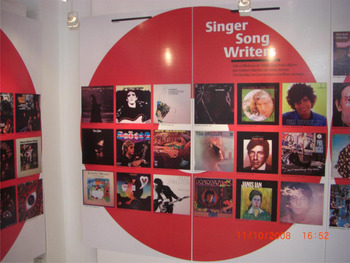
The exhibition comprised three concomitant narratives: a written narrative, delivered by text panels; a sonic version, exhibited by a selection of songs from records, which played musical sound continuously over loudspeakers in the gallery; and a visual narrative, made up of the reproduction of nearly 500 vinyl record sleeves, along with some other items of popular music related material culture. The decision was taken to scan the sleeves and reproduce them on panels owing to the high cost of insurance for exhibiting the actual objects, many of which are practically unique examples. Moreover, this meant that the exhibition could become a travelling exhibition and therefore be taken on tour and set up very easily elsewhere.
The exhibition had both a principal title, A Magia do Vinyl, [‘The Magic of Vinyl’), and a secondary title, a Música que Mudou a Sociedade [‘the Music that Changed Society’]. The application of A Magia do Vinil as the title over the external exhibition entrance, immediately followed by A Magia do Vinil, a Música que Mudou a Sociedade in the interior entrance hall proved interesting and highlighted the curator's main purpose: to convey evidence of something perceived as having markedly changed Western societies from a cultural point of view, that is, vinyl records and their music. The title also hints at the close relationship between popular music and vinyl records or the music industry, a type of relationship of which audiences are usually unaware or at least typically do not often think about.
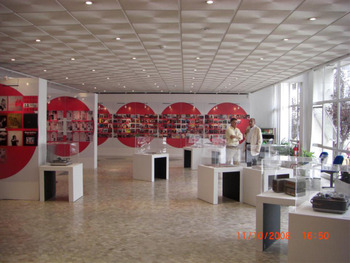
A Magia do Vinil, a Música que Mudou a Sociedade – general exhibition view, Câmara Municipal de Almada.

Moving forward, the exhibition itself started with a large introductory panel and then unfolded into several sections introduced by a sentence or a couple of sentences each. The majority of these sentences introduced sections based on exhibiting a set of reproductions of vinyl sleeves, although a few sections contained no introductory text at all and instead exhibited material culture related to popular music such as guitars, record players, books and magazines.
Having described the exhibition in terms of its overall organisation, I now present and discuss its analysis.
Subjectivity, ideology and canonisation
One of the major contributions provided by contemporary museum studies towards implementing inclusive museum practices is its willingness to reveal and tackle the side effects of curators hiding their personal voices when building exhibition narratives by means of recourse to the third person. Indeed, Mieke Bal (Reference Bal and Macdonald2011) clearly demonstrates how, in the curator applying the ‘grammatical figure of the third person'Footnote 7 in their text, the danger emerges of the narrative becoming the ‘definitive version’ of the theme for its audience; the ‘side effect’ of this is that museum-goers are confined in their assessment of an exhibition (of popular music, for instance) to a particular ideological and canonical stance, one grounded in the subjectivity of the curator but never acknowledged as being so. While I believe that A Magia do Vinil does in part work towards both a contemporary historicisation of popular music and the fostering of inclusive museum practices, it is also apparent that issues of the curator's subjectivity, ideology and canonisation are very much of significance – as analysis of the exhibition's text panels duly sheds light on.
Owing to its central location and size, the large introductory panel in the exhibition constituted an essential instance of communication for analysis, providing a good opportunity to study how the curator represented the subject. Its narrative assumed a historical rationale. As we have always been taught history through the stories of important figures, I believe that visitors, on encountering this, would have immediately recognised this discursive practice and absorbed it easily. Indeed, some authors have reported how many visitors are left bewildered in the absence of any conservative discursive formats, and so I would propose that, in terms of its overall organisation, the large introductory panel might have matched visitor habits and instilled feelings of competence in ‘being able’ to understand the exhibition; ultimately, it can become as if that which we are not used to does not actually exist. However, in fact, what this panel does, in terms of its contents, is to provide visitors with an historical rationale grounded in an hierarchical view of popular music, in that it determines for its audience what and who are the most important music and musicians – an approach that is in no way in line with the most recent findings within the field of popular music studies, which have proved these kind of appraisals to be contextual and subjective rather then given (we shall be returning to this point later).
A Magia do Vinil, a Música que Mudou a Sociedade – detail of one of the panels, Câmara Municipal de Almada.

The texts for each of the large introductory panel sections generally displayed the same organisational structure, reflecting the main purpose of informing by retelling events, typically through recourse to the recount genre. Alongside this, however, the objective of describing the musical panorama prevailing between 1955 and 1975 proved visible, thus revealing some features of the report genre too. The recount and report genres play a regulatory and pedagogic function, contributing to the museum's conventional role of explaining phenomena (Ravelli Reference Ravelli2006). They typically encourage and support the communication of ‘neutral’ information as practised by 19th-century natural history museums (Ravelli Reference Ravelli1996, p. 312), and convey the assumption of a relatively authoritative, persuasive role for the curator. Indeed, the literature supports the proposition that, when interacting with these genre types, visitors retain the right to receive information through conventional institutional voices but not to internally construct it, i.e. reflect on what they have read or take a critical stance towards it; they accept the ideas as unproblematic and trustworthy, as per the authoritative communication model envisioned by the modernist museum. In conclusion, genre analysis of the large introductory panel demonstrates a disguised directive stance at play that aims at shaping visitors’ perceptions of, and their value orientations towards, popular music and its history to match one ‘true’ understanding of events.
As mentioned above when describing A Magia do Vinil’s overall organisation, the exhibition then leads into a number of sections, each with its own title and an introductory sentence or sentences. While each isolated sentence does not convey an actual genre (as did the large introductory panel), a genre for the overall exhibition may be identified from amalgamation of these parts. The exhibition presents a number of arguments that follow an underlying chronological order, within which some thematic sections are introduced. These arguments persuasively build up the curator's thesis: popular music has changed the world and recording music in vinyl was fundamental to this end; consider all these transformations and movements that have taken place; it is time to think differently and acknowledge their value. The overall purpose stems from putting forward an argument and thus the exhibition genre is exposition. Indeed, the final sentence, ‘Divulgar este património é espalhar o saber’ [‘Disclosing this heritage is to spread knowledge’], reinforces the value ascribed to music and functions as a reorientation for visitors in a feature typical of the exposition genre. Furthermore, this introduces the words património [‘heritage’] and saber [‘knowledge’], two words that are becoming increasingly powerful in museums, as well as in everyday discourse. Reinforcing all this is the display of 500 vinyl sleeve reproductions, representing just a fraction of an immense collection, with its power resulting from its size.
Having analysed genre in the text panels, I now focus on register analysis, which takes account of the situational specificity of the texts and reveals very insightful information, not only about the representation of the theme by the curator(s) but also about the interactional potential of the texts. As such, the analysis reports that, in terms of the domain represented, several popular music-related musicians, genres and cultural movements prove the most frequently mentioned participants. There is, meanwhile, no consistent verbal reference to the record sleeves exhibited. In terms of the processes deployed, by means of the verbs chosen, relational processes conveying the possessions and attributes of actors (see the aforementioned Bustam's (Reference Bustam2011) frameworkFootnote 8 ) are all largely present, thus demonstrating a classificatory and descriptive stance. Examples include: ‘O rock ‘n’ roll é uma mistura de elementos do country e do rhythm ‘n’ blues’ [‘Rock ‘n’ roll is a mixture of elements from country and rhythm ‘n’ blues’]; ‘Dylan será diferente pela genialidade’ [‘Dylan might be different because of his genius ’]. There are a substantial number of other actional processes, such as the existential, which thus construct a world of certainties. One example comes with: ‘E havia, claro, as grandes cantoras de jazz como Billie Holiday ou Ella Fitzgerald’ [‘And there were, of course, great jazz singers such as Billie Holiday and Ella Fitzgerald’]. Similarly, verbal processes are relatively frequent, some of which assign power and authority to the curator, constructed on expertise: ‘É de realçar o papel preponderante’ [‘Mention must be made of the leading role’]. On the other hand, mental processes, which are also actional and frequently express degrees of affection, are barely in evidence.
Other lexical choices play an interesting role, not only within the scope of museum display practices,Footnote 9 but also concerning the representation of popular music – namely: (1) evaluative and hierarchical lexical compositions, which are the most evident. A few examples include: ‘a mais conhecida’ [‘the most well known’]; ‘alguma da melhor e mais incompreendida música’ [‘some of the best and most misunderstood music’]; and ‘alguns dos maiores talentos’ [‘and some of the greatest talents’], alongside many others; (2) qualities or value judgements, which are ascribed to participants (musicians and musical movements). These are also extensively deployed, with some examples being: alucinante; assinalável; bela; decisivo; emblemático; estrela; exímio; famoso; genial; and genuíno; [amazing, remarkable, beautiful, decisive, emblematic, star, eminent, famous, ingenious and genuine].
To sum up, the substantial usage of actional processes constructs a world where musicians and musical movements are valued as active. Classificatory relational processes prove evident. These, in conjunction with the significant application of evaluative and hierarchical lexical compositions and extensive recourse to qualities or value judgements ascribed to participants, build up a sharp distinction – between the universe of figures positively highlighted by the curator and the not-mentioned others. This type of construction predisposes the visitor to accept the personal appraisal of the curator, not as an expression of subjective taste but as being factual and so, authoritative. Ultimately, the visitor ends up ascribing value to music within the limits of the curator's own aesthetic choices. What is more, in this specific case, this type of construction creates a hierarchical world where music is divided into ‘good’ and ‘bad’ music, in other words into ‘the music of the curator’ and ‘the music of others’, and therefore depicts a particular vision of reality. This, then, encodes an ideology of binary opposition, where meanings are generated through a contrast between positive and negative (Hartley Reference Hartley2011; Mikula Reference Mikula2008); Mikula's (Reference Mikula2008, p. 16) understanding of binarism maintains that this is not any universal principle and its ‘deconstruction seeks to destabilize binary oppositions by subverting their implicit hierarchy and leaving them in a suspended, irresoluble condition’.
In light of the knowledge about popular music delivered by contemporary scholarship, I believe that the aforementioned constructions of the curator constitute a partial and narrow representation of popular music. The fact that the text panels are written in the ‘grammatical figure of the third person’ only enhances this partial vision, given how this conceals the writer's subjectivity and assigns ultimate authority to the contents. However, as mentioned above, very specific lexical choices conveying evaluation, hierarchy and value judgements precisely express – in the main – the author's own personal appraisal. Appraisals are a device serving to introduce a personal point of view and thus able to produce a more spoken and intimate text. Nevertheless, once again, the appraisal submitted in A Magia do Vinil’s text is not explicitly announced by usage of the first person and might therefore reveal an attempt to position visitors so that they accept and share this opinion – and a particular view on the world.
On the other hand, by stating aesthetic evaluations, the curator might be attempting to ascribe the significance of art music to popular music, i.e. the curator takes it seriously. Indeed, my ethnographic research firmly supports this idea, as demonstrated by the following excerpt from my interview with the curator: ‘What we want to do is something that has quality, something that brings prestige’. Here we can witness the recourse to words such as memória, património and saber [‘memory’, ‘heritage’ and ‘knowledge’], which also awards an intellectual status to popular music. This may also work to enhance the power and authority of the curator's knowledge, by ascribing particular distinction to his taste.
The practice of writing in the ‘third person’ also produces side effects to other aspects of the narrative. Regarding the selection of the 500 records on exhibition, this process was entirely in the hands of the curator and resulted in the exclusive display of those records the curator deemed most representative of the period between 1955 and 1975. The fact that this selection was governed by the tastes and knowledge of but one person raises interesting questions (and connects to passionate debates that are taking place more broadly in museum studies today). From my perspective, I see no inherent or significant problem were visitors clearly informed about this by means of recourse to the first person. Contrariwise, however, the grammatical usage of the third person, in conjunction with the strong lexical choices – alluded to within my analysis of the text panel – generates the effect of concealing the curator's voice and thus imposing his specific canon of popular music's musicians and albums onto visitors.
Although I truly subscribe to both Karja's views that ‘canons represent a way for members of a community to express their shared values’ (Karja Reference Karja2006, p. 4) and that history is inevitably compelled to be told as a particular, definitive version of events, resultant of power struggles to speak loudest,Footnote 10 I would also advocate the view that guardians of specific canons must wilfully disclose themselves by means of applying the grammatical figure of the first person, alongside an explanation of their own criteria for museumgoers to freely adopt or refute the respective perspective. Otherwise, exhibitions end up as monological discourses revolving around the visitor's reverence of the curator's set of ‘truths’ – and this falls out of line with contemporary museum purposes and assumptions. Furthermore, in interview, the exhibition's curator referred to the featured musicians as being, from his point of view, beyond fashionable trends and general criticism, and also as being of the utmost aesthetic quality. Nevertheless, he was vague about the specific criteria that led him to consider these musicians as aesthetically superior to others. In sum, this also testifies to a practice in which one particular curator prioritises his own specific tastes – a practice based upon and reinforcing a rationale of distinction (as identified in the textual analysis) between ‘my kind of music and yours’.
To conclude, in terms of museum practices, this practice inherently fosters a non-inclusive approach, in that it propels a relationship comprising the roles of ‘expert’ and ‘novice’. From the perspective of popular music studies, the text panels signal and prompt a subjective interpretation of popular music and its history, while simultaneously attempting to mask this self-same subjectivity; they thereby constitute an ideological representation of popular music, shaping and reinforcing one specific canon. I now move onto other analytical dimensions, namely those of sound and vision, in order to provide a more comprehensive analysis of this exhibition.
Sound
At the beginning of this paper, while exploring the issues in the literature concerning exhibiting popular music in museums, I considered the exhibition of musical sound itself as being at the core of my preoccupations with the effective addressal of popular music within museum settings. Analysis of A Magia do Vinil demonstrates that this exhibition included the objective of displaying musical sound but that this, nevertheless, assumed the conventional approach for exhibitions seeking to fulfil such remit, in that musical sound was not critical to the overall narrative but rather merely played a decorative role. More specifically, for the particular purpose of complementing the exhibition with music, the curator and the other organisers made a recording of approximately 24 hours of popular music from the 1960s; the final CD resulted from an arbitrary selection put together by the curator and some friends. These played all day, every day, from the opening to the close of the exhibition. (In fact, it took several days to play right through the entire collection of records.) Some other interactive practices involving music sound were suggested by the curator, such as setting up a small discotheque where people could listen to the records after visiting the exhibition, or organising a series of popular music concerts. Nevertheless, these proposals were not taken up by the Oficina da Cultura as the human and logistical resources were not available.
The interview with the curator also revealed how the sleeves, and not the sounds, constituted the major exhibition item, with this suggesting a ‘collection concept’ as underlying and structuring the exhibition, manifest in the curator's own collection. In terms of the behaviour expected from museumgoers, vinyl record sleeves played the core role of sound souvenirs (Bijsterveld and Dijck, Reference Bijsterveld and Dijck2009), potentially prompting meaningful memory work and nostalgia from within the audience, followed by audio technology objects (for example, record players). As such, I believe that this practice signalled the maintenance of conventional museum practices towards popular music, in that it did not take advantage of the opportunities of sound's recently increasing presence within the museum to creatively expand on the representation of popular music. This is not to ascribe no significance to the curator's collection but rather situates the curator's approach within the longstanding practice of using physical objects for admiration. As a matter of fact, museums are, traditionally, primarily conceived of in terms of the collections that they house, and the objects on display are seen as the end point of interpretation. Although the exhibition A Magia do Vinil did not exactly emerge from a policy guideline or endeavour that encouraged museums to reflect on the practice of popular music or to heritagise it, the exhibition did come about as a result of an individual act of collecting that also fits in with conventional museum practices for the exhibitions of musical remit. Although music was played constantly over loudspeakers at A Magia do Vinil, visitors were not even informed of what was being played or why. The curator neither attached any particular significance to music as a museum resource specifically, nor did he entirely take advantage of its unique potential to create bonds. The practice of emphasising sight over sound still remained. Despite technological advances in media and sound, sound was timidly or secondarily exhibited, with only passive listening practices encouraged in the exhibition.
I must emphasise at this point that none of this is to say that I am in any way against the exhibition of record sleeve collections, or even music lovers and record collectors and their ideas and knowledge. To the contrary, I am absolutely grateful to them for their envisioned stature-feeding and nurturing of arguably ‘sacred archives’. Nevertheless, I believe that, as curators, music lovers and record collectors need to work in pluri-disciplinary teams for exhibitions to move on from conventional approaches. Indeed, it seems that the well-established idea of a ‘collection concept’, specifically here of records, opens up opportunities to disclose, or emphasise, the idea of popular music itself as being something that one can own – that is, based upon an underlying ontology of popular music where it is the music held by records, not the records themselves, that becomes the object ‘owned’. The idea underlying such a project would have enabled an exhibition experience that saw the possession of things ultimately dissolving into the possession of meanings. In such a context, the ‘collection concept’ might in fact have been explored in terms of the specific, affective, emotional and identity-formative relationships people establish with it, and this would have turned the exhibition into a more social facility.
Vision
From the point of view of the visual narrative of the exhibition A Magia do Vinil, two dimensions here articulate meaning and thus require discussion: on the one hand, there are the specific exhibits chosen for display; on the other hand, there is the organisation of the exhibits and spaces used, along with the graphic design of the text panels.
As mentioned above, 500 record sleeves were exhibited, which demonstrates a primary choice to exhibit material culture objects and indicates a conventional exhibitive approach that seems to clearly have been inherited from traditional museum practices. Nevertheless, as the actual sleeves ended up substituted by reproductions, the extraordinary value ascribed to the real objects usually on show in museums and their ability to convey remembrance experiences were not directly exploited in this exhibition.
As for the panel design, the length of the introductory panel – 4305 words of densely printed text – is manifestly unsuitable for a museum exhibition. Five words per second is an average museum reading speed (Serrell Reference Serrell1996, p. 27), which means that even the most interested reader would have to stand for at least 15 minutes to get through this extensive introductory text. On the other hand, the whole text for the subsequent panels (535 words) came in sharp contrast to this, which makes it very likely that most visitors only ever read the exhibition text panels; the fact that the exhibition panel design graphically highlighted each sentence at the beginning of every thematic section, together with the use of easy-to-read print size, endowed these sentences with a powerful impact.
In terms of the organisation of exhibits and spaces, the entire gallery was given over to the exhibition; this was laid out in small modules artificially shaped by panels, interspersed with several showcases displaying other objects such as books, magazines, turntables and so forth. The sleeve reproductions were printed directly onto the panels. Overall, both the organisation of the room and the panel design itself helped shape a compelling narrative.
Conclusion
In this paper, I have reflected upon the practice of heritagising popular music by analysing the exhibition A Magia do Vinil from two different perspectives, those respectively provided by music studies and museum studies, as part of a broader study designed with the aim of understanding the exhibition of popular music in museums in Portugal at the beginning of the 21st century. Two sets of issues concerning the exhibition of popular music were subject to prior discussion in order to set the stage for inquiry: the representational, and the nature of the discourses deployed by the curator through the texts; and display-related issues, which included consideration of the options for displaying popular music – sonically and visually – as an example of material and/or immaterial culture.
Globally, I believe that the exhibition A Magia do Vinil staged popular music from a particular and subjective logic of representation, in which the curator constructed a view of popular music grounded in his personal taste while displaying conventional museum practices based on a collection of material culture – and thereby driving the audience into a conventional style of interactive engagement. In addition to this, the recourse to the grammatical figure of the ‘third person’ allowed that representation to take on an ideological character and maintain a particular canon. More specifically, discursive analysis of the exhibition's written narrative suggested a hierarchised world where music gets divided into ‘good’ and ‘bad’ music – in other words, the ideology of binary opposition, where meanings are generated through a contrast between positive and negative (Hartley Reference Hartley2011; Mikula Reference Mikula2008). In effect, this encodes a mismatch between the curator's ‘kind of music’ and that of others, and signals a tendency for the ‘music lovers and record collectors’ group of curators to attach primacy to reproducing their own ontologies of popular music, which derive from the perspective of experiencing ‘the record’ (and its music) as an object of personal ownership. In his article Ontologies of Music, Philip V. Bohlman (Reference Bohlman, Cook and Everist2001 [1999]) insightfully establishes a theoretical framework of ontologies for thinking about music on the basis of everyday musical experiences and practices. The experience of ‘my kind of music vs. your kind of music’ is extremely deeply rooted and plays a prominent role in Western societies. Indeed, records have endowed music with the opportunity to become an easily owned object.Footnote 11 The arrival of sound-recording technologies in the 19th century, and their development and realisation in the 20th century, redefined people's relationships with music. Records came to crystallise a moment, thereby enabling the opportunity for people to retrieve that moment whenever they wish (Reynolds Reference Reynolds2011: XXXV). This has resulted in people attaching very personal meaning and affect to music, thus leading to a tendency to see musical tastes become the subject of affirmation and, consequently, of defence.
In the case of the exhibition's explicit adoption of terms such as heritage, cultural memory, knowledge and social and cultural value of music, their usage not only comes to add value and power to popular music, and thus to reposition it with a higher status, but they also act to legitimate the curator's discourse about popular music.
Taking into account the fact that popular music as a cultural and urban practice requires understanding in relation to its placing at the specific intersection of cultural, social, technological, emotional and aesthetic environments (Shuker Reference Shuker2001; Toynbee Reference Toynbee2000; Tschmuk Reference Tschmuk2006), I would emphasise the point that the voice of the curator in exhibitions such as A Magia do Vinil should be clearly identifiable through linguistic devices such as recourse to the first person – as I have sustained throughout this discussion. With this specific approach, visitors would not follow the exhibition as if it were delivering institutional and thus ‘authoritative’ knowledge about popular music, but would, rather, approach it as an act of personal interpretation, which is, in fact, what it is.
The non-usage of musical sound to structure the exhibition conceptually falls into the trap of a conventional approach: the open-ended condition of sound has traditionally pushed it into being a non-exhibitive subject, and this, in conjunction with the longstanding encouragement of silence in museum contexts, has led to the great temptation to use records and their sleeves to represent the materiality of musical sound.
Museums are remarkable and powerful institutions, and so the way popular music is being rearticulated as heritage in their exhibitions holds significant ramifications for the meanings attributed contemporarily. Accordingly, our job as academics arguably involves tackling archetypal myths about music in general, while also challenging commonly held views about popular music in the light of the findings of ethnomusicology and popular music studies research. I believe that only by drawing its narratives into this kind of framework will popular music exhibitions become productive acts that bring about a new dynamic to knowledge on the subject. Ultimately, the aim is not only to foster a curator's nostalgic point of view but also to begin a discussion about how interpretative concepts and sounds have been challenged through history. Of course, such an ambitious appeal cannot be achieved at any one time, but I do advocate endeavours that are both inclusive and provide different spaces of fostering individual interpretation.
During the course of this research, I have pondered over which dimensions of popular music the literature should address and their respective interest to audiences. Although I do not attempt to be comprehensive and conclusive, I nevertheless believe that a critical history of popular music would draw on a blend of issues such as identity, affect and emotion, performance, production, consumption, symbolicity, text and value, and material and social dimensions. Theoretical issues and debates on contemporary popular music abound from which curators can source their narratives (Strinati, Reference Strinati2004 [1995]), and I would state that scholars of music studies should have a mission not only to conduct research for the sake of developing knowledge but also to enable it to empower communities in museum settings. In the end, museums are publicly funded institutions embedded in societies, and so academia has a responsibility to assist in the development of exhibitions with communities in mind. In addition, I specifically believe in the idea of museums as places that convey different ways of perceiving matters by enlarging the space of representation of their exhibition subjects – that there are different ways of conceptualising these (Lord Reference Lord2006). This would, in turn, support the development of practices around staging popular music exhibitions as a new music-making practice.
Within this framework, I envision the strengths of exhibiting popular music themes to be twofold. On the one hand, there is the deployment of popular music exhibitions as a new practice in music production and consumption in Western societies, tasked with providing visitors with informed conceptions of people's ordinary, emotionally rewarding, experiences of music. I particularly draw on the concept of a museum's exhibitions as constituting a space in which ordinary relations within culture are constructed but moreover are enabled to become open to critical reflection and change (Lord Reference Lord2006). More specifically, I envisage the museum as an innovative producer of popular music by means of placing audiences within a context that blends imagination and discourse. By imagination, I envision the exhibition of popular music ‘objects’ which are themselves sounds so as to make it possible for audiences to achieve and perform open-ended aesthetic, emotional and social experiences. By discourse, I envision a space able to rescue audiences from ‘muteness’ about popular music by offering several conceptual and cultural orders for interpretation.
The stage is set: either specialised training in curatorship on popular music themes, or the formation of curatorial teams with diversified skills and expertise in what may be termed an effective understanding of popular music and of museum studies, is required for the concert or show to successfully and playfully begin.