On Election Night activists on the left eagerly awaited the results hoping their hard work in the election would produce a favorable shift in the balance of power in Washington. When the votes were all counted and Democrats Jim Webb (VA) and Jon Tester (MT) were finally declared the winners of Senate seats in two of the closest races, the Democrats regained control of both the House and Senate for the first time since the Republican takeover of 1994. As a result of the election, one set of interest groups would fall out of favor and another set would find new access on the Hill. Pharmaceutical firms, oil and gas companies, and student loan providers, targets of the Democrats' populist “100 Hours” agenda and big contributors to the Republicans, were instantly thrown on the defensive. Anti-war groups, environmental groups, and labor unions with weak ties to the Republican leadership and strong relationships with the incoming Democratic leaders, were newly empowered. As the legislative director for one of the largest unions, the American Federation of State, County, and Municipal Employees, observed a few months into the 110th Congress, “It's a whole new ball game. Key leaders on the Hill are much more receptive, and I look 10 years younger.”1
Chuck Loveless quoted in Alyssa Rosenberg, “Lobbying & Law—Labor's New Muscle,” National Journal, March 24, 2007.
After spending 12 years on the defensive under Republican rule, those groups that had helped the Democrats achieve their electoral victories hoped the new Congress would produce momentous change in a range of policy areas. They had helped deliver victory for the Democrats. Now they expected the Democrats to deliver for them. Despite all the campaign promises and the elation on the left with the electoral results, there were clearly going to be limits on what the incoming Democratic congressional leadership could deliver for the groups that make up the party's base. Given the ease of minority obstruction in the American political system and the narrowness of the Democratic majorities, it would be very difficult for legislation to survive the inevitable Republican-led filibusters and presidential veto threats. The supermajority requirements necessary to invoke cloture and override vetoes dictated that bipartisan compromise would be necessary to get policy changes through the legislative process and these compromises might alienate liberal groups. Pleasing the base and getting things done is extraordinarily difficult, as the initially uncompromising Republican House leadership that led a remarkably unified caucus discovered 12 years ago when the Contract with America agenda hit a wall in the Senate and White House. In contrast with 1994, the new Democratic majority was made possible by the victory of a number of centrist candidates in districts and states that tilted to the right and it wasn't clear that even Democratic Party unity could be maintained on contentious legislation. The incoming congressional leadership thus faced a number of challenges. Could they maintain party unity among liberal and centrist Democrats, reach out to Republicans in order to build viable legislative coalitions, and deliver the votes necessary to satisfy the base groups and maintain their enthusiasm going into the 2008 election?
After 10 months in power, the Democratic leadership has only seen a few policy changes signed into law. These include the minimum wage increase, reduced interest rates on student loans, and a compromise version of legislation implementing some of the outstanding recommendations of the 9/11 commission. Base groups have many reasons to be disappointed. In the 9/11 commission legislation, Democrats were forced to drop a provision backed by organized labor guaranteeing collective bargaining rights for TSA workers to avoid President George W. Bush's veto. At the time of this writing, the bipartisan State Children's Health Insurance Program's reauthorization bill, a priority for many groups on the left, had just been vetoed and Democratic leaders were forced to seek even greater compromise in an already compromised bill because the legislation did not have veto-proof support in the House. On energy policy, which often pits two Democratic base groups—labor and environmentalists—against each other, environmental groups are concerned because the House version of the energy bill does not include the improved fuel efficiency standards for automobiles included in the Senate version. While another party priority, a proposal to allow the federal government to negotiate prices for prescription drugs under Medicare, easily passed the House, it has not yet cleared a Republican-led filibuster in the Senate. Legislation to make it easier for unions to organize more workers met a similar fate, also easily passing the House but failing in the Senate because of yet another Republican-led filibuster. While obstruction has been the main issue, activists have also been disappointed with some of the leadership's strategic decisions. Some gay rights groups have been very critical of a recent anti-discrimination measure based on sexual orientation that passed the House without protections for transgendered individuals because leaders thought the measure would sink the bill. Groups concerned with the administration's perceived violations of civil liberties are very disillusioned by the congressional leadership's decision to temporarily extend the government's broad powers to eavesdrop in investigations of suspected terrorism rather than risk the Democrats being tarred as soft on terrorism.
In the most visible example of congressional gridlock, even though the elections were read as a rebuke by the voters of the Iraq War, not only is the U.S. no closer to withdrawing from Iraq, more forces have been deployed as part of the administration's “surge” strategy. Democratic leaders managed to push a bill though both the House and Senate in the spring that conditioned funding for the war on adopting a timetable for troop withdrawal but did not have the numbers to override Bush's veto. While the House has passed other measures trying to change the course in Iraq, the Senate has been stymied by Republican-led filibusters. Although Democratic leaders have sought a bipartisan compromise in the Senate that might survive a filibuster to once again force Bush to exercise his veto, compromises that pull in more Republicans lose liberal Democrats. As a result, the Senate Democratic leadership abandoned the seemingly futile effort to find a workable compromise on the issue of troop withdrawal this fall and instead called for a series of votes to force senators to go on the record. So far, the Democratic leadership has been unwilling to force the administration's hand by trying to cut off funding for the war, a strategy favored by many anti-war activists.2
Before going out for Thanksgiving recess, the Senate failed to invoke cloture on yet another Iraq War funding measure that included a timetable for redeploying troops as well as a Republican measure that would have provided emergency funding with no strings attached. As a result, no new supplemental funding for the war was appropriated and the administration and congressional leaders are now engaged in a war of words over whether the Pentagon has adequate funds going into next year.
Clearly the 110th Congress is unlikely to deliver significant policy change, but can it keep the base on board? The Democratic leadership has been able to deliver a high level of party unity and to force Republicans and Democrats alike to take tough votes on legislation of interest to many base groups that will likely animate the 2008 elections. As of early August, Democratic Party unity was at record high levels—averaging 92% support for the party's position in the Senate and 95% in the House.3
Party unity support figures based on calculations of individual party unity scores reported in CQ Weekly, online at www.cqpolitics.com/party_unity.html.
Carl Pope quoted in Margaret Kriz, “Cover Story—Changed Climate,” National Journal, January 27, 2007.
As a major component of the Democratic base since the New Deal era, labor has spent decades not only trying to navigate the institutional obstacles to majority rule in the American political system but also trying to build support within an often divided Democratic congressional caucus for the movement's agenda. While the institutional obstacles are still powerful, there have been unprecedented levels of Democratic support for some of labor's top legislative priorities—such as labor law reform—in the 110th Congress. The growing partisanship on labor issues illustrates the culmination of a number of changes in the American political system, including the partisan polarization of group politics, the growing polarization of the congressional parties, and the final stages of the realignment of the Democratic Party away from Southern conservatism toward a more union-friendly liberalism. While elements of the base may grow disillusioned, organized labor, sensing the possibility of significant policy change if the Democrats gain the presidency and expand their congressional majorities, is likely to welcome incremental change in the 110th Congress and increased oversight of the Bush administration while focusing their sights on 2008.
The Partisan Polarization of Group Politics
Despite repeated claims of non-partisanship, organized labor has been one of the most partisan interest groups in American politics. The labor movement has historically had the closest and most enduring relationship with the Democratic Party of any organized constituency (Greenstone [1969] 1977; Dark 1999). In addition to substantial campaign contributions to Democratic candidates and the Democratic Party, organized labor has provided its envied organizational infrastructure and its army of foot soldiers to turn out the Democratic vote for decades. But throughout the postwar period, labor activists and scholars have repeatedly questioned the value of this alliance with the Democrats, with leftist Mike Davis even labeling the relationship a “barren marriage” in an oft-quoted observation (Davis 1986). Until recently, Democratic unity on labor issues has been undermined by the opposition of conservative Democrats largely from the South. Having seen priority legislation like labor law reform fail even at the height of postwar liberalism in the Great Society years, labor activists have had bitter experience with the limitations of the American political system and the ability of the Democratic Party to deliver on its promises even with unified Democratic government and substantial congressional majorities. However, back in the 1940s the mainstream labor movement rejected third-party politics in favor of making a home within the Democratic fold and trying to reorient the congressional Democratic Party away from Southern and rural conservatives. As this process has gradually taken place, the congressional Democratic caucus has indeed become more supportive of labor, but at the expense of the replacement of most conservative Democrats with conservative Republicans. This realignment produced a surge in the number of Republican seats in the South and ultimately the loss of the Democratic congressional majority in 1994.
Whereas labor has historically been somewhat unusual among American interest groups in the degree of its support for one party, partisanship among a range of groups increased after the Republican takeover of Congress. Former Republican Speaker of the House Newt Gingrich (GA) and his allies had long been frustrated with the opportunism of business groups and trade associations and their willingness to contribute to Democrats in order to maintain access. After 40 years, many business groups seemed to complacently accept the Democratic lock on control of Congress. The rising Republican leadership felt that these groups as their ideological allies should be more partisan in their support of the Republican Party, just like organized labor was in its support of the Democrats. In the 1994 election cycle, Gingrich convinced a number of business groups that a Republican takeover of Congress was possible and pushed them to favor Republican challengers in their campaign contributions. After the Republican victory business contributions became more heavily tilted to the Republican Party, making labor's contributions even more important for the Democrats and reducing business leverage over the Democratic Party.
The groups that helped bring the Republicans to power in Congress, the so-called Leave-Us-Alone Coalition of anti-tax, anti-regulation, and anti-government interests, came to exert unprecedented influence on Capitol Hill as power players like the National Federation of Independent Business and the National Rifle Association enjoyed a close relationship with the Republican leadership. Former House Majority Leader Tom Delay (TX) and conservative strategist Grover Norquist, who coordinates the activities of the Leave Us Alone Coalition, sought to transfer the record levels of partisanship within the halls of Congress in the mid-nineties beyond the ideological groups that formed the party's base to the larger world of lobbying and group politics. They masterminded the K-Street Project, a strategy to cajole and coerce trade associations, business groups, corporate representatives, and lobbying firms into shunning Democrats in favor of hiring lobbyists with connections to the Republican Party. The leadership expected the groups to help enforce party discipline.
The growing polarization of the group universe was enhanced by the election of George W. Bush and the narrow partisan balance that has characterized American politics during his presidency. Although there are still groups that straddle the aisle, more have felt compelled to choose sides. Some groups with long-standing ties to Democrats, such as the AARP, adapted to unified Republican control of the government by taking on new leadership and reorienting their legislative agenda to be more compatible with Republican policy priorities. Other groups, including organized labor, maintained their alliance with the Democratic Party and rather than make overtures to the Republicans redoubled their efforts to push them out of office.5
A few unions made overtures to the Bush administration. For example, the Teamsters reached out to the White House hoping the administration might end long-standing federal supervision of the union stemming from earlier corruption charges, and the United Steelworkers sought to cooperate with the administration to get tariffs on imported steel. However, these relationships quickly turned sour.
Organized Labor and the 110th Congress
Because of their tight relationship with the Democratic Party, organized labor has been relegated to an almost entirely defensive role under unified Republican control of the government. As a result, no group has toiled harder to return the Democrats to power. Despite declining union membership, the growing sophistication of labor's get-out-the-vote operation that targets union members and their families as well as other reliably Democratic constituencies has sustained labor's impact in elections largely under the leadership of the AFL-CIO (Francia 2006). Today, many areas of labor strength, such as California and New York, are the most reliably blue on the electoral map. In other comparatively high union density areas like Michigan, Minnesota, Ohio, and Pennsylvania, labor's efforts can tip the balance in the Democrats' favor.
Labor proved to be a key player in the 2006 elections. Because of the importance of labor's electoral efforts, alarm spread through Democratic circles when a split in the AFL-CIO in 2005 led to the formation of a rival federation, Change to Win. Many feared the infighting among top labor officials might compromise labor's role in the upcoming elections when the Democrats stood the best chance in over a decade of making substantial gains. Despite a rocky start, the stakes of the election encouraged the two sides to coordinate their efforts. The bad blood at the top of the union leadership structure had not filtered down to state and local level activists in many areas and the split does not appear to have adversely impacted the grassroots electoral operation. An Election Night poll by Peter D. Hart Research Associates commissioned by the AFL-CIO found that 93% of union members had been contacted regarding the election, 74% voted for a Democrat for House, and 73% for a Democrat in Senate battleground states.6
Polling data found at www.aflcio.org/issues/politics/labor2006/howvoted.cfm.
The freshmen of the 110th Congress have not disappointed organized labor. Many of these new “moderates,” while conservative on social issues, ran quite populist campaigns emphasizing issues of economic insecurity. Heath Shuler, who won a much publicized race in a conservative district in North Carolina, is anti-abortion and anti-gun control but he placed a lot of emphasis in his campaign on traditional Democratic economic issues like support for a government safety net and opposition to free trade. Jim Webb gave almost as much attention to income inequality and issues adversely affecting American workers in his campaign as he did to criticizing the administration's handling of the war in Iraq. As a result, these moderates have been far more open to labor's legislative agenda than the conservative Democrats of decades past. The congressional leadership's concern with maintaining the majority in 2008 and protecting the seats of moderate freshmen has had the most adverse effect on groups active on social issues like abortion and gun control, which have received very little attention. It is remarkable that unlike those at Columbine High School, the Virginia Tech shootings elicited barely a peep from Democrats in favor of gun control. In contrast, the Democratic leadership has found economic populism, including support for organized labor, to be a point of consensus in the caucus that holds liberals and centrists together.
Overall, the complexion of the House is much improved for organized labor. After Congress went out for its Labor Day recess, the AFL-CIO released an interim scorecard based on votes on legislation of interest to labor. The House has voted with labor's position in 100% of the votes on issues ranging from “100 Hours” agenda items like the minimum wage and Medicare prescription drug negotiations to budget bills and the Iraq War supplemental spending bill. Whereas the average lifetime legislative score of Republicans replaced by Democrats in the House was 21.3% in support of labor, the Democrats that have replaced them have voted with labor an average of 97% of the time. As of early September, 22 of the 30 Democrats in seats that changed parties have a perfect score. Even among the 13 freshmen who became part of the Blue Dog Coalition, there has been an average of 95% support for labor's position.
Labor's position has only prevailed in the Senate in 71% of the votes targeted by the AFL-CIO through September, but this is far better than the Senate's average of 40% during the first six years of the Bush administration. Four of the seven lost votes were failed cloture votes. While labor's overall success rate in the Senate is lower than in the House largely because of the supermajority requirements of the procedural votes, Democratic unity on labor's agenda in the Senate is still very high. In the six senate seats that changed parties, the new Democrats have an average interim score of 97% in support of labor's position compared with a lifetime average of 23% for the Republican incumbents they replaced. The new class of senators has been even more supportive of labor than incumbent Democrats; the nine freshman Democratic senators have an average interim AFL-CIO rating of 96% compared with an average interim rating of 90% for incumbents. Two of the new centrists, Senators Tester and Webb, have perfect scores.
Democratic Unity on Labor Law Reform
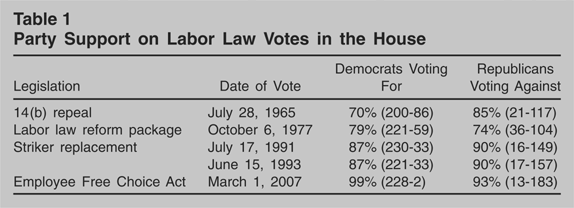
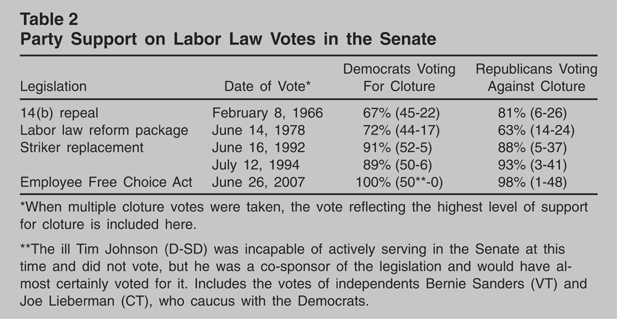
Of central importance to organized labor, there has been remarkable and unprecedented Democratic unity on votes on labor law reform in both the House and Senate. Recent votes on labor law reform reflect the current division between the parties more clearly than votes on almost any other issue, with all but universal support among Democrats and very close to universal opposition among Republicans. As recently as 1994, many Southern Democrats were unwilling to support labor on labor law votes despite intense pressure from congressional leaders. But in the 110th Congress, all of the new Democrats, regardless of region or district composition, voted with labor on every important labor law vote, including a series of votes on the Employee Free Choice Act (EFCA).7
Other labor law votes in the 110th Congress included Senate votes on collective bargaining rights for TSA workers in the September 11 Commission recommendations legislation and a House vote on collective bargaining rights for civilian workers under the National Security Personnel System.
Three Democratic members did not vote but were cosponsors of the legislation.
The significance of the vote on EFCA can be seen in a comparison with votes on labor law reform from previous decades (see Tables 1 and 2). The Taft-Hartley Act was passed by a Republican-controlled Congress in 1947 with the goal of reining in the power labor unions had gained during the New Deal and World War II eras. It included a number of provisions that made it more difficult for unions to organize new workers, including section 14(b) that allowed states to pass “right-to-work” laws prohibiting the union shop. Most Southern and many rural Western states immediately passed such laws, which make it difficult for unions to negotiate union security arrangements that help them solve collective action problems. After several failed attempts to repeal the entire Taft-Hartley bill in the 1940s, labor turned to trying to repeal what it viewed as the most onerous provision, section 14(b), during the John F. Kennedy and Lyndon Johnson presidencies. But in what would become a recurring pattern on labor law reform votes, the legislation comfortably passed the House in 1965 only to be defeated by a Republican-led filibuster in the Senate. A decade later, as unionization rates were starting to decline appreciably, the labor movement's top priority was a comprehensive package of labor law reforms that would have made it easier for unions to organize more workers. Once again, the House passed the legislation but it was successfully filibustered in the Senate. In the early nineties labor hoped to build momentum for more comprehensive labor law reform in passing a bill that would have prohibited the permanent replacement of striking workers, a practice that undermines the power of the strike and can be used by employers to force a union out of the workplace. But the legislation was defeated in both the George H. W. Bush and Bill Clinton administrations. Although Democratic support for the measure was significantly greater than in the earlier labor law votes, a number of Southerners voted against the legislation and once again it was successfully filibustered in the Senate. The votes on EFCA in the 110th Congress demonstrate that the Democratic Party has become much more unified in its support of labor and that labor law reform has become an almost purely partisan issue. Regardless of region or ideological orientation, there was almost monolithic support for labor's position among Democrats. As Bill Samuel, the legislative director of the AFL-CIO, observed in March: “We have permanent allies across the country now in the Democratic Party, and that's significant to us.”9
Bill Samuel also quoted in Rosenberg (2007).
Party Support on Labor Law Votes in the House

Party Support on Labor Law Votes in the Senate

Looking Forward
Although they had high hopes, labor leaders and other activists allied with the Democratic Party expected that many of the issues on their agenda would not become law in the 110th Congress because of Republican opposition. They are instead hoping to point to the Democrats' willingness to challenge the Bush administration and to Democratic unity in congressional votes on issues of interest to the base to motivate their constituencies in the 2008 elections. The level of Democratic support on controversial measures like EFCA offers labor activists in particular new hope that 2008 could finally produce a Democratic majority capable of delivering on its promises. The increasing polarization of the parties and the groups allied with them, however, suggests that it will be very difficult to attract any Republican support on many issues that concern the base, perhaps even more so after the 2008 election. This means the Democrats will need a filibuster-proof majority in the Senate, a tall order. There is also the risk that Democratic unity may suffer if the policy changes congressional Democrats vote on are no longer symbolic but likely to become law. For labor, there is also the risk that business will return to its old position of courting the party in power, thereby undermining the centrality labor has assumed to the Democratic Party's fortunes since the Republicans took control of Congress. The unity on issues like EFCA is also not likely to be reflected in other areas of interest to the labor movement, such as trade.10
So far the Democratic leadership has tread lightly on the issue of free trade. The Bush administration reached an agreement with congressional leaders in the spring to include more protections for workers and the environment in trade agreements, but the president's fast-track trading authority was allowed to expire over the summer. One of the deals negotiated prior to the expiration, a trade agreement with Peru, passed the House in early November with the support of a minority of Democrats and was expected to clear the Senate. However, other agreements are likely to be more contentious. While many Democrats are likely to support free trade initiatives in the future, many of the freshmen campaigned on the issue of the loss of jobs to unfair trade practices and are more supportive of labor's position on the issue.