Introduction
In a series of seminal mortality studies in the 1970s, Tsuang et al. used data from the Iowa 500 cohort (Tsuang & Woolson, Reference Tsuang and Woolson1977; Tsuang et al. Reference Tsuang, Woolson and Fleming1980) to show that people with schizophrenia, a manic or depressive presentation, had shorter lives than either the Iowa general population (Tsuang et al. Reference Tsuang, Woolson and Fleming1980) or surgical controls (Tsuang & Woolson, Reference Tsuang and Woolson1977); these effects were adjusted for gender, age and calendar period. Similar findings have been described in many other countries, populations and eras (Saha et al. Reference Saha, Chant and McGrath2007).
Subsequently, Tsuang & Simpson (Reference Tsuang and Simpson1985) commented that there was a continued need for mortality studies in psychiatry, owing to the chronic nature of major psychiatric illnesses and uncertain prognosis (Tsuang & Simpson, Reference Tsuang and Simpson1985). This is just as relevant 25 years later, because there is evidence that the discrepancy between the increasingly effective medical care of the general population and that delivered to patients with psychotic illness has expanded (Bradford et al. Reference Bradford, Kim, Braxton, Marx, Butterfield and Elbogen2008). Thus, it is imperative to study not only suicide and accidental deaths amongst those with psychotic illness (Black et al. Reference Black, Warrack and Winokur1985), but also ‘natural’ causes of death.
In this study we describe the mortality of a cohort of 2723 patients following their first contact with services for psychosis. We examine the overall mortality, deaths from common causes as well as changes in mortality from 1965 to 2007.
Method
Study cohort
To allow comparison of a range of urban to rural locations, we assembled our composite cohort from three parallel UK cohorts of incident patients with psychotic illness, collected in an identical manner in South-east London (the Camberwell cohort), Nottingham (Nottinghamshire) and Dumfries and Galloway (South-east Scotland).
For the Camberwell cohort (n=2056), case records were collected for all patients who presented to secondary care services with any psychotic presentation over four decades (1965–2004) in Camberwell. This is a densely populated, urban inner-city area, geographically aligned to the southern part of the London borough of Southwark. For the period 1965–1984 the starting point was the Camberwell Cumulative Psychiatric Case Register (Castle et al. Reference Castle, Wessely, Der and Murray1991) and then for 1984–2004, hospital computer records were used to generate a list of all patients admitted with any possible psychotic illness [International Classification of Diseases (ICD)-9 codes 295, 295.6, 297, 296.0, 296.2, 296.4, 298, 292.1 and ICD-10 codes F20, F25, F22, F30, F31.3, F31.2, F31.6, F28, F29, F12.5, F16.6, F19.5, F16.75, F19.75] in the catchment area (Boydell et al. Reference Boydell, van Os, Lambri, Castle, Allardyce, McCreadie and Murray2003). Case records of patients from the area were individually examined to identify those who made contact with services but were not admitted. From 2000–2004 resource limitations meant that the study was restricted to a smaller area consisting of the nine most southern contiguous electoral wards (approximately two-thirds of the original Camberwell population). Patients with co-morbidities such as drug and alcohol misuse were not excluded unless this was the sole cause of the psychotic episode.
The Nottingham cohort (n=203; from a mixture of urban, suburban and rural environments) was that identified in the Aetiology and Ethnicity in Schizophrenia and Other Psychoses (AESOP) study (1997–1999) (Kirkbride et al. Reference Kirkbride, Fearon, Morgan, Dazzan, Morgan, Tarrant, Lloyd, Holloway, Hutchinson, Leff, Mallett, Harrison and Jones2006). As in Camberwell there was a broad search strategy to maximize the opportunity of identifying all incident cases (Cooper et al. Reference Cooper, Goodhead, Craig, Harris, Howat and Korer1987).
The Dumfries and Galloway cohort (n=464) was that identified for a study conducted in parallel with the Camberwell study (1979–1998) (Kirkpatrick et al. Reference Kirkpatrick, Tek, Allardyce, Morrison and McCreadie2002). Dumfries and Galloway is a relatively sparsely populated, mainly rural area comprising predominantly (99.5%) white residents. Cases were obtained from two main sources: (i) the data for in-patients held centrally in Edinburgh by the Information and Statistical Division of the Scottish Office, and (ii) locally held registers of out-patients, domiciliary visits and ‘after hours’ referrals (Kirkpatrick et al. Reference Kirkpatrick, Tek, Allardyce, Morrison and McCreadie2002).
Exclusion criteria in all three centres were not being resident in the catchment area, having a clear organic cause for the symptoms and onset before 16 years of age.
Ethical approval for the study was obtained from local ethics committees at each of the three centres.
Diagnostic procedure
Case records of the subjects were examined and rated using the Operational Checklist for Psychotic Disorders (OPCRIT) version 3.4 (McGuffin et al. Reference McGuffin, Farmer and Harvey1991). This is a well-validated symptom checklist based on the Present State Examination and enabled operational research diagnostic criteria (RDC) (Spitzer et al. Reference Spitzer, Endicott and Robins1978) computer diagnoses to be made using the OPRCIT programme (McGuffin et al. Reference McGuffin, Farmer and Harvey1991) for the year after each patient's first presentation. Those patients with a broad RDC diagnosis of schizophrenia, schizo-affective disorder, psychotic mania or bipolar disorder, psychotic depression or ‘other’ (which included atypical psychosis and schizophreniform psychosis) were included in this analysis. Inter-rater reliability was monitored frequently and found to be good for diagnostic categories: the overall range of agreement was 0.75–0.94 (Dutta et al. Reference Dutta, Boydell, Kennedy, van Os, Fearon and Murray2007).
Mortality data
Routine mortality data for England and Wales for the period 1965–2007 was obtained from the Office for National Statistics (ONS). For 1965–2000 this was sourced from the 20th Century Mortality CD-ROM [international standard book number (ISBN) 1857742397] which consists of an aggregated database of deaths by age group, gender, year and underlying cause and also includes mid-year population estimates produced by the ONS. The comparable dataset for 21st-century mortality which contains data for 2001–2007 was downloaded from the ONS website on 10 February 2009 (Office for National Statistics, 2009).
To prepare the standard file to use as a population comparison, the data were grouped by gender, age group and calendar year into the broad categories of (i) unnatural causes (ICD-7 E800–E999; ICD-8 E800–E999; ICD-9 E800–E999; ICD-10 V01–Y89), (ii) suicide – and from 1968 (ICD-8) undetermined deaths given a coroner's open verdict – (ICD-7 E970–E979; ICD-8 E950–E959 and E980–E989; ICD-9 E950–E959 and E980–E989; ICD-10 X60–X84 and Y10–Y34) excluding the temporary codes E988.8 (ICD-9) and Y33.9 (ICD-10); injury by other specified means, undetermined whether accidentally or purposely inflicted, (iii) neoplasms (ICD-7 140–239; ICD-8 140–239; ICD-9 140–239; ICD-10 C00–D48), (iv) diseases of the circulatory system (ICD-7 400–468; ICD-8 390–459; ICD-9 390–459; ICD-10 I00–I99) and (v) diseases of the respiratory system and certain infectious and parasitic diseases (ICD-7 470–527 and 001–138; ICD-8 460–519 and 001–139; ICD-9 460–519 and 001–139; ICD-10 J00–J99 and A00–B99). The suicide group is a subset of the unnatural death group, and deaths from accidents and other unnatural causes were derived by subtracting suicides from unnatural causes. Similarly, the category of all natural causes was obtained by subtracting unnatural causes from all causes of death.
Causes of death
Death certificates were obtained up to and including 31 March 2007 from the ONS and the General Register Office (GRO) for Scotland. The ONS and GRO also provided information (including the date) on those who had emigrated or left the register for other reasons, e.g. because they had been removed from a family doctor's list as their whereabouts was unknown. Further tracing was done through the Central Services Agency in Northern Ireland.
Statistical analysis
Survival-time analysis was used to calculate mortality rates from different causes per 100 000 person-years. Mortality rates specific for age (split into the same 10-year age groups as the study), gender and calendar period (split into 5-year groups from 1965–2004 and 2005–2007) in the general England and Wales population were applied using the STATA version 10 istdize procedure (StataCorp LP, USA) to each study population to calculate the expected number of cases for each calendar period by gender. Standardized mortality ratios (SMRs) were calculated by dividing the total number of observed cases by the total expected number and multiplying by 100. The 95% confidence intervals (CIs) were calculated by assuming that the observed number of deaths followed a Poisson distribution. The number of excess deaths for each cause of death was calculated by subtracting the expected number from the observed number of deaths. Where there was no difference from the population mortality for a particular cause of death, the χ2 goodness-of-fit test was applied to compare the observed and expected proportions in a proportional analysis.
Poisson regression models were used to test the difference in SMRs (for all causes of death) over calendar period of follow-up, using the expected number of deaths for each stratum as the offset and assuming multiplicative effects between the number of deaths and calendar period.
As case ascertainment was undertaken in an identical manner across sites, we knew that if there were no significant differences between the areas, the cohort could be merged before analysis, to increase the number studied.
Results
Cohort characteristics
A total of 2723 individuals (55.2% men) with first-contact psychosis were included in the study. More than half (1460, 53.6%) had a diagnosis of schizophrenia. The remaining RDC diagnostic categories were 383 (14.1%) with schizo-affective disorder, 287 (10.5%) with psychotic mania or bipolar disorder, 171 (6.3%) with psychotic depression and 422 (15.5%) in other diagnostic groups.
Mean age at first contact was 33.6 years (s.d.=16.2, median=28.4). Follow-up time ranged from 1 week to 41.7 years, with a mean of 11.5 years (s.d.=9.3, median=8.5). Women had a longer mean follow-up time (11.6 years) than men (10.9 years) (t=−2.01, df=2721, p=0.05). Follow-up time did not vary by diagnostic category.
The vital status of 2510 (92.2%) individuals was established on 31 March 2007. A total of 444 (16.3%) of the cohort had died, 2044 (75.1%) were still alive and residing in the UK, 22 (0.8%) had emigrated and 213 (7.8%) had to be censored before the census date as their whereabouts was unknown. Of the deaths, 374 (84.2%) were from natural causes and 70 (15.8%) from unnatural causes.
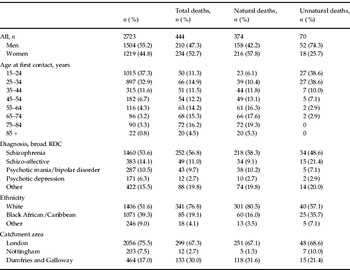
Table 1 presents the demographic distribution of the study cohort and the observed deaths. Deaths from any cause were fairly evenly distributed between men and women (47.3% v. 52.7%) but almost three-quarters (74.3%) of the unnatural deaths occurred in men and most of these happened before the age of 35 years (77.2%). Conversely, there was an excess of female deaths from natural causes (57.8%). The schizo-affective diagnostic group had a disproportionately high proportion of unnatural deaths (24.1%) compared with the proportion of total deaths (10.9%) or natural deaths (9.1%). Black Africans and Caribbeans accounted for a high proportion of unnatural deaths (35.7%) compared with their proportional contribution to total deaths (18.9%) or natural deaths (16.0%).
Distribution of cohort and observed deaths (total, natural and unnatural) by gender, age at first contact, diagnosis and ethnicity

RDC, Research diagnostic criteria.
Causes of death
The different categories of underlying cause of death are shown in Supplementary Table S1 (available online). Of deaths from natural causes, there were 142 (38.0%) deaths from diseases of the circulatory system, 75 (20.1%) deaths from diseases of the respiratory system and certain infectious diseases and 68 (18.1%) deaths from malignant neoplasms. The remaining 89 (23.8%) deaths from natural causes were from diverse categories: 38 (42.7%) before the age of 65 years and 51 (57.3%) after 65 years.
The majority of deaths from unnatural causes (53, 75.7%) were due to suicide or undetermined intent. The most frequent method of suicide was by hanging, strangulation or suffocation (15, 28.3%). Suicide mortality peaked in the first 2 years after initial contact (16, 30.2%), although 12 (22.6%) occurred a decade or more after first contact.
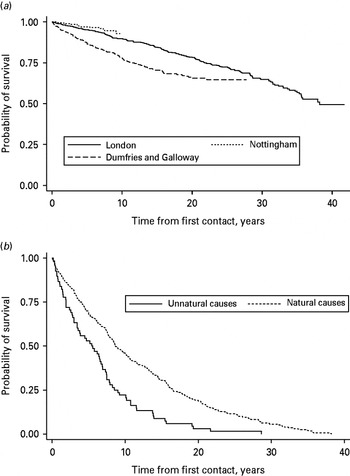
The peak for all-cause mortality (and natural-cause mortality) also occurred in the first 2 years after initial contact (71, 16.0% all-cause; 55, 14.7% natural-cause). Fig. 1 shows the Kaplan–Meier survival curve for (a) all-cause mortality according to centre and (b) deaths by natural/unnatural causes.
(a) Kaplan–Meier survival curves showing all-cause mortality according to centre for London, Nottingham, Dumfries and Galloway. (b) Kaplan–Meier survival curves showing deaths by natural and unnatural causes.

The mean age at death for men was significantly lower than that for women (56.4 v. 72.1 years, t=−8.91, df=442, p<0.001). This difference remained when unnatural deaths were excluded from the analysis (62.4 v. 74.9 years, t=−7.59, df=372, p<0.001).
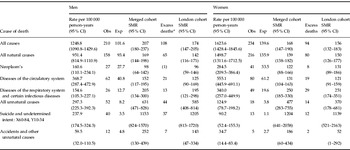
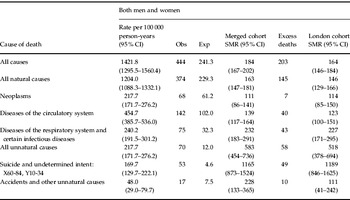
Tables 2 and 3 summarize the overall SMRs for men and women separately and together. There were no distinct differences in the patterns of mortality in the three catchment areas and therefore the datasets were merged for final analysis, although the SMR analysis is also shown restricted to the London cohort in Tables 2 and 3 to show the results remained the same.
Summary of rates per 100 000 person-years, SMRs for the merged cohort (standardized by age and calendar year), excess deaths and SMRs restricted to the London cohort, by gender

SMR, Standardized mortality ratio; CI, confidence interval; Obs, observed; Exp, expected.
a Parentheses indicate fewer deaths.
Summary of rates per 100 000 person-years, SMRs for the merged cohort (standardized by age, gender and calendar year), excess deaths and SMRs restricted to the London cohort

SMR, Standardized mortality ratio; CI, confidence interval; Obs, observed; Exp, expected.
The all-cause SMR was 184 (95% CI 167–202), almost double the risk of mortality compared with the population of England and Wales (Table 3). Overall, 203 (45.7%) of the deaths could be considered excess deaths compared with the number which would be expected if the mortality pattern for the general population of England and Wales applied. Of the excess mortality, 71.4% was accounted for by deaths from natural causes and 28.6% by deaths from unnatural causes. For women, the number of excess deaths was higher for natural than unnatural causes (80/14=5.7 times higher), with diseases of the respiratory system and certain infectious diseases as the main causes of excess deaths (29, 30.9%). For men there was also a higher propensity for excess deaths from natural than unnatural causes (65/44=1.5 times higher); however, suicide and undetermined intent was the largest category of excess deaths (37, 34.3%).
The risk of death from diseases of the circulatory system was significantly elevated in both men and women. However, the highest SMR for a natural cause of death was for diseases of the respiratory system and certain infectious diseases where there was more than double the risk compared with the general population (men SMR 205, 95% CI 134–300; women SMR 250, 95% CI 185–330). The absolute mortality from neoplasms was not significantly different from the population of England and Wales for either men or women. However, in a proportional analysis using a χ2 goodness-of-fit test to compare proportions, the observed proportion of cohort subjects dying from neoplasms was 0.15 (68/444) which was significantly less than the expected proportion, which was 0.25 (61.18/241.27) (p⩽0.001).
The mortality risk for suicide and undetermined intent was almost 12 times more than would be expected for both men and women (overall SMR 1165, 95% CI 873–1524) and accounted for the majority of the unnatural causes of death (49/58, 84.4%). Accidents and other unnatural causes accounted for only a doubling in the expected number of deaths (SMR 228, 95% CI 133–365).
Time trends in mortality
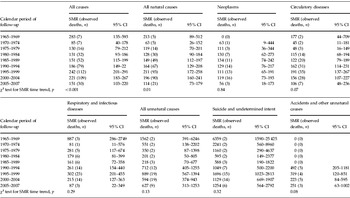
Table 4 shows the time trends in mortality for different causes of death. The all-cause SMR had a high value of 283 (95% CI 135–593) in 1965–1969. In subsequent 5-year periods there was a significant increase in SMR (p<0.001), rising from 85 (95% CI 40–178) in 1970–1974 to 242 (95% CI 201–291) in 1995–1999. There was a slight fall in SMR from 2000 onwards, but it still remained statistically significantly higher than the general population. This overall trend was mirrored by natural causes of death (p=0.01). There was also some weak evidence of an increasing risk of mortality from circulatory diseases compared with the England and Wales population (p=0.07), but no such trend for either respiratory and infectious diseases or neoplasms. These same time trends were evident when the cohort was restricted to the Camberwell sample but the number of deaths in Nottingham and Dumfries and Galloway were too small to analyse separately.
Causes of death of 444 people following first-contact psychosis with observed deaths, SMRs and 95% CIs for each 5 years of follow-up and 2005–2007

SMR, Standardized mortality ratio; CI, confidence interval.
There were no consistent trends for the unnatural causes of death. The weak evidence of a trend for accidents and other unnatural causes (p=0.08) was largely a result of there being no such classified causes of death in our cohort before 1990.
Discussion
Key findings
People with psychotic disorders have a mortality risk almost twice that of the general population, with most deaths attributable to natural causes. The overall mortality gap between such patients and the general population is widening. Diseases of the respiratory system, certain infectious diseases and deaths from circulatory diseases were the most common causes of deaths, in that order, with evidence to suggest the last may be increasing over time; there were no differences for neoplasms.
All-cause mortality
A recent systematic review by Saha et al. (Reference Saha, Chant and McGrath2007) suggested that amongst patients with schizophrenia the SMRs for all-cause mortality may be increasing from the 1970s to the 1990s. Our study strongly supports this claim, showing increases over the last four decades in a large UK cohort. The widening differential mortality gap suggests that patients have not benefited from the improvements in health care which have been available for the general population. There is strong evidence to suggest that there are inadequacies in medical care for people with severe mental illness (Cradock-O'Leary et al. Reference Cradock-O'Leary, Young, Yano, Wang and Lee2002), possibly owing to the competing demands of mental and physical diagnoses (Haupt et al. Reference Haupt, Rosenblatt, Kim, Baker, Whitehead and Newcomer2009; Roshanaei-Moghaddam & Katon, Reference Roshanaei-Moghaddam and Katon2009), bias in the attitude of health care providers or a simple failure to address medical problems (Graber et al. Reference Graber, Bergus, Dawson, Wood, Levy and Levin2000). The diverse urban–rural composition of our merged cohort means there would have been widespread variation in medical resources and socio-economic differences by region. It was interesting that the results were consistent even when the London patients were analysed separately, suggesting mortality amongst patients with first-contact psychosis is not necessarily dependent on environmental and regional influences.
Time trends in mortality
Our study found overall increases in the all-cause mortality and natural-cause mortality, which was in accordance with a large Swedish linkage study (Ösby et al. Reference Ösby, Correia, Brandt, Ekbom and Sparen2000) and a small community cohort study (n=370) of people with schizophrenia in the UK (Brown et al. Reference Brown, Kim, Mitchell and Inskip2010), but contrary to the findings of another Scandinavian study (Heila et al. Reference Heila, Haukka, Suvisaari and Lonnqvist2005). Whereas there was no evidence of a trend in SMRs for neoplasms or respiratory and infectious diseases, for circulatory diseases there was weak evidence of an increasing trend in SMRs. Ösby et al. (Reference Ösby, Correia, Brandt, Ekbom and Sparen2000) showed a statistically significant increasing trend for patients following first admission with schizophrenia for the period 1976 to 1995 in Stockholm County.
Although UK mortality from ischaemic heart disease fell between 1980 and 2000 (Brown et al. Reference Brown, Kim, Mitchell and Inskip2010) and was taken into account in the calculation of cardiovascular deaths by indirect standardization, there was a concomitant trend for a rise in SMR from circulatory diseases in our cohort. Therefore the cardiovascular mortality gap compared with the general population appears to be widening.
Most patients with first-contact psychosis will have required treatment with antipsychotics, and since the early 1990s, this will have increasingly been with second-generation anti-psychotics. There is now concern about the association of some of these medications with weight gain and the metabolic syndrome (Remington, Reference Remington2006). The metabolic syndrome has been associated with double the risk of all-cause mortality and a 2- to 3-fold increase in cardiovascular mortality (Lakka et al. Reference Lakka, Laaksonen, Lakka, Niskanen, Kumpusalo, Tuomilehto and Salonen2002) and the full impact of adverse health outcomes associated with these drugs may only fully emerge in the next few decades, when the first wave of increased mortality from cardiovascular causes and diabetes could be expected.
However as shown in the FIN11 study, long-term cumulative exposure to antipsychotics is associated with lower mortality than no drug exposure, and it is possible that life-style and living circumstances might better account for mortality rates than potential adverse effects of some treatments (Tiihonen et al. Reference Tiihonen, Lönnqvist, Wahlbeck, Klaukka, Niskanen, Tanskanen and Haukka2009). Such risk factors for excess mortality include the increased rates of cigarette smoking in patients with psychotic disorder compared with the general population (Baker et al. Reference Baker, Richmond, Haile, Lewin, Carr, Taylor, Jansons and Wilhelm2006), as well as unhealthy diet, a sedentary life-style and relative poverty (Marder et al. Reference Marder, Essock, Miller, Buchanan, Casey, Davis, Kane, Lieberman, Schooler, Covell, Stroup, Weissman, Wirshing, Hall, Pogach, Pi-Sunyer, Bigger, Friedman, Kleinberg, Yevich, Davis and Shon2004). A recent study has even suggested that certain second-generation antipsychotics might be cardiovascular protective (Blasco-Fontecilla et al. Reference Blasco-Fontecilla, Baca-Garcia and de Leon2010). It could be postulated that the trend for decreasing SMRs seen from 2000 onwards might be related to improved long-term treatment, but this will only be possible to study in ensuing decades.
Deaths from diseases of the respiratory system and certain infectious diseases
As well as cigarette smoking being a risk factor for respiratory causes of death (Brown et al. Reference Brown, Birtwistle, Roe and Thompson1999), there is some evidence that use of antipsychotics in the elderly is associated with an increased risk of pneumonia, possibly owing to dyskinesia of the oral pharyngeal muscles (which can result in aspiration), as well as sedation which is a well-known cause of swallowing problems (Knol et al. Reference Knol, van Marum, Jansen, Souverein, Schobben and Egberts2008). There were indeed 38 deaths from pneumonia in the London cohort, yet this is too few to analyse meaningfully.
Deaths from diseases of the circulatory system
In this study, there was a significantly elevated risk of death from circulatory system diseases in both men and women, although, as expected, this risk was lower in women. It is possible that as our cohort remains relatively young after a mean 11.5-year follow-up period, the proportion of cardiovascular deaths relative to other causes might be expected to be considerably higher after a further 10 years have elapsed.
Deaths from neoplastic causes
In line with most other studies of psychotic disorders, deaths from cancer were not elevated in either men or women in our study, with only 3.4% excess deaths being attributed to this category. The apparently low proportion, or ‘deficiency’ of deaths due to cancer may be due to the larger than expected number of overall observed deaths, mainly owing to suicides (Tsuang et al. Reference Tsuang, Woolson and Fleming1980). Harris & Barraclough (Reference Harris and Barraclough1998) found no difference between observed and expected numbers of neoplasm-related deaths in patients with schizophrenia when both genders were combined. However, they speculated that the elevated risk for cancer when women with schizophrenia were studied alone (SMR 115, 95% CI 106–125) reflected increased mortality from breast cancer, which could be a result of low fertility in this population (Dalton et al. Reference Dalton, Mellemkjær, Thomassen, Mortensen and Johansen2005).
In spite of high rates of cigarette smoking in patients with psychoses (Baker et al. Reference Baker, Richmond, Haile, Lewin, Carr, Taylor, Jansons and Wilhelm2006), cancer has not emerged as a major cause of death in age-adjusted mortality studies. One intriguing possibility is that a protective genetic factor may offer cancer resistance, as well as predisposing to psychotic illness (Lichtermann et al. Reference Lichtermann, Ekelund, Pukkala, Tanskanen and Lonnqvist2001). Certainly incidence studies have tended to show reduced standardized incidence ratios for tobacco-associated cancers, particularly in men (Dalton et al. Reference Dalton, Mellemkjær, Thomassen, Mortensen and Johansen2005).
Suicide, accidental and other unnatural causes of mortality
The propensity for increased suicides and accidental deaths in schizophrenia, affective and other non-affective psychoses has been cited almost universally in the literature (Hiroeh et al. Reference Hiroeh, Appleby, Mortensen and Dunn2001). However, we have previously reported that there is a danger of overestimating lifetime suicide risk when using data from studies which have a limited follow-up period (Dutta et al. Reference Dutta, Murray, Hotopf, Allardyce, Jones and Boydell2010). In his meta-analysis of competing mortality in the psychosocially vulnerable, Neeleman (Reference Neeleman2001) pooled schizophrenia and bipolar cohorts that reported total and cause-specific mortality. He found that for schizophrenia the random-effects SMR rose from natural (230, 95% CI 180–290) via accidental (300, 95% CI 210–440) to suicide deaths (1230, 95% CI 860–1760), whereas for bipolar disorder, suicide (1710, 95% CI 980–2950) and natural deaths (200, 95% CI 130–300) were elevated, but not accidental mortality (120, 95% CI 40–320). As our cohort is a mixed cohort, the lack of elevation in accidental mortality may be a reflection of this diversity.
There was an interesting gender difference in causes of mortality. For men, unnatural deaths and particularly suicides were of importance, whereas for women excess deaths from natural causes outweighed unnatural causes. Given the importance of suicide, particularly among young men in this study, an implication for early psychosis services might be the development of targeted interventions including individual crisis planning (Bertelsen et al. Reference Bertelsen, Jeppesen, Petersen, Thorup, Øhlenschlaeger, Quach, Christensen, Krarup, Jørgensen and Nordentoft2007). This is illustrated by the OPUS trial, which was able to study suicidal plans and attempts prospectively over 5 years. The high numbers of participants required to show a clinically relevant difference between treatment groups is a problem in designing randomized controlled trials of interventions to reduce suicide mortality; general public health schemes which would have an impact on both ‘high-risk’ groups and the general population are to be advocated as they can have a higher population impact than targeted interventions (Dutta et al. Reference Dutta, Murray, Allardyce, Jones and Boydell2011).
Although there appeared to be a disproportionately high number of unnatural deaths amongst black Africans/Caribbeans (29.4%) and the other ethnic group (27.8%) than in the white group (11.7%), this is likely to be because ethnic minority groups presented later in the case ascertainment period, and therefore other causes of death had not had sufficient time to become manifest.
Strengths and limitations of the study
A major strength of this study is that it is based on an incidence rather than a prevalence cohort. This means that there is no variation in the stage of illness from which subjects were studied. For example, Brown et al. (Reference Brown, Kim, Mitchell and Inskip2010) state that in their 25-year follow-up of a prevalence cohort of 370 patients with schizophrenia, 343 (93%) had already survived the period of greatest excess mortality (Mortensen & Juel, Reference Mortensen and Juel1993). There was further selection bias because patients with significant drug or alcohol misuse were excluded, whereas in our study all first-contact psychosis patients regardless of drug or alcohol misuse at first presentation or later in the course of illness were included. Our method should therefore have avoided underestimation of the SMRs.
Inclusion in our cohort was based on RDC diagnoses which are likely to be more valid and accurate than register-based diagnoses. However, the inclusion criteria missed those with unrecognized psychosis or those who sought help only from primary care: thought to be a tiny number in the UK (El-Adl et al. Reference El-Adl, Burke and Little2009). Loss to follow-up in our cohort was small, with the status of less than 8% being unknown at the census date.
A potential source of bias is the fact that four revisions of the ICD were bridged by the duration of our study and there have been changes in the way that the underlying cause of death is selected by the ONS (Janssen & Kunst, Reference Janssen and Kunst2004). Collapsing the causes of death into broad categories based on ICD chapters was therefore desirable. Discontinuities in the registration of causes of death that result from the implementation of different versions of the ICD could then be regarded as negligible (Anderson et al. Reference Anderson, Miniño, Hoyert and Rosenberg2001).
The SMR for 2005–2007 appeared low in our study compared with the general trend for previous 5-year follow-up periods for all causes and all natural causes of death. Although the lower number of person-years in the 2005–2007 period of follow-up was taken into account, it is still possible that there was under-enumeration of deaths in this period. The trace date was 31 March 2007, yet all deaths certificates up to this date are unlikely to have been available from the ONS, owing to delays in release.
Caution should be exercised in the interpretation of SMRs when comparing our study with others, because the values calculated are dependent on the age distribution of the study population and on the chosen ‘standard’ population (Tsai & Wen, Reference Tsai and Wen1986). To make strict comparisons between studies, standardization using the same ‘standard’ population – e.g. the World standard (Ahmad et al. Reference Ahmad, Boschi-Pinto, Lopez, Murray, Lozano and Inoue2001) – would be required. A further caveat concerning UK mortality studies, such as ours, is that death certificates particularly for natural deaths may be inaccurate in describing the cause of death (Tuffin et al. Reference Tuffin, Quinn, Ali and Cramp2009). The majority are completed by junior doctors who have received little formal training in their completion; their categorizations are often markedly different to those of consultants, with 46% disagreement reported by Tuffin et al. (Reference Tuffin, Quinn, Ali and Cramp2009). However, our use of broad categories of death should have limited the potential margin of error and we have no reason to suspect systematic bias for patients with psychosis.
Implications
Overall, the number of deaths in our cohort was nearly double that expected if population rates had applied, with evidence that the excess has increased significantly over the four decades from 1965 onwards. Our cohort is more heterogeneous in diagnostic categories than previous studies, but this means it is also more clinically representative of all first-contact psychosis patients. The need for better understanding of the iatrogenic, life-style and disease-related causes of death in patients with psychosis is clear, as is research into interventions to address this ultimate health inequality.
Note
Supplementary material accompanies this paper on the Journal's website (http://journals.cambridge.org/psm).
Acknowledgements
We thank Professors David Castle, Jim van Os and Simon Wessely for establishing the Camberwell First Episode Psychosis Study and collecting much of the early data in London and Professor Robin McCreadie for establishing the Dumfries and Galloway cohort. We gratefully acknowledge assistance from Dr Kimberlie Dean in identifying some of the new patients from 1997 onwards and Dr Al-Saadi for collation of some of the early death certificates. We acknowledge the support of Dr Morven Leese who advised on statistical aspects of the study and Mr Colin Gale of Bethlem Royal Hospital Archives & Museum for assistance with archived records.
This study was funded by the Medical Research Council, London, UK, as well as by grants from the British Medical Association, Psychiatry Research Trust, London, UK and the Chief Scientist Office, Scottish Government, Edinburgh grant: CZH/4/110, Scotland, UK.
Declaration of Interest
None.