Executive dominance of the legislature is a defining characteristic of Westminster-style political systems. Rank and file legislators have few institutional means to influence policy outcomes or establish individual reputations. In large measure, this is a function of high levels of party discipline enabled by leadership control of candidate selection and advancement within the party. Legislators must resort to other parliamentary tools to attract attention and influence outcomes. In Britain, one such tool is the early day motion (EDM)—a formal public statement of support for a particular position that, despite being a motion, is almost never debated or put to a vote. Some members use EDMs extensively, introducing dozens of motions each session, while other members of parliament (MPs) never sponsor such motions.
Research on EDMs has focused on their utility as indicators of member preferences. Since EDMs are not whipped by the parties, scholars have used them to identify groups of MPs with similar preferences (Finer, Berrington and Bartholomew Reference Finer, Berrington and Bartholomew1961; Berrington Reference Berrington1973; Franklin and Tappin Reference Franklin and Tappin1977), to locate them on a general left-right dimension (Leece and Berrington Reference Leece and Berrington1977; Kellermann Reference Kellermann2012), to examine opinions on particular issues (Berrington and Hague Reference Berrington and Hague1998; Childs and Withey Reference Childs and Withey2004) and to measure cohesion within political parties in the House of Commons (Bailey and Nason Reference Bailey and Nason2008). Despite this interest in EDMs as indicators of preferences, there has been little consideration of the reasons why members introduce them in the first place.
This article argues that members use EDMs, in part, to cultivate an individualized reputation in their constituencies. The importance of individual candidates in the decision-making calculus of British voters has been a matter of some debate. The conventional wisdom has long been that individual candidates are essentially irrelevant to electoral outcomes in the United Kingdom, since party discipline gives voters incentives to vote for the party rather than the candidate. Carey and Shugart (Reference Carey and Shugart1995) argue that the British electoral system has the lowest incentive to cultivate a personal vote of all single-member district systems. Moreover, scholars found little evidence of an incumbency advantage for sitting members of parliament, a traditional indicator of a personal vote (Gaines Reference Gaines1998).
Yet it is clear that MPs spend a great deal of time addressing constituent concerns (Cain, Ferejohn and Fiorina Reference Cain, Ferejohn and Fiorina1987; Norris Reference Norris1997; Gay Reference Gay2005). Prior research indicates that members believe that constituent service provides electoral benefits. This link extends beyond traditional forms of constituent service to encompass explicitly legislative activities. Kam (Reference Kam2009) finds a positive association between constituent service and dissent in parliamentary votes. Bowler (Reference Bowler2010) shows that members who introduce private member bills have better electoral outcomes. Moreover, there is some evidence that an incumbency advantage has emerged in recent elections, particularly for incumbent Liberal Democrat MPs (Smith Reference Smith2013).
If certain legislative activities allow members to improve their individual electoral prospects, members have a clear incentive to engage in those activities, even though they may increase intraparty tensions. As Kam (Reference Kam2009) argues, efforts by individual members to improve their own electoral fortunes may place them at odds with party leaders if those efforts call into question the party's ability to act cohesively. However, the development of a personal vote advantages incumbent members over challengers, and by extension parties in the majority over opposition parties, giving party leaders an incentive to encourage such efforts. This is particularly true in legislatures elected from single-member districts, because the fortunes of party leaders depend on the electoral performance of individual MPs rather than the party as a whole. As an example of this dynamic, Proksch and Slapin (Reference Proksch and Slapin2012) show that party leaders exert far less control over backbench participation in floor debates in Britain than in Germany.
Given the incentives facing individual legislators, it is not surprising that they would seek to use any available legislative tool to develop a personal vote, particularly when those tools do not seriously threaten the control of party leaders. In the British House of Commons, EDMs are such tools. While they are purely signaling devices without formal legislative consequences, they provide a low-cost way for members to increase their visibility and respond to constituent concerns. Using a new dataset containing over 20 years of EDM sponsorship data, the evidence presented in this article suggests that greater rates of EDM sponsorship are associated with increased margins of victory in subsequent elections. While this result cannot be interpreted as an unbiased estimate of the causal effect of EDM sponsorship in the absence of a physical randomization, it suggests that EDM sponsorship may help members at the ballot box. Moreover, the strength of this association appears to have increased in recent years.
To the extent that members believe that sponsoring EDMs can improve their electoral prospects at the margin, members from electorally competitive constituencies should introduce more EDMs than members from safe constituencies. To test this hypothesis, EDM sponsorship data is analyzed using a hierarchical negative binomial hurdle model—new to the political science literature—that accounts for several characteristics of EDM data: repeated observations on MPs, a large number of observations with zero outcomes and high variation in the number of EDMs sponsored from session to session. The results show that members with smaller margins of victory in the previous election are more likely to introduce EDMs, and that they introduce EDMs at a higher rate than those with large margins of victory. Major differences also exist between the parties in the rate at which MPs sponsor motions. Moreover, the relationship between electoral vulnerability and EDM sponsorship has become stronger over the past 20 years.
Taken together, these results suggest that establishing a personal vote has become increasingly important to members, and that members have responded by increasing their use of EDMs in an effort to cultivate support among their constituents. This accounts for much of the dramatic increase in the use of EDMs over the past few decades. More importantly, this analysis demonstrates that even in a political system in which individual legislators have little control over their own electoral prospects, politicians will do whatever they can to improve those prospects at the margin. Exerting effort in the form of greater legislative activity can be a rational response to electoral vulnerability even when the payoffs of that effort are small. While EDMs have evolved in the specific institutional context of the British House of Commons, many legislatures have procedures by which members can draw attention to themselves. In these cases, as with EDMs, the effects of the procedures outside of the legislature may be as (or more) important in explaining their use as their consequences within the legislature.
EDMs in Context
EDMs are non-binding internal petitions in the House of Commons that enable members to express their opinions in the form of a parliamentary motion that would, if debated and approved, express the sense of the Commons. While EDMs are rarely debated, much less voted on, other members can sign motions to indicate their support. The list of members who support the motion can be seen by other legislators and the public. Any member can sponsor an EDM on any topic, although parliamentary norms restrict government ministers from introducing or signing EDMs due to the convention that the government speaks with one voice. The speaker and deputy speakers also refrain from introducing or signing EDMs. Members can introduce an EDM at any point during a parliamentary session, but they are closed to new signatures at the end of each session. An EDM may then be reintroduced in subsequent sessions if the underlying issue remains politically salient.
EDMs arose from a 19th-century practice in which MPs introduced motions for consideration “at an early day”: an unspecified date in the future (House of Commons Information Office 2010b). As the government leadership took control of the parliamentary agenda in the 19th century (Cox Reference Cox1987), such motions were rarely debated, but they continued to be tabled by members in an effort to place their opinions on the record. A more formal system was developed by the clerks of the House of Commons in the 1940s to record the names of supporters. In recent years, additional infrastructure has been added to make EDMs more visible inside and outside the House of Commons, including an online database in which EDMs can be searched by topic or member. These changes were accompanied by a dramatic increase in the number of EDMs introduced. During the 1940s and 1950s, members introduced fewer than 150 per session. Since 2000, in contrast, the number of EDMs introduced has averaged approximately 1,800 per session. Many legislative bodies in other countries have methods by which private members can propose motions for the record, but in most cases they do not have the prominence or the ability to record support from other members as do EDMs in the House of Commons.Footnote 1
There are four broad categories of EDMs. Some are policy related, in that they support or oppose actions that could be taken by the government. Such EDMs allow members to differentiate themselves from their party leadership on politically salient issues without voting against the leadership in a division. Other EDMs are proposed for local reasons. Members gain attention in their constituencies by sponsoring EDMs that recognize the activities of local individuals or organizations or draw attention to local concerns. A third group of motions aims to score points against other political parties without necessarily advocating particular policies. Finally, a small subset of EDMs is used by opposition leaders for procedural reasons to bring regulations promulgated by the government forward for debate. Aside from procedural EDMs that are designed to prompt debate on regulations, EDMs rarely have direct parliamentary or policy consequences. On occasion, an EDM may be debated on the floor of the House of Commons and lead to a division being taken. The no-confidence motion that brought down the Callaghan government in 1979 was technically an EDM introduced by Margaret Thatcher, but such outcomes are the exception (House of Commons Information Office 2010b).
Instead, EDMs are best thought of as expressive, potentially non-credible methods for MPs to signal their positions to others. The cost of sponsoring an EDM is trivial and does not depend to any significant degree on the content of the motion. Some EDMs are designed to influence outcomes within the House of Commons by sending signals to party leaders or other MPs. To the extent that scholars have attempted to explain EDM sponsorship, they have focused on factors internal to the House of Commons (Berrington Reference Berrington1973). Beyond this, however, EDMs can be used to send messages to actors outside of the House. Some are aimed at lobbyists or pressure groups that seek evidence that their efforts influence legislators. Finally, some EDMs send messages to constituents. The message may be policy oriented, designed to differentiate an MP from his or her party line, or may simply be intended to demonstrate that the member is an active parliamentarian who cares about his or her constituency.
EDMs share certain characteristics with private member bills. From a practical perspective, the main difference is that private member bills have a small chance of becoming law, while EDMs are purely signaling devices. Recent research suggests that sponsoring legislation is a response to vote-seeking incentives in a wide range of legislative systems (Bowler Reference Bowler2010; Bräuninger, Brunner and Däubler Reference Bräuninger, Brunner and Däubler2011; Brunner Reference Brunner2012). Most notably, Loewen et al. (Reference Loewen, Koop, Settle and Fowler2013) demonstrate that private member bills have a positive causal effect on electoral outcomes in Canada by taking advantage of the randomization used to select bills for consideration. If the electoral benefits of private member bills are due to the attention received by members who sponsor them, rather than the fact that they are draft legislation, then EDMs should produce similar benefits without the need for legislative text.
As with private member bills, EDMs generate publicity for the members who introduce them. The introduction of an EDM is a formal legislative act that provides a hook for media coverage in a way that a simple press release does not. Members can use EDMs as part of a larger campaign to raise issues of interest to their constituents and, by extension, to raise their own profile in the constituency as an active, engaged legislator.
Article counts from British newspapers between 2005 and 2010 demonstrate a systematic relationship between the number of EDMs introduced and the amount of media coverage relating to EDMs that a member receives.Footnote 2 In other words, sponsoring EDMs was a successful way for members to get their names in the press. The results suggest a partisan difference in the rate at which EDMs translate into media coverage. Holding constant the number of EDMs introduced, Conservative MPs were mentioned in fewer articles than members of other parties, suggesting that EDMs are less useful for members of that party.
Introducing an EDM also allows members to respond to constituents who ask them to do something about a particular problem. These may be individual constituents or organized pressure groups promoting a campaign for policy change. Correspondence regarding EDMs makes up a small, but non-trivial, proportion of constituent mail. Sponsoring an EDM gives the impression that the MP has taken some action in response to the constituent's concerns. Introducing and signing EDMs can thus be seen as a form of constituent service.
To be sure, the effectiveness of EDM sponsorship in this regard may depend in part on constituent misunderstandings of the consequences of motions. As Douglas Hogg, MP stated during a parliamentary inquiry into EDM usage: “it is a form of humbuggery that actually you are deceiving people into thinking you are doing something significant but you are not” (House of Commons Procedure Committee 2007, 22). To the extent that this is true, EDMs are valuable as a means for members to persuade constituents that they are working hard on their behalf.
EDMs and Electoral Outcomes
Members have a strong incentive to sponsor EDMs if doing so improves their chances of re-election. To determine whether greater EDM sponsorship is associated with better electoral performance, this study considers the electoral outcomes for new members seeking re-election for the first time. The evidence for this analysis consists of data on EDM sponsorship from 1989 to 2010 obtained from the EDM database maintained by the House of Commons (House of Commons Information Office 2010a). Motions used for procedural purposes are excluded from the count, since these motions have different procedural implications and follow a different data-generating process from substantive EDMs. Likewise, amendments that modify existing EDMs are not included. Observations from members initially elected in by-elections are also excluded.Footnote 3
For this analysis, the average number of EDMs sponsored per session is calculated for each parliament. The party affiliation for each member is coded as Labour, Conservative, Liberal Democrat or other. The number of years an MP served as a government minister is also recorded in light of the parliamentary norm against EDM sponsorship by government members. This biographical data was coded from information contained in Gay et al. (Reference Gay, Cracknell, Hardacre and Fessey2010).
The outcome is the change in the margin of victory, measured as a percentage of the total vote, from the first to the second election. The vote share margin of the winning candidate over the second-place candidate offers a measure of the degree to which the winner may face a serious challenge in the next election. The vote share margin has a number of desirable attributes as a measure of competitiveness (Blais and Lago Reference Blais and Lago2009), and the confidence of legislators in their re-election prospects is likely to increase monotonically as their margin of victory increases.Footnote 4
Restricting attention to MPs facing re-election for the first time has several benefits. It removes the effects of time-invariant member and constituency characteristics. Moreover, by looking only at members in their first re-election bid, there is no need to consider how members’ prior legislative activity affected their baseline electoral margin of victory. In addition, relatively few first-term MPs receive appointments in the government that would affect their ability to introduce EDMs.
Even with the inferential benefits derived from a focus on first-term members facing re-election, it would be inappropriate to view the results as the causal effect of EDM sponsorship in isolation. Estimating the causal effect of a particular legislative activity or institution is extremely difficult in the absence of a physical randomization (Kellermann and Shepsle Reference Kellermann and Shepsle2009; Loewen et al. Reference Loewen, Koop, Settle and Fowler2013). Since no such randomization exists for EDMs, it would be necessary to control for all other forms of legislative activity, even those that are fundamentally unobservable. In the absence of all such variables, it is difficult to know the direction of any resulting bias (Clarke Reference Clarke2005). Instead, it is more appropriate to interpret the results as the effect of greater EDM sponsorship—and everything correlated with greater EDM sponsorship—on electoral outcomes.
Analyzing the electoral outcomes for first-term MPs seeking re-election in the same constituency produces a sample of 676 cases between 1992 and 2010. This number does not include first-term MPs who contested a different constituency in their second election, MPs who did not run for a second term or MPs who ran against other incumbent MPs due to changes in constituency boundaries. Only 26 cases are excluded by these restrictions. The analysis does include MPs who ran in newly drawn constituencies that substantially overlapped with their prior constituency, although excluding these cases does not substantively alter the findings.
As noted above, the outcome of interest is the change in electoral margin. Since EDM sponsorship is likely to exhibit diminishing marginal returns, with the incremental benefit of introducing an additional EDM decreasing as the total number increases, the average number of EDMs introduced is transformed by taking the square root.Footnote 5 The regression model assumes a uniform change in electoral margin for each party during each election, with regional parties and independents treated as a single group. The number of years as a government minister is also included. Finally, the prior electoral margin is included to allow for regression to the mean in electoral outcomes.
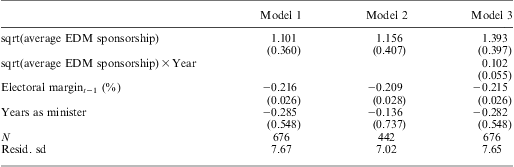
The results show a clear association between EDM sponsorship and increased electoral margins after controlling for partisan electoral shifts and prior electoral margins. Table 1 shows the results of two linear regressions, with Model 1 estimated using all constituencies and Model 2 estimated without constituencies affected by periodic Boundary Commission reviews.Footnote 6 In both cases, the conditional association between EDM sponsorship and electoral margin is positive and statistically reliable. The results imply, for example, that a member who introduced an average of four EDMs per session would have an expected increase in electoral margin that is 1.1 percentage points greater than a member who introduced an average of one EDM per session. While the difference in electoral outcomes associated with EDMs is far less than the partisan shifts observed in each election or the degree of regression to the mean, individual members can control their EDM sponsorship behavior, while they have little control over their party's electoral fortunes.
Change in Electoral Margin (%) as Function of EDM Sponsorship
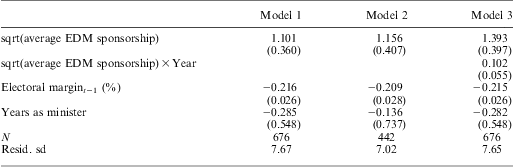
Note: posterior mean estimates from Bayesian linear regression of the change in electoral margin as a percentage of total vote on indicated covariates and party-year fixed effects (not shown). Posterior standard deviations in parentheses. Model 2 excludes observations subject to periodic Boundary Commission reviews.
Moreover, there is some evidence that the association between EDM sponsorship and improved electoral margins has increased over time. Model 3 includes an interaction term between EDM sponsorship and year, with the year variable recentered to the year 2000. In Bayesian terms, the posterior probability that the interaction term is positive is 96.7 percent. The magnitude of the interaction term is also substantively meaningful, suggesting an increase of one percentage point per decade based on the posterior mean, which represents more than doubling the magnitude of the relationship during this 20-year time period.
Taken together, these results show a small but statistically reliable association between EDM sponsorship and electoral outcomes. While this cannot be interpreted as the causal effect of EDM sponsorship in the absence of a randomization, it suggests that members might have reason to believe that EDM sponsorship helps them at the ballot box in a system where individual legislators have few other ways to appeal to constituents.
Theoretical Framework
To the extent that EDM sponsorship is associated with better electoral outcomes for members of parliament, as shown in the previous section, members have an incentive to use EDMs to solidify their electoral position by developing a personal vote—support linked to their own behavior rather than that of their party. The members most in need of a personal vote are those in highly competitive constituencies, and as a result, such members would be expected to introduce EDMs more often than members from safe constituencies.
The underlying theoretical framework for this hypothesis assumes that members behave rationally in their use of EDMs—that is, they introduce EDMs until the marginal cost of sponsoring an additional motion exceeds its marginal benefit. In keeping with the prior discussion, the benefits of EDM sponsorship are assumed to be in part electoral, and to exhibit diminishing marginal returns. The costs of EDM sponsorship stem from the effort involved in introducing them and soliciting support from other members, effort that could be dedicated to other parliamentary activities or to non-parliamentary interests.
Members receive electoral benefits from EDM sponsorship and other legislative activities if those activities convince some subset of voters in their constituency to support the incumbent MP, even though they prefer a different political party in the abstract. If members care about winning re-election rather than maximizing their vote share, then the benefit of persuading that subset of voters declines as the member's expected vote share increases. Members from marginal constituencies have a greater incentive to introduce EDMs because they benefit more from an improved reputation. To the extent that the electoral benefits of EDMs have increased, as suggested by the analysis in the previous section, members should use EDMs more frequently in response, leading to an increase in EDM sponsorship over time.
Likewise, partisan differences in EDM sponsorship will be observed if there are systematic differences in the marginal benefit that members of different parties receive. As noted in the previous section, Conservative MPs obtain less news coverage for their EDMs than Labour or Liberal Democrat MPs. This should lead Conservative members to introduce fewer EDMs, since they receive less pay-off for their efforts. However, while Labour and Liberal Democrat MPs receive similar levels of publicity for their EDMs, Liberal Democrats have fewer outlets for their legislative activities as members of a smaller political party, which should make EDMs more attractive to them.
The electoral benefits that members receive from sponsoring EDMs also depend on the degree to which constituents can be persuaded to change their views. As members spend more time in office, their ability to change constituent perceptions should decrease. In a Bayesian sense, constituents will have stronger priors about their members as time goes on. Likewise, former ministers will also be less likely to change the opinions of constituents through their legislative activities because their participation in government is likely to have solidified constituent perceptions. Both of these should reduce the incentive to introduce EDMs.
Turning to the cost side of the equation, the effort associated with EDM sponsorship could be dedicated to other parliamentary activities or to non-legislative interests. If members dedicate all of their time to legislative activity, then EDM sponsorship would necessarily be a substitute for other behaviors such as the introduction of private member bills, participation in floor debates, or oversight through parliamentary questions or service on select committees. Yet if members have significant non-parliamentary interests, the relevant trade-off is likely to be with time dedicated to those other interests. In that case, one would observe greater effort in all facets of legislative activity when members believe they are electorally vulnerable.
Modeling EDM Sponsorship
Having set out a framework for EDM sponsorship as a response to electoral vulnerability, this study next develops an appropriate statistical model to analyze EDM data. The dependent variable for this analysis is the number of EDMs introduced by a member in a given session of parliament. During the period from 1989 to 2010, the average number of EDMs introduced by members was 2.14 per session. Among those introducing at least one EDM, the average number introduced was 4.85. The total number of observations is 13,527, divided among 1,290 distinct members over 21 sessions.
The EDM sponsorship counts have several characteristics that drive the selection of a statistical model. First, many MPs do not sponsor any EDMs in a particular session of parliament, either because they are bound by the convention against EDM sponsorship by government members or because they view EDMs as irrelevant. As a result, the over 7,000 zero counts in the data come from a different data-generating process than that of standard count models. Secondly, there is significant variability from session to session in the number of EDMs introduced by individual MPs. Members who are active sponsors in one session may become less active if their issues become less salient. Thirdly, the EDM data consist of repeated observations of the same members from different parliamentary sessions. The median MP contributes nine observations to the dataset. This raises the prospect that the outcomes will be correlated within MPs, even after conditioning on the appropriate covariates.
The hierarchical negative binomial hurdle model proposed by Min and Agresti (Reference Min and Agresti2005) is used to deal with these characteristics of the data. The hurdle model divides the analysis into two parts. The hurdle component models a member's decision to introduce any EDMs at all, which in this case depends on a member's belief that EDMs are useful parliamentary tools. For some members, this hurdle is imposed externally by the convention against the introduction of EDMs by members on the government payroll, while for others it comes from a belief that EDMs are not valuable. If the hurdle is overcome, a truncated count distribution is used to model the number of EDMs introduced. The excessive variability in the non-zero counts is addressed through the use of a truncated negative binomial model, which allows the dispersion of counts to be estimated from the data.Footnote 7 Finally, the repeated-measures characteristic of the data is addressed by introducing random effects into both the hurdle and count components of the model. Following Min and Agresti (Reference Min and Agresti2005), the random effects are allowed to be correlated for each MP, but are assumed to be independent across MPs.
While both hurdle and hierarchical models have been used in political science, no existing work combines both of these elements. Drawing on the public health literature, this analysis follows Neelon, O'Malley and Normand (Reference Neelon, O'Malley and Normand2010) in implementing a Bayesian hierarchical hurdle model; the main difference is in the use of a truncated negative binomial distribution, rather than truncated Poisson, to model the count portion. The model is fit using WinBugs (Spiegelhalter et al. Reference Spiegelhalter, Thomas, Best and Lunn2003) by way of the R2WinBugs package in R.
To formalize the model, define Yij to be the number of EDMs sponsored by member i in session j. Zij is an indicator variable equal to 1 if Yij ≥ 1 and 0 if Yij = 0. The sampling distribution for hurdle models can be separated into a model for Zij, which is assumed to follow a Bernoulli distribution with probability πij, and a model for Yij given that Zij = 1, which is assumed to be a truncated negative binomial distribution, where μij and θ are the conditional mean and dispersion, respectively, for the untruncated distribution:
 $${\rm{Prob}}[Y = {{y}_{ij}}|{{X}_{ij}}]\, = \,\frac{{\frac{{\Gamma (\theta \, + \,{{y}_{ij}})r_{{ij}}^{\theta } {{{(1\,{\rm{ - }}\,{{r}_{ij}})}}^{{{y}_{ij}}}} }}{{\Gamma (1\, + \,{{y}_{ij}})\Gamma (\theta )}}}}{{1\,{\rm{ - }}\,r_{{ij}}^{\theta } }}\; \; where\; \; {{r}_{ij}}\, = \,\frac{\theta }{{\theta \, + \,{{\mu }_{ij}}}}\; \; for\; \; {{y}_{ij}}\, \in \,1,2,3, \ldots .$$
Standard link functions are used to model πij and μij as a function of the explanatory variables Xij. For the hurdle component, the logistic link is used:
 $${\rm{logit}}({{\pi }_{ij}})\, = \,{{\gamma }_{i1}}\, + \,{{{\rm{X}}}_{ij}}\alpha .$$
The log link is used for the mean of the untruncated negative binomial mean in the count model:
 $$\log ({{\mu }_{ij}})\, = \,{{\gamma }_{i2}}\, + \,{{{\rm{X}}}_{ij}}\beta .$$
The legislator-specific random effects γi 1 and γi 2 are included to capture correlations between outcomes for a particular MP. These random effects are assumed to follow a bivariate normal distribution:
 $${{\gamma }_i}\,{\rm{:}}\,N(\mu, \Sigma ).$$
This allows for correlation between the random effects in the count and hurdle components for a given legislator. Members who usually do not introduce any EDMs are likely to introduce few EDMs in those sessions where they clear the hurdle.
The key explanatory variable in this analysis is the measure of electoral vulnerability. The margin of victory in the previous election, in this case measured as a proportion, is used as a measure of the competitiveness of each constituency. The observed margins range from less than 0.001 in marginal constituencies to well over 0.5 in safe constituencies, with a median of 0.2. Several biographical characteristics are also included, again coded from Gay et al. (Reference Gay, Cracknell, Hardacre and Fessey2010). The same four-group coding (Labour, Conservative, Liberal Democrat and other) is used for party affiliation, with members who switched parties during a parliamentary session coded as members of the party to which they belonged for the longest period of time in that session. A variable is constructed for government ministers (as well as the speaker and deputy speakers) to account for the parliamentary norm barring them from EDM sponsorship. An analogous variable is constructed for members of the opposition frontbenches.
Two variables capture potential changes in EDM sponsorship behavior over time. The first, tenure in office, measures the member's number of years of continuous service in the House of Commons. The second, former government minister, is an indicator variable for members who have returned to the backbenches after serving in government.
Finally, two variables measure characteristics of the parliamentary sessions. The first variable, session length, measures the length of time between the opening and closing of a session as a fraction of a calendar year. During this period, the first session of each parliament was longer than the average and the last session was shorter. Longer sessions have more EDMs, since members can introduce them at any time during the session. The second variable, year, is a linear trend designed to capture any increase in EDM sponsorship that is not accounted for by the other variables.
Since this is a Bayesian model, weakly informative priors are assumed to complete the model. Given the large number of observations, these priors have little effect on the posterior density. For the coefficients in the hurdle and count models, independent normal priors are chosen with mean 0 and variance 10,000. The priors for μ 1 and μ 2, the means of the random effects, are also normal with a mean of 0 and variance of 10,000. The prior for the precision of the random effects, Σ−1, is Wishart(I 2, 2). Finally, the prior for the dispersion parameter θ is Uniform(0, 100).
MCMC algorithms used to estimate hierarchical Bayesian models often suffer from poor mixing due to high posterior correlations between the parameters. To reduce this problem, steps are taken to reduce the posterior correlations. First, rather than estimating global intercepts and zero-mean random effects separately, individual-specific intercepts are estimated in both parts of the model. Secondly, each of the interval-level predictors used in the model is centered. Finally, contrast coding is used (rather than the standard dummy variable coding) to model party affiliation. The estimated results for party affiliation are then translated back to the standard dummy variable representation for interpretation. The results reported in the article were obtained from three chains run in parallel for 20,000 iterations. Standard convergence diagnostics showed no obvious problems.
The hierarchical negative binomial hurdle model described above produces a substantially better fit to the data than either a standard negative binomial model or a non-hierarchical negative binomial hurdle model. More importantly, the hierarchical model changes the substantive inferences from the model, revealing the importance of electoral vulnerability for EDM sponsorship. Results from all of these models are compared in an online appendix.
While the model presented here is more appropriate for this data, the analysis uses observational data without randomization of the electoral margin, again making causal inferences difficult. That said, the inferential problems involved in estimating the effect of electoral margin on a particular legislative behavior are less severe than those associated with estimating the effect of a particular behavior on subsequent electoral outcomes. For one thing, it is unnecessary to worry about other forms of legislative activity contemporaneous with EDM sponsorship in a given session, since those activities are post-treatment relative to the electoral margin. The inclusion of random effects also removes much of the contribution from time-invariant characteristics of members and constituencies. Like all random effects models, however, bias can result if the random effects are correlated with the key explanatory variable, in this case if high-sponsorship types are more likely to be elected from marginal constituencies. As a consequence, the results must be interpreted with care.
Results
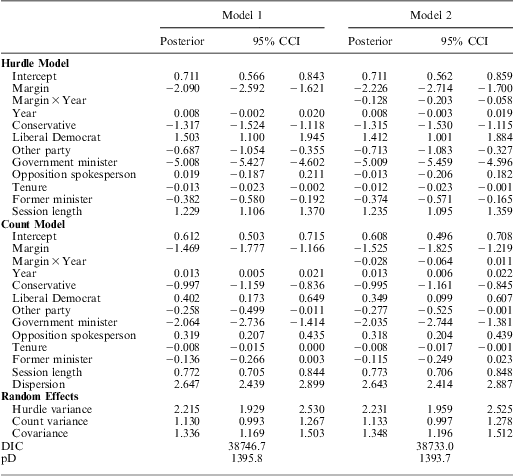
Results from the hierarchical negative binomial hurdle models show a clear empirical relationship between electoral margin and EDM sponsorship that has increased over time. In Model 1, each of the predictor variables enters into the model additively, while Model 2 incorporates an interaction term between the margin of victory and the session year to allow for changes in the relationship between electoral vulnerability and EDM sponsorship over time. The posterior mean estimates and 95 percent central credible intervals are presented in Table 2. Results from the hurdle component, presented in the upper section of Table 2, show the expected difference in the log-odds of sponsoring at least one EDM in a given session. The estimates from the count component, presented in the lower section of Table 2, do not have a simple interpretation. The count model is parameterized in terms of the mean of the untruncated negative binomial distribution, while the model uses the truncated negative binomial distribution. The signs and relative magnitudes, however, can be readily discerned.
Hierarchical Negative Binomial Hurdle Model Estimates for Early Day Motion Sponsorship

Note: posterior mean estimates and 95 percent central credible intervals generated from the hierarchical negative binomial hurdle model with the indicated covariates. Samples for each model were generated from three MCMC chains run for 20,000 iterations (n = 13,527).
The key finding from Model 1 is the negative relationship between electoral margin and EDM sponsorship in both components of the model. Electoral competitiveness, as measured by the margin of victory, varies widely from constituency to constituency. Every increase of 10 percentage points in the margin of victory reduces the odds of sponsoring at least one EDM by 19 percent. Likewise, the marginality of the constituency also increases the expected number of EDMs introduced by members who clear the hurdle and introduce at least one EDM. These results strongly suggest that members are responding to competitive pressures in their decision to introduce EDMs. This is consistent with the hypothesis that members perceive them as a way to improve their standing in their constituencies.
Party affiliation also plays an important role in predicting which members will sponsor EDMs, even after controlling for other member characteristics. Liberal Democrats are the heaviest users of EDMs, even after controlling for other factors. The odds that a Liberal Democrat MP will introduce at least one EDM are 4.6 times higher than those of a similarly situated Labour MP. Likewise, among MPs who sponsor at least one EDM, Liberal Democrats sponsor more EDMs on average. In contrast, Conservative MPs are far less likely to introduce at least one EDM than Labour MPs, and introduce many fewer EDMs on average when they introduce at least one. To the extent that Conservative MPs receive less publicity from their EDMs, the lower sponsorship rates for Conservative MPs are a rational response to these lower benefits.
The remaining variables largely behave as predicted. Members of the government almost never introduce EDMs, due to the norm that the government acts as a collective body.Footnote 8 On the rare occasions that a government member introduces at least one EDM, the number introduced is lower than that of other members. In contrast, opposition frontbenchers are comparable to backbench MPs in terms of the probability of crossing the EDM hurdle, and introduce more EDMs, on average, when they do.Footnote 9
Members are less likely to introduce EDMs as their time in office increases, although the magnitude of this relationship is small relative to party or electoral margin. Members who return to the backbenches after serving in government are less likely to sponsor EDMs, and introduce fewer of them when they do. Finally, as expected, there is a strong relationship between session length and EDM sponsorship, and the rate of EDM sponsorship has increased over time.
Turning to Model 2, an interaction term between margin of victory and session year is added to allow for changes in the relationship between electoral competitiveness and EDM sponsorship over time. The overall fit of this model can be compared to Model 1 by using the Deviance Information Criterion (DIC) proposed by Spiegelhalter et al. (Reference Spiegelhalter, Best, Carlin and Van Der Linde2002). The DIC is designed for use in hierarchical models; it is a measure of predictive error, much like the Akaike Information Criterion, of which it is a generalization. Smaller values of the DIC indicate a better fit to the data, with a difference of 10 or more constituting significant evidence in favor of the more complex model. In this example, the difference is 13, suggesting that the model with the interaction term is a better fit for the EDM sponsorship data.
The inclusion of the interaction term produces minimal changes in the estimates of the other coefficients, since both of the variables in the interaction term were centered prior to the analysis. In the hurdle component, the interaction term is negative and statistically reliable, with a posterior mean estimate of −0.131. To put this more concretely, the model estimates that a 10 percentage point increase in vote margin reduced the odds of sponsoring at least one EDM in 1989 by 9 percent, while in 2009 the same difference in vote margin reduced the odds by 30 percent. In the count component, the interaction term is negative but does not attain a 95 percent threshold of statistical reliability; the model suggests a 93.1 percent posterior probability that the effect of marginality on the average number of EDMs introduced is increasing over time.
To fully assess the effects of margin of victory, party affiliation and other variables, it is necessary to combine the model's count and hurdle components. When the coefficients on a variable are both positive or both negative in the two parts of the model, the effects reinforce each other. The posterior predictive distribution allows for the calculation of the average number of EDMs introduced for various combinations of the predictors. This is accomplished using the draws from the posterior distribution of the parameters, including the distribution of the random effects, and then sampling from the full sampling distribution and averaging the results.
Figure 1 displays posterior predictive means and 95 percent central credible intervals for the number of EDMs introduced as a function of party affiliation and margin of victory, based on the estimates of Model 2. Expected counts are simulated for a backbench member with 12 years of experience and no prior government service in a hypothetical 365-day session. These values approximate the median characteristics in the dataset. The figure displays simulated results for 1989 on the left and 2009 on the right. The large differences associated with party affiliation are immediately apparent. Liberal Democrat MPs introduce roughly 60 percent more EDMs on average than Labour MPs, while Conservatives introduce approximately one-third as many as Labour.
Posterior predictive intervals for the mean number of EDMs introduced as a function of party and vote margin
Note: intervals represent 95 percent central credible intervals for the average number of EDMs introduced by hypothetical MPs with the indicated party affiliation and margin of victory, holding other characteristics fixed at typical values and averaging across random effects. Intervals generated from 3,000 samples from the posterior predictive distribution implied by Model 2.
Figure 1 demonstrates the effect of marginality on EDM sponsorship. Even in 1989, comparing a member who won office with the median margin of victory to a member who won by a few votes (roughly 0.2 versus 0.0) increases the expected number of EDMs introduced by 25 percent for members of each party. By 2009, the marginal MP would be expected to introduce 50 percent more EDMs than the median MP. For a Labour MP in 2009, this translates to an additional 1.2 EDMs per session, while for a Liberal Democrat it implies 1.7 additional EDMs per session. While these effects are not as large as the differences between the major parties, they demonstrate a substantial link between perceived electoral vulnerability and the introduction of EDMs, particularly since the average number of EDMs introduced per member is only 2.14 per session.
The increased use of EDMs over time by electorally vulnerable members is not simply an artifact of an overall increase in EDM sponsorship. Members elected from very safe constituencies introduced EDMs at essentially the same rate in 2009 as they did in 1989. In contrast, EDM sponsorship increased dramatically for MPs from marginal constituencies. The expected number of EDMs for a Liberal Democrat MP from a marginal constituency increased from 3.7 to 5.5 between 1989 and 2009. Labour and Conservative members displayed similar proportional increases. This demonstrates that electoral considerations have become more important in explaining EDM sponsorship behavior over the past 20 years, likely reflecting greater incentives to develop a personal vote.
While the model identifies relationships between many of the predictor variables and EDM sponsorship behavior, a large degree of unmodeled heterogeneity remains in the data. This appears in two places in the results. First, the variance components for the individual-level random effects show high levels of variability across members in both components of the model. The standard deviation of individual intercepts in the hurdle component is approximately 1.5, while in the count component it is just over 1. These are large relative to the magnitudes of the coefficients on the substantive variables. In addition, the correlation between the intercepts for a given individual approaches 0.9. There is also significant intra-individual variation from session to session, as indicated by the posterior estimates for the dispersion parameter in the count component.
The two forms of unmodeled heterogeneity have difference sources. Variation from session to session in sponsorship by individual MPs is likely a function of changes in the political agenda. As particular policy issues or local concerns become more salient, MPs have a greater incentive to introduce EDMs. In addition, parliamentary rules governing EDMs may force members to introduce several motions on the same topic. The high level of heterogeneity across MPs from the same party is likely due to variation in the degree to which members believe that EDMs are effective, their overall level of effort dedicated to parliamentary activities, their staff resources and other idiosyncratic factors. In particular, the evidence in this study suggests that the electoral value of EDMs has increased over time. In this context, some MPs will be early adopters who recognize the increased electoral utility of EDMs, while others will not, leading to variation in the use of EDMs across MPs.
The amount of individual-level heterogeneity in the model implies much larger effects of electoral vulnerability for members who are otherwise inclined to use EDMs, and smaller effects for those who are not so inclined. These differences stem from the multiplicative nature of both parts of the model. For example, a Labour MP with random effects one standard deviation above the mean would introduce 2.6 additional EDMs per session in 2009 if elected from a marginal district rather than a median district. Yet a Labour MP who was one standard deviation below the mean would only introduce 0.4 additional EDMs per session if elected from a marginal district rather than a median district. In other words, the substantive effect of electoral vulnerability is large for members who think EDMs are useful and small for those who do not.
Discussion
The key result of this article, that members elected with small electoral margins sponsor more EDMs on average than those with large margins, provides further evidence that sitting MPs act as if their individual behavior can affect electoral outcomes. Along with the finding by Bowler (Reference Bowler2010) with respect to private member bills, this suggests that electorally vulnerable MPs use whatever legislative tools they have at hand to establish an individual reputation. These legislative activities should be seen as complements to more traditional forms of constituency service. Electorally vulnerable MPs will act on all fronts to shore up their positions with voters.
The results also demonstrate that the relationship between electoral vulnerability and EDM sponsorship has increased over the past two decades. This increase stems from one of two factors. Members believe either that establishing a personal vote has become more important, or that EDMs have become more useful in responding to electoral vulnerability. There is reason to attribute some of the increase to the latter. Information about EDMs has become more readily accessible by the public through vehicles such as the online EDM database maintained by the House of Commons, and new forms of social media make it easier for MPs to communicate with their constituents.
The possibility that the personal vote has increased in importance in British elections should not be discounted. Sponsorship of EDMs is associated with better electoral outcomes for first-term members of parliament. Moreover, there is some evidence that this association has increased over the past 20 years. As voters become more responsive to legislative activity, the incentive for members to cultivate a personal reputation through greater legislative activity should also increase. To the extent that responsiveness to legislative behavior is a new development, it would explain the apparent contradiction between the conventional notion that the personal vote is a minor factor in British politics and the accumulating evidence that MPs condition their behavior on electoral vulnerability. Moreover, the heavy use of EDMs by Liberal Democrat MPs may help to explain, in part, the greater incumbency advantage for those members.
Taken together, these findings also help to explain the dramatic increase in the total number of EDMs introduced each session. A significant portion of the increase can be explained by the replacement of members from low-sponsorship parties with members from high-sponsorship parties. Likewise, the increasing responsiveness of MPs to the electoral competitiveness of their constituencies explains a great deal of the increase in EDM sponsorship. While the overall distribution of electoral margins remained relatively stable over this time period, members from marginal constituencies increased their sponsorship of EDMs by 50 percent from 1989 to 2009. Members from safe districts remained fairly constant in their sponsorship behavior. As a result, much of the overall increase in the number of EDMs introduced is due to the increased sponsorship rates of members from competitive constituencies.
Finally, in addition to the implications of these findings for understanding legislative behavior in the House of Commons, the statistical model used in this article has broad application for legislative studies in general. A great deal of legislative data consists of outcomes measured repeatedly on an annual or sessional basis. To the extent that these outcomes are counts with excess zeros, the hierarchical negative binomial hurdle model, or the closely related hierarchical zero-inflated negative binomial model, provides a straightforward way to analyze the data while taking the repeated-measures aspect into account.