Introduction
The management of cognitive problems and organic and functional psychiatric disorders and symptoms within acute general hospital settings often involves pharmacological agents (hereafter psychotropics). Recent studies in nursing homes in Australia have found high use of psychotropics, patients remaining on them for longer than recommended, and questions over the appropriateness of their use given their often modest benefit and significant side effect profiles (Westbury et al., Reference Westbury, Jackson, Gee and Peterson2010a; Reference Westbury, Jackson and Peterson2010b). Given the concerns over the use of psychotropics in residential aged care facilities, their use in general hospital settings also warrants inquiry (Australian Commission on Safety and Quality in HealthCare, 2013), especially as the average age of patients in general hospitals is rising (Australian Institute of Health Welfare, 2015). Psychotropics are defined in this study as drugs that are used for symptoms of mental illness (e.g. hallucinations, anxiety), cognitive disorders (delirium, dementia) or particular behaviors (e.g. aggression, agitation). Each class has a range of indications and off label use. As with any medication, psychotropics have a range of adverse effects and potential interactions with other drugs and medical conditions (Psychotropic Expert Group, 2013).
Despite the high prevalence of cognitive and psychiatric disorders in the general hospital, few recent studies have explored the prevalence of psychotropic prescribing in this setting. Elliot et al. (Reference Elliott, Woodward and Oborne2001) in an Australian study of nine public hospitals found that 36% of patients aged 65 years and over were prescribed benzodiazepines, with 20% of these prescriptions assessed as appropriate use. Howes and colleagues (Reference Howes, Ryan, Fairbrother, O’Neill and Howes1996), in a tertiary referral hospital in Australia, found that 23.6% of patients (mean age of 60 years), were prescribed benzodiazepines for the first time in hospital and 5.3% continued to received benzodiazepines at the time of discharge. Rankin and Brakoulias (Reference Rankin and Brakoulias2012), in a study of 410 patients in a metropolitan hospital in Australia, found that 16% of patients were prescribed temazepam (a benzodiazepine), with its use associated with increased length of stay and greater use of analgesia. There is scant data on the use of cognitive enhancers such as cholinesterase inhibitors in general hospital inpatients, but one study reported a rate of 2.3% of all adult admissions to a general hospital in the USA, with the majority being continuation scripts rather than newly commenced in hospital (Swan et al., Reference Swan, Wagle, Thompson-Moore and Taffet2013). Studies of other psychotropic use in the general hospital are lacking.
The use of psychotropics in the elderly is especially pertinent given changes in pharmacokinetics and pharmacodynamics, and the potential for polypharmacy and greater medical comorbidity all conferring more susceptibility to adverse effects (Wawruch et al., Reference Wawruch, Fialova, Zikavska, Wsolova, Jezova and Kuzelova2008). A study in a Slovakian general hospital found that patients aged 65 years or over had high rates of polypharmacy (which included psychotropic medication) and inappropriate prescriptions in 21% of patients (Wawruch et al., Reference Wawruch, Fialova, Zikavska, Wsolova, Jezova and Kuzelova2008). In an Australian sample (39,695) of Department of Veteran Affairs patients using allied health and hospital services, 87% were identified as having at least one comorbid condition that may cause potential treatment conflict with their antidepressant prescription (Caughey et al., Reference Caughey, Roughead, Shakib, McDermott, Vitry and Gilbert2010).
Rates of psychiatric comorbidity are particularly high in older inpatients with estimates that up to 60% of people over the age of 65 years in acute hospitals in the UK have a mental disorder, with dementia, delirium and depression accounting for the majority (Royal College of Psychiatrists, 2005). In an Australian acute geriatric hospital, 16% had anxiety symptoms at a subsyndromal level, and 48% of the participants had depression at subsyndromal level (Bryant et al., Reference Bryant, Jackson and Ames2009). The prevalence of delirium in general hospitals remains high despite being grossly underdiagnosed (Guideline Development Group, 2010; Wand et al., Reference Wand, Thoo, Ting, Sciuriaga, Baker and Hunt2014), with treatment including both pharmacological (usually psychotropic) and non-pharmacological approaches. A recent study by Meagher et al. (Reference Meagher2014) in a 500 bed tertiary referral hospital in the United Kingdom found the point prevalence of delirium and subsyndromal delirium was 25% using DSM-IV diagnostic criteria. Although the use of psychotropics in delirium and dementia is common, the evidence is mixed and modest and harm may be great (Draper and Wand, in press; Guideline Development Group, 2010). Given these high prevalence rates and the ageing hospital population (with accompanying greater rates of dementia), the use of psychotropics is likely to grow in the future and it is imperative that the appropriateness and safety of their use are evaluated.
Aim
The aim of this study was to establish the prevalence of psychotropic medication use. Secondary aims were to elucidate where indications were documented, whether dosing was within Therapeutic Goods Administration guidelines, adverse effects and important clinical processes relevant to medication prescription.
Methods
The study occurred in a 500 bed tertiary referral hospital in central Sydney, Australia. A point prevalence study was conducted by auditing of medications charts in the selected inpatient settings. All medical and surgical wards were included with the exception of the intensive care or high dependency units and Emergency Department, as these settings by definition have significant proportions of critically ill and intubated patients, who usually require large doses of sedative, anaesthetic and other psychotropic agents. Areas audited included aged care, general medicine and surgery, oncology, renal, orthopaedics, neuroscience, and plastic surgery.
An audit tool was developed and pilot tested with 12 patient records and 6 clinicians for face validity. Variables recorded on the audit tool included: age, sex, medical specialty, and the psychotropics prescribed (drug name, dose, indication, and potentially related adverse events). Whether the medication was newly prescribed in hospital or continued from the community, if psychotropic medications were continued on discharge, whether the patient saw a psychiatrist, and any documented advice to prescribers post-discharge described in the medical file were also noted. The appropriateness of dosing was compared with the Australian Therapeutic Guidelines (Psychotropic Expert Group, 2013).
A team of auditors (mental health nurses, psychiatry registrars and consultants, a pharmacist, and pharmacy students) were trained to use the audit tool, using sample medication charts. A date in July 2014 was selected for the audit. All patient notes that were available to be audited were selected from each ward with team members entering the data on a paper form. De-identified data were entered into an electronic database. Descriptive analysis and univariate statistical analysis of de-identified patient audit data was undertaken. Relevant data were entered into SPSS (version 22.0; SPSS, Chicago, IL, USA) for analysis. The local human research ethics office approved the study.
Results
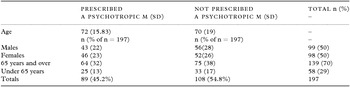
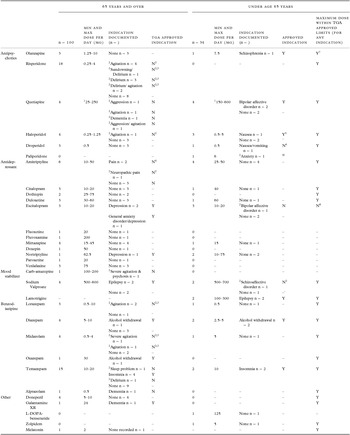
One hundred and ninety-seven available patient files were audited. A total of 139 (71%) patients were 65 years or over. Those patients who were prescribed psychotropics had a mean age of 72 years and those not prescribed psychotropics had mean age of 70 years. Table 1 outlines the sample demographics. There were no significant differences for age or gender for those prescribed a psychotropic versus those who were not prescribed a psychotropic. There were a total of 134 individual prescriptions of psychotropics. A total of 89 (45.2%) of patients were prescribed one or more psychotropic medications. Of all the patients audited the following psychotropics were prescribed: 35 (17.7%) antidepressants; 21 (11%) antipsychotics; 19 (10%) benzodiazepines; six (3%) mood stabilizer; five (2%) cholinesterase inhibitors; one (0.5%) anti-parkinsonian medication, and one (1%) patient zolpidem and one (1%) melatonin. Table 2 shows details of the individual psychotropic prescriptions and their indications. The majority of psychotropic prescriptions were in people aged 65 years and over. Risperidone was the most frequently prescribed antipsychotic overall and only prescribed to patients 65 years and over. Quetiapine was dosed statistically significantly higher in the under 65 years of age group. Amitriptyline was the most commonly prescribed antidepressant, with doses (10–50 mg) in the range more commonly associated with pain management, n = 3 of the sample over aged 65 years. Another n = 3 patients over aged 65 years of age had no indication documented for their amitriptyline prescription, which is a concern as amitriptyline has been associated with inappropriate prescribing in the elderly (Helton et al., Reference Helton, McGrain and Muliira2005). Escitalopram was the next most commonly prescribed antidepressant and temazepam the most widely used benzodiazepine.
Demographics

Individual psychotropics by age group

1Statistically significantly different doses between groups p = 0.041.
2Indication supported by Australian Therapeutic Guidelines 44, Updated March 2015.
3Indication supported by local health district guidelines.
4Australian Medicines Handbook approved use.
5TGA approved for nausea and vomiting if associated with radiation / oncology (information not documented at time of audit).
6Indication supported by Australian Therapeutic Guidelines 44, Updated March 2015 for post-operative nausea and vomiting (information not documented at time of audit).
7Maximum dose not specified for elderly.
8TGA approved maximum recommended dose in elderly patients = 10 mg/day.
A total of 18 (14%) of the 134 individual prescriptions had the indication completed on the medication chart, 34 (26%) having some documentation of indication in the medical file, 5 had indication documented in both the medical record and medication chart, and 79 (60%) had no indication documented. A total of 27 (20%) were not indications (see Table 2) used by the Therapeutic Guidelines and therefore could be regarded as off label prescribing (Psychotropic Expert Group, 2013). Twenty-three (26%) of patients with prescriptions for psychotropics were reviewed by a psychiatrist during their admission. Seventy-three (56%) psychotropic prescriptions were hospital-initiated and 58 (44%) of all psychotropic prescriptions were continued upon discharge. There was no formal advice documented advising future prescribers about the psychotropic prescriptions. Possible medication transcription errors included: six patients medications were not listed in the discharge summary; one patient on L-DOPA-Benserazide was discharged on 200 mg daily although prescribed 100 mg as an inpatient; another patient was discharged on Nortriptyline 35 mg although on 75 mg during admission; and a patient was discharged on Sodium valproate 100 mg although prescribed 500 mg as an inpatient. All doses of psychotropics were compared to the Australian Therapeutic Guidelines and were within recommended dose ranges (Psychotropic Expert Group, 2013).
Information relating to potential adverse events or side effects was limited. In terms of antipsychotic polypharmacy, three patients were found to be on two different antipsychotics, both haloperidol and risperidone in each case, which is regarded as inappropriate (Mojtabai and Olfson, Reference Mojtabai and Olfson2010).
Discussion
This study contributes to the limited body of knowledge relating to psychotropic prescribing in acute general hospitals. Rates of benzodiazepines use have been most studied, and appear comparatively lower at this study hospital (10%) in contrast to 23.4% at a similar hospital, geographically close to the study hospital (Howes et al., Reference Howes, Ryan, Fairbrother, O’Neill and Howes1996), and 36% reported by Elliot et al. (Reference Elliott, Woodward and Oborne2001) also in Australia (Rankin and Brakoulias, Reference Rankin and Brakoulias2012). Rates of cholinesterase inhibitor prescriptions (2.5%) closely matched that of the US study by Swan et al. (Reference Swan, Wagle, Thompson-Moore and Taffet2013). We were unable to find any studies reporting rates of antidepressant, mood stabilizer or antipsychotic use in general hospitals. There is a dearth of recent studies regarding psychotropic use in general hospital settings however, studies from the 1970s and 80's report variable prevalence rates for psychotropic use ranging from 9% (Davidson et al., 1975) and 10% (Haggerty et al., 1986), to 23% (Magni et al., 1984), 32% (Salzman and Van der Kolk, 1980) and 42.8% (Salzman, 1981), with the higher figure similar to our study findings (45%).
A key finding from this study was the sub-optimal documentation of indications for the psychotropic prescriptions. Forty percent of psychotropic prescriptions had no indication recorded within the medication chart or medical file. Whilst we cannot ascertain whether prescribers knew what the medications were indicated for, this raises the potential for medication errors, off-label (and perhaps non-evidence based) use. Further, this lack of documentation may give rise to medico-legal complications for the prescriber if adverse events arise. Anecdotally, it is recognized that many psychotropics are used in an off label manner to target certain behaviors such as aggression and agitation or isolated symptoms such as hallucinations, insomnia or low mood (without major depression) in general hospitals. Without a recorded indication it is difficult to examine the quality of psychotropic prescribing and to educate clinicians on best practice. Further, the lack of recording of drug indication in this study makes it difficult to speculate on possible associations with adverse drug events or unsafe practice, and about the appropriateness of continuation of psychotropics on discharge. Aside from the accepted psychiatric indications for major depression, anxiety disorders, dementia, and psychotic illnesses, there is some evidence for the use of psychotropics in general hospital settings, such as delirium. For example, a recent meta-analytic review by Hirota and Kishi (Reference Hirota and Kishi2013) found that the prophylactic use of typical antipsychotics was superior to placebo in preventing delirium in surgical patients. Benzodiazepines are commonly used in acute alcohol or benzodiazepine withdrawal, epilepsy and as premedication prior procedures, with some, if limited, study of their use (Elliott et al., Reference Elliott, Woodward and Oborne2001).
All dosing audited used was within recognized dosing guidelines used in the health service (Psychotropic Expert Group, 2013). Whilst within TGA guidelines, for many of the off label prescribing there may have been inappropriate dosing. For example, carbamazepine was prescribed for severe agitation and psychosis at 200 mg a day, which may been seen as sub therapeutic; paliperidone, an antipsychotic was prescribed for “anxiety” at 6 mg a day which would be more in a dose range for psychosis than anxiety; and nortriptyline 62.5 mg was prescribed for depression, which may be seen as inappropriate in older patients (Finkel et al., Reference Finkel, Richter and Clary1999). The tricyclics such as amitriptyline and nortriptyline are argued to be inappropriate drugs in elderly patients by some authors due to the high risk of anticholinergic effects, pro-arrythmic effects and orthostatic hypotension (Hayes et al., Reference Hayes, Klein-Schwartz and Barrueto2007). The dosing of lorazepam was up to 10 mg per day, which is particularly high for elderly patients, as was risperidone at 4 mg a day.
It is difficult to identify which practices and procedures contribute to the rates of psychotropic prescriptions in the study hospital. There are a number of possible explanations. The study site has regular falls committee meetings where the use of psychotropics within the hospital are monitored, pharmacists are directly involved in the monitoring of prescriptions at ward level, and the clinical governance of nursing and medical staff includes hospital wide business rules for treating diagnoses such as delirium with pharmacological agents (whether they are known or adhered to is unclear).
The monitoring of psychotropic medications in older inpatients is especially important due to the potential for adverse effects (such as falls, sedation, hypotension, anticholinergic effects), drug interactions and polypharmacy (Karow and Lambert, Reference Karow and Lambert2003). We could not find evidence of monitoring for common adverse effects such as extrapyramidal signs with antipsychotics. It is recognized that older patients experience more medication-related adverse effects than younger adults (Onder et al., Reference Onder, Lattanzio, Battaglia, Cerullo, Sportiello and Bernabei2011). In this study inpatients over 65 years had significantly more antipsychotic prescriptions compared to patients under 65 years (32 vs. 10 years). As schizophrenia and psychotic illnesses are relatively uncommon we suspect this difference in prescription rate may relate to higher rates of behavioral disturbances in older people, for example in delirium or dementia, for which risperidone is indicated (Psychotropic Expert Group, 2013). However, current delirium guidelines do not advocate antipsychotic use as first line treatment of delirium, but emphasize non-pharmacological approaches (Wand et al., Reference Wand, Thoo, Ting, Sciuriaga, Baker and Hunt2014). The majority of doses of risperidone in our study were low, with the exception of one older patient on 4 mg which had no indication documented, and would be potentially be considered an unacceptably high dose in an older person. It is not known to what extent non-pharmacological strategies were employed first or contemporaneously.
The use of temazepam as the most commonly prescribed benzodiazepine may not be surprising as insomnia is common in general hospital inpatients. Insomnia is variably managed and often medications are prescribed out of hours by on call medical officers unfamiliar with the patient. The results highlight that holistic interventions such as sleep hygiene protocols could be developed to help reduce the reliance on temazepam (and the attendant risk of adverse events) for the management of insomnia. It is unknown to what extent non-pharmacological techniques are currently employed for insomnia, or indeed other isolated symptoms or behaviors, in general hospitals. The use of long half-life benzodiazepines, such as diazepam, in the elderly patients of the study sample, has been regarded by some as inappropriate prescribing (Salzman, Reference Salzman2005).
Although there are recognized indications for the use of antidepressants, antipsychotics, mood stabilizers and benzodiazepines in general hospital patients, there are many reasons to strive to reduce the rates of psychotropic use overall and in particular to target inappropriate prescribing. This is especially important given high rates of continuation of hospital-initiated psychotropics upon discharge (44%). The absence of any instructions to community prescribers (predominantly general practitioners) in discharge letters is of concern. We suspect that many newly started psychotropics were intended to be used in the short-term (for example for delirium) yet, without indications or advice to prescribers, many will be continued without review. It has been suggested that a tool to assess for inappropriate prescribing would be a valuable and practical way of assessing the quality of prescribing and providing feedback to prescribers as part of quality improvement initiatives (Wawruch et al., Reference Wawruch, Fialova, Zikavska, Wsolova, Jezova and Kuzelova2008). Such a tool may be worthwhile in further rationalizing the use of psychotropics within acute generalist specialties. Further, pharmacist reviews of hospital inpatients may be particularly important. A systematic review of the impact of clinical pharmacist reviews on patient outcomes in general hospitals revealed that pharmacist interventions were reasonably well implemented (i.e. taken up 39–100% of the time) (Graabæk and Juel Kjeldsen, Reference Graabæk and Juel Kjeldsen2013).
Study limits
Several limitations have been identified which must be considered when contextualizing the key issues arising from this type of study. Interpreting patient data when unfamiliar with the patient and making subsequent judgements based upon these interpretations is contextually problematic; for example making a definitive link between adverse events and psychotropics. Finally, the audit provided a cross-sectional snapshot of psychotropic prescribing in the study hospital only and not all inpatients medication charts and files were audited as some people were off the wards having procedures or investigations. Some medication charts may also have been under review in the Pharmacy at the time of the audit, leading to underestimates of rates of psychotropic prescription. Some adverse effects may not have been recognized as drug related or were multifactorial in origin. There were limits on our ability to pair dose used and indication (e.g. dose of quetiapine for delirium differs for that for schizophrenia). Notwithstanding these limitations, healthcare audits are important indicators of compliance with legal and professional standards and expectations, and can be used to effect clinical practice improvements (Lamont et al., Reference Lamont, Brunero, Barclay and Wijeratne2011; Reference Lamont, Brunero and Sharma2015).
Conclusion
Educating prescribers about the importance of recording indications and giving information to community prescribers regarding reasons for use or justification for off label use, intended duration of use and dosing will necessitate ongoing work. Routine clinical supervision, auditing and providing feedback on psychotropic prescriptions from a multidisciplinary perspective needs to be in place in general hospital settings (Brunero and Lamont, Reference Brunero and Lamont2012; Graabæk and Juel Kjeldsen, Reference Graabæk and Juel Kjeldsen2013). The study highlights the need for examination of settings such as intensive care, high dependency units and Emergency Departments, where psychotropic use may be prevalent and high dosing may occur more frequently. Regular auditing, followed by education initiatives and feedback, hospital policy and protocols, and available prescribing guidelines are required.
Conflict of interest
None.
Description of authors’ roles
Brunero S- Formulated the research questions, designed the study, data collection, data analysis, and writing: Wand A- study design, data collection and writing: Lamont S- collected the data, data analysis and assisted with writing the paper: Johns L- data collection, analysis, and writing.