Impact
The establishment of a causal relationship between maternal prepregnancy overweight or obesity and congenital malformations of the intestine in offspring faces challenges in observational studies, where inherent limitations such as lack of randomization, potential confounding, and reverse causal associations hinder conclusive evidence. Mendelian randomization (MR) emerges as a valuable approach, employing genetic variations as instrumental variables to infer causal links between exposure factors and outcomes. In this study, we aim to explore the causal relationship between body mass index in females and congenital malformations of intestine in offspring using a bidirectional, two-sample MR analysis with the latest genome-wide association studies database.
Introduction
Congenital intestinal anomalies, including malrotation, Meckel’s diverticulum, duodenal web, duodenal atresia, jejunoileal atresia, and duplications, often present with neonatal obstruction. Manifestations may also occur later in childhood or adulthood, presenting as vomiting, abdominal pain, abdominal mass, or gastrointestinal bleeding. Reference Morris, Kennedy and Cochran1 In the distal intestine, Hirschsprung’s disease and Anorectal Malformations are congenital disorders seen in neonates with intestinal obstruction. Reference Wetherill and Sutcliffe2 The prevalence of congenital intestinal malformations varies depending on the specific condition. A report from Italy indicated that between 1981 and 2014, the prevalence of anorectal malformations was approximately 3.09 per 10,000. Additionally, mortality rates increased after 2000, rising from 73.3% to 97.7% for birth weights ≥2500 g, and from 23.8% to 68.8% for birth weights <2500 g. Reference Cassina, Fascetti Leon and Ruol3 Prepregnancy maternal obesity is associated with an elevated risk of high child hyperactivity–inattention symptoms, contrasting with a normal prepregnancy body mass index (BMI). Reference Dow, Galera and Charles4 Maternal overweight and obesity are recognized risk factors for macrosomia. Reference Yu, Teoh and Robinson5,Reference Dai, He and Hu6 Studies indicate that mothers delivering macrosomic infants face an increased risk of subsequent metabolic disorders, including diabetes and gestational diabetes mellitus, compared to mothers of infants with normal birth weight. Reference Dyck, Karunanayake and Pahwa7 For nulliparous mothers, a lower prepregnancy BMI, particularly BMI <18.5 kg/m2, exhibits a notable protective effect against fetal macrosomia, particularly among those aged 35 years and above. Conversely, younger multiparous mothers benefit more from a lower BMI. Reference Li, Xing and Wang8
The establishment of a causal relationship between maternal prepregnancy overweight or obesity and congenital malformations of the intestine (CMI) faces challenges in observational studies, where inherent limitations such as lack of randomization, potential confounding, and reverse causal associations hinder conclusive evidence. While traditional randomized clinical controlled trials are methodologically sound, ethical concerns limit their practicality. Mendelian randomization (MR) emerges as a valuable approach, employing genetic variations as instrumental variables (IVs) to infer causal links between exposure factors and outcomes. Genetic variations, following Mendelian laws, are randomly distributed in the population, providing substantial control over confounding factors. Reference Ference, Ray and Catapano9 The rise of GWAS and GWAS meta-analysis has bolstered MR as an efficient and feasible method for investigating causal effects. Reference Li, Liu and Wang10 Two-sample MR, leveraging summary statistics from GWAS, allows for the estimation of causal effects on outcomes. This method utilizes genetic variation-exposure factor association data and genetic variation-disease outcome association data from two independent samples with similar distribution characteristics. In the study, we aim to explore the causal relationship between BMI in females (ieu-a-974) and congenital malformations of intestine (CMI) (finn-b-Q17_OTHER_CONGEN_MALFO_INTESTINE) using a bidirectional, two-sample MR analysis with the latest GWAS database.
Materials and methods
Data source
Publicly accessible data for genetic variants associated with BMI in females were obtained from the Genetic Investigation of ANthropometric Traits (GIANT) Consortium as exposure. Reference Locke, Kahali and Berndt11 The consortium included 171,977 participants and the number of included single-nucleotide polymorphisms (SNPs) was 2,555,511 (Figure 1).
Manhattan plot of the included single-nucleotide polymorphisms about BMI in females. (Red line as threshold: P-value = 5 × 10⁻⁸).

The CMI dataset was obtained from finngen_R10_Q17_OTHER_CONGEN_MALFO_INTESTINE (FinnGen biobank analysis round 10), also from a European population, with a case size of 107 and a control group of 218,235 individuals and containing 16,380,465 SNPs. Reference Kurki, Karjalainen and Palta12 The detail of studies and datasets was presented in Table 1.
Details of studies and datasets used in the study

Selection of instrumental variables
The IVs used in this study were selected based on the following criteria: (1) significant genome-wide association (P < 5e–8) with the exposure, or P-value <1e–5 if no relevant SNPs were identified, and minor allele frequency in the outcome >0.01; (2) linkage disequilibrium (LD) r2 < 0.001 within a 10,000 kb distance. SNPs associated with confounders or outcomes in the Phenoscanner (http://www.phenoscanner.medschl.cam.ac.uk/) were excluded. In total, there were 36 SNPs included in this study (rs3127553, rs3101336, rs12401738, rs11165643, rs17024393, rs543874, rs6548237, rs10182181, rs1016287, rs13098327, rs16851483, rs10513801, rs10938397, rs2112347, rs6457796, rs12529728, rs2060604, rs16912921, rs1928295, rs10733682, rs12575252, rs10767664, rs3817334, rs7138803, rs4981693, rs7141420, rs745213, rs12446632, rs11646653, rs1121980, rs11663558, rs7239883, rs663129, rs8097783, rs2303108, rs6091540).
The calculation of individual SNP variance was conducted utilizing the formula R2 = 2 × b2 × EAF × (1 − EAF)/ (2 × b2 × EAF × (1 − EAF) + 2 × SE2 × N × EAF × (1 − EAF)). Meanwhile, the F-statistic was derived from the equation F = (N − k − 1)/k × R2/ (1 − R2), where N represents the sample size of the GWAS study, k denotes the number of IVs, and R2 signifies the proportion of exposure explained by IVs. An F-statistic below 10 designates weak IVs, potentially introducing bias into the results. Consequently, caution is advised in the interpretation of outcomes. Reference Burgess and Thompson13
Main analysis method
After obtaining BMI-associated or congenital malformations of the intestine (CMI) data from the GWAS study or GWAS meta-analysis through the MR-Base platform, Reference Locke, Kahali and Berndt11 MR analysis was conducted using the “TwoSampleMR” package (version 0.5.8) in the R program (version 4.3.2). Three statistical methods – inverse-variance weighted (IVW) method, weighted median estimator, and MR-Egger regression – were employed to explore the causal relationship between female BMI and CMI. Reference Hemani, Zheng and Elsworth14–Reference Hartwig, Davey Smith and Bowden17 The IVW method involves meta-analyzing Wald ratios for included SNPs to assess causal relationships. Reference Hemani, Zheng and Elsworth14,Reference Bowden, Del Greco and Minelli15 A crucial assumption is that all included SNPs must be valid variables. In contrast, MR-Egger regression remains functional even when all SNPs are invalid. Reference Hartwig, Davey Smith and Bowden17 The slope of MR-Egger indicates the BMI effect on CMI when the intercept term is zero or statistically insignificant. Reference Hemani, Zheng and Elsworth14,Reference Hartwig, Davey Smith and Bowden17 The weighted median estimator requires a minimum of 50% valid variables, with results expressed as odds ratio (OR) and its 95% confidence interval (CI). A P-value below 0.05 denotes statistical significance.
Sensitivity analysis
The leave-one-out method was employed to assess the sensitivity of the results. Consistent with meta-analysis principles, each SNP was systematically removed one at a time, and the effect of the remaining SNPs was recalculated using the IVW method. Reference Mikshowsky, Gianola and Weigel18 This approach allowed for an in-depth examination of the impact of individual SNPs on causal inference.
Results
Detail information of the included SNPs
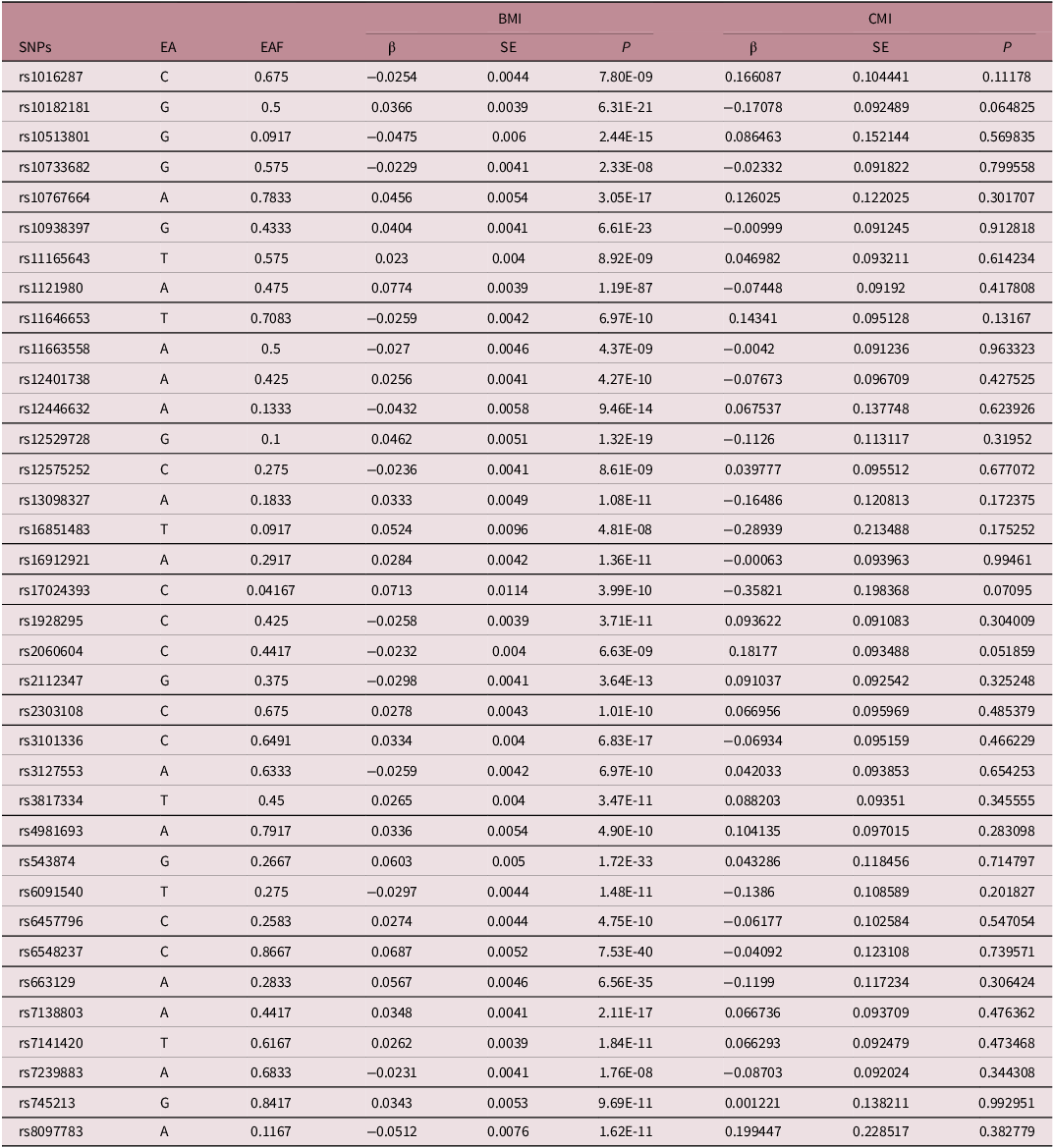
The details of each SNP were presented in Table 2, including the effect allele (EA), and effect allele frequency (EAF). Estimations of the associations of each SNP with BMI and CMI including beta value, standard error (SE) and P-value were also presented in Table 2.
Characteristics of the SNPs associated with BMI and their associations with congenital malformations of intestine (CMI)

Abbreviations: BMI, body mass index; CMI, Congenital malformations of intestine; EA, effect allele; EAF, effect allele frequency; SE, standard error; SNP, single-nucleotide polymorphism.
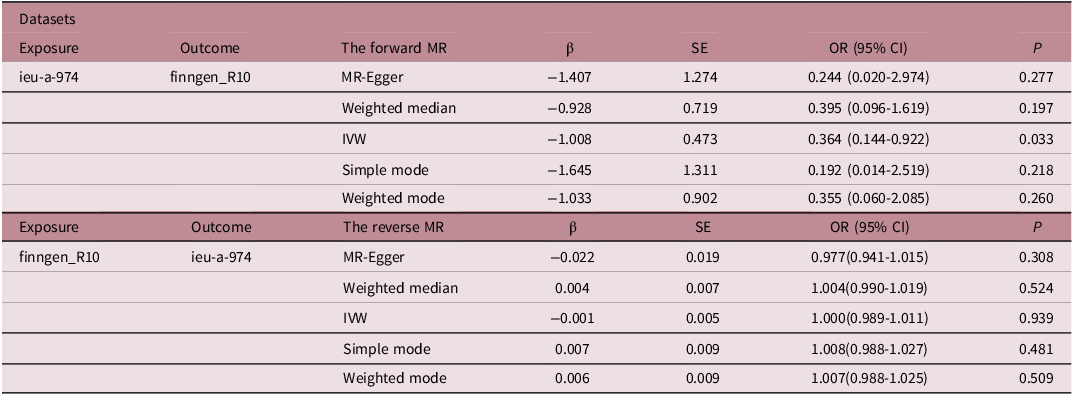
Causal Effect of BMI in females on CMI. As presented in Table 3, result of the IVW method suggested that there was a negative association between BMI in females with higher genetic predictability for the risk of CMI (OR 0.364, 95% CI 0.144–0.922). The weighted median estimator and MR-Egger method were estimated (the weighted median estimator: OR 0.395, 95% CI 0.096–1.619; MR-Egger Method: OR 0.244, 95% CI 0.020–2.974). These results could also be observed in the forest plot (Figure 2) and the scatter diagram (Figure 3).
Forest plot of single-nucleotide polymorphisms (SNPs) associated with body mass index (BMI) and the risk of congenital malformations of intestine (CMI). Black points represent the log odds ratio (OR) for CMI per standard deviation (SD) increase in BMI in females.

Scatter plot of SNPs associated with BMI in females and the risk of congenital malformations of intestine (CMI). The plot presents the effect sizes of the SNP-BMI association (x-axis, SD units) and the SNP-CMI association (y-axis, log (OR)) with 95% confidence intervals. The regression slopes of the lines correspond to causal estimates using the three main mendelian randomization (MR) methods (the IVW method, weighted median estimator, and MR-Egger).

Causal associations between genetically determined MR analysis of exposures with outcomes

Abbreviations: finngen_R10: finngen_R10_Q17_OTHER_CONGEN_MALFO_INTESTINE; IVW: Inverse variance weighted; CI, confidence interval; OR, odds ratio; SE, standard error; P: P-value.
Sensitivity analysis
There was no evidence that the result was affected by genetic pleiotropy (MR-Egger regression intercept = 1.6 × 10⁻², SE = 0.047, P = 0.738) (Table 4). From the result of the Leave-one-out method, there was no single SNP playing a decisive role in the causal inference (Figure 4).
Leave-one-out of SNPs associated with BMI in females and their risk of congenital malformations of intestine (CMI). Each black point represents result of the IVW MR method applied to estimate the causal effect of BMI in females on CMI excluding particular SNP.

Heterogeneity and pleiotropy analyses

Abbreviations: finngen_R10: finngen_R10_Q17_OTHER_CONGEN_MALFO_INTESTINE; IVW, inverse-variance weighted; MR, Mendelian randomization; P: P-value.
The reverse MR
Subsequently, we conducted a reverse MR analysis to explore the potential causal relationship between CMI and BMI in females. Given the absence of SNPs meeting the significance threshold of p < 5e–8 in the CMI GWAS, we derived 73 independent genetic IVs using a less stringent threshold of p < 1e–5. Neither MR-Egger nor IVW methods revealed significant pleiotropy or heterogeneity among these 73 independent IVs, as indicated by Cochran’s Q statistics (Table 4). The IVW analysis results suggested a lack of discernible causal effect of CMI on BMI in females (Table 3). Furthermore, the leave-one-out sensitivity analysis revealed heterogeneity for each SNP when compared with other SNPs (Supplementary Figure 1).
Discussion
Congenital anomalies of the intestine, such as aganglionosis, are attributed to the arrested migration of parasympathetic ganglion cells, a process typically occurring between the second and third month of fetal life. Reference Butler Tjaden and Trainor19,Reference Wester and Granström20 Duodenal atresia, unlike many other intestinal atresias, is frequently associated with various congenital anomalies. Approximately 25–40% of cases exhibit an association with Down’s syndrome, while less frequent associations include malrotation, biliary tract and cardiac malformations, and the VATER association (vertebral defects, anal anomalies, tracheoesophageal atresia, renal anomalies). Reference Morris, Kennedy and Cochran1,Reference Freeman, Torfs and Romitti21 Consequently, congenital intestinal malformations not only bear the influence of external factors during the fetal period but also impose a substantial burden on affected families. Additionally, the etiology of various intestinal malformations remains unclear. Prepregnancy BMI categories were defined as underweight (BMI <18.5 kg/m2), healthy weight (18.5–23.9 kg/m2), overweight (24.0–27.9 kg/m2), and obesity (≥ 28.0 kg/m2). Underweight status was associated with an elevated risk of preterm birth and small for gestational age, while displaying an inverse association with large for gestational age, primary cesarean delivery, and stillbirth. Reference Tang, Zhu and Chen22 However, classical epidemiological studies face challenges in elucidating the causal sequence of exposure factors and disease outcomes due to confounding factors. This study aims to investigate the relationship between maternal prepregnancy BMI and the risk of congenital malformations of the intestine (CMI) through a two-sample Mendelian randomized study based on GWAS. The results indicate a causal link between maternal prepregnancy low BMI and an increased risk of CMI.
In this pioneering study, we employed a bidirectional, two-sample MR method based on GWAS to investigate the causal relationship between BMI in females and the risk of CMI. This represents the first MR study on CMI to date. Conducting the forward MR analysis (BMI in females on CMI), we observed nonsignificant heterogeneity and pleiotropy for the IVs. Leveraging PhenoScanner, we diligently identified SNPs with a high risk of pleiotropy, affirming the validity of the IVs. All IVs exhibited F values exceeding 10, signifying ample strength. Furthermore, the independence of exposure and sample datasets in this two-sample MR analysis enhances the reliability and comprehensiveness of the results. Thirty-six SNPs significantly associated with BMI in females were chosen as IVs. Employing the IVW method, weighted median estimator, and MR-Egger MR method with data from the GWAS study of CMI, the forward MR analysis from two independent GWAS datasets indicates a potential causal link between decreased BMI in females and the incidence of CMI. In contrast, the inverse MR analysis, utilizing two independent GWAS datasets on BMI in females as outcomes with either a random or fixed effects model of IVW method, suggests no causal association between CMI and BMI in females. No potential pleiotropy was detected in the inverse MR analysis. Compared to traditional observational studies, the causal estimates derived from MR analysis mitigate issues of reverse causal associations and multiple confounding biases.
The etiology of the causal relationship between BMI in females and CMI remains incompletely understood. A retrospective study involving 3837 Japanese females with uncomplicated singleton pregnancies revealed an independent association between maternal underweight before pregnancy and low birth weight, particularly in nonobese women. Reference Ikenoue, Miyakoshi and Kasuga23 Low BMI in females before and during pregnancy may be attributed to conditions such as anorexia nervosa Reference Arnold, Johnson, Mahon and Agius24 and pregnancy-induced vomiting. Reference Bird, Grant and Bandara25 Women with anorexia nervosa may experience menstrual dysfunction, low bone density, and sexual dysfunction before pregnancy, and during pregnancy, they may face obstetric complications such as miscarriage, preterm delivery, or low birth weight in offspring. Reference Andersen and Ryan26 Several studies have demonstrated that maternal underweight is significantly linked to a higher risk of preterm birth, Reference Rahman, Abe and Kanda27,Reference Gul, Iqbal and Anwar28 which, in turn, may lead to low birth weight and the occurrence of associated immature anomalies, potentially resulting in conditions like apple-peel atresia (a type of congenital anomaly of the small intestine), Reference Zhu, Gao and Alganabi29 esophageal atresia, Reference Miyake, Nakano and Yamamoto30 gastroschisis, Reference Clark, Walker and Gauderer31 and hip osteoarthritis. Reference Hussain, Ackerman and Wang32 However, conventional observational studies encounter challenges in establishing the causal relationship between BMI in females and CMI due to potential confounding factors and reverse causal associations. The MR method, utilizing genetic variations as IVs, emerges as a promising tool for investigating such causal relationships between exposure factors and outcomes.
Our study leveraged the MR method to effectively control confounding factors and mitigate reverse causal associations. The use of data from published GWAS and meta-analyses provided a robust foundation with a substantial sample size and diverse genetic variations. Despite these strengths, limitations remain inevitable. Firstly, the challenge of validating genetic polymorphisms persists, and despite employing the MR-Egger method, potential misclassification cannot be entirely eliminated, gene-environment interactions were not evaluated in this study. Secondly, our analysis focused on a GWAS dataset of BMI derived from a European female population, which may limit generalizability. Generalizing these findings to other populations requires further investigation. Additionally, the two-sample MR study may face overidentification issues, potential violations of MR assumptions may occur, thereby overestimating the association between SNPs and the exposure. Lastly, the limited sample size of CMI cases in the GWAS database (n = 107) may constrain the statistical power of our MR analysis, there is no method to address unobserved pleiotropy.
Conclusion
This study utilized bidirectional MR analysis to assess the causal impact of decreasing maternal prepregnancy BMI on the occurrence of congenital malformations of the intestine (CMI) in females. Our results provide evidence for a causal relationship in this context. However, no evidence supporting a causal link between the occurrence of CMI and maternal prepregnancy BMI was found. These findings contribute valuable insights for identifying and protecting populations at risk of CMI in offspring, potentially informing the development of innovative prevention and treatment strategies.
Supplementary material
The supplementary material for this article can be found at https://doi.org/10.1017/S2040174425100184.
Data availability statement
The datasets used and/or analyzed during the current study are available from the corresponding author on reasonable request.
Acknowledgements
We want to acknowledge the participants and investigators of the FinnGen study.
Funding statement
Fujian Provincial Natural Science Foundation of China, No.2022J01437. The Foundation of Fujian High-level Clinical Medical Center (ETK2023016).
Competing interests
The authors have no conflict of interest.
Ethical standard
Not applicable.
Declarations
Not applicable.