


Introduction
The night before he faced a firing squad in 1915, Joe Hill, a leading member of the Industrial Workers of the World (IWW), sent a telegram to William ‘Big Bill’ Haywood, a fellow organiser and revolutionary spirit. Known worldwide as a songwriter and labour activist, Hill had been caught up in a shooting in Salt Lake City and convicted of murder, his prosecution ably assisted by police, local church leaders and mine owners. Haywood, a leading figure in the militant and powerful Western Federation of Miners (WFM), had earlier been in the same predicament. But whereas Hill was executed for a killing he did not commit, Haywood was acquitted of the cooked-up charges that had threatened to send him to death row. Violence, they both knew, structured labour politics in the United States. But Hill’s message to Haywood was defiant. He wrote: ‘Don’t waste time mourning, organize!’.Footnote 1
Alfred Hayes’s magnificent poem, ‘I dreamed I saw Joe Hill last night’, tells this story and celebrates his enduring legacy. The fourth verse reads:
The IWW (or WobbliesFootnote 3) is unique in the labour movement. It characterises itself as a revolutionary industrial union, organising across North America, Europe and Australia.Footnote 4 It boasts organising committees in dozens of countries, with collective membership over the last century running to millions of workers.Footnote 5
Standard accounts of the IWW usually consign the union to history, giving the lie to Hayes’s celebration of Hill’s influence. Disagreement turns on the diagnosis of the causes of the union’s defeat in the United States:Footnote 6 was the failure endogenous to the IWW’s politics and organising, or explained by the hostile forces railed against it? In 1944, Rose Pesotta, the creative, energetic post-war organiser of the International Ladies Garment Workers’ Union,Footnote 7 decided that it was a bit of both. Multiple forces had combined to crush the union, but she pinned the union’s failure on its ‘roseate dreams’ of ‘industrial solidarity the world over and the social revolution’ and ‘fundamental weakness in tactics’.Footnote 8
Forty years later, and at a greater distance from the ‘romantic’ period Pesotta surveyed, Judi Bari also admitted the US organisation’s historic weaknesses. However, she saw them as pointers to renewal. Writing fresh lyrics to Ralph Chaplin’s ‘fighting theme song’ Solidarity Forever (1915), she harked back to the IWW’s glory days, emphasising the soundness of its anti-bureaucratic, solidaristic opposition to the ‘scab unionism’Footnote 9 of the American Federation of Labor (AFL) and the latent power of the members.Footnote 10
Today’s Wobblies share Bari’s goal. The question is: how to rebuild? Does revolutionary unionism still entail the universalisation of the organisational schema the IWW envisaged in the preamble to the IWW’s constitution in 1905: ‘building the structure of the new society in the shell of the old’? Does it entail class struggle, as the preamble also sets out, ‘until the workers of the world organise as a class, take possession of the means of production, abolish the wage system, and live in harmony with the Earth’? And if the IWW demands of workers that they treat ‘an injury to one an injury to all’, how does it build solidarity in a diverse and international workforce?Footnote 11
Our argument is that this discussion is yet to be had and that the tensions that Pesotta identified in 1944 have not been fully addressed. We focus on the efforts of the Wales, Ireland, Scotland and England Regional Administration of the IWW (hereafter WISE-RA) to reconstruct the Union between c.2014 and 2020. As we show, the structural review conducted by WISE-RA from around 2014 was extensive. It resulted in the de-centring of the US regional administration (RA) through ‘minimalist confederalism’, instituted bottom-up union organising and administrative control and the integration of anarchist practices and politics in WISE-RA’s processes. However, our research, co-produced with WISE-RA, suggests that it was also constrained by the failure to include the preamble in the review process and by a fixation with democracy.Footnote 12
Tellingly, WISE-RA labelled the review ‘structural’ rather than constitutional. Crucially, using the preamble as the definitive point of reference to continually rewrite the rules, it reaffirmed a normative commitment to industrial unionism, as the goal that its activism is designed to prefigure, and glossed the constitutional problems this presented by promoting class militancy. The attempt to press the solution into a reimagined democratic process was minimally successful but distracted from the need to reckon with its contradictory ideological heritage.
In our assessment, the preamble is both a firework and a millstone. It both animates the Union by promoting an uncompromising critique of capitalism, an ethos of solidarity and a prefigurative approach to change. But it saddles the Union with cultural norms based on US industrialisation and a constitutional model of industrial unionism that failed to garner support from the unions essential to it during the IWW’s formative period and prompted a paralysing clash between ‘centralisers’ and ‘decentralisers’. The structural review aimed to curtail the power of organisers by limiting remuneration and to democratise the union’s processes to challenge the entrenched power of straight white men. Yet it reaffirmed an unhelpfully reductionist concept of class war and an equally outdated ethos around which to organise. In sum, while the review initiated a democratising process dressed as anarchism, the attachment to the preamble limited the reconstitution.
To unpack this argument and examine the limits of the 2016–19 structural review, we divide the chapter into four parts. The first (The Preamble to the Constitution) examines the status of the iconic text. We present it as the IWW’s declarative statement and show how the collective ‘we’, here the working class, has been read in the twenty-first century through an anarchist lens by the rank and file. Understanding the significance of the preamble is the key to the chapter.
The second part (Constitutionalisation) looks at the pivotal history of the union in North America.Footnote 13 Brought into being by an elite, some working class, some anarchist, mostly white men, the union mobilised workers by voluntary association to realise a plan for industrial unionism based on an American-centric model of turn-of-the-century industry. Riven by factionalism and organising with a multinational workforce, the IWW promoted an ethos of solidarity to constitute Fellow Workers (FWs) as a class, thus emphasising divisions between workers and employers and downplaying the significance of workforce diversity. Reviewing the historiographical debate about the IWW’s ideology, we describe the union as nominally anarchist and show how its constitutionalisation simultaneously fuelled an internal dispute between ‘centralisers’ and ‘decentralisers’, cementing the problems that the prefigurative plan for industrial unionism posed, while discouraging internationalisation.
The third part (Constitutional Review) brings the narrative into the twenty-first century. It recounts the International Structures Review Process, which instituted a form of anarchistic, minimal confederalism in the international structures of the union, and built decentralisation and de-facto subsidiarity into WISE-RA. We argue that a new generation of recruits, many of them anarchist, complained about barriers to participation in the Union, but saw solutions in better organising, more democracy, and endless tinkering with the Rule Book and Manual of Processes and Procedures (MOPP), rather than reconstitutionalising, to better facilitate this organisational drive and align the whole union with its underlying anarchist ethos. Ironically, better organising was stymied by a refusal to professionalise by paying organisers and the executive, in deference to the preamble’s prefigurative proscription against wage labour. The fourth part (Limits of the Constitutional Review) draws further on the membership survey and focus groups to explore the successes and failures of this structural reform, revealing the mismatch between the anarchistic ethos of its members, the normative architecture of the IWW’s preamble and reformed organisational structure. The IWW’s failure to constitutionalise anarchy is the focus of the concluding discussion.
The Preamble to the Constitution
The IWW was the initiative of a select group of labour organisers who met secretly on 2 January 1905.Footnote 14 The following June, a larger group of just over 200 activists met in Chicago to ‘confederate the workers’ of America ‘into a working class movement’ dedicated to the ‘emancipation of the working class from the slave bondage of capitalism’.Footnote 15
It was a socially and politically diverse group. Apart from Haywood, its leading personalities included Lucy Parsons, Vincent St John, Mary ‘Mother’ Jones, Daniel de Leon and Eugene Debs. Parsons, a former member of the Knights of Labour and widow of Albert Parsons, was a vocal anarchist campaigner for workers’ rights.Footnote 16 Vincent St John, described as a ‘revolutionary’, had cut his teeth in the WFM to become the IWW’s ‘dominating influence’Footnote 17 after its fractious second convention in 1906. Mary ‘Mother’ Jones, who, like Albert and Lucy Parsons, had been active in the Knights of Labour, organised with miners, silk workers and dressmakers in struggles for the eight-hour day and workplace safety.Footnote 18 Daniel de Leon, a former professor of international law, was the driving force behind the Socialist Labour Party (SLP), a revolutionary Marxist party, some say dogmatic sect, formed to realise revolution through the ballot box.Footnote 19 Debs, a socialist republican was co-founder of the Socialist Party of America (SPA), a breakaway from the SLP, and five-time presidential candidate.Footnote 20
Debates about the preamble reflected the divergent aims of the bodies these key figures represented, either formally or informally.Footnote 21 The first iteration, agreed at the June 1905 conference, was designed to chart a course between political affiliation and independence. Father Thomas J. Hagerty, a one-time anarchist, Marxist theoretician disaffected with ‘slowcialist’ parliamentary struggle of the SPA, is credited with its drafting.Footnote 22
The original text included a clause promoted by De Leon and Debs to support class action on the ‘political’ as well as the ‘industrial field’. In 1906, a statement avoiding ‘endorsement of any political party’ was added in recognition of the rivalry between the SLP and SLA.Footnote 23 After two years of wrangling over the direction of the Union, the preamble was amended at the Fourth Convention of 1908. The ‘political clause’ was removed, Debs withdrew, and De Leon was expelled.Footnote 24 The effect of their departure was to cement the IWW’s direct-action ethos and its independence from party-political control, but not its anarchism.
The second change, proposed by Judi Bari and others involved in the environmental advocacy group Earth First!, was made via referendum in 1991.Footnote 25 The new wording broadened the aims of class struggle from taking ‘possession of the means of production’ to living ‘in harmony with the earth’, thus extending the concept of capitalist exploitation to planetary destruction and calling for ecological transformation as well as labour revolution.Footnote 26 The text deserves full citation:
The working class and the employing class have nothing in common. There can be no peace so long as hunger and want are found among millions of the working people and the few, who make up the employing class, have all the good things of life.
Between these two classes a struggle must go on until the workers of the world organise as a class, take possession of the means of production, abolish the wage system, and live in harmony with the Earth.
We find that the centering of the management of industries into fewer and fewer hands makes the trade unions unable to cope with the ever growing power of the employing class. The trade unions foster a state of affairs which allows one set of workers to be pitted against another set of workers in the same industry, thereby helping defeat one another in wage wars. Moreover, the trade unions aid the employing class to mislead the workers into the belief that the working class have interests in common with their employers.
These conditions can be changed and the interest of the working class upheld only by an organisation formed in such a way that all its members in any one industry, or in all industries if necessary, cease work whenever a strike or lockout is on in any department thereof, thus making an injury to one an injury to all.
Instead of the conservative motto, ‘A fair day’s wage for a fair day’s work’, we must inscribe on our banner the revolutionary watchword, ‘Abolition of the wage system’.
It is the historic mission of the working class to do away with capitalism. The army of production must be organised, not only for everyday struggle with capitalists, but also to carry on production when capitalism shall have been overthrown. By organising industrially we are forming the structure of the new society within the shell of the old.
Two points are worth noting. First, the theorisation of class struggle. The IWW divides society into two hostile camps. The preamble locates the source of the structures of oppression in the wage system, and the solution to these problems in worker solidarity and the expropriation of the ‘employing class’.Footnote 27 It frames the resolution of these contradictions in capitalism as the cessation of the social war: ‘The historic mission’ of ‘the army of production’, is to take control of the means of production, end the competitive ‘wage wars’ sponsored by reformist trade unions and the employers and bring ‘peace’ and ‘harmony’ to the planet and our relationship with nature.
Second, the preamble pinpoints industrial unionism as the means and ends of revolutionary organising. This has two aspects, an ‘everyday struggle with capitalists’ and workplace organising. The shape of the former is not stipulated but is assumed to complement the task of union building. The revolutionary aim is to take control of production by developing the Union’s administration into an organisation capable of coordinating the wider structures of the economy. In this respect, the IWW is revolutionary syndicalist in all but name. By way of comparison, conventional unions enable employers to rule workers by dividing them, while the IWW promotes solidarity by bringing workers together in workplaces, regardless of their role or trade.Footnote 28 The incorporation of the principle ‘an injury to one is an injury to all’, a neo-Kantian phrasing also borrowed from the Knights of Labor, signals that class solidarity extends to all, irrespective of creed or colour.Footnote 29 The creation of ‘one big union’ advances this goal by enabling the Union to coordinate relations between its composite parts.
The preamble has always been a touchstone for union organising, reproduced by constitutional decree in IWW membership packs, and ‘in every issue of its various newspapers, pamphlets, and other publications’.Footnote 30 Paul Brissenden, author of the seminal 1919 study of the IWW, called it the ‘Magna Carta of the proletariat’.Footnote 31 The Industrial Worker, the newspaper of the IWW in the Pacific Northwest, called it the IWW’s ‘guiding star’.Footnote 32 It is not an adaptable hallmark, such as those adopted by the Occupy movement, which we discuss in Chapter 6. Rather, it is a marker of identity and an authoritative reference for an approach to revolutionary and prefigurative workplace organising.
This remains the case today. In WISE-RA, the preamble is sacrosanct. Following IWW tradition, the re-founding principles of the 2016 structural reform process included the stipulation that the preamble be included in new members packs and preface all regional and national rule books. Whether by custom or design, the language and ideas are already deeply ingrained in the membership. One participant told us at a 2016 workshop:
we [the IWW] are providing a vehicle for people to actually take on their employers in their workplace, ’cause that’s where the struggle is, it’s not in this room, not in the discussions we had this morning about finance. I mean that was good, the way we did it was great, but that’s not where the fight is. The fight is against employers.Footnote 33
When we surveyed the membership in 2016 and asked members why they joined and what they found most attractive about the IWW, we found similar responses.Footnote 34 One member said: ‘full agreement with preamble and with historic aims and achievements’. Other replies were less succinct but similarly focused on the preamble’s leading ideas and commitments: ‘Working class solidarity and collective action to win goals in the short term with a wider aim of collectivising the means of production’. Others tied the preamble to the IWW’s history. Figures like Joe Hill and the Irish republican James Connolly, loom large in some members’ imaginations.Footnote 35 The Spanish anarchist union, Confederación Nacional del Trabajo (CNT), and the wider international syndicalist movement also feature prominently.Footnote 36 One member explained:
The IWW means many things to me: a proud history of revolutionary working-class action and solidarity, commitment to workplace democracy and the ideas of workers management. I think that the IWW is particularly relevant today as, in many ways, conditions are starting to look similar to those in which the union was formed: eg. erosion of labour rights, rise of precarious work, huge unemployment, inefficacy of main trade unions to be able to defend and fight for worker’s interest.Footnote 37
Yet the status accorded to the preamble leaves considerable space for re-interpretation. For example, referring to IWW history and the notion of solidarity embedded in it, one respondent linked anticapitalist struggle to industrial democracy, a term not found in the text: ‘I had studied, its roots, history and ideology, had met some IWW members, who I was impressed with. I deeply respected the essence of solidarity the union expresses. And its clear message of the abolition of the wage system, capitalism and the state and “industrial democracy”. Ideological reasons, I guess. And, of course, Joe Hill’.Footnote 38
In WISE-RA, the preamble is also read through the lenses of a new generation of anarchist-friendly activists and those who identify as anarchist. In our survey, only five respondents referred to anarchism and anarcho-syndicalism as a reason for joining, but the perception in WISE-RA that the IWW is anarchist is widely shared. As one member explained, the IWW ‘was the biggest anarchist-influenced organisation in the UK’.Footnote 39
An evening social held at the end of the WISE-RA conference on 29 April 2017 pinpointed the special significance of the preamble for these members. It was recited, accompanied by the growling drones, and percussive tones of a post-punk band, reaching a crescendo with the final line: ‘By organising industrially we are forming the structure of the new society within the shell of the old’! The effect of the sonic waves pulsing out of the yurt was powerful beyond words, almost hallucinogenic. But in ordinary circumstances, too, this is the phrase that has acquired mythical status.
In the language of contemporary politics, the last line of the preamble is a statement of prefigurative action. It embraces a defiant critique of capitalism and a mode of organising to address its contradictions. The question, which we turn to below, is how far the aspirations of the new generation hark back to a culture of heroic resistance which brushes the frailties of the union’s constitution under the carpet.
Constitutionalisation
What constitutional norms does the preamble affirm? Below, we argue that the IWW was constitutionalised as an American-centric, anticonstitutional movement which attempted to unite workers in all industries, whatever their role, through the inculcation of norms of direct action and solidarity. The strong association of anarchism with anticonstitutionalism explains why the IWW’s ideological make-up has stoked fierce debate from its inception. Given the anarchistic leanings of WISE-RA’s membership, we examine the historiography to ground the analysis of re-constitutionalisation that follows. Rejecting the view that the IWW was an anarchist union, we identify solidarity and direct action as the union’s central norms.
Ideology
Historians of the IWW employ a mix of cultural and political markers to analyse the Union’s complexion. Brissenden chose French syndicalism as the foil for his assessment.Footnote 40 Its influence was felt after 1908, he argued, when concepts of sabotage, direct action and strike favoured by Europeans filtered into the IWW.Footnote 41 Figures like Tom Mann,Footnote 42 who promoted industrial unionism internationally, were instrumental in this ‘contagion of ideas’.Footnote 43 Brissenden denied that the language imported from France, which he regarded as alien, demonstrated the decisive influence of European thought on the IWW. Sabotage and direct action, he argued, ‘had been practiced by American working men years before those words ever came into use among our radical unionists’.Footnote 44 The IWW was of ‘American origin, not French’. It was an ‘indigenous American product, if there ever was such a thing’. Indeed, its rootedness in US labour movement traditions explained its uniqueness.
For Dubofsky, too, the IWW was ‘an American product’.Footnote 45 He examined two early disputes to document its ideological complexion. The first, about priorities and goals, divided ‘conservatives’ keen to steer the IWW towards bread-and-butter unionism, from ‘revolutionaries’ who, ever fearful of a collapse into reformism and corporate collusion, wanted to keep the revolutionary struggle front and centre of the IWW’s activities.Footnote 46 The second dispute, erupting two years later in 1908, turned on the preamble’s ‘political clause’, pitting De Leon’s parliamentarians against Haywood’s ‘proto-syndicalists’.Footnote 47 De Leon’s exit was, in his book, a measure of the IWW’s anarchist sensibility.
In van der Walt and Schmidt’s more recent analysis, the IWW was an internationalist anarcho-syndicalist union, ‘inspired and influenced’ by a global ‘second wave of syndicalism’ that had enjoyed its first flowering in the 1890s. Moreso than Brissenden, they emphasise the cross-fertilisation of socialist ideas and the interpenetration of European and American traditions. However, removing the IWW from its mooring in American labour traditions, they also argue, against Dubofsky, that the two currents represented by de Leon and Haywood were both syndicalist and, as such, part of a ‘broad anarchist tradition’.Footnote 48 That De Leon and others in the IWW drew on Marxist social and economic theory is immaterial to this assessment, in their view, since much of this analysis could have been found in anarchist writings too.Footnote 49
The overlaps between Haywood’s ‘pseudo-syndicalism’ and Pierre Monatte’s defence of syndicalism as anarchism give credence to van der Walt and Schmidt’s classification of the IWW as anarchist. Yet this designation is not borne out by the IWW’s other leading figures. In the IWW’s heyday, De Leon made the strongest connection but only by denigrating the anarchism of the union in terms anarchists would reject. His angry charge was that the union had become a magnet for ‘bums, anarchists, and physical force destroyers’.Footnote 50
Lucy Parsons, the best-known anarchist in the IWW, did not provide a strong counter. She described the IWW as an instantiation of the ‘Chicago Idea’,Footnote 51 the libertarian-socialist mode of labour activism that emerged in the 1880s from the agitation for the eight-hour day, and she repeatedly linked the aims of the IWW to the struggles of the Haymarket anarchists. Yet this link is best described as aspirational.Footnote 52 Moreover, when she addressed the 1905 convention, she not only acknowledged the contentiousness of her explicitly anarchist stance,Footnote 53 but also encouraged her audience to set their personal affiliations to one side and ‘sink such differences as nationality, religion, politics’ for the sake of ‘the industrial republic of labor’.Footnote 54
Bob Black, an advocate of post-left anarchy, relaxes van der Walt and Schmidt’s hard line to portray the IWW as anarchist in a generic sense: it was ‘non-political’ in an ‘active’ not a ‘passive way’. It ‘never officially espoused anarchism’, he notes, but ‘there was no space for the political state in its ideology’.Footnote 55
This assessment is also questionable. The IWW’s widely circulated handbook, The IWW In Theory and Practice, used a dubious political history to outline an insurgent antipolitical conception of anarchism and distinguish ‘anarcho-syndicalism’ or ‘unionism of anarchist origin’ from industrial unionism. On the plus side, the text argued, anarcho-syndicalism was a doctrine ‘promoting working class interests and social revolution’. Less encouragingly, it was ‘opposed to politics, the state and formal organization’. In contrast, industrial unionism derived from Owenism. It aimed ‘at replacing the capitalist state based on territory and property by a workers’ administration based on occupation, or industrial union lines according to the American adaptation’.Footnote 56 Owen’s influence on Warren was ignored. The thrust of the argument was that the IWW was not anarchist because anarchism was an inflexible, destructive force, unsuited to the transformation of the American economy. The statement continued: ‘The spontaneous, loosely federated group conception of unionism entertained by many anarcho-syndicalists is not possible in modern US industry. This calls for a greater interlocking management and control by a highly interorganized working class than the anarcho-syndicalist conception allows’.Footnote 57
Contrary to Black’s finding, this rejection of decentralised federalism creates a praxis for a state-like administration in industrial unionism. In the next subsection (Institutions), we analyse the sister concepts, worker solidarity and industrial union, to consider how this space was filled. The argument is that class solidarity and economic reductionism tended towards organisational unity rather than division, and that industrial unionism tended towards the concentration of power, not its decentralisation. The final subsection (Constitutional Inheritance) discusses the IWW’s reputational legacy and the constitutional dilemma the first generations of US Wobblies bequeathed the current generation of reformers.
Institutions
Worker solidarity and industrial unionism are the practical expression – the institutionalisation – of the preamble’s more abstract appeal to class struggle and the idea of the ‘new society’. The IWW In Theory and Practice helpfully sets out their interconnection by stretching a critique of Madisonian democracy to capitalism. The charge is that James Madison and Alexander Hamilton institutionalised a factional divide between the ‘rich and the well-born’ and the ‘mass of the people’ under the guise of federalism.Footnote 58 The IWW’s republican-inflected concept of class struggle tied domination to political elitism and solidarity to the rejection of employers’ power. The IWW struggled for the ‘many’ against ‘the few’ asserted the ‘lesser interests’ of workers over ‘landed’, ‘manufacturing’ and ‘moneyed’ interests.Footnote 59 The workers’ interest, realised through the direct control of industry, was the means and ends of class struggle: ‘Solidarity! Industrial Solidarity!! Working Class Solidarity!!!’Footnote 60
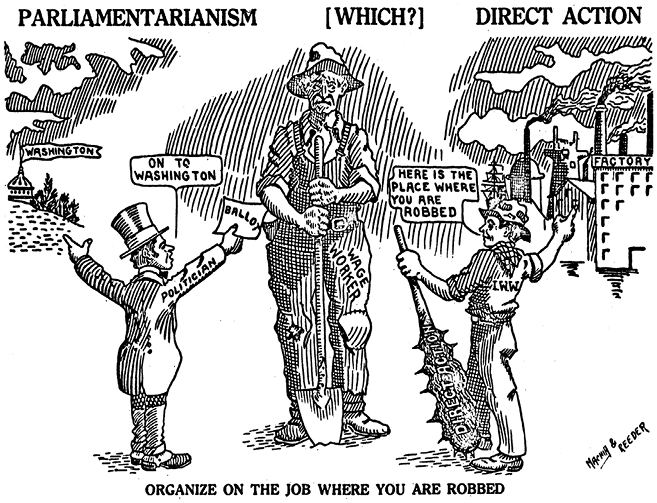
A cartoon in the Industrial Worker published in 1911 captured this idea of worker interest (see Figure 5.1). It depicted a wage worker in overalls flanked by a politician to the left, and a Wobbly on the right. The frock-coated politician holds up the ballot paper and, looking towards the US Capitol, urges: ‘On to Washington’. The Wobbly points to the factory, holding a cudgel inscribed with direct action. The caption reads: ‘Here is the place where you are robbed’.Footnote 61 The message to the worker is that power comes from union.
‘Organize on the Job where you are Robbed’, Industrial Worker, Spokane, WA, 23 March 1911.
Solidarity was cashed out in different terms. Hagerty conceptualised it as ‘organic interdependence’.Footnote 62 For Haywood, it meant empathy and inclusivity. At the founding conference, he charged the Union with improving the life of ‘the fellow that is down in the gutter […] realising that society can be no better than its most miserable’.Footnote 63 The IWW, he argued, should be ‘broad enough to take in all the working class’.Footnote 64 A statement in the Industrial Union Bulletin stressed the class aspect: ‘When we, all of us, of both sexes, and of all races who work in mills or factories, realize that we are all skinned by the same bosses and that the bosses are unities in the skinning process, and that it is time for us to get together and call a halt to the skinning game, the old trick of play us one against another will work no more’.Footnote 65
Unity was the common thread linking all these iterations. An unsigned article in the Voice of Labor published immediately after the January 1905 meeting, found an analogy in physics common to anarchist thought at the time: ‘the relation which the atom bears to the organism in physical nature is the relation which the individual bears to society’. As the ‘social organism’ was ‘an aggregation of the atom man’ it followed that every individual was ‘a being of the earth’ whose ‘welfare depends entirely upon the conditions surrounding his existence upon the earth’.Footnote 66 The language, which chimed with Hagerty’s work, was also reminiscent of Kropotkin’s. The difference was that, for Hagerty, unity was incompatible with division. Division spelt capitalist competition and the anarchy of production; solidarity was the antidote. Another article in the same issue of Voice of Labor called for ‘a unionism that UNITES in place of a unionism that DIVIDES’.Footnote 67
This conception was embedded in every facet of the IWW’s philosophy and practice. Literature published in multiple languages sowed it into workers’ everyday relationships.Footnote 68 Language classes were set up to enable workers of all ethnicities to participate and embrace the doctrine ‘No Race, No Creed, No Color’.Footnote 69 Native American organisers like Franklin Rosemont campaigned for a multi-ethnic unionism that looked beyond spurious ethnic and racial distinctions and emphasised the universal experience of being a worker. To ensure that solidarity extended to migrant workers without papers the Union adopted the term ‘Fellow Worker’ (FW) in preference to ‘Fellow Citizen’ or comrade as a term of address.Footnote 70
Solidarity, in particular class solidarity, was also promoted through direct action. As Voltairine de Cleyre noted in 1911, this concept had ‘acquired in the popular mind the interpretation, “Forcible Attacks on Life and Property”’.Footnote 71 Yet in the IWW, it was associated with the ‘[f]orce of education, force of organization, force of a growing class-consciousness and force of working-class aspirations for freedom’.Footnote 72
The IWW struggled to cement this conception in the years leading up to the US intervention in the First World War. Indeed, between the Anarchist Exclusion Act of 1903 and the Immigration Act of 1918, the membership was often dragged into a series of pitched battles with vigilantes and the private militias routinely deployed by employers to disable the union and crush strikes. Those identified as leaders, like Hill and Haywood, were targeted by police and justice systems.Footnote 73
Even in the face of such brutal organised repression, the IWW leaders remained committed to non-violent action.Footnote 74 For Mother Jones, violence was the instrument of capitalist oppression, not the tool of workers’ emancipation. Responding to fatal shootings and wounding of strikers in New Jersey, she told the workers’ wives to ‘see that your husbands use no firearms or violence no matter what the provocation’.Footnote 75 Even Debs, a vocal and fearsome critic of the IWW’s methods and tactics,Footnote 76 acknowledged the hokum cooked up by the ‘capitalist press’ in 1918 to outlaw and crush the union. The IWW, he commented, was not a ‘conspiracy to blow up the mills and factories in the East, to burn the crops and destroy the orchards in the West, poison the springs and wells in the North, paralyze the cotton and rice industries in the South, and spread ruin and desolation everywhere’.Footnote 77 On the contrary, it was organised to destroy despotism and establish democracy. Similarly, The IWW In Theory and Practice defined direct action as an exercise of workers’ autonomous collective action:
Industrial action directly by, for and of the workers themselves, without the treacherous aid of labor misleaders or scheming politicians. A strike is initiated, controlled and settled by the workers directly affected, is direct action. Industrial action for political purposes, such as general strike to enforce labor laws […] veto unjust laws, secure the release of labor and political prisoners […] is direct action. The control of industry directly by the workers themselves is direct action. Direct action is combined action, directly on the job […] Direct action is industrial democracy.Footnote 78
Industrial unionism was the institutional goal of solidaristic direct action. Popularised through the idea of ‘One Big Union’ it, too, encapsulated an idea of unity and a rejection of division or competition. As Hagerty put it, the ‘final solution of the labor problem’, namely the ‘emancipation from strikes, injunctions and bull-pens’ was industrial unionism.Footnote 79
The plan was to avoid the pitfalls of competitive craft unionism modelled by the American Federation of Labor (AFofL). The IWW view was that the AFofL had ‘saturated the American labor movement with the spirit of destructive competitive opposition rather than that of class solidarity’.Footnote 80 The Manifesto of Industrial Unionism endorsed at the January 1905 conference laid the main charges: craft unionism encouraged scabbing, bred hatred between workers, delivering the ‘helpless and disintegrated into the hands of the capitalists’. Craft rivalry fuelled drives to ‘create trade monopolies’ and forms of corporativism that enabled employers to raise prices and profits. Division also bred ‘political ignorance’, or prejudice, dividing workers ‘at the ballot box, as well as in the shop, mine or factory’.Footnote 81
Under Hagerty’s influence, the industrial union mirrored the structure of US industry,Footnote 82 famously depicted in his wheel-chart. The diagram grouped major industries in six departments: foodstuff, mining, transportation, building, manufactures and public services. Some were considerably bigger than others. The department of building was subdivided into bricklayers and bridgemen. The vast department of manufactures comprised ten industries: textiles, leather, woodworking, metals and machines, glass and pottery, papermills, chemicals, rubber, brooms and jewellery. Each industry was further subdivided into a variety of specialist groups. The non-exhaustive list for jewellery included watchmakers, engravers, jewellery makers and diamond cutters. Hagerty imagined that each department would have a central administration, and collectively, that these would form the union’s general administration, prefiguring the future organisation of society. The organisational model was revised over time. But the IWW retained Hagerty’s basic structure (see Figure 5.2).Footnote 83
‘The One Big Union Structure: Father Thomas J. Hagerty’s Wheel’.
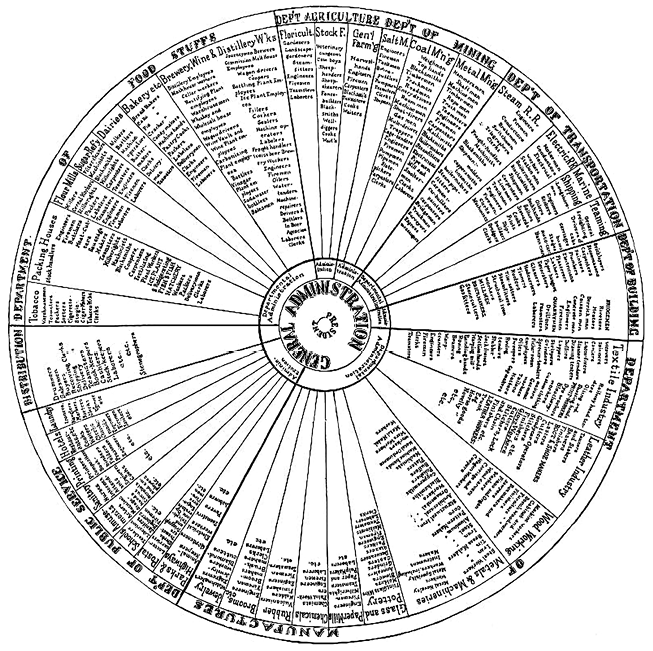
Figure 5.2 Long description
Image depicts the division of Union representation by industrial sector. These are agriculture and fisheries, mining and minerals, construction, and manufacturing and general production, with all workers linked by industry within one big union.
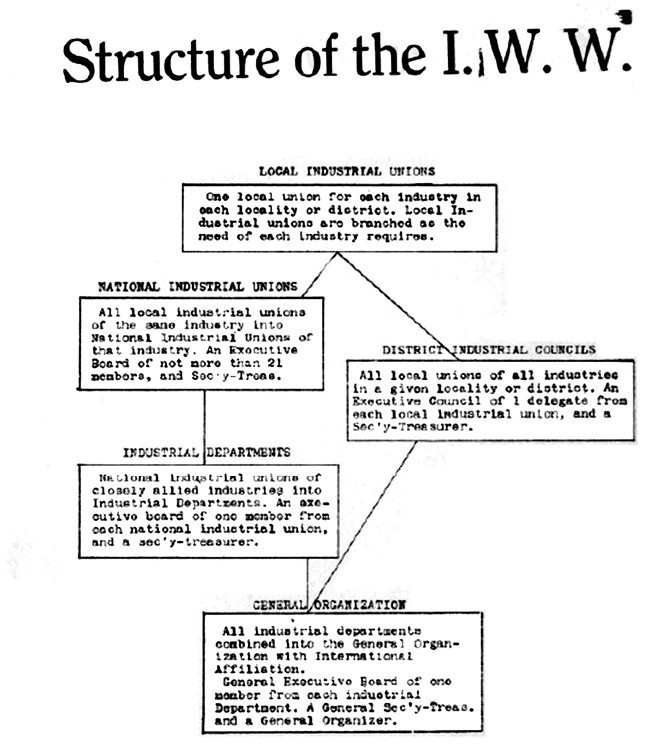
A system of locals complemented the departmental organisation depicted on the wheel. The Industrial Union Bulletin’s accessible, albeit simplified summary of the industrial union called ‘for the formation of Industrial Departments, National Industrial Unions, and Local Industrial Unions’. The latter united ‘all workers in a given industry’ in ‘a given locality’. This complicated the structure but reinforced the organising principle: the idea was to match the power of the corporations and trusts by concentrating workers’ power and bringing its exercise under the control of the union. The Bulletin remarked, it ‘was logically necessary’ for the workers to unite the local unions under a General Executive Board (GEB) of a National Industrial Union.Footnote 84 An unsigned statement published in the Voice of Labor in 1905 described this concentration as an organic relationship: the ‘intelligent, concrete expression from member to local, from local to national industrial, and from international industrial to general industrial organization’.Footnote 85 Eerily presaging Lenin’s disingenuous demand in the April theses, it declared: ‘All power should rest in a collective membership’.Footnote 86 The text of the 1905 Constitution spelt out the implications: ‘All organizers shall at all time work under the instructions of the General President’, the IWW’s ‘Executive head’.
In the years leading up to the First World War, these arrangements were kept under constant review. Significant revisions were made to the union’s governing institutions. As factional debates took hold, ‘anarchist’ decentralisers successfully pressed for the curtailment of executive power, putting local branches at the heart of the union (see Figure 5.3).Footnote 87
Vincent St John’s image of the structure of the IWW (1913).
However, the aspiration to align the Union with the structure of US industry was reaffirmed. In 1909, when the union reduced the number of Departments from thirteen to six, The Industrial Worker explained that it did so to ensure that ‘the IWW has a form of organization which is adapted to the changing conditions of industry’.Footnote 88
Historians sometimes describe the pressure to decentralise the IWW disparagingly as a misguided process of de-professionalisation explained by the dominance of ‘hobo’ elements – transitory workers – within the IWW. The economist and labour historian Robert Hoxie explained the weakness of the IWW as a consequence: the dues-paying membership remained small, strikes failed to increase or stabilise recruitment and that the local branches functioned ‘to all intents and purposes’ as ‘autonomous bodies’.Footnote 89 Likewise, sympathetic to the predicament created by the departure of the ‘stationary’ unions like the WFM, De Caux argued that the IWW veered too much towards the migratory workers and had ‘neither money, organizers, nor ambition’ to meet the needs of those labouring in the dynamic industries in the East.Footnote 90 Yet decentralisation did not inhibit local organising. ‘Locals’, often assisted by leading activists like Hill, Mother Jones and Elizabeth Gurley-Flynn (Hill’s prototype ‘Rebel Girl’), led fearless free speech campaigns and organised strikes with migratory workers in the grain belt and industrial labourers in the timber yards.Footnote 91
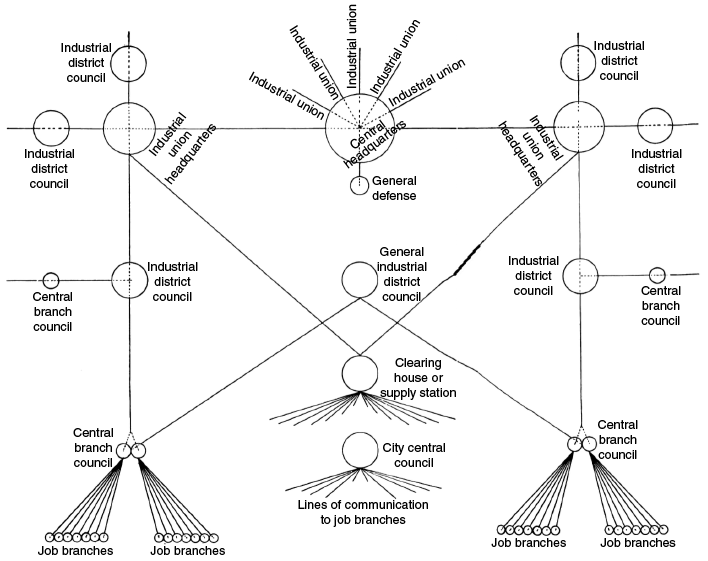
From the point of view of the IWW’s legacy, the shift towards decentralisation exposed the union’s lack of a clear mode of operation. The emergence of a de facto grassroots constitution, operating in conditions of severe repression, in parallel to the official union, posed significant problems. As Brissenden put it, the perception amongst the decentralisers was that the IWW’s ‘state socialistic’ modelling of the union was not well matched to the ‘syndicalist’ preamble.Footnote 92 Yet in pushing towards syndicalism, the decentralisers highlighted the fragility of the IWW’s plan for industrial union: the grassroots movements that mobilised after 1908 struggled to realise Hagerty’s plan. In 1920, George Hardy, a seasoned organiser on both sides of the Atlantic, urged the IWW to review its ‘elastic’ constitution to meet the ‘rapid changes […] taking place in the economic world, and the apparent blood-thirsty tactics of the masters of industry’.Footnote 93 Industrial unionism, he argued, was no longer fit for purpose. His new plan, illustrated above (Figure 5.4), was shaped by his experience of the British Shopstewards’ Movement. It united workers in ‘job branches’ and proposed a series of delegate councils to co-ordinate activities between branches and within districts. He called this revamped one big union ‘the Co-operative Commonwealth – Industrial Communism’.Footnote 94 The inelasticity of the I. W. W.’s constitution scuppered it.
George Hardy’s Model of ‘Co-operative Commonwealth – Industrial Communism’.
The repercussions of industrial unionism were felt just as keenly in the parochialism of the IWW’s theorisation of ‘the World’.Footnote 95 As Wayne Thorpe argues, the founders adopted the name Industrial Workers of the World to indicate a commitment to working-class internationalism.Footnote 96 But the model of the industrial union did not support this. The worry Lucy Parson’s voiced at the June 1905 convention was that the name wrongly universalised the US model of industrial unionism and misleadingly implied world leadership of the international proletariat. Her view was that it covered ‘too much ground’ and the alternative proposal, Industrial Union of America, covered ‘too little’. Her suggestion, ‘The American Branch of the Industrial Workers of the World’, was not accepted.Footnote 97
The IWW’s enduring fear of anarchism frustrated later efforts to affiliate the union with international confederations of syndicalist unions, notably the broadly syndicalist International Workers’ Association (IWA). Early attempts at affiliation were defended on the grounds that, contrary to the centraliser’s view, affiliation was not a ‘constitutional’ question.Footnote 98 But as industrial unionism spread around the world in the 1920s, Regional Administrations (RA) that sought affiliation with the IWA were de-chartered. The general strategy of the IWW after the First World War was to maintain its independence from the Communist International, or Comintern, and its union arm the Profintern, and the groupings around the French syndicalist Confédération Générale du Travail (CGT), as well as the IWA. Those against affiliation, like Fred Thompson, one-time editor of the IWW’s Industrial Worker, denounced as ‘anarchistic freaks’Footnote 99 those who would affiliate with the IWA, arguing that the constitution prohibited affiliation with either political parties or what the Cleveland organiser, Frank Cedervall called any other ‘[a]nti-political sects’.Footnote 100 Thompson recognised the injustice of deciding the interests of the foreign administrations in Chicago, and despite their protestations, the Chilean IWW administration joined the IWA in 1922. But to this day, the stated position of the IWW, clarified during the 2016 International Structural Reform process, remains non-affiliation.Footnote 101 The global organisation of the union, and the independent rights and prerogatives of the constituent parts were never clearly outlined, meaning a de facto US-centrism persisted into the twenty-first century.
Constitutional Inheritance
In the mid 2010s, structural reformers inherited a rule book that had been written for US workers to transform an economy which had itself already been revolutionised. As Simms, Holgate and Heery argue, the IWW evolved an organising model that emphasised worker self-organisation, collective action in the workplace ‘with the objective of presenting a fundamental challenge to structures and capital accumulation’.Footnote 102 It was a tall order in a period of industrial capitalism, but near impossible in a post-industrial era. It is perhaps not surprising that the WISE-RA set the concept of industrial unionism to one side and devoted their energies to the improvement of union democracy and internationalisation.
Our survey responses suggest that current members identify with key figures in the history of the IWW and broadly with its ethos, as we will discuss more fully below, but the data gives no clue about the aspects of IWW history that most appeal to twenty-first-century FWs. Nevertheless, there is ample discussion in the literature of the misfit between the history and the IWW’s present. As Jeff Shantz notes in his discussion of Judi Bari’s green-syndicalist initiatives, the configuration of industrial unionism is conceptually problematic. Changes in the form and function of capitalism and the demographic and political composition of the workforce complicate the IWW’s terms of reference. In 2005, the term ‘gig economy’ had yet to be coined, but the environmental crisis and the critique of Fordism common on the left coincided with de-industrialisation and the move to the service economy in the west. The revision of socialist theory by feminists, queer theorists and scholars of critical race theory makes these complications more obvious. As Shantz and Adam argue: ‘Unfortunately, even fatally’ the IWW’s historic aim of creating ‘One Big Union’ is now ‘largely a discursive device which expresses at a symbolic level the class unity of working people organised against capital. It cannot be understood literally as a practical alternative, at least not in the current context’.Footnote 103
The complexity of the intellectual and transnational context for the writing of the IWW’s foundational constitutional document is sublimated in its programmatic simplicity, as the contradictions it tried to transcend. What we now explore is the mismatch between the rule book, the organisational structure, and the revolutionary ambitions of the union in those early phases of its re-foundation in the twenty-first century.
Constitutional Review: The New Millennium
As we have discussed above, anarchism had become the touchstone for social movement organising by the turn of the millennium, animating the alter-globalisation movement in Europe and the Americas. As one IWW member put it in an interview:
I think that the collapse of the Soviet Union, before that the kind of corruption of the Russian revolution has led a lot of people to look at more decentralized forms of organization. And though I’m not really sure I’d consider myself an anarchist, you know it seems like such an optimistic thing to call oneself, you know [chuckling], but I do like the fact that the IWW is focusing on trying to build power in the workplace, power resulting from power in the workplace and not necessarily going the political route, trying to get people elected to office […] I think a lot of it has to do with like the increased interest in anarchism […] especially resulting from the whole world trade, World Trade Organization in Seattle thing. And I think a lot of, sort of, environmentalists, and other people on the left are coming to see the labor movement as a natural ally and the IWW is a natural ally within the labor movement.Footnote 104
The influx of ‘the new anarchists’, as David Graeber called them,Footnote 105 forced dramatic changes on the union’s structure too. Intersectional accounts of power, the machinations of trade union officials, the historical experience of Bolshevism, the spread of consensus decision-making in protest movements, and the explosion of social media, put workerism in the union on notice.
In this penultimate part of the chapter, we give an account of the radical reconstitution of the union in the past ten years, a process we contributed to through our co-produced research.Footnote 106 Our aim is to show how anarchism reshaped the union and to evaluate the effects of the constitutional changes that were introduced. We examine the two parallel reforms. The first transformed the IWW’s international structure by decentring the American administration in the global organisation. The second decentralised power in the RAs reinforcing historic trends that reflected the memberships’ anarchistic sensibilities. None of the tensions identified in the ideals and realities of class struggle were resolved through this process: the IWW remained committed on paper to a plan for industrial unionism that the membership was ill-equipped to deliver, and committed to building an organisation capable of taking on corporate capitalism by building solidarity with workers who more often than not laboured alone and on a shoestring. We assess the impact of these reforms and discuss the memberships’ perception in the final, fourth part (Limits of Constitutional Review: Decision-Making and Participation) of the chapter.
The International Structural Review Process (2014–19)
The IWW remained an active force in UK union organising during and after the Second World War, but the union’s fortunes changed noticeably following an uptick in US activism in the early noughties, apeing what David Graeber called the underlying anarchist ethos of the day.Footnote 107 Activists schooled at summit protests and in movements like Reclaim the Streets and the Climate Camps, streamed into the IWW around 2005, attracted by its advocacy of direct action. Yet the concept had new connotations. As Christiansen argues, the union appeared to offer ‘a way to practice anarchism’,Footnote 108 while its history painted a picture of ‘what [ideal] union action looks like’ and a ‘sense of collective agency’ that empowered members ‘to bring about change’.Footnote 109 The shift in the UK gathered steam around 2010. Most recruits, anarchists, non-aligned Trotskyists, Marxists and others were concentrated in three key industries: education, hospitality, and administration.
Inspired by the hugely successful struggle for a Starbucks Workers Union, led by US Wobblies at the turn of the millennium, the UK IWW also achieved several high-profile wins. One was to force the reinstatement of sacked Pizza Hut staff in Sheffield in 2011.Footnote 110 This led to the formal UK certification of the Union in 2012, and the ramping up of activities notably at the department store John Lewis, and London University’s School of Oriental and African Studies (SOAS), where the union secured minimum wage and unpaid wages for outsourced cleaning contractors. In Bristol, the union won unpaid wages for hospitality workers,Footnote 111 and the reinstatement of a sacked whistle blower at Bristol City Council.Footnote 112 The IWW also built solidarity and organising capacity amongst largely South Asian food package workers in and around Heathrow. Dual carders took leading roles in the University and College Union (UCU), both in the national negotiating teams and in rank-and-file branch organising. A sister to the US Incarcerated Workers Organising Committee (IWOC) was established in the UK around 2016, affiliated with, and organised through the IWW, to support prison workers and fight the general intensification of wage slavery under capitalism (unlike the Anarchist Black Cross, which supported those jailed for political activities and others caught up in the waves of anti-globalisation actions). An Anti-Fascist Defence Committee was established to align with and support other anti-racist groups organising around the country, and the Pan African Worker’s Association (PAWA) (UK) followed. Finally, the IWW’s environmental unionism caucus worked within and alongside Extinction Rebellion during its most prominent years.
A key focus for the UK wing of the union (WISE-RA) was the expansion of the gig economy. From 2016, the IWW began organising and supporting Deliveroo riders. Building on the example set by Wobblies in Bristol, branches across the country joined the campaign. Achieving tangible financial gains for workers, including increased drop rates, IWW branches forged links with migrant workers, and disseminated knowledge of IWW organising tactics to indigenous and migrant workers alike.Footnote 113
This catalogue of activity is no doubt partly responsible for the rapid increase in membership from around 200 in 2005, to around 1,300 in 2016 and over 4,000 in 2024.Footnote 114 The problem was that the union’s processes and structures were ill-designed to support this new wave of labour organising. Indeed, the membership explosion highlighted the persistence of the structural problems that the IWW had experienced in the past.
Like the twentieth-century Wobblies, the twenty-first-century membership was often undocumented, low-waged or temporarily unwaged.Footnote 115 But dues were still paid to the General Executive Committee in Chicago, with a proportion returned to the UK regional organising committee (ROC) for redistribution. The rule book, revisions of which took up days of WISE-RA conference proceedings, also reflected US labour history, regional organising, and procedural norms, and bore little or no relation to the lived realities of the IWW in the UK. The establishment of three spin-off unions – Acorn, a tenants’ union, the Industrial Workers of Great Britain, and the United Voices of the World – was bittersweet. On the one hand, activists trained in the IWW were able to put those skills into practice in their communities. On the other hand, the IWW’s failure to branch out from workplace organising illustrated the weaknesses of the ‘One Big Union’ mantra.
The reform process to democratise the union worldwide was the UK membership’s ambitious response. It initiated a twin-track ‘structural reform’ process. The first was designed to decentralised power in the international organisation by transforming the single union run from Chicago into a ‘minimalist confederalism’, in which each of the hitherto national or ROCs would become fully fledged RAs, that is, devolved administrations of the Union, with their own rules, dues, and organisational structure. The second was designed to democratise the union by empowering the general membership branches (GMBs) in WISE-RA. Reforms removed the voting rights of regional officers, hitherto the executive, including the regional secretary, and put decision-making in the hands of mandated delegates from each of the union’s (mainly municipal) branches. In sum, the democratisation of the Union from the bottom up took the form of regional and municipal decentralised federalism, Father Hagerty’s industrial unionism was effectively abandoned, and organising turned to mobilising the working class by winning individual disciplinary and grievance disputes with bosses.
The two reform processes were first proposed at the European Regional Administration (ERA) annual conference in 2014 and were completed and adopted by the union two years later.Footnote 116 The motions pointed to two issues, one a mismatch of ‘culture’, and two, the US-centric ‘sphere of deliberation’. As Lucy Parsons anticipated in 1905, proposers of the motion questioned the designation ‘world’ in the union’s name and asked ‘whether IWW members and bodies outside North America are adequately represented within the General Administration’.Footnote 117 As the Union did not amass a vast war chest each year, the question of dues was not particularly pressing. Nevertheless, the ways in which dues were redistributed were manifestly questionable prior to structural reform. The minutes to the 2014 conference suggest that the North American administration was unhappy that European delegates to the GEB had a vote on issues which did not directly concern them, and fully appreciated the injustice of retaining their dues.Footnote 118
At the 2014 convention of the General Administration in Chicago, ERA delegates also proposed and passed a motion to establish a commission to conduct an ‘audit and analysis’ of all the rules and principles pertaining to the international structure of the Union. The need for this arose, the delegates argued, from the growth of RAs in the UK (BIROC), Iceland (ICEROC), Australia (AUSROC), the German-speaking regions (GLAMROC) and elsewhere.Footnote 119 It was hard to tell where the rules of the General Administration ended and those of the other RAs began, how to translate the US-centric language and practices into local idioms and practices, and whether members in those region could be adequately ‘represented’ by the General Administration in Chicago. The International Structural Reform Committee (ISRC) was mandated to scrutinise and propose ‘radical’ changes to the union’s structure. Yet there was no intention to examine the union’s organisational or cultural roots. The ‘core principles’ of the General Administration’s constitution, the spirit and letter of the preamble in particular were all sacrosanct. The rest would be worked out through the rewriting of the rule book at successive conferences.
The committee adopted consensus decision-making to determine which changes to propose. A simple majority was used for contentious decisions. Because the committee represented the full geographical spread of the union, it reduced the US GEB to a minority. But there was little friction. Finding that the proposals maintained the democratic structures of the union and were consistent with the spirit of the union’s internal institutional organisation, the GEB was supportive of the measures. The chair noted that ‘a clear and substantive consensus was reached […] on all of the issues that had so far been under discussion, and beyond’.Footnote 120
The changes proposed to the international structure of the Union were far reaching and unprecedented. As the report puts it: ‘This consensus centred on the concept of a “minimalist” confederal structure that keeps international level mandates and bureaucracy to the strict necessary minimum, designed to enhance administrative efficiency on all levels and to prioritise regional administrative/organisational autonomy as far as possible’. The committee agreed that ‘an international executive board and secretariat with wide oversight, governance and discretionary powers’ was ‘unnecessary and undesirable’, and further, that the Union develop ‘a minimal set of carefully conceived international structures and procedures […] in an international constitutional document’; establish a ‘minimally contentious and internationally democratic mechanism’; introduce international coordinating committees and finally continue with the policy of dissuading formal affiliation with international organisations and to maintain its formal a-political stance. As the committee put it:
the committee members observed that in the case of the IWA, a revolutionary Anarcho-Syndicalist international, a disproportionate amount of time and energy seems to be spent on divisive and unnecessary factional, ideological, procedural or administrative disputes in which the international structures seem to be consistently instrumentalized. It is the committee’s opinion that an IWW International Convention, Executive Board and Secretariat with wide discretionary powers that can impose excessively detailed mandates on how regional sections should run their affairs would tend to promote that kind of undesirable situation.Footnote 121
The committee flagged the association with an anarchist union as an affiliation of a ‘political’ kind, contrary to the IWW’s constitution and preamble. The committee conceded that this is ‘not necessarily a correct reading of the purpose or spirit of that constitutional clause, which is arguably directed at political parties and groups and not unions’. Yet it maintained that non-anarchists in the union may object to affiliation with an overtly anarchist body, reinforcing the norm of independence, and alienating the IWW from the wider syndicalist movement.Footnote 122
The ‘International Guiding Principles and Rules’ were ratified at the IWW annual convention in 2016, agreed by referendum, and adopted by the UK RA at the conference that same year. It became the overarching constitutional document for the entire union from that point onwards. In their report to the 2016 WISE-RA conference, the UK delegate to the ISRC noted: ‘The new International Guiding Principles and Rules, are a major step forward and have the effect of making all RAs equal. This means that the WISE-RA will be no longer subordinate to the General Administration [sic. A reference to the GEB in Chicago]’.Footnote 123 Where the International Guiding Principles and Rules (IGPRs) were unable to resolve disputes within or between RAs, or where these RAs pursued policies in contravention of this document, Article X provided for an International Conciliation Committee, that would oversee mediation and, failing that, final appeal to the triennial International Convention (or conference of RAs). So unlikely is it that a dispute would get to this level, that the International Convention’s sovereignty is symbolic where it is understood to exist at all. Given that all members at these conferences are delegated from branches, through the RAs to the International Convention, the normative hierarchy of the union was inverted.
What did the new IGPRs establish? The preamble and the first article restate the IWW’s commitment to a post-capitalist future, defined by the absence of ‘the wage system’, and the prefigurative role of industrial unionism, ‘building the new in the shell of the old’, which is ‘absolutely necessary for emancipation’. It also prohibited ‘all alliances, direct or indirect, with any political parties or anti-political sects, and disclaims responsibility for any individual opinion or act which may be at variance with the purposes herein expressed’ (Article IIV).
The IGPRs were also transformative in three ways. First, they established the overarching constitutional architecture and ethos of a global union for the first time. All other documents and processes were assessed in terms of their compliance with these general principles: Article II, §I, pertaining to membership, and Article III §IV, relating to the relatively autonomous structure and independent rule books of the RAs, both reinforce this. The General Executive Council based in Chicago was abolished and the ROCs, which were previously coordinated through Chicago, became autonomous ‘Regional Administrations’, with rights to write their own rule books. This seismic change – fulfilling Lucy Parsons’ aspiration – formalised the ‘“minimalist” confederalism’ of the union, while avoiding the formal use of the ‘f-word’, associated with the anarcho-syndicalist federations of the IWA.Footnote 124
Third, RAs were given the latitude to pay their officers for their work. Article IV on Union Democracy states that: ‘The compensation of all IWW officers and employees, including benefits and perquisites of office, shall not exceed that of their highest-paid members’. As we will see, WISE-RA ran aground on this matter because it failed to embrace this contradiction between the founding ethos of the preamble and this provision in the IGPRs, allowing the Union to pay its executive and administrators, in fact, even its organisers. We turn to this problem when we assess the reforms in ‘Limits of Constitutional Review’.
Subsidiarity in the Union: Founding the Delegate Executive Council
Alongside these international structural reforms, members in WISE-RA radically overhauled the structure and organisation of the RAs, and eventually re-wrote the rule book. Fellow workers in the ERA (formerly the British Isles ROC) reviewed their local rule book and organisational structures and stopped paying dues to the central Chicago office. Given that these processes were led by broadly the same people, and that this cohort of FWs were overwhelmingly identified as anarchist, the correspondence in the outcomes is to be expected. That they caused so many problems is somewhat more surprising.
The process of revising the rule book formally began at the 2014 ERA conference. There were four motions pertaining to the structural reform of the Union on the agenda.Footnote 125 The first sought to create a new international governing organisation for the Union, what would in effect become the ‘International Guiding Principles and Rules’. The second was to formally recuse the ERA from votes pertaining only to North American issues. Both failed, mainly because neither could be decided unilaterally by the ERA, and so were, as the Secretary noted, out of order. The ISRC was still in process at this time, and would not report until the following year, but WISE-RA wasted no time in getting its own house in order.
The third motion was for the establishment of a new Regional Executive Board. This passed with overwhelming support. The fourth established an internal Structural Reform Committee, within ERA. It was tasked with developing a new ‘Constitution and Bylaws to replace the current Rule Book and to govern the Industrial Workers of the World in the area covered by this Regional Administration’. This motion also attracted overwhelming support.
The urgency for a new RA and rule book arose from the expansion of the membership. At the start of the first wave of new recruitment in 2005, the UK IWW was a group of about 200 members. The Annual Return, filed with the Certification Officer in 2012, records 436 members, and by 2016 the membership stood at around 1,300. Even with such relatively low numbers, the IWW was by then the largest anarchist-leaning organisation in the UK.
The committee reported at conference the following year. In just twelve months, volunteer FWs had completely revised and restructured the ERA rule book, and by committee. Unable to adopt the new rule book for procedural reasons in 2015, it was formally adopted at the following conference in 2016. At that conference, in the shadow of the UK’s impending exit from the EU, the new rule book was adopted by majority vote, alongside a change of the RA’s name from ‘European’ to ‘Wales, Ireland, Scotland and England Regional Administration’ (WISE-RA). It was a monumental piece of work completed by committed volunteers.
The aim of the reforms was to move the UK administrative model from one of mass involvement in central decision-making, possible when membership is low, to a devolved form of subsidiarity, in which the rank and file of the union are represented by delegates at these central coordinating bodies. Since the broad membership was neither industrially coordinated, nor workplace-based, the municipal and regional GMBs remained the primary organising units. However, even though they represented the membership, the GMB delegates to the RA were outnumbered by the officers of the Union (secretary, treasurer, etc.), almost two to one, and so had no real voting power.
Admittedly, these executive officers were often also active in their branches, but many officers were members of branches with inactive memberships, while delegates from Bristol, Leeds, Bradford and Sheffield were activists in branches with the lion’s share of members in the union, but had fewer regional officers at the General Executive Board, and so had less voting power. In contrast, the number of delegates sent to the Annual Conference was (and remains) proportional to the branch membership numbers (evolving from 1:10 in 2016 to 1:34 in 2024). But the day-to-day running of the union remained the preserve of a largely unaccountable group of core members.
The solution to this concentration of unelected power and the domination of experience was a proposal to create a Delegate Executive Council (DEC), to formalise the de facto bottom-up decentralisation of the RA that had been in place, largely in contravention of the by-laws established in Chicago, since the Union’s revival in 2005. This instituted a system whereby each branch sent a delegate to the DEC with a single vote on all motions brought to it.Footnote 126 The voting rights of the officers of the Union (Secretary, Treasurer, Membership Secretary, regional organisers and Industrial Union national secretaries) were removed, though they retained an advisory role. In practice, this often meant that experienced non-voting officers supported inexperienced volunteer and rotating delegates (when branches sent delegates at all), and also invariably shaped the agenda and influenced the outcomes.
As the administration of the Union became increasingly delegated and shared, the Secretary of the RA’s duties were slimmed down from over a dozen tasks to four, but in practice, the restructuring and the expansion of the Union’s membership and activities swelled the size and scale of the DEC’s activities. Now having to represent their branches and chair and administer the Executive Council, the Delegate officers saw their (voluntary) workload almost double. The DEC gradually assigned the active members of the Union to a proliferation of officer roles. A sorely needed Access Officer was added to the DEC, in addition to a Women’s Officer, chairs of all departments (admin, merchandise, literature, international, to name but four) were now expected to provide reports of their activities over the previous quarter, and they could expect to be quizzed by the branch delegates.Footnote 127 In addition, as delegates to DEC served only one year, and took as long to ‘learn the ropes’, a high turnover meant that the Regional Officers, who could (until the rules were changed) be re-elected indefinitely on two-year terms, were quickly able to dominate meetings. To make matters worse, the Chair of DEC was now customarily drawn from the delegates. The idea was to relieve the workload of the Secretary and ensure the branches had a firmer grip on proceedings. But this increased the pressure on novice delegates, discouraging service and perhaps also explaining the enduring gender imbalances.Footnote 128 This was a historic problem, formally recognised in 2015 when rule 2.4 (3.4 in 2016) mandated that the union to seek gender balance and equality and diversity in its administrative structures.
The Debate about Rules: Wage Labour in the IWW
To date, the administration of the IWW, a registered union, with legal requirements to submit annual returns, file accounts and comply with the UK law, was almost all voluntary, and attempts to establish paid administrative roles were informally and formally blocked through appeals to the founding ethos of the union, and constitutional procedures.Footnote 129
Debates about whether the IWW should pay its members for work in the Union had been open and vociferous since at least 2013. A discussion document summarised the principle of this position and inadvertently showed how procedural and bureaucratic processes stymied the development of the union.Footnote 130 The movers of the proposal pointed out that paid administrative positions are normal in the US RA and permitted by the constitution. They were opposed to paid organisers, arguing that all members should be organisers, but argued that the administration of the Union could not be voluntary. Paying administrators would facilitate the participation of FWs who lacked independent means and/or gendered social capital. In 2013, ERA (as it was then called) did not have the money to fund this proposal, but the proposal failed anyway. Even though the Chicago-based General Secretary-Treasurer of the Union was receiving $30,600 per annum, FWs in the UK union argued that payment for work by a union opposed to wage labour contravened the Union’s preamble.
The proposal was revived three years later. Motion 9 at the 2016 annual conference aimed to formalise a system of paying IWW members for administrative and other duties. This was first brought to DEC in February 2016 and tabled with no decision made on the topic then. It was brought to conference as a motion that summer, which read: ‘The IWW is committed to the abolition of the wage system. However, while the wage system exists, we will fight to defend the employment rights of workers. As part of our commitment to this, where we have a need to pay for ongoing work, we will issue employment contracts, so that our own workers have secure and fair employment’.Footnote 131 Three proposals to amend the motion to set up a working group to look at the issue all fell. The motion passed, unamended, by a simple majority, but no sooner had it passed than a point of order noted that the proposal constituted a change to the rule book and so needed a two thirds majority vote to pass. The conference minutes suggest that subsequent debate was heated, and after two more rounds of voting, the motion was deemed out of order and tabled for the next DEC meeting. It never came to the November DEC, was not on the conference agenda the following year, and by 2018, the proposer had left the IWW to take up a paid organiser role in a mainstream union. Today, much of the Union’s administrative work is undertaken by a small group of self-employed contract administrators, who are also members, and accountancy work is sub-contracted to a separate workers co-op called Third Sector Accountancy.
Finally, and to bring the reforms full circle, a motion at the 2017 conference called on conference to decide ‘whether WISE-RA members are in favour or against joining the new international organisation [of revolutionary syndicalist unions] proposed at the Bilbao conference in November 2016, following the split within the IWA/AIT’. The motion passed unanimously, and an international department set up in 2017 to help see this through, but little came of it. A reluctance amongst senior officers and rank and file members to use the designation ‘anarchist’ or ‘anarcho-syndicalist’, prohibited a formal alliance of the IWW with the IWA, but closer liaison with other syndicalist unions, and the establishment of a translation department deepened international solidarity. In 2018, a conference motion carried to register IWW/WISE-RA as a ‘supporter member’ of the New International, a grouping of anarcho-syndicalist unions that included the CNT and Freie Arbeiterinnen -und Arbeiter-Union (FAU), which supported the international coordination of the unionisation and organisation of Deliveroo riders Europe-wide from 2016. Little came of this, and the lack of international solidarity with like-minded organisations continues to stymie the union’s development.
Limits of Constitutional Review: Decision-Making and Participation
Almost immediately the reforms were enacted, WISE-RA was beset by an existential crisis framed as a failure to organise, which was itself caused by a failure of union democracy understood as participation in democratic processes, rather than representation of the demos through them. Participation rates in union democracy, whether at branch level, or in elections, were at or around 20 per cent, comprising roughly 200 active members, spread across the twelve branches, out of a total membership of just over 1,000. Participation in annual elections of officers produced very low turnouts, roughly 10 per cent, and branch meetings mustered at best perhaps half a dozen members each.
However, as more experienced members routinely remarked, while absolute numbers are very low indeed, proportionally, the IWW enjoyed better levels of participation and representation in the administration of their union than most mainstream unions. Unlike those other unions, the IWW is explicitly and constitutionally a participatory union, with activist members always demanding more of each other, and those activists having cut their teeth in protest movements and on the streets, they had very high expectations of one another, and impatience to boot.
The aim of the co-produced survey and follow-up focus groups was to better understand how FWs understood the barriers to democratic participation in the union. Assuming, correctly as it turned out, that members broadly identified as anarchist, we wondered what they thought the barriers to fuller participation would be. We and WISE-RA also wanted to conduct an audit of the structural reform that had been in motion for at least two years by that point, and assess how far it had succeeded in meeting members’ expectations. The open-ended questions and the group discussions provided invaluable insights into the quantitative data. The general conclusion of the membership was that the reforms hadn’t been anarchistic enough.
The survey confirmed our conjecture about the make-up of WISE-RA. A high proportion of respondents identified of anarchist. The second standout result was the preponderance of white men in the union.Footnote 132 When we discussed the data at branch meetings, FWs confirmed that the data reflected their membership and that the lack of diversity highlighted an underlying problem in recruitment. We were told about initiatives to increase BAME membership and improve gender representation, even where rates of participation were already higher than the national norm (e.g., in Sheffield).
Unsurprisingly, given the demographic spread, most respondents to the survey and participants at the meetings had a very demanding conception of democracy and participation. We asked survey respondents to explain how they understood the concept in open text boxes. Democracy was defined in terms of equality of input, not in order to achieve equality of outcome. Phrases like, ‘having an equal say’ or ‘voice’, or being an ‘equal participant’, and ‘equality in decision making’, or ‘everyone can participate equally in decision making’, were common. This understanding of participation was often aligned with conceptions of ‘worker democracy’, or ‘communities controlling their own destinies’ through ‘participatory decision making’, thereby challenging and overturning structures of ‘race class and gender’.Footnote 133 Asked what would make decision-making better, members identified needing transparent modes of representation and delegation, an ethos of ‘[p]articipation, solidarity and care’. One member put it like this: for things to work better, ‘the power imbalances present in wider society […must be] recognised and actively challenged so these are not reproduced within branches/at meetings’.Footnote 134
Some members recognised the demands that the IWW placed on their FWs but were realistic enough to understand that most members either cannot or do not want to get involved. At a workshop on union democracy with eight self-selecting union members, that ran alongside the 2016 conference, one member said no one should be surprised that turnout is low for bureaucratic participation, whether in branch meetings, elections or conference attendance: none of this is what ‘interests the majority of members at the moment’.Footnote 135 Another participant (P4) noted that far higher numbers turn out for pickets and protests, and general activism, but the running of the union just did not excite members. P5 went on to suggest that proportionally, the percentage of members who turn out for IWW elections and conferences is far higher than more mainstream unions, with perhaps the exception of the transport workers (RMT). The ambition was always to boost participation, not to ignore it, to aspire for higher activist and organising density, not to entrust the Union’s leadership to an unaccountable clique. P3 stated, ‘What I’m much more concerned about than that [turnout at elections] is this issue of participation in the decision-making structures of the union in the conference, in the DEC, in local branch meetings, and I agree we should do everything we can to try and promote that’. But ‘10% [participation] is nowhere near good enough’ P8 stated. P1 chimed in:
The vast majority of our members are not of that ilk, and we’ve got to understand basically that we are strange creatures, we are fucking very strange creatures. People think that we’ve got two heads when we say we’re off to a conference for a weekend. What!? To discuss rule book changes. WHAT!? You know. Rule book. What the fuck’s a rule book?Footnote 136
Overall, decision-making at the local level, in branches was viewed positively, particularly when issues were clear, and clearly communicated, and when processes were transparent (Q12). But below this level (branches are ‘higher’ than the DEC), things became very opaque. One respondent claimed that decision-making in the union was ‘effectively centralised’, another that it was ‘dominated by a minority’, and ‘easily manipulated by cliques’ (Q11). Responses to Q12 reinforced this general perception. Meetings and decision-making go badly when facilitation fails, the egoistic personalities push themselves to the fore, and ‘Non-binary people and women in branch get tokenised without being listened to’. Proposed solutions were not procedural but pointed more directly at underlying cultural problems. As one respondent put it:
meetings must be accessible, information must be accessible, men and white people must recognise their privilege, we need to address disablism [sic], procedures and systems must be developed that ensure the same people/types of people are not always dominant within the group/wider Union.Footnote 137
When we took these results to the branches for discussion, we got similar but more nuanced perspectives. One member remarked that one of the negative side-effects of thinking so carefully about the role and legitimacy of the DEC, and broadly for the better, was that members then sought out ‘[b]ureaucratic solutions to problems’, rather than more informal ones in branches or between them.Footnote 138 Some members were very complimentary of the DEC, especially the way it regularly brought members together from across the UK. But most branch members we talked to had no idea what the DEC was for, had little or no interaction with it, and wanted even less. Most activists, in other words, supported the autonomy of branches, and at best ignored the regional administrative body.
The DEC was considered exclusive, not only because of its institutional removal from the concerns of the rank and file, but also because of the failure to consider important access needs. Able-bodied members with families found weekend meetings and conferences scheduled during school holidays to be the exclusive preserve of those with the ability to share family commitments. Acrimonious debate, over-assertive individuals, a lack of familiarity with process, and meetings that routinely stretched to four hours, also made it difficult to convince active branch members to become branch delegates.
Compounding this, the presumption that all members should be organisers and participate was not a universally held view. Many members were quite content to see the IWW as a service union, demonstrated by their lack of participation, however you construe that term. But even active members rejected the notion that everyone should be an organiser. One said, ‘I don’t think everybody or everyone should be an organiser […] No, I think it’s a terrible idea actually […] And I can say personally, I’d be a terrible organiser’.Footnote 139 Another member at a different branch recognised that activism does not come naturally and is more likely to attract people who are ‘like, you know, an anarchist, activist sort, naturally’.Footnote 140 And this is distinctly gendered too. One FW said: ‘we get spoken down to quite a lot cos you’re young and female’. Agreeing, another said: ‘I think there has at least been a history in the Left of like grumpy old men standing up in meetings and shouting and getting away with it for a long time’.Footnote 141
Alongside a broadly inactive membership, one that expressed dissatisfaction with, or ignorance of the workings of its DEC, it is perhaps unsurprising that ‘the rules’ played little or no role in shaping the broad membership’s involvement. Most of those we surveyed believed a rule book was important, but often substituted decision-making for rules. Many probably shared this FW’s views:
having clear procedures and rules that are basically inviolable I think is really important. […] the less systematic you are with your decision-making processes, the more room there is for abuse, so with the show of hands thing it can be a popularity contest, but it’s actually good to develop really robust relatively straightforward and simple, but inviolable inflexible procedures for decision making.Footnote 142
Clearly, there was a concern for what Jo Freedman has called ‘the tyranny of structurelessness’. But no doubt this FW’s views were also widely shared amongst the more activist and anarchist core:
as far as I’m concerned, if it, like says in the rule book that you can’t do it then you can. And you also interpret the rule book in a way that, because every text is open to interpretation, right? So you’ve got the rule book in front of you. Even if it does kind of say that you can’t do it, you interpret is as broadly as you can. If the union gets shit done, don’t let the rule book stop you.Footnote 143
One FW observed, somewhat tongue in cheek, that the rule book ‘only ever plays a role when [FWx] wants to stop someone doing something’, to which FWx responded, ‘I think it only plays a part when there’s an argument at a conference to be honest, or an argument at DEC’.Footnote 144 The failure to engage with the rule book as a constitutive part of the Union’s normal functioning is an ongoing problem its anarchist core will have to address. But the anarchist culture runs deep.
Our survey demonstrated that ‘nearly eighty respondents [33%] saw the union as a means to an end or a tool, while twenty-nine saw the union prefiguring the new in the shell of the old’.Footnote 145 The IWW is a vehicle for activism, not primarily the end itself. More to the point, because WISE-RA has no workplace recognition agreements, meaning that no majority of IWW members are recognised as the primary bargaining unit in any workplaces,Footnote 146 trained WISE-RA reps support members on an ad hoc basis, either by supporting them in meetings, or through direct action. Neither is particularly revolutionary. The latter ranges from letter writing and ‘marching on the boss’, to picketing. Marching on the boss involves delivering the member’s demands to the boss collectively and noisily, in order to impress on them the unity and power of the collective behind the aggrieved member. As a result, GMBs become the primary locus for organising, often doubling up as what some uncharitably call ‘anarchist social clubs’, and in others more akin to ‘historical reenactment societies’, as one FW put it. Even though the induction processes for new members encourages FWs to become more active, first in branch meetings, then as reps and organisers (climbing the ‘Wobbly ladder’ as it’s called), nevertheless, members claimed that it is the direct action ethos of the union, from picketing to marching on the boss, that built solidarities and friendships far more effectively than attending branch meetings or doing the admin.Footnote 147 Lamentably few saw administration and the ethos of the union as mutually reinforcing: most of our anarchist respondents saw them as opposed to one another.
Conclusion
‘Don’t mourn, Organise!’, Joe Hill’s dictum, is easier said than done. Debates about what the IWW is are central to its internal organisation and the union’s conception of who it should be organising with. On the 22 February 2018, Pete Davies, the then chair of the WISE-RA Organising Department, sent a written response to North American Regional Administration (NARA)’s request for views on their plan to reallocate workers to new Industrial Unions (IUs), redefined broadly in line with modified four-part wheel depiction of the workforce and to reflect what NARA’s executive saw as the new make-up of modern workplaces. Davies’ response focused on two significant issues with the North American proposals. First, the list of suggested IUs did not correspond to the work undertaken by most WISE-RA members. For example, ship builders and air transport workers would have had a lonely time in their IU, assuming any were IWW members, while non-working or unwaged workers were simply excluded from the IU organisation altogether. Second, Davies argued that division of the labour force into four main sectors simply did not align with the nature of modern work (and, as we have argued above, probably never did). Cleaners worked in several different industries, for example, and effective organising in this area is a result of galvanising cleaners across sectors, not within them, not least because numbers are higher that way. Moreover, the low waged often work two jobs and dividing their organising between two IUs would be administrative headache. And this led to the third point that WISE-RA had taken the view that organising needed to take place by workplace and by the GMB. By 2018, the reality was that the restructuring of the Union into General Members Branches, administered and coordinated by the DEC and the de facto federal structure of the international union, had killed industrial unionism. Davies argued, to reorganise ‘by means of Father Heggarty’s Wheel and these hypothetical unions seems to be putting the cart before the horse of actual organising’.Footnote 148 That horse had well and truly bolted by then anyway.
Was there a constitutional solution to this seeming impasse, a way of reconciling workerism, street activism and anarchist identity politics with the broadly federal and grassroots administrative structure that has been built? That is for others to decide, and FWs continue to discuss these issues. From our point of view, all the ingredients are there for the IWW not only to thrive but also to provide other unions with a model for organising. Yet the IWW seems unable to embrace the anarchy at the heart of its prefigurative politics and its anarchist members are unwilling to embrace the fullness of constitution activism. Workplace domination by bosses, and the structural domination of capitalism, felt by the unwaged as much as the waged, is best addressed by organisations that refuse to privilege one revolutionary subject over any other, but which involve collectives in the rule-making, and expect everyone to chip in with administration.
Second, the focus on boosting democracy, as a cipher for participation in the workings of the Union, overlooks the disabling and limiting tendencies of the constitutional structure of that organisation. The struggle against unjust power and domination demands precisely the introspective critique of the organisation that the IWW undertook but also non-reductive solutions. In other words, revolutionary agency and structure must be understood as fluid, imperfect and open. The IWW’s resistance to anarchism is partly at fault for the union’s failure to live with itself and to maximise its anarchic potential. The Preamble to the IWW, and the constant tinkering with the rule book to mitigate its demands, perfectly encapsulates this contradiction or tension: it is both a firecracker and millstone, repeatedly galvanising and hobbling its new members.
The causes of this failure are not only contemporary but can also be traced to the historical legacy of the IWW’s constitution. While vigilantes forced FWs into forms of militancy easily decried as ‘anarchist’, the IWW promoted direct action as an apolitical stance and alienated itself from the wider anarcho-syndicalist movement. De-centring the IWW through radical international structural reform, while foregrounding the preamble of the 1905 constitution, pressed the anarchist ethos of the alterglobalisation movement into a constitutional structure that could barely contain it. The new rank and file members, schooled in the intersectional politics of the movement of movements, struggled to reconcile the IWW’s commitments to direct action with its inherited workerism.
Despite delegating authority to branches, minimising officer power and enabling RAs to flourish independently, the IWW has not grown significantly, and its revolutionary credentials are undermined by its daily reformism: winning local disputes for individual workers is not a sign of failure, but it sits awkwardly alongside the aspirations of the preamble. Willingly acceded to by new members, the veneration of the preamble, reinforced a commitment to a future that members were not equipped to deliver, even supposing they were wedded to it. The failure to review the commitments signalled by the preamble and develop a fully intersectional critique of capitalism ensures the union will always be fighting with itself as it tries to advance the struggle for a post-capitalist future.
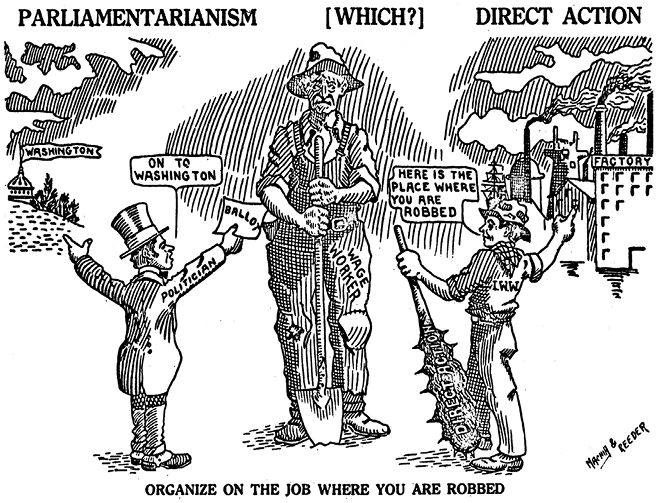
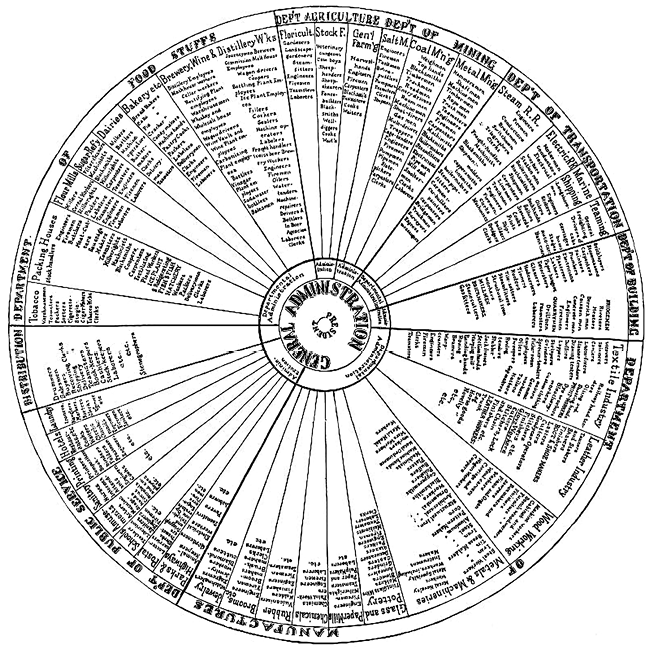
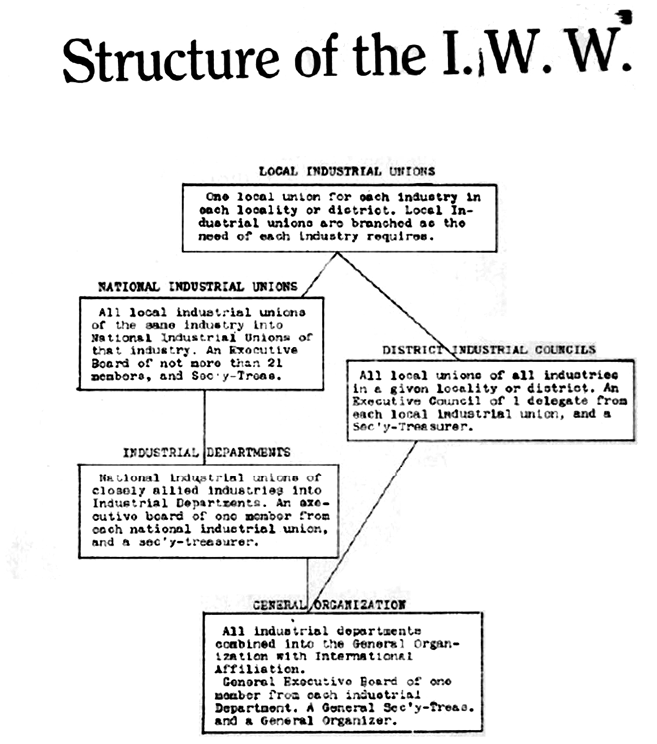
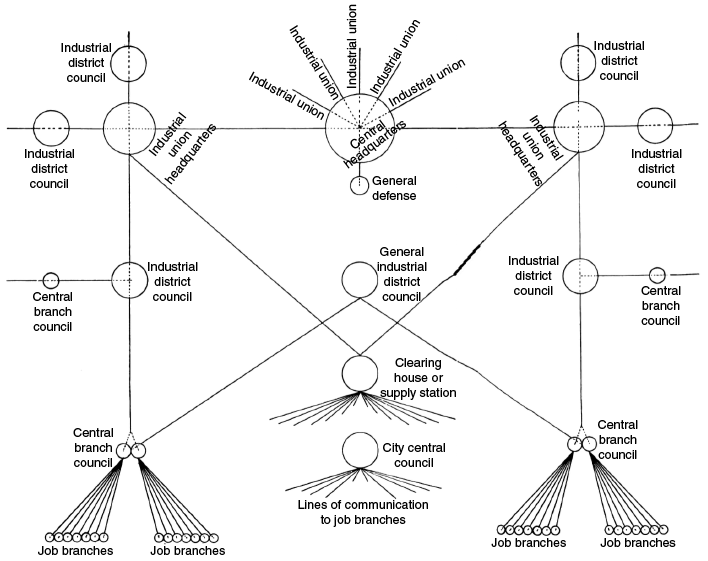

 Open access