

In sixteenth-century Europe, the dominance of Italian culture caused a variety of responses in territories north of the Alps. Lands such as Poland with strong religious or dynastic ties to Italian states were keen to emulate their culture. In other territories such as France, the import of Italian cultural practices prompted patriotic resistance. To understand how cultural goods were transferred and appropriated in the early modern period, it is necessary to study the forces that attracted north Europeans to Italian culture and also the processes whereby Italianisation was resisted. In each place or institution where they were appropriated, Italian cultural practices acquired a different set of meanings. This article aims to expose the complex mixture of attraction, resistance and appropriation involved in the reception of Italian secular song in the central German territory of Thuringia, particularly in schools and churches between 1575 and 1600.
In German-speaking lands the appropriation of Italian culture was led by social elites, who used it as a mark of their distinction. Aristocrats cultivated Italian art and music to show their cultural prestige. In Saxony, Electors Moritz (ruled 1541–53) and August (ruled 1553–86) remodelled the Dresden court palace in Italian style, adding sgraffito decoration and frescos by the three Tola brothers. From 1549 the Dresden court ensemble included Italian instrumentalists such as Antonio Scandello, Cerbonio Besozzi and Matteo Besozzi, while the three Tola brothers were also active there as singers.Footnote 1 Munich too became a centre for Italian culture under Albrecht V (ruled 1550–79), with the import of classical antiquities and Italian artworks, as well as the hiring of musicians such as Massimo Troiano.Footnote 2
Elite merchants likewise used Italian culture and luxury goods to show their moneyed status. The Fugger family in Augsburg patronised artists working in Italian style, imported sculptures from south of the Alps, and between 1508 and 1518 they constructed an Italianate burial chapel in the city’s Annakirche. They were also keen collectors of Italian secular music. A 1566 inventory for Raimund Fugger, Jr. (1528–69) shows that he owned over fifty books of madrigals and villanellas, and also musical instruments acquired from Bologna and Venice.Footnote 3 Another Augsburg merchant, Hans Heinrich Herwart (1520–83), had over 180 books of Italian secular music in his post-mortem inventory.Footnote 4 As Bernd Roeck argues, merchants such as the Fuggers were regarded as nouveaux riches by the older feudal classes, and through these displays of Italian luxury objects they sought to legitimise their newly acquired status.Footnote 5
Given that the early appropriations of Italian culture were motivated by its exclusivity, we should not be surprised that secular Italian music was a minority taste in German-speaking lands before the 1560s (as Mary Lewis has recently shown).Footnote 6 From the 1570s, a wider interest in Italian secular music developed, as city dwellers began emulating the Italianate tastes of aristocrats and leading merchants. Pivotal to this process was musical life in Nuremberg, which had strong trade links to northern Italy. The city hosted several music societies whose members cultivated Italianate secular music; members of the music society formed in 1588 included the Florentine merchant Carlo Albertinello and Nurembergers such as Paul Behaim II, who had previously lived in Italy.Footnote 7 The Nuremberg publisher Katharina Gerlach issued collections of Italian madrigals, starting with the three volumes of Friedrich Lindner’s anthology Gemma musicalis (1588–90). Gerlach and her successor Paul Kauffmann then issued reprints of Italian single-composer editions such as canzonettas and madrigals by Orazio Vecchi and Luca Marenzio.Footnote 8 Italian secular vocal music was also popular in other trading cities, such as Danzig, where the merchant Georg Knoff (d. 1605) owned a collection of 267 items of printed music (including 196 books of Italian secular vocal music, mostly Venetian editions probably acquired in the 1580s).Footnote 9
Yet there was another strand in the German response to Italian secular music that until now has not been researched. This strand ran through the schools and churches of central Germany from the 1570s onwards, particularly in the Lutheran heartlands of Saxony and Thuringia. Pastors and teachers here were repelled by the erotic texts of Italian villanellas and madrigals, yet they and their pupils could not resist the singable qualities of this repertory. Using rhetoric influenced by German patriotism, they attacked Italian secular music as an insidious foreign influence that was corrupting traditional German values of piety and valour. They sought to purify the repertory of villanellas and madrigals by replacing the Italian texts with devotional or moralistic words in Latin or German. Through such contrafacta they hoped to recover the virtue they believed was inherent in all music, and to make the attractive Italian melodies into a morally uplifting repertory for schoolboys.
Evidence of this strand in the reception of Italian secular music can be found in four little-known partbook anthologies printed in Erfurt by Georg Baumann between 1576 and 1598, containing contrafacta of Italian songs. The first two collections comprise the two instalments of the Cantiones suavissimae published in 1576 and 1580.Footnote 10 Edited by the Magdeburg cantor Leonhart Schröter with Latin texts by the Mühlhausen teacher Ludwig Helmbold, these anthologies contain contrafacta of villanellas by such composers as Baldassare Donato, Orlande de Lassus and Adrian Willaert. The third collection is the Primus liber suavissimas praestantissimorum nostrae aetatis artificum Italianorum cantilenas (1587), edited by the Eisleben teacher Melchior Bacusius, and containing Latin and German contrafacta of madrigals by such composers as Girolamo Conversi, Giovanni Ferretti, Andrea Gabrieli, Luca Marenzio, Giovanni Maria Nanino and Orazio Vecchi.Footnote 11 The last anthology considered in this article is the Amorum filii Dei decades duae . . . Zwantzig liebliche und gantz anmutige . . . Newe Jharß oder Weyhenachten Gesenglein (1598), edited by the Gotha cantor Johannes Lindemann; it contains Christmas and New Year contrafacta, primarily of dance-songs such as balletti by Giovanni Giacomo Gastoldi.Footnote 12 As will be explained below, none of these anthologies (with the exception of the 1576 collection) survives complete. Their fragmentary survival has hindered scholarly investigation, and until now the concordances of these volumes have not been systematically identified. In 2012, however, the British Library acquired a copy of the Discantus partbook of the 1576 and 1580 anthologies, facilitating much of the research in this article.
The four anthologies show that the Thuringian city of Erfurt was an important centre for the dissemination of secular Italian music, pre-dating in some ways the better-known activities in Nuremberg. Indeed, Bacusius’s Primus liber suavissimas . . . cantilenas (1587) was published a year earlier than the first volume of Lindner’s Gemma musicalis, yet contains contrafacta of some of the Italian compositions that would later be reprinted by Lindner. That Thuringian towns were centres for the dissemination of Italian music is not surprising, given their position at the crossroads of trade routes. Erfurt stood at the junction of the Via Regia running from Frankfurt am Main to Lusatia and Silesia, and the Völkerstraße running from Nuremberg (with its connections to Italy) to the Hanseatic towns of northern Germany.Footnote 13 But whereas Nuremberg’s music publishers catered for a market across German-speaking lands, the Erfurt printer Georg Baumann mainly supplied a regional market of schools and churches.Footnote 14 Baumann’s other music editions included sacred songs and Latin odes by Thuringian cantors such as Joachim a Burck and Johann Steurlein, aimed for use in worship, education or edification. Consequently the anthologies of Italian music published by Baumann heavily adapt their respective villanellas and madrigals in order to suit his target market.
I begin by exploring the anti-Italian rhetoric used by German patriots, showing how these rhetorical tropes occur in the prefatory material of the Erfurt anthologies. Following a discussion of Lutheran beliefs about the power of contrafacta to purify shameful songs, I examine the process of adaptation in each anthology. In the 1576 and 1580 Cantiones suavissimae, lewd villanellas were converted into pieces resembling the didactic Latin odes used in schools. Bacusius’s 1587 anthology praised the mastery of Italian composers, yet he still had to change the texts to make these pieces acceptable for school use. Finally, Lindemann’s Amorum filii Dei decades duae showed the limits of the contrafactum technique: a 1605 ordinance decreed that these dance-songs were too frivolous for church use, even when supplied with sacred words.
GERMAN PATRIOTISM AND ANTI-ITALIANISM
In the sixteenth century ‘Germany’ and ‘Italy’ did not exist as nation states, yet people from these lands had a strong sense of their collective identities. Such identities were partly shaped by language and culture; also influential was the Hippocratic and Ptolemaic view that the climate of a region shaped the temperament of its people. Thus the Germans, living under cold skies, were likely to be an austere people, whereas the warm sunshine of Italy supposedly encouraged a sensual and impassioned character in its inhabitants. Patriotism was also fuelled by comparisons with other peoples and territories: as Caspar Hirschi explains, ‘nations are products and producers of a competitive culture and engage in endless contests about material and symbolic values’.Footnote 15 Orest Ranum has observed that early modern patriots often praised their nation by denigrating a ‘counter-identity’ – an ‘Other’ that might comprise the base character of neighbouring native peoples.Footnote 16 Indeed, early modern rhetoric, in which praise was normally accompanied by blame, demanded that any encomium of a nation also include attacks on the faults of other nations.
Basic to the developing German sense of national character was Tacitus’s Germania (98 ad) as rediscovered in the fifteenth century. Tacitus’s original text was intended to inform his fellow Romans about the nature of the German peoples, rather than to moralise on their virtues or vices. As appropriated by German humanists such as Conrad Celtis in his Germania generalis (1498), however, Tacitus’s account was used to project an image of ancient Germans as a chaste and virtuous people, who demonstrated their masculinity through their stoic acceptance of hardship and their bravery in battle.Footnote 17 These early accounts of the German character already used Italy as a counter-identity: even Tacitus implicitly praised the chastity of German tribes, as opposed to the seductive spectacles, lascivious feasts and clandestine love letters common in Rome.Footnote 18
As patriotic discourse among German humanists increased in the decades around 1500, so too did their anti-Italian rhetoric. Many of these writers struggled with a sense of cultural inferiority, aware that Italian humanists tended to disparage northerners as drunken barbarians. In his oration at Ingolstadt University in 1492, Conrad Celtis called on his countrymen to ‘emulate . . . the ancient nobility of Rome’ and prove they were the worthy inheritors of the classical heritage: ‘Do away with that old disrepute of the Germans in Greek, Latin and Hebrew writers, who ascribe to us drunkenness, cruelty, savagery and every other vice bordering on bestiality and excess.’Footnote 19 Other German writers asserted their intellectual superiority by accusing Italians of moral corruption. In 1493 a group of humanists in Regensburg penned Latin epigrams condemning Italian humanists as pederasts and sodomites whose sexual urges undermined any attempt at scholarly discipline.Footnote 20 In 1505 Jakob Wimpheling’s Rerum germanicarum epitome contrasted the praiseworthy achievements of Germans with the corruption of Rome.Footnote 21
Anti-Italian feeling was fuelled by German grievances about the papacy’s political power and financial demands. Around 1500 such opposition to the papacy led many Germans to look to the Holy Roman Emperor, Maximilian I, as a potential defender of Teutonic customs and laws against the influence of Rome. An anonymous poem of 1513, Die Welsch Gattung, calls on the emperor to reform the political corruption and immorality spreading northwards from Italy. It warns:
Beware, you German nation,
Of the wind that comes from the south:
The saying is, it is not healthy.Footnote 22
Invoking the Hippocratic notion of climate as shaping temperament, this passage interprets the warm Mediterranean wind as threatening the virtue bred in colder German climes.
With the onset of the Lutheran Reformation, German Italophobia took on a strongly anti-Catholic character.Footnote 23 Luther’s writings combine a grudging patriotic pride in his fellow Germans with abhorrence for the religious and moral corruption of Italian lands. The Tischreden attributed to Luther contain many anecdotes shaped by his experience of visiting Rome in 1510. He remembered the city as an abyss of immorality (‘If there is a hell, then Rome stands on it’Footnote 24 ), comparable to the heathen east: ‘Under Pope Julius [II, reigned 1503–13], Rome had such unmentionably great rudeness and whore-mongering that it was like a place in India.’Footnote 25 Luther also denounced Italy as the source of an ‘Epicureanism’ that was undermining morals and marriage, and was spreading to Germany.Footnote 26 Besides these accusations of immorality, Luther attacked Italians for their impiety: ‘The Italians insult and laugh at those of us who believe in the Holy Scripture.’Footnote 27 From 1566 most of these anti-Italian sayings were available to schoolmasters and pastors through the publications of Luther’s Tischreden edited by Johannes Aurifaber, classified under the headings ‘Von Wahlen vnd Italienern’ and ‘Von der Stadt Rom’.Footnote 28
Humanists and Lutherans alike directed particular ire at the intermediaries who brought Italian culture north of the Alps and thereby contaminated the Teutonic character. Luther complained that ‘courtesans and mercenaries have imported what they have seen and learned in Rome and Italy’.Footnote 29 Perhaps the worst of these agents of cultural transfer were merchants, who were castigated in Ulrich von Hutten’s Praedones (Brigands, c. 1520/1). Hutten’s book comprises a dialogue between the author, a merchant and a knight. The knight (who symbolises Teutonic valour) claims that merchants have robbed ‘Germania’ by squandering its money on foreign luxuries: ‘You search everywhere, in all regions, oceans, lands, every corner of the world, to find what can be exchanged here for our money. It is as if you had sworn to leave no gold or silver in Germany.’Footnote 30 When the merchant protests that ‘You cannot deny that it is pleasant to have these foreign things here’,Footnote 31 the knight replies with an argument already voiced by Celtis in 1492,Footnote 32 namely that such exotic luxuries are destroying the moral fibre of Germans:
On the contrary, I assert it is unnatural to bring things here that do not grow here. Ah, had you not taught Germany to treasure such shameful things as extravagance, convivial dining, gluttony and feasting, and also such useless things as foreign clothes, gold, gems and purple robes. Then on one hand the customs would not have been corrupted, on the other hand the money would stay in our country. Furthermore if this has not happened, we would not do what we currently do: murder, war, violence and injustice. We would remain spared from these temptations and would not be enslaved to the provocations of shameful pleasures, but, as with our forefathers (who were courageous men), we would through emulation hold onto virtue and strive for fame.Footnote 33
Similar attacks on merchants occurred later in the sixteenth century. A school play by Nicodemus Frischlin, Julius redivivus (1585), includes a merchant named Allobrox, who audaciously claims that the roughness of Germans in former eras has been civilised by the advent of foreign trade. Allobrox is then denounced by Hermann, a soldier whose name invokes the German warrior who defeated the Roman invaders in Teutoburg in ad 9. Hermann criticises the merchant for importing luxury goods (such as pepper, sugar, figs) and female musicians (lutenists and harpists) that diminish Teutonic virility.Footnote 34
Such comments indicate the backlash encountered by the German social elites who promoted Italian culture. In the Praedones Hutten named the target of his contempt as the Fuggers, who as we have seen were among the earliest patrons of Italian culture north of the Alps. Luther’s Tischreden also attacked Germans who showed Italophile tastes, citing the proverb: ‘An Italianate German is worse than the devil. For as soon as a German has learned the Epicureanism of Italy and has tasted these morsels of hell, he will become far more annoying and troublesome than an Italian.’Footnote 35 The Lutheran reformer Johann Agricola (c. 1494–1566) likewise collected proverbs lamenting his countrymen’s willingness to submit to clothing, masters and diseases from Italy, France and Spain.Footnote 36 Such anti-Italian feelings were potentially also aroused by the Saxon and Bavarian princes who collected madrigals, and by the Nuremberg connoisseurs of Italian secular song.
Lutheran attitudes to Italian madrigals and villanellas were shaped not only by German patriotism but also by the suspicion of secular song held by many religious reformers. In a 1525 homily Luther used St Paul’s exhortation that Christians sing ‘psalms and hymns and spiritual songs’ (Colossians 3:16) to argue that ‘He warns us away from using secular, carnal and indecent songs’.Footnote 37 Later in the century Lutheran pastors reiterated such views. Cyriacus Spangenberg (1528–1604) wrote: ‘The most shameful misuse of music, contrary to neighbourly love, is when you sing such godless, unchristian or bawdy and obscene songs, through which other people, especially the young, are annoyed, tempted and led to evil, sin or shame.’Footnote 38 Wolfgang Büttner in his Epitome historiarum (1596) related the tale of women on a wedding-cart who sang ‘immoral and shameful songs’. These songs ‘were so obscene that Satan turned the wagon over, crushing five people with many broken arms and thighs’.Footnote 39 This story was retold by the theologian Christoph Frick in his Music-Büchlein (1631), along with an account of how four mummers at a wedding celebration at the French court caught fire and died after singing shameful songs. Frick concluded: ‘Therefore God has punished and taken payment for the whorish, shameful singing.’Footnote 40 Such clerical suspicion of secular song was not unique to Lutheranism – Italian priests also condemned love-songs, particularly as the Counter-Reformation gathered force – but in combination with nascent patriotism, it helps explain the hostility voiced by some German pastors and teachers towards Italian secular music.
This patriotic hostility can be glimpsed in the prefatory materials of the 1576 and 1587 collections of Italian secular music published in Erfurt. In the 1576 Cantiones suavissimae, Leonhart Schröter began the dedication (to the Erfurt town council) with the customary praise of music. He then wrote:
But there now is a perversion of talents, so that many disgrace the worth of this divine science, not merely with loves repulsively pertaining to prostitutes, but furthermore they are unafraid of displaying every baseness for their pleasure. One such example comprises French and Italian songs with their soft and voluptuous meanings, which when sung then heard strongly excite the soul. It is truly to be lamented that the sweetest rhythms are exposed in the showy costume of courtesans – for the public as in the theatre – which are most shameful and hinder the tender youth.Footnote 41
Schröter made no mention of German secular songs, instead taking French and Italian songs as his examples of the abuse of music. Although the ‘sweetest rhythms’ of these foreign songs were irresistible to schoolboys, their ‘soft and voluptuous meanings’ undermined the manly valour that German educationalists sought to instil in their pupils. Schröter thus implicitly invoked the many previous warnings (such as those by Celtis and Hutten) about foreign luxuries softening the ancient heroism of the German character.
The commendatory poems in the 1587 Primus liber suavissimas … cantilenas likewise show an anti-Italian rhetoric. Written by Thuringian pastors and teachers, these poems describe Italian music as coming from ‘a dirty mouth’ and arousing a ‘depraved sensuality’.Footnote 42 Another commendatory poem personifies Italian song as a foreigner marooned in German lands:
I am an Italian offspring, born of a distant parent
And a foreigner under German skies.
I was wearing the face of the Cyprian mother.
Recently I curse my pernicious appearance,
the tinder of lustfulness; now
I wed the undefiled bride.Footnote 43
The verse articulates the sense of alterity felt by the ‘Italian offspring’ now that he has migrated to colder German climes. The ‘Cyprian mother’ is a reference to Venus, who symbolises the erotic texts of madrigals. The Italian song repents of this pernicious eroticism, describing the texts as ‘the tinder of lustfulness’. (‘Tinder’ [fomes] was the term used by Luther to describe the tendency for sinfulness latent in all humankind.Footnote 44 ) Only by marrying the ‘undefiled bride’ of sacred or moralising texts can the Italian song eliminate this underlying sinfulness.
Such prefatory texts confirm that Italian culture was a contentious import in German-speaking lands of the late sixteenth century. Whereas some aristocrats and merchants valued Italian cultural products as a sign of exclusivity, Lutheran teachers and pastors of a patriotic persuasion regarded these imports as causing degeneracy. Previous musicological scholarship has tended to describe the arrival of the Italian madrigal in late sixteenth-century German lands with neutral terms such as ‘reception’ and ‘dissemination’.Footnote 45 A broader interdisciplinary perspective, however, shows the clashing forces of attraction and resistance when cultural products are relocated to a new environment.
LUTHERAN NOTIONS OF CONTRAFACTA
Faced with the dangers of Italian secular music, Lutheran teachers and pastors sought to purify it by making contrafacta. Changing the texts of madrigals and villanellas to eliminate erotic subject matter was not unique to Lutheranism. Similar techniques were used by Italian clerics as the Counter-Reformation took force: Father Giovenale Ancina published a collection of sacred contrafacta of three-voice madrigals, Tempio armonico della Beatissima Vergine (Rome, 1599),Footnote 46 and in an extant copy of the anthology L’Amorosa Ero (Brescia, 1588), he used pasteovers on individual words to convert the erotic texts into spiritual ones.Footnote 47 For Ancina, such contrafacta were a way to replace ‘obscene, indecent and dirty texts’ with words that were ‘honest, decent and holy’.Footnote 48 He claimed that carnal men refused to sing contrafacta, indicating their pleasure was in the texts rather than the notes.Footnote 49 The Lutheran teachers and pastors who made contrafacta followed a similar agenda of moral purification, yet they also subscribed to a distinctive notion of the intrinsic holiness of music. Removing erotic texts from Italian madrigals allowed this God-given goodness to shine unimpeded from the notes.
Luther praised the innate holiness of music in his Latin preface to Georg Rhau’s Symphoniae jucundae (1538), subsequently published in an enlarged German version in 1564.Footnote 50 Extolling music as ‘this exquisite, useful and cheerful creation of God’, he noted that ‘through knowledge and diligent practice in it, you can expel shameful thoughts and avoid bad company’.Footnote 51 Furthermore, ‘when the natural music is strengthened and polished through art, one firstly beholds and recognises (yet cannot comprehend) with great amazement the great and complete wisdom of God in his wondrous work of music’, in particular in the polyphonic combination of separate voice-parts.Footnote 52 The intrinsic godliness of music is evident in its power to banish the devil, shown by the story of David’s harp driving evil spirits out of Saul.Footnote 53
Lutherans were also strongly aware of music’s power to make a text more powerful and persuasive. Such a view was articulated repeatedly by Melanchthon, for instance in his preface to the Psalmodia, hoc est cantica sacra (Nuremberg, 1553) compiled by the Lüneburg school conrector Lucas Lossius. Noting the affective power of music (‘How can we grasp the fact that our spirits are stung by these motions of air? We must recognise them as works of God’Footnote 54 ), he commended that: ‘Our ears are drawn to song, and delightful harmonies penetrate deeper into our minds and stick more tenaciously in our memory.’Footnote 55 Luther’s Tischreden condensed this belief into a vernacular axiom: ‘The music makes the text come to life.’Footnote 56 The practice of contrafacta suggested that music’s power to vivify a text was not bound to a single set of words, but could be easily transferred to another set of words, bringing them to life in turn; indeed, some publications of the period describe the process of making contrafacta with the word ‘transferirt’.Footnote 57
Such beliefs about music’s holiness and affective power underpinned Lutheran attitudes to the making of contrafacta. In 1556 the theologian Erasmus Alber declared: ‘My way is that where the good music has a bad text, then I give such music a good text.’Footnote 58 Alber made this comment within a refutation of the anti-musical reforms of Andreas Bodenstein von Karlstadt; he was defending the use of Latin plainsong in church, with the words changed if necessary to avoid promulgating ‘bad’ doctrine. Alber’s maxim was then adopted by Lutherans to justify the practice of contrafacta more generally. In 1631 it was quoted by Frick in his discussion of how to avoid ‘wanton, lascivious and shameful songs’.Footnote 59 His notion of rescuing the intrinsic goodness of music can also be detected within the collections of contrafacta published in Erfurt in the late sixteenth century.
Even before the anthologies of Italian pieces were published in Er-furt, a manifesto for the use of contrafacta can be found in the collection of song texts Gassenhawer/ Reuter vnd Bergliedlin/ Christlich/ moraliter, vnnd sittlich verendert (1571), assembled by Heinrich Knaust (1521/24– after 1577). From 1557 Knaust lived in Erfurt, holding the posts of canon and then Scholasticus at the Catholic cathedral of St Mary.Footnote 60 Most of the fifty-one song texts in his collection are sacred contrafacta of ‘street songs’ (Gassenhauer) and ‘riding songs’ (Reuterlieder) – the rowdy or bawdy music favoured by young people in the street.Footnote 61 For instance, he modified the popular song ‘Es wollt ein Jäger jagen’ so that the eponymous hunter meets not three lusty maidens in the wood, but instead the personifications of Hope, Faith and Love.
In the dedication of his collection, Knaust explained the pedagogical purpose of his contrafacta:
I have taken some shameful street songs and riding songs and transferred and modified them to a sacred or moral sense and text . . . so my pupils should apply these new texts to the tunes when they wanted to practise singing and to omit the lascivious texts. For although the old compositions are good and especially pleasing to me, I did not like the words, and have therefore changed them.Footnote 62
Knaust explained that he valued the melodies partly for their intrinsic qualities and partly because of his personal familiarity with them: ‘I am content with the old songs on account of their skilful composition and because in my youth I first learned to sing from them.’Footnote 63 That he viewed music from a strongly Lutheran standpoint is evident from his description of it as ‘the beautiful, noble and godly art’Footnote 64 which alone, among all the liberal arts, had the power to dispel the devil.Footnote 65
Knaust’s emphasis on the ‘skilful composition’ of the original tunes was echoed in a commendatory verse to the collection written by the Saxon author Andreas Gartner. His poem acknowledged the affective power of the melodies, distinct from their indecorous words:
Since the old songs sound good
And truly lovely,
One of them can work well on the heart
And must please everyone.
But the words serve no use,
Helping neither discipline nor honour.
One should instead use God’s word,
Which alone will strengthen the soul.Footnote 66
For Gartner and Knaust, the practice of contrafacta allowed music’s virtue and eloquence to be transferred to texts of pedagogical or moral value.
Similar beliefs about contrafacta can be detected in the Erfurt anthologies of villanellas and madrigals. Indeed, a link between Knaust and the 1576 Cantiones suavissimae is provided by Ludwig Helmbold, who contributed a German song text (‘Von Gott will ich nicht lassen’) and a Latin commendatory poem to Knaust’s book, and then subsequently wrote the Latin texts for the 1576 and 1580 Cantiones suavissimae. In the 1576 Cantiones suavissimae, the dedication praises the contrafactum texts added by Helmbold:
Ludwig Helmbold, the man and best poet, who skilfully works with his admirable talent, has converted many French and Italian songs for better use in singing, applying those meanings that have dignity at the same time as gravity, not just for moulding the boys in virtue and intellect, and for preserving their best qualities and strengthening the customs of most, but also for enticing them to the rudiments of piety with pleasure.Footnote 67
As in Knaust’s song book, the contrafacta have a pedagogical purpose, reworking attractive music so it can become a vehicle to communicate principles of piety. Additionally there is a patriotic agenda here: the new texts remove the voluptuous softness associated with Italian imports, instead reinforcing the Teutonic qualities of ‘dignity’ and ‘gravity’ that can build virtue in the schoolboys.
The ability of contrafacta to purify Italian music is also described in the commendatory poems for the 1587 Primus liber suavissimas . . . cantilenas. As the verse written by Michael Julius (deacon at the Margarethenkirche in Gotha) explains:
The Italian song here forms resounding rhythms
Yet previously it came from an unclean mouth.
Now with changed words and unchanged music
Every crowd sings it, celebrating its having been made
by the awesome God.Footnote 68
The phrase ‘resounding rhythms’ evokes a Melancthonian sense of music’s harmonic ratios and their power to control the emotions. This power is of divine origin (‘having been made by the awesome God’) and can be recovered by replacing the erotic words with wholesome ones; the musical notes do not require alteration. As in Alber’s and Knaust’s statements, the poem emphasises the intrinsic holiness of music, a holiness that facilitates the making of contrafacta.
The Lutheran belief in the inherent virtue of music implies that a vocal composition can exist independent of its text, and that a contrafactum can obliterate all connotations of the previous set of words. It does not allow for contrafacta that stand in a close relationship to the original, retaining the same first line and changing only one or two offending passages (as with some of Knaust’s song texts). In such cases, the sacred contrafacta might reinscribe the memory of the secular original in the minds of listeners. In discussing the Erfurt contrafacta of Italian songs, it is therefore crucial to examine the degree of transformation that occurs as a madrigal or villanella is converted into a devotional or moralistic song. The following sections explore each of the Erfurt anthologies of Italian music, outlining their fragmentary survival and discussing the likely sources for their pieces. I then probe the textual and musical transformations, to understand better how Italian secular vocal music was appropriated by Lutheran pastors and schoolteachers.
CLEANSING THE VILLANELLA
The two volumes of Cantiones suavissimae, published in Erfurt in 1576 and 1580, contain Italian villanellas adapted for use at Latin grammar schools in central Germany. A genre originating in the erotic jests of Neapolitan popular culture, the villanella underwent a gradual process of civilisation as it travelled northwards through Italian territories and then over the Alps. Such attempts at civilisation culminated in the 1576 and 1580 Erfurt anthologies, where the catchy melodies of the villanella were adapted to carry Latin moral lessons to schoolboys.
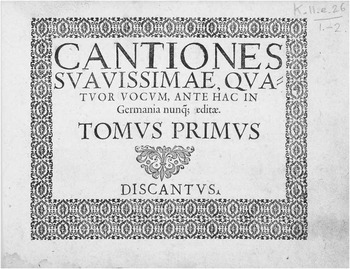
Each volume of the Cantiones suavissimae consists of four oblong quarto partbooks, containing twenty-five contrafacta of villanellas. The title pages of both the 1576 and 1580 volumes bear the simple inscription: Cantiones suavissimae quatuor vocum, antehac in Germania nunquam editae (Sweetest songs in four voices, never before published in Germany) (Figure 1). The dedication in book 1 identifies the author of the Latin texts as Ludwig Helmbold (1532–98), and the editor of the music as Leonhart Schröter (c. 1532–c. 1601). Helmbold was educated in Mühlhausen and at the universities of Erfurt and Leipzig. He worked as a teacher in Erfurt and from 1570 in his hometown of Mühlhausen; a prolific writer of Latin verse, he was crowned imperial poet laureate in 1566.Footnote 69 Schröter was cantor in the Thuringian town of Saalfeld from c. 1561 to 1576, and then cantor in Magdeburg until 1595. The only interruption in his teaching career was between 1571 and 1573, when he was temporarily dismissed for his sympathies with the followers of Melanchthon; during these two years he worked as librarian at the Wolfenbüttel court.Footnote 70 Helmbold knew Schröter as early as 1561, to judge from a poem dedicated to Schröter in his collection of epigrams from that year.Footnote 71
Cantiones suavissimae . . . tomus primus, ed. Leonhart Schröter (Erfurt, 1576), title page. British Library, K.11.e.26 (1). By permission of the British Library Board

The only exemplars of Cantiones suavissimae listed in RISM B/I are copies of the Altus partbook of volumes 1 and 2 in Toruń’s Biblioteka Uniwersytecka;Footnote 72 this Altus partbook is all that remains of a complete set of both 1576 and 1580 volumes once held by the Marienbibliothek in Elbing (present-day Elbląg, Poland).Footnote 73 Complete sets of partbooks of book 1 are held in the Bayerische Staatsbibliothek, Munich (catalogued in RISM A/I)Footnote 74 and in the Biblioteka Jagiellońska, Kraków (not catalogued by RISM).Footnote 75 In 2012 the British Library acquired the Discantus partbook of books 1 and 2 from the music dealer Hans Schneider;Footnote 76 this Discantus partbook, now shelved as K.11.e.26, facilitates a study of the concordances in volume 2.
Although the volumes of Cantiones suavissimae do not identify the composers or titles of the original villanellas, I have identified sources for all but three of the pieces (see Table 1). Sixteen pieces come from Baldassare Donato’s Il primo libro di canzon villanesche, ‘perhaps the most successful of all the villanesca collections’ of the sixteenth century;Footnote 77 at least seven editions were printed by Gardano and Scotto in the 1550s, of which the 1556 or 1558 editions are the most likely source for Schröter’s anthology.Footnote 78 Thirteen pieces come from Perissone Cambio’s Canzon villanesche alla napolitana a quatro voci (Venice, 1545, 2/1551).Footnote 79 Another thirteen villanellas are from Adrian Willaert’s Canzone villanesche alla napolitana (Venice, 1545), which included several pieces attributed to other composers such as Francesco Corteccia.Footnote 80 Finally, five pieces come from Orlande de Lassus’s so-called opus 1, Le quatoirsiesme livre a quatre parties (Antwerp, 1555; also published in the same year as Il primo libro dovesi contengono madrigali, vilanesche, canzoni francesi, e motetti a quattro voci).Footnote 81 Schröter therefore reworked villanellas which had been published up to thirty years earlier and which already had a rich reception history.
Contents of Cantiones suavissimae, ed. Leonhart Schröter (Erfurt, 1576, 1580)

Sources are indicated with RISM identifiers as follows:
C551 Perissone Cambio, Le canzon villanesche alla napolitana a quatro voci (Venice, 1545) (2nd edn. 1551)
154520 Adrian Willaert, Canzone villanesche alla napolitana (Venice, 1545)
155519 Orlande de Lassus, Le quatoirsiesme livre a quatre parties (Antwerp, 1555)
155815 Baldassare Donato, Il primo libro di canzon villanesche alla Napolitana (Venice, 1558)
In Italian lands the villanella was a piece of erotic banter, initially associated with Neapolitan popular culture and courtesans, and then later imitated in aristocratic, academic and even clerical circles. The strophic texts are rich in dialect and veiled obscenities: typically they present the words of a male suitor, who voices his erotic frustrations with his chosen woman via a series of double meanings (with phallic symbols such as crowing cockerels, or metaphors for sexual encounters such as fingering a bagpipe’s drone).Footnote 82 Frequently a further level of innuendo can be detected, referring to transgressive sexual practices including sodomy.Footnote 83 In Neapolitan culture of the 1530s and 1540s, villanellas were sung in three-voice versions whose unsophisticated musical texture (often with consecutive fifths and octaves) indicated the genre’s popular roots. From the 1540s, four-voice settings became fashionable among sophisticated Venetian audiences, including aristocratic households and academies keen to mimic the dialect crudities of Neapolitans.Footnote 84 These four-voice arrangements by such composers as Cambio, Donato and Willaert had the melody in the tenor or soprano, and could be performed by a vocal ensemble or by a solo voice with lute accompaniment.Footnote 85 Whether in three or four voices, villanellas were characterised by a homophonic, syllabic texture and declamatory text-setting with irregular phrase-lengths and rhythms. Often a phrase is repeated with the note-values halved, giving a sense of chattering intensification to the music.
Villanellas were cultivated by the German connoisseurs of Italian culture mentioned in the introduction to this article. At the Dresden court, Antonio Scandello composed four-voice villanellas on Italian texts, possibly for performance at table by the Tola brothers or as carnival entertainment; his book of villanellas, dedicated to the Elector of Saxony, was first published by Gerlach in Nuremberg in 1566.Footnote 86 Villanellas were cultivated too at the Bavarian court in Munich and the satellite court of crown prince Wilhelm at Landshut. At a commedia dell’arte performance at the 1568 Munich wedding, Lassus famously sang a villanella Chi passa per questa strada to his own lute accompaniment.Footnote 87 Elite merchants also collected Venetian publications of villanellas: in Augsburg, Raimund Fugger, Jr. owned four-voice canzone villanesche by Perissone Cambio and Willaert,Footnote 88 and Hans Heinrich Herwart owned Willaert’s 1545 book and Donato’s 1551 book of four-voice villanellas.Footnote 89 It is unclear whether German connoisseurs grasped the multiple layers of innuendo in villanella texts; perhaps a full understanding was possible only for those Germans who had studied in Italy. For German patriots, however, the erotic content of villanellas would have confirmed their critique of aristocrats and merchants as degenerately aping Italian hedonism.
Even outside the domain of connoisseurs, several villanellas achieved popular dissemination in German-speaking lands. Often they circulated in tablature, without the Italian texts that were problematic for many Germans. Lassus’s villanellas including La cortesia and Madonna mia appeared in Sixt Kargel’s lute books published in Strasbourg in the 1570s.Footnote 90 Two villanellas from Donato’s collection appear in the 1571 keyboard Tabulaturbuch edited by the Leipzig organist Elias Nikolaus Ammerbach, and another is in Ammerbach’s 1583 anthology; Ammerbach gives no composer ascriptions for these pieces, and presents two of them with German titles, showing they were already circulating in Germanised forms.Footnote 91 One of these villanellas (Se pur ti guardo) was also published with German sacred words, ‘Allein nach dir, Herr Jesu Christ’, by the Erfurt firm of Baumann in a 1572 partbook collection of devotional music.Footnote 92 Later this same tune would be used in a mechanical clock for Philipp II of Pomerania, and the connoisseur Philipp Hainhofer correctly identified its German and Italian titles.Footnote 93 Such diverse adaptations show how the declamatory melodies of villanellas became accepted in their own right, as items of popular culture with the original words removed.
Lutheran teachers and pastors, however, remained concerned by the erotic connotations of the villanella, as shown by the dedication to the Cantiones suavissimae quoted above. Consequently in their 1576 and 1580 anthologies, Helmbold and Schröter replaced the secular Italian words with Latin moralising texts. Their choice of language reflected the belief of grammar school teachers that pupils should speak Latin at all times, even for recreation.Footnote 94 Helmbold’s texts offer moral lessons relevant to pupils: for instance, speech should be truthful (1576, no. 3); alcohol should be drunk in moderation (1576, no. 5); pleasure is not a human gift but comes from heaven (1580, no. 21).
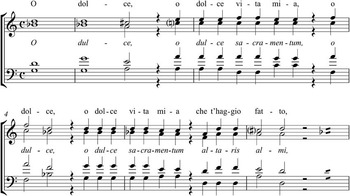
By replacing Italian with Latin texts, Helmbold and Schröter exploited the lexical and grammatical similarities between the two languages, although frequently the Latin contrafacta lack the metrical and rhyme schemes of the Italian originals. Sometimes they created parallelisms between the original text and the contrafactum, so that keywords in the Italian villanella are rendered as cognate Latin words. Such a technique is used in O dulce sacramentum (1576, no. 24), a contrafactum of Willaert’s O dolce vita. The first strophe of Willaert’s original sets the words of a rejected lover, consumed by the pain of love:

Helmbold and Schröter’s non-strophic contrafactum picks up the bittersweet nature of carnal love in the original text. For them, these bittersweet emotions instead symbolise Holy Communion, in which Christ’s tortured body and blood become balm for the sick soul:

The contrafactum retains the most distinctive feature of Willaert’s villanella, namely the setting of ‘dolce’ (now rendered as ‘dulce’). This keyword is sung to a succession of chords that delay arrival at the D minor tonal centre of the villanella; the G minor and B flat major chords are from the mollis side of the tonal spectrum and might be perceived as tender by sixteenth-century listeners (Example 1). Helmbold and Schröter thus sought to purify the villanella’s text while retaining an aspect of its musico-poetic identity.
Adrian Willaert, O dolce vita mia che t’haggio fatto (Canzone villanesche alla napolitana, 1545), with contrafactum (in italics), ‘O dulce sacramentum’ (Cantiones suavissimae . . . tomus primus, 1576)

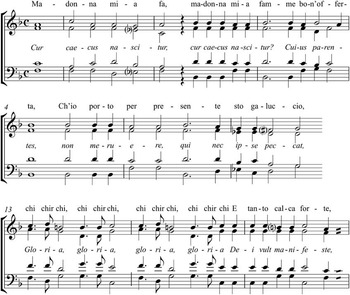
A more radical transformation is found in Cur caecus nascitur (1580, no. 14), a reworking of Willaert’s Madonna mia famme bon’offerta. The secular original has three strophes setting the words of a man offering his ‘sto galuccio’ (‘fat cock’) to ‘madonna’ (his lady, possibly a courtesan):

The phallic innuendo is made plain by the refrain’s evocation of the cock, including his crowing (‘chi chir chi’), followed by the closing couplet describing his sexual dominance over the hen. Willaert’s setting gradually increases the speed of declamation, from the slow statement of the initial phrase, to the repeated dotted rhythms on the cries of ‘chi chir chi’ (Example 2).
Adrian Willaert, Madonna mia famme bon’offerta (Canzone villanesche alla napolitana, 1545), with contrafactum (in italics), ‘Cur caecus nascitur’ (Cantiones suavissimae . . . tomus secundus, 1580), opening and refrain

Schröter and Helmbold converted this bawdy banter into a moral lesson on disability, based on John 9:1–3 (when Jesus and the disciples meet a blind man):
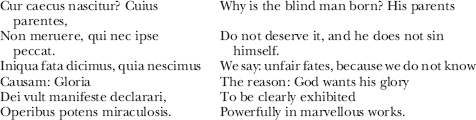
The new text paraphrases Jesus’ explanation that blind people are born not because they or their parents have sinned, but rather because God brings forth a diversity of creatures to display His glory and power.Footnote 97 The climactic crowing is now set to the word ‘Gloria’; phallic jesting has become a lesson in moral theology for schoolboys.
Through such transformations, Helmbold and Schröter made the four-voice villanella resemble the Latin ode. Musical settings of odes had been cultivated in German grammar schools since the 1500s, typically characterised by four-voice homophony whose rhythms followed the Latin prosody. In the 1570s the genre was still flourishing, with Ludwig Helmbold contributing the texts for Joachim a Burck’s Odae sacrae (1572), one of the earliest books of music printed by Georg Baumann in Erfurt. Burck’s settings respect the quantitative rhythms of the Latin verse (the semibreve and breve are used to set short and long syllables respectively) and he avoided repeating lines of text. Otherwise these settings of odes resembled the villanella in several ways, notably the syllabic declamation, homophonic four-voice texture and avoidance of word-painting. Indeed, Helmbold and Burck’s Odae sacrae are described on the title page as ‘ad imitationem italicarum villanescarum’; Nicole Schwindt notes this is the earliest use of the term ‘villanella’ in a published German collection of music.Footnote 98 By adapting the Italian villanella into a form similar to the Latin ode, Helmbold and Schröter exemplified a common response to cultural exchange, namely to translate the foreign into familiar terms.Footnote 99
In turn, Helmbold and Schröter’s contrafacta gained their own lives, being copied in manuscript partbooks and tablatures (see Table 1 above). For instance, Johann Velbonius, the tutor of the Lüneburg patrician Franciscus Witzendorff in the 1590s, copied four pieces from the collection for the benefit of his teenage pupil.Footnote 100 Latin contrafacta of villanellas suited the repertory of the partbooks assembled by Velbonius, which also included Latin motets, Latin odes from Burck’s Odae sacrae, and German songs. Another piece from the 1576 anthology was copied by Sebastian Fleischmann, who studied at Erfurt University from 1586 and later became pastor in Udestedt from 1606 to 1628. Fleischmann copied Dulcis quies brevisque conceditur within a partbook set that contained liturgical, devotional and secular compositions.Footnote 101 Such copying shows that, although Helmbold and Schröter are unlikely to have fully succeeded in their aim of displacing the immoral Italian originals, their contrafacta enabled villanellas to be assimilated within a repertory deemed suitable for Lutheran educational use.
PURIFYING THE ‘FOREMOST MASTERS’
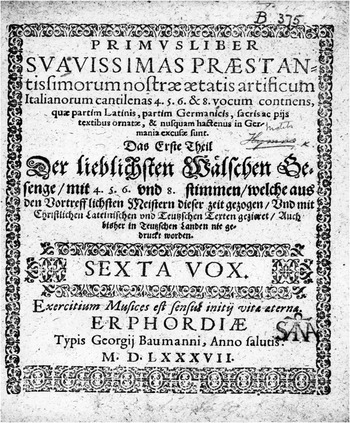
Melchior Bacusius’s Primus liber suavissimas . . . cantilenas (1587) marked a new phase in the appropriation of Italian secular music in central Germany. Like Schröter and Helmbold, Bacusius sought to purify secular vocal music for an audience of German schoolboys. His 1587 collection is distinctive for presenting an up-to-date repertory of Italian music with an emphasis on the mastery of the composers, who are identified for each piece. As the verbose title page explains in both Latin and German: ‘The first book of the sweetest Italian songs in 4, 5, 6 and 8 parts, which are taken from the foremost masters of this age, and are adorned with Christian Latin or German texts.’ (See facsimile in Figure 2.) As with Schröter and Helmold’s anthologies, the title page correctly claims that these pieces were never before printed in German lands. Bacusius’s collection pre-dates the better-known Gemma musicalis edited by Friedrich Lindner and published in Nuremberg between 1588 and 1590. It is thus valuable evidence of how far Italian music had infiltrated among the pastors and teachers of central Germany.
Primus liber suavissimas praestantissimorum nostrae aetatis artificum Italianorum cantilenas 4. 5. 6. & 8. vocum continens, ed. Melchior Bacusius (Erfurt, 1587), title page. Note the ‘SANA’ stamp of the church and school of St. Anna, Augsburg. British Library, B.375. By permission of the British Library Board

Only fragmentary copies of Bacusius’s anthology survive. An incomplete set of partbooks (Discantus, Altus, Basis and Quinta Vox), originally owned by the church and school of St. Anna in Augsburg, survives in the Bischöfliche Zentralbibliothek, Regensburg.Footnote 102 The Sexta Vox partbook from the St. Anna set, identified by its ‘SANA’ stamp, is now in the British Library (Figure 2).Footnote 103 Copies of the Altus, Basis and Quinta Vox partbooks are held at the Biblioteka Jagiellońska, Kraków (formerly owned by the Preussische Staatsbibliothek, Berlin),Footnote 104 and a further copy of the Altus partbook is in the Sächsische Landesbibliothek, Dresden (formerly owned by the Stadtbibliothek, Zittau).Footnote 105 There is no extant copy of the Tenor partbook, which presumably contained the dedication or preface; in the absence of this prefatory material, much must remain conjectural about the circumstances of this volume.
No editor is named on the title page of the anthology. However, a commendatory poem in the Discantus partbook (headed ‘In Cantiones Italicas à Melchiore Bacusio editas’) indicates that the editor was Melchior Bacusius (or Backhaus). In 1586 Bacusius was appointed as the fourth teacher (Quartus) at the grammar school in Eisleben; this post also carried the responsibilities as cantor at the nearby Andreaskirche.Footnote 106 He may have been the ‘Melch. Backhusius’ who matriculated at Erfurt University in Michaelmas 1570, connecting him to the environment of Helmbold and Knaust.Footnote 107 The commendatory poems in the surviving partbooks – written by such figures as Bartholomäus Hubner (doctor of medicine in Erfurt), Christoph Winer (preacher in Sundhausen, and formerly deputy head at the Gotha Gymnasium) and Johann Wagner (deacon of the Andreaskirche in Erfurt) – again suggest the collection’s genesis in a central German milieu of clerics and intelligentsia.
A possible connection with local members of the nobility is suggested by four of the contrafacta (nos. 5, 13, 22 and 26), which set biblical mottoes used by members of the Mansfeld and Schwarzburg-Frankenhausen houses (according to headings in the 1587 printed edition; see Table 2). In at least one case (no. 13, ‘Hat Gott der Gnad vergessen’, a version of Psalm 77:10) the same biblical motto is found in the funeral sermon of the nobleman in question.Footnote 108 It is therefore possible that some of the contrafacta were made for aristocratic patrons, using their personal mottos (symbola). On the other hand, as will be shown below, some of the texts have a didactic tone that indicates a likely audience of schoolboys.
Contents of Primus liber suavissimas . . . cantilenas, ed. Melchior Bacusius (Erfurt, 1587)

Bacusius’s anthology contains contrafacta of twenty-six pieces, scored for four to eight voices in a range of styles from the lighter canzonetta to the more serious madrigal (see Table 2). The strophic structure and rhythmic energy of the canzonetta are represented by eight four-voice pieces from Orazio Vecchi’s Canzonette, books 1 and 2 (Venice, 1580), two five-voice pieces from Girolamo Conversi’s Il primo libro de canzoni alla napolitana (Venice, 1571) and one five-voice piece from Giovanni Ferretti’s Canzone alla napolitana a cinque voci (Venice, 1567). Through-composed five-voice madrigals include two by Luca Marenzio and one by Giovanni Maria Nanino from the 1582 anthology Dolci affetti (Venice, 1582) and a piece each by Nanino and Lelio Bertani possibly from Antwerp anthologies of 1583. Larger-scored pieces include three madrigals from Andrea Gabrieli’s Il secondo libro de madrigali a sei voci (Venice, 1580) and two madrigals from Vecchi’s Madrigali a sei voci (Venice, 1583). The anthology closes with two eight-voice pieces attributed to Ferretti and Marenzio, for which the printed originals are unknown. The piece attributed to Marenzio, In der Höhe sey Gott Ehr Lob, also survives in a version again ascribed to Marenzio but with a Latin sacred text ‘Exaltabo et benedicam nomini tuo in saeculum saeculi’, in a manuscript originating in the electoral school at St. Afra in Meissen and copied c. 1593–6 by the Meissen pupil Urban Birck.Footnote 109 (The Latin version is incomplete, with just Discantus 2, Tenor 1, Tenor 2 and Bass 2 parts extant; Bacusius’s anthology supplies the missing parts, and allows the fragmentary edition of the Latin version in the Marenzio Opera Omnia to be completed.Footnote 110 )
Bacusius’s anthology is a testament to the cosmopolitan musical networks of cantors in central Germany, who were evidently aware of up-to-date Italian repertory. Most of the Italian originals for his anthology were first printed in Venice within the previous seven years; the exceptions include the three canzonettas by Canzoni and Ferretti (published in the years around 1570s), and four pieces that may derive from the Antwerp anthologies Harmonia celeste (1582) and Symphonia angelica (1585) (see Table 2). The Italian editions presumably used by Bacusius were not advertised in the catalogues of the Frankfurt book-fair, suggesting that Thuringian school musicians obtained recent Italian music from specialist dealers or their own personal contacts. Possibly one route was via the convivial circles of university students, who were often keen purchasers of recent secular repertory.Footnote 111 Regardless of how Bacusius obtained his sources, his collection appeared a year before the first volume of Friedrich Lindner’s Gemma musicalis was published in Nuremberg, and has some overlaps of repertory with it. Three of the Italian originals used by Bacusius were subsequently reprinted by Lindner.Footnote 112 Lindner’s Gemma musicalis is usually regarded as the first publication of wholly Italian-texted pieces edited by a German: Susan Lewis Hammond describes it as an ‘important preparatory step toward the broader German reception of Italian secular song’.Footnote 113 Yet Bacusius’s 1587 book shows that even before Lindner’s anthology, central German schoolteachers were sufficiently aware of Italian secular music to adapt it radically for didactic and devotional use.
Of the twenty-six contrafacta in the collection, half have Latin texts and half have German texts. Compared to the moralising and didactic texts of Helmbold and Schröter’s collections, the Latin texts in Bacusius’s anthology have a stronger devotional focus, often urging the worship of Christ (as in Quas Christe, quas grates tibi canemus, no. 1, or Christus orbis Salvator, no. 10). Like Helmbold and Schröter’s O dulce sacramentum studied above, the Latin contrafacta may echo the metrical structure of the Italian originals or the musico-poetic emphasis on certain keywords. The contrafacta with German texts offer more drastic transformations of the originals. Most of the German texts are paraphrases of biblical passages and hence replace the original poem with a prose text. A few use pre-existing German song texts, which rarely follow the scansion of the Italian original.
The moralising and didactic tendencies of the collection are evident in no. 14, Diß ist der Werlet lauff, a reworking of Conversi’s Canzon’ va al mio bel sol. Originally this was the final piece in Conversi’s 1571 collection of canzonettas, with a text that compares the male beloved to a long-awaited sunrise:Footnote 114

Bacusius replaced these words with text taken verbatim from Paul Rebhun’s Lutheran school drama Ein geistlich Spiel von der Gotfurchtigen vnd keuschen Frawen Susannen (Zwickau, 1536). The play is a didactic retelling of the apocryphal story of Susanna: two elders spied on her bathing, and when she resisted their lecherous demands, they sentenced her to death on false charges of adultery. Bacusius used the text from the chorus at the end of Act II, which warns about the injustice of the world and the corrupt acts of the powerful.Footnote 115 The first two strophes are as follows:

The remaining three strophes lament the injustices suffered by the weakest in society. Whereas in Rebhun’s 1536 publication this text was set as a bicinium, Bacusius used the chattering rhythms of Conversi’s canzonetta to energise this warning to Lutheran schoolboys: unlike the Old Testament elders, they should show the honesty expected of true Germans.
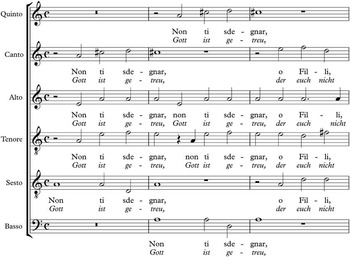
A more extreme transformation occurs in no. 23, Gott ist getreu, a contrafactum of Andrea Gabrieli’s six-voice madrigal Non ti sdegnar. The original poem chastises Phyllis for fleeing from her lover, then urges her to enjoy sensual pleasure before this is made impossible by the passing of time:Footnote 116

The contrafactum substitutes a prose text, based on 1 Corinthians 10:12–13, which expresses the opposite sentiments of the Italian original: Christians should avoid temptation, using God’s faithfulness as a defence.Footnote 117

Gabrieli’s epigrammatic setting conveys the paradoxes of the poem with false relations and many changes of note-values and texture. It opens homophonically with the command ‘Non ti sdegnar’ (‘Don’t be annoyed’) to Phyllis. In Bacusius’s version this stark passage sets the words ‘Gott ist getreu’, highlighting the scriptural motto that defines the tone of the contrafactum (Example 3). Gabrieli depicted the words ‘In un momento fugge’ (‘disappears in a trice’) with rapidly repeated quavers, but Bacusius changed these into longer note-values to give slower declamation on ‘über eueren Vermögen’ (‘beyond what you can bear’).
Andrea Gabrieli, Non ti sdegnar (Il secondo libro de madrigali a sei voci, 1580), with contrafactum (in italics), ‘Gott ist getreu’ (Primus liber suavissimas . . . cantilenas, 1587), opening

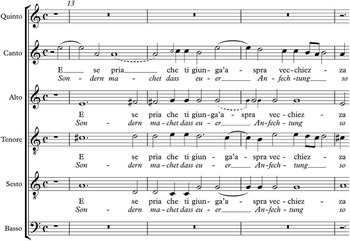
Halfway through Gabrieli’s setting, the music reaches a dramatic pause, before a thinner four-voice texture introduces the second half of the poem, with its vision of bitter old age. In the contrafactum this pause introduces the antithesis in the biblical text, ‘Sondern machet dass euer Anfechtung’ (‘But when you are tempted’). The descending suspensions with which Gabrieli depicted ‘vecchiezza’ (‘old age’) give an appropriate harshness to ‘Anfechtung’ (‘temptation’), but as Helen Geyer observes, there is an inelegant emphasis on the last syllable of ‘Anfechtung’ (Example 4).Footnote 118 More successful are the closing bars of the contrafactum: here the short repeated-note motif (used in the madrigal to warn of the inexorable passage of time) underlines the scriptural admonition to stand firm against temptation.
Andrea Gabrieli, Non ti sdegnar (Il secondo libro de madrigali a sei voci, 1580), with contrafactum (in italics), ‘Gott ist getreu’ (Primus liber suavissimas . . . cantilenas, 1587), bb. 12b–15.

Gott ist getreu purifies Gabrieli’s madrigal, removing the original text with its invitation to sensual temptation. Despite some problems of word placement and accent, Bacusius transferred the emotional charge and rhetorical sophistication of Gabrieli’s music to the scriptural text. His contrafactum appealed strongly to school and church musicians around 1600 in central Germany, who in all likelihood did not know the Italian original. As Table 2 shows, many of Bacusius’s contrafacta appear in manuscripts associated with Lutheran schools or musical societies; indeed one of the most popular contrafacta was Gott ist getreu, with copies made c. 1600 by the Udestedt pastor Sebastian Fleischmann and in two manuscripts associated with the school and church in the Saxon town of Löbau.Footnote 119
Bacusius’s anthology shows how central German school musicians had a cosmopolitan awareness of recent Italian secular vocal music, including sophisticated pieces such as Andrea Gabrieli’s six-voice madrigals that were only available in Venetian editions. Aware of the musical appeal of this repertory, Bacusius sought to cleanse it for devotional and didactic use. By removing the erotic texts, his contrafacta not only allowed schoolboys and pastors to admire the music of the ‘foremost masters’; he also restored the holiness that Lutherans believed was innate in music. As the motto on the title page of Bacusius’s anthology explained: ‘The practice of music is a foretaste of eternal life’ (Exercitium Musices est sensus initij vitae aeternae).Footnote 120
DANCE-SONGS AND THE LIMIT OF THE CONTRAFACTUM
The final anthology of contrafacta of Italian songs printed by the Erfurt firm of Baumann is Johannes Lindemann’s Amorum filii Dei decades duae . . . Zwantzig liebliche und gantz anmütige . . . Newe Jharß oder Weyhenachten Gesenglein (1598). Lindemann and his collaborator Cyriacus Schneegass added Christmas and New Year texts to recent Italian dance-songs, notably the balletti of Giovanni Giacomo Gastoldi. The strong rhythms and joyous refrains of these dance-songs appealed strongly to German audiences and seemed a suitable adornment for the Christmas season. Perhaps because of their strong rhythms, several of Lindemann’s contrafacta were popular, being copied scribally and reprinted in hymnals; some, such as In dir ist Freude, form part of the Lutheran chorale tradition to this day.
There is confusion about the date and extent of Lindemann’s anthology, probably caused by its fragmentary survival. Following a statement made by Johann Gottfried Walther in 1732,Footnote 121 both New Grove and Musik in Geschichte und Gegenwart report that the anthology was published in three instalments in 1594, 1596 and 1598.Footnote 122 The surviving Tenor partbook (now in the Biblioteka Jagiellónska, KrakówFootnote 123 ) bears the date ‘1598’ on its title page. (The only other fragments to survive are sections of the Quinta Vox and Alto partbooks, neither with the title page.Footnote 124 ) Supporting a 1598 publication date is an advertisement in the spring of that year in Georg Willer’s catalogue for the Frankfurt book-fair.Footnote 125 The confusion over 1594 and 1596 was presumably caused by references in the 1598 dedication of Amorum filii Dei decades duae to previous publications by Lindemann, including the now-lost Tribus decadibus amorum filii Dei that was reportedly published four years earlier.Footnote 126 The dedication also mentions a single song Jesu wollst uns weisen that Lindemann offered two years earlier as a New Year’s gift to his patron, and was then reprinted in the 1598 anthology; the Cantus II partleaf of the 1596 print of this song survives in the Gotha Forschungsbibliothek.Footnote 127
Like the previous anthologies studied in this article, Amorum filii Dei decades duae originated in the environment of Thuringian schools. The editor named on the title page and dedication is Johannes Lindemann (c. 1550–c. 1634), who was immersed in the world of Lutheran pedagogy. He was distantly related to Martin Luther and his uncle Cyriacus Lindemann (1519–68) was deputy head then headmaster of the Gotha Gymnasium in the 1550s and 1560s. Johannes studied at the Gotha school and matriculated at Jena University in 1568.Footnote 128 By 1580 he was cantor at the Gotha Gymnasium, where he remained for the rest of his life.Footnote 129 Lindemann’s collaborator in the collection appears to have been Cyriacus Schneegass (1546–97), who had himself studied at the Gotha school in the early 1560s. From 1573 until his death he was pastor in Friedrichroda (about 11 miles south-west of Gotha). Schneegass was married to Lindemann’s cousin, and dedicated a 1590 treatise on temperament to Johannes Lindemann, whom he described as ‘his kindred beloved’.Footnote 130 The 1598 collection has one song-text ascribed to Schneegass, ‘Gott sey geehrt’; in addition, monophonic versions of two of the contrafacta (Jesu wollst uns weisen and Herr Jesu sey gepreiset) appear in Schneegass’s 1597 Geistliche Lieder and these texts have also been attributed to him by modern hymnologists.Footnote 131 Because Lindemann and Schneegass were embedded within Lutheran institutions, they might have been expected to share the same suspicion towards Italian secular song as shown by Schröter, Helmbold and Bacusius.
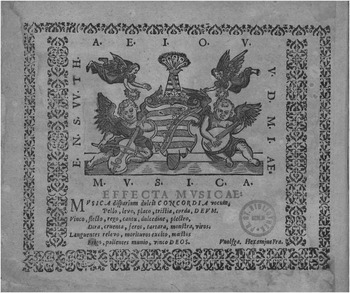
Yet the surviving Tenor partbook of Amorum filii dei decades duae does not contain any anti-Italian rhetoric. Instead it is dedicated to an aristocratic connoisseur of Italian culture, Johann Casimir of Saxe-Coburg (1564–1633), the overlord of Gotha. Johann Casimir was also the dedicatee of the 1596 partleaves containing Jesu wollst uns weisen, which incorporates his name as an acrostic. Johann Casimir had Italianate tastes: in 1623 he employed the architect Giovanni Bonalino to build an arcaded roof terrace (Altana) in Venetian style at the Ehrenburg in Coburg.Footnote 132 On balance, though, these aristocratic connections do not dilute the Lutheran educational flavour of Lindemann’s collection. Johann Casimir was the patron of the Gotha Gymnasium, and from 1595 he funded improvements such as new classrooms and extra staff to teach topics such as Hebrew.Footnote 133 Furthermore, the mottoes that surround the Saxon coats-of-arms on the 1596 and 1598 editions refer to the Protestant piety of the Saxon Ernestine princes (Figure 3). Both publications include the motto ‘V.D.M.I.Æ.’ (‘Verbum Dei manet in aeternum’/‘The Word of God endures for ever’), which was used throughout the sixteenth century by Saxon princes on their liveries.Footnote 134 Both also include the motto ‘A.E.I.O.V.’ (‘Allein Evangelium ist ohne Verlust’/‘Only the Gospel is not lost’) used by Johann Casimir’s father, Johann Friedrich II of Saxony (1529–95), who from 1567 until his death was imprisoned by the Emperor; it denotes his steadfast Lutheran faith in Scripture during his captivity.Footnote 135 Taken together, these mottos place Lindemann’s contrafacta in the context of Lutheran princes eager to show their piety rather than their Italianate tastes.
Amorum filii Dei decades duae . . . Zwantzig liebliche und gantz anmutige/Lateinische und Deutsche Newe Jharß/oder Weyhenachten Gesenglein, ed. Johannes Lindemann (Erfurt, 1598). Tenor partbook, verso of title page. Biblioteka Jagiellónska, Kraków, Mus. Ant. Pract. L920

The prefatory material of the 1598 anthology repeatedly stresses music’s power to move the emotions. In the dedication, Lindemann describes music as ‘a noble, heavenly and eternal gift of God . . . [which] delights the hearts of men and encourages cheerfulness’.Footnote 136 This theme is reinforced by a poem on the verso of the title page, entitled ‘Effecta Musicae’ (Figure 3):

Lindemann’s anthology attributes this poem to Wolfgang Hexamius (d. 1582), cantor in Eisleben. However, fragments of it were used widely in the late sixteenth century, for instance as decorations on a Flemish virginal of c. 1568Footnote 137 and in English printed and manuscript sources including Mathew Holmes’s lutebook.Footnote 138 The poem is also found in a set of partbooks from Helmstedt dated 1668.Footnote 139 Whatever the origins of the poem, it fits well with a Melanchthonian emphasis on the power of harmony both to sway the human spirit and to animate the words of a contrafactum.
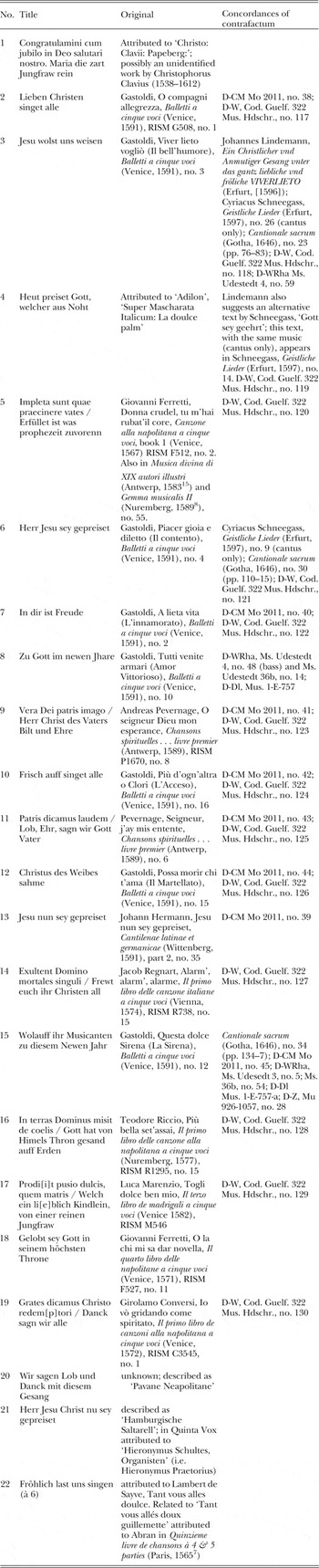
Lindemann’s 1598 volume contains twenty-two pieces, most of which are dance-songs in five voices (see Table 3). The composers of the original versions are indicated on a table of contents at the end of the Tenor partbook, and the text incipit or title of the original is indicated above each contrafactum. Eight of the pieces are reworked from Giovanni Giacomo Gastoldi’s Balletti a cinque voci (first published in Venice in 1591). Six pieces are reworkings of light madrigals or canzonettas from the late 1560s to early 1580s that often have energetic rhythms, including pieces by Giovanni Ferretti and Girolamo Conversi that had already achieved popularity in anthologies, plus compositions by Luca Marenzio, Jacob Regnart and Teodore Riccio. There are two adaptations of French spiritual chansons from Andreas Pevernage’s Chansons spirituelles (Antwerp, 1589). Several of the remaining pieces are as yet unidentified dance-songs, possibly based on instrumental pieces, including a ‘Mascharata Italicum’ (no. 4), a ‘Pavane Neapolitane’ (no. 20), and a ‘Hamburgische Saltarello’ attributed to the Hamburg organist Hieronymus Praetorius (1560–1629).
Contents of Amorum filii Dei decades duae, ed. Johannes Lindemann (Erfurt, 1598)

Lindemann’s eight contrafacta of Gastoldi’s balletti are one of the earliest examples of the reception of these dance-songs in German-speaking lands. Gastoldi’s balletti gained immense popularity across Europe: their singable melodies, ‘fa-la’ refrains and energetic rhythms allowed them to cross linguistic boundaries and be appreciated regardless of their text. Lindemann must have used one of the Venetian editions of the Balletti. The first surviving editions printed north of the Alps were an Antwerp edition of 1596 and a Nuremberg edition of 1600, yet Lindemann had access to Gastoldi’s music by 1595 at the latest, in order to have devised and printed Jesu wollst uns weisen (a contrafactum of Viver lieto) for New Year’s Day 1596. Hence Lindemann was adapting Gastoldi’s music at about the same time as the Londoner Thomas Morley, whose Ballets of 1595 contain many pieces modelled on Gastoldi’s originals. By the late 1590s Gastoldi’s melodies were entering the repertory of popular song transmitted orally or monophonically, as is suggested by the appearance of two melodies in Schneegass’s Geistliche Lieder (1597), where they are described as ‘well-known tunes’ (‘bekandte Melodeyen’). Lindemann’s and Schneegass’s adaptations once again show that Thuringians were abreast of the latest musical fashions from Italy.
By adapting dance-songs for devotional purposes, Lindemann followed a tradition of Christmas dancing in Lutheran lands. The insistent rhythms and bodily movement of dance signified not only the joyfulness of the season but also the nature of Christmas as a celebration of the Word made flesh. Luther permitted dancing with innocent motives: ‘Young children dance without sin; if you do the same and act like a child, then dancing will not harm you.’Footnote 140 Indeed, his Christmas chorale Vom Himmel hoch encouraged singers to dance around the crib:

Lindemann’s title page speaks of the power of dance-songs when sacred texts are applied ‘for the awakening of blessedness and more occasions of Christian joy’.Footnote 141 His contrafactum of the ‘Hamburgische Saltarello’ also evokes the role of dance in religious praise:

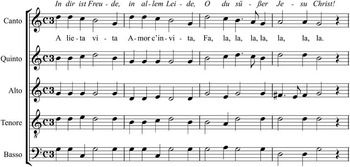
Emblematic of Lindemann’s effort to create sacred joy in music is his contrafactum of Gastoldi’s A lieta vita. The original text proclaims the happiness engendered by profane love, a mood reinforced by the triple-time metre and the repeated five-syllable phrases:

Lindemann’s contrafactum acknowledges that the joy in Christ stems from his suffering, yet the five-syllable lines (unusual in German verse) give his version a breathless excitement (Example 5):Footnote 142

Giovanni Giacomo Gastoldi, A lieta vita (Balletti a cinque voci, 1591), with contrafactum (in italics), ‘In dir ist Freude’ (Amorum filii Dei decades duae, 1598), opening

Later in the strophe the ‘fa-la’ refrain is set to ‘Halleluja’. In other pieces within the collection, Lindemann replaced the nonsense syllables with a description of the angels’ songs of praise (as in Wolauff ihr Musicanten, based on Questa dolce sirena, or Lieben Christen singet alle, based on O compagni allegrezza).
Probably because of their catchy rhythms, Lindemann’s contrafacta achieved widespread popularity. Copies of the printed edition were owned by educational institutions such as the school of St. Anna in Augsburg.Footnote 143 Individual pieces were also copied scribally, as shown by the concordances listed in Table 3. Nine pieces (including five of the Gastoldi contrafacta) appear in a manuscript compilation of sacred music c. 1630 held at the Coburg Morizkirche.Footnote 144 Fourteen of Lindemann’s contrafacta were copied in a manuscript appended to a copy of Friedrich Weißensee’s Opus musicum (Magdeburg, 1602).Footnote 145 Three pieces were copied by the Udestedt pastor Sebastian Fleischmann in manuscripts possibly intended for a mix of devotional and convivial uses. Several of Lindemann’s contrafacta also appeared in printed hymnals, starting with three pieces in the Gotha Cantionale of 1646. Such further uses confirm Lindemann’s claim in the dedication of his anthology that his pieces were sought after by ‘many pious cantors and devout Christians’.Footnote 146
Despite their popularity, Lindemann’s contrafacta could not dispel the secular connotations of Gastoldi’s dance rhythms. Particularly problematic were the pieces entirely in triple time, a metre which did not occur in the previous Erfurt anthologies of contrafacta except for some internal or closing sections of pieces. In 1605 a school ordinance in Gotha warned against such contrafacta. Reiterating the view of late sixteenth-century Saxon edicts that church music should be decorous, devout, ‘most holy’ and ‘most salubrious’, the ordinance attacked spiritual adaptations of secular songs, warning that: ‘Anything that leads to sweetness, to mere ear-tickling and to frivolousness is evil, even when pious texts are attached to the songs.’Footnote 147 It prescribed: ‘Wherefore the cantor should wholly abstain from reckless Italian things, if there are any, and triple-time compositions, so nobody should be offended by what he does. He should perform that which is pious, grave and dignified, and was composed by ancient and extraordinarily distinguished musicians, Lassus, [Alexander] Utendal, Gallus, Clemens non Papa, [David] Palladius and other pious and devout individuals.’Footnote 148 The ordinance echoed other edicts that upheld a canon of sixteenth-century polyphonic composers.Footnote 149 Yet a patriotic subtext can also be discerned: the serious, dignified nature of the approved polyphony conformed to the belief of humanists such as Celtis and Hutten that German culture should show gravitas rather than the sensual frivolity of Italian imports. The 1605 edict shows that Lindemann had reached the limits of the contrafactum technique to alter the meanings of song. Because Gastoldi’s music had such strong dance rhythms, changing the text could not completely purge it of its sensual connotations. Significantly, Lindemann’s triple-time contrafacta (such as In dir ist Freude) were not among his hymns included in the official 1646 Gotha hymnal (see Table 3).
CONCLUSION
The arguments in this article have been extrapolated from fragmentary evidence. Apart from the Cantiones suavissimae . . . tomus primus (1576), none of the Erfurt anthologies of Italian secular music survives complete. This low survival rate (particularly in comparison to the many extant copies of Nuremberg publications such as Lindner’s Gemma musicalis) might indicate that lower print-runs were the norm in Erfurt. It might also suggest that the exemplars of these Erfurt anthologies were used to the point of destruction by schools and churches, rather than being preserved by collectors until they were acquired by research libraries. My arguments may have to be modified should further material come to light, particularly the missing tenor partbooks of Schröter and Helmbold’s 1580 anthology and of Bacusius’s 1587 collection, which in both cases presumably contained the dedications.
Nonetheless, this article has shown that in the mid- to late sixteenth century, Italian secular vocal music was not a neutral presence in German-speaking lands. Instead its cultural, moral and social connotations made it a highly contested import, depending on the environment where it was received. Aristocrats and merchants sought this repertory as a sign of cultural capital and welcomed its sensual connotations as befitting the sophistication of their lifestyle. By contrast, many clerics and schoolteachers feared that Italian secular songs would undermine traditional Teutonic virtues of chastity and valour. The discourse of patriotic purification motivated the contrafacta that were published by Georg Baumann in Erfurt between 1576 and 1598. Yet regardless of whether Germans were enthusiastic or suspicious about Italian madrigals and villanellas, they could not deny the musical appeal of this repertory to school pupils, amateur singers and professional musicians alike.
The fear of Italian music as immoral persisted into the early seventeenth century and continued to motivate further contrafacta such as those studied by Susan Lewis Hammond, who suggests they were partly motivated by increasing antagonism between Lutherans and Catholics around the start of the Thirty Years War.Footnote 150 Martin Rinckart’s Triumphi de Dorothea (Leipzig, 1619) provided contrafacta of madrigals from the anthology Trionfo di Dori, with new texts on the theme of praising God via song. Rinckart’s dedication speaks of the ‘carnal nature’ (Fleischlichen art) of the original Italian texts, and claims that through his substitution of spiritual texts, ‘my beloved Dorothea is fully liberated from her Italian ungodliness and moreover, praise God, may become pure and Lutheran’.Footnote 151 Even in the late seventeenth century, some pastors still stigmatised Italian music for its supposed immorality. In the dispute about the Hamburg opera in the 1680s, one area of debate was ‘whether one is introduced to damnable Italian morals through Italian musical works’.Footnote 152 Henrich Elmenhorst, a defender of the opera, satirised such an attitude by expressing surprise that the performance of Italian motets in church did not also engender dangerously immoral Italian attitudes.Footnote 153 Future research could therefore explore how these patriotic discourses contributed to definitions of national musical styles from the late seventeenth century onwards, including the emerging idea of a distinctively German music characterised by its complexity and profundity.