Introduction
The transmission of human immunodeficiency virus (HIV) and other sexually transmitted infections (STIs) remains a global issue of ‘epidemic’ proportions. According to the World Health Organisation, 35 million people are estimated to be currently living with HIV and more than 1 million people acquire STIs every day around the world.1,2 Some infections are curable, such as syphilis, gonorrhoea, chlamydia and trichomoniasis, while others require life-long management and treatment, including HIV and herpes. Within Europe there has been a reported 80% increase in HIV diagnosis since 2004, despite expanding access to screening and treatments.3 The HIV epidemic has been described as ‘ageing’ in parallel with an ageing population globally and improved rates of longevity in economically advantaged nations.Reference Poynten, Grulich and Templeton4 However, the health needs of older adults living with HIV and other STIs and the diagnosis of STIs in later life are still neglected areas of research and policy.
In this review we explore issues relating to sexual health in older adults by drawing on international research literature. Before turning to the needs of older adults, we first discuss the social context informing sexual health priorities and campaigns in contemporary Britain. The sexual landscape in the UK is changing, or at least the perception of its consumption. Safe sex campaigns of the 1980s (Tombstone/AIDs) have long since left the public psyche and the younger generations now embarking on an active sex life have never encountered them. Whilst it is clear that safe sex campaigns (for example, ‘Condom, No condom’, 2012) do exist, they are not at the same profile.
In 2013, there were 446,253 new STI diagnoses,1 more than doubling those reported just over a decade earlier, in 2003. This is not the whole picture, however, as there are certain diseases and demographic groupings that have shown increases that are particularly marked. Between 2012 and 2013 there was a 15% increase in new cases of gonorrhoea and, in the same time period, a 9% increase in syphilis.1 Set against the social backdrop of increased legal equality in terms of gender and sexuality, ease of access to sexual health information and increased protection from STI transmission, it can be expected that greater numbers of the adult population will feel more informed of their sexual health status and more willing to access sexual health services. This may initially lead to further increases in numbers of diagnoses.
While STI transmission is not specific to sexual identity or orientation,5 there are cohorts targeted by public health agencies that are at higher risk of STI transmission. Men who have sex with men (MSM) are identified as a ‘high risk’ population and accounted for 74% of new syphilis diagnoses in 2014,5 an alarming increase when considering the potential health complications if left untreated. Though health promotion campaigns are often targeted at this group, there are clear shortcomings in getting the message across, primarily around population engagement and illustrated by increasing incidence rates.
Much like other social groups, MSM are not a homogeneous group and public health agencies need to take into account intersecting differences in ethnicity, culture, faith, ability and of course age that influence men's engagement with health campaigns. Syphilis has a well-documented disease progression which details not only the phases, but also the symptoms and potential end-stage complications. With the advent of penicillin, syphilis was almost eradicated and as such has become an almost forgotten STI, yet one that is now experiencing a resurgence. In 2008 there were 11 times the number of primary and secondary diagnoses in GUM (genitourinary medicine) clinics than in 1999, with MSM experiencing the largest increase and heterosexual men following not too far behind.6 Considering the potential serious effects, particularly of neuro-syphilis, if left untreated and the long symptom-free latent phase, increased screening and public awareness appears to be the best recourse to tackle this resurgence.
Similar increases have been seen in HIV diagnoses. When mapping the incidence of HIV diagnosis from the early 1980s, there was a relatively continuous rise until 2000 when the trajectory took a steep incline and infection diagnosis rates increased.7 Despite the very prominent health campaign in the 1980s, the incidence of HIV transmission continues to increase.Reference White, Ward and Garnett8 It can be argued that the development of combination anti-retroviral treatments to manage the condition, changing it from a life-limiting infection to that of a chronic condition, has lessened the impact of safe sex campaigns.Reference Chena, Weideb and McFarlanda9,Reference Lim, Christen and Marshal10 This discovery also coincides with the marked increase in diagnosis rates and the decrease in both number of AIDS diagnoses and deaths.3
What is not evident from the above information is that the available research pertains largely to younger adults. Adults over 50 years of age have previously represented a hidden population in relation to STI and HIV diagnosis, and ageing is yet to be fully recognized within sexual health strategies and planning as a significant social factor shaping transmission, diagnosis and treatment. New diagnoses of HIV among adults over 50 more than doubled between 2002 and 2011, rising from 442 in 2002, to 990 in 2012.11 Not only is this one of the fastest growing age groups to be given a HIV-positive diagnosis, but it is also one of the fastest growing cohorts living with the condition. In 2012, one in four adults living with diagnosed HIV were aged 50 years and over compared with only one in eight in 2003.11 This means that this age group is not only living with HIV, but also age-related decline in physical and mental health and other health co-morbidities, some of which like reactive arthritis can be exacerbated by the condition.12
A common misconception about older adults is that they do not engage in sexual intercourse or sexual behaviour. Indeed they are often viewed as asexualReference Bulford and Singh13 or, if they are viewed as engaging in sex, then they are assumed to be heterosexual.Reference Willis, Maegusuku-Hewett, Raithby and Miles14 Despite this pervasive myth,Reference Gott and Hinchliff15 the above statistics on STI transmission indicate this is clearly not the case. Older adults over 60 years of age report being sexually active in spite of identified declines in sexual functioning and arousal.Reference Lindau, Schumm, Laummann, Muicheartaigh and Waite16,Reference Somes and Donatelli17 More recently, the National Survey of Sexual Attitudes and Lifestyles 3 in Britain included respondents up to 74 years of age to capture the sexual attitudes and activities of older British adults. This was the first time the survey has included adults over 59 years of age. The survey findings show that older adults continue to engage in sexual activity in later life, albeit with less frequency than younger age cohorts.Reference Mercer, Tanton and Prah18 The findings also indicate increases in the number of adults of all ages reporting sexual activity with a same-sex partner, with 11.5% of women and 8.0% of men reporting same-sex experiences. While it is extremely difficult to make population estimates on the basis of sexual identity, crude estimates suggest that there are 1.2 million older people identifying as lesbian, gay and bisexual (LGB) in the UK.Reference Ward, Pugh and Price19
Sexual activity is an important facet in older adults’ wellbeing. Gott and HinchliffReference Gott and Hinchliff15 indicated that of those older adults in their sample who were engaging in sexual activity, all rated it as either ‘important’ or ‘very important’. Furthermore, respondents indicated a wide range of sexual relationships experienced including new, multiple and ‘casual’ relationships.Reference Gott and Hinchliff15 However, whilst research clearly indicates that older adults are indeed sexually active, it is not examining their health literacy or their behaviour. Likewise, sexual health strategies and policies are not immune from ageist beliefs that remain prevalent in academic and scientific communities. This evident gap in health and social research raises some pertinent questions. How are the sexual lives of older adults discussed in contemporary research literature? How are the health and wellbeing needs of this cohort being addressed within existing frameworks? What are the unique issues facing these cohorts that are not currently being addressed? This systematic review of international literature seeks to address these questions.
Search methods
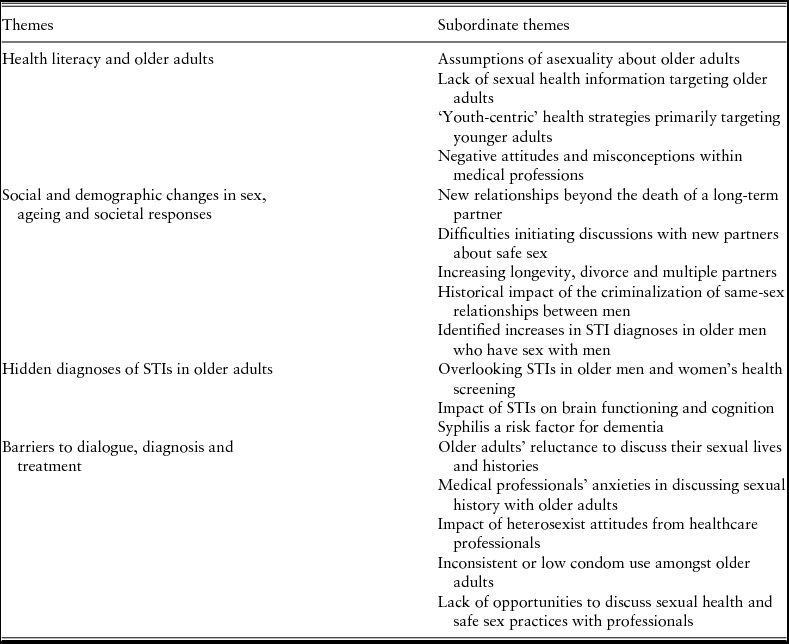
A systematic literature review was conducted to ascertain what was known about the sexual health of older adults, their safe sex behaviours, risk factors and barriers to accessing Department for Integrated Sexual Health (DISH) services. The searches were conducted using the following online academic search portals and journal repositories: ‘PsychINFO’, ‘Web of Science’, ‘Science Direct’ and ‘MEDLINE’. The search was further restricted to academic peer-reviewed journals written in English and published in the last 15 years. The papers were read using the PQRS approachReference Memory and Roth20 and categorized prior to a more detailed coding for key methodologies, methods, results and implications. From this, the agreed ordinate themes arising were: Health literacy and older adults; Social and demographic changes in sex, ageing and societal responses; Hidden diagnoses of STIs in older adults; and Barriers to dialogue, diagnosis and treatment. Full details of the search methods are available from the corresponding author. Table 1 provides a summary of ordinate and subordinate themes in the literature.
Summary of ordinate and subordinate themes in the literature

Findings
Health literacy and older adults
Despite the dominant assumption that older people are asexual or lacking sexual desires,Reference Bauer and Geront21,Reference Doll22 older adults are sexually active in later life.Reference Somes and Donatelli17 Indeed, it is important to them to be soReference Gott and Hinchliff15 and, as discussed above, it is evident that older adults are engaging in a wide range of sexual relationships and experiences.Reference Gott, Rogstad, Riley, Ahmed-Jushef and Green23 However, available research indicates that there is a distinct lack of sexual health information targeted towards and provided for the older adult population.Reference Slinkard and Kazer24 This lack of information can be seen as a substantial contributory factor to the sexual risk-taking behaviours observed in this population. Further to the lack of information, older people are also not seen as a priority group from the perspective of the NHS and local DISH services. While the sexual health status of younger adults is a healthcare, social and research priority, it remains a largely ignored aspect of ageing.Reference Abel and Werner25 Despite a life-course approach,26 the priorities of these services are younger adults who are seen as the more ‘at-risk’ group. This suggests a disparity between research findings and policy for clinical practice. Whilst numerically this is correct, a small but significant amount of those older adults who were tested have returned positive results. This could indicate one of two things: those older adults who put themselves at risk are aware of this and go for testing, or that there are more widespread issues regarding prevalence rates of STIs within the older cohort that are not observed due to lack of self-referral to DISH clinics. In both instances, increasing a targeted health literacy campaign towards older adults and improving the accessibility of services would benefit their health and wellbeing. To do this, however, it is important to address negative attitudes and misconceptions.Reference Duerson, Thomas, Chang and Stevens27–Reference Nash, Stuart-Hamilton and Mayer32
Social and demographic changes in sex, ageing and societal responses
During the last five decades, there have been significant social and demographic changes within Britain, such as increased longevity, enhanced recognition of civil and political rights and increased divorce rates. These have, in turn, shifted attitudes towards sexual relationships, sexual activity and household patterns of intimacy. Those older adults who are widowed are no longer necessarily resigned to a single life following the death of a spouse, but are instead becoming more likely to seek and find out other people for new relationships, both sexual and for companionship.Reference Smith and Christakis33 In doing this, they are potentially engaging in sexual activity with a new partner about whose sexual history they may know very little. The desire for company and intimacy may impact on the decision-making process about whether to practise safe sex or not – requesting this highly sensitive information from a sexual partner may be seen as a signal of distrust and potentially compromise the relationship.Reference Crosby, Shrier and Charnigo34 Furthermore, initiating discussions about safe sex and condom use and indeed accessing STI screening were not familiar practices prior to the onset of the HIV epidemic in the 1980s.Reference Schick, Herbenick and Reece35
A similar issue is that of increased longevity and the associated dissolution of ‘romantic relationships for life’,Reference Schick, Herbenick and Reece35 in parallel with increases in divorce rates. It is also of note that this phenomenon is not exclusive to the lives of young people, with increasing divorce rates in the over-50s.36 In introducing extramarital relationships, there is an increased risk of STI transmission should unprotected sex be engaged in by all parties, especially if the third party is also engaged in another relationship. It is the change in these dynamics that opens up the risk of STI transmission when combined with the already identified low levels of health literacyReference Slinkard and Kazer24 and targeted information campaigns. The risks of multiple partners and of condom-less sex have not been made apparent, especially within the heterosexual community where condoms were seen very much as a strategy for preventing unwanted pregnancy (no longer a possibility post-menopause) and where STI/HIV transmission was perceived and falsely depicted as a homosexual problem.Reference Tan, Wong and Chan37
It has already been established that one of the largest expanding groups of older adults reporting positive results on STI screening are MSM7 and this is true for both younger and older adults. This can be partly traced to the criminalization of homosexuality in the UK prior to legal reform in 1967. From this point, although still not socially acceptable, it was no longer a criminal offence that could cause incarceration and create a criminal history.Reference Fish38 Although the sexual lives of MSM were no longer formally policed by the State, the shadow of criminalization may continue to hinder older LGB adults from accessing and discussing their sexual lives with health professionals.Reference Willis, Maegusuku-Hewett, Raithby and Miles14,Reference Fish38,Reference Stonewall39 From this point through to wider social acceptance in the 1990s and 2000s, the incidence of STIs in MSM has continued to rise.5 There has been sustained campaigning and awareness-raising within gay and bisexual communities about the transmission of STIs and notably of HIV. These campaign efforts are competing with increased access to antibiotics, the availability of antiretroviral combination therapy for people living with HIV and that the gay community values sex to such a great degree that sexual pursuits, even towards old age, are considered imperative which may compromise safe sex messages.Reference Jacobs, Kane and Ownby40 More engagement is clearly needed, targeted not only at MSM but also specific groups. Campaigns targeted at MSM accessing commercial social venues and clubs are unlikely to be effective in addressing the need of older men in the same way that a general population campaign is unlikely to reach the older adult cohort.
Hidden diagnoses of STIs in older adults
There are several reasons why STIs can be overlooked medically, with many related to the prototypical processes of ageing. In women, symptomatology of infection includes cramps, bloating and vaginal bleeding, all of which are associated with menopauseReference Pearline, Tucker and Yuan41 and can be overlooked by both the older adult and the medical professional.Reference Sherrard and Wainwright42 Confusion can occur also around causes of genital irritation such as genital ulcers or primary chancroid, where other more common complaints for older adults may be mistaken, for example urinary tract infections (UTI).Reference Wilson43 Engaging in conversations with older adults about their sexual activity could be one way of establishing possible causes and entering into dialogues about sexual health practices. To do this, however, misconceptions of older people's sexuality and overcoming the embarrassment of discussing these, from the perspective of both the older patient and the practitioner, have to be overcome. Increased awareness within the medical and research fraternities need to be fostered, developing specialist targeted campaigns designed to engage specifically with older adults.
Research indicates that STIs can influence not only reproductive capacity but also brain function, especially cognition,Reference Mehrabian, Raycheva, Petrova, Tsankov and Traykov44,Reference Wendelken and Valcour45 mimicking more common causes of dementia such as Alzheimer's disease. It is thus evident that medical professionals need to be more open to the possibility that an older adult may be presenting with a STI, in order to facilitate its effective treatment and to reduce the risk to partners. The correct diagnosis and successful treatment of STIs in older adults could also prove to be cost saving, where potentially expensive support costs could be alleviated through the successful treatment of the infection. A prime example of this is syphilis, as its tertiary symptomatology may be reversible/treatable if caught at early or latent stages, or stoppable thereafter.Reference Arnold and Kumar46,Reference Parsonage, Wilkins, Snowden, Issa and Savage47 This may add to the argument that testing should be made more accessible for older adults, with specialist clinics/times available for their sole use in the same way that there is for younger ‘at-risk’ groups.
Barriers to dialogue, diagnosis and treatment
Despite living through a period of significant legal and social reform in the 1960s and 1970s, older people may be reluctant to discuss aspects of their sexual lives and histories in comparison with younger people.Reference Bulford and Singh13,Reference Slinkard and Kazer24 Similarly, differences between generations may prevent older adults communicating their concerns regarding sexual health, activity and wellbeing to younger adults.Reference Rivers48 Older adults are unlikely to engage in such conversations with their adult children, or indeed other members of their family, because of (i) wider societal beliefs of older adults as lacking sexual interest and desires, and (ii) the highly sensitive and stigmatized nature of discussing personal and intimate details with younger generations. This discomfort is not limited to family members, as older adults and non-specialized doctors share the same social anxieties with engaging in open and frank discussion about sexual health and activity.Reference Jeffers and DiBartolo49 This may lead to skirting around sexuality-related issues and, where symptoms are presented, preferring to test, diagnose and treat for other ‘more likely’ causes based on chronological age.Reference Duerson, Thomas, Chang and Stevens27,Reference Sherrard and Wainwright42
Feelings of shame and embarrassment can accompany self-reports of sexual history.Reference Sherrard and Wainwright42 Arguably, this increases the responsibility of healthcare professionals to initiate discussions about sexual health, activity and wellbeing in their interactions with older adults. While older adults report a willingness to discuss their sexual lives with medical professionals, they may not have the vocabulary or the confidence in their GP to encourage them to discuss psychosexual problems or STI-related symptoms in an open manner.Reference Bulford and Singh13 Social discomfort may be shared by medical professionals who may be reluctant to initiate discussions about sexual history with older patients in fear of causing personal offence, evoking responses of embarrassment, or because of negative feelings of disgust associated with dominant discourses of ageing and sex.Reference Somes and Donatelli17 Sherrard and WainwrightReference Sherrard and Wainwright42 contend that GPs are ideally situated as primary health professionals for screening older patients’ sexual histories and identifying STI symptoms. Failure to diagnosis STIs can delay the treatment of bacterial infections, or worse, result in misidentification of manifestations of HIV as being ageing-related symptoms.Reference Sherrard and Wainwright42
Heterosexist attitudes (the prevailing assumption that all older people live heterosexual lives) may blinker health and social care staff from appropriately responding to LGB-identifying older adults, or recognizing adults in same-sex relationships, for example MSM.Reference Dentato, Orwat, Spira and Walker50 The practice of care workers providing support to older people in residential and nursing settings may be confounded by assumptions of both asexuality and heterosexuality. Both social discourses can prevent staff from discussing sexual histories with residents, resulting in this information being absent from residents’ care plans.Reference Willis, Maegusuku-Hewett, Raithby and Miles14,Reference Jeffers and DiBartolo49
Lack of opportunities to discuss sexual health with GPs and other primary health professionals prevents older adults from receiving information and education on safer sex practices and limits knowledge of professionals about their patients’ sexual health.Reference Slinkard and Kazer24–Reference Abel and Werner25,Reference Sherrard and Wainwright42 This can limit some older groups’ understandings of HIV transmission; for example, older women may be unfamiliar with condom use and HIV risks associated with unsafe sex.Reference Neundorfer, Britton and Lynch51 In turn, this can lead to inconsistent or low condom use among older adults.Reference Smith and Christakis33 Universal sexual health screening of older adults would place new demands on healthcare services especially in terms of cost,Reference Matiluko and Crystal52 but increased attention to possible STI symptoms is vital.Reference Holden and Trachtman29 Health professionals need to be mindful of older adults’ potential exposure to unsafe sex and include discussions of sexual practices in routine health assessments.Reference Fox-Seaman28,Reference Holden and Trachtman29,Reference Minicucci, Vieira, Oliviera and Marques53,Reference Poggiali, Pisani, De Padova, Ghilardi and Bilenchi54
Conclusions
Sex and sexuality are intrinsic dimensions across the life course and cannot be separated from discussions of healthy ageing in later life. Furthermore, sexual health is an integral aspect of individual wellbeing and interconnected with maintaining physical and mental health. This review has illuminated the multiple barriers and challenges older adults can experience in accessing care and support with sexual health in later life, including recognition of older people as sexually active. There is a dearth of discussion in the literature and research about older people's sexual relationships and preferred sexual activities in later life, indicating a significant gap in available information on sexual health and safe sex targeting older adults. With a wider social and political appreciation of an ageing population and the health and social care needs that this brings with it, sexual health and wellbeing are issues that similarly need to be addressed. Healthcare is increasingly being seen as a holistic endeavour (incorporating social needs) and this also includes sexual health. This is something that needs to be acknowledged, both in theory and in practice, when addressing the wellbeing of older adults in the community and supported living environments.
This review has highlighted the need for enhanced dialogue between older people and health and social care professionals about older adult's sexual relationships, both past and present. This means counteracting the stigma of sex and sexuality in ageing, with affirmative public health messages and campaigns about the importance of sexual wellbeing and sexual rights in later life. In parallel, there is demand for ensuring that care provision to older people with declining physical and mental health, inclusive of those in residential settings, should encompass their sexual health needs. This means facilitating affirmative conversations with residents about sexual activity and relationships and identifying methods of providing safe sex resources to older adults in a supportive and stigma-free environment. For example, older adults may not wish to approach younger care staff or managers to obtain condoms and lubricant, so it may be prudent that these are discretely made available within the facility to help combat the stigma involved in seeking out protection. This is not a new strategy as these resources are frequently made available in commercial clubs, nightclubs and venues where MSM socialize and where young adults can access them. Where this strategy has been widely supported by the respective communities, the same opportunities are not being given to older adults. This suggests an ageing-blind approach to sexual health campaigns and strategies. When there is no other way of accessing such safe sex precautions, this would seem a logical extension to existing schemes for older adults.
Reviewing the literature does appear to indicate the benefits of increased targeted health promotion campaigns and the open provision of safe sex resources to older people. It would also suggest that existing DISH services need to be made more user-friendly for older adults, rethinking strategies in an innovative way, with heightened awareness in the community, residential care and healthcare settings. The overarching message, however, is that of combating ageism in clinical and research communities. Older people do want to have sex, older people are having sex and, like younger cohorts, older people are not necessarily using protection.
Conflicts of interest
None