Research on the role of children's temperament in the development of behavior problems, and more generally, adjustment outcomes, has a long and rich history. Since the early Thomas and Chess’ New York Longitudinal Study (Thomas & Chess, Reference Thomas and Chess1977), rapidly growing bodies of literature have delineated complex influences of early temperament on future adjustment. Rothbart and Bates (Reference Rothbart, Bates, Damon, Lerner and Eisenberg2006) presented a comprehensive overview of processes that may link early temperament to future adjustment, encompassing four main classes of effects: direct and indirect linear effects, Temperament × Environment interactions, and Temperament ×Temperament interactions (as well as miscellaneous effects). Enormous bodies of research that have since emerged can be largely mapped onto those classes of effects, although doing so would greatly exceed the scope of the current article.
Rothbart and Bates (Reference Rothbart, Bates, Damon, Lerner and Eisenberg2006) noted that whereas research pertaining to the first three classes of processes had grown exponentially, especially on Temperament × Environment interactions, the last category – Temperament × Temperament interactions – had been accumulating much more slowly. This assessment is generally still accurate today. Consequently, the study of such effects is a useful scientific enterprise, particularly in developmental psychopathology. One possible type of those interactions is particularly relevant, when “One temperament trait can protect against risk consequences of another temperament-based trait” (Rothbart & Bates, Reference Rothbart, Bates, Damon, Lerner and Eisenberg2006, p. 137). We would add that one temperament trait can also exacerbate risks due to another trait.
Of note, the idea of an interplay among personality traits has a long history. Already in 1980, Block and Block, inspired by the Lewinian perspective, presented a then-innovative and since very influential approach to the development of individual differences that emphasized two broad personality parameters: ego control and ego resiliency (Block & Block, Reference Block, Block and Collins1980). They assessed those parameters using observations of children's behavior in large behavioral batteries and teachers’ reports in the California Q-set (CCQ; Block & Block, Reference Block and Block1969; a set of 100 diverse personality traits). The construct of ego control emphasized characteristics such as ability to delay gratification, to inhibit impulses, to plan and think ahead, or to resist temptation. Over-control and under-control represented the high and low ends of this dimension, respectively. Both very high and very low scores were considered maladaptive, with mid-range scores seen as optimal. The construct of ego resiliency incorporated a number of personality characteristics. Flexible and adaptive emotion regulation, particularly when frustrated or stressed, appeared key. Resourceful adaptation to changing circumstances and environmental contingencies, including a capacity to regulate flexibly ego control as required in a specific context, represented high ego resiliency. “Brittleness” or “going to pieces under stress” represented the low end. Higher levels of ego resiliency were considered adaptive.
Certain characteristics reflected both ego control and ego resiliency; for example, planfulness or ability to delay gratification (Block & Block, Reference Block, Block and Collins1980). Importantly, the Blocks depicted the interplay of the two constructs in a 2 × 2 matrix illustrating the “personality profiles” that corresponded to the combinations of high and low levels of each trait (Block & Block, Reference Block, Block and Collins1980, p. 89). Ever since, many scholars of children's temperament and personality development have referred to those two concepts, particularly when studying regulatory processes. Both ego control and ego resiliency are often cited in the context of discussion of regulatory mechanisms of temperament (e.g., Rothbart & Bates, Reference Rothbart, Bates, Damon, Lerner and Eisenberg2006), although various scholars’ interpretations are not always fully consistent.
In the current article, we focus on two temperament-based inhibition systems. One broad system is associated with reactive inhibition, or behavioral inhibition (BI). Kagan and his colleagues have conducted extensive classic research on this trait, documenting its early origins, stability over time, and biological underpinnings and correlates (e.g., Kagan & Fox, Reference Kagan, Fox, Damon, Lerner and Eisenberg2006; Kagan, Reznick, Clarke, Snidman, & Garcia Coll, Reference Kagan, Reznick, Clarke, Snidman and Garcia Coll1984; Kagan & Snidman, Reference Kagan and Snidman2004). BI is a robust temperament characteristic, typically studied in paradigms involving unfamiliar persons and events, and mildly stressful or challenging behavioral probes (“Risk Room” and “risky acts”). Inhibited children show a consistent pattern of caution, fearfulness, reticence, and shyness; in contrast, uninhibited children readily explore and eagerly engage in “risky” behaviors (e.g., play with an odd toy, crawl through a tunnel, approach a person in a costume).
The other broad system is associated with active inhibition, or ability deliberately to suppress a dominant behavior – often hedonically rewarding and much desired – and execute instead a subdominant behavior, even if mundane or unappealing. Several inter-related massive literatures refer to this system as effortful control (EC), inhibitory control, executive function, self-control, self-regulation, or emotion regulation, to mention only a few (Duckworth & Kern, Reference Duckworth and Kern2011; Eisenberg, Smith, Sadovsky, & Spinrad, Reference Eisenberg, Smith, Sadovsky, Spinrad, Baumeister and Vohs2004; Kochanska, Murray, & Harlan, Reference Kochanska, Murray and Harlan2000; Moffitt et al., Reference Moffitt, Arseneault, Belsky, Dickson, Hancox, Harrington and Caspi2011; Nigg, Reference Nigg2017; Posner & Rothbart, Reference Posner and Rothbart2000; Rothbart & Bates, Reference Rothbart, Bates, Damon, Lerner and Eisenberg2006; Rueda, Reference Rueda, Zentner and Shiner2012). Often, researchers have distinguished “hot” and “cool” aspects of EC (e.g., Brock, Rimm-Kaufman, Nathanson, & Grimm, Reference Brock, Rimm-Kaufman, Nathanson and Grimm2009; Kim, Nordling, Yoon, Boldt, & Kochanska, Reference Kim, Nordling, Yoon, Boldt and Kochanska2013; Willoughby, Kupersmidt, Voegler-Lee, & Bryant, Reference Willoughby, Kupersmidt, Voegler-Lee and Bryant2011; Zelazo & Carlson, Reference Zelazo and Carlson2012). Hot EC has been typically assessed in batteries of tasks that call for suppressing a dominant behavior (e.g., delaying a highly appealing, desired action), whereas cool EC has been often measured in more cognitive, executive function tasks.
In developmental psychopathology, both BI and EC in childhood have been extensively studied in the context of risk for future disorders (Nigg, Reference Nigg2000). Kagan's group and many other researchers have demonstrated that children at the high end of BI are at risk for internalizing disorders, mostly anxiety (e.g., Biederman et al., Reference Biederman, Hirshfeld-Becker, Rosenbaum, Hérot, Friedman, Snidman and Faraone2001; Chen & Schmidt, Reference Chen, Schmidt, Lerner and Lamb2015; Degnan, Almas, & Fox, Reference Degnan, Almas and Fox2010; Fox, Henderson, Marshall, Nichols, & Ghera, Reference Fox, Henderson, Marshall, Nichols and Ghera2005; Kagan & Fox, Reference Kagan, Fox, Damon, Lerner and Eisenberg2006; Klein, Dyson, Kujawa, & Kotov, Reference Klein, Dyson, Kujawa, Kotov, Zentner and Shiner2012; Klein & Mumper, Reference Klein, Mumper, Perez-Edgar and Fox2018; Liu & Pérez-Edgar, Reference Liu and Pérez-Edgar2019; Sandstrom, Uher, & Pavlova, Reference Sandstrom, Uher and Pavlova2020).
Very low levels of BI, however, may also pose developmental risks. Fearlessness, or low BI, has been robustly established as a risk for a range of future disruptive problems, including aggression, disregard for rules and others’ welfare, callous unemotional traits, and oppositional and conduct problems (e.g., Biederman et al., Reference Biederman, Hirshfeld-Becker, Rosenbaum, Hérot, Friedman, Snidman and Faraone2001; Calkins, Blandon, Williford, & Keane, Reference Calkins, Blandon, Williford and Keane2007; Gao, Raine, Venables, Dawson, & Mednick, Reference Gao, Raine, Venables, Dawson and Mednick2010; Lykken, Reference Lykken1995; Patrick et al., Reference Patrick, Kramer, Vaidyanathan, Benning, Hicks and Lilienfeld2019; Raine, Reynolds, Venables, Mednick, & Farrington, Reference Raine, Reynolds, Venables, Mednick and Farrington1998; Shaw, Gilliom, Ingoldsby, & Nagin, Reference Shaw, Gilliom, Ingoldsby and Nagin2003; Tackett, Martel, & Kushner, Reference Tackett, Martel, Kushner, Zentner and Shiner2012).
Several researchers have studied characteristics that overlap with the low end of BI, although they considered those characteristics as reflecting a separate temperament system rather than low BI. Fox and colleagues (e.g., Fox, Henderson, Rubin, Calkins, & Schmidt, Reference Fox, Henderson, Rubin, Calkins and Schmidt2001) introduced a temperament dimension labeled “exuberance.” Although exuberant children share common characteristics with children low on BI (high sociability, approach, low fear), Degnan et al. (Reference Degnan, Hane, Henderson, Moas, Reeb-Sutherland and Fox2011) emphasized that BI and exuberance are distinct temperamental dimensions, with the latter described as a combination of high approach and positive affect. Empirically, exuberance is, in part, assessed in the classic Risk Room episodes (coded for approach vs. inhibition, and positive and negative affect, Putnam & Stifter, Reference Putnam and Stifter2005; Stifter, Putnam, & Jahromi, Reference Stifter, Putnam and Jahromi2008).
Buss, Kiel, Morales, and Robinson (Reference Buss, Kiel, Morales and Robinson2014) introduced a concept of “bold approach.” Bold approach was based on observations of young children's behavior in several episodes, including Risk Room episodes; high bold approach represented essentially the low end of BI. Honomichl and Donnellan (Reference Honomichl and Donnellan2012) examined a dimension of Surgency extracted from mothers’ reports of their preschool children's temperament (high approach, high activity, low shyness). Across those studies, the researchers generally reported that high exuberance, bold approach, or Surgency predicted observed and informant- and self-reported measures of externalizing, disruptive behavior problems. In this context, two additional points should be made. One, although the concepts of low BI, high exuberance, bold approach, and Surgency do overlap, they are not the same, and distinctions among them need to be acknowledged. Two, high scores on those dimensions may be associated with positive social behaviors as well (e.g., sociability, friendliness).
With regard to EC, massive literature has linked its low levels with risks for externalizing psychopathology – the development of disregard for rules and externalizing problems (Eisenberg et al., Reference Eisenberg, Smith, Sadovsky, Spinrad, Baumeister and Vohs2004; Morales et al., Reference Morales, Miller, Troller-Renfree, White, Degnan, Henderson and Fox2019; Morales, Pérez-Edgar, & Buss, Reference Morales, Pérez-Edgar and Buss2016; Nigg, Reference Nigg2017; Olson, Sameroff, Kerr, & Lopez, Reference Olson, Sameroff, Kerr and Lopez2005; Rothbart & Bates, Reference Rothbart, Bates, Damon, Lerner and Eisenberg2006). EC generally predicts positive adjustment (Kochanska & Knaack, Reference Kochanska and Knaack2003; Kochanska et al., Reference Kochanska, Murray and Harlan2000; Moffitt et al., Reference Moffitt, Arseneault, Belsky, Dickson, Hancox, Harrington and Caspi2011; Rothbart & Bates, Reference Rothbart, Bates, Damon, Lerner and Eisenberg2006).
Several bodies of research have examined interactions between the two inhibition systems, including mutually compensatory interactions proposed by Rothbart and Bates (Reference Rothbart, Bates, Damon, Lerner and Eisenberg2006), in which a (high or low) score on one temperament trait can offset a child's high risk due to a (high or low) score on another trait. Several studies have examined interplay of BI and EC with regard to the risk for internalizing problems, particularly anxiety. Anxiety is associated with a high level of BI, but such risk can be offset by a high level of EC (Degnan & Fox, Reference Degnan and Fox2007; Oldehinkel, Hartman, Ferdinand, Verhulst, & Ormel, Reference Oldehinkel, Hartman, Ferdinand, Verhulst and Ormel2007; Nystrom & Bengtsson, Reference Nystrom and Bengtsson2016). Of note, the effects have often been complex, and depended on the type of EC processes that were studied. Certain forms of EC, such as the ability to control and shift attention, seem to attenuate the risk for internalizing problems among children with high BI, whereas some other forms, such as inhibitory control, can exacerbate the risk (Pérez-Edgar, Taber-Thomas, Auday, & Morales, Reference Pérez-Edgar, Taber-Thomas, Auday, Morales and Lagattuta2014; Sportel, Nauta, de Hullu, de Jong, & Hartman, Reference Sportel, Nauta, de Hullu, de Jong and Hartman2011; Thorell, Bohlin, & Rydell, Reference Thorell, Bohlin and Rydell2004; White, McDermott, Degnan, Henderson, & Fox, Reference White, McDermott, Degnan, Henderson and Fox2011). Overall, the findings consistently point to an adaptive role of EC, as long as the child is able to recruit it for a proactive regulation of fear (rather than becoming over-inhibited and inflexible; Buzzell, Troller-Renfree, Morales, & Fox, Reference Buzzell, Troller-Renfree, Morales, Fox, Pérez-Edgar and Fox2018; Hassan, Poole, & Schmidt, Reference Hassan, Poole and Schmidt2020; Troller-Renfree et al., Reference Troller-Renfree, Buzzell, Bowers, Salo, Forman-Alberti, Smith and Fox2019; Troller-Renfree, Buzzell, Pine, Henderson, & Fox, Reference Troller-Renfree, Buzzell, Pine, Henderson and Fox2019).
Some studies have demonstrated that EC had similar protective effects for children with heightened negative emotionality (Rothbart & Bates, Reference Rothbart, Bates, Damon, Lerner and Eisenberg2006). Negative emotionality, sometimes described as difficult temperament, is a broader trait, which, in addition to fearfulness or BI, often includes proneness to other negative emotions, such as sadness or anger (Lonigan & Vasey, Reference Lonigan and Vasey2009; Muris & Ollendick, Reference Muris and Ollendick2005). Those studies have often focused on children's externalizing problems as outcomes, including future aggression, disregard for rules, or disruptive conduct. A large body of research, using a broad range of measures, has persuasively demonstrated that EC can interact with negative emotionality in predicting future disruptive outcomes, such that high EC can offset risks due to the high proneness to various negative emotions (e.g., Colder & Stice, Reference Colder and Stice1998; Eisenberg & Fabes, Reference Eisenberg, Fabes and Clark1992; Eisenberg et al., Reference Eisenberg, Guthrie, Fabes, Shepard, Losoya, Murphy and Reiser2000, Reference Eisenberg, Valiente, Spinrad, Cumberland, Liew and Reiser2009; Nielsen, Olino, Dyson, & Klein, Reference Nielsen, Olino, Dyson and Klein2019). A typical interpretation of such effects has generally emphasized that children can recruit EC to help them regulate negative emotions – mostly anger. EC can help prevent those emotions from becoming disruptive and dysfunctional, as ultimately reflected in conduct problems.
Multiple comprehensive models have explicitly identified low levels of both BI-related traits (low reactive inhibition, fearlessness, boldness, risk-taking) and EC-related traits (low active inhibition, poor capacity for self-regulation of behavior or emotion) as triggering two key pathways to antisocial or disruptive problems for children with low scores (Eisenberg & Fabes, Reference Eisenberg, Fabes and Clark1992; Fowles & Dindo, Reference Fowles and Dindo2009; Frick & Morris, Reference Frick and Morris2004; Nielsen et al., Reference Nielsen, Olino, Dyson and Klein2019; Nigg, Reference Nigg2006; Reference Nigg2017). Conversely, both high BI and high EC have been implicated as temperamental substrates of adaptive pathways to children's mature conscience and sociomoral competence, including internalization of standards and values (Kochanska, Reference Kochanska1993; Kochanska, Coy, & Murray, Reference Kochanska, Coy and Murray2001).
Fewer studies have examined whether EC and BI interact in predicting externalizing conduct problems such that high EC could potentially buffer the risks conferred by low BI, or fearlessness, and whether risks due to deficient EC, amply implicated in the development of disregard for rules and externalizing symptoms, can be buffered by high levels of BI. As well, little research has examined mutually exacerbating effects: Whether low EC can further increase the risk for externalizing problems for children with low BI, and vice versa.
However, this literature has been growing. Thorell et al. (Reference Thorell, Bohlin and Rydell2004) found that the combination of low EC and low-to-average BI was associated with heightened levels of hyperactivity, but the risk for hyperactivity was mitigated among children who were high on at least one of the dimensions (i.e., low EC and high BI, or high EC and low BI).
Researchers studying exuberance and the related characteristics have documented interactions between exuberance or bold approach and various forms of EC with regard to the development of externalizing problems. Stifter et al. (Reference Stifter, Putnam and Jahromi2008) found that emotion regulatory capacities, assessed in a disappointment paradigm, decreased the presence of preschool problem behaviors for exuberant children, although no such protective effects were found for classic EC tasks involving delay. Dollar, Stifter, and Buss (Reference Dollar, Stifter and Buss2017) applied latent group analysis to observations of toddlers in the Risk Room procedure, and identified inhibited, exuberant, and average groups. Mothers rated toddlers’ inhibitory control and social adjustment (in peer relations) 2 years later. Their findings were consistent with Stifter et al. (Reference Stifter, Putnam and Jahromi2008): As inhibitory control abilities increased, exuberant children were rated by their mothers as higher in peer adjustment. Buss et al. (2014) examined interactions between inhibitory control (essentially equivalent of EC) and bold approach and reported a relatively consistent pattern of results across several measures of externalizing behavior problems, such that low inhibitory control and high approach put children at risk for developing externalizing behavior problems. They stated that “Bold approach was a significant moderator in every analysis such that being low in bold approach was a protective factor for children low in inhibitory control” (p. 243).
We continue to examine the interplay of the two temperament inhibitory systems, reactive (BI) and active (EC) in the current work. We present two longitudinal studies of typically developing young children, both examining BI, EC, and their interaction as predictors of future outcomes. Both studies employed fully parallel measures of BI and EC. In the first study, we observed disregard for parental rule in a naturalistic prohibition context as the outcome. In the second study, we examined mothers’ and fathers’ reports of externalizing problems.
To strengthen the potential for replication, both studies involved two-parent community families and typically developing children, drawn from the same population, with the two cohorts of children separated by approximately six years. Study 1 included 112 mother–child dyads. Study 2 included 102 mothers, fathers, and children. In both studies, families entered when children were infants, and were followed longitudinally. In Study 1, we obtained observational measures of BI and EC at age 2.5 years and observational outcome measures (disregard for maternal rules) at age 4. In Study 2, we assessed BI and EC at three assessments, at ages 2, 3, and 4.5, and examined their respective effects on parents’ ratings of children's externalizing problems (opposition and defiance, conduct problems, aggression) obtained at ages 5.5 and 6.5. In addition, given the large literature on the role of BI in the development of internalizing problems, and the known overlap between internalizing and externalizing problems, we controlled for the former. This approach allowed us to rule out the potential confounding effects of internalizing problems when examining the associations between inhibition and externalizing problems.
Study 1
Participants
The participants (two-parent community families) responded to ads and flyers distributed in an area that included a college town, a small city, small towns, and rural areas in US Midwest. Only mothers and their typically developing children (almost all born in 1995–1996) participated (N = 112, 56 girls). They entered the study when children were 8–10 months old. The families were mostly White (97% of mothers, 92% of fathers), but represented a range of SES. Approximately half of the parents had college or postgraduate education (59% of mothers, 57% of fathers); 15% of mothers and 10% of fathers had some college; 26% of mothers and 31% of fathers had high school education only. Most mothers worked outside of home (19% were homemakers): 38% were professionals; 31%, technicians or in sales; 5%, in service jobs; 2% laborers. Among fathers, 40% were professionals; 27%, technicians or in sales; 9%, in service jobs; 1%, farmers; and 13%, craftsmen, repairmen, laborers. Family income varied: under $20,000 (7%), $20,001–$30,000 (13%), $30,001–$40,000 (20%), $40,001–$50,001 (17%), $50,001–$60,000 (l6%), and more than $60,001 (25%). The study was approved by the University of Iowa IRB, and mothers signed informed consents.
Overview
All data were based on observations during 2–3-hour laboratory sessions (two at 33 months, 2.5 years, and two at 45 months, 4 years), conducted by female experimenters (Es) and videotaped for future coding. We present data on BI and EC, observed at 2.5 years (N = 104, 52 girls) and on children's disregard for maternal rule at 4 years (N = 101, 49 girls; in addition, analogous behavior reflecting scores, were obtained at 22 months, N = 106, 53 girls, and used as a covariate). Multiple teams of coders coded behavioral data. Approximately 15%–20% of cases were used for reliability, followed by frequent realignments. Note that the best practices in reliability have evolved over the last 25 years. Consequently, most statistics included kappas, alphas, and in one case of coding latencies, percent agreement.
Measures
Children's BI, 2.5 years
Paradigm
In a 10–12-min “Risk Room” paradigm (Kagan, Reznick, & Gibbons, Reference Kagan, Reznick and Gibbons1989; Kochanska, Aksan, & Joy, Reference Kochanska, Aksan and Joy2007; Kochanska et al., Reference Kochanska, Coy and Murray2001), the child faced mildly threatening events in an unfamiliar environment. The laboratory room was decorated with many odd-looking and slightly frightening objects (e.g., Halloween masks) and objects that could potentially involve mildly challenging physical activities (e.g., balance beam, a strange big black box, trampoline, ladder). The child was first observed while exploring the room (3 min), and then in seven “Risky Acts” –interactions with a stranger who encouraged the child to perform mildly threatening acts (e.g., ride an odd tricycle, slide down a strangely decorated slide, insert a hand into an odd box, touch a strange robot, put on scary masks, approach a person in a costume).
Coding and data aggregation
We coded proximity to mother for every 30 s as touching or within arm's length, hovering close but further than arm's length, or more than 1/3 room away from mother (reliability, kappa, .98), latency to explore (100% within 1 s), presence or absence of exploration for every 30 s, including extra credits for exploring particularly threatening objects (kappas, 1.00), and a fearful response to each Risky Act (0 = act performed immediately after the demonstration and before the first prompt, to 5 = never performed), plus an extra point if the child showed distress (kappa, .96). The number of segments in direct proximity to mother, latency to explore, reversed exploration score, and the scores for each Risky Act were all standardized and averaged into one BI score (Cronbach's alpha = .85).
Children's EC, 2.5 years
Delay tasks
Children performed several highly scripted tasks (Snack Delay, Tongue, Wrapped Gift, and Gift in Bag). The tasks are widely used, and have been included in several publications (e.g., Kochanska, Aksan, Penney, & Doobay, Reference Kochanska, Aksan, Penney and Doobay2007; Kochanska, Barry, Jimenez, Hollatz, & Woodard, Reference Kochanska, Barry, Jimenez, Hollatz and Woodard2009; Kim & Kochanska, Reference Kim and Kochanska2020; Kochanska & Knaack, Reference Kochanska and Knaack2003), and therefore are described briefly, with details available from the authors. All called for delaying highly desirable, hedonically attractive acts. Snack Delay (four trials) required waiting to reach for an M&M placed under a cup until E rang the bell. In Tongue (three trials), the child was asked to keep an M&M on his or her tongue without eating it. Wrapped Gift required first, waiting, facing away from E, who was noisily wrapping the gift, without peeking (Gift Wrap), and second, waiting in the seat, without touching, to unwrap the gift while E want to get a bow (Gift Bow). The Gift in Bag required waiting to retrieve a gift from a colorful bag until E brought a bow.
Coding and data aggregation
In Snack Delay, each trial was coded from 0 = eats the candy before E lifts the bell, to 4 = waits until bell is rung. The scores were averaged. In Tongue, in each trial, the latency to eat the M&M was coded, and the scores were averaged. Wrapped Gift produced two final scores, Gift Wrap and Gift Bow. Gift in Bag produced one final score. Each represented a composite of several (standardized) coded behaviors that cohered; for example, peeking, staying in seat, touching/opening the gift, as well as latencies to peek, to open, to leave seat, etc. Reliability of coding, average kappas, were .94 for Snack Delay, .83 for Wrapped Gift, and .94 for Gift in Bag. For Tongue, 90% of latencies were within a 2-sec difference.
The four scores (Snack Delay, Tongue, Gift Wrap, Gift Bow, Gift in Bag) were aggregated into the final EC score, following standardization of the first two. That score was internally coherent, Cronbach's alpha = .71.
Children's disregard for maternal rule, 4 years
Paradigm and coding
Mothers were asked to prohibit their children from touching very attractive objects on a low shelf in the laboratory, and to enforce the prohibition throughout both laboratory sessions. At the end of the second session, the mother reminded the child about the prohibition, asked him or her to engage in a dull sorting task, and left to the adjoining room, leaving the child alone for 8 min (details are in Kochanska et al., Reference Kochanska, Coy and Murray2001).
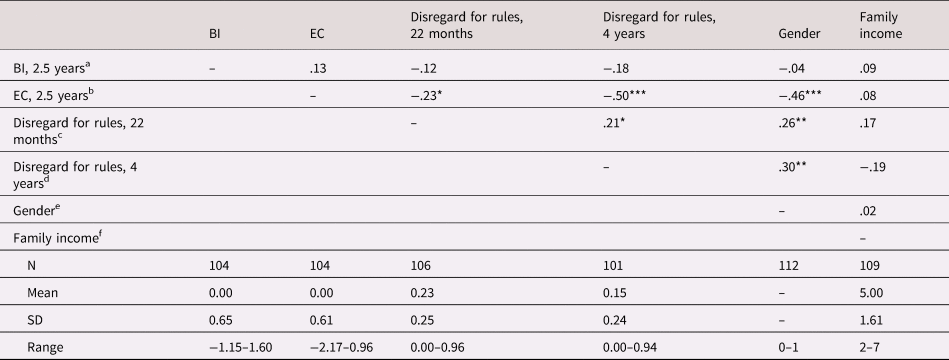
Child behavior was coded for every 5-s segment, employing several codes. Here, we use the measure of deviation or disregard for rules (taking objects off the shelf, unconstrained play with the objects). Reliability, kappa, was .92. The deviation codes were tallied and divided by the number of segments (excluding the relatively rare segments when the child was out of room, trying to get into the mother's lap, etc.). A fully analogous score was also obtained at 22 months and served as a covariate in the analyses. All descriptive data are presented in Table 1.
Descriptive statistics and correlations in study 1

Note. BI = behavioral inhibition; EC = effortful control.
a Composite of standardized scores for behavioral inhibition in the Risk Room paradigm.
b Composite of standardized scores for delay tasks.
c,dPercent of observed segments in which child engaged in rule violation.
e Gender was coded 0 = girl, 1 = boy.
f Family income was coded on a 7-point scale.
Correlations involving gender are point-biserial. *p < .05. **p < .01. ***p < .001.
Results
Children who dropped out of the study at age 4 years and those who remained did not differ on any variables, with one exception: The former were from families with lower incomes compared to the latter, t (107) = −3.08, p = .003. Little's missing completely at random (MCAR) test indicated that data were missing completely at random, χ2 (18) = 16.522, p = .56.
We first inspected the descriptive statistics and correlations (see Table 1). BI and EC at age 2.5 years were uncorrelated. Children's disregard for maternal rule was moderately stable from 22 months to 4 years and both measures correlated negatively with EC, but not with BI. Compared with girls, boys exhibited lower EC and more disregard for rules.
Next, we examined the anticipated interaction of EC and BI in predicting disregard for rules. Specifically, we modeled EC, BI, and their interaction at 2.5 years as the predictors, and disregard for maternal rule at 4 years as the outcome variable. BI was modeled as a moderator of the relation between EC and the outcome. Child gender and family income were included as covariates. In addition, we statistically controlled for disregard for rules at 22 months. We conducted the analysis using Mplus (Muthén & Muthén, Reference Muthén and Muthén1998–2020), which allows for unbiased missing data treatment with the full information maximum likelihood (FIML) method. BI and EC were computed from standardized variables and thus already mean-centered; in addition, we mean-centered disregard for rules at 22 months and family income.
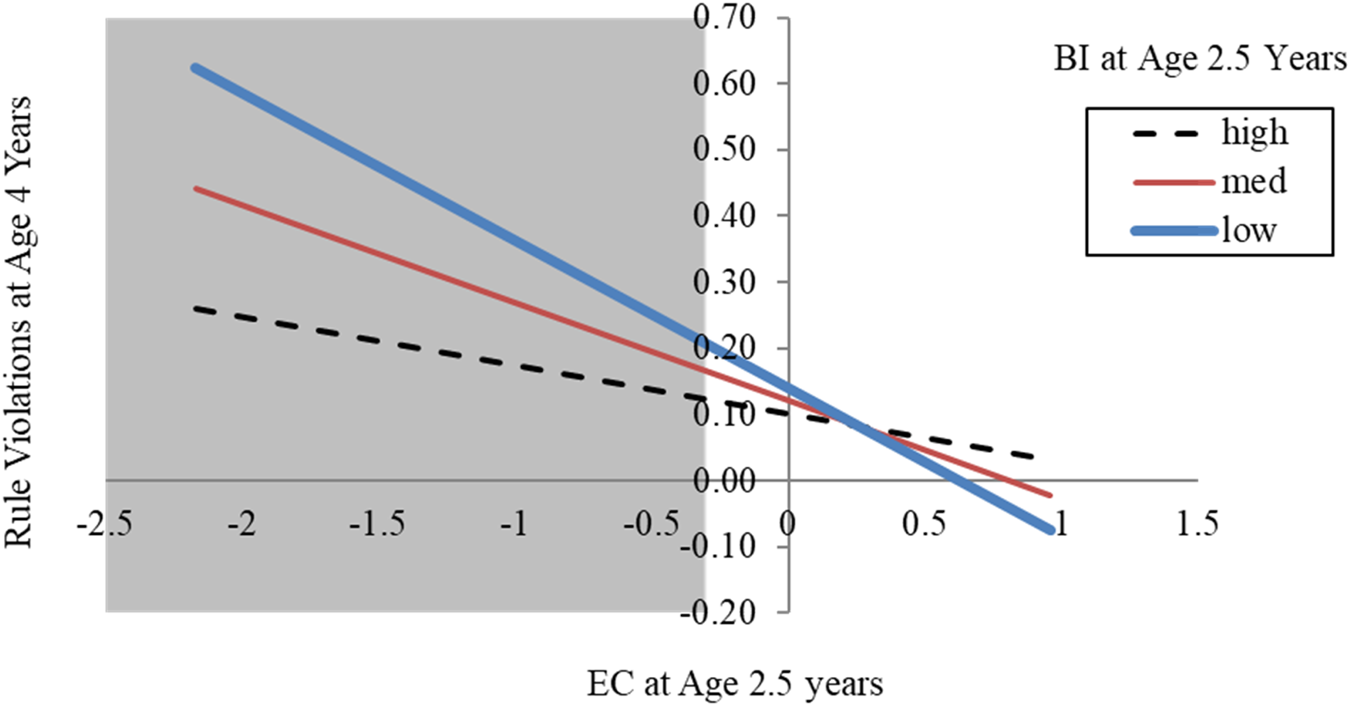
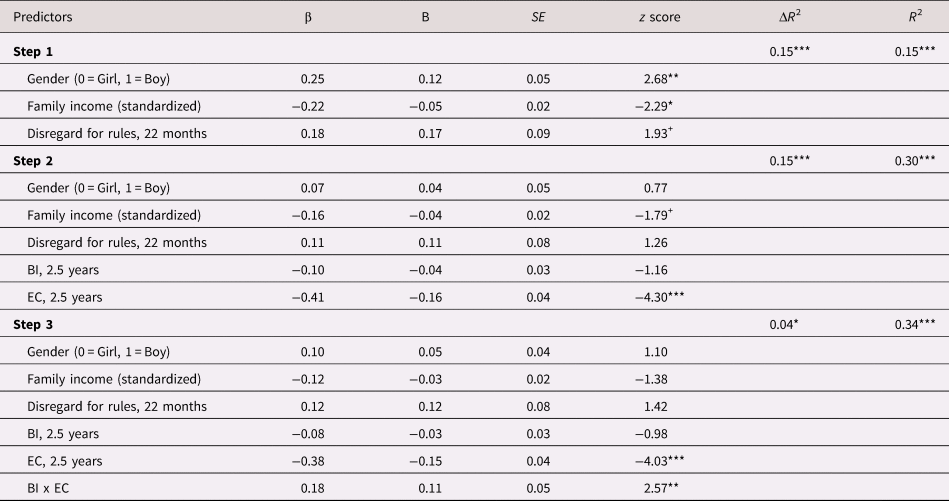
Results of the regression model (Table 2) showed that early EC, but not BI, was associated negatively with disregard for rules at 4 years. However, the association between EC and disregard for rules was qualified by a significant interaction between BI and EC. The follow-up analysis, using simple slopes (Aiken & West, Reference Aiken and West1991), is depicted in Figure 1. For children with low (−1 SD) and average (0 SD) BI (relatively fearless or uninhibited), EC at age 2.5 years was associated negatively with disregard for rules at 4 years, B = −0.22, SE = 0.04, p < .001, and B = −0.15, SE = 0.04, p < .001, respectively. By contrast, for children with high BI (+1 SD, relatively fearful and inhibited), the relation between EC and disregard for rules was not significant, B = −0.07, SE = 0.05, p = .14. Of note, the effect of EC remained significant with all the predictors in the equation.
Study 1. Simple slopes of EC predicting disregard for rules at low (−1 SD), mean (0 SD), and high (+1 SD) values of BI. Solid lines represent significant simple slopes, and dashed line represents nonsignificant simple slope. The shaded area represents the region of significance. BI = behavioral inhibition. EC = effortful control.

Study 1: Prediction of disregard for rules at age 4 years from BI, EC, and their interaction, controlling for disregard for rules at 22 months
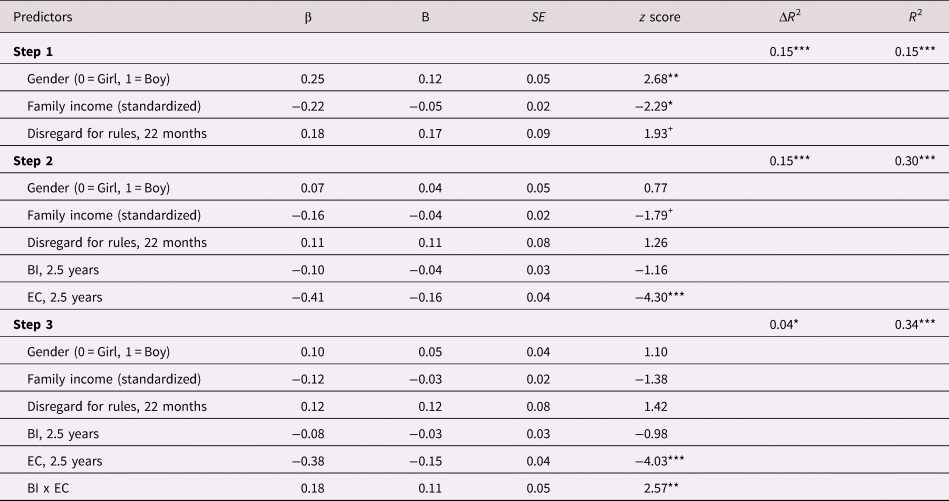
Note. β = standardized regression coefficient using the STDXY (for continuous predictors) and STDY (for categorical predictors) options in Mplus; B = unstandardized regression coefficient; BI = behavioral inhibition; EC = effortful control.
+ p < .10. *p < .05. **p < .01. ***p < .001.
Further analysis using the Johnson–Neyman region-of-significance (RoS) technique (Johnson & Fay, Reference Johnson and Fay1950) suggested that compared with children with high BI scores, children with low BI scores showed more disregard for rules when their EC was low (<−0.46 SD). When the levels of EC were moderate to high, children engaged in few rule violations regardless of their BI scores.
Discussion
Ample literature has portrayed fearlessness (low BI, or reactive inhibition) and poor self-regulation (low EC, or active inhibition) as two parallel pathways to developing disruptive problems (Eisenberg & Fabes, Reference Eisenberg, Fabes and Clark1992; Fowles & Dindo, Reference Fowles and Dindo2009; Frick & Morris, Reference Frick and Morris2004; Nielsen et al., Reference Nielsen, Olino, Dyson and Klein2019; Nigg, Reference Nigg2006; Reference Nigg2017). Relatively less research has examined whether the two pathways may interact, or Temperament × Temperament interaction (Rothbart & Bates, Reference Rothbart, Bates, Damon, Lerner and Eisenberg2006), except for the work on exuberance and related characteristics. We tested whether high EC can mitigate the risk due to low BI, and vice versa, or whether low EC may extenuate the risk due to low BI, or vice versa. We examined such model in the context of predicting a very common disruptive behavior in childhood – disregarding or violating a maternal prohibition.
The pattern of findings reflected in simple slopes and RoS was fully consistent with our model. Children who were relatively fearless (low to average BI) were more likely to break maternal rule, but only if their EC was also low. When EC was high, children were unlikely to break the rule, regardless of their level of fearfulness. Children with low EC scores were more likely to disregard the rule, but only when they were relatively fearless (low to average BI). Thus, high EC could offset the risk due to low BI, and high BI could offset the risk due to low EC. The findings are consistent with literature that has demonstrated that BI and EC play mutually compensatory roles in the development of externalizing traits (Thorell et al., Reference Thorell, Bohlin and Rydell2004), but they extend those effects to early disruptive behaviors. A weakness in one inhibitory system can be compensated by strength in the other system. Moreover, we found evidence for the mutual “negative synergy”: Children with relatively low scores on both systems were most likely to engage in the disruptive, rule-breaking behavior (Buss et al., 2014; Xu, Farver, & Zhang, Reference Xu, Farver and Zhang2009).
The study has limitations. Our measures of disregard for maternal rule targeted relatively mild and benign behaviors that are very common among young children. The mothers represented a low-risk community sample and children were typically developing. Therefore, we did not examine serious behavior problems or highly compromised ability to inhibit behavior; however, the measures of BI, EC, and disregard for rules were all well distributed and thus all reflected robust variation. We note, however, that across several studies, all with community samples, we have found that measures of early regard for rules significantly predicted future internalization of parental values and overall sociomoral competence, as well as disruptive behavior problems (e.g., Kochanska, Brock, & Boldt, Reference Kochanska, Brock and Boldt2017; Kochanska, Koenig, Barry, Kim, & Yoon, Reference Kochanska, Koenig, Barry, Kim and Yoon2010). Future studies should replicate the findings in samples enriched for children's problematic behavioral profiles.
The limitations are offset, in part, by several strengths, including a longitudinal design and robust observational methods. The findings highlight interaction effects of reactive and active inhibition in the development of disruptive behaviors, significant even after earlier individual differences in rule-violating behaviors had been statistically controlled.
Study 2
Participants
The families (N = 102, 51 girls) were recruited from the same area as the families in Study 1, and they also consisted of two-parent community families with typically developing infants (almost all born in 2001). Both mothers and fathers participated. The families’ education ranged broadly: Among mothers, approximately 25% had a high school education (or less), 54% had an associate or college degree, and 21% had a postgraduate education; among fathers, the respective figures were approximately 30%, 51%, and 20%. The annual family incomes were as follows: less than $20,000 (8%), $20,000–$40,000 (17%), $40,000–$60,000 (26%), over $60,000 (49%). In terms of ethnicity, 90% of mothers were White, 3% Hispanic, 2% African American, 1% Asian, 1% Pacific Islander, and 3% other non-White; 84% of fathers were White, 8% Hispanic, 3% African American, 3% Asian, and 2% other (in 20% of families, one or both parents were non-White). The University of Iowa IRB approved the study (Developmental Pathways to Antisocial Behavior: A Translational Research Program, 200107049). We obtained parents’ informed consents at the entry to the study.
Overview
At the entry to the study, children were 7 months old. This article reports data collected at 25 months (age 2, N = 100, 50 girls), 38 months (age 3, N = 100, 50 girls), 52 months (age 4.5, N = 99, 49 girls), 67 months (age 5.5, N = 92, 45 girls), and 80 months (age 6.5, N = 90, 43 girls). At most of those times, there were two 2–4 hr long observational video-recorded sessions in a laboratory, one with each parent, conducted by female Es (except for age 3, when the sessions were at home and in the laboratory, with each parent participating in half of each session). Children's BI and EC were assessed at ages 2, 3, and 4.5. Those paradigms and measures were purposely essentially identical to those employed in Study 1, to allow for a robust replication, and are described very briefly. The guidelines regarding behavioral coding paralleled the approach in Study 1. Mother- and father-reported data on children's disruptive, antisocial behavior problems were collected at ages 5.5 and 6.5.
Measures
Children's BI, 2, 3, and 4.5 years.
Paradigm
At each age, the child was observed in two “Risk Room” paradigms, one with each parent (six observations total), which paralleled closely Study 1.
Coding and data aggregation
Coding was essentially parallel to Study 1. Reliability was high at all times; alphas ranged from .74 to 1.00. There were very minor differences in the aggregation strategy. In FS, we created two composites for the session with each parent (BI toward objects and BI toward the stranger). The respective Cronbach's alphas for BI toward objects, in mother and father sessions, respectively, were .85 and .82 at age 2, .81 and .61 at age 3, and .85 and .83 at age 4.5. The Cronbach's alphas for BI toward the stranger, in mother and father sessions, respectively, were .77 and .76 at age 2, .82 and .81 at age 3, .83, and .78 at age 4.5. At each age, the four composites strongly cohered: Cronbach's alphas were .82, .78, and .89, at ages 2, 3, and 4.5, respectively, and were averaged into one BI score for each age.
Children's EC, 2, 3, and 4.5 years
Delay tasks
The tasks were essentially identical to those used in Study 1. At age 2, we administered Snack Delay (twice, one in each session), Gift Wrap and Gift Bow, and Gift in Bag. At age 3, there were Snack Delay, and Gift Wrap and Gift Bow. At age 4.5, there were Snack Delay, Gift Wrap and Gift Bow, Gift in Bag, and Tongue.
Coding and data aggregation
Coding and data aggregation were fully parallel to Study 1. Reliability of coding remained high. At age 2, kappas ranged from .77 to 1.00, and alphas .88 to 1.00. At age 3, kappas ranged from .84 to 1.00, and alphas from .71 to 1.00. At age 4.5, kappas ranged from .82 to 1.00, and alphas from .94 to 1.00.
The scores were aggregated into a composite score for each age. The tasks cohered; Cronbach's alphas were .78 at age 2 and .81 at 4.5. The inter-correlations among the three scores at age 3 ranged from .25 to .40, all ps < .05.
Children's externalizing behavior problems, 5.5 and 6.5 years
Parent-rated instruments
At each age, we selected two scales, Oppositional Defiant Disorder (ODD, eight items), and Conduct Disorder (CD, 15 items) from Child Symptom Inventory (CSI-4; Gadow & Sprafkin, Reference Gadow and Sprafkin2002) and Overt Aggression scale (four items) from Macarthur Health Behavior Inventory (HBQ, Boyce et al., Reference Boyce, Essex, Woodward, Measelle, Ablow and Kupfer2002; Essex et al., Reference Essex, Boyce, Goldstein, Armstrong, Kraemer and Kupfer2002), completed by mothers and fathers. In CSI, we used parents’ Symptom Severity ratings: 0 = never, 1 = sometimes, 2 = often, 3 = very often. At each age and for each parent, we summed the ODD and CD scales into a score of externalizing behavior problems. The four externalizing scores (across two parents and two ages) cohered, Cronbach's alpha = .82, and were aggregated into an overall mother- and father-rated externalizing score.
In HBQ, parents rated each item as 1 = never/not true, 2 = sometimes/somewhat true, 3 = often/very true. The items were averaged for each parent at each time. The four scores (across two parents and two ages) cohered, Cronbach's alpha = .74. These scores were aggregated into an overall mother- and father-rated overt aggression score.
The overall externalizing and overall aggression scores robustly correlated, r (92) = .68, p < .001. They were standardized and aggregated into an overall parent-rated externalizing behavior score for age 5.5–6.5 years.
Children's internalizing behavior problems, 5.5 and 6.5 years
At each age, we created an internalizing behavior problem score for each parent's ratings by summing the scales of depression, generalized anxiety disorder, specific phobia, obsessive-compulsive disorder, posttraumatic stress, tic disorder, social phobia, and separation anxiety from CSI-4, also based on Symptom Severity ratings. The four scores (across the two parents and two ages) cohered, Cronbach's alpha = .64, and were aggregated into an overall parent-rated internalizing behavior score for age 5.5–6.5 years.
Results
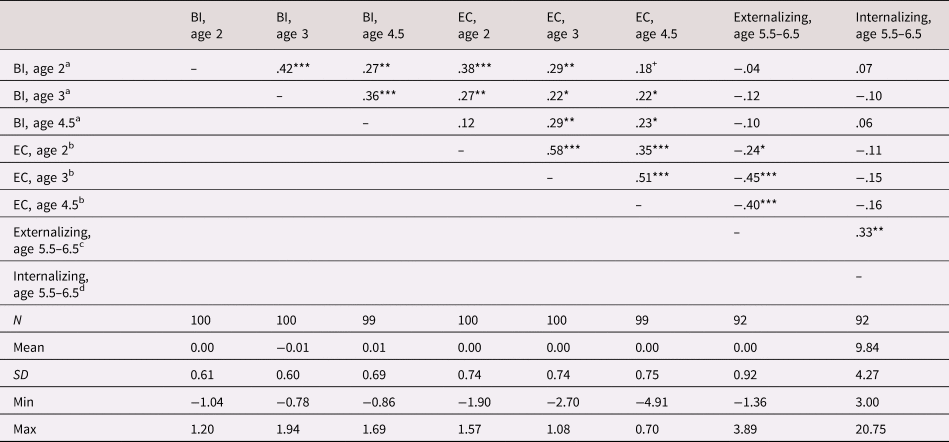
Attrition analysis revealed no significant differences on any variables between children who remained versus those who dropped out from the study. Little's MCAR test revealed that data were missing completely at random, χ2 (25) = 25.583, p = .43. Descriptive statistics and correlations are listed in Table 3. BI and EC at ages 2, 3, and 4.5 were modestly to moderately correlated with each other. Both traits were moderately stable across the three assessments. EC, but not BI, was correlated negatively with externalizing problems at ages 5.5–6.5. Parents’ ratings of children's externalizing and internalizing problems were positively correlated.
Descriptive statistics and correlations in Study 2

Note. BI = behavioral inhibition; EC = effortful control.
a Composite of standardized scores for behavioral inhibition in the Risk Room paradigms, two at each age.
b Composite of standardized scores for delay tasks.
c Composite of standardized scores for mother- and father-rated externalizing problems and aggression.
d Composite of mother- and father-rated internalizing problems.
+ p < .10. *p < .05. **p < .01. ***p < .001.
Similar to the analytical approach adopted in Study 1, we used BI, EC, and their interaction to predict externalizing problems at 5.5–6.5 years, with BI modeled as the moderator of the association between EC and externalizing problems. Because BI and EC develop rapidly from 2 to 4.5 years, to capture the potential developmental timing effects, we estimated separate effects of BI and EC, and their interaction at each age: at 2, 3, and 4.5 years. Child internalizing problems were covaried. Because child gender and family income did not produce significant effects in the final equation, to reduce the number of predictors those variables were not included.Footnote 1 All continuous predictors were mean-centered. Analysis was conducted in Mplus, and missing data were handled using FIML.
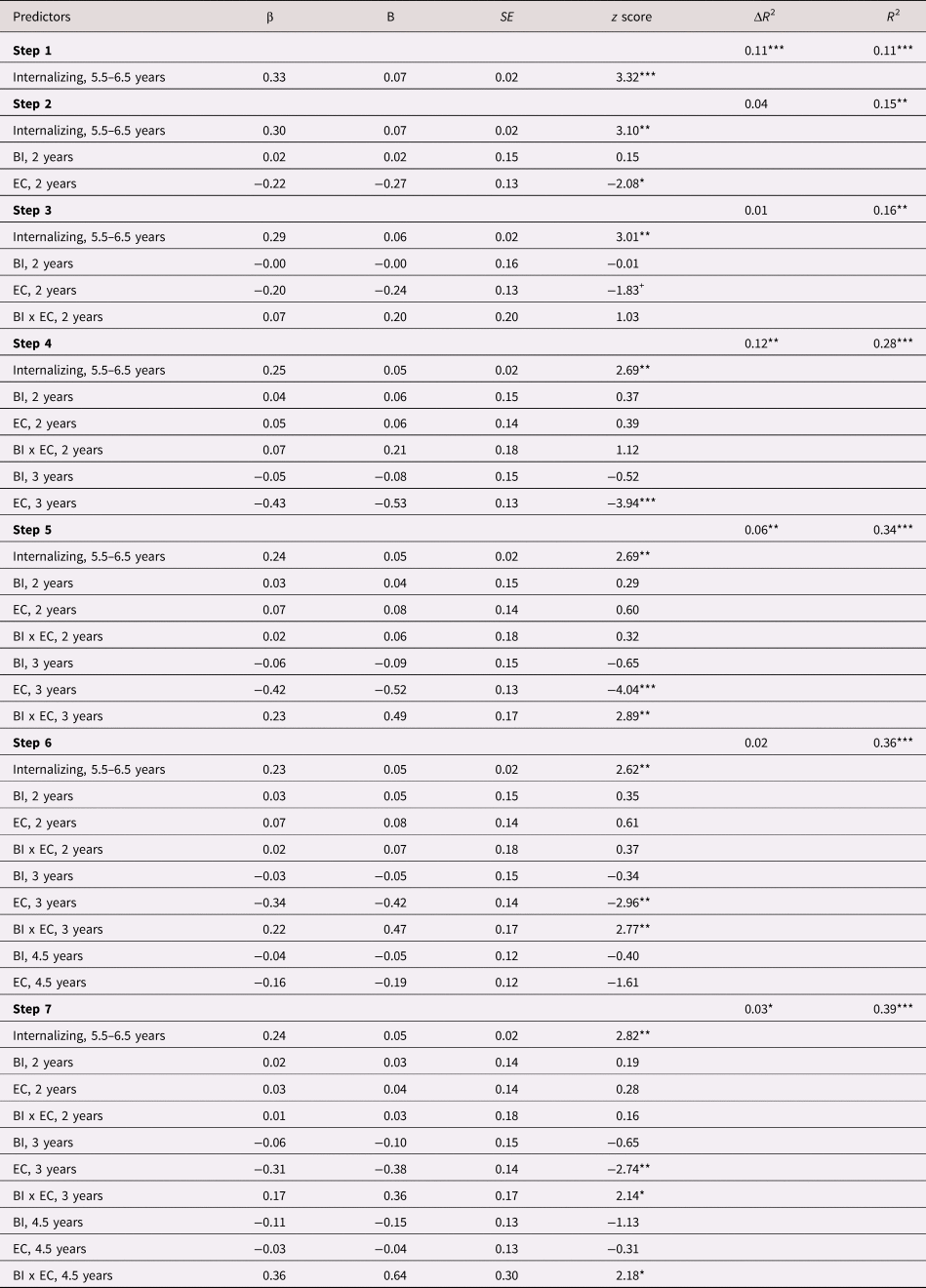
The findings in Study 2 partially replicated those in Study 1, but in addition revealed the role of developmental timing. Detailed results of the models are in Table 4. At age 2, neither BI nor EC, nor their interaction predicted externalizing behavior at ages 5.5–6.5.
Study 2: Prediction of externalizing problems at age 5.5–6.5 years from BI, EC, and their interactions at ages 2, 3, and 4.5 years

Note. β = standardized regression coefficient using the STDXY option in Mplus. B = unstandardized regression coefficient. BI = behavioral inhibition. EC = effortful control.
*p < .05. **p < .01. ***p < .001.
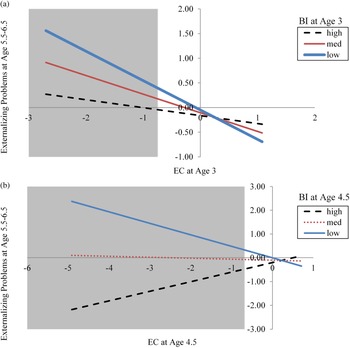
However, at age 3, EC, but not BI, was associated negatively with externalizing problems at ages 5.5–6.5. As in Study 1, the effect of EC was qualified by a significant interaction between BI and EC. Simple slopes of the interaction are depicted in Figure 2, Panel a. For children with low (−1 SD) and average (0 SD) BI (relatively fearless), EC at age 3 was associated negatively with externalizing problems at 5.5–6.5 years, B = −0.60, SE = 0.17, p < .001, and B = −0.38, SE = 0.14, p = .006, respectively. By contrast, for children with high (+1 SD) BI (relatively fearful), EC was unrelated to externalizing problems, B = −0.16, SE = 0.17, p = .34. Mirroring the findings in Study 1, the Johnson–Neyman RoS test suggested that children with average or low BI scores, and who were also low in EC (<−1.10 SD) displayed more externalizing problems than their fearful peers.
Study 2. (Panel a): Age 3. Simple slopes of EC predicting externalizing problems at low (−1 SD), mean (0 SD), and high (+1 SD) values of BI. (Panel b): Age 4.5. Simple slopes of EC predicting externalizing problems at low (−1 SD), mean (0 SD), and high (+1 SD) values of BI. Solid lines represent significant simple slopes, and dashed lines represent nonsignificant simple slopes. The shaded area represents the region of significance. Results based on the interaction effects in the final equation, with all predictors entered. BI = behavioral inhibition; EC = effortful control.

At age 4.5, neither BI nor EC was related to externalizing problems. However, as in the model for age 3, the interaction between BI and EC was significant. Simple slopes of the interaction are depicted in Figure 2, Panel b. As at age 3, for children with low BI (−1 SD, relatively fearless), EC was associated negatively with externalizing problems, B = −0.49, SE = 0.18, p = .006; whereas for children with average (0 SD) and high (+1 SD) BI, EC was unrelated to externalizing problems, B = −0.04, SE = 0.13, p = .76, and B = 0.40, SE = 0.30, p = .17, respectively. The Johnson–Neyman RoS test suggested that children who were fearless at age 4.5, and who were also low in EC (<−0.93 SD) displayed more externalizing problems than their fearful peers.
Discussion
The goal of Study 2 was to replicate the findings from Study 1 with a very comparable sample. We utilized measures of BI and EC that were parallel to Study 1 to deliver a close replication. We expanded the targeted age range from toddler age to the entry to kindergarten and the early school age, when the ecological contexts in which children are immersed and daily tasks and interactions they face become increasingly complex.
In addition, we examined the studied processes separately at three different points in development: at age 2, 3, and 4.5. Moreover, we aimed to extend the findings about early disregard for maternal rule to a broader spectrum of disruptive problems. To that effect, we measured externalizing problems robustly, obtaining data from two informants – mothers and fathers – across two assessments and deploying well-established instruments. Furthermore, we controlled for the effect of children's internalizing problems, given their known (and found in this study) overlap with externalizing problems.
Remarkably, we replicated largely the same pattern of findings as in Study 1. Specifically, children with relatively low BI (fearless) were rated as having more externalizing problems, but only when their EC was also low. By contrast, children with high BI (fearful) displayed few externalizing problems, even when their EC was low. Thus, as in Study 1, high EC could offset the risk due to low BI, and high BI could offset the risk due to low EC. Also replicating Study 1, we found evidence for the mutual “negative synergy”: Children with relatively low scores on both inhibitory systems (low BI and low EC) were rated as having the most externalizing problems.
Importantly, the analyses revealed the role of developmental timing: the effects of temperament on externalizing problems were not yet present for measures of temperament at age 2 and first appeared at age 3, to remain significant at 4.5. One possible reason may be the fact that EC only emerges in the second year and is generally seen as developing quickly in the third year. Also, both temperament traits, and particularly BI, are only moderately stable throughout early childhood (Degnan & Fox, Reference Degnan and Fox2007). Consequently, it is not surprising that the scores obtained closer in time to the outcomes would be more predictive. This interesting developmental timing effect needs to be replicated in future studies.
Study 2 shared some of the same limitations with Study 1. The families came from a low-risk, two-parent community sample with typically developing children. Nevertheless, the measures of externalizing problems and the temperament traits were largely well distributed, and the findings supported our model. Future studies should include diverse samples and children with elevated behavior problems. In contrast to Study 1, in Study 2 we did not have (and could not covary) earlier parallel measures of the outcomes, as CSI and HBQ were first administered at age 5.5. Nevertheless, Study 2 produced, by and large, a robust replication of Study 1.
General Discussion
Although research on Temperament × Temperament interactions (Rothbart & Bates, Reference Rothbart, Bates, Damon, Lerner and Eisenberg2006) has been recently growing, those effects have received less research attention than other types of interactions involving temperament, for example, interactions with parenting or environment more generally. In the present two-study package, we examined the interplay of two inhibitory systems of temperament – reactive inhibition, fearfulness, or BI and active, deliberate inhibition, or EC– in the early development of disregard for rules of behavior (in Study 1) and more generally, externalizing problems (in Study 2). The findings were quite straightforward and replicated across both studies.
Both studies produced evidence that EC predicted the outcomes. In Study 1, children with stronger EC skills were less likely to disregard maternal rule at age 4. In Study 2, children with stronger EC skills at age 3 were less likely to be described by parents as displaying opposition, defiance, disregard for rules, and aggression at age 5.5–6.5. In neither study did we find comparable main effects for BI.
Most importantly, however, in both studies, we replicated the interaction effects of the two inhibitory systems, supporting our key expectations. The strength of one inhibitory system compensated for the risk associated with the relative weakness of the other. In particular, for children with relatively low EC, being fearful served as a factor protecting from emerging disruptive behavior, either observed or reported by parents. As well, we observed “negative synergy” in both studies, with the weakness of one system exacerbating the weakness of the other. For the children with relatively low EC, being fearless amplified the development of disruptive behavior. Children who had low scores on both reactive and active inhibition were most likely to disregard rules at preschool age and to be described as having more externalizing problems at the entry to kindergarten and early school age. Stated another way, the findings were consistent in that BI alone did not predict behavioral outcomes in either study. It did, however, interact significantly with EC, such that when high, it served as a protective factor for children with low EC, but when low, it amplified risks for those children (with terms “protective” or “risks” referring to disruptive behavior).
Those findings dovetail with the gist of several bodies of research, although in various literatures the temperament constructs have been conceptualized and operationalized in ways that were related, but far from identical. Block and Block (Reference Block, Block and Collins1980) proposed four child personality profiles as combinations of high and low ego control and ego resiliency. Children representing both low ego control and low ego resiliency were characterized as externalizing, under-controlling of impulse, and restless. In a more recent literature, several studies have demonstrated that various regulatory mechanisms (e.g., EC, inhibitory control, emotion regulation, attentional skills) can be recruited to offset developmental risks for externalizing problems due to excessive exuberance or bold approach (Buss et al., 2014; Dollar et al., Reference Dollar, Stifter and Buss2017; Stifter et al., Reference Stifter, Putnam and Jahromi2008; Morales et al., Reference Morales, Miller, Troller-Renfree, White, Degnan, Henderson and Fox2019).
Of note, conceptualizations of regulatory mechanisms range broadly (Nigg, Reference Nigg2017). In the current work, we chose to focus on “hot” EC skills, operationalized as performance in various delay tasks. As we indicated earlier, many studies have examined other processes, sometimes referred to as “cool” EC or executive function, assessed in more cognitive tasks (e.g., effortful attention, Stroop-like tasks). Our past work (Kim et al., Reference Kim, Nordling, Yoon, Boldt and Kochanska2012) revealed that “hot,” but not “cool” EC predicts behavior problems. When we conducted the current analyses using “cool” EC, we again found that it did not predict our outcomes, either alone or in interactions with BI.
Study 2 revealed an interesting role of developmental timing. The predictive role of EC and the interaction between BI and EC emerged at age 38 months, the age comparable to Study 1 (33 months). It then remained significant at age 4.5 (52 months). It was not yet present at age 2 (25 months). In the second year, EC only begins to emerge, to develop rapidly in the third year (Rothbart & Bates, Reference Rothbart, Bates, Damon, Lerner and Eisenberg2006). Perhaps some degree of maturation is necessary to reveal the predictive role of early individual differences.
This work has several limitations. Both studies involved community samples and typically developing children. It is important to keep in mind that even children with relatively higher scores in our outcome measures – disregard for maternal rules in Study 1 and externalizing problems in Study 2 – were still largely well within a scope of normative variation. Similarly, the BI and EC scores in our samples were most likely in a typical range. Because different studies adopt different measurement and coding practices, and observational scores are typically standardized, it is not possible to compare our BI and EC scores with those in other studies (or generally, to compare scores across studies in the field). It would be most appropriate to think about the scores in our studies as “relatively higher or lower BI or EC scores” (i.e., compared to the scores of other children in the respective sample). We therefore need to be cautious when generalizing the findings to broader populations. Nevertheless, the findings followed the predicted patterns. Future work with families and children selected to represent elevated levels of risk for both internalizing and externalizing psychopathology will be important.
Further, both samples were also relatively modest in size, a limitation that was perhaps offset, in part, by longitudinal designs and rich behavioral and reported data from multiple observations and well-established instruments. In future research, larger samples will be essential, particularly to elucidate the effects of developmental timing, for example, by deploying strategies such as latent growth curve modeling.
The findings add to our growing understanding of Temperament × Temperament interactions and have implications for identifying early risk factors for disruptive and externalizing behaviors. Future studies need to investigate how reactive and active inhibitory systems develop, interact, and lead to risk and resilience in the contexts of early caregiving environments, especially among at-risk populations.
Acknowledgments
The authors thank many students and staff members for their help with data collection and coding, and parents and children in Parent–Child Study and Family Study for their commitment to this research.
Financial Statement
This research was funded by NIMH Grants R01 MH63096 and K02 MH01446, NICHD Grant R01 HD069171, NSF Grant SBR-9510863, and a Stuit Professorship (to G.K.).
Conflicts of Interest
None.