Introduction
Everywhere we look within our Solar system, we see evidence of impacts. Mercury is a pockmarked husk, the small remnant of a once larger differentiated planet (e.g. Benz et al. 2008), and revealed by images from passing spacecraft to be covered in innumerable craters, young and old. Despite Venus's thick atmosphere, which shields the planet's surface from small impactors, rapidly removes the evidence of impact scars, and makes it difficult to detect such scars in the first place, numerous impact features are known on the surface of Venus. The Moon, our nearest neighbour, is covered in the evidence of impacts both recent and dating back as far as the putative Late Heavy Bombardment (e.g. Gomes et al. Reference Gomes, Levison, Tsiganis and Morbidelli2005). Mars, too, bears the scars of innumerable impacts, from the giant basin which covers the entire northern hemisphere of the planet (Andrews-Hanna et al. Reference Andrews-Hanna, Zuber and Banerdt2008) to the myriad smaller craters imaged by orbiting craft (e.g. Grant et al. Reference Grant2008) and visited by roving vehicles (e.g. Cabrol et al. Reference Cabrol2006; Calvin, W. M. et al. Reference Calvin2008).
Compared with Mercury, the Moon and Mars, relatively few impact craters are known on the Earth. The current tally stands at just 176Footnote 1 confirmed impact features, a value which reflects the efficient weathering which removes such features from the surface on geological timescales, the difficulty in detecting and confirming such features (which are particularly well hidden by e.g. rainforests, oceans, and polar caps), and the fact that impactors are very efficiently slowed upon hitting the ocean, such that only the largest can leave craters beneath the ~70% of our planet which is covered by the oceans (Baldwin et al. Reference Baldwin, Milner, Burchell and Crawford2007; Milner et al. Reference Milner, Baldwin and Burchell2008).
Despite the relative paucity of impact structures on the Earth, it is clear that impacts continue to rain down upon our planet. Such impacts can have significant effects on the biosphere of the planet, and have been proposed as the cause of a number of mass extinctions through the Earth's history. The extinction event which has drawn most attention over the years was that which involved the death of the dinosaurs, 65 million years ago. Many astronomers believe that the major factor in that extinction was the impact of a large (~10 km) asteroidal or cometary body, creating the Chicxulub impact crater (e.g. Brett, Reference Brett1992; Bottke et al. Reference Bottke, Vokrouhlický and Nesvorný2007), though a number of other mechanisms are considered more likely by scientists in other fields (e.g. Glasby & Kunzendorf Reference Glasby and Kunzendorf1996; Poinar & Poinar Reference Poinar and Poinar2008). Regardless of what truly killed the dinosaurs, however, the idea that they could have been wiped out by the impact of a giant rock from space highlights the importance of understanding the processes by which such objects can be placed on Earth-encountering orbits. Such understanding is also vitally important when it comes to considering the search for life beyond our Solar system as is discussed in the review by Horner & Jones (Reference Horner and Jones2010), elsewhere in this proceedings.
Within our Solar system, there are three distinct groups of objects which contribute to the impact flux at Earth. The near-Earth asteroids, rocky and metallic bodies ranging in size up to the 32 km diameter Ganymed, are currently believed to be the main contributors to the terrestrial impact flux, with smaller contributions coming from short- and long-period comets (e.g. Chapman Reference Chapman1994; Bottke et al. Reference Bottke, Morbidelli, Jedicke, Petit, Levison, Michel and Metcalfe2002). The three populations of potentially threatening objects are all dynamically unstable, and would be expected to become depleted on timescales of, at most, a few million years, if they were not continually resupplied from reservoirs of more stable parent objects.
The near-Earth asteroids are sourced from the asteroid belt (e.g. Morbidelli et al. Reference Morbidelli, Bottke, Froeschlé and Michel2002), and the mechanisms by which they are delivered to the Earth are believed to be well understood (as discussed in that work). The long-period comets are sourced from the Oort-cloud, a vast collection of cometary nuclei held in cold storage in a cloud believed to stretch half-way to the nearest star (e.g. Oort Reference Oort1950), and are thought to be injected to the inner Solar system as a result of perturbations on the Oort-cloud by passing stars (e.g. Oort Reference Oort1950; Biermann & Huebner Reference Biermann, Huebner and Lust1983), giant molecular clouds (e.g. Mazeeva Reference Mazeeva2004; Thaddeus & Chanan Reference Thaddeus and Chanan1985), the galactic tide (e.g. Heisler & Tremaine Reference Heisler and Tremaine1986; Fouchard et al. Reference Fouchard, Froeschlé, Matese and Valsecchi2005), and even, potentially, a massive companion to the Sun (e.g. Horner & Evans Reference Horner and Evans2002; Matese et al. Reference Matese, Whitman and Whitmire1999; Murray Reference Murray1999; Matese & Whitmire Reference Matese and Whitmire2010).
The origin of the short-period comets, however, is still the subject of some debate. While the proximate source of these objects is well known to be the Centaurs (e.g. Horner et al. Reference Horner, Evans, Bailey and Asher2003, Reference Horner, Evans and Bailey2004a, Reference Horner, Evans and Bailey2004b; Tiscareno & Malhotra Reference Tiscareno and Malhotra2003; di Sisto & Brunini Reference di Sisto and Brunini2007), the origin of the Centaurs themselves is still not well constrained. Initially, the Edgeworth-Kuiper beltFootnote 2 was mooted as the main source region for the Centaurs (e.g. Levison & Duncan, Reference Levison and Duncan1997). Indeed, the belt itself was independently predicted by both Edgeworth (Reference Edgeworth1943) and Kuiper (Reference Kuiper and Hynek1951) to explain the short-period comet population, long before the first members were discovered. Kuiper, however, suggested that such a belt would likely no longer be present as a result of dynamical scattering by Pluto, which was then still believed to be a planet-mass object. More recent studies have suggested that the key source of Centaurs is either the Scattered DiskFootnote 3 (e.g. Volk, K. & Malhotra, M. Reference Volk and Malhotra2008) or the inner Oort Cloud (e.g. Emel'Yanenko et al. Reference Emel'yanenko, Asher and Bailey2005, Reference Emel'Yanenko, Asher and Bailey2007). Horner & Evans (Reference Horner and Wyn Evans2006) also showed that some Centaurs can be captured into 1:1 mean-motion resonance with the giant planets (primarily Jupiter), becoming temporary members of their Trojan populations (in a solely gravitational set up consisting of the Sun and the host planet (and possibly other objects in distant orbits), any route by which an object can be dynamically captured can also be followed allowing an object to escape to non-Trojan space). Given that effects such as dynamical capture are time-reversible processes, the authors suggested that the Jovian Trojan population might act as an additional source of material to the Centaur population, contributing some small fraction of the total flux of fresh cometary material into the inner Solar system.
In this work, we propose a second resonant source of material for the Centaurs, namely the Neptune Trojan population. In section 2, we provide a brief description of this recently discovered addition to the menagerie of Solar system objects, before describing briefly a variety of dynamical studies we have carried out into both their formation and the evolution of current members of the family. In section 3, we provide exemplar results showing how Neptune Trojans can evolve to become short-period comets, before detailing simple calculations which suggest the Neptune Trojans might even represent the main source of material to the Centaur population. Finally, in section four, we discuss the implications of our work for our understanding of habitability in our own Solar system and beyond, and draw our conclusions.
The Neptune Trojans
Planetary Trojans are objects which orbit the Sun trapped within the 1:1 mean-motion resonance of a given planet. In the simplest terms, this means that such objects orbit the Sun with essentially the same orbital period as the planet, on approximately the same orbit, moving such that they are protected by the action of the resonance from ever experiencing a close encounter with that planet. Most such objects move on tadpole-shaped orbits, librating around the L4 and L5 Lagrange points, located 60° ahead and behind of the planet in its orbit. These Lagrange points offer regions of stability in which objects can remain trapped on timescales of billions of years (e.g. Holman & Wisdom Reference Holman and Wisdom1993; Murray & Dermott Reference Murray and Dermott1999; Nesvorný & Dones Reference Nesvorný and Dones2002). A few objects trapped in Trojan orbits follow less stable horseshoe-shaped paths, moving between the L4 and L5 Lagrange points, but still never approaching their host planet particularly closely. Such orbits are typically somewhat less stable than their tadpole brethren, and as such are less well represented in the catalogue of Solar system Trojans. For an aesthetically pleasing and simple illustration of both tadpole and horseshoe Trojan behaviour, we direct the interested reader to figs 1 and 2 of Chebotarev (Reference Chebotarev1974).
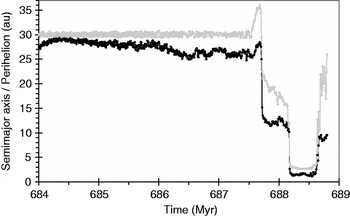
The dynamical evolution of a pre-formed Neptune Trojan during the few million years around its escape from the Neptunian Trojan cloud. This object formed as a Neptune Trojan prior to Neptune's migration, and was carried by the migration of the planet from an initial semi-major axis of 18.1 AU to 30.1 AU, remaining as a Trojan throughout. Its orbit was then followed under the influence of the four giant planets, Jupiter, Saturn, Uranus and Neptune until it was ejected from the Solar system, just under 689 Myr after Neptune ceased migration. The grey line shows the evolution of the object's semi-major axis, and the black line its perihelion distance. The first 684 Myr of the objects evolution were unremarkable, but the final ~3 Myr of its life as a Trojan was marked by a gradual increase in orbital eccentricity (evidenced by the gradual inward march of the Trojan's perihelion distance. Eventually, at around 687.5 Myr, the object leaves the Neptune Trojan population, and a series of close encounters with Neptune and Uranus drive the object inward, dropping its perihelion towards the orbit of Saturn. At around 688.2 Myr, the object is captured to a short-period cometary orbit, reminiscent of that of comet 2P/Encke, where it remains for around 500 kyr, before being ejected back to the Centaur region, then removed from the Solar system just before the 689 Myr mark. The orbital elements of this Trojan at the start of the integration (t=0) were a=30.118392 AU, e=0.0211010, i=8.730000°.

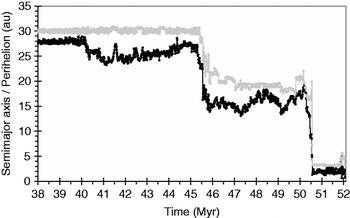
The dynamical evolution of a pre-formed Neptune Trojan during the few million years around its escape from the Neptunian Trojan cloud. This object formed as a Neptune Trojan prior to Neptune's migration, and was carried by the migration of the planet from an initial semi-major axis of 18.1 AU to 30.1 AU, remaining as a Trojan throughout. Its orbit was then followed under the influence of the four giant planets, Jupiter, Saturn, Uranus and Neptune until it was ejected from the Solar system, just over 52 Myr after Neptune ceased migration. The grey line shows the evolution of the object's semi-major axis, and the black line its perihelion distance. The first 40 Myr of the evolution of this object were unremarkable, but a sudden increase in orbital eccentricity (evidenced by a sudden drop in perihelion distance) just after the 40 Myr mark marks the beginning of its exit from the Trojan cloud. The increased eccentricity of the orbit makes it significantly less stable as a Trojan, and just 6 Myr later, the object leaves the Trojan cloud for the Centaur population. It rapidly moves inwards, ending up on an orbit with aphelion near Uranus (~19 AU), under whose control the object remains until ~50.5 Myr, when a series of close encounters with Saturn and Jupiter inject it to the inner Solar system as a short-period comet, where it remains for the last ~1.5 Myr of its life before being ejected from the Solar system by a close encounter with Jupiter. The orbital elements of this Trojan at the start of the integration (t=0) were a=30.042517 AU, e=0.0355650, i=14.80000°.

The most famous Trojan population is that hosted by the planet Jupiter. The first member, 588 Achilles, was discovered in 1906, and there are now over 3000 such objects known. It is postulated that there may actually be more objects in the Jovian Trojan population than the asteroid belt – the only reason we have found fewer to date is simply that they are further from the Sun, and hence significantly fainter and harder to detect. For the same reason, the first Neptunian Trojan was not discovered until 2001 – again, these objects, being still more distant, are even fainter and harder to spot. However, the presence of such a population had been, to an extent, anticipated long before that discovery (e.g. Mikkola & Innanen Reference Mikkola and Innanen1992).
To date, only six Neptune Trojans have been discovered, namely 2001 QR322, 2004 UP10, 2005 TN53, 2005 TO74, 2006 RJ103 and 2007 VL305. All six objects move on tadpole orbits around the Neptunian L4 Lagrange point (for a table detailing their orbital parameters, we refer the interested reader to Lykawka et al. Reference Lykawka, Horner, Jones and Mukai2009, table 1). Despite this apparent lack of observational data, the population already displays a number of unexpected features. First, based on this small observational sample, it is estimated that the Neptune Trojan population is at least as numerous as that of the main Asteroid belt, and likely actually outnumbers that population by an order of magnitude (Sheppard & Trujillo Reference Sheppard and Trujillo2006). Furthermore, although it had been widely postulated that any Neptunian Trojan population would be dynamically cold (i.e. the members having very low orbital inclinations and eccentricities), it instead seems to be considerably more excited than was expected, as evidenced by the two moderately inclined Trojans (2005 TO74 & 2006 RJ103) and those with unexpectedly high inclination (2005 TN53 & 2007 VL305). This result seems particularly surprising when one considers that our Solar system is believed to have formed from a dynamically cold disk of debris (with particles on very low inclination and eccentricity orbits). Had the Trojans formed from such a disk, then it seems reasonable to anticipate they would also lie on very dynamically cold orbits (e.g. Chiang & Lithwick Reference Chiang and Lithwick2005; Hahn & Malhotra Reference Hahn and Malhotra2005). The situation is exacerbated by the biases inherent in the search for objects beyond Neptune. Surveys often concentrate on areas in the plane of the ecliptic, which means that objects on low inclination orbits are far more likely to be discovered than those at high inclination. Sheppard & Trujillo (Reference Sheppard and Trujillo2006) argue that finding so many highly inclined Trojans in the current sample suggests that there are likely to be far more Trojans on high inclination orbits than there are on dynamically cold orbits, which in turn has implications for the formation of the population itself. As such, a number of authors now view the Neptune Trojans as an exciting new test bed for models of the formation of our Solar system (e.g. Ford & Chiang Reference Ford and Chiang2007; Lykawka & Mukai Reference Lykawka and Mukai2008; Levison et al. Reference Levison, Morbidelli, Vanlaerhoven, Gomes and Tsiganis2008; Lykawka et al. Reference Lykawka, Horner, Jones and Mukai2009, Reference Lykawka, Horner, Jones and Mukai2010; Lykawka & Horner Reference Lykawka, Horner, Jones and Mukai2010). Over the coming decade a number of observational programs will greatly increase our understanding of the Neptunian Trojan population, from detailed studies of individual Trojans using the Herschel space telescope (e.g. Mueller et al. Reference Mueller2009) to the potentially vast numbers of new objects that will be discovered by surveys such as Pan-STARRS (Jewitt Reference Jewitt2003) and the LSST (Ivezic et al. Reference Ivezic2008). A better understanding of the structure of the Neptunian Trojan cloud will reveal a great deal about the dynamical processes which occurred during the final stages of planetary formation within our Solar system, and provide a vital extra datum for models attempting to explain the more general process through which other planetary systems form and evolve.
Simulating the capture and evolution of the Neptune Trojan population
We have carried out a number of contemporaneous studies of the Neptunian Trojan population (using the dynamical packages MERCURY (Chambers, Reference Chambers1999) and EVORB (Brunini & Melita Reference Brunini and Melita2002) to carry out our numerical orbital integrations), in an attempt to better understand their formation and long term evolution. That work is explained in detail elsewhere (e.g. Lykawka et al. Reference Lykawka, Horner, Jones and Mukai2009, Reference Lykawka, Horner, Jones and Mukai2010; Lykawka & Horner Reference Lykawka, Horner, Jones and Mukai2010; Horner & Lykawka Reference Horner and Lykawka2010a, Reference Horner and Lykawkab). Here, we present a brief summary of that work, prior to detailing the key results that have implications for the flux of potential impactors to the inner Solar system.
First, to examine the stability of the current Neptune Trojan population, we carried out small scale integrations (using just a small number of test particles) of the orbits of each of the known Trojans. For these, we took the nominal orbit of each object (as of 5th Feb 2009) and used that as the base for a population of 100 clones. These clones were placed on orbits spread evenly across the 3σ orbital uncertainties in the object's semi-major axis and eccentricity and, when combined with a test particle placed on the nominal orbit, led to a test population of 101 objects. The orbits of these particles were then integrated for a period of 10 Myr under the influence of Jupiter, Saturn, Uranus and Neptune, which allowed the various properties of their resonant behaviour to be determined (for more detail, see section 2 of Lykawka et al. Reference Lykawka, Horner, Jones and Mukai2009). Interestingly, the behaviour of the clones of 2001 QR322 suggested that it might be somewhat dynamically unstable (in contrast to the results of earlier work, e.g. Chiang et al. Reference Chiang2003; Marzari et al. Reference Marzari, Tricarico and Scholl2003; Brasser et al. Reference Brasser, Mikkola, Huang, Wiegert and Innanen2004; Sheppard & Trujillo Reference Sheppard and Trujillo2006). This led us to a more detailed study of the dynamics of that object (Horner & Lykawka Reference Horner and Lykawka2010b), which followed the evolution of 19 683 test particles (spread evenly across ±3σ in semi-major axis, inclination and eccentricity around the nominal orbit) for a period of 1 Gyr. That study revealed that the number of clones of 2001 QR322 that remain in the Neptunian Trojan cloud decays in a roughly exponential fashion, with a typical dynamical half-life of ~550 Myr. Once the clones leave the Neptunian Trojan population, they behave as typical Centaurs, experiencing repeated close encounters with the giant planets which act to hand them back and forth, much as described in Horner et al. 2004. Indeed, a number of the clones evolved inward to become Jupiter-family comets for a period of time prior to their removal from the Solar system. The Jupiter-family comets are the component of the short-period comet population whose aphelia lie in the vicinity of Jupiter's orbit. These objects make up the great bulk of the short-period population, and typically move on orbits of period ~10 years or less. A protracted stay as a Jupiter-family comet, then, increases the likelihood of a given object having the opportunity to hit the Earth – simply, the shorter the orbital period of the object, the more potential encounters with the Earth can happen in a given period. For more details on the difference between the Jupiter-family comets and the short-period comets, we direct the interested reader to Horner et al. Reference Horner, Evans, Bailey and Asher2003.
In parallel to these studies, we examined the effect of planetary migration (e.g. Fernandez & Ip Reference Fernandez and Ip1984; Malhotra Reference Malhotra1995; Gomes et al. Reference Gomes, Morbidelli and Levison2004; Hahn & Malhotra Reference Hahn and Malhotra2005) on the Neptunian Trojan population (Lykawka et al. Reference Lykawka, Horner, Jones and Mukai2009). In that work, we considered a variety of conservative scenarios detailing the final stages of planetary formation. There are two distinct ways in which an object can become a Neptune Trojan at the current time. Firstly, it is possible that they could form as such, prior to the migration of the planet, and then be carried along with it through the course of its subsequent migration to its current location. Alternatively, the object could form elsewhere, and be captured as a Neptune Trojan at a later date. Due to the various instabilities encountered by the planet through the course of its migration, it seems that the easiest way to capture such objects would be during that process, although it should be noted that Horner & Evans (Reference Horner and Wyn Evans2006) show that temporary capture of material to planetary Trojan clouds can happen even at the current epoch. In our work, then, we considered both possibilities. We followed the dynamical evolution of pre-formed Trojans as they were transported along with Neptune during its migration, and also examined the efficiency with which the planet captured fresh Trojans from the planetesimal disk through which it migrated.
We found that migration was typically unable to excite the pre-formed Trojan population to high inclinations and eccentricities, except when it involved the orbits of Uranus and Neptune experiencing a period of mutual excitation. In that scenario, the transport was highly inefficient, with the great majority of objects being lost (even if some were later recaptured). In the other scenarios tested, transport of Trojans was surprisingly efficient, with survival rates of up to 98%. The capture of Trojans during migration was reasonably inefficient, typically of order 0.1–1%. Although this sounds a small value, we note that there was likely upwards of 30 Earth-masses of material from which to capture Trojans, and so such capture is fully compatible with a large modern day Trojan population. Captured objects typically reproduced the observed spread of inclination and eccentricities of the current day Neptune Trojan population, and so seem the most promising source of that population. Again, for more detail, see Lykawka et al. Reference Lykawka, Horner, Jones and Mukai2009. We followed that work by further examination of the influence of the initial planetary architecture on the final Trojan population, finding that scenarios in which Uranus and Neptune are mutual resonant leads to a significant dynamical excitation and erosion of the Neptunian Trojan cloud (Lykawka et al. Reference Lykawka, Horner, Jones and Mukai2010).
Finally, in an ongoing project, we are examining the behaviour of the Trojan clouds produced at the end of the planetary migration runs detailed in Lykawka et al. (Reference Lykawka, Horner, Jones and Mukai2009). There, we use the post-migration results as the seed for fresh integrations that follows the evolution of the Trojan clouds over the 4 Gyr since migration came to a halt. Those simulations are still ongoing, but reveal a significant flux of Trojan material onto unstable orbits in the outer Solar system.
A common theme across all these integrations is the transfer of material from theoretically stable orbits within the Neptune Trojan cloud to the dynamically unstable Centaur population. Once objects become Centaurs, they are dynamically indistinguishable from Centaurs sourced from other regions of the Solar system, and behave much as illustrated in earlier detailed studies of such objects (e.g. Horner et al. Reference Horner, Evans and Bailey2004a, Reference Horner, Evans and Baileyb; di Sisto & Brunini Reference di Sisto and Brunini2007; Volk & Malhotra Reference Volk and Malhotra2008; Bailey & Malhotra Reference Bailey and Malhotra2009). Therefore, on the basis of those previous works, it seems reasonable to expect that some ~30% of escaped Neptune Trojans will, at some point, become Jupiter-family comets.
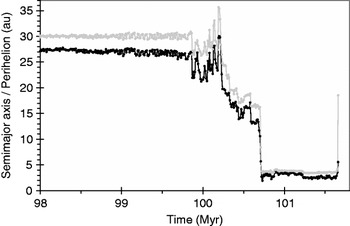
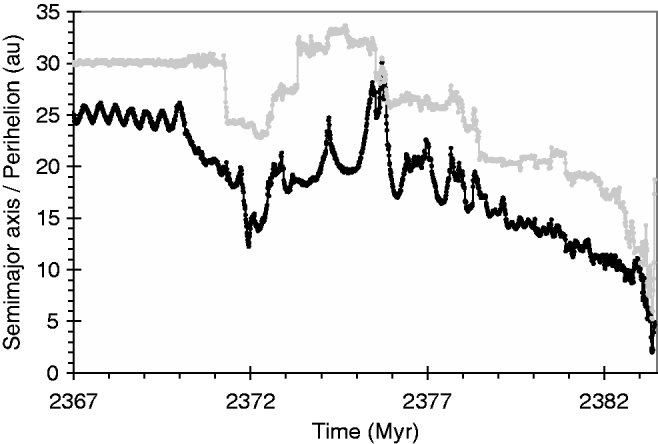
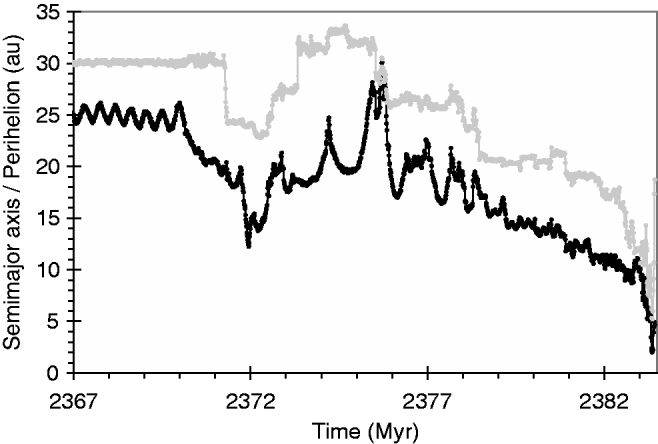
To illustrate this behaviour, we present a few examples of the evolution of objects that become Jupiter-family comets after leaving the Neptune Trojan population in figures 1–4. For simplicity, each object shown comes from the post-migration evolution of a population of objects obtained at the end of a scenario in which Neptune migrated slowly (taking ~50 Myr) from an initial semi-major axis of 18.1 AU to its current location. The three other giant planets (Jupiter, Saturn and Uranus) also migrated over the same timescale, such that all giant planets reached their terminal locations at the end of the period.
The post-migration evolution of the objects under the influence of Jupiter, Saturn, Uranus and Neptune was followed using MERCURY (Chambers, Reference Chambers1999) until they were removed from the Solar system (reaching an ejection distance of 50 AU)Footnote 4. In each figure, t=0 corresponds to the start of those integrations following the evolution of the clouds of particles once Neptune's migration has come to a halt, so the time shown on the x-axis corresponds to the post-migration evolution of the object. The objects shown in figures 1 and 2 were originally pre-formed Neptune Trojans, whilst those shown in figures 3 and 4, by contrast, were originally captured as Neptune Trojans from the planetesimal disk during the migration of the planet. Although these objects formed at different locations in the disk, they survived within the Trojan clouds for tens or hundreds of Myr after the migration of the planet ceased. It should be noted that the evolution of the objects was followed using a time-step of 0.5 years, which, though perfectly reasonable for objects in the outer Solar system, would be expected to yield errors in the orbits of objects moving with perihelia of less than ~2 or 3 AU. As such, we caution the reader to view the final evolution of the objects (once they are within the inner Solar system) as illustrative rather than definitive, especially since the terrestrial planets were not included in the integrations. Nevertheless, these examples illustrate nicely the way in which objects can move rapidly (sometimes in less than 1 Myr) from orbits in the Neptunian Trojan clouds to become short-period comets.
The dynamical evolution of a captured Neptune Trojan during the few million years around its escape from the Neptunian Trojan cloud. This object was initially a member of the planetesimal disk through which the planets moved as they migrated. It was captured as a Neptune Trojan during that planet's outward migration from an initial location 18.1 AU from the Sun, in the early days of our Solar system. Once Neptune ceased to migrate, having reached its current location, the dynamical evolution of the object was followed under the gravitational influence of Jupiter, Saturn, Uranus and Neptune, until it was removed from the Solar system. After almost 100 Myr evolving as a typical Neptunian Trojan, the object left the Neptune Trojan cloud, and rapidly and chaotically evolved inwards as a Centaur through a series of close encounters with Neptune, Uranus, Saturn and Jupiter. Less than 1 Myr after leaving the Trojan cloud, the object was injected to the inner Solar system on a long lived short-period cometary orbit, where it remained for almost 1 Myr before being ejected from the Solar system by a close encounter with Jupiter. The orbital elements of this Trojan at the start of the integration (t=0) were a=29.986243 AU, e=0.0551690, i=1.75000°.

The dynamical evolution of a captured Neptune Trojan during the few million years around its escape from the Neptunian Trojan cloud. This object was initially a member of the planetesimal disk through which the planets moved as they migrated. It was captured as a Neptune Trojan during that planet's outward migration from an initial location 18.1 AU from the Sun, in the early days of our Solar system. Once Neptune ceased to migrate, having reached its current location, the dynamical evolution of the object was followed under the gravitational influence of Jupiter, Saturn, Uranus and Neptune, until it was removed from the Solar system. After about 2.370 Gyr evolving as a typical and “stable” Neptunian Trojan, the object left the Neptune Trojan cloud. It then underwent a random walk in semi-major axis and eccentricity, as a result of close encounters with Neptune and Uranus, for a period of some 12 Myr, until it finally underwent a series of close encounters with Saturn which resulted in the object being transferred to Jupiter's domain at around the 2.383 Gyr mark. In just a few hundred thousand years, the object was injected to the inner Solar system on a short lived short-period cometary orbit, upon which it remained for around 0.1 Myr before being ejected from the Solar system by a close encounter with Jupiter. The orbital evolution of this object, particularly the Gyr-timescale survival as a Neptune Trojan prior to escaping the Trojan clouds, highlights the fact that escapees from the Trojan clouds can evolve to orbits in the inner Solar system at all times through the evolution of the Solar system, even to the current day. We can therefore expect some fraction of the modern SPC population to have been sourced from the Neptunian Trojan population, so long as that population continues to decay at this epoch (a result which seems to be the case based on current observational and theoretical evidence, as described in the main text). The orbital elements of this Trojan at the start of the integration (t=0) were a=30.111069 AU, e=0.1955760, i=34.620000°.
It is fairly straightforward to make a simple estimate of the contribution of the Neptune Trojans to the Centaur population. Here, we present two such “back of an envelope” calculations, one very conservative, the other significantly less so.
Conservatively, let us assume that the current day population of the Neptunian Trojan clouds numbers some 106 objects greater than 1 km in diameter. This is within the range suggested for the population of the asteroid belt at these sizes (700 000 to 1.7×10⁶; Tedesco & Desert Reference Tedesco and Desert2002). If we then assume that 2001 QR322 is particularly unusual in being dynamically unstable, and that the typical decay lifetime of objects in the Neptune Trojan population is similar to the age of the Solar system (i.e. 4 Gyr), then this suggests that, over the last 4 Gyr, a total of ~106 objects have been transferred from the Neptune Trojan population to the Centaurs (and ~300 000 of them have become Jupiter-family comets, following Horner et al. Reference Horner, Evans and Bailey2004a, who showed ~30% of Centaurs enter the Jupiter-family at some point). This suggests an injection of approximately one new Centaur every 4000 years. In comparison, Horner et al. (Reference Horner, Evans and Bailey2004a) suggested that, in order to maintain a steady state Centaur population of ~44 000 objects, the Centaurs required one new member every 125 years. In other words, with these very conservative approximations, the Neptunian Trojan population is still capable of supplying ~3% of the total flux of Centaurs.
If, however, we assume that the Neptunian Trojan population is in fact of order 107 objects (as suggested by the results of Sheppard and Trujillo Reference Sheppard and Trujillo2006), and that 2001 QR322 is only marginally more unstable than the typical Trojan (such that typical Trojans have a dynamical half-life of 1 Gyr), then the Trojans become the key source for the Centaurs. In this scenario, 107 Trojans would have become Centaurs in the last 1 Gyr, a flux of one new object every 100 years – more than enough to maintain the predicted Centaur population without recourse to any other source region!
It is clear that significantly more study is needed of the Neptune Trojans. As new objects are discovered, dynamical studies will reveal whether 2001 QR322 is the exception, or the norm, and the true extent of the current day contribution of the Neptune Trojans to the Centaur population will become clear. It seems likely that the final result will lie somewhere between the two extremes detailed above, but it is clear that, at the very least, the Neptune Trojans should not be discounted as a source of objects that could hit the terrestrial planets.
Discussion and Conclusions
It is clear that the Neptune Trojan population represents a large reservoir of objects held essentially in cold storage since the giant planets migrated to their current locations. Although the bulk population is stable on Gyr timescales, its members are not absolutely dynamically stable, which results in a small but continuous trickle of objects leaving the cloud and moving onto dynamically unstable, planet crossing orbits. In other words, the Neptune Trojan population acts to continually resupply the Centaur population, which is the proximate source of the Jupiter-family comets, which contribute a significant fraction of the impact hazard to the Earth.
With even conservative assumptions, we have shown that the Neptune Trojans can supply at least a few percent of the material needed to maintain the Centaur and Jupiter-family populations at the currently observed level, and might even be the primary source of such objects. When one additionally considers that the Jovian Trojan population, itself likely larger than that in the asteroid belt, is likely undergoing an equivalent gradual shedding of material, it seems certain that resonant objects within planetary systems can be a significant, and hitherto overlooked, source of material feeding potentially hazardous orbits. Such a concept is of particular interest when it comes to the determination of impact fluxes and habitability in exoplanetary systems. Surveying such systems in the infra-red reveals the presence of dust linked to either the collisional grinding of, or out-gassing from, populations of potentially hazardous objects in those systems, and it is often considered that a large amount of dust in a given planetary system infers that that system would have a prohibitively high collisional regime for the development of life. It is certainly true that, in our own Solar system, collisional fragmentation plays a significant role in the transfer of material from the asteroid belt to the inner Solar system (the source of the Near-Earth asteroids), and such behaviour has also been invoked to explain the potential transfer of material from the Edgeworth-Kuiper belt to the Centaur population. In this work, however, we show that there exists a purely dynamical route by which material can be transferred from a stable reservoir (the Neptune Trojans) to the inner Solar system (the Jupiter family comets). Since such transfer does not require significant collisional grinding, it seems reasonable to consider that it would not be the source of a significant amount of dust within our system, and equally, would not yield detectable levels of dust in exoplanetary systems.
In other words, when one considers the likely habitability of exoplanetary systems, a lack of dust cannot, necessarily, be taken to directly infer a lack of potentially hazardous objects. Objects decaying from resonant populations (such as the Trojans) could easily take the role of “silent killers”, making such systems significantly less clement than would otherwise be the case. It is therefore important that such populations are properly considered when the habitability of such systems is assessed, in order to understand the degree to which those systems could be considered habitable.
Acknowledgements
PSL and JAH gratefully acknowledge financial support awarded by the Daiwa Anglo-Japanese Foundation and the Sasakawa Foundation, which proved vital in arranging an extended research visit by JAH to Kobe University. We are also particularly grateful to the referee of this paper, Barrie Jones, who made a number of helpful suggestions that greatly improved the sense, feel and flow of the paper.