Introduction
As our society ages, so the number of people with dementia living in the community will increase enormously, creating an ever greater demand on care and welfare services to deliver efficient and customized care. The policy in northern European countries is increasingly directed at enabling people with dementia to live in their own homes for as long as possible, which is also perceived to be the desire of most people with dementia. To be able to provide the appropriate care needed to realize this aim, it is important to know what the individual social, physical and emotional care needs of community-dwelling people with dementia are (van der Roest et al., Reference van der Roest, Meiland, Maroccini, Comijs, Jonker and Dröes2007). Unfortunately, their opinions and wishes regarding care are generally neglected in research.
Determining the care needs of people with dementia can be undertaken by surveying needs among informal carers and professional carers (proxy care needs) or among people with dementia themselves (subjective care needs) (Huijsman, Reference Huijsman1990; de Klaver and Scholten, Reference de Klaver and Scholten2002). Until recently, studies into the care needs of people with dementia focused mainly on proxy reports (Bjorkhem et al., Reference Bjorkhem, Olsson, Hallberg and Norberg1992; Vernooij-Dassen, Reference Vernooij-Dassen1993; Philp et al., Reference Philp1995; Gordon et al., Reference Gordon1997; Koffman and Taylor, Reference Koffman and Taylor1997; Dello Buono et al., Reference Dello Buono1999; Toseland et al., Reference Toseland, McCallion, Gerber, Dawson, Gieryic and Guilamo-Ramos1999; Aggarwal et al., Reference Aggarwal, Vass, Minardi, Ward, Garfield and Cybyk2003; Rodriguez et al., Reference Rodriguez, Leo, Girtler, Vitali, Grossi and Nobili2003; Bowes and Wilkinson, Reference Bowes and Wilkinson2003; Gaugler et al., Reference Gaugler, Kane, Kane and Newcomer2005; Buntinx et al., Reference Buntinx, Lepeleire and Ylieff2006). These studies show that community-dwelling people with dementia have substantial care needs, and a relatively high level of service use, especially regarding mobility, personal care, household tasks, behavior problems and supervision.
The few studies that have investigated subjective needs in dementia are mainly qualitative, small sample size studies, which focus on how people with dementia experience their disease and their satisfaction on received care (van der Roest et al., Reference van der Roest, Meiland, Maroccini, Comijs, Jonker and Dröes2007). So far, the subjective care needs of people with dementia have not been assessed systematically on a large scale.
This study aimed to gain insight into the care needs of community-dwelling people with dementia. For the first time a large sample of community-dwelling people with dementia and their carers were interviewed on their experienced needs, the extent to which these needs are met or unmet, and on the reasons why they experience unmet needs. This study also investigated service use, agreement on needs between people with dementia and their carer, and the relationship between sociodemographic characteristics and needs.
Method
Design
Using a cross-sectional design, the met and unmet care needs of persons with dementia were inventoried among people with dementia and their carers. The relationship between these needs and background characteristics of people with dementia and informal carers was examined as well. A between-subjects design was used to investigate the level of agreement between the needs mentioned by patients and carers within patient-carer dyads, and to describe the experienced deficiency in the offered care. To investigate possible regional differences, needs as well as the available offer were inventoried in two regions in the Netherlands.
This study was approved by the Medical Ethical Committee of the VU University Medical Center, Amsterdam.
Setting and participants
The study was carried out in two regions of the Netherlands: Noord-Holland (in the north) and Nijmegen (in the south). People with dementia and (if possible) their informal carers were approached via public recruitment in three Alzheimer cafés and in the Mantelzorgkrant (a magazine for informal carers) and through various care providing organizations: the Centrum Indicatiestelling Zorg (CIZ, the organization that determines the type and amount of care one needs and is entitled to), two memory clinics, ten meeting centers which provide a combined support program for people with dementia and their informal carers (Dröes et al., Reference Dröes, Meiland, Schmitz and Van Tilburg2004a), and three psychogeriatric day care centers. Finally, respondents were included from an ongoing study in GP practices in Noord-Holland (PIKOM project) (Jansen et al., Reference Jansen2005).
The inclusion criteria for participation in the study were: (i) a diagnosis of dementia and (ii) living at home. A total of 891 patient-carer dyads were approached with a letter inviting them to participate in the study (Figure 1). Of these, 367 (41.2%) were not reached or did not meet the inclusion criteria. Of the remaining 524 dyads, 372 (70.9%) dyads initially agreed to participate, with 51 dyads later dropping out due to, amongst other things, nursing home admission, illness and time constraints on the informal carer. The final response was 61.3%. Data were gathered on 332 persons with dementia who were living in the community and who were known to health care or welfare services. Of these, 236 persons with dementia and 322 informal carers were interviewed (Figure 1).
Inclusion of participants in research.

Instruments
By means of a list of background characteristics, informal carers were interviewed about their own sociodemographic circumstances and those of the people with dementia. Personal characteristics, social economic status, objective burden, service use and social support were all recorded. Care needs and care use of people with dementia were mapped using the Camberwell Assessment of Need for the Elderly (CANE) (Reynolds et al., Reference Reynolds2000; Dröes et al., Reference Dröes, Van Hout and Van Der Ploeg2004b; Orrell and Hancock, Reference Orrell and Hancock2004).
The CANE is a semi-structured interview that assesses met and unmet care needs and care use in 24 areas (social, medical, and psychological needs, and needs regarding (living) environment). Respondents are asked about any difficulties or problems with performing activities in each of the areas. For instance, the area of ‘food’ includes activities of shopping for food, preparing food, the ability to compose a healthy diet, or being able to eat at all. Needs are met when a difficulty in a particular area is being provided for, in such a way that the person no longer feels its negative impact on his or her overall quality of life. For instance, a person can be assisted by an informal or professional carer on a certain task. Unmet needs are experienced when a person is not supported for a problem that occurs in a particular area, or receives insufficient or inadequate support. In our study we also made an inventory of the reasons for unmet needs.
Besides the care needs within the 24 areas, the CANE assesses the amount of informal and professional support actually received, and the amount of professional support that is desired by the respondents. Because the CANE takes into account four different viewpoints (the person with dementia, the informal carer, the professional carer and an independent observer), it is easy to compare the different views on the care needs of an elderly person. In our study only the opinions of people with dementia and informal carers were recorded. Reliability and validity of the Dutch CANE are good (test-retest reliability: 0.66 ≥ κ ≤ 0.84; Dröes et al., Reference Dröes, Van Hout and Van Der Ploeg2004b; van der Roest et al., Reference van der Roest, Meiland, Van Hout, Jonker and Dröes2008a).
The subjective burden of the informal carer was measured using the Self-Perceived Pressure from Informal Care (SPPIC; reliability ρ = 0.79; Pot et al., Reference Pot, Dyck and Deeg1995).
A clinical judgment about the severity of dementia was determined using the Global Deterioration Scale (GDS; Cronbach's α = 0.90: Reisberg et al., Reference Reisberg, Ferris, Leon and Crook1982; Muskens, Reference Muskens1993), and the Mini-mental State Examination (MMSE; test-retest reliability: Pearson r = 0.98: Folstein et al., Reference Folstein, Folstein and McHugh1975; Roth et al., Reference Roth1986) was administered to all people with dementia who were interviewed in person.
The available care offer for the most frequent unmet needs was inventoried in two specific regions (Amsterdam-Zuid and Nijmegen) by using the internet, relevant documentation such as brochures from local authorities and welfare organizations, and by consulting professional carers (social worker, elderly worker, care coordinator of the memory clinic, social psychiatric nurse, employee of the carer support organization) in these regions.
Procedure
All community-dwelling persons with dementia and their informal carers who were identified via databases of care-providing organizations and open public recruitment and who met the inclusion criteria were informed about the study in writing and verbally respectively. People who were prepared to participate in the study gave their written consent. Face-to-face interviews with persons with dementia and informal carers were separately conducted at home by trained interviewers (graduate students of psychology and medicine). Verification of diagnosis type and severity of dementia was retrieved in writing from the general practitioner or specialist after the interview. As the respondents who joined through the PIKOM project were not yet formally diagnosed, their GDS score was determined on the basis of their MMSE score, using the guideline of Reisberg and Lauter (Reference Reisberg and Lauter1993), and Reisberg et al. (Reference Reisberg, Ferris, Leon and Crook1982). The different GDS stages were classified as follows: MMSE > 29: GDS 1–2; 29 ≤ MMSE ≥ 24: GDS = 3; 23 ≤ MMSE ≥ 18: GDS = 4; 17 ≤ MMSE ≥ 14: GDS = 5; and 13 ≤ MMSE ≥ 6: GDS = 6, MMSE < 6: GDS = 7.
Analysis
The data were analyzed using SPSS 11.0. Frequency distributions were determined to identify needs on the different areas. Subsequently, the level of agreement between the needs reported by people with dementia and their informal carers was assessed by calculating κ coefficients: κ values between 0.00 and 0.20 were valued as poor agreement, 0.21–0.40 fair, 0.41–0.60 moderate, 0.61–0.80 good, and 0.81–1.00 very good agreement (Altman, Reference Altman1991). A Wilcoxon signed rank test was executed to determine significant differences between the amounts of received and desired professional care. χ2 tests, ANOVA-tests and t-tests were conducted and Pearson correlation coefficients were calculated to check for relationships among sociodemographic characteristics and needs. The service offer and possible reasons for unmet needs were identified.
Results
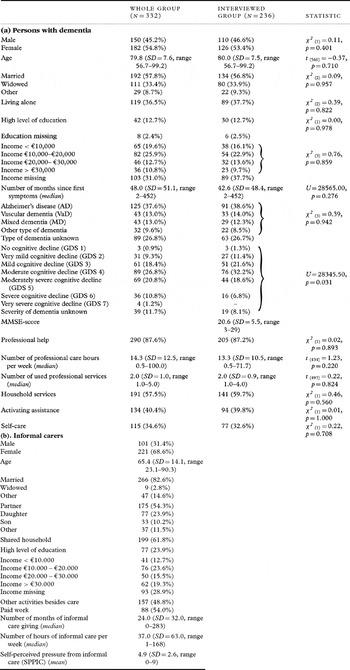
A total of 332 persons with dementia and/or their informal carers were included in the study; 236 persons with dementia and 322 informal carers agreed to be interviewed. Table 1 describes the sociodemographic characteristics of the respondents. More than half of the people with dementia were female (n = 182, 54.8%) and married (n = 192, 57.8%), and more than one third of them lived alone (n = 119, 36.5%). Their mean age was 79.8 years (SD = 7.6). The majority of the respondents were diagnosed with Alzheimer's disease (n = 125, 51.4%), followed by vascular dementia (n = 43, 17.7%) and mixed dementia (n = 43, 17.7%). The type of dementia was unknown for 89 respondents. The stages of dementia ranged between mild cognitive impairment and very severe cognitive decline (GDS 1–7); most respondents suffered from mild cognitive decline to moderately severe dementia (GDS 3–5). A large proportion of the people with dementia received professional household services (n = 191, 57.5%) or attended a form of day-care (n = 134, 40.4%). More than half of the people with dementia were cared for by their partner (n = 175, 54.3%), most informal carers were female (n = 221, 68.6%). Their mean age was 65.4 (SD = 14.1). The interviewed group of people with dementia (n = 236) did not differ from the total group of included persons with dementia (n = 332) except for the severity of dementia (U = 28345.50, p = 0.031): the interviewed group of persons with dementia contained few respondents with severe to very severe dementia (Table 1).
Sociodemographic data for persons with dementia (whole group and interviewed group) and informal carers

GDS = Global Deterioration Scale; MMSE = Mini-mental State Examination.
Needs
Persons with dementia
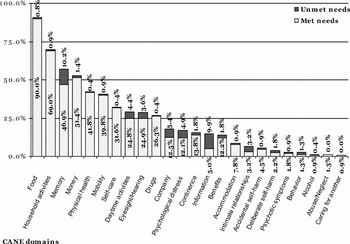
Persons with dementia indicated an average of 5.4 (SD = 3.1, range 0–15) needs. Of these, an average of 4.9 needs were met and 0.5 were unmet. More than half of the interviewed persons with dementia indicated they needed or received assistance from professional or informal carers regarding food (for instance, shopping for groceries and preparation of food) (90.8%), household activities (69.9%), memory (e.g. support of memory and coping with memory loss) (57.1%) and money (52.7%) (Figure 2). In the areas of food, household activities and money the majority of the respondents felt that they received appropriate care. The highest proportions of unmet needs reported by persons with dementia concerned support for memory problems, information about dementia, available care and treatment, company, and psychological distress (see Figure 2 for the percentages of met and unmet needs for each domain).
Percentage of (met and unmet) needs reported by people with dementia.

Informal carers
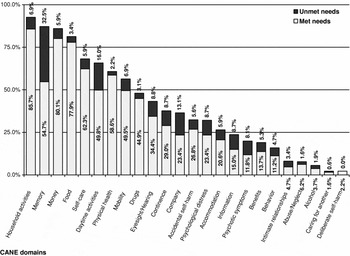
Informal carers reported an average of 9.6 needs (SD = 3.4, range 0–17), with an average of 7.9 met needs and 1.7 unmet needs. More than half of the interviewed informal carers indicated that their relative needed or received assistance (informal and professional) with household activities (92.5%), memory (87.2%), money (86.0%), food (81.3%), self-care (68.2%), daytime activities (65.8%), physical health (60.7%) and mobility (56.4%) (Figure 3). The informal carers, like the persons with dementia, most frequently reported met needs in the domains of household activities, money and appropriate food. The highest proportion of unmet needs were reported by informal carers regarding memory, daytime activities and company (see Figure 3 for the percentages of met and unmet needs for each domain). Informal carers on average reported 4.2 more needs than people with dementia (t (537) = −14.61, p < 0.001). Of those, 3.0 were met needs (t (537) = −12.25, p < 0.001) and 1.2 were unmet needs (t (537) = −7.27, p < 0.001).
Percentage of (met and unmet) needs reported by informal carers of people with dementia.

Professional support
The people with dementia who were interviewed reported that they received professional care largely for self-care, daytime activities, company and household activities (Figure 4). Persons with dementia wanted more professional help in 33.3% of the studied areas, with the areas of company and memory being mentioned most frequently (Figure 4).
Differences between received and desired amount of professional care by people with dementia and informal carers.

Informal carers reported that most of the professional assistance for the people with dementia was received in the domains of company, daytime activities, household activities, physical health and self-care (Figure 4). Informal carers wanted more professional help on 17 (70.8%) of the investigated domains, with the highest need being for more support for daytime activities and memory problems (Figure 4).
Agreement within patient-carer dyads
Needs
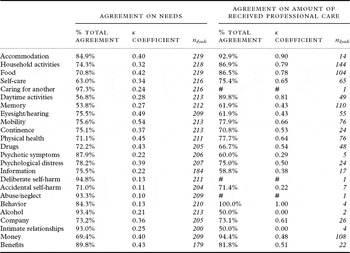
The degree of agreement (κ) between the needs of people with dementia and the needs as reported by their informal carers varied between 0.10 and 0.54 (poor to moderate). The highest values were found in areas related to physical functioning, namely mobility (κ = 0.54), eyesight/hearing (κ = 0.49) and physical health (κ = 0.45). Poor agreement was found for more subjective measures like behavior problems (κ = 0.13), deliberate (κ = 0.13) and accidental self-harm (κ = 0.11) and abuse/neglect (κ = 0.10) (Table 2).
Agreement within patient-carer dyads on needs and on amount of received professional support

Professional support
Overall there was fairly good agreement on the actual amount of professional help provided within patient-carer dyads. Most κ values varied between 0.90 (very good) and 0.22 (fair). The highest values were in the domains of accommodation (κ = 0.90), daytime activities (κ = 0.81) and household activities (κ = 0.79); the lowest levels of agreement were found for received professional care on psychotic symptoms (κ = 0.29), information about the disease and care and treatment possibilities (κ = 0.38), alcohol (κ = 0.00) and intimate relationships (κ = 0.00) (Table 2).
Relationships between personal and context variables and number of reported needs
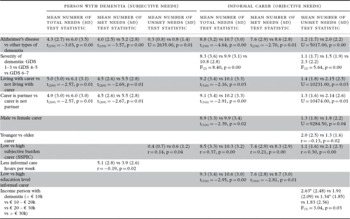
Several sociodemographic characteristics of people with dementia and their informal carers proved to be related to the number of reported needs, i.e. type and severity of dementia, living situation, carer type, gender, age, subjective burden and number of informal carer hours. People who had a type of dementia other than AD, who did not live with their carer or had a carer who was not their partner experienced more needs in total and more met needs than people with AD who shared the household with their carer, or who were cared for by their partner. Furthermore, people with non-AD dementia and people with a carer who experienced high levels of burden, experienced more unmet needs as compared to people with AD or people who were cared for by carers who were not highly burdened.
Informal carers caring for a person with non-AD dementia, who cared for a person with severe dementia, who did not share the household, or who took care of someone who was not their partner, who were female, or were experiencing high levels of burden reported more needs (in total and more unmet) compared to carers of a person with AD, in the beginning stages of dementia, who shared a household, cared for their partner, who were male, or experienced low levels of burden. Carers of people with non-AD dementia or who were experiencing high levels of burden reported relatively many met needs as well, while younger carers and carers of people with a low income, reported more unmet needs than elderly carers and carers of people with a high income. Furthermore, more highly educated carers reported more needs in total and more met needs than carers with lower education levels. Table 3 presents the mean values and significant test statistics.
Significant relationships between person and context variables and number of (met and unmet) needs as reported by people with dementia and informal carers

GDS = Global Deterioration Scale; SPPIC = self-perceived pressure from informal care.
The relationship with met or unmet care needs on specific areas was studied for the following characteristics: severity of dementia, gender of the informal carer, type of patient-carer relationship and carer burden.
Severity of dementia
While no relationship was found between the severity of dementia and the amount of (met or unmet) needs reported by people with dementia, informal carers of people with severe dementia reported relatively more met needs regarding self-care than carers of people with mild to moderate dementia (χ 2(4) = 15.71, p = 0.003). They also reported more unmet needs regarding support for memory problems (χ 2(4) = 17.70, p = 0.001), psychotic symptoms (χ 2(4) = 13.88, p = 0.008), accidental self-harm (χ 2(4) = 17.28, p = 0.002) and handling finances (χ 2(4) = 13.40, p = 0.004).
Carer gender
No relationships were found between the (un)met needs experienced by people with dementia or informal carers on specific need areas and the gender of the informal carer.
Type of patient-carer relationship
People with dementia who were cared for by a non-partner carer, experienced unmet needs relatively more frequently regarding support for household activities (χ 2(2) = 12.93, p = 0.008), company (χ 2(2) = 9.28, p = 0.010) and intimate relationships (χ 2(2) = 6.84, p = 0.033). Non-partner carers in turn also reported relatively more unmet needs regarding household activities (χ 2(2) = 7.13, p = 0.028), company (χ 2(2) = 14.47, p = 0.001) and intimate relationships (χ 2(2) = 11.09, p = 0.004). Additionally they experienced more unmet needs in the areas of self-care (χ 2(2) = 15.82, p = 0.000) and drugs (χ 2(2) = 9.08, p = 0.011).
Carer burden
People with dementia who had highly burdened carers reported experiencing insufficient support with communication problems (χ 2(2) = 6.29, p = 0.004) and psychological distress (χ 2(2) = 6.16, p = 0.046) relatively more often. Highly burdened carers reported more frequently that the person with dementia received adequate support (met needs) for food (χ 2(2) = 7.90, p = 0.019), self-care (χ 2(2) = 7.30, p = 0.026), daytime activities (χ 2(2) = 15.38, p = 0.000), psychological distress (χ 2(2) = 6.09, p = 0.004) and money (χ 2(2) = 7.44, p = 0.024), but at the same time they reported more frequently that support (met and unmet need) was needed for continence (χ 2(2) = 9.33, p = 0.009), company (χ 2(2) = 15.71, p = 0.024), memory problems (χ 2(2) = 16.86, p = 0.000), psychotic symptoms (χ 2(2) = 13.84, p = 0.001) and behavior problems (χ 2(2) = 10.87, p = 0.048). They also reported that the (in)formal care provided was insufficient more often.
Service offer and reasons for unmet needs
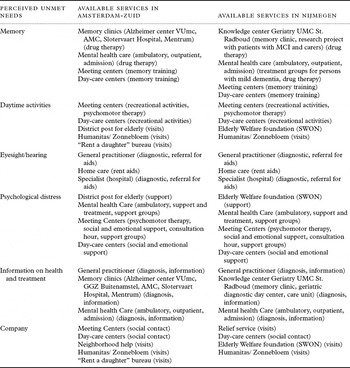
Investigation revealed that services were available for the main unmet care needs (Table 4). The available service offer in the north of the Netherlands was similar to the offer available in the south. A check for differences in the amount of (un)met needs reported in the north and south of the Netherlands showed that informal carers in the south of the Netherlands reported more unmet needs (m = 2.76, SD = 2.17) than carers in the northern regions (m = 1.57, SD = 2.09; t (316) = −2.92, p = 0.004). As compared to carers from the north of the Netherlands, carers living in the south reported relatively more often that the support was not adequate and needs were unmet, in particular regarding support with memory problems (χ 2(2) = 9.06, p = 0.011), information for the person with dementia (χ 2(2) = 21.43, p = 0.000) and behavioral problems (χ 2(2) = 6.30, p = 0.017).
Most frequently mentioned unmet needs by people with dementia and informal carers in relation to service offer in two Dutch regions

When reporting unmet needs, respondents were asked why they were unmet. With regard to unmet needs for memory, daytime activities and psychological distress, people with dementia and informal carers both said that they were not aware of the availability of the relevant services. When they did know about it, informal carers thought that taking up the offer of the service would not be helpful. With regard to unmet needs for daytime activities, psychological distress and company, professional help was often refused by people with dementia. Furthermore, professional care (provided mostly for memory, daytime activities, company and, to a lesser extent, also for psychological distress) seemed insufficiently attuned to individual wishes or the offered amount was not enough. One specific reason mentioned for unmet needs on daytime activities was that people were confronted with too much bureaucracy when organizing the care. Regarding unmet needs for information, people with dementia mentioned they had either received little or no information, or that they had received unclear (printed) information about their dementia and possible treatment. Informal carers on the other hand thought the information provided was not understood and indicated that in some cases the presence of dementia was denied.
Discussion
For the first time a large sample of community-dwelling people with mild to severe dementia has been interviewed about their met and unmet care needs, and their opinions have been compared with those of their informal carers. The needs reported by people with dementia and informal carers were fairly similar, although the former reported fewer (met and unmet) needs. The areas in which assistance for the person with dementia was most frequently required, according to the person with dementia and his/her carer were food, household activities, money and memory. The majority of needs in these areas were met, except the need for support with memory problems. Informal carers in particular reported unmet needs relatively frequently in other domains as well, such as daytime activities, company and eyesight/hearing, whereas the persons with dementia, besides memory support, most frequently experienced insufficient or inadequate support for information, company and psychological distress.
Our findings on subjective needs in dementia confirm recent research outcomes. As in our study, Edelman et al. (Reference Edelman, Kuhn, Fulton and Kyrouac2006) found high levels of need for information. Needs assessed by Meaney et al. (Reference Meaney, Croke and Kirby2005) in the domains of memory, self-care, health, mobility and house care correspond to our findings. Many smaller qualitative studies of the experience of dementia, and coping with it, in which people with dementia were interviewed, mentioned problems in the areas of memory, psychological distress, company and information (van der Roest et al., Reference van der Roest, Meiland, Maroccini, Comijs, Jonker and Dröes2007). Extensive research has been done on the needs of people with dementia among proxies. Our results correspond to outcomes of earlier studies, for example regarding the need for help with household activities, personal care, memory problems, daytime activities, food and company (see, for example, Philp et al., Reference Philp1995; Nankervis et al., Reference Nankervis, Schofield, Herrman and Bloch1997; Toseland et al., Reference Toseland, McCallion, Gerber, Dawson, Gieryic and Guilamo-Ramos1999; Dello Buono et al., Reference Dello Buono1999). The added value of our study is that earlier small-sample research has now been confirmed in a large-scale systematic inventory and that more insight has been obtained on the frequency of needs in community-dwelling people with dementia as experienced by people with dementia themselves and their carers.
In general, agreement within individual patient-carer dyads on needs was low: the best levels of agreement were found for physical domains, whereas agreement on needs with regard to possible accidental self-harm (e.g. wandering) and abuse/neglect was very poor. Proxy reports generally show that patients assess themselves as being less in need of assistance than their informal carers (Lyons et al., Reference Lyons, Zarit, Sayer and Whitlatch2002). If we compare our κ values with other research, they are lower than in studies on patients with other mental disorders (Hancock et al., Reference Hancock, Woods, Challis and Orrell2006). It is easy to ascribe this difference to a lack of insight in the person with dementia. However, agreement within dyads on the amount of received professional care was generally good, and recent research by Karel et al. (Reference Karel, Moye, Bank and Azar2007) shows that people with mild to moderate dementia are capable of reliable judgment on their quality of life and health care (see also Dröes et al., Reference Dröes2006). It is also known that proxy opinions on the needs of people with dementia appear to be influenced by such factors as the subjective burden of their informal carer and the impact that their behavioral symptoms have on them (Thorgrimsen et al., Reference Thorgrimsen2003; Meiland et al., Reference Meiland, Kat, Van Tilburg, Jonker and Dröes2005). The coping strategies of persons with dementia – such as denial or avoidance, minimization and normalization, or to continue living as before as identified in a literature review by de Boer et al. (Reference de Boer, Hertogh, Dröes, Riphagen, Jonker and Eefsting2007) – could perhaps also explain the low agreement on needs found within patient-carer dyads. Trying to maintain feelings of autonomy is important for people with dementia as well (Dröes et al., Reference Dröes2006; Steeman et al., Reference Steeman, Godderis, Grypdonck, De Bal and Dierckx de Casterlé2007), and this may influence their coping and perception of needs. To remain autonomous, people with dementia might scale down their needs, because they are reluctant to allow a home care worker into their house or accept support from relatives. This is illustrated by the percentage of overall agreement between people with dementia and informal carers. The overall agreement on needs was lowest for assistance with memory problems (53.8%), daytime activities (56.8%), self-care (63.0%), and money (69.4%). While many informal carers recognized and reported a need for care and assistance in these domains, many people with dementia either did not (want to) report, or did not recognize, their need for support in these specific areas.
Several factors may influence the need for a service and actual use of that service (Andersen, Reference Andersen1995; Andersen and Davidson, Reference Andersen, Davidson, Andersen and Davidson1996). For instance, the perception of a need can be influenced by the knowledge people have of health care services and the way they value them.
Respondents reported that most professional help was received in the areas of self-care, daytime activities, household activities and physical health, but a desire for extra professional support was expressed in many domains. The agreement on the amount of received help within patient-carer dyads was moderate to good. Following Andersen's Behavioral Model of Health Care Use (Andersen, Reference Andersen1995; Andersen and Davidson, Reference Andersen, Davidson, Andersen and Davidson1996), Toseland et al. (Reference Toseland, McCallion, Gerber and Banks2002) found that needs, enabling factors (such as rural/urban location, availability of transportation), and predisposing factors (such as carer-patient relationship or gender) together explained a relative high percentage of variance in use of community-based dementia health care and human services. Enabling factors such as knowledge of services, access and other barriers to services, and health care insurance explained more variance than the needs itself. When people experience an unmet need and are not aware of an adequate service in their region but only of a service far away, or when they do not have the resources to pay for the service, they are more likely not to use that service. However, this does not mean that there is no desire for the services.
Several sociodemographic characteristics proved to be related to the number of (met and unmet) needs that people experienced. Those with non-AD dementia and being cared for by a highly burdened carer experienced insufficient or inadequate support more often. Carers reported relatively more unmet needs when they cared for a person with non-AD dementia, the dementia was severe, they did not share a household with or were not the partner of the person with dementia, they were young, they experienced high subjective burden or when the person with dementia had a low income. Specific background characteristics were also related to different needs. In the case of more severe dementia, informal carers were more likely to report unmet needs in the areas of self-care, memory problems, psychotic symptoms, accidental self-harm and money. Non-partner carers were more likely to report unmet needs for household chores, company, intimate relationships, self-care and medication. These are needs that are easily fulfilled by a partner or cohabiting carer, but can cause difficulties or require more effort from a carer who does not live with the person with dementia.
In the regions where this study was carried out, services were available for the most frequently mentioned unmet needs. Informal carers living in the southern region of the Netherlands reported relatively more often that support for their relatives was not sufficient, especially for help with memory problems, information provision and behavior problems. As the available service offer between the north and the south was the same, a possible explanation for this difference could be that people were less aware of the available services (see also Toseland et al., Reference Toseland, McCallion, Gerber and Banks2002). The service may also not correspond to individual needs or to the amount of support needed. These were the most common reasons people mentioned for experiencing unmet needs. Reasons known from the literature for non-use of services are (perceived) inadequacy of services, long waiting lists, unavailability and unawareness of services (in an area), high costs and reluctance of the person with dementia to use a service (Brodaty et al., Reference Brodaty, Thomson, Thompson and Fine2005; Forbes et al., Reference Forbes, Debra and Janzen2006). More research on service use is necessary. In particular, studies on barriers to the use of services, such as costs or individual thresholds, the promotion and thus awareness of a service and its content in a region will give more insight into the existence of unmet needs and ways to solve them.
The results of this study show that many needs are fulfilled satisfactorily because the appropriate (in)formal support was provided for the perceived problems. However, for some problems, especially for memory problems, daytime activities, company, information, psychological distress and eyesight/hearing, a relatively high percentage of the respondents reported that they received insufficient (in)formal support. It was remarkable that, while most professional support was delivered for company and daytime activities, people still reported unmet needs in these domains. This leads to the conclusion that the offered day care does not meet individual wishes and preferences. In order to solve this problem, more notice should be taken of individual preferences and alternatives provided where appropriate. People with dementia received relatively little support for memory problems and inadequate provision of information on dementia and available services. Besides the support from regular care services, utilization of information and communications technology (ICT) could provide opportunities to solve these needs. At present, a range of assistive technology devices is available that can provide memory support to people with dementia, for instance devices that give reminders for activities or appointments or can help to locate lost objects (Oriani et al., Reference Oriani2003; Gilliard and Hagen, Reference Gilliard and Hagen2004; Lauriks et al., Reference Lauriks2007; Meiland et al., Reference Meiland2007). Regarding information provision on dementia and the available service offer, professionals should be more aware of the need for information and provide clear and up-to-date information to their clients. ICT services may help to provide such information, for instance the many websites with information on dementia and the available service offer (Lauriks et al., Reference Lauriks2007). A major disadvantage of these websites is that they are generic and static, and sometimes relevant information is difficult to find. Recently, a new web-based DEMentia specific Digital Interactive Social Chart (DEM-DISC) has been developed and a prototype has been tested (van der Roest et al., Reference van der Roest, Meiland, Jonker and Dröes2009). DEM-DISC is a demand-oriented system that aims to provide users with customized advice about available care and welfare services in order to meet and alleviate unmet needs (van der Roest et al., Reference van der Roest2008b). The first user field test proved satisfactory. People with dementia and their carers had fewer unmet needs after using DEM-DISC for a two-month period. In general it is likely to be more effective when information is provided that is tailored to individual needs.
Some caution is required in the interpretation of the results of this study. Since the interviewers were students, they may have had difficulty in recognizing problems and therefore some degree of under-reporting may have occurred. Furthermore, the response was not optimal. The non-response was partially caused by the overburdening of informal carers. In this study, feeling overburdened was related to having more unmet needs, and therefore this non-response may have caused an under-representation of unmet needs as experienced by overburdened carers. Another reason for non-response was that people with dementia living alone could not always be reached by telephone and it was frequently not possible to identify their informal carer. Non-inclusion of these people may have led to an under-representation of people with dementia living alone in the community. The ethnicity of 76% of the people with dementia was known. Of this group, the majority (92%) were Dutch. No data were collected about the ethnicity of the informal carers. In view of the limited variation in ethnicity no further analysis was conducted into the relationship between ethnicity and care needs. However, since ethnicity is known to be associated with carer burden, the experience of care giving and service needs (Janevic and Connell, Reference Janevic and Connell2001; Daker-White et al., Reference Daker-White, Beattie, Gilliard and Means2002), we would recommend including respondents from different ethnic backgrounds in future studies into care needs, in order to get insight into (unmet) care needs of people with different ethnic backgrounds.
The results of this large-scale study provide insight into the met and unmet needs of community-dwelling people with dementia as reported by themselves and by their carers, and also into how these needs are related to several sociodemographic characteristics. This insight was lacking until now. In their study on care needs, Meaney et al. (Reference Meaney, Croke and Kirby2005) interviewed people with dementia and their carers, but the researchers reported joint patient-carer responses, and so no insight into individual needs could be gained. This insight was also not provided by the initiative of the National Dementia Program that made inventories of existing needs in different regions of the Netherlands in order to improve dementia care on a regional level (Meerveld et al., Reference Meerveld, Schumacher, Krijger, Bal and Nies2004). In that study very few people with dementia were directly involved. The instrument used in this study, the CANE, gave us the opportunity to compare statistically the views of people with dementia and their carers, thereby giving valuable insight into needs that may be useful for their psychogeriatric care. To be able to provide adequate support, care professionals have to bear in mind that the views of people with dementia and their carers are complementary. Care providers should also be aware of the factors that are associated with an increased risk of experiencing unmet needs, such as having non-AD dementia or severe dementia, separate households and informal care provided by non-spouses, younger and female carers or carers who experience high subjective burden.
This study shows that in order to achieve adequate delivery of customized care, care providers should take into consideration the perspectives of both the person with dementia and the informal carer. To make it easier for people to utilize care services and to increase public awareness of available care services, care providers should at least offer clear and accessible information. The results also offer professionals an indication of which specific groups of people with dementia and informal carers are at risk of experiencing more unmet needs. This will enable professionals to be more alert and efficient in providing the necessary care.
In order to improve the general well-being of people with dementia, all factors that are important for the quality of life of people with dementia should be taken into account. People with dementia value various aspects as important for their own well-being, such as affect, self-esteem, social contact and being useful (Dröes et al., Reference Dröes2006). These quality of life aspects can be strongly influenced by delivering customized care, and they should therefore be included in assessing and fulfilling care needs, in practice and in future research. Insight into the discrepancies between current and desired care services may help improve these services and increase their efficacy.
Conflict of interest
None.
Description of author's roles
H. G. van der Roest collected the data, carried out the analysis and wrote the paper. F. J. M. Meiland assisted with the analysis and with writing the paper. H. C. Comijs commented on earlier versions of the manuscript. E. Derksen, A. P. D. Jansen and H. P. J. van Hout were responsible for some of the data collection and commented on earlier versions of the manuscript. C. Jonker commented on earlier versions of the manuscript. R. M. Dröes designed the study, supervised the data collection and the analysis and assisted with writing the paper.
Acknowledgments
This study was conducted in the context of the FReeband User eXperience project (FRUX) and was funded by the Dutch Ministry of Economic Affairs under contract BSIK 03025, Dioraphte Foundation, RCOAK, NHDI, Foundation Het Zonnehuis and Stichting Alzheimer & Neuropsychiatrie Foundation. The authors wish to express special thanks to all the respondents, the Centrum Indicatiestelling Zorg (CIZ) in Amsterdam, the program coordinators of the participating Meeting Centers, the day-care center for people with early onset dementia of the Evean Eduard Douwes Dekker, the day-care centers of the Flevohuis and Zorgcentrum de Buitenhof and the volunteers of the Amsterdam Alzheimer Cafés Noord, Centrum, and Zuideramstel.