

INTRODUCTION
Current globalization tendencies have contributed to making “the world flat” and have led to a “borderless world” regarding transnational production, investment, and information (Friedman Reference Friedman1990; Thomson Reference Thomson1995:217). However, the growing movement of people and goods in the era of globalization provides excellent opportunities to develop economic integration among countries and also forces them to face several threats of transnational crimes (Shelley Reference Shelley, Caparini and Marenin2006). In other words, globalization has created a “dark logic” with cross-border connection nodes and intensified interconnectedness in the economic, political, and cultural interactions. Unavoidably, among a borderless world, criminal networks have also become a global concern (Battersby Reference Battersby, Steger, Battersby and Siracusa2014:702–5). Furthermore, drug networks are becoming more durable and more diverse, even more frequently in systematic scales of collaboration designed to further transnational criminal activities based on their flexible motilities and capacities. According to this logic argument, since 20 years ago, Williams (Reference Williams, Arquilla and Ronfeldt2001:61) noted that the most common and distinctive characteristics of these transnational crime dimensions and scales are drug trafficking without borders from some nations to others via shared borderlands. In particular, these networks tend to be employed in several countries to achieve the tremendous benefits of trafficking illicit commodities with low risk from law enforcement agencies (LEAs).
To some extent, the flexibility, scope, and dynamics of the trafficking entities, of course, have increased the challenge for LEA capacities. Thus, according to von Lampe (Reference von Lampe2012), two of the five significant challenges faced by researchers of transnational organized crime are identifying the modus operandi and the geography of transnational organized crime.Footnote 1
Vietnam’s economic performance has been remarkable since the first decade of the 21st century. Vietnam has managed to sustain an average Gross Domestic Product (GDP) growth rate of 7.25%, and by 2018 the average income per capita reached US$2,540 up from less than US$400 in 2000 (Government of Vietnam 2018; United Nations Office on Drugs and Crime (UNODC) 2012b; United Nations Viet Nam 2017). In just over two decades, Vietnam went from being a weak, underdeveloped economy to reaching middle-income country status and improving the living conditions of millions of people. Generally, Vietnam has met most of the Millennium Development Goals (Australian Government 2018; United Nations Viet Nam 2017). As the country enters the current decade, it has the ambition of becoming a modern industrialized nation, with an overall goal of increasing GDP per capita by 70% by 2020, up to US$3,200–3,500 per person (Government of Vietnam 2018; United Nations Viet Nam 2017). In pursuit of this objective, Vietnam intends to reform and modernize governance, overcome disparities and gender inequalities, and fight corruption and crime, including all drug-related activities at the border with its neighbors. Accordingly, based on signed bilateral drug control cooperation agreements with many countries in the Southeast Asian region, including Laos, Vietnam has strengthened prevention and suppression responses to counter-narcotics trafficking activities across their shared borderland areas. Although LEAs have implemented strict measures to detect, investigate and prosecute syndicates who illegally traffic drugs on land routes, these efforts have been insufficient to address the emerging challenges and the increasingly sophisticated modus operandi of drug traffickers. Utilizing secondary data from official statistics of LEAs, this article first provides the overall picture of drug trafficking in the mainland Southeast Asian (MSA) area, including Cambodia, Myanmar, Laos, Thailand, and Vietnam. In the second section, it also briefly draws the illegal drug situation in Vietnam. The third part evaluates the main characteristics of drug trafficking networks by locating and mapping hotspot routes across the Vietnam–Laos border. In the final paragraph, the paper assesses the respective cooperation policies among the two countries to combat this battle.
AN OVERVIEW OF DRUG TRAFFICKING IN THE MAINLAND SOUTHEAST ASIAN REGION
Drug trafficking in the MSA, particularly opium, heroin and amphetamine-type stimulants (ATS), has been increasing with some complex movements in the first decade of the 21st century. Most MSA countries have been faced with challenges and difficulties in controlling cross-border drug trafficking. Meanwhile, LEAs were also monitoring massive volumes of people and vehicles crossing certain land boundaries (Chin and Zhang Reference Chin and Zhang2015; Chouvy Reference Chouvy and Chouvy2013b; Silva Reference Silva2016). While the production of opium in the Golden Triangle declined sharply since the early 2000s, the booming of ATS expanded to almost all MSA countries. In particular, methamphetamine (also known as “ice” or yaba) is mainly manufactured in the MSA typically in the form of tablets, with seizure reports indicating that the pills are primarily intended for markets within that sub-region (UNODC 2015c, 2017a). It is also much easier to transport and can be more readily disguised as licit substances (Blickman Reference Blickman, Kramer, Jelsma and Blickman2009:53; Chouvy Reference Chouvy and Chouvy2013a; Windle Reference Windle2016). Besides that, many complaints from government reports and social media have shown that corruption is one of the struggles in Myanmar and Laos’s law enforcement approaches (International Crisis Group 2019; International Narcotics Control Strategy Report (INCSR) 2016). That is why, perhaps, both Myanmar and Laos have remained the two most dominant countries producing opium in the Asian region, with an estimated 41,000 ha in Myanmar and 5,328 ha in Laos in 2017 (INCSR 2018; UNODC 2015b, 2017b).Footnote 2
Recent research indicates that drug trafficking and transit routes across the MSA area have been proliferating and dynamic, with frequent changes in trafficking routes and tactics to exploit any available pathways and vulnerable points across porous borders (Chouvy Reference Chouvy and Chouvy2013a; UNODC 2015a). Accordingly, heroin is almost entirely sourced in Myanmar and distributed to other countries through some trafficking hotspots, including northeastern Myanmar, Vietnam’s borderland with northern Laos, northern-most Thailand, and the Vietnamese–Cambodia border (Association of Southeast Asian Nations (ASEAN) Narcotics Cooperation Center (ASEAN-NARCO) 2017; UNODC 2016:20). Some heroin is transported by land across Laos and Thailand, and also by sea through ports in southern Myanmar (Chouvy Reference Chouvy and Chouvy2013a; Kramer et al. Reference Kramer, Jensema, Jelsma and Blickman2014; Routray Reference Routray2018). The drug traffic across the northern Myanmar border with south China (Yunnan province) remains the primary source of heroin in the Chinese market and beyond, including Vietnam and Laos (ASEAN-NARCO 2017; Chin and Zhang Reference Chin and Zhang2015; Ministry of Public Security of China 2014). The UNODC estimated that China continues to account for the majority of heroin seizures in the region, with annual seizures of 8.5 tons, up from 7.3 tons in 2012 (UNODC 2015c:49). Most nations in this region have porous, inaccessible, mountainous areas, some with extensive waterways and coastlines, which are easily exploited to transport illegal drugs using different modus operandi (Routray Reference Routray2018; Silva Reference Silva2016; Su Reference Su2013). For example, trafficking between Myanmar and China flows in both directions, as the processing of heroin requires precursor chemicals, mainly acetic anhydride (Chin and Zhang Reference Chin and Zhang2015; Su Reference Su2013). On the one hand, the majority of heroin is trafficked from Myanmar directly across the border to Yunnan province (China) to continue trans-shipment in northern areas of Vietnam such as Langson, Quangninh, Laocai, Caobang, Hagiang, Laichau and Dienbien (Binh Reference Binh2017; Loc Reference Loc2017). On the other hand, in some cases, speedboats have been used to ship drugs along the Mekong River as one of the prioritized selections. Thus, the Mekong has become one of the frequent smuggling routes alongside land transportation routes in the MSA (Blickman Reference Blickman, Kramer, Jelsma and Blickman2009; Chouvy Reference Chouvy and Chouvy2013b; Douglas Reference Douglas2017). Additionally, sharing the borderland with China, the region is considered a significant producer of methamphetamines. MSA countries such as Myanmar, Laos, and Vietnam are also facing pressures and challenges of the illegal trade of precursor chemicals (pseudoephedrine and ephedrine) into their domestic markets (Chin and Zhang Reference Chin and Zhang2015; Douglas Reference Douglas2017; Kramer et al. Reference Kramer, Jensema, Jelsma and Blickman2014).
The drug users’ trend has become much more complicated in the MSA, with rapid increases in local consumption linked to growing affluence and social expectations. Traditional producer and corridor or trans-shipment countries for narcotics bound for Europe and the United States, especially the Golden Triangle countries, Myanmar, Thailand, and Laos, are now significant consumers of illicit ATS and new psychoactive substances (NPS). One official statistic in the latest publication of UNODC notes that the criminals and insurgents in the MSA that operate the drug trade are making enormous profits from their operation with an annual income estimated at US$30 billion for ATS trafficking (UNODC 2016:20). At the regional level, the spreading of the synthetic drugs market in Southeast Asia has changed rapidly because it is much easier to transport and can be more readily concealed, while opium and heroin use diminished between the mid-to-late 1990s. Furthermore, the failure of states to provide harm reduction programs has led to slow intervention and a lack of healthcare services for drug users, likely causing addicts to seek ATS resources in “black” markets for self-treatment (Kramer et al. Reference Kramer, Jensema, Jelsma and Blickman2014; Windle Reference Windle2017). As a result, this tendency has led drug users in this region to create complex patterns and trends for drugs in recent years. According to a global synthetic drug assessment (UNODC 2017a), a rapid rise in seizures in many Southeast Asian countries, especially in the MSA region, is unavoidable. Alongside the common ATS types such as ketamine, methamphetamine, and ecstasy that became popular more than one decade ago, the Southeast Asian countries have faced the intrusion of some NPS among drug abusers in the recent five years. According to the UNODC report, from 2009 with only 32 different synthetic cannabinoids to 2017 with over 250 substances, new NPS appear annually at an average rate of about one substance per week. Thus, to detect, prevent, and treat psychological disorders of substance abuse is a great challenge for the international community (UNODC 2018:5–6). There were at least around 739 different NPS from 106 countries and territories to explore and report to UNODC from 2009 to 2016 that point out the practical challenges for LEAs to investigate NPS-related cases in each country in the MSA region (UNODC 2018). Paradoxically, although thousands of people are arrested each year for drug trafficking in the MSA, the high profits of the drug trade continue to lure thousands more into the business. Furthermore, ignoring the death penalty applying to drug-related crimes in Laos, Thailand, and Vietnam’s regulations, “traffickers continue to smuggle drugs across borders in a continuous game of cat-and-mouse with law enforcement” (Mahathir Reference Mahathir, Rahman and Crofts2013:vii).
ILLEGAL DRUGS: CURRENT SITUATION IN VIETNAM
Supply Scale of Drug Trafficking
To confirm, at the current time, Vietnam is not the main source of illicit drugs in the Asian region. Historically, growing opium has been one of the primary forms of agricultural cultivation of the mountain farmers – mostly local ethnic minority groups in the northern villages of Vietnam sharing borderland with Laos. Many official documents have confirmed that almost these volumes of opium cultivation, which have occurred since at least the 1600s in Vietnam’s feudal regime, served local ethnicity’s needs as medical forms to cure their health concerns and ritual events more than for trading aims (Hoa Reference Hoa2008; Michaud Reference Michaud2000; United States Department of Justice Drug Enforcement Agency (DEA) 1992). Other controversial debates hypothesized that the political motivations of France’s colonial regime or the United States in Vietnam’s wars involved illicit trading (McCoy Reference McCoy1972; Robins, Helzer, and Davis Reference Robins, Helzer and Davis1975; Stanton Reference Stanton1972). After the 1975 Revolution Victory till the Revolution Period (Đôi Mói in Vietnamese) in 1986, the limited conditions to reconstruct and develop the country and the strict application of embargo trading activities of the Western regime led to the ineffective control of society by the Party-State, including the size of opium cultivation. In 1985, the total volume of the poppy crop in Vietnam estimated around 19,050 ha, contributed to one of the largest markets in the Asia region, but ranked lower than Myanmar, Afghanistan, and Laos (DEA 1992, 2003; Tuan Reference Tuan2001; United Nations International Drug Control Programme (UNDCP) 2001). However, the rest of Vietnam’s areas decreased remarkably by 98% (to 323 ha) compared to 19,050 ha in 1985 and by 50% compared to 1998 (Tuan Reference Tuan2001:118–19). Programs for the development of alternative crops connected to other socio-economic development programs such as Program 327 (Greening Bare Land and Bare Hills), Program 135 (Hunger Eradication and Poverty Reduction), and Program 661 (Permanent Settlement and Development of New Economic Zones) contributed to this achievement (Tuan Reference Tuan2001; UNDCP 2001). Besides that, the Party-State of Vietnam has applied strictly many mandatory orders to eradicate opium production. By 2015, authorities explored and investigated at least 146,792 m2 (equivalent to around 14.6 ha) at seven northern provinces, namely Sonla, Dienbien, Laichau, Caobang, Hagiang, Backan, and Yenbai (Ministry of Agriculture and Rural Development (MARD) 2016). Although the Party-State has declared eliminating opium cultivation in the law and policy, growing the opium poppy in Vietnam continued in some mountainous locations. International observers argued that some struggles in alternative development policies negatively impacted opium growers. They have questioned the long-term effectiveness of “coercive negotiations to persuade farmers to stop growing opium” (Windle Reference Windle2016:486, Reference Windle2017:2).
Since the 2000s, trends and patterns of drug users and illegal drug consumption have changed across the Southeast Asian region, Vietnam’s markets included. Accordingly, illegally transporting heroin and ATS productions to trade for domestic demand generated more income than opium crops for traffickers (Vuong et al. Reference Vuong, Ali, Baldwina and Millsa2012; UNODC and Standing Office on Drugs and Crime (SODC) 2012; Windle Reference Windle2012, Reference Windle2017). Firstly, for heroin, according to McCoy (Reference McCoy2003:285), most heroin production of the Golden Triangle extended from the Shan hills of north-eastern Burma through to northern Thailand and the H’mong mountains of Laos. As a result, some of these proportions were trafficked into Vietnam from Laos via either international gateways or private roads (INCSR 2013:225). One survey of Kramer, Jelsma, and Blickman (Reference Kramer, Jelsma and Blickman2009:47) noted that heroin in both Southeast Asia and the Golden Triangle is frequently sold in various forms and amounts. For instance, “a compressed block of heroin on the China–Burma border weighs 350 grams and measures 6 × 4 × 3 ½ inch (15 × 10 × 9 cm)”. Thus, it can be concluded that the heroin-producing area of the Golden Triangle is central to the MSA drug trade. It also directly or indirectly impacted regional consumption between the supply-and-demand scale, and Vietnam has not escaped this trend. Besides that, some heroin production of poor quality or mixed impurities in Vietnam over the last five years has shown the increasing availability of domestic manufacturing to supply internal consumption (Binh Reference Binh2017; Luong Reference Luong and Viano2017). Secondly, for ATS, Vietnam’s anti-narcotics authorities admitted that ATS and ecstasy-group substances were smuggled into Vietnam from Cambodia, China, Laos, Myanmar, and Thailand (UNODC 2012a:117). One national research and survey scale in Vietnam of the UNODC noted that there were many different types of ATS available. It existed in Vietnam in various forms, including tablets, crystals, and powder, as analyzed by the Institute for Forensic Science (UNODC and SODC 2012:12). No clandestine methamphetamine manufacture had been reported in Vietnam prior to 2005; however, the ATS market has continued to expand and diversify, with a 65% increase in the country’s methamphetamine pill seizures in 2011 as the number of youth users increased (INCSR 2013:318).
To some extent, the trafficking and use of various ATS, including methamphetamine and the bulk of NPS sold on the streets, particularly ecstasy, have swiftly created a second top drug consumed in Vietnam after heroin for four main reasons. First, Vietnam was increasingly vulnerable to the threat of precursor chemicals due to Vietnam’s geographical position in the neighborhood of the world’s biggest hubs of synthetic drug manufacture from the Golden Triangle (UNODC 2012b:3). Particularly, sharing a borderland with China – a major precursor chemical manufacturing center – drug traffickers can take advantage of geography, trading, and tourism to smuggle ATS and its related substances into Vietnam. Second, its high value and considerable benefits derived directly from this unlawful transporting and trading led to the remarkably increasing volume of ATS seizures during this period (International Narcotics Control Board 2006; UNODC and SODC 2012; UNODC Vietnam 2013). Third, the price of ATS in Vietnam has decreased in recent years. For example, “ice” or yaba prices five years ago were around VND 700–800 million/kg (equivalent to US$35,000–40,000), now they cost only VND 100 million (US$5000). This makes it more affordable for users to buy it (Thanh Reference Thanh2019). Finally, regarding demand’s scope, since 2003, using methamphetamine pills and ecstasy has enlarged gradually in metropolitan areas and expanded to rural markets (UNODC and SODC 2012). The Government of Vietnam became concerned that ATS trafficking had increased into Vietnam and that the country was likely to become a major drug-producing area soon. Accordingly, the quantity of crystalline methamphetamine abusers continued to rise remarkably in 2008, and, after that, ATS have also overtaken opium as the second most widely used drugs in Vietnam since 2010 (UNODC and SODC 2012; UNODC Vietnam 2013). Therefore, alongside heroin, ATS have become a new challenge to Vietnam’s LEAs in drug control.
Statistics on seizures and drug-related arrests confirm that throughout the 1990s, Vietnam has been continuing to face illegal drug concerns, particularly for heroin and ATS. When drug-related crimes were first regulated in the Criminal Code of Vietnam (CCV), the country had only 1,698 cases of drug-related crimes. The total cases across the Vietnam and Laos border accounted for nearly 20% of crimes (Vinh Reference Vinh2002). However, only one decade after the 1985 CCV was introduced, from 1991 to 2000, the LEAs investigated and prosecuted 43,211 cases, a 27-fold rise. So far, the situation of the Vietnam–Laos border was considered a hotspot by LEAs, particularly Nghean, Dienbien, Thanhhoa, and Quangtri provinces that shared borders with Phongsali, Huaphanh, Bolikhamxay and Savannakhet provinces of Laos (Vinh Reference Vinh2002). Notably, after the 1999 CCV passed with one separate chapter entitled “Drug-related crimes” covering 10 separate articles, LEAs have investigated regularly to detect and crack down on at least 112,642 cases of drug-related offenses (Vinh Reference Vinh2002). In this period, big case studies showed that LEA cases in the cross-border areas of the two countries were investigated and prosecuted successfully. Laos is recorded as the main supplier of heroin to Vietnam’s domestic market, and Operation VXT with accomplices is one of the typical cases in this period (Hieu Reference Hieu2012; Minh and Tuan Reference Minh and Tuan2013). This case was dealt with only after it operated nearly for one decade with opium and heroin transported and traded from the early 1990s until 1998. In 1998 LEAs arrested several Vietnamese and Laotian traffickers, which resulted in eight death penalties and eight life imprisonment among 22 offenders. More than 250 kg of heroin and 210 kg of opium were seized (Hieu Reference Hieu2012; Minh and Tuan Reference Minh and Tuan2013). However, the hotspot drug trafficking routes across the Vietnam–Laos borderland have continued to expand to different drug-related cases through cunning operations. Although the Government applied some strict measures with its absolute power for LEAs to counter narcotics, the lucrative profits of illicit drugs have been “encouraging” traffickers to supply domestic markets. Besides that, the high demand for drug users in Vietnam at that time contributed as pull-and-push factors to make the situation of drug trafficking from Laos to Vietnam via land more complicated (Luong Reference Luong and Viano2017; Windle Reference Windle2016).
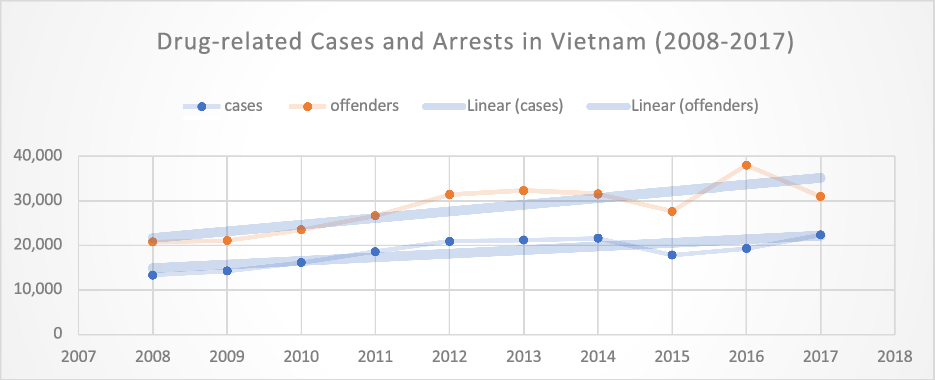
Additionally, proximity to the Golden Triangle region, combined with porous borderland and weak border-gate control and failed states in enhancing bilateral cooperation, led to a considerable increase in trend. Accordingly, the increase of drug-related cases and traffickers were complicated patterns across the borderland between Vietnam and its shared borderland (Binh Reference Binh2017; Ministry of Public Security (MPS) 2017; Tuyen Reference Tuyen2017). In comparison, Figure 1 shows that for only around half of the decade, the total drug cases were dramatically higher than 10 years before, 185,560 cases between 2008 and 2013 compared to 112,642 cases in the period of 1997–2006. Yet, one salient point from this figure is that the number of total offenders in the period of 2008–2017 was always higher than the entire cases of 283,994 traffickers compared to 185,560 cases, in which the percentage of cases and traffickers investigated across the Vietnam–Laos routes is also higher than the rest of the borderland’s areas between Vietnam and Cambodia and China (MPS 2017, 2018).
Drug cases and traffickers. Source: Adapted from the Annual Reports of Vietnam at the ASEAN Inter-Parliamentary Assembly Fact-Finding Committee (AIFOCOM), between 2008 and 2017

Demand Scale of Drug Use
Apart from the complications of supply reduction, the demand reduction of Vietnam also faced many practical challenges and barriers. Historically, growing and using opium was a traditional habit and effective medicine against pains, diarrhea, and illness, a stimulant in folk festivals across the northern mountainous and upland areas of Vietnam sharing the borderland with Laos (Anh Reference Anh1933; Doumer Reference Doumer1903; Huyen Reference Huyen1944). Perhaps, apart from health services and human rights, this tradition had contributed to a high rate of drug abusers in the ethnic minority communities (Giang et al. Reference Giang, Ngoc, Hoang, Mulvey and Rawson2013; Hoa Reference Hoa2008; Oanh Reference Oanh2007). Although the Communist Party of Vietnam has passed several prohibition policies combined with propaganda campaigns to eradicate opium cultivation and its usage, the long-term effectiveness still raises questions about the power of the Party-State (Vuong et al. Reference Vuong, Ritter, Shanahan, Ali, Nguyen, Pham, Vuong and Le2018; Windle Reference Windle2016, Reference Windle2017). Alongside the Government’s extensive efforts to reduce as much opium cultivation as possible, the LEAs have also applied strict measures and professional operations to prevent and combat drug smuggling and trafficking from Laos in Central North areas. However, these attempts were insufficient to curb the growth of demand by drug users in Vietnam from the 1990s until now.
According to annual reports of the SODC, Ministry of Public Security (MPS 2017) and Department of Social Affairs (Ministry of Labour, War Invalids and Social Affairs (MOLISA) 2018), drug abuse has become a widespread phenomenon not only in urban areas but also in the countryside after the Đôi Mói in 1986. Although Vietnam has tried to manage the acceleration of drug abuse in the country through Resolution No. 06 of the Government in 1993 – one of the first legislative regulations of Vietnam to enhance the leadership of the Party-State to control drugs – the number of drug users still increased gradually from 1986 through 1993. In 1996, the Political Bureau of the Party Central Committee officially issued Decree No. 06 to enhance the Party’s leadership in preventing and combatting illicit drugs in Vietnam. It was recorded as one of the most significant efforts of Vietnam to control drugs, particularly to limit and reduce drug addiction in society before signing and ratifying three United Nations Drug Conventions (1961, 1971, 1988) in 1997 (Hoà Reference Hoa2008; Vuong Reference Vuong2007). At that time, Vietnam only focused on demand-and-supply reduction policies by investing in law enforcement and strictly punishing any drug-related offense. To contrast, harm reduction approaches related to public health and human rights of drug users were not available in practice (Oanh Reference Oanh2007; UNODC and SODC 2012; Vuong et al. Reference Vuong, Ali, Baldwina and Millsa2012; Windle Reference Windle2012). Except for the remarkable achievements to eradicate opium cultivation between 1990 and 2001, the percentage of drug addiction in society was still high, and even the average increase of drug abusers seemed to grow in various patterns. Accordingly, in the period 1994–2009, the number of drug addicts with management records increased three times more than before, an average increase of 6,400 people per year (MOLISA 2018).
Although Vietnam decriminalized drug use in the 1999 CCV to concentrate on healthcare and public services to treat drug users more as patients rather than offenders, the trend of demand drug use still increased each year for the next 10 years (Giang et al. Reference Giang, Ngoc, Hoang, Mulvey and Rawson2013; Vuong et al. Reference Vuong, Ali, Baldwina and Millsa2012). Accordingly, for the period 2010–2016 the number of drug users reached up to 9,300 people per year. It climbed to 11,000 drug users at the end of 2017, which contributed to the total drug users in Vietnam to register around 222,582 cases, with about 40–70% ATS abusers (MOLISA 2018). The total of drug abusers in 10 provinces on the borderland between Vietnam and Laos accounted for 17.75%, approximately 35,523 registered users, out of all 63 areas in Vietnam in 2015 and still changing in recent times with the occurrence of new illegal drugs threats (MPS 2017, 2018). Besides that, preferring synthetic drugs and psychotropics to traditional drugs such as opium, cannabis, and heroin has become a more predominant trend. Extending “new” types of ATS in metropolitan cities also led to the difficulty of calculating the exact number of drug abusers in Vietnam (ASEAN Inter-Parliamentary Assembly (AIPA) 2018; Bach et al. Reference Bach, Boggiano, Nguyen, Nguyen, Van Nguyen, Hoang, Le, Tran, Le, Latkin, Vu, Zhang and Ho2018; Windle Reference Windle2017). The latest reports of authorities also admitted that the practical number of drug abusers was different than those of registered users due to the national statistical survey among those addictions out of the total population not available at the moment (MOLISA 2018). Footnote 3 Yet, to some extent, many users were still scared to enter state-led treatment programs because of “the threat of police harassment and incarceration in compulsory treatment centers” (Windle Reference Windle2016:488). Thus, as Vietnam’s National Assembly shared at the annual meeting of the ASEAN Inter-Parliamentary Assembly Fact-Finding Committee to Combat the Drug Menace (AIFOCOM), “the real figure of the drug addicts might have been higher than that documented” (AIPA 2014:4). Unavoidably, there was around 50% of drug users having mental health problems, two-thirds of all HIV cases in the total of people who inject drugs, including all 10 provinces across Vietnam borderland with Laos, and at least 1,600 overdose deaths (MOLISA 2018; Vuong et al. Reference Vuong, Ritter, Shanahan, Ali, Nguyen, Pham, Vuong and Le2018). Besides, nearly two-thirds of those drug users were unemployed or had difficulties with employment opportunities, particularly young people in mountainous areas sharing the border of two countries without access to education and work chances (Bach et al. Reference Bach, Boggiano, Nguyen, Nguyen, Van Nguyen, Hoang, Le, Tran, Le, Latkin, Vu, Zhang and Ho2018; MOLISA 2018; Vuong et al. Reference Vuong, Ritter, Shanahan, Ali, Nguyen, Pham, Vuong and Le2018). Furthermore, drug addiction was considered the primary factor leading those young drug users to break the law about 50% to 100% times higher than that of the normal citizen in society (MOLISA 2018).
MAPPING DRUG TRAFFICKING ROUTES ACROSS THE VIETNAM’S BORDERLAND WITH LAOS
The geographical boundaries between Vietnam and Laos cover about 2,340 km of length stretching across Vietnam’s 10 provinces: Dienbien, Sonla, Thanhhoa, Nghean, Hatinh, Quangbinh, Quangtri, Thuathienhue, Quangnam, and Kontum. All of these territories of Vietnam are adjacent to 10 southern provinces of Laos, namely Phongsaly, Luangprabang, Houaphan, Bolykhamsay, Khammoune, Savannakhet, Salavan, Xiengkhouang, Sepon, and Attapeu. Most shared borderland areas go over the top or through mountains and tropical forests with the lowest place about 300 m and the highest at around 2,700 m of altitude (National Border Committee 2011). There are many high mountains with that make walking difficult and which limit walking; however, poppy cultivation is a suitable crop for the top locations over 1,000 m (Hoa Reference Hoa2008; National Border Committee 2011). For nearly two centuries, opium cultivation was the dominant illicit drug in Laos, with over 28,000 ha in 1998 that ranked Laos as the third-largest producer of opium in the world. In Vietnam, instead, the size of poppy crops in Vietnam declined dramatically to around 323 ha in 2001 from 19,050 ha in 1985 (INCSR 2011; Tuan Reference Tuan2001). Since that time, the Laotian government did strive to reduce the cultivated area and declared its success in significantly decreasing opium poppy cultivation in 2006 (UNODC 2006:37).Footnote 4 The potential production of dry opium for 2013 could yield 23 tons from 3,900 ha (UNODC 2013:21,26). Almost all of this was transferred illegally to third countries in Asia and beyond even though Lao’s anti-narcotics authorities have made some remarkable efforts to supply reduction over recent years, either from domestic Laos or from Myanmar through Laos.
Multiple factors have driven the complex nature of cross-border drug trafficking between the two countries. Firstly, topographical features, crossing the whole of two shared borderlands, cover thousands of narrow roads. Small tracks combine with many up-and-down hills, the main overland gateway for illicit drugs entering Vietnam (Chouvy Reference Chouvy2002, Reference Chouvy and Chouvy2013b; DEA 2003). Transport and travel between the two sides are challenging and difficult, except for a few international and national border-gate areas with a dense population (Hoang Reference Hoang2007; Lintner Reference Lintner2008). Roads are almost not available due to outdated conditions and poor infrastructure. Notably, at deeply internal border areas, many traffickers take advantage of forest trails, streams, and rivers to escape the LEAs’ control while carrying drugs. Secondly, regarding traditional culture and their habits, residents across borders of two sides are mostly ethnic minority groups such as H’mong, Thai and Laotian H’mong who live with distinct characteristics of close clan networks and their traditional rituals (Michaud Reference Michaud2000; Rapin Reference Rapin2003). They protect and support their relatives against anything impacting their local benefits. For example, although the Government proclaimed the campaign of opium eradication since 1996, some of the local farmers across mountainous commutes between Vietnam and Laos continued to maintain a sizable proportion of their poppy cultivation to the present day (Griffiths Reference Griffiths and Thomas2006; Hoa Reference Hoa1996; UNODC 2013). However, it must be restated that they grow opium to serve their ethnic needs, not for illegal trading or transporting outside Vietnam. Thirdly, the modus operandi of traffickers has become increasingly sophisticated, cunning and of intense action from the first stages (look for potential suppliers in Laos, connect to exchange, and trade to transport into Vietnam markets) to the final stages (stockpile drugs before transferring from Lao territories to Vietnam provinces, avoid LEA monitors, and send these packages to buyers). Moreover, many traffickers, who often bear a lot of previous convictions and offenses, have already used weapons and firearms to protest LEAs if discovered (MPS 2012; SODC 2013). Those trafficker groups, under new estimates by Vietnam’s authorities, transported to domestic markets at least 48% heroin and 92 % opium. Many cases of ATS and NPS have been illegally trafficked into Vietnam by various armed criminal groups in recent years (MPS 2017, 2018). These features have been challenging to LEAs’ effectiveness to prevent and combat cross-border drug trafficking between the two countries.
According to the SODC, in the period 2008–2017, all LEAs investigated and prosecuted over 33,000 cases and arrested more than 55,000 offenders across Vietnam’s borders with Laos, accounting for approximately 17–20% of total drug-related cases (MPS 2017, 2018). For example, only in 2017, LEAs detected 4,299 drug-related cases and arrested 5,673 offenders with nearly 554.5 kg of heroin, 282 kg of opium, 3.33 million tablets of ATS, 358 kg of ATS, 102 guns, and 1,079 bullets. Vietnam successfully conducted 2,470 cases with 3,298 offenders. Meanwhile, 280 cases and 383 traffickers were investigated by Laotian authorities (MPS 2018). Both authorities of Vietnam and Laos admitted that some drug trafficking syndicates smuggled from the Golden Triangle into Vietnam via hotspot areas in Laos and that this has been increasing with complicated operations and sophisticated patterns. Around the border areas, some transnational drug trafficking groups (Laotian) intimately incorporated with the local drug traffickers (Vietnamese) store a significant amount of drugs to be trafficked into Vietnam and beyond whenever they find a suitable time (Binh Reference Binh2017; Công an Nghê An 2013; MPS 2017). Particularly, at blurred points between the two countries, the modus operandi of traffickers presents more practical challenges and difficulties to border liaison offices (BLOs) to explore and investigate.
According to the Criminal Investigation Police on Drug-related Crimes of the Ministry of Public Security, hotspot drug trafficking routes across the Vietnam and Laos border were classified and named based on (1) geopolitical factors, (2) professional operation of drug trafficking groups created, and (3) LEAs’ specific assessments at that time. By doing this, there are at least three border centers considered as hotspot drug trafficking routes between the two sides.
North-West Routes (Tây Bắc)
Geographically, the “North-Western Drug Triangle” is an unofficial nickname by LEAs and drug traffickers when talking about the 30 km of remote jungle area between the two countries with four districts at four provinces, namely Huaphan province (Laos); Moc Chau district, Sonla province; Mai Chau district, Hoabinh province; and Quan Hoa district, Bathuoc district, Thanhhoa province (Vietnam). All these surrounding areas are a pristine, rocky mountain region with virtually no inhabitants. The three most dangerous hotspots include Hang Kia, Pa Co commune (Mai Chau district, Hoabinh province) and Long Luong commune (Van Ho district, Sonla province). These triangle locations are the most complex area for the illegal transport and trade of drugs in the whole of the north-western region (MPS 2017, 2018). Accordingly, most illegal drugs such as opium, heroin, ATS, and NPS have been frequently combined and mixed into one transportation timeline, not separated, from Laos via the small trails and inter-district roads to Vietnam’s shared locations, such as Pang Hoc, Muong May (Phongsaly, Laos)-Na U (Dienbien, Vietnam), Pa Hang, Huoi Hieng (Huaphan, Laos)-Moc Chau (Sonla, Vietnam) (Hoà Reference Hoà2018; Viêt Nam News 2018; Vietnam Television (VTV) 2018). In particular, the most convenient area for criminals is to transport narcotics from the Golden Triangle through Huaphan province (Laos) to Vietnam via a proper way (Long Sap border gate at Moc Chau district, Sonla province) or via unofficial pathways (tracks through a forest between two sides) before gathering illicit drugs at Hang Kia, Pa Co commune to expand the volume of drugs and deliver them to Vietnam markets or Chinese counterparts (Hoà Reference Hoà2018; VTV 2018). Taking advantage of geography, climate features and difficult conditions, during shipping from Laos to Vietnam, any time drug mules were noticed by the police or border guards, the smugglers could always switch back to Laos or slip into the dense forest (Binh Reference Binh2017; MPS 2017).
From these different routes, illegal drugs were transported and traded from Laos to Vietnam or before shipping to third countries. More than 85% of ethnic minorities are living across these routes. They may become vulnerable to recruiters to take part in illegal trading. Indeed, some of them were involved or seduced to join drug trafficking syndicates and even protest the LEAs, which led to worries and concerns by local governments and bystanders (Hoà Reference Hoà2018; Viêt Nam News 2018). Therefore, either “North-Western Drug Triangle” or “Golden Triangle Holy Land,” these mountainous areas were considered as the best locations for many drug lords and their dangerous accomplices to escape LEAs’ pursuits and continue to collude with local residents for trading illegally from Laos to Vietnam (Loc Reference Loc2017; MPS 2018). Those drug lords often rent houses of ethnic people and hire them to buy drugs in Lao’s residential areas. Beside reckless and agitated cunning, criminals also use sophisticated tactics to avoid LEA monitors by sending one group without illegal drugs to double-check the police’s patrol before transporting (Luong Reference Luong2019a). Besides that, they usually prefer to use local people belonging to ethnic minorities, and very familiar with the area, to carry these illicit drugs, accompanied by gunmen to follow and escort them (Hoà Reference Hoà2018; VTV 2018). Therefore, although the LEAs understand the real activities of those traffickers, they encounter considerable difficulties controlling and arresting them (Luong Reference Luong2019a). Drug traffickers frequently move and hide in the thick forests and rocky terrains, and they are even ready to use firearms and dogs (Luong Reference Luong2019a). When arrested, it is not easy to take them out of the area due to the dangerous terrain that makes it difficult to move and control those arrested.
Central-Northern Route (Bắc Miền Trung)
The central-northern route consists of six provinces bordered by Laos at medium and low altitudes, namely Thanhhoa, Nghean, Hatinh, Quangbinh, Quangtri, and Thuathienhue, characterized by a vast mountainous terrain on both sides. The Western mountainous area of Thanhhoa province has a height of 1,000–1,500 m; meanwhile, the mountainous region of Nghean-Hatinh province is upstream of the Truong Son range (National Border Committee 2010). The local ethnic minorities in these three provinces have a long history of opium cultivation (DEA 1992; Hoa Reference Hoa1996). Under the strict control and forced eradication by the Government, almost all these poppy fields have been already destroyed, except for a few crops still sneakily grown by local farmers (Luong Reference Luong and Viano2017, Reference Luong2019a). A similar situation as the above north-western region, most six provinces of this region have also been recorded as main concerns for transnational narcotics trafficking from Laos to Vietnam by LEAs (Loc Reference Loc2017; MPS 2018). Most traffickers often take advantage of topographical factors to carry illegal drugs (heroin and ATS) disguised carefully into their backpacks or vehicles crossing hills and forests to enter Vietnam’s internal territories (Công an Nghê An 2013; Hieu Reference Hieu2013). There are many hotspot areas of the two countries identified by LEAs such as Muong Quac, Sam To (Huaphan, Laos)-Que Phong (Nghean, Vietnam), Noong Het (Xiengkhoang, Laos)-Ky Son (Nghean, Vietnam), Lac Xao (Bolykhamxay, Laos)-Cau Treo (Hatinh, Vietnam), and Den Sa Van (Savannakhet, Laos)-Lao Bao (Quangtri, Vietnam) (Binh Reference Binh2017; MPS 2018). For example, Nghean province has a national border of 419 km close to three regions of Laos (Huaphan, Xiengkhoang, and Bolykhamxay), with some private trails and long-distance footpaths. These distinguishing features are exploited remarkably well to transport and trade illegal drugs into domestic markets by traffickers. Although LEAs and local administrations have applied strict measures for border control, identifying the modus operandi of traffickers is often faced with challenges and difficulties due to their changing their stockpiles and means of transport any time (Thảo Reference Thảo2018). Meanwhile, with around 190 km of borderline shared with Huaphan province (Laos), at least 80% of drug trafficking and smuggling of Thanhhoa province was carried out by both strong organized and self-contained criminal groups (Luong Reference Luong and Viano2017, Reference Luong2019a). They are ethnic minorities (mainly H’mong groups) that built up close networks with military weapons and strict escorts ready to fight LEA monitors (Linh Reference Linh2018). Accordingly, both H’mong and Thai local ethnic groups in Nghean and Thanhhoa provinces often collude with Laotian criminals to establish networks for illegal trafficking heroin and ATS across Laos’s borders into Vietnam (Luong Reference Luong and Viano2017, Reference Luong2019a). They prioritize recruiting the same clan and local blood-relationship to join their groups.
Central-Southern and Highland Route (Nam Mien Trung va Tay Nguyen)
Among 10 provinces sharing borderlands with Laos, both Quangnam and Kontum provinces in the central-southern and highland region have lesser complicated opium cultivation and drug trafficking than the two above areas. At the current time, most concerns in these locations include illegal export and import of timber trafficking and minerals, and illegal migration and marriages across the border (MPS 2018). The maximum volume of drug trafficking seized annually in two of these provinces is under 100 blocks of heroin and 1,000 ATS tablets, while the Nghean and Thanhhoa hotspots accounted for more than 1,000 bricks of heroin and 10,000 ATS tablets (Loc Reference Loc2017; MPS 2017). In the recent five years, some new cross-border drug trafficking cases in the two provinces were investigated, including between Quangnam, Kontum province (Vietnam) and Sekong, Attapeu province (Laos), particularly at Tay Giang district (Quangnam)-Ka Lum district (Sekong), Nam Giang district (Quangnam)-Dac Chung district (Sekong) and Ngoc Hoi district (Kontum)-Phou Vong district (Attapeu) (Binh Reference Binh2017; MPS 2017). However, it does not mean that drug trafficking in these areas will be not affected by other factors, mainly when Vietnam and Laos will put into action the Master Plan on ASEAN Connectivity 2025 to connect the rest of the countries in the region (Luong Reference Luong2019b). In particular, in these above routes, one obvious point is established by the East–West Economic Corridor (EWEC) with the official connection between Northeast Thailand, Central Laos, and North Central Vietnam, the so-called Asian Highway (Asian Development Bank 2010). According to the Ministry of Industry and Trade (MIT 2018), in Vietnam, the EWEC starts at the Lao Bao International Border Gate to connect the National Highway No. 1A at Dong Ha City (Quangtri province) via No. 9 to reach Thuathienhue province before going to Danang Seaport via the Haivan Pass Tunnel. Accordingly, both Tay Giang and Nam Giang district (Quang Nam province) play an essential role in connecting the EWEC from Danang’s Seaport to two national border gates, namely Dak To Ooc (Sekong)-Nam Giang (Quangnam), Ka Leam (Sekong)-Tay Giang (Quangnam) via the National Highway No. 14B and No. 14D to reach Boleven’s Highland and Chongmek, Nakhon and Bangkok (MIT 2018).
Besides that, the Greater Mekong Sub-region Cross-Border Transport Agreement (CBTA) has already been signed among countries since June 2018 via ratifying the Memorandum of Understanding to implement the CBTA, permits for the transportation of goods and passengers along agreed routes and border gates (ASEAN 2017; MIT 2018). It is not only to facilitate trade opportunities between Cambodia, Laos, Myanmar, and Vietnam but also to control potential threats and risks for national security and social order for common borders such as Vietnam and Laos (ASEAN 2017; Binh Reference Binh2017; Loc Reference Loc2017). Apart from the expected economies that can be achieved in the future when ASEAN becomes a community in 2020, there are some international border-gates, and economic corridors could be targeted by non-traditional crime threats, especially with drug trafficking. In the last year, LEAs in Vietnam with helpful assistance of Laos’s police dismantled foreign traffickers and their Vietnamese accomplices to transport more than 300 kg of meth via the Bo Y International Border Gate before moving into Ho Chi Minh City and beyond (Luong Reference Luong2019b). Therefore, the CBTA needs further international, regional, and national cooperation in exchanging and collaborating measures with the purposes for enhancing the effectiveness of combating drug trafficking.
CONCLUSIONS
Although drug trafficking and its networks in Vietnam are not a new phenomenon, understanding more comprehensively about the nature of these issues is still lacking to explain and analyze as much specifically as practically possible. With the purposes of initial assessments for describing the narcotics trafficking situation in Vietnam briefly, the current paper concentrated on visualizing the locating and mapping of drug trafficking networks across Vietnam’s borderland with Laos. The findings show that many drug traffickers, either Vietnamese or Laotian, conspired with their complicities’ systems, involving relatives and friends in Vietnam to facilitate drug transportation into Vietnam before spreading out into other markets. Thus, within the scope of the supply side, it created the complicated nature of cross-border drug trafficking networks, particularly at international gateways and economic corridors across the border of two sides. The scale of demand drugs from internal Vietnamese territories is also making the battle of drug trafficking across the Vietnam–Laos border more difficult, particularly with emergent dominations of ATS and NPS consumption in the youth generation in recent times. These factors are causing practical difficulties and ongoing challenges not only with LEAs of Vietnam but also for regional authorities in the MSA in implementing international cooperation at this time. Under the current policies of Vietnam and Laos, enhancing law enforcement systems is still a prioritized solution in supply-and-demand reduction. Thus, some practical approaches in policing should be focused on improvements. Accordingly, firstly, researching, and training for professional assessors on new drug detection methods need to be more prioritized for both LEAs countries. Secondly, timely updated information related to the world drug situation, especially new ATS and NPS, should support the initial approach to help anti-narcotics officers assess exactly these drugs during investigating and prosecuting. Besides that, thirdly, improving the inspection capacity as well as strengthening the equipment and modern machinery in drug inspection for LEAs also call for investment and development with the two countries. However, for long-term strategies, alternative investment, and sustainable development at some places of local opium cultivation should be implemented in parallel with poverty eradication programs. By doing this, the ethnic minority communities will not only gain food security and healthcare services but also become aware of the negative impacts of growing opium poppies. At the hotspot drug trafficking routes, perhaps, one political devolution in multi-ethnic border regions should be researched in more detail. It is recruiting and using patriarchal villagers or headmen of clans as representatives of the Government to advise and commend their local minorities for avoiding the traffickers’ lucrative offers. This approach should be more prevalent in these areas. Last, but not least, although both Vietnam and Laos have signed and maintained bilateral cooperation to combat drug trafficking since 1998, more specific and more effective recommendations should be integrated and deployed consistently.
Acknowledgements
The author would like to express his respectful thanks to his former PhD principal supervisor, Associate Professor Paul Battersby, Associate Dean, School for Global, Urban, and Social Science, RMIT University as well as Professor Emilio C. Viano, Editor and the anonymous reviewers of the International Annals of Criminology for their useful recommendations. Last, but not least, the author is very grateful to all his police colleagues across 10 borderland provinces between Vietnam and Laos, who provided and shared their unlimited contributions to combat drug trafficking.
Hai Thanh Luong is a Vietnamese criminologist and an Honorary Principal Research Fellow at the Social and Global Studies Centre, RMIT University in Australia. His areas of interest include cross-border crimes, transnational organized crime in the Mekong and Southeast Asia region, harm reduction, and policing. His latest book Transnational Drug Trafficking Across the Vietnam–Laos Border was published by Palgrave Macmillan (2019). He has also published in several journals like the Asian Survey, Journal of Crime and Justice, International Journal of Cyber Criminology, Trends in Organized Crime, International Journal of Crime, Justice and Social Democracy, and the Journal of Safety Community and Well-Being.