In recent years, scholars of music in the United States have begun to acknowledge the ubiquitous presence of binder's volumes—bound collections of sheet music—in the homes of women throughout most of the nineteenth century. Numerous collections, now housed in libraries and other archives, historical properties, and private homes, attest to the popularity of such books. In my own work, I have investigated well over a thousand binder's volumes compiled in the nineteenth-century South. Certainly there were many more: in addition to those books that must have perished through the intervening years, there is no way to know how many binder's volumes remain with descendants of the original owners or have been sold by antique booksellers. For several decades during the twentieth century, some librarians found it preferable to unbind the volumes and catalog the sheet music individually. This practice practically obliterates an owner's imprint on a collection and makes discerning the cultural implications of a volume difficult if not impossible.
The 2011 publication of Emily's Songbook: Music in 1850s Albany, a binder's volume from upstate New York, stands alone in this regard.Footnote 1 Ironically, several notable studies by cultural historians have examined meanings inherent in other artifacts of women's culture, such as embroidery and drawing, in order to paint a fuller picture of how these actions can be read as integral parts of a girl's education, but music—the accomplishment most frequently lauded in antebellum materials—does not figure in equal measure in the existing scholarship on the period.Footnote 2 Therefore, this essay will demonstrate that binder's volumes and their contents were vital to a young woman's upbringing in the antebellum South not only for the musical repertory they contain, but also for the very acts of compilation and collection they represent, their display within the parlor, the ways in which their visual imagery gave extra meaning to the music contained within them, and the combined impact these aspects had on both those observing the young woman and the young woman being observed.
In addition to showing the young woman as an object for others to view, these books also allow us to see the owner's voice present in many individual volumes. Sometimes the books included pressed flowers or other personal items.Footnote 3 All of the volumes chosen for this essay include intimate writings and occasional drawings that reinforce the concept of the personal nature of the binder's volume. Such jottings imbue these books with fuller portraits of the owners than can be gleaned from a mere listing of contents. In this respect, the circumstances surrounding their compilations likens them to the more familiar commonplace book, another artifact by which young women learned how to perform culture within their own circles. Cultural historians have recognized commonplace books as sources for women's reading for some time, and in recent years they have expanded the usual list of reading materials (books, magazines, and journals) to embroidery, drawing, and painting.Footnote 4 I propose to add to this list the musical binder's volume. In this regard binder's volumes not only provide evidence of what music was popular among certain segments of the antebellum population, but they also indicate how Americans literally viewed music and its performance as part of what I interpret to be a cultural curriculum that helped preserve norms and hierarchies within social structure. This curriculum, bolstered by the numerous advice books published during the period, prepared young women to adhere to the strict cultural expectations that governed their lives. Images on sheet music functioned as signs by which young women would be read and measured by others. To learn how to present the correct text for such reading, they followed a curriculum that guided them through the correct Performance of their culture.Footnote 5
Binder's volumes are indeed the primary artifacts of antebellum women's musical culture. In his acknowledgment that these collections of sheet music serve as more than records of popular genres, composers, and styles, Daniel Cavicchi has described binder's volumes as “scrapbooks . . . able to contain both descriptive writing, clippings of reviews, and images.”Footnote 6 Many girls also used them to record life events, poetry, and words of wisdom. Some even used them to draw in or for other types of personal use. On occasion it is possible to see the types of music some preferred, although the collections must also be viewed with consideration of what was available in the area in which the owners lived.
We would do well to clarify whose culture is being taught, and herein lie perhaps the most illuminating aspects of the current study. Modern authors have tended to position musical accomplishment as a marker of elite status, and in the antebellum South such status belonged chiefly to the planter class.Footnote 7 However, the reality was that young women from a variety of economic circumstances and social backgrounds owned music.Footnote 8 To that end, the primary data for this essay exists in five binder's volumes belonging to three young women who represent remarkably different socio-economic situations. Eliza Harwood (1827–1888) grew up in Williamsburg, Virginia, in the home of her aunt and uncle. Although closely related to prominent families in the area, Harwood's guardians were never wealthy (they ran a boarding house), so her status, while arguably “elite” because of her blood relations, economically was not that of the upper class.Footnote 9 Mary Stedman (b. 1840) of Fayetteville, North Carolina, was the daughter of an unsuccessful merchant-turned-steamship captain who died in an accident on the Cape Fear River in 1858, leaving a wife and eleven children. Mary, too, considered herself a “lady of quality.”Footnote 10 Kate Berry (1839–1908) was the daughter of a wealthy bookseller in Nashville, Tennessee. While her pedigree was less remarkable than Eliza Harwood's, her family's economic status was far above Harwood's.Footnote 11 These binder's volumes represent three young women who did not come from planter's households; they therefore expand current notions of how binder's volumes functioned in nineteenth-century America.
One of the more remarkable facts about such collections is that although they may have belonged to women from strikingly diverse backgrounds, socio-economic ranks, ethnicities, and regions, their musical contents nonetheless maintain consistency, as will be demonstrated in the case studies below. Because of this consistency, binder's volumes function as artifacts that communicate critically important cultural information. Most of them include between thirty and forty pieces of sheet music, usually published within a decade or two. Certain aspects of the repertory remain constant. For the voice, the basic repertory consists of sentimental songs, opera arias (often simplified and given English texts), and pseudo-folk songs associated with the Old World, often with titles such as “Tyrolian Air.” Sacred music can occasionally be found, but the majority is secular. The solo piano repertory centers on dances such as schottisches and waltzes, as well as variations on popular tunes. Guitar music (either solo or as accompaniment) figures in some books but not as frequently as piano. Books might also include entire sets of quadrilles, battle pieces, or arrangements of melodies from popular operas. Famous composers such as Henry Bishop, Michael William Balfe, Stephen Foster, as well as Rossini, Verdi, Bellini, and Donizetti, might be found alongside local composers, such as Robert Meyer of New Orleans or William Orchard of Columbia, SC. If she was an accomplished pianist, a woman's book might include works by composers such as William Vincent Wallace and Louis Moreau Gottschalk. Within these generalizations, some diversity exists, based primarily on geographic regions: local composers, what the nearest music seller chose to offer, and pieces dedicated to schools or students in the area.
Culture and a Cultural Curriculum
Defining culture is no simple task. Katherine Grier's understanding of “culture” as described in her Culture and Comfort: Parlor Making and Middle Class Ideology, 1850–1930 provides a useful instrument for analyzing binder's volumes as cultural artifacts.Footnote 12 First, Grier posits that Anglo-American culture grew out of an eighteenth-century use of material goods to guide social behavior and consumption well into the nineteenth century, arguing that gentility came to be understood as one part of how culture was defined, and that through the symbols of culture a young woman proved that she had been educated in manner, deportment, and taste. Second, Grier sees culture as deriving meaning from sets of artifacts, “constellations of artifacts [that] are structured and culturally positioned ways of communicating some kinds of critically important cultural information.” Finally, she asserts that “the culture expresses meaning by manipulating symbols; in so doing, it expresses to itself as much as to outsiders what it thinks is [important].” Binder's volumes reflect this dual expression (to both the owner and the viewer) of culture.
Cultural adherence indeed required a cultural curriculum, one that went beyond textbooks or even advice books. Scholars such as Catherine Kerrison and Susan Harris have considered other types of print culture equally a part of the curriculum. For example, Harris finds that the interlacing of the study of botany and literature evinced a sophisticated combination of symbolic, cultural, and hermeneutic coding in a variety of print sources, including novels and the ever-popular Godey's Lady's Book.Footnote 13 Kerrison finds that “for elite young women, these books comprised the core curriculum of an education designed to prepare them for their entry into genteel society and the marriage market; for adults, novels facilitated women's continued participation in social rituals that assumed increasing importance over the course of the century.”Footnote 14 Both scholars interpret such reading materials as part of a cultural curriculum.
The objective of this curriculum was to produce young women who exuded sensibility, taste, and accomplishment. In her work on visual culture, historian Catherine Kelly pairs literary culture with the pursuit of accomplishment in the fine arts as a means of acquiring sensibility and taste.Footnote 15 She finds that nineteenth-century commentators thought that sensibility itself should be counterbalanced by intelligence and reason and therefore justified artistic accomplishment and intellectual rigor for this population. Furthermore, while sensibility was considered a natural gift, it could also be cultivated.Footnote 16 It is that cultivation that concerns us here: how a curriculum designed for the cultivation of sensibility and taste used as its primary materials both print culture and the fine arts. In published sheet music, we find a convenient confluence of literary (print) culture intertwined with accomplishment: the literary record resides in printed sheet music and the images printed on it.Footnote 17 These images served as both guides in the cultural instruction to the owner and as proof of cultural attainment to the observer.Footnote 18
Even though young women's accomplishments were not on display for the general public, as a rule, there were opportunities for them to be observed. At graduation exercises and similar events, commonplace books were laid out for public display so that parents and others could verify that their daughters had been instructed with the correct materials.Footnote 19 With this act, the books confirm that young women emulated the wisdom and judgment that they found in others as a practice in the cultivation of sensibility and taste. Similarly, binder's volumes were often laid out in the parlor, which Grier interprets as the “comfortable theater” for middle-class presentation values.Footnote 20 The parlor was the space in which antebellum women displayed their cultivation and the stage on which they performed culture.Footnote 21 The placement of binder's volumes on the piano in the parlor helped assure guests of the family's social suitability. A young woman's name imprinted on the cover of a music collection signified her proprietorship of the volume and fully associated her with its contents. Even if a book was closed, the owner's name on the volume cover immediately credited her with musical accomplishment, regardless of her musical abilities.
Imagery
The illustrations within a binder's volume further refine how a young woman might use sheet music to represent her cultural attainment. Depictions of music in visual art have long been examined for what they tell us about musical practice. More recently, they have been read with a broader interpretation that extends to issues of gender and culture. In Music and Image: Domesticity, Ideology, and Socio-Cultural Formation in Eighteenth-Century England, Richard Leppert makes the following observations concerning references to music in visual art:
As a topos in visual art music itself is silenced . . . all that remains of music in the image is its trace as a socialized activity. The question arising from visual representation is hence one of music's socio-cultural function. This in turn leads directly back from the abstract realm of ideas and their history to a grounding in social practice.Footnote 22
He continues by noting that “representation is necessarily and always highly selective.” As such, the coupling of music and imagery functions as a deliberate attempt to communicate a cultural code that viewers will understand. One of the chief places to find pictorial representations of music in the nineteenth century was on sheet music. Scholars have studied these pictures from many perspectives, from the artistry of the engravers and lithographers to the ways specific cultural groups are represented.Footnote 23 My focus in the following case studies, however, is the incorporation of visual aids in the pursuit of the deliberate molding of character. Each of the three women examined for this article left her imprints on images in her binder's volumes that share clues as to her character and upbringing.
Eliza Harwood (1827–1888) of Williamsburg, Virginia
The music in Eliza Harwood's three surviving books spans several decades, and some of it clearly belonged to members of her extended family whose names appear on some of the pages. This handing down was a common practice, even among wealthy southerners. Furthermore, friends (male and female) also presented Eliza with gifts of music, writing their names on the first pages. She apparently was a popular girl and a gifted musician. Music that is associated only with Eliza dates mostly from between 1840 and 1843, and all three volumes appear to have been bound by 1843, when she was fourteen years old. Most of the music in the collection would have been a little out of date by that year, but that circumstance seems to have been common, as we shall also see in the case of Mary Stedman below. For example, Donizetti and Bellini, two composers who figure prominently in binder's volumes of the 1840s and 1850s, are not present here. Eliza's volumes include a number of dances (quadrilles and waltzes), some patriotic music, and songs typical of the period. Her piano music includes pieces by Kiallmark, Moscheles, Hummel, and Herz. Her vocal music ranges from early works by Benjamin Carr to Henry Bishop, as well as William Iucho, who was working in Kentucky at this time. All of the vocal music is in English. She owned arrangements of arias by Rousseau, Rossini, and Boieldieu, mostly for solo piano without voice.
Evidence from within the volumes, chiefly from a numbering system she used, proves that Eliza owned more music than she had bound into volumes. She also engaged with the music as a musician. A few of the vocal works have solfege written in the vocal line, and some of the piano pieces have fingerings added. Based on the breadth and technical requirements found among her three volumes, it is clear that Eliza's skills as a pianist were considerable. Undoubtedly they contributed to her being able to work as an organist and music teacher, albeit briefly, after the Civil War.Footnote 24
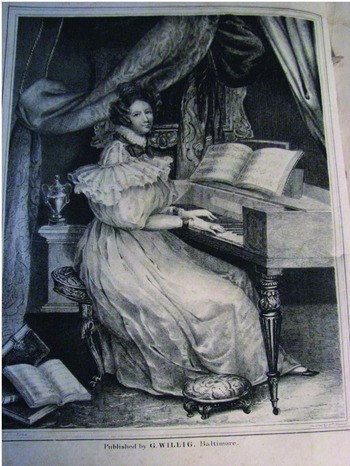
One of the binder's volumes that belonged to Eliza Harwood opens with a picture of a woman seated at the piano with her hands poised to play (Figure 1).Footnote 25 Notably, the volume does not include the musical exercises that the publisher, George Willig, originally attached to the image. That Harwood had the image bound as the first item people, including Harwood herself, would see when they opened her book—and did not include the music—promotes an interpretation of the binder's volume as more than just a collection of music. The Willig image invites a comparison with the frontispiece of Parthenia (1612/13), the first work for keyboard published in England, which is famous because it begins a visual tradition of associating women with a keyboard instrument in music publications.Footnote 26
Willig's girl at the piano (Baltimore: Willig, n.d.) [Eliza Harwell's book]. Willig opened his shop in Baltimore in 1828. The young woman's voluminous sleeves would have been in vogue in the 1830s, which is probably the date of this edition. Private collection, used by permission.

Such images correlated keyboard performance with feminine accomplishment and confirm that from the earliest days of music publication, women playing a keyboard instrument meant more than simply making music.Footnote 27 If a woman was to be seen playing the instrument, the visual element had to be a part of the Performance. The capital “P” here indicates a much broader performance than merely the playing or singing; I use it to distinguish between the experience of engaging musical practice with an audience and the more typical understanding of performance as music happening audibly.Footnote 28 I wish to emphasize not the playing of a piece nor the singing of a song as only a musical event but a learned behavior of physical display intended for reception by others who understood the code of conduct signified in the Performance of culture.
The Willig image in Figure 1 provided Eliza Harwood with a model for how she should appear at the piano. Placing it first in the volume meant that anyone who opened it would associate Harwood with musical accomplishment. A closer examination of the image offers an enlightening visual lesson in keyboard Performance. We see a young woman gazing out at the viewer, and her posture is restrained, no doubt partly because of the restrictive clothes she is wearing.Footnote 29 The nineteenth-century girl in the picture clearly knows her music repertory, as the other music books on the floor are meant to demonstrate. She has achieved accomplishment, which is shown by the elaborate cup, and she has sufficient wealth to own elaborate but tastefully demure clothes. Through this image and its placement, Harwood indicates to the observer that she has been properly brought up. The image also reminds Harwood how she should look at the piano: she is not engrossed in the music but controlled and contained, the ideal state for women in antebellum culture. Moreover, this image opened an edition of piano exercises, not performance pieces, which almost certainly explains why Eliza did not include the music. Piano exercises would indicate that she worked at music, which would be inappropriate because young women did not “work.” Such practice was a behind-the-scenes activity that was not for public display, like activities that took place in the back rooms of the house. Binder's volumes were for the parlor; practice books were private.
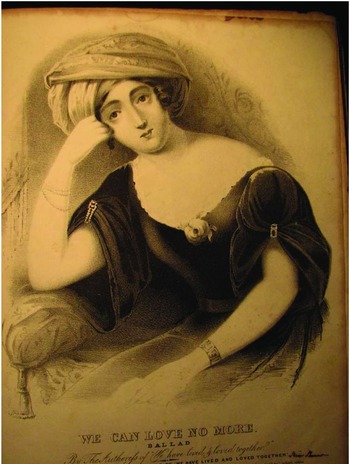
Binder's volumes do more than illustrate how young women should look while engaged in a musical performance. They can also provide visual clues to other aspects of behavior. Another image found in one of Eliza Harwood's books provides instruction in how one is to look if she is heartbroken; it also reflects a personal incident in her life. Born in 1827 near Williamsburg, Virginia, Harwood became engaged to Tristram Skinner when she was twelve.Footnote 30 When she was thirteen, Trim broke off the engagement. The break-up was apparently difficult for Harwood, who expressed her disappointment by writing Skinner's name next to the title of the song “We can love no more.” (See Figure 2.) She must also have referred to the song in a letter to Trim because he wrote out the second stanza and added Eliza's name on one of his private papers.Footnote 31 The image on this music probably served as a model for Eliza, one that showed her how she should look in this time of sadness and loss. The woman seems to be maintaining her composure and is not sobbing or obviously distraught. Restraint is indeed the order of the day as dictated by behavior manuals, stories in magazines, and other teaching tools in the curriculum. The right amount of sentimentality was decreed in print culture of the period, including images such as this one. From such images Eliza would have learned to hold her emotions in check and not become overly sentimental, a quality that etiquette books simultaneously prized and warned against overdoing.
Cover, “We Can Love No More,” anonymous (New York: Atwill, n.d.) [Eliza Harwell's book]. Private collection, used by permission.

Mary Stedman (b. 1840) of Fayetteville, North Carolina
Mary Stedman's single surviving binder's volume is instructive for several reasons. It consists of thirty-eight pieces of vocal music with piano accompaniment or solo piano pieces, with dates ranging from 1819 to 1847, bound together. It begins with two sacred songs: an early print of “Jesus Saviour of my soul” (undated) and “When for eternal worlds we steer: pious song for one or four voices” (1843). Perhaps she attributed some cachet to religious music, which would be natural given the number of her acquaintances who were the children of clergymen, and presented it first in her binder's volume. The rest of the volume is secular music. For the piano, Stedman owned dances, such as “The Giraffe Waltz” (1845), and variations sets, such the “variations faciles et brillantes” on “The Watcher” by Charles Grobe. On the whole, her songs with piano accompaniment include earlier pieces, including “When the Day with Rosy Light” and “The Rose of Cashmere” (both from 1819), “The Harp that Once thro’ Tara's Halls” and “Gaily the Troubadour” (both 1829), but some date from as late as 1843.
Because she was not born until 1840, the music that Mary Stedman played and sang likely belonged to another family member before she received it, as had some of Eliza Harwood's music. Mary's mother, Olivia Potter (1813–1886) of Raleigh, may have owned some of the older music, or indeed any other woman in her extended family might have passed it on to Mary. She was thirteen years old when her parents’ eleventh child was born—financial circumstances may not have allowed for the purchase of new music.Footnote 32 There is no doubt, however, that the binder's volume was Mary's and that the drawings and writings in it are hers. As such, it serves to tell us something about her.
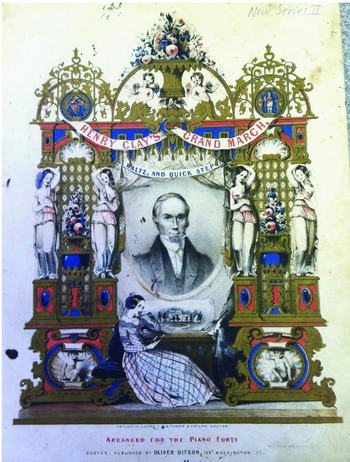
Parents could use sheet music to encourage young women to follow their parents’ lead in areas such as politics, which we can observe in Mary Stedman's binder's volume. For example, the image on the first page of “Henry Clay's Grand March, Waltz, and Quickstep” (see Figure 3) of Stedman's book is the first in a group of three pieces that have a connection to Henry Clay, the noted politician from Kentucky. Mary's father's livelihood directly depended on a successful mercantile economy, and he may have agreed with Clay's support of protectionist policies.Footnote 33 Her collection also includes two pieces linked to Clay's family home, Ashland: “The Ashland Waltz” and “The Ashland Quick Step.” That a binder's volume of thirty-eight pieces has three (counting the march, waltz, and quickstep as a single item) connected to Clay suggests some identification with the politician. The prominent placement of these political titles also suggests that they have special significance. Possibly John Stedman sought to teach Mary the “right way” to think about politics by providing her with this music. Having this item in her collection would also announce the household's position on the matter.Footnote 34
Cover, “Henry Clay's Grand March,” by John C. Bartlett (Boston: Ditson, 1844) [Mary Stedman's book]. Nineteenth Century American Sheet Music, New Series, vol. 2. Music Library, University of North Carolina, Chapel Hill.

The images on “Henry Clay's Grand March, Waltz, and Quickstep” send mixed messages. The scantily clad women who serve as somewhat “classical” statues lending tradition to Clay's political efforts vividly contrast with the demure and modestly dressed young woman who is reading in front of a landscape. It shows what appears to be a home, signifying that the woman's place was at home. Obviously Mary was to imitate the latter. Why else include such an image on this cover, if not for the fear that the classical females might be taken as ideals to emulate? The proper young woman might also have served to sell the music to conservative buyers, just as the draped nymphs might have attracted other types of consumers.Footnote 35 She leisurely reads a book safely in front of the home and counterbalances the questionable dress of the four young women framing Clay's portrait. Indeed, the juxtaposition of the young woman and home seems out of place in the context of the rest of the page, which emphasizes Clay. The lesson for young women equates them with home, not politics, Washington, or the dress and mood of the characters along the sides of the image of Clay.
Mary Stedman's binder's volume also provides an example of how personal these books were and how much description an owner might leave in such a book. Stedman drew on several pages in her music book and also made comments about her friends and acquaintances. On p. 22 she compiled a list of “choice young ladies” that provides an interesting account of social status in antebellum North Carolina. Each southern state had developed its own distinct character, and North Carolina certainly differed from surrounding states, as Bill Cecil-Fronsman demonstrates in Common Whites: Class and Culture in Antebellum North Carolina. North Carolina, for example, had significantly fewer grand plantations and a more active middle class.Footnote 36 Stedman's book reflects this unusual social order because her list of choice young ladies does not include anyone from the planter class, but rather the daughters of local merchants and clergymen in Fayetteville.Footnote 37 She wrote the list of socially appropriate girls into her book as a confirmation that she was associated with the right people as dictated almost certainly by her parents, and so that those who might use her book would see that she did so.
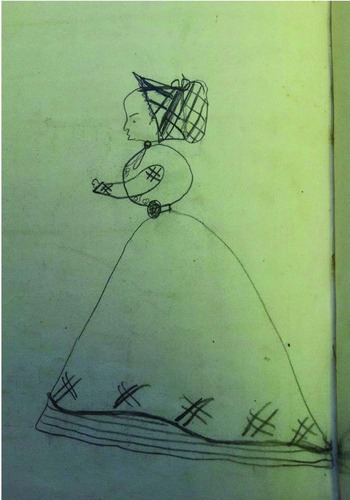
Stedman also drew pictures of people and of a house in her book. The image in Figure 4, found on the back of a piece of music in the middle of her book, reflects how she thought she should look. The image depicts a walking costume (complete with bonnet) and the highly fashionable tiny waist. Here Mary used her music book to affirm that she knew what society required of her body and dress. Her adherence to codes of dress and body image testified to her knowledge of proper self-representation and confirmed her place in her social circle.
Stedman's drawing [Mary Stedman's book] Nineteenth Century American Sheet Music, New Series, vol. 2. Music Library, University of North Carolina, Chapel Hill.

Kate Berry (1839–1908) of Nashville, Tennessee
The two binder's volumes (numbers 125 and 126) at the Center for Popular Music at Middle Tennessee State University that belonged to Kate Berry contain numerous printed pictures that accompany the music, as does the volume owned by her older sister Ellen. The two women probably had more access to printed images because their father was a noted bookseller in Nashville and the family was personally acquainted with those who sold music in town. Moreover, of the three young women investigated here, Kate Berry seems to have had the most control over her music selections because many of them were published when Berry was at least ten years old, and they do not appear to have been hand-me-downs from other relatives.
Volume 125 contains forty-four pieces, mostly from 1848–52; Volume 126 has thirty-two, mostly from 1851–54. Like Eliza Harwood, Kate Berry included more piano than vocal music in her volumes. Modern music, often with images on the first page, is one aspect that distinguishes Berry's collection from the others examined here. That volume shows a preference for dances, especially waltzes and polkas.Footnote 38 She also followed the trend for operatic melodies arranged in sets by composers such as Theodore Oesten, three of which (arrangements from L'elisir d'amore by Donizetti, Beatrice di Tenda by Bellini, and I due Foscari by Verdi) she included in this volume. These piano versions appeared soon after the operas: I due Foscari had been premiered only in 1844 in Rome and in 1847 in the United States, but William Hall published them in New York in 1848.Footnote 39 Volume 126 also contains piano versions of famous opera tunes, including Ferdinand Beyer's reworking of Ernani melodies. Two of William Vincent Wallace's pieces in that volume demand facility at the keyboard (his “Grande polka de concert” and “Le rêve”). Three other pieces of note include Patrick S. Gilmore's “Good news from home” and “Sad news from home” (both 1854), and Stephen Foster's “My Old Kentucky home” (1853). That Kate's father was a merchant involved in prints (books) must have been a contributing factor in the speed with which she acquired recently published music.
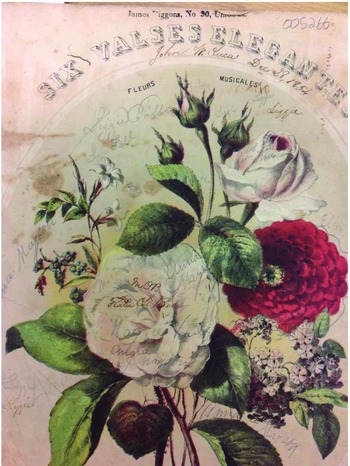
Like Mary Stedman, Berry used one of the pages in her binder's volume to include the names of her friends, including them on an image for “Six Valses Elegante.” (See Figure 5.) At least eight names can be discerned on this page, including her older sister Lizzie, Lizzie Fall, Anna Marson, Maggie Vaulx, John W. Lucas, Mr. OB, Ellen [illegible], and Kate's own name. It bears the date 28 December 1854. The women's names mostly appear on flowers, which might be why they were included on this particular page. Furthermore, these names appear to be signatures, like an autograph book. These people must have visited Berry's home, and these signatures serve as a record of the occasion(s).Footnote 40
Cover, “Six Valses Elegantes,” by William Vincent Wallace (New York: Hall & Son, 1853) [Kate Berry's book]. Sheet Music Collection, vol. 125, Center for Popular Music, Middle Tennessee State University, Murfreesboro.

Berry's binder's volumes contain a wealth of information about her life and what she found important to know as a young woman of fifteen. She used them to record many of her personal feelings and thoughts. While some are entertaining, such “Miss Berry, The Belle of Bellevue” written in the back of one volume, others suggest her concern with her self-presentation and family. Just as she would have done with a commonplace book, she copied verse into her binder's volumes, such as “Beauty in vain her pretty eyes may roll/Charms strike the sight but merit wins the soul” (with “merit” underlined twice). No verse shows this personal connection as well as her notations regarding the deaths of family members and friends. On “Are We Almost There?” Berry wrote, “Thursday Night at ten o'clock precisely Sue Hoffman died/15th February 1855,” and then, in 1863, already married to Hardy Bryan (1828–1885) and heading a family of her own, she subtracted 1855 from 1863, determining that it had been eight years since Sue had died.
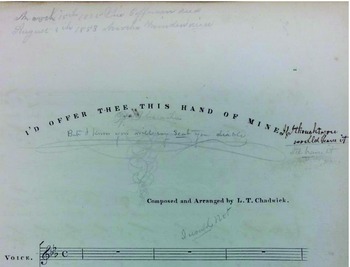
Not all of Berry's writings, though, are serious: there is some flirtatious commentary regarding what looks to be a male admirer. The additions to the song “I'd Offer Thee This Hand of Mine” suggest that she was in a conversation with a young man, possibly in clandestine circumstances. To the title, someone—not Berry—added, “If I thought you would have it,” in ink (see Figure 6). Underneath this addition Berry penciled in, “I'll have it.” Moreover, under the arched title she wrote, “If I Loved thee” and “But I know you will say Scah [sic] you diable,” which she then answered, “I would [underlined],” and then “not” is written in a different hand. They seem to have been flirting, and such jottings occur throughout both of her volumes. In the music that follows, the “ink hand” wrote Kate's name in, and she replied in pencil. Perhaps these notations capture a closely chaperoned meeting where Kate and a young man used the music to communicate with each other without anyone else overhearing them.
“I'd Offer Thee This Hand of Mine,” by L. T. Chadwick (New York: Firth, Pond, 1849) [Kate Berry's book]. Sheet Music Collection, vol. 125, Center for Popular Music, Middle Tennessee State University, Murfreesboro.

A palpable sense of Berry's personality emanates from her volumes. She unreservedly marked up her binder's volumes, sometimes to the point of silliness (such as drawing mustaches on women). For example, in her copy of the very popular song “Katy Darling,” she changed each “Katy” in the song to “Kate.” Even more striking are her emendations to the image on the title page. The picture is of a man half-kneeling, half-lying on the ground in front of “Katy's” tombstone. Fifteen-year-old Kate changed the name on the tombstone to “Kate,” wrote “Hill” above the man and “Hill at Kate's Grave” (in ink), added “heavy hagard [sic] + worn he sits weeping” and “June 21st, 1854” in pencil. “Hill” is Wiley Hill, whose name appears elsewhere in the volume. Unlike the previous example, here she does not appear to have been in a conversation with a young man while writing on her music: most of changes are in ink and all seem to be in her hand. The image prompted her to muse about a particular romance, and drawing inspiration from the title, Berry unabashedly expressed her feelings on her music. In this case, she saw the picture as one she wanted Hill to emulate. He had perhaps recently broken off a courtship with her or, more likely, given her penchant for flirtatious commentary elsewhere in her books, was not giving her enough attention.Footnote 41
Kate Berry did play the pieces in her binder's volumes. Volume 125, which includes music published between 1845 and 1852, consists of a high percentage of dances. As was common in this period, the Berrys may have accompanied dancing as part of entertaining their friends. The slightly later volume, Volume 126, includes her copy of William Vincent Wallace's “Le rêve,” op. 21, in which she marked places where the left or right hand takes the large chords. Another indication is the date “May 16” and a line drawn as if to mark the place where Kate should have practiced to by that date. That she changed her name on several of the vocal scores further indicates that she used the music. Significantly, she played from it after her marriage in 1856, evidence for which lies in her copy of François Hünten's arrangement from Bellini's opera Norma (005340-SMVOL), on which “Kate May 1 1858” and fingerings have been added.
Conclusion
The women examined here represent many different aspects of southern society. I have deliberately stayed away from famous names, such as the “elite” women of Charleston, in order to demonstrate the pervasiveness of binder's volumes and music education of young women throughout the South before the Civil War and to show that their use included a much broader segment of the population than we have heretofore acknowledged. Furthermore, they also suggest that the collections served to educate young women from diverse socio-economic backgrounds in a cultural curriculum that was consistent throughout the South.
The images found on music in antebellum binder's volumes and the personal notations made by the young women who owned them demonstrate that we can learn much from these books if we read them as more than collections of popular music. Certainly they contribute to our understanding of music during this period because they offer evidence of which genres, composers, and styles were available to and frequently performed by large numbers of people. All three young women profiled here collected dance music and had it bound into their volumes. Both Kate Berry and Eliza Harwood owned versions of “La Cachucha;” both Kate and Mary Stedman included “The Harp That Once Thro’ Tara's Halls.” These pieces were popular during the antebellum period, and their presence here serves to underline the fact that all of the binder's volumes examined for this study consisted of similarly styled music, the main difference being that Kate's was slightly later than that of the others. The music reflects taste and an appropriate level of culture; it shows that the young women had been instructed to play and to sing (all the binder's volumes examined here include both solo piano music and songs for solo voice). The music is of the “correct” types, too: mostly sentimental songs, dances, and variations on popular tunes. But the purpose of the books also goes deeper: they demonstrate how one is to be viewed, how one is to present herself for the gratification of others, how one is to think or behave, how one moves within desired social circles. To see these aspects we have to look beyond the repertory included in them.
Many young women used their binder's volumes as they might use commonplace books, as places to record poetry they found instructive or inspiring (or simply pretty), to record social events, to draw images, to collect the names of friends, and to express themselves. Godey's Lady's Book began to include a section called “the centre-table commonplace book” in 1856, and the editor succinctly defined its role to “contain our clippings for the month, alternating from grave to gay, the sentimental to the practical.”Footnote 42 Binder's volumes have similar content. In so doing they reflected young women's education in a cultural system as well as their accomplishments within that system.
The deliberate act of choosing sheet music and even particular pages to be bound corresponds to deciding which items to copy into commonplace books, and the marking up of pages suggests agency related to a personal imprint on the same. Eliza Harwood numbered her sheet music before it was bound. Her three extant volumes are missing about thirty numbers from the sequence, and some pieces have no numbers at all. Clearly she did not simply bind all that she owned. Mary Stedman's collection may have been less luxurious and was indeed old-fashioned, but she extensively engaged with her binder's volume, leaving a record of who her friends were, how she thought she should look, and other details about life in Fayetteville. Kate Berry's two volumes illustrate not only the music that she owned and perhaps needed to use for dancing in the parlor; they also demonstrate that her piano skills improved considerably from the simple aria arrangements in Volume 125 to the more difficult settings in Volume 126 (which includes the latest dates): the second volume shows her a better pianist, presumably after further practice and study. It might also be possible to read Volume 125 as evidence that Kate Berry played the piano for her friends to dance and Volume 126 for solo performance.
The cultural norms we see in these materials appear to have crossed economic and social boundaries, from the less affluent, whose music was passed down to Stedman and Harwood to the extravagant purchase of sheet music with images for Berry.Footnote 43 The “everydayness” of these books and the women who owned them has resulted in their being ignored in broader studies of American culture. In fact, for decades the binder's volumes were not traditionally viewed as worthy of note or even preservation. Many are still located among boxes of “ephemera,” or else they were unbound and catalogued as separate musical compositions.Footnote 44 This practice ensures that we can remember the men who composed the music, but not the women who played it.Footnote 45 Even notable collections of historic sheet music do not catalog them under labels that indicate a bound collection, but only by the titles and composers on individual pieces in them. And while having pages of music available digitally is important for research, the choice has been made in almost all cases to include only the sheet music itself, so that images such as those from Stedman's book remain hidden. These practices have erased the individuality of many women from the past, but in order to more fully understand women's culture in the antebellum period we must tease out these types of details.
Looking at binder's volumes as more than collections of popular sheet music reveals much about the world in which antebellum women resided. Many women used them to record life events, poetry, draw, and for other purposes, practices that allow us to view them today as a type of commonplace book. Doing so provides a fuller account of how music was part of a broader education and the Performance of culture. Furthermore, it invites questions that have yet not been asked but which are critical in understanding the history of American music in the nineteenth century.