


Introduction
Research on processes in cognitive behavioural interventions has identified several aspects of psychotherapy interventions that are important for patient outcome. These can be summed up into aspects of therapist competence and adherence to therapy techniques on the one hand and therapeutic alliance aspects on the other (e.g. Chui et al., Reference Chui, Hill, Kline, Kuo and Mohr2016; Linden et al., Reference Linden, Langhoff and Rotter2007; Newman et al., Reference Newman2010; Prasko et al., Reference Prasko, Vyskocilová, Mozny, Novotny and Sleecky2011; Roos and Werbart, Reference Roos and Werbart2013; Weck et al., Reference Weck, Grikscheit, Höfling, Kordt, Hamm, Gerlach, Alpers, Arolt, Kircher, Pauli, Rief and Lang2016).
In the empirical literature, therapeutic alliance has been widely discussed. There are different aspects by which therapeutic alliance plays a role in therapy outcome: on the one hand, the therapeutic alliance seems to be an important precondition for the subsequent competent implementation of therapeutic techniques (Weck et al., Reference Weck, Grikscheit, Jakob, Höfling and Stangier2015b), while on the other hand it has been argued that therapist adherence plays an important role at the beginning of therapy, whereas higher alliance late in therapy is associated with a better outcome (Haug et al., Reference Haug, Nordgreen, Ost, Tangen, Kvale, Hovland, Heiervang and Havik2012). It has been discussed whether alliance is a predictor for treatment outcome, and there is support for this hypothesis (Arnow et al., Reference Arnow, Steidtmann, Blasey, Manber, Constantino, Klein, Markowitz, Rothbaum, Thase, Fisher and Kocsis2013; Zilcha-Mano et al., Reference Zilcha-Mano, Solomonov, Chui, McCarthy, Barrett and Barber2015), but also findings showing that more than alliance is needed and other aspects also contribute to the outcome, e.g. change of symptoms and avoidance of drop-out (Barber et al., Reference Barber, Zilcha-Mano, Gallop, Barrett, McCarthy and Dinger2014; Hendriksen et al., Reference Hendriksen, Peen, Van, Barber and Dekker2014; Roos and Werbart, Reference Roos and Werbart2013). It has also been found that patients’ and therapists’ perceptions of alliance are different (Bachelor, Reference Bachelor2013; Heinonen et al., Reference Heinonen, Lindfors, Härkänen, Virtala, Jääskeläinen and Knekt2013), but not completely independent of each other, which leads to the assumption that they may influence each other (Nissen-Lie et al., Reference Nissen-Lie, Havik, Hoeglend, Roennestad and Monsen2015).
The next important aspect associated with treatment outcome is the therapist’s competency and adherence (Ginzburg et al., Reference Ginzburg, Bohn, Höfling, Weck, Clark and Stangier2012; Rozek et al., Reference Rozek, Serrano, Marriott, Scott, Hickman, Brothers, Lewis and Simons2018). Competency dimensions that are crucial in psychotherapy have been described as therapeutic alliance, case assessment and conceptualization, self-reflection, and intervention (Newman, Reference Newman2010; Prasko et al., Reference Prasko, Vyskocilová, Mozny, Novotny and Sleecky2011). Therapists are able to fit their styles of intervention to the patient’s level of functioning and distress (Milbrath et al., Reference Milbrath, Bond, Cooper, Znoj, Horowitz and Perry1999). Therapists encouraging an engaging relational style seem advantageous in short-term therapies, but constructive coping techniques are also helpful (Heinonen et al., Reference Heinonen, Lindfors, Härkänen, Virtala, Jääskeläinen and Knekt2013). Therapists’ experience, training and skills as well as providing support are associated with lower drop-out (Roos and Werbart, Reference Roos and Werbart2013). Besides alliance (r = .31), therapist adherence (r = .54) was especially predictive of changes in agoraphobic avoidance behaviour 6 months after treatment (Weck et al., Reference Weck, Grikscheit, Höfling, Kordt, Hamm, Gerlach, Alpers, Arolt, Kircher, Pauli, Rief and Lang2016). In health anxiety treatments, therapist competence was indirectly associated with the treatment outcome, mediated by therapeutic alliance (Weck et al., Reference Weck, Richtberg, Jakob, Neng and Höfling2015a).
In psychotherapy short interventions, each single session and not only a long-term treatment perspective holds importance (e.g. Chui et al., Reference Chui, Hill, Kline, Kuo and Mohr2016; Milbrath et al., Reference Milbrath, Bond, Cooper, Znoj, Horowitz and Perry1999). Short-term psychotherapies with 4–18 sessions have proven successful (e.g. Abbass et al., Reference Abbass, Town and Driessen2012; Muschalla, Reference Muschalla2017). The level of change in psychotherapy is reached by a log linear rather than a constant pattern of change, which means that the first 4–6 sessions hold importance in terms of an initial improvement (Stulz et al., Reference Stulz, Lutz, Kopta, Minami and Saunders2013). In clinical settings, group therapies are often used due to the inpatient setting and economical aspects. Group therapies can be organized as (slow-)open groups, and therefore each session should regard one specific topic that should be elaborated and finished in the same group session, e.g. in a group for work coping, one session may concentrate on interactional skills for return-to-work conversation, another session may concentrate on how to calm oneself down insituations of high work load, etc. In (slow-)open groups, new participants can enter the group at any session, or leave the group. Accordingly, there may be a partly different assembly of participants in each single group session. Due to these reasons, one group session can be regarded separately from the other sessions. In the empirical literature, sessions have been investigated, e.g. clients’ and therapists’ affective developments over the sessions course and their impact on session quality and alliance (Chui et al., Reference Chui, Hill, Kline, Kuo and Mohr2016).
Objectives
The present research ties up at this stage. It provides empirical data on the outcome of cognitive behavioural therapy (CBT) group sessions, depending on alliance, competency aspects perceived by therapists, co-therapists and patients. This is the first evaluation of group session aspects and session outcomes in rehabilitation patients with work anxieties in slow-open groups. The explorative questions of research are as follows:
(1) Are patients’, therapists’ and co-therapists’ perceptions of the same group session similar or different?
(2) (In which way) are group sessions that result in worse outcomes (low patient-perceived work coping) different from group sessions resulting in a better outcome (higher work coping)?
(3) Which aspects of the group session are predictive for a better outcome (high patient-perceived work coping)?
Method
Patients with work anxieties were treated in a CBT group. Groups were organized with a slow-open intake procedure. This work-directed CBT group intervention leads to improved work coping and shorter sick leave duration for some patients in the following 6 months compared with a recreational group (Muschalla, Reference Muschalla2017; Muschalla et al., Reference Muschalla, Linden and Jöbges2016). The present analysis is an addition to these global findings and it analyses the therapy outcomes at the level of group sessions.
Setting and work-coping group
All group therapy sessions were conducted in a naturalistic setting of an inpatient rehabilitation, i.e. a multi-modal treatment for people with chronic health problems. The criterion for participation in this group therapy was a specific work-anxiety disorder (Muschalla, Reference Muschalla2017; Muschalla et al., Reference Muschalla, Linden and Jöbges2016) and patients had to be of working age (18–65 years old). There was no other psychotherapy intervention besides the group treatment investigated here, i.e. the therapy processes cannot be influenced by parallel psychotherapy context variables.
One hundred and forty-nine work-coping group sessions were conducted by a state-licensed psychotherapist. She had 10 years of practical experience in this profession. Each group contained on average 5–6 patients and lasted for 90 minutes. Groups were slow-open, i.e. in each session new patients could come in and other patients could leave the group. Each group session concentrated on one therapy topic. Typical topics were calming oneself when being nervous at work, handling a great amount of work, working together with colleagues and supervisors, presenting one’s own health problem, or solving problems and conflicts actively at work (Muschalla, Reference Muschalla2017). In 125 sessions, a co-therapist was present; in 76 sessions a psychologist was present, and in 49 sessions another psychotherapist (behaviour therapy) who had 8 years of practical professional experience was present. The co-therapist’s task was to observe the group process, as well as the therapist technique behaviour (the latter could only be done by the psychotherapist co-therapist).
The work-coping group was a manualized modular CBT group (Muschalla, Reference Muschalla2017; Muschalla et al., Reference Muschalla, Linden and Jöbges2016b). It has been conceptualized by experts for treating work anxieties and is based on evaluated cognitive behavioural anxiety therapy approaches (Clark and Beck, Reference Clark and Beck2009; Koch et al., Reference Koch, Geissner and Hillert2007). Intervention contents are coping and capacity training such as problem-solving, personal initiative behaviour, stress management capacities and distress tolerance (Carpenter et al., Reference Carpenter, Sanford and Hofmann2019; D’Zurilla and Goldfried, Reference D’Zurilla and Goldfried1971; Frese and Fay, Reference Frese and Fay2001; Kaluza, Reference Kaluza2004; Lazarus, Reference Lazarus1993). Work-directed role plays was used for training interaction and conflict-solving. Guided discovery and group feedback was used for correction of dysfunctional beliefs. Typical work situations were used for training and participants were taught to use coping strategies dependent on situational requirements (Cheng et al., Reference Cheng, Kogan and Chio2012). The therapy focused on self-management and self-regulation (Gottschling et al., Reference Gottschling, Hahn, Maas and Spinath2016). Sessions were structured according to the typical scheme of CBT group interventions, beginning with a brief introduction to the group’s aim by the therapist, followed by asking the patients for their therapy topics (‘Which behaviour or coping style do you want to train?’), a short recapitulation of the last group’s topics and homework assignments, deciding on a new topic for this session, elaboration of the topic, as well as conclusion and homework assignments.
Participants
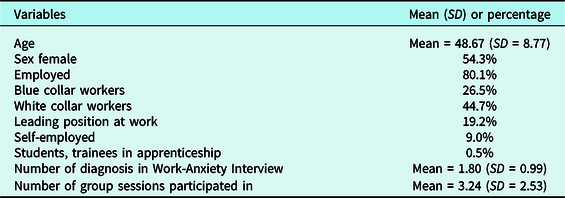
Two hundred and eight patients participated in the work-anxiety groups. Participants were assessed with the Work-Anxiety Interview (Linden and Muschalla, Reference Linden and Muschalla2007), and had at least one relevant work-anxiety diagnosis (Table 1).
Group therapy participant characteristics

Instruments
Immediately after each group session, patients and (co)therapists completed a short questionnaire including two scales: patients were asked for ratings on their perception of the group session’s process (patient version of the Short Group Behavior Therapy Competency Checklist (BTCC); Linden et al., Reference Linden, Baumann, Lieberei, Lorenz and Rotter2011; Muschalla, Reference Muschalla2017) and their present work-coping perception [patient version of the Inventory for Job-Coping and Return (JoCoRi); Muschalla, Reference Muschalla2017; Muschalla et al., Reference Muschalla, Linden and Jöbges2016]. The therapist and co-therapist were asked for ratings on their perception of the group session’s process (therapist version of the Short Group BTCC; Linden et al., Reference Linden, Baumann, Lieberei, Lorenz and Rotter2011; Muschalla, Reference Muschalla2017), and their perception regarding the extent to which each of the work-coping issues were trained in the session (therapist version of the JoCoRi; Muschalla, Reference Muschalla2017: Muschalla et al., Reference Muschalla, Linden and Jöbges2016). In n = 49 group sessions in which the therapist and co-therapist were both psychotherapists, the long version of the BTCC (Linden et al., Reference Linden, Langhoff and Rotter2007) was additionally completed by the therapist and co-therapist.
Behavior Therapy Competency Checklist
The BTCC (Linden et al., Reference Linden, Langhoff and Rotter2007) is an assessment instrument for monitoring therapy quality. The BTCC enables evaluating details of a therapist’s technique behaviour regarding the aims of the session, alliance, structuring the session, group therapy techniques, global session quality, and the extent to which the therapist asked questions instead of making declarative questions. The scale ranges from 1 = do not agree at all, to 7 = completely agree. The BCTT was evaluated in an earlier study in a behaviour therapy setting for patients with different types of mental disorders (Linden et al., Reference Linden, Langhoff and Rotter2007). One hundred and eighty-four tape-recorded therapy sessions from 14 behavioural therapists were evaluated by four independent raters. Concordance was 79.6%, kappa values for rater-pairs was .612 (p < .001), and intraclass-correlation (ICC) was .720.
Short Group BTCC
The Short Group BTCC (Linden et al., Reference Linden, Baumann, Lieberei, Lorenz and Rotter2011; Muschalla, Reference Muschalla2017) includes three items of the BTCC (Linden et al., Reference Linden, Langhoff and Rotter2007) that were modified for group sessions. The Short Group BTCC was filled in after each group session. It asks whether patients gained new insights and experiences from the group session, the extent to which they felt understood by the therapist, and the extent to which the working alliance in the group was good. Therapists as well as patients answered these three items. Patients were additionally asked whether they felt good in the group. Each item was rated from 0 = do not agree at all, to 4 = completely agree.
JoCoRi work-coping
After each group session, participants were asked to give a short rating on their perceived work coping on seven coping items. The JoCoRi patient version has been evaluated in independent samples and showed good Cronbach’s alpha (.822) and validity (Muschalla, Reference Muschalla2017; Muschalla et al., Reference Muschalla, Linden and Jöbges2016). The instruction was: ‘Please imagine being at your workplace right now. How could you do the following things?’. Each item was rated from: 1 = not able to do this, to 5 = best coping ability for doing this. The work-coping items reflect the contents of the work-coping group. Besides the patient’s self-rating on the JoCoRi, therapists and co-therapists rated the same JoCoRi items after each group session, with the instruction of judging the extent to which patients learnt to apply the respective coping behaviour in that day’s group session.
Statistical analysis
Correlative analysis was used to analyse the relationship of group perception between the patient, therapist and co-therapist (Table 2). Comparisons of groups with high and low session outcomes were done by t-tests (Table 3). Regression analysis was conducted to identify which degrees of variance explanation different therapy aspects have for the session outcome (Tables 4 and 5).
Means (standard deviation) and correlations between therapists’, co-therapists’ and patients’ perception of the group sessions
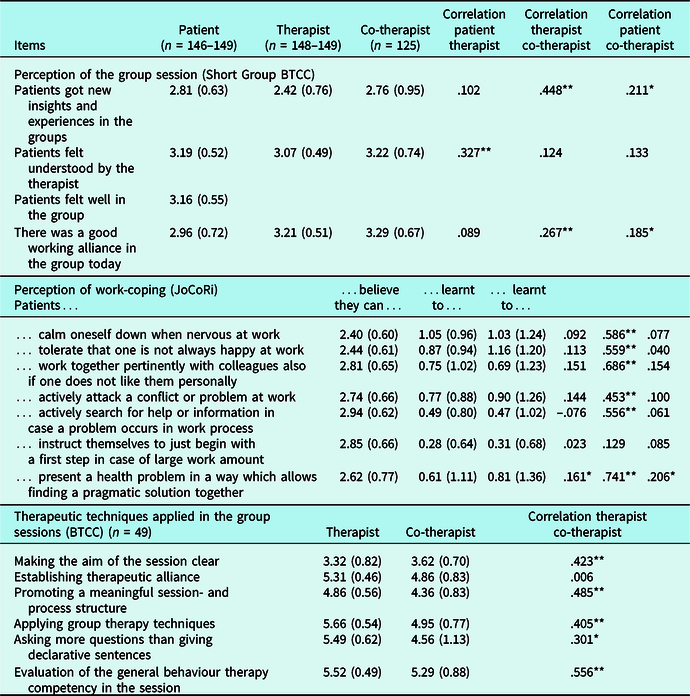
*p < .05, **p < .01. There were few missing values in the Short Group BTCC data, therefore patient number varies between n = 146–149 and therapist number between n = 148–149.
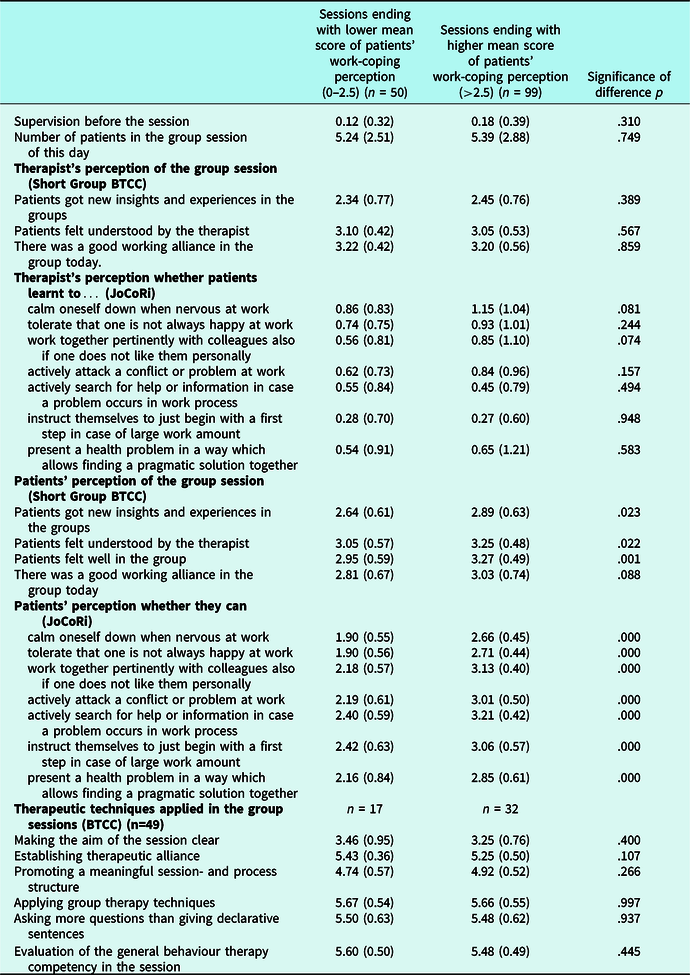
Comparison of sessions ending with high patients’ coping perception versus sessions ending with low patients’ coping perception

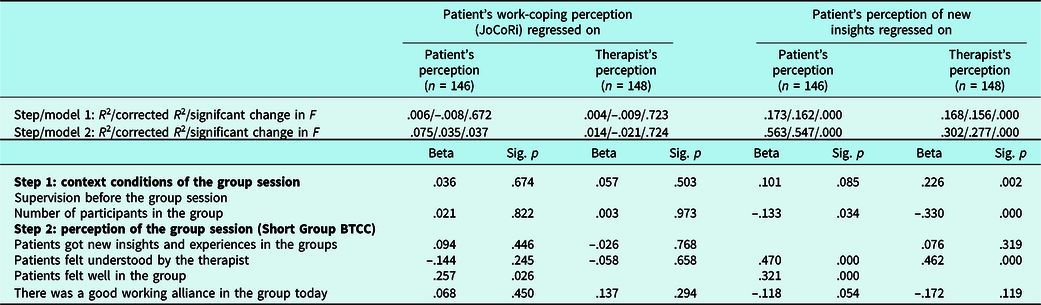
Regression analysis: patient’s work-coping perception (JoCoRi) regressed on therapist’s and patient’s perception on group session process (n = 148 group sessions)

Full data on all the included items were available from 146 patients, and 148 from therapists. Therefore 146 and 148 cases could be included in this regression analysis.
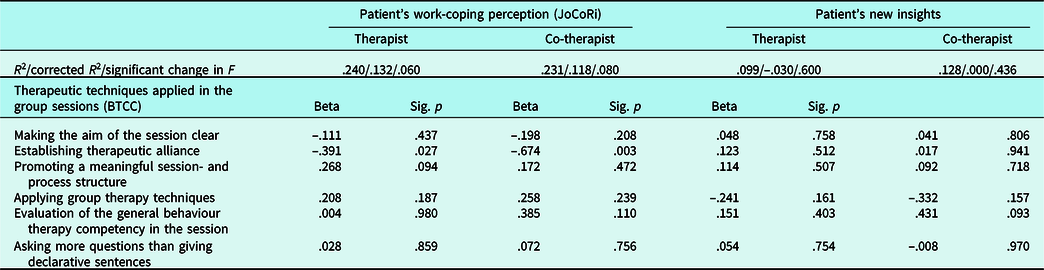
Regression analysis: patient’s work-coping perception and patient’s new insights regressed on therapist’s and co-therapist’s perception of therapy techniques accuracy (n = 49 sessions)

Results
Patients’, therapists’ and co-therapists’ perceptions of the same group session
The therapist and co-therapist agreed concerning the extent to which there was a good working alliance (r = .267**) and patients gain new insights (r = .448**) (for asterisks, see Table 2, Short Group BTCC). The therapist and co-therapist agreed about the work-coping contents that patients learnt (Table 2, JoCoRi correlations), but not concerning whether patients felt understood.
The patients and therapist agreed that patients felt understood by the therapist (r = .327**). By contrast, patients agreed with the co-therapist about gaining new insights and experiences (r = .211**), and that there was a good working alliance (r = .185*, Table 2, Short Group BTCC).
However, patients’ beliefs concerning the extent to which they could apply work coping was independent from what the therapist and co-therapist thought patients learnt in the group session (Table 2, JoCoRi).
The therapist and co-therapist agreed significantly (r = .301* to .556**, Table 2, BTCC, ‘Correlation therapist co-therapist’ column) concerning the therapeutic techniques that the therapist applied in a group session, with the exception of establishing therapeutic cooperation (r = .006, n.s.).
Group sessions with lower and higher work-coping outcomes
Patient’s perception of being understood by the therapist and gaining new insights is significantly higher in sessions ending with a higher work-coping perception (Table 3, Short group BTCC) compared with sessions ending with a low work-coping perception.
By contrast, there are hardly any significant differences in therapist’s perception, either regarding the group sessions as such, or what the therapist thought the patients learnt (Table 3, Short Group BTCC, JoCoRi). In sessions ending with higher patient work-coping perception, therapists were slightly more optimistic that patients learned self-calming (JoCoRi, p = .081) and working together with colleagues (p = .074).
The therapeutic techniques applied in the group sessions were conducted in similar quality (i.e. without significant differences) in both group sessions ending with higher patient work-coping perception and groups with lower perceived work coping (Table 3, BTCC).
Aspects of the group session are predictive for higher session outcomes
Concerning the main outcome – i.e. work-coping perception (Table 4, JoCoRi) – patients’ perception of the group session holds some relevance; the aspect of feeling good in the group contributed significantly to variance explanation. Therapist perception and context conditions (supervision before the group, number of patients in the group) were not of relevance. However, patients’ work-coping perception was also predicted by a technical aspect (Table 5, BTCC); interestingly, lower effort devoted to alliance building was associated with higher patient work-coping perception directly after a group session.
Discussion
Patients’, therapists’ and co-therapists’ perceptions of the same group session
The patient–therapist or patient–co-therapist combinations are less concordant in aspects of working alliance and gaining new insights compared with the therapist–co-therapist. This may be due to the different perspectives of patients and therapists on the group process. Similar observations have also been made by other researchers. For example, Langhoff et al. (Reference Langhoff, Baer, Zubraegel and Linden2008) suggested distinguishing between therapist–patient alliance (alliance from the therapist’s perspective), patient–therapist alliance (alliance from the patient’s perspective), mutual therapeutic alliance and therapist–patient concordance. Accordingly, Bachelor (Reference Bachelor2013) advised that therapists should not assume that their views on the therapeutic alliance and therapeutic work are shared by the patient and that the therapist should seek the patient’s feedback.
The therapist–co-therapist are more narrowly related in their session perception. This may be due to fact that they share similar (CBT-based) concepts of what good therapeutic cooperation is, and which insights patients may gain from the group session.
Aspects of the group sessions and session outcome work coping
Therapists perform with similar technical quality in group sessions with higher or lower session outcome. Therefore, the different session outcomes (work coping) cannot be due to different qualities of therapist performance but may rather be due to patient variables. This is partly in contrast to earlier findings highlighting the importance of therapeutic technique (Ginzburg et al., Reference Ginzburg, Bohn, Höfling, Weck, Clark and Stangier2012). Evidence also shows that patient variables play a role in therapy outcomes, i.e. the patient’s openness to discuss their problem, and the patient’s predisposition to change and accept psychological treatment (Keijsers et al., Reference Keijsers, Schaap and Hoogduin2000).
An interesting question concerning the working alliance is why was there a negative relationship between the therapist’s efforts to establish therapeutic alliance and the patient’s perceived work-coping ability? This finding initially seems contradictory as therapeutic alliance or interpersonal aspects have been discussed as an essential basis for a good outcome (Flückiger et al., Reference Flückiger, Grosse Holtforth, Znoj, Caspar and Wampold2013; Keijsers et al., Reference Keijsers, Schaap and Hoogduin2000). However, as present literature on alliance suggests, alliance as such is not the only central predictor for a good therapy outcome. There is evidence that aspects of alliance operate differently in different treatment types: for example, a focus on affect has been found as important for benefits of short-term dynamic psychotherapy, although it interferes with the benefits of cognitive therapy (Ulvenes et al., Reference Ulvenes, Berggraf, Hoffart, Stiles, Svartberg, McCullogh and Wampold2012). Furthermore, Haug et al. (Reference Haug, Nordgreen, Ost, Tangen, Kvale, Hovland, Heiervang and Havik2012) have found that a therapist’s adherence at start of therapy was important for long-term outcomes after anxiety treatment. It has also been suggested that alliance and adherence may both play a role (Weck et al., Reference Weck, Richtberg, Jakob, Neng and Höfling2015a), albeit a different role in different therapy sections (Haug et al., Reference Haug, Nordgreen, Ost, Tangen, Kvale, Hovland, Heiervang and Havik2012), while alliance is needed as a precondition for correctly implementing interventions (Weck et al., Reference Weck, Grikscheit, Jakob, Höfling and Stangier2015b). According to this, it may be the case that in a continuously running group therapy with a slow-open intake procedure (as for the group investigated here), there cannot be a strong focus on alliance and establishing a therapeutic cooperation but rather a focus on training work-coping capacities, i.e. the contents of the group. This may also explain why none of the other technical aspects was significantly related with the patient’s work-coping outcome.
It seems that patients who subjectively feel good in the group are associated with a better outcome. It may be the case that feeling good is an underlying aspect of general mental condition that is not specifically influenced by the concrete therapy session. It may be the case that patients who feel good are generally higher in their work-coping perception, independent of what happens in the concrete group session (working alliance, feeling understood, getting new insights) and how the therapist performs. Thus, it may be possible that those who are generally in a better status are more positive in report on both the therapy session and their work-coping ability. This would explain the difference between patient’s and not between the therapist’s ratings between the groups of high and low work-coping outcomes (Table 2).
Therapists expected marginally better learning of ‘self-calming’ and ‘working together with colleagues’ in those sessions when patients rated their work-coping higher. A possible underlying mechanism for this tendency might be that therapists adjust their therapeutic style or perception to the patient’s level, as observed by Milbrath et al. (Reference Milbrath, Bond, Cooper, Znoj, Horowitz and Perry1999). In the present investigation, the therapist may have adjusted her perceived level of topics learnt to the patient’s status. However, the fact that therapeutic techniques or therapist’s group perception did not play a role for work-coping outcome (Tables 3 and 4) supports the assumption that patient status itself holds strong relevance.
Limitations and strengths
The outcome work coping was assessed through self-rating by the patients. Due to common method bias, there may be a narrower relation between patient’s perception of the group session and their work-coping ability. It should be replicated whether a therapist’s performance is more fruitful for the patient’s outcome when it is not too strongly focused on alliance building, but rather considering patient perceptions. Future research should consider observation of outcome. Work coping might be assessed with capacity ratings on problem-solving tasks or work simulations.
As a limitation, the group therapy was a behaviour therapy. It may be the case that group processes appear differently in a psychodynamic/psychoanalytic setting.
A strength of this study is that it has been conducted in a naturalistic setting with (co)therapists who have long professional experience. The study followed recent suggestions to consider different perspectives in therapy session research, namely the patient, therapist and observer (Ardito and Rabellino, Reference Ardito and Rabellino2011; Langhoff et al., Reference Langhoff, Baer, Zubraegel and Linden2008). Furthermore, following the multi-level model of psychotherapy (Linden et al., Reference Linden, Langhoff and Rotter2007), different levels of therapeutic action have been considered, including therapist’s technical quality, session content and the alliance.
Conclusion
The present research adds evidence to the question of whether and in what way different perspectives (patient, therapist, co-therapist) play a role in group therapy. It has been found that the patient, therapist and co-therapist have different perspectives on the same group therapy session, which fits with an earlier similar observation (Langhoff et al., Reference Langhoff, Baer, Zubraegel and Linden2008). Patients’ perceptions are associated with session outcome (here in terms of perceived work coping). A lower session outcome is not associated with a poor technique performance of the therapist. Therapists should not only be aware of correct technical performance (which has shown to be the important basis (Ginzburg et al., Reference Ginzburg, Bohn, Höfling, Weck, Clark and Stangier2012), but additionally they should be aware of patients’ perception of group process and group topics, as well as patients’ subjective outcome perceptions. Therapists should not focus too strongly on alliance building, as this might by associated with patients’ poorer coping outcomes at the end of a session.
Acknowledgements
This manuscript underwent English language check by Kelly GmbH.
Financial support
This research has been financially supported by the German Federal Pension Agency.
Conflicts of interest
The author has no conflicts of interest with respect to this publication.
Ethical statements
This study was approved by the Ethics Committee of the University of Potsdam, Germany, and the internal review board of the German Federal Pension Agency, including the Department of Data Protection.
Key practice points
(1) Patients, therapists and co-therapists have different perceptions of group therapy sessions.
(2) Therapists should not focus too strongly on alliance building, as this might be associated with poorer outcomes for patients.
(3) Therapists must not only be aware of their own technical performance. They should also be aware of patients’ perceptions of the group and outcome.



Comments
No Comments have been published for this article.