To the Editor—The coronavirus disease 2019 (COVID-19) global pandemic has had a devastating impact on older people living in care homes. Reference Comas-Herrera, Zalakaín and Litwin1–3 COVID-19 poses a significant risk to care-home residents who have poor underlying health and are more vulnerable to infection. Reference Neill, Sartaj, Holcroft, Hasan, Conway and Aldeyab4–Reference Brandén, Aradhya and Kolk6 Understanding the epidemiology of COVID-19 outbreaks in care homes is necessary to aid disease prevention. Reference Hashan, Smoll and King7 Here, we describe and compare the epidemiologies of COVID-19 outbreaks occurring in the first and second pandemic waves in care homes in Northern Ireland using routinely available data.
The variables considered in the study were chosen to reflect markers of outbreak severity (ie, mortality, duration of outbreak, symptomology at outbreak notification), outbreak by setting and care home size. For the purposes of this study, the first and second waves of COVID-19 care-home outbreaks were considered to have occurred from March 1 through July 31, 2020 (153 days) and from August 1 through December 24, 2020 (146 days), respectively. Data on care-home outbreaks were collected by the Health Protection Team at notification and at the closure of the outbreak. Data regarding deaths attributed to COVID-19 in care homes were obtained from the Northern Ireland Statistics and Research Agency (NISRA). We defined outbreaks in a care-home facility as ≥2 cases occurring that were confirmed by severe acute respiratory coronavirus virus 2 (SARS-CoV-2)–positive laboratory results within a 14-day period among residents and/or staff in the care home.
This outbreak investigation was conducted as part of public health practice to manage the outbreak as well as to support the wider public health surveillance and to inform policy decisions regarding SARS-CoV-2 testing in care homes. As such, the work did not require research ethics committee approval, which is in keeping with guidance from the UK Health Research Authority.
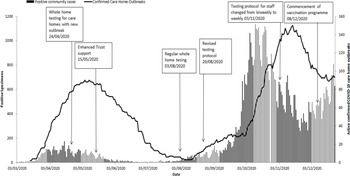
The data revealed 110 laboratory-confirmed outbreaks in the first pandemic wave compared with 314 outbreaks in the second wave. A chart showing care-home outbreak waves together with background community incidence is presented in Fig. 1. The average durations of care-home outbreaks were 64.7 days in the first wave and 35 days second wave. The average duration of care-home outbreaks in both waves was 44.1 days. The average number of deaths per day in the second wave was 1.53 (224 deaths in 146 days) versus an average of 2.28 (349 in 153 days) in the first wave. The testing of asymptomatic persons did effectively not occur during the first wave; thus, no outbreaks during this wave were reported as ‘asymptomatic.’ During the second wave, 170 outbreaks were ‘asymptomatic’ at the time of notification; 79 (46.5%) of these progressed to symptomatic outbreaks and 91 (53.5%) remained ‘asymptomatic’ throughout their duration. In first wave, 6 outbreaks (5.5%) involved staff only, whereas 142 outbreaks (45.4%) in second wave involved staff only at notification. In Northern Ireland, there are approximately equal numbers of residential and nursing-home facilities. However, the proportions of total outbreaks occurring in each of these settings were 30% in residential facilities and 70% in nursing homes during the first wave; this figure was similar in the second wave, 26% in residential facilities and 74% in nursing homes. Regarding facility size, in the first wave, 207 (91.6%) care homes with ≤30 people did not register an outbreak, 130 (74.3%) care homes with 31–50 people did not register an outbreak, and 42 (52.5%) care homes with ≥51 people did not register an outbreak. In the second wave, 146 (64.6%) care homes with ≤30 people did not register an outbreak, 72 (41.1%) care homes with 31–50 people did not register an outbreak, and 12 (15%) care homes with ≥51 people did not register an outbreak.
Chart showing care-home outbreak waves together with background community incidence. Testing in care homes was initially offered to residents in care-home settings that met the case definition criteria agreed at the Four UK Nations level and was endorsed by the Department of Health for local implementation. As new clinical evidence emerged in relation to atypical presentations, it became clear that the clinical picture in vulnerable and older populations did not always meet the general case definition as established initially through the Four UK Nations and the World Health Organization. The indications for testing in care homes were subsequently broadened and were kept under review. To avoid testing delays, the testing guidance was amended for care homes in response to the change in definitions advising care homes to treat all residents with atypical symptoms as probable COVID-19–positive cases in facilities and to manage these situations as potential COVID-19 outbreaks in which a COVID-19 diagnosis had been confirmed and to avoid further delays in cohorting these residents while awaiting testing. The revised case definition was expanded to alert clinicians and care homes to the need for a higher index of suspicion being warranted about possible atypical COVID-19 presentations particularly in care home facilities. Findings from a local study also highlighted that testing only for symptomatic residents and staff may not have identified all residents and staff with SARS-COV-2, and they supported the change to the Northern Ireland policy for testing all residents and staff for COVID-19 in care homes with new outbreaks regardless of symptoms. Reference Neill, Sartaj, Holcroft, Hasan, Conway and Aldeyab4 On April 24, whole-home testing was introduced for care homes with new outbreaks. In early May, whole-home testing was applied retrospectively to all open outbreaks notified prior to April 24 and not closed on or before May 7. Also as precautionary approach, the local testing policy in care homes was revised again to introduce a program of testing in all COVID-19–free care homes. The program took effect on Monday, August 3.

In this study, the first and second pandemic waves had approximately the same duration, yet a significantly larger number of outbreaks were recorded in the second wave. This finding may be due to ascertainment bias in that some genuine outbreaks of COVID-19 in the first wave may have remained ‘suspected’ because specimens were not sent for testing. On the other hand, the increase in testing capacity in the second wave may have resulted in some scenarios being labelled ‘outbreaks’ when, in fact, the positive laboratory results were related to the detection of nonviable viral genome and inactive infections. The reduction in deaths and the average outbreak duration observed between first and second waves is encouraging. Outbreaks involving staff accounted for 45% of outbreaks in the second wave compared with only 6% in the first wave, which may reflect the implementation of the staff and residents screening policy. Although some positive laboratory results may not represent infectiousness, the precautionary approach to the care-home population may have helped identify and appropriately manage and care for those at genuine risk of transmission to others.
In both waves, the proportion of total care homes reporting outbreaks was substantially skewed toward nursing homes. Interestingly, the split was approximately equal in both waves. Notably, our findings remained constant despite external variables operating across both waves. Additionally, more care homes reported multiple outbreaks in the second wave. The extent to which this is related to the expansion in testing and whether there were individual care-home–specific explanations (eg, staff shortages or high levels of frailty) remains uncertain. Finally, evaluating the relationship between care-home size and outbreaks indicates that as care-home size increased, the setting was more likely to record at least 1 outbreak.
The study was limited by its observational descriptive design, and it was not possible to control for externalities which may have had influence on the care-home sector during the study periods.
In conclusion, improvements occurred in the measurements of those variables that were selected as markers of outbreak severity. Although these may have occurred independently of health service input, they coincided temporally with a range of interventions that were applied throughout the course of both pandemic waves. The composite activity of all interventions together may have been important in interrupting the chain of transmission at multiple levels.
Acknowledgments
We would like to thank care home staff and the Duty Room Team at the Public Health Agency who provided and collected the necessary data, respectively, that enabled this analysis.
Financial support
This study was carried out as part of our routine work.
Conflicts of Interest
All authors report no conflicts of interest relevant to this article.