1. Introduction
Since the innovative and seminal work of Hans Cloos (Cloos, Reference Cloos1925), magmatic fabrics in plutons, that is, shape-preferred orientations of magmatic minerals acquired in melt-present conditions (Paterson, Vernon & Tobisch, Reference Paterson, Vernon and Tobisch1989; Paterson et al. Reference Paterson, Fowler, Schmidt, Yoshinobu, Yuan and Miller1998; Vernon, Reference Vernon2000), have been extensively employed to infer a wide range of magmatic and tectonic processes in the Earth's crust (see Paterson et al. Reference Paterson, Fowler, Schmidt, Yoshinobu, Yuan and Miller1998 for review). For instance, fabric patterns and structural relations around plutons in conjunction with radiometric ages may provide rigorous, and in many cases the only available, constraints on dating regional tectonic deformation and plate kinematics in magmatic arcs and orogenic belts (e.g. Gleizes et al. Reference Gleizes, Leblanc, Santana, Olivier and Bouchez1998; Paterson et al. Reference Paterson, Fowler, Schmidt, Yoshinobu, Yuan and Miller1998; Benn et al. Reference Benn, Paterson, Lund, Pignotta and Kruse2001; Archanjo et al. Reference Archanjo, Trindade, Bouchez and Ernesto2002; Callahan & Markley, Reference Callahan and Markley2003).
A vast majority of fabric studies have documented a single magmatic fabric in a single pluton and, logically, have inferred a single fabric-forming process. The fabric formation thus has been traditionally thought to result either from internal magmatic processes or regional tectonics, depending on the temporal evolution of mechanical coupling of the pluton/host rock system (Paterson et al. Reference Paterson, Fowler, Schmidt, Yoshinobu, Yuan and Miller1998; Barros, Barbey & Boullier, Reference Barros, Barbey and Boullier2001). This approach has also been adopted in numerous anisotropy of magnetic susceptibility (AMS) studies of granitoid plutons, as the AMS provides a fast and efficient method for analysis and quantification of magnetic fabric controlled by the orientation of ferromagnetic and paramagnetic minerals (for reviews and principles of the AMS method see, e.g. Hrouda, Reference Hrouda1982; Jackson & Tauxe, Reference Jackson and Tauxe1991; Rochette, Jackson & Aubourg, Reference Rochette, Jackson and Auborg1992; Tarling & Hrouda, Reference Tarling and Hrouda1993; Borradaile & Henry, Reference Borradaile and Henry1997; Bouchez, Reference Bouchez, Bouchez, Hutton and Stephens1997; Borradaile, Reference Borradaile2003, pp. 297–326).
These seemingly straightforward views on the significance of magmatic (macroscopic) fabric and magnetic fabric (revealed using AMS) have been somewhat complicated by the recent discovery of multiple fabrics preserved in a single pluton (elaborated, for example, by Paterson et al. Reference Paterson, Fowler, Schmidt, Yoshinobu, Yuan and Miller1998), making our interpretations of fabric-forming processes much more difficult. To date, an increasing number of examples of multiple fabrics in a single granitic pluton have been documented, such as the Main Donegal Granite in Ireland (Pitcher & Berger, Reference Pitcher and Berger1972; Hutton, Reference Hutton1982; Paterson et al. Reference Paterson, Fowler, Schmidt, Yoshinobu, Yuan and Miller1998), the Barnum Lake and Trout Lake plutons in Canada (Borradaile & Kehlenbeck, Reference Borradaile and Kehlenbeck1996), the deep borehole EPS-1 near Soultz-sous-Foret in France (Schulmann, Ježek & Venera, Reference Schulmann, Ježek, Venera, Bouchez, Hutton and Stephens1997), the Dirty Face, Entiat and Mount Stuart plutons in Washington (Paterson et al. Reference Paterson, Fowler, Schmidt, Yoshinobu, Yuan and Miller1998), the Estrela Granite Complex in Brazil (Barros, Barbey & Boullier, Reference Barros, Barbey and Boullier2001), the Land's End granite in Cornwall (Kratinová et al. Reference Kratinová, Schulmann, Hrouda and Shail2004), and several plutons in the Bohemian Massif, Czech Republic (Žák, Schulmann, & Hrouda, Reference Žák, Schulmann and Hrouda2005; Verner et al. Reference Verner, Žák, Hrouda and Holub2006, Reference Verner, Žák, Nahodilová and Holub2008) and in the Sierra Nevada, California (Paterson et al. Reference Paterson, Fowler, Schmidt, Yoshinobu, Yuan and Miller1998, Reference Paterson, Onezime, Teruya and Žák2003; Žák, Paterson & Memeti, Reference Žák, Paterson and Memeti2007).
The goal of this paper is to elaborate on the concept of multiple magmatic fabrics in plutons. We first review different types of multiple magmatic fabrics that are scattered over the literature and have been either predicted by numerical modelling or documented in plutons. We then briefly describe two case examples of Variscan plutons in the Bohemian Massif where multiple magmatic fabrics were revealed in porphyritic granitoids and syenitoids using integrated field mapping, anisotropy of magnetic susceptibility (AMS), and electron back-scatter diffraction (EBSD). Finally, we discuss possible fabric-forming processes and emphasize complications in interpretation of the significance of both magmatic (macroscopic) and magnetic (AMS) fabrics when multiple fabrics are recognized in a pluton.
2. Multiple magmatic fabrics in plutons – types and definitions
We refer to multiple magmatic fabrics in a broad sense, covering a wide range of specific fabric types and scales. Descriptive characteristics of the different possible end-member types of multiple fabrics that may develop in plutonic rocks or were predicted by modelling (see Ildefonse, Arbaret & Diot, Reference Ildefonse, Arbaret, Diot, Bouchez, Hutton and Stephens1997 and Arbaret et al. Reference Arbaret, Fernandez, Ježek, Ildefonse, Launeau and Diot2000 for reviews) are surveyed below and are portrayed in a summary cartoon (Fig. 1).
Conceptual cartoon depicting the main types of multiple fabrics in plutons manifested at the sample scale. For the sake of simplicity, only orthorhombic fabric symmetry and neutral (LS) fabric ellipsoid are considered. Stereonets (lower hemisphere) show orientation of foliation (F) as great circles and lineation (L) as squares, assuming perfect alignment of individual particles.

Three important aspects should be taken into account in definitions and interpretations of various types of multiple magmatic fabrics in plutons:
(1) The type of individual objects or particles that statistically define each fabric. If mineral grains define the fabric, it is referred to as the mineral fabric throughout this paper.
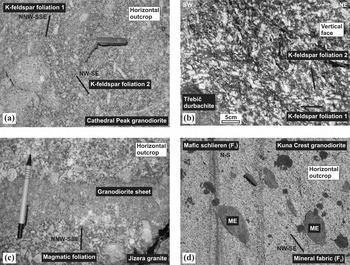
In monoparticle systems, which consist of particles with identical shapes (axial ratios) and sizes, particle orientations may define two or more different statistical maxima (also referred to as sub-fabrics) in a plutonic rock (Fig. 1). This case is shown in Figure 2a, where K-feldspar phenocrysts in the Cathedral Peak granodiorite, central Sierra Nevada, California, are set in finer-grained groundmass, have approximately the same size, and define two distinct foliations that are at a high angle to each other. On a larger scale, the two feldspar foliations on this outcrop are parallel to two pluton-wide foliations and also to superposed regional host rock structures (see Žák, Paterson & Memeti, Reference Žák, Paterson and Memeti2007 for geological setting and other details). Similarly, in the porphyritic melasyenite (durbachite) of the Třebíč pluton, Bohemian Massif (for further information on geological setting, see Holub, Reference Holub1997; Janoušek & Holub, Reference Janoušek and Holub2007; Škoda & Novák, Reference Škoda and Novák2007), steep magmatic foliation defined by euhedral K-feldspar phenocrysts abruptly changes its orientation into flat-lying foliation over a centimetre scale (Fig. 2b).
Field examples of multiple magmatic fabrics in plutons. (a) Two steep magmatic foliations (NNW–SSE and NW–SE) defined by K-feldspar phenocrysts in the Cathedral Peak granodiorite of the Tuolumne batholith, central Sierra Nevada, California. In general, the feldspars that define foliation 2 (interpreted as younger foliation by Žák, Paterson & Memeti, Reference Žák, Paterson and Memeti2007) seem to have rugged and poorly defined margins, suggesting that they underwent late-stage growth into a mush that had a greater crystal content than while foliation 1 was being acquired. Swiss Army knife (9 cm long) for scale. (b) Two magmatic foliations (steep and flat-lying) in the durbachite of the Třebíč pluton, eastern margin of the Bohemian Massif. (c) Magmatic foliation in the Jizera granite of the Krkonoše–Jizera plutonic complex, Bohemian Massif. The foliation overprints granodiorite sheet at a high angle. Note the irregular sheet margins wrapping around K-feldspar phenocrysts. Pencil (13 cm long) for scale. (d) Compound magmatic fabrics in the Kuna Crest granodiorite of the Tuolumne batholith, central Sierra Nevada, California. The fabrics are defined by mafic schlieren parallel to the intrusion margin, being overprinted by a pluton-wide NW–SE mineral foliation. Swiss Army knife (9 cm long) for scale.

In multiparticle systems, individual particles represented solely by crystals or mineral grains having different sizes and shapes (e.g. biotite, magnetite, and feldspar) make up a mixture (heterogeneous particle population), and each particle type may define a distinct orientation (sub-fabric; Fig. 3). This type of multiple fabrics was predicted by the Jeffery theory of motion of ellipsoidal particles in viscous fluid for various flow regimes (e.g. Jeffery, Reference Jeffery1922; Fernandez & Laporte, Reference Fernandez and Laporte1991; Ildefonse et al. Reference Ildefonse, Launeau, Bouchez and Fernandez1992; Ježek et al. Reference Ježek, Melka, Schulmann and Venera1994; Ježek, Schulmann & Segeth, Reference Ježek, Schulmann and Segeth1996; Arbaret et al. Reference Arbaret, Fernandez, Ježek, Ildefonse, Launeau and Diot2000; Jiang, Reference Jiang2007). A complex natural example of this type of multiple magmatic fabrics was reported by Schulmann, Ježek & Venera (Reference Schulmann, Ježek, Venera, Bouchez, Hutton and Stephens1997) in Variscan porphyritic granite in the Vosges, where biotite and K-feldspar sub-fabrics share a single, flat-lying foliation, but two perpendicular K-feldspar lineations developed within the K-feldspar foliation plane.
(a) Index map showing location of the Krkonoše–Jizera plutonic complex in the northeastern part of the Bohemian Massif (central Europe). (b) Simplified bedrock geological map of the Krkonoše–Jizera Plutonic Complex and its host rock. The Bedřichov tunnel is located in the porphyritic Jizera granite near its southwestern margin. Geology based on Klomínský (Reference Klomínský2005) and Kozdrój, Krentz & Opletal (Reference Kozdrój, Krentz and Opletal2001).

On the other hand, fabric may also be defined by magmatic structures such as igneous layering, alignment of microgranular enclaves, or mafic schlieren (as defined using criteria outlined in Paterson, Vernon & Tobisch, Reference Paterson, Vernon and Tobisch1989), or by a combination of mineral fabric and magmatic structure(s) (Fig. 1). The latter case of multiple magmatic fabrics, hereinafter referred to as the compound fabric, seems to be, in our experience, a common type in plutons and should be distinguished from the preceding examples. We have recently documented a number of examples where magmatic structures (e.g. mafic schlieren, layering) retain their shape and orientation but are overprinted by mineral fabrics. For instance, in the Jizera granite, Bohemian Massif, pluton-wide magmatic foliation defined by K-feldspar phenocrysts overprints a granodiorite layer at a high angle (Fig. 2c). Other examples include mafic schlieren in the Kuna Crest granodiorite, central Sierra Nevada, California, with constituent mineral grains and nearby microgranular enclaves being reoriented parallel to regional magmatic foliation (Fig. 2d; see also Paterson et al. Reference Paterson, Onezime, Teruya and Žák2003 and Žák, Paterson & Memeti, Reference Žák, Paterson and Memeti2007 for further details).
(2) The geometry of fabric elements (foliation, lineation) and their relative importance. A wide range of combinations of fabric elements and fabric ellipsoid shapes (prolate, neutral, oblate) that define multiple fabrics may exist and have been documented in plutons: two foliations associated with weak to no lineation (the Jizera granite: J. Žák, unpub. data; this study), two foliations, each bearing its own lineation (Verner et al. Reference Verner, Žák, Nahodilová and Holub2008), two foliations sharing a single lineation (Paterson et al. Reference Paterson, Onezime, Teruya and Žák2003), or two lineations within a common foliation plane (Schulmann, Ježek & Venera, Reference Schulmann, Ježek, Venera, Bouchez, Hutton and Stephens1997).
(3) The scale at which the multiple fabrics are manifested, as the scale may vary from a sample scale, where fabric is defined by small millimetres- to centimetres-sized mineral grains within a small volume of rock (e.g. statistical alignment of grains in an 8–11 cm3 AMS sample), to a pluton scale where multiple fabrics may also be defined on the basis of different fabric patterns mapped in different parts of a single pluton. For example, in the Tuolumne batholith in central Sierra Nevada, California, an earlier margin-parallel magmatic foliation is preserved particularly along pluton margins and in magmatic lobes that extend outward from the main batholith (Memeti et al. Reference Memeti, Paterson, Economos, Žák and Erdmann2005), and has been heterogeneously overprinted by one or two later regional magmatic foliations (Žák, Paterson & Memeti, Reference Žák, Paterson and Memeti2007). On the other hand, in the Sázava pluton in the central Bohemian Massif, presumably earlier intrusive fabric, preserved in the pluton centre and characterized by steep lineation and roughly concentric foliation pattern, has been overprinted along pluton margins by magmatic to sub-solidus fabric that records regional deformation (Žák, Schulmann, & Hrouda, Reference Žák, Schulmann and Hrouda2005).
3. Two case examples of complex multiple fabrics in porphyritic plutonic rocks
We have recently examined magmatic fabrics in a number of Variscan plutons in the Bohemian Massif, and it is our notion that the multiple fabrics as defined above may be much more common than is usually thought. This statement particularly applies for porphyritic granitoids and syenitoids where phenocrysts may define a distinct fabric other than that recorded by mineral grains in their host matrix (e.g. Arbaret et al. Reference Arbaret, Fernandez, Ježek, Ildefonse, Launeau and Diot2000). Below we first briefly introduce basic principles of the AMS method to provide a general background for our AMS and fabric studies, and then we describe two particularly illustrative case examples of multiple fabrics having some important implications for the interpretation of magmatic fabrics in plutons.
3.a. Anisotropy of magnetic susceptibility (AMS) – a brief overview
Low-field (<1 mT) anisotropy of magnetic susceptibility (AMS) has been routinely used to reveal ‘cryptic’ magnetic fabric in granitoid plutons (see Hrouda, Reference Hrouda1982; Tarling & Hrouda, Reference Tarling and Hrouda1993; and Bouchez, Reference Bouchez, Bouchez, Hutton and Stephens1997 for reviews). Magnetic susceptibility is a second-rank tensor that relates the induced magnetization of a rock linearly with the intensity of an applied magnetic field:

where Mi (i = 1, 2, 3) are components of the magnetiz-ation vector, Hj (j = 1, 2, 3) are components of the vector of intensity of applied magnetic field, and kij are magnetic susceptibilities, that is, dimensionless constants of proportionality (e.g. Hrouda, Reference Hrouda1982). The components k11, k22, k33 are referred to as the maximum (kMAX), intermediate (kINT) and minimum (kMIN) principal susceptibilities, respectively.
In short, at each sampling site within a given pluton, the AMS method provides several main pieces of information.
(1) The bulk susceptibility, expressed as kMEAN =(kMAX + kINT + kMIN)/3, reflects the qualitative and quantitative content of magnetic minerals in the rock and is a sum of ferromagnetic, paramagnetic and diamagnetic components. Paramagnetic minerals, such as biotite or hornblende, have very low slightly positive magnetic susceptibility in the order of 10−4 (SI); ferromagnetic minerals s.l. (e.g. magnetite or maghemite) have positive susceptibilities several of orders of magnitude higher than those of paramagnetic minerals. Susceptibility of diamagnetic minerals (quartz, feldspar) is slightly negative (Bouchez, Reference Bouchez, Bouchez, Hutton and Stephens1997). The bulk susceptibility thus gives an initial clue as to whether the AMS in a rock specimen is carried by paramagnetic minerals, ferromagnetic (s.l.) minerals, or both (e.g. Bouchez, Reference Bouchez, Bouchez, Hutton and Stephens1997). For detailed investigation of AMS carriers, however, measurements of susceptibility variations with temperature are necessary (e.g. Hrouda, Reference Hrouda1994).
(2) The susceptibility tensor can be geometrically represented by an ellipsoid having principal axes kMAX, kINT and kMIN (e.g. Hrouda, Reference Hrouda1982; Tarling & Hrouda, Reference Tarling and Hrouda1993). The orientation of the AMS ellipsoid with respect to geographic coordinates then corresponds to the orientation of magnetic fabric, that is, directions of magnetic lineation (kMAX) and normal to magnetic foliation (kMIN) at a sampling site. This piece of information is commonly used to construct maps showing patterns of magnetic fabric (foliations and lineations) within a pluton.
(3) In addition to the orientation of the AMS ellipsoid, several statistical parameters have been used to further quantify the magnetic fabric (see review in Tarling & Hrouda, Reference Tarling and Hrouda1993, pp. 17–23). Below, we use the P parameter, expressed as P = kMAX/kMIN (Nagata, Reference Nagata1961), called the degree of AMS, which reflects the eccentricity of the AMS ellipsoid and thus indicates the intensity of the preferred orientation of the magnetic minerals in the rock. The higher the P parameter, the stronger the preferred orientation. We also use the T parameter, expressed as T = 2 ln(kINT/kMIN)/ln(kMAX/kMIN) − 1 (Jelínek, Reference Jelínek1981), which indicates the symmetry (shape) of the AMS ellipsoid. It varies from −1 (perfectly linear magnetic fabric, prolate ‘rod-shaped’ ellipsoid) through 0 (transition between linear and planar magnetic fabric) to +1 (perfectly planar magnetic fabric, oblate ‘disc-shaped’ ellipsoid).
3.b. Multiple magmatic fabrics in the Jizera granite
In the porphyritic Jizera granite of the Carboniferous Krkonoše–Jizera plutonic complex, northeastern Bohemian Massif (Fig. 3; see also Žák, Vyhnálek & Kabele, Reference Žák, Vyhnálek and Kabele2006 and Mazur et al. Reference Mazur, Aleksandrowski, Kryza and Oberc-Dziedzic2006 for more detailed information on geological setting), we investigated magmatic K-feldspar fabric and AMS in an underground tunnel (referred to as the Bedřichov tunnel, Fig. 3b). The tunnel provides a unique opportunity to study fabrics in the interior of the granite pluton at depths up to 140 m beneath the present-day surface. Here we present observations from selected continuous sections along the northwestern side of the tunnel wall between 120–320 m from its western entrance.
For this analysis, the long axes of sections through K-feldspar phenocrysts were traced from photomosaics to construct a map of the tunnel wall (Figs 4, 5). Moreover, at 16 sites sampled for AMS and at one other site (BT17 in Fig. 5), phenocryst outlines were traced from photographs in a 1 m2 area around the sampling site to obtain a more detailed picture of magmatic fabric. The crystals’ long axes were treated as axial data of unit length and their orientation was measured using the freeware UTHSCSA ImageTool program (ftp://maxrad6.uthscsa.edu). The orientations are given as the angle between the long axis and horizontal reference line. The angle ranges from 0° to 180° and is measured anticlockwise from the reference line. The circular data are presented as rose diagrams and characterized quantitatively by mean vector orientation and mean vector length R which expresses the strength of the alignment (R=1 for perfect preferred orientation, R=0 for uniform or perfectly bimodal distribution: Borradaile, Reference Borradaile2003).
Detailed structural map of the northwestern wall of the Bedřichov tunnel (section 120–220 m). The map shows traces of the longest axes of K-feldspar phenocrysts in a continuous section through the Jizera granite. Results of image analysis of shape-preferred orientation of K-feldspar phenocrysts are presented as rose diagrams for each structural domain. Stars indicate location of sampling sites for AMS.

Detailed structural map of the northwestern wall of the Bedřichov tunnel (continued from Fig. 4, section 220–320 m).

Such detailed observations of magmatic fabric in a continuous section provide an important piece of information on changes in orientation, intensity and homogeneity of magmatic fabric in the Jizera granite, which cannot be obtained from discontinuous surface outcrops. We are aware of this analysis taking into account only the ‘apparent fabric’ in two-dimensional section through the three-dimensional ‘true’ magmatic fabric. However, this approach is justified by the fact that any change in the ‘apparent fabric’ must also represent change in the ‘true’ fabric in three dimensions.
Results of the image analysis, summarized in tunnel wall maps in Figures 4 and 5, reveal the following important characteristics of K-feldspar shape-fabric in the Jizera granite. Domains of homogeneous strong shape-fabric, characterized by unimodal orientation distribution and R exceeding 0.8, alternate with domains of weak shape-fabric, characterized by multimodal orientation distribution and R around 0.6. The K-feldspar shape-fabric also displays significant gradual or abrupt changes in orientation, as exemplified by domains of steep phenocryst alignment (and thus also steep ‘true’ fabric) changing into domains of subhorizontal phenocryst alignment. In the examined section of the tunnel, these changes in both orientation and intensity occur over a scale of a metre to tens of metres. K-feldspar phenocrysts in some places also follow a ‘wave-like’ pattern marked as undulations of phenocryst traces with a metre-scale wavelength.
Magnetic fabric (AMS) of the Jizera granite, carried by coaxial contributions of biotite, magnetite and maghemite as indicated by temperature variations of susceptibility (thermomagnetic curves not given: M. Chlupáčová, unpub. data), was investigated at 16 sampling sites along the examined section of the tunnel (stars in Figs 4 and 5 indicate sample AMS locations). The sampling strategy was to cover the large variations in K-feldspar phenocryst fabric described above.
In contrast to the variable K-feldspar shape-preferred orientation, no significant gradients or changes in magnetic fabric intensity, shape of the AMS ellipsoid, or orientation of magnetic foliations and lineations were observed, and the magnetic fabric appears relatively homogeneous (Fig. 6). Magnetic foliations dip moderately to steeply and strike WNW–ESE to NW–SE; only a few samples have other orientations (Fig. 6). Most of the magnetic lineations plunge shallowly to moderately to the NW or SE, defining two prominent maxima at the periphery of the stereogram in Figure 6. A small number of lineations plunge steeply at variable trends and define a weak girdle-like pattern between the two maxima. The magnetic (AMS) fabric thus seems decoupled from the K-feldspar shape-fabric. In other words, the complexity in K-feldspar fabric is not recorded by the AMS signal (magnetic fabric) of interstitial matrix around phenocrysts.

3.c. Multiple magmatic fabrics in the Knížecí Stolec pluton
The c. 341 Ma Knížecí Stolec pluton is a roughly sub-circular intrusion rimmed by inward-dipping cone sheets that was emplaced into high-grade rocks of the Moldanubian Unit, southwestern Bohemian Massif (Fig. 7; see Verner et al. Reference Verner, Žák, Nahodilová and Holub2008 for geological setting and other details). The dominant rock type is porphyritic melasyenite (durbachite) with feldspar phenocrysts (~70% K-feldspar and ~30% oligoclase) of up to 4–5 cm in size set in biotite-rich groundmass. In the pluton, we documented steep margin-parallel magmatic foliation that has been overprinted by flat-lying magmatic foliation, the latter being concordant with host-rock metamorphic foliation (Fig. 7). Both distinct types of magmatic foliations are defined by the shape-preferred orientation of feldspar phenocrysts and were interpreted as being a result of intrusive strain during emplacement (steep margin-parallel foliation) overprinted by regional sub-vertical contraction (Verner et al. Reference Verner, Žák, Nahodilová and Holub2008).
(a) Index map to show the location of the Knížecí Stolec pluton in the southwestern part of the Bohemian Massif. (b) Simplified bedrock geological map of the Knížecí Stolec pluton showing magmatic foliation pattern in the pluton. Grey symbols indicate steep to moderately dipping foliation that is roughly parallel to pluton margins; black symbols label flat-lying magmatic foliation concordant with metamorphic foliation in the host granulite. Stereonets (equal area, lower hemisphere projection) show orientation of steep and flat-lying magmatic foliation in the durbachite and flat-lying metamorphic foliation in the granulite.

In this paper, we complement the structural data by a study of the anisotropy of magnetic susceptibility (AMS) and electron back-scatter diffraction (EBSD; see Prior et al. Reference Prior, Boyle, Brenker, Cheadle, Day, Lopez, Peruzzo, Potts, Reddy, Spiess, Timms, Trimby, Wheeler and Zetterström1999 for basic principles of the method). As the electron back-scatter diffraction yields orientation of crystallographic axes of paramagnetic minerals (biotite and amphibole are main AMS carriers in the durbachites; Fig. 8a) with respect to the foliation plane, this approach allows for direct comparison of AMS, crystallographic preferred orientation, and macroscopic feldspar phenocryst fabric. For this analysis, we used two drill cores previously measured for the AMS from two sampling sites located in the northwestern part (KV335; Fig. 7b) and at the southeastern margin of the pluton (KV340; Fig. 7b). The EBSD analysis was carried out in thin-sections oriented perpendicular to the magnetic foliation and parallel to the magnetic lineation (kMAX −kMIN plane).
(a) Bulk susceptibility histogram of samples KV335 and KV340 from the Knížecí Stolec pluton (see Fig. 7 for location). The bulk susceptibility is in the order of 10−4, indicating that the AMS carriers are paramagnetic minerals. (b) Magnetic anisotropy P–T plot for samples from stations KV335 and KV340. (c) Stereonet (lower hemisphere, equal area projection) showing orientation of magmatic feldspar foliations and lineations measured in the field at stations KV335 and KV340. (d) Stereonets (lower hemisphere, equal area projection) showing orientations of maximum, intermediate and minimum principal susceptibilities (kMAX, kINT and KMIN, respectively) with 95% confidence areas at stations KV335 and KV340.

In short, the results of combined field data, AMS and EBSD (Figs 7, 8, 9) indicate the following. The feldspar phenocryst foliation shows good correlation to the magnetic foliation at site KV340; both foliations dip moderately to the N and NNW (Fig. 8c, d). On the other hand, at site KV335 magnetic foliations are flat-lying (Fig. 8d), whereas the feldspar phenocryst foliation dips moderately to the NE (Fig. 8c). The feldspar phenocryst lineations plunge shallowly to the ENE, and are thus virtually the same at both sites. However, the magnetic and macroscopic lineations differ in trend by ~45° at both sites (Fig. 8c, d). Magnetic fabrics at the two sites also differ in terms of degree of anisotropy and shape of the AMS ellipsoid. Compared to site KV335, characterized by an oblate AMS ellipsoid, site KV340 exhibits a prolate AMS ellipsoid and slightly higher P parameter (Fig. 8b), whereas the macroscopic fabrics exhibit equally developed lineation and foliation at both localities.
At site KV335, the crystallographic preferred orientation of biotite revealed using EBSD corresponds well with the orientation of the AMS ellipsoid; the c axes cluster around the direction of minimum principal susceptibility kMIN (Fig. 9). The orientation of amphibole (actinolite) is more complex. The a axes correspond well to the direction of minimum principal susceptibility kMIN (Fig. 9), however, the b axis directions are clustered at an angle of about 40–60° to the direction of maximum principal susceptibility kMAX (Fig. 9). In addition, the c axes, which may represent the amphibole lineation, are at an angle of about 30° to the mean magnetic foliation plane (Fig. 9).
(a) Orientation of principal susceptibilities (kMAX – maximum principal susceptibility, kINT – intermediate principal susceptibility, kMIN – minimum principal susceptibility) with respect to the crystallographic axes of single actinolite and biotite crystals. Redrafted from Borradaile (Reference Borradaile2003). (b) Results of our EBSD analysis from two stations (KV335, KV340) in the Knížecí Stolec pluton. Crystallographic axes of actinolite (a, b, c axis) and biotite (b, c axis) are plotted on lower hemisphere, equal area projection. Orientations of maximum principal susceptibility (kMAX) and minimum principal susceptibility (kMIN) are indicated at the periphery of stereonets. Contours: KV335–actinolite (0.958%, 2.83%), KV335–biotite (1%, 1.5%, 1.7%), KV340–actinolite (0.787%, 2.04%), KV340–biotite (0.787%, 1.42%, 2.04%, 2.67%).

At site KV340, the biotite crystallographic axes are at a high angle to the respective AMS directions (Fig. 9). The b axis of amphibole forms a cluster near the maximum principal susceptibility (kMAX) direction, however, the a axes are at a high angle to the minimum principal susceptibility (kMIN). In addition, the amphibole c axes form a prominent maximum at the periphery of the diagram and are at a high angle to the mean magnetic foliation plane.
Apparently, multiple fabrics exist in the examined durbachite of the Knížecí Stolec pluton, with no simple relationship among the fabric defined by feldspar phenocrysts (Fig. 8c), magnetic (AMS) fabric carried by paramagnetic silicates (biotite, amphibole; Fig. 8d), and crystallographic preferred orientation of biotite and amphibole (Fig. 9).
4. Multiple magmatic fabrics: what are the likely fabric-forming processes?
The above overview and case examples raise an important question: what are the likely processes that may account for the formation of multiple fabrics in plutons? Given that magmatic fabrics in plutons may generally record both strain caused by internal magmatic processes and/or regional tectonic strain (Paterson, Vernon & Tobisch, Reference Paterson, Vernon and Tobisch1989; Paterson et al. Reference Paterson, Fowler, Schmidt, Yoshinobu, Yuan and Miller1998; Benn et al. Reference Benn, Paterson, Lund, Pignotta and Kruse2001; Callahan & Markley, Reference Callahan and Markley2003), several plausible mechanisms may be theoretically invoked to explain the formation of multiple magmatic fabrics. Below, we divide the existing explanations into those based solely on numerical and analogue modelling of fabric development and those based on field observations. Finally, we add a few remarks stemming from our fabric studies in porphyritic granitoids mentioned above.
Numerical models and analogue experiments have provided the following possible interpretations for the formation of multiple fabrics in magmatic rocks: (1) development of multiple particle orientation through differential rotation of particles having different shapes or axial ratios (see fig. 8 in Arbaret et al. Reference Arbaret, Fernandez, Ježek, Ildefonse, Launeau and Diot2000 and further information in Blumenfeld & Bouchez, Reference Blumenfeld and Bouchez1988; Fernandez & Laporte, Reference Fernandez and Laporte1991; Arbaret et al. Reference Arbaret, Fernandez, Ježek, Ildefonse, Launeau and Diot2000); (2) formation of transient perpendicular lineations during combined pure and simple shear (see details and fig. 7 in Willis, Reference Willis1977); (3) formation of perpendicular lineations as a result of combined simple shearing and coaxial flattening with unequal principal extensions within the shear plane (Schulmann, Ježek & Venera, Reference Schulmann, Ježek, Venera, Bouchez, Hutton and Stephens1997, fig. 9); (4) formation of multiple lineations due to the progressive switch of lineation orientation during transpressional deformation as a result of increasing finite strain or convergence angle (Melka et al. Reference Melka, Schulmann, Schulmannová, Hrouda and Lobkowicz1992; Parry et al. Reference Parry, Štípská, Schulmann, Hrouda, Ježek and Kröner1997; see also details and fig. 5 in Tikoff & Greene, Reference Tikoff and Greene1997).
The major shortcomings of most modelling-derived interpretations, which refer to a single process and a single strain regime, are rather specific conditions for multiple fabrics to develop and be preserved in plutons. As noted by Arbaret et al. (Reference Arbaret, Fernandez, Ježek, Ildefonse, Launeau and Diot2000), these conditions may be rare in nature. Moreover, fabrics preserved in plutons have been recognized generally to have poor strain memory and to form late in the hypersolidus history of plutons (Paterson et al. Reference Paterson, Fowler, Schmidt, Yoshinobu, Yuan and Miller1998; Fowler & Paterson, Reference Fowler and Paterson1997) under conditions that are far from those assumed in the theoretical modelling (e.g. ideally viscous fluid v. multiphase high-strength crystal-rich mush). Rigorous constraints and more realistic interpretations of multiple fabric formation may come from field studies, carefully documenting large-scale fabric patterns, fabric relations to magmatic and host rock structures, and geometrical continuity of multiple fabrics across a pluton. In contrast to the modelling results, field studies increasingly suggest that multiple fabrics develop successively, and that they record superposition of magmatic and tectonic strains on highly crystallized magma (e.g. Borradaile & Kehlenbeck, Reference Borradaile and Kehlenbeck1996; Barros, Barbey & Boullier, Reference Barros, Barbey and Boullier2001; Paterson et al. Reference Paterson, Onezime, Teruya and Žák2003; Žák, Schulmann, & Hrouda, Reference Žák, Schulmann and Hrouda2005; Žák, Paterson & Memeti, Reference Žák, Paterson and Memeti2007).
Our recent field and AMS studies in the porphyritic granite and melasyenite plutons may provide some additional insights into the latter mechanism by which multiple fabrics may develop. Both cases described above exhibit feldspar phenocryst shape-fabric, which is either partially or entirely decoupled from fabric recorded in the host matrix. A thorough microstructural study is beyond the scope of the present paper, but it is also important to note that evidence of pervasive solid-state deformation overprint is absent in both plutons examined here (e.g. fig. 7 in Verner et al. Reference Verner, Žák, Nahodilová and Holub2008). The multiple fabrics in the Jizera granite and durbachite of the Knížecí Stolec pluton thus likely formed in the environment of grain-supported crystal-rich mush during the presence of some portion of melt, which does not preclude some subsolidus deformation mechanisms operating during the fabric development (such as crystal plasticity, dynamic recrystallization and melt-enhanced grain-boundary sliding: e.g. Paterson et al. Reference Paterson, Fowler, Schmidt, Yoshinobu, Yuan and Miller1998; Vernon, Reference Vernon2000; Vernon, Johnson & Melis, Reference Vernon, Johnson and Melis2004).
In the Jizera granite, remarkably homogeneous magnetic (AMS) fabric (Fig. 6) dominated by ferromagnetic grains (magnetite, maghemite) in the inter-phenocryst matrix contrasts sharply with the complex metre-scale variations in K-feldspar phenocryst orientation (Figs 4, 5). Unfortunately, the lack of criteria (e.g. relationships to compositional boundaries, stoped blocks or host rock structures) does not allow rigorous constraint of the temporal relationship between the K-feldspar and magnetic fabrics. However, it is difficult to imagine forming such complex variations of phenocryst fabric without displacing and straining the paramagnetic and ferromagnetic grains in the host interstitial matrix. If the alignment and strain of magnetic grains had occurred prior to or simultaneously with the acquisition of the K-feldspar fabric, we would expect rather heterogeneous orientation distribution of magnetic fabric, similar to that revealed by image analysis of K-feldspar phenocrysts along the tunnel wall (Figs 4, 5). Therefore, based on the homogeneity of AMS directional data, we infer that the magnetic fabric was acquired later than the K-feldspar phenocryst shape-fabric.
In the durbachite of the Knížecí Stolec pluton, our mapping revealed two pluton-wide feldspar foliations, one margin-parallel and one flat-lying (Fig. 7). On the basis of fabric overprinting and relations to other magmatic structures (enclaves, aplite dykes), we have interpreted elsewhere that the margin-parallel foliation formed during emplacement and was superposed by younger flat-lying foliation recording regional strain (Verner et al. Reference Verner, Žák, Nahodilová and Holub2008). This study revealed some additional fabric complexities at two stations (KV335 and KV340), for example, the crystallographic-preferred orientation of biotite and hornblende in the inter-phenocryst matrix differs from both K-feldspar fabric and, in some cases, also from the AMS principal directions (Figs 8, 9).
Based on the above observations, our interpretation of a mechanism of formation of multiple fabrics in the porphyritic granitoids and syenitoids is that the feldspar phenocrysts established a rigid, porous framework, which (a) is analogous to LBF (Load Bearing Framework) texture in polycrystalline materials (Handy, Reference Handy1994), and (b) recorded different strain increments than the inter-phenocryst matrix prior to final solidification. Small grains (e.g. biotite, magnetite) in melt pockets and films within the feldspar phenocryst framework still could reorient in response to later strain increments, presumably by a mechanism of melt-aided grain boundary sliding (e.g. Park & Means, Reference Park and Means1996; Launeau & Cruden, Reference Launeau and Cruden1998; Paterson et al. Reference Paterson, Fowler, Schmidt, Yoshinobu, Yuan and Miller1998; Vernon, Reference Vernon2000; Rosenberg, Reference Rosenberg2001; Rosenberg & Handy, Reference Rosenberg and Handy2001). We envision that by this mechanism, weak grains (e.g. magnetite) in the interstices among feldspar phenocrysts could possibly record small increments of distributed strain (perhaps as small as 5–15% shortening: e.g. Benn, Reference Benn1994) to produce new AMS fabric not being recorded by the observable phenocryst alignment. In particular, magnetite grains in ferromagnetic granitoids may record extremely weak strain superposed on near-solidus magma to produce homogeneously oriented AMS fabric, even if the magnetite grains exhibit no significant shape-preferred orientation and AMS is controlled by alignment of intragranular domain walls (Borradaile & Kehlenbeck, Reference Borradaile and Kehlenbeck1996). The Jizera granite may represent a possible example of this process.
As opposed to the free rotation of rigid particles assumed in the modelling, this mechanism of multiple fabric formation in plutons involves strain partitioning (e.g. Vigneresse & Tikoff, Reference Vigneresse and Tikoff1999) between the stiffer phenocryst framework that recorded earlier strain, and the weak interstitial melt that is still able to accommodate weak strains prior to final crystallization. In agreement with recent studies on granite rheology and melt topology in partially molten granites (Rosenberg & Handy, Reference Rosenberg and Handy2005) that suggest that 90% of crystal boundaries are lubricated by melt at even less than 10% melt volume in the system, we envision that this process may operate even at high crystallinities when the magma is semi-solid and already capable of being brittly fractured.
In the two mentioned examples, the magnetic fabric reflects strain increments partially or entirely different from the macroscopic feldspar phenocryst fabric and provides information presumably only on the latest part of the finite fabric history. The AMS may also show significant decoupling from the crystallographic preferred orientation and from macroscopic feldspar fabric. We argue that the two-phase nature of the porphyritic granitoids and syenitoids during their crystallization, characterized by rigid framework and inter-phenocryst melt-bearing matrix, makes them favourable for preserving multiple fabrics, but also particularly risky when only AMS is used to investigate pluton fabric.
5. Concluding remarks
(1) Multiple magmatic fabrics in plutons may record accumulated strain increments caused by remarkably different processes superposed on high-strength crystal-rich mush during final pluton crystallization. The mush consists of a rigid crystal framework that may record different amounts and types (magmatic, tectonic) of strain than the inter-phenocryst matrix, and multiple magmatic fabrics may then develop by the mechanism of melt-aided grain-boundary sliding at high magma crystallinities. This mechanism applies particularly to porphyritic plutonic rocks. If this is true, multiple magmatic fabrics may serve as a sensitive indicator of evolving mechanical coupling between pluton and host rock during the final stages of crystallization and may provide valuable information on interaction between magmatic and tectonic processes in the Earth's crust.
(2) This model implies that fabric observations, quantitative analysis, and modelling done on a small scale are insufficient on their own to serve as rigorous constraints for interpreting the significance of multiple magmatic fabrics in plutons. The key information that may help to distinguish among permissive fabric-forming processes has to come from evaluation of large-scale fabric patterns and structural relations of magmatic fabrics to intrusive contacts and to magmatic and host rock structures.
(3) In the porphyritic granitoids and syenitoids we have examined (e.g. the Jizera granite, ultrapotassic plutons of the Bohemian Massif), magnetic (AMS) fabric carried by groundmass paramagnetic and ferromagnetic minerals was commonly decoupled from the feldspar phenocryst shape-fabric. Our interpretation is that the AMS reflects overprinting strain not being recorded by the feldspar phenocryst fabric. In cases where two distinct feldspar fabrics were revealed in a pluton such as in the Knížecí Stolec pluton (Bohemian Massif), the AMS may be biased by the presence of the multiple fabrics. This raises a cautionary note on using AMS in porphyritic plutonic rocks with no detailed field mapping, as the magnetic fabric may miss much of the preserved pluton's fabric history and key information for fabric interpretation may remain unseen.
Acknowledgements
We gratefully acknowledge the very constructive and thorough reviews by Brian O'Driscoll and Claudio Rosenberg; their valuable comments helped to improve the original version of the manuscript significantly. Assistant Editor Jane Holland is thanked for careful editorial handling of our paper. We also would like to thank Josef Klomínský for providing data from the Bedřichov tunnel and for his great help in drawing maps of K-feldspar phenocrysts. Marta Chlupáčová is gratefully acknowledged for help in measuring and interpretation of magnetic mineralogy and AMS at the Laboratory of Rock Magnetism, AGICO, Brno, Czech Republic. The present paper also benefited from discussions and collaboration with Scott Paterson, František Hrouda and František Holub. This study was completed as a part of post-doctoral research of Jiří Žák. We acknowledge financial support from post-doctoral grant of the Grant Agency of the Czech Republic no. 205/07/P226 (to Jiří Žák), Grant no. 271/2005/B-GEO/PrF of the Charles University Grant Agency (to K. Verner), and the Ministry of Education, Youth and Sports of the Czech Republic Research Plan no. MSM0021620855. Underground mapping in the tunnel was supported by the Radioactive Waste Repository Authority of the Czech Republic (SÚRAO) project ‘Geological and structural characterization of granitoids in the Bedřichov tunnel in the Jizera Mountains’ (to Josef Klomínský).