Introduction
Thirty years ago Bob HolmanFootnote 1 coined the term ‘resourceful friends’ (Holman, Reference Holman1983) to describe the role played by professionals and volunteers working alongside families at risk of coming to the attention of child protection authorities. Since then, developments in the funding and management of human services have seen an eclipse in the practice of community social work. Additionally, the pursuit of formal professional recognition has led to a delineation of professional boundaries, which tends to preclude reciprocal friendly relations between service users and social workers (Australian Association of Social Workers (AASW), 2010).
The Family Inclusion Network (FIN) in Townsville, Queensland, is a non-government organisation with the mission to ‘ensure parents, grandparents and significant others have access to the information, support and advocacy they require to actively and equitably participate in the child protection process’ (http://www.fin-qldtsv.org.au/p2aboutus1.html). Over the 5 years since its inception, FIN has become an incorporated service users’ organisation and a registered charity, in which families and supporters work together to give families a voice, and to assist those who are involved in the child protection system to maintain contact with their children in care and, wherever possible, to bring their children home (Human Rights and Equal Opportunities Commission (HREOC), 1997) to their family, community and culture.
FIN Townsville's core humanitarian values are respect for the dignity and worth of all people, together with a commitment to achieving greater social justice for some of the most stigmatised families in the Australian community. Holman's resourceful friends model of practice (Holman, Reference Holman1983) – now endorsed by ‘Community Links’ in London (Robinson, Reference Robinson2010) – together with Heather Lovatt's conception of ‘fostering families’ (Lovatt, Reference Lovatt2013), best describe the way supporters work successfully alongside families.
Increasingly, FIN Townsville sees itself reclaiming and reinvigorating a radical tradition of community work and collective action (Banks, Reference Banks and Lavalette2011; Ferguson & Woodward, Reference Ferguson and Woodward2009), and asserting the professional integrity of the resourceful friends model for FIN's work.
In this article we aim to (re)articulate the resourceful friends model of practice and discuss some of the issues posed by this way of working. While working as resourceful friends may be best undertaken by non-government community organisations, nonetheless the model poses a challenge for statutory child protection services to give serious consideration to the potential benefits that might flow from replacing a deficit model of viewing families with a more humane, strengths-based family inclusive practice.
Community Social Work: What We Do
Community social work seeks to tap into, support, enable and underpin informal community relationships, with a view to developing community groups characterised by mutuality and democracy, and committed to personal support and collective action (Holman, Reference Holman1997).
From its inception in 2008, FIN Townsville adopted a strong dual commitment to operating with, by and for family members, and to work at both individual and systems levelsFootnote 2. Thus, FIN Townsville is not an organisation run only, or mainly, by professionals, rather it is actioned by families for families, with the help of supportive others. These ‘others’ (many of whom are social work practitioners or students) take on the role of being resourceful friends (Holman, Reference Holman1983, Reference Holman1997) who support family members in meetings with the Queensland Child Safety Department and in the Children's Court. Family members are centrally involved in the FIN Townsville committee, which is active in undertaking systems advocacy, making submissions for changes in child protection policy and practice, and meeting with key ministers and bureaucrats.
FIN Townsville remains an unfunded community organisation (with parent members opposed to seeking government funding), so fund-raising events are a regular occurrence in order to cover the costs of insurance, a website and a hotline phone. These shared activities, together with twice-monthly information and support groups, are important means for ‘building community’ (Ife, Reference Ife2013) within FIN Townsville. While the FIN community is important for many parents and grandparents, others prefer to relate on an individual level with resourceful friends, and there is no pressure to join in group activities. Indeed, some parents and potential supporters are challenged by FIN's refusal to exclude any parent with children in care, and they may take time to accept each other without judgement. Thus, reasserting FIN values and, at times, diffusing conflict have been necessary parts of FIN activities.
The first 5 years saw 87 families make contact with FIN Townsville, seeking information and/or support. FIN Townsville built a group of over 20 support volunteers, with several social work students remaining involved after completing their field placements with FIN. Twice-monthly peer supervision and support sessions take place with volunteers, and professional development opportunities are accessed regularly. Two FIN volunteers are engaged in postgraduate research projects involving families, and effort is invested in grounding the work of FIN on research and social work theory. FIN is keen to expose current students to good practice in community work and, similarly, FIN provides an opportunity for professional volunteers to practise in more radical ways alongside service users than is possible in mainstream human service organisations (Beresford, Reference Beresford and Lavalette2011).
Part of the agenda in radical social work (Ferguson & Woodward, Reference Ferguson and Woodward2009; Lavalette, Reference Lavalette2011) is to reframe conventional professional boundaries (O’Leary, Tsui, & Ruch, Reference O’Leary, Tsui and Ruch2013). The resourceful friends model enables supporters to work with families and develop relationships with equal power, while still upholding their professional integrity (AASW, 2010). In this way, supporters’ own interests remain subordinate, yet supporters can, and do, accept reciprocal help from family members and this, in itself, has been beneficial for family members.
In seeking to explore how families and supporters have experienced their involvement with FIN, the FIN Townsville committee of family and supporting members agreed to invite reflections during purposeful, but free-ranging, discussions held at FIN support group meetings and through voluntary contributions to the ‘Your Say’ section of the occasional FIN Townsville newsletter (FIN Townsville, 2013, pp. 6–8). All five participants and seven contributors consented with enthusiasm to their views being included in this article, but agreed that names would be changed to protect their privacy. Throughout the processes involved with gathering and analysing reflections, and writing this article, the FIN committee (which includes three active researchers from James Cook University) has ensured compliance with principles of ethical research practice. All FIN contributors to this article had opportunities to comment on drafts, and revisions were made accordingly. The final version of the article was endorsed unanimously by the FIN Townsville committee, which is keen for the resourceful friends model to be disseminated widely and adopted elsewhere.
The remainder of this article will focus on the essential elements of the resourceful friends model and will assess the extent to which it offers an invaluable dimension to family inclusive child protection practice.
In What Ways Resourceful? In What Ways Friends?
“It's friendship with a twist.” (Debbie, Sept. 2013)
This ‘twist’ in the relationships offered to families accessing FIN Townsville adds value to the qualities found in a good friend – namely, sharing knowledge about the child protection system and how it works, and a sense of purpose in helping a family to work with the system in order to preserve contact with their child in care and/or secure the return of their child to their family. As one parent said,
“Knowledge and information – this is the ‘big one’ which FIN supporters give you: how the system works and how they can help you participate in it. They help you write letters; support you at meetings; help you develop contacts; they keep you informed, share information, join up the dots.” (Sally, Sept. 2013)
Another parent member outlined that when Child Safety entered their lives they had a poor knowledge regarding the legislation and their rights:
“The Family Inclusion Network has been so helpful. They are a wealth of knowledge and were able to point out areas that had been mismanaged or simply incorrect.” (Dimity, July 2013)
A grandparent member appreciates
“. . . the fact that somebody is out there who understands what the problems are and what we are going through. And it's good to meet professionals who know what support systems are available.” (Tracey, July 2013)
A father was thankful that volunteers did everything they could for him with all available resources. He praised FIN for
“. . . standing up so members are being heard. And actually believing what you say and don't pass judgement.” (Tim, July 2013)
Non-judgemental Support
Alongside knowledge used purposively, parents in FIN Townsville valued most highly the experience of a non-judgemental attitude – the core social work value, identified in the 1950s by Biestek (Reference Biestek1957), but only implicit in the current AASW Code of ethics (AASW, 2010). As Sally said,
“. . . you’re respected; someone cares; you’re valued; you’re not judged; you’re not dismissed as just a ‘piece of shit’ [i.e., labelled negatively as ‘a single parent’ or ‘involved with child safety’ and therefore automatically judged as ‘bad’ and ‘undeserving’].” (Sally, Sept. 2013)
“They make time to listen – without judgement, with acceptance; they walk in our shoes.” (Clare, Sept. 2013)
The significance of not feeling judged, in enabling families to engage in constructive ways with the child protection system, was spelt out by several parents/grandparents. For example, Sally said,
“It helps you overcome the shame and embarrassment factor. You develop trust in the supporters so you can show them those Child Safety affidavits which paint such a dreadful picture of you. You can talk more openly about shameful stuff with FIN supporters than with friends or family – or even with other professionals – because from them you fear judgement. Trust is very important.” (Sally, Sept. 2013)
“The good things about FIN are that they don't judge who you are, and they support us in meetings with Child Safety. They help us deal with people in a polite manner instead of going off the handle.” (Clare, July 2013)
“You’re helped to feel able to face things; helped to get strong – to fight, to not feel so scared. They give you encouragement, hope, the ability to move on.” (Fran, Sept. 2013)
More than a Friend
Clearly, the resourceful friends found in FIN Townsville are ‘more than a friend’ (Laken, Reference Laken1984) as parents find that everyday friends and family can be unhelpfully critical, even rejecting, in the face of intervention by child protection authorities.
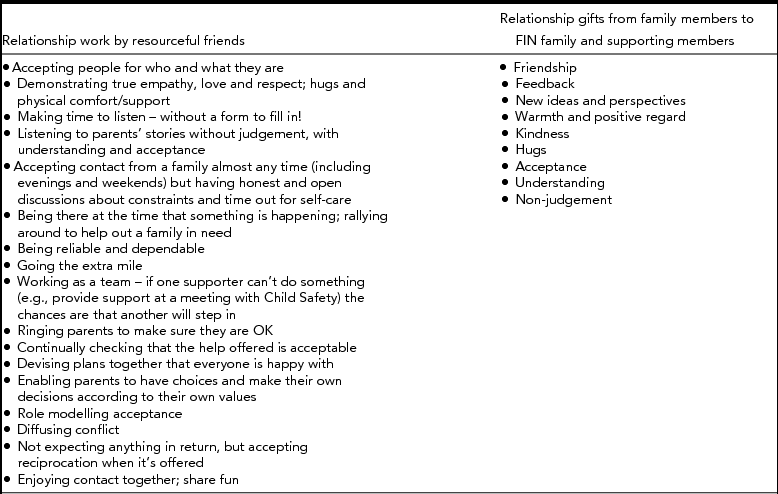
In Table 1 the relationship qualities that highlight the meaning of friendship in FIN Townsville are summarised. The qualities that accompany a non-judgemental attitude, such as respect and empathy, are clearly identified, and these resonate with the principle, ‘Love of Humanity’, emphasised by Morely and Ife (Reference Morely and Ife2002). One FIN parent exclaimed in amazement,
FIN Townsville Resourceful Friends – relationship work.

“You guys are passionate about people! You don't do it for the money.” (Sally, Sept. 2013)
FIN supporting members are all volunteers and this fact is appreciated by FIN families as it contributes to a sense that they are genuine – giving their time and commitment freely, above and beyond the role prescriptions of a paid job.
“FIN supporters have a passion for standing up for people's rights.” (Dimity, July 2013)
“Becoming involved with FIN brings you to the crux of what true social work is . . . to work with people and not against them. Supporting family members as equals is the true essence of achieving human rights and social justice.” (Jane, FIN volunteer, July 2013)
“Yes, FIN is an amazing support group which exemplifies the social work values of respecting the inherent dignity and worth of individuals and provides non-judgemental support and advocacy to vulnerable citizens in our society. (Megan, social work student with FIN, July 2013).
Other resourceful friend qualities identified in Table 1 include being reliable and dependable, being open to contact at times of need, including evenings and weekends, reaching out and making contact when parents are immobilised by depression, and going the extra mile. As Sally observed,
“They follow up with calls or texts – ‘How are you doing?’, ‘How can I help?’ This makes a huge difference; it stops you giving up.” (Sally, Sept. 2013)
“They don't set themselves up as experts, aren't know-it-alls, don't impose solutions, aren't superior, don't distance themselves from you.” (Families’ group discussion, Sept. 2013)
Clearly, reducing the interpersonal distance between supporters and families is highly valued, although this may appear to contravene notions of professional boundaries in ‘official’ social work (Lavalette & Loakimidis, Reference Lavalette, Loakimidis and Lavalette2011). FIN Townsville members claim that such rigid boundaries are not appropriate in community social work, and that co-producing practice with service users is a profoundly professional act (Beresford, Reference Beresford and Lavalette2011) and aids in healing from trauma.
Trauma caused by loss of a child into state care is an inevitable reality for many families involved with FIN, and is especially acute when a child is removed solely on the grounds of ‘risk’ rather than actual maltreatment. Important aspects of relationship processes in FIN involve reaching out and being with a parent or grandparent, creating a safe space in which families can tell their stories and be heard, facilitating remembrance and mourning, and understanding anger and/or depression. Staying with people as a ‘faithful companion’ (Jones, Reference Jones2009) is absolutely vital and, in time, as Herman (Reference Herman1997) identifies, signs of hope can emerge, leading to growth, personal change, action to regain contact, and (wherever possible) reunification home of their child from care, connection with others in similar circumstances and collective action for social justice. This healing process model is particularly pertinent for the work of FIN as it assists with understanding the loss and grief associated with child protection intervention, and the uneven journey a parent/grandparent may take towards overcoming demoralisation. FIN supporters rejoice when a parent is able to face his/her struggles and become strong, but Herman's model also enables supporters to understand and not despair when re-traumatisation and relapse occur. The process of healing can be ongoing, especially with chronic sorrow (Roos, Reference Roos2002) following loss of a child into long-term care.
Reciprocal Friendships
While humane relationship work (Featherstone, White, & Morris, Reference Featherstone, White and Morris2014) is central to the role of FIN resourceful friends, the reciprocal nature of friendship in FIN is important too. These are highlighted in the right-hand column of Table 1, where the relationship gifts of family members to each other and to supporting members are documented. These make the experience not only empowering for families, but also energising for professional volunteers. Analysis of how support groups can mirror and augment support usually hoped for from family (Flexman, Berke, & Settles, Reference Flexman, Berke and Settles1999) resonates closely with the mutual support which is nurtured within FIN Townsville.
“You meet other parents, this overcomes shame: you’re all in the same boat, have a shared connection, develop bonds, build strength in yourself and in numbers.” (Clare, Sept. 2013)
“The supporters are our friends – and they allow us to become their friends, unlike other human service workers.” (Jack, Sept. 2013)
“The most rewarding thing about working with FIN is learning about letting go of one's power over people. I like the fact that in FIN, professionals and volunteers work alongside parents as equals.” (Jane, FIN professional volunteer, July 2013)
Beyond the resources of knowledge and purpose, and the vital qualities of non-judgement and commitment, there is one further aspect which is hugely important: the provision of practical help in fostering families (Lovatt, Reference Lovatt2013).
Practical Help
Over recent decades, talking therapies have gained status in social work, and practical help for all except the elderly or sick has been perceived as pre-professional and encouraging undesirable dependency (Queensland Council of Social Services (QCOSS), 2013). Consequently, much-needed practical support for families has become largely unavailable in current neo-liberal human service systems, as highlighted in pertinent research (Ghate & Neal, Reference Ghate and Neal2002; McArthur, Thomson, Winkworth, & Butler, Reference McArthur, Thomson, Winkworth and Butler2010).
This retreat from offering practical support has been criticised from an empowerment perspective, which asserts that many people's lives are so troubling or so lacking in resources that practical help is often the first step toward the person regaining a sense of control (Lord & Hutchison, Reference Lord and Hutchison1993). Certainly, many FIN families in distress, sometimes in poverty, and often without wider family support, say that the help they need most, in order to emerge from feeling overwhelmed, is some form of practical help.
FIN Townsville members have been quick to recognise this, and resourceful friends have found that not only is the most valuable assistance you can give practical, but that ‘the listening ear comes into its own whilst you are doing the practical help together – not for people, but with people’ (personal communication, Pip Pinhorn, community social worker, Sept. 2013).
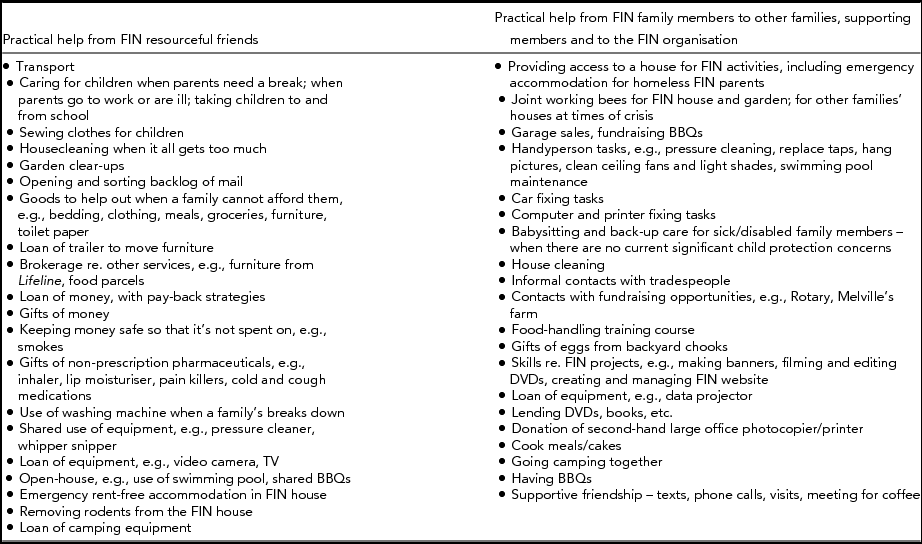
Table 2 presents some of the practical help that has been offered by FIN resourceful friends. Transport, child care and material goods (including food and non-prescription pharmaceuticals) are the most frequently needed. Some professionals may react with unease at the mention of loans or gifts of money, and certainly this is not something that all FIN supporters are able to offer; but some FIN resourceful friends already donate to worthy causes, and sometimes the dire straits of a FIN family are the most immediate worthy cause. When parents are unable to afford fuel for their car to visit their children in care, then lending them twenty dollars until their next benefit arrives is seen to be in the best interests of their children, which is a core FIN objective.
Practical help – when somebody needs a helping hand.
Helping with house cleaning can make a highly significant difference in times of crisis and FIN has enabled a single mother, who was overwhelmed by physical ill health and depression, to have her five children restored home within a week by mobilising six resourceful friends to each give 2 hours to work with her to clean up her house. As Lovatt has said, ‘neglect is largely about dirt’ (personal communication, Sept. 2013), but FIN asserts that dirt is an unacceptable reason for removing dearly loved children into care. Thus, giving a family ‘a leg up’ in their time of need is a preferable response, especially if it can be followed by ongoing support, as outlined by Lovatt in her model for fostering families (Lovatt, Reference Lovatt2013) and narrated in the family example below.
While practical help is one of the valuable resources which FIN friends can offer families, it is also a valuable resource which families can offer each other and, additionally, to supporters in FIN and to the FIN organisation. The right-hand column of Table 2 provides recent examples of the extensive reciprocal helping relationships enjoyed within the FIN Townsville community. Most notable was a father who arranged the use of an empty house, in need of renovation, as a base for FIN activities and temporary accommodation for any homeless FIN parent whose children are in care.
Such reciprocity enriches the lives of all in the FIN organisation and is invaluable for (re)building the self-esteem of people caught up in child protection intervention. As Tim and Jack articulated,
“The supporters accept help from us and this makes us feel included, needed, worthy; you feel you have something to offer, you can give something back.” (Tim, Sept. 2013)
“We work together as equals in fundraising activities, in working bees at the FIN house and in other families’ homes. And we have fun together.” (Jack, Sept. 2013)
Fostering Families: A Family Example
By providing practical and emotional support, FIN Townsville is actively engaged in fostering families (Lovatt, Reference Lovatt2013), actively working to prevent children from being removed and placed into care, supporting families while children are in care and sustaining families after the return of children from care. In the following example, Jenny and Kim write in some detail about their experience of fostering families, placing in context the qualities of FIN resourceful friends.
“We are women, mothers and friends and share a passion for, and a commitment to, best practice in child and family welfare. Jenny has experienced intervention with statutory child protection and is a parent member of FIN, while Kim is a social worker and supporting member of FIN. We learn from each other, support each other and have grown to know and understand each other since meeting 12 months ago.
Our story is most relevant when we tell it backwards and from Jenny's perspective, so we will start from how things are for us today and then work back.”
Jenny
“Today I phoned to say that I have a job and start Monday. I haven't worked for years and feel so excited. Things seem to be getting better for me and when things go wrong I don't seem to go as far down as I did before. I feel stronger, more capable and not alone.
I spent the week at Kim's place with my kids while she was away. To be honest I was shocked that she would like me that way (as a friend). That is a big thing! Kim trusts me with her house and all. Nobody has ever trusted me like that – certainly not a professional support person. It's good to have someone ongoing like family. It's hard when you don't have blood family. I like it because we have become close and my kids love her.
A few months ago when my teenage son was visiting we had some trouble – he was self- harming, threatening my other children and trashed our house. I was beside myself. I knew that if Child Safety got involved (like before) they would think badly of me, see me as not managing and take my kids again. I called Kim late at night when he was going off and she came and talked with him and with me. The good part about FIN is that it is for the whole family, not just me and not just the kids. We worked out some services to help him and decided that my other kids would stay at her place for a couple nights until my son went back to his Dad so that we could all be safe. It was a bit like foster care except fostering the whole family. It was also my decision, the kids felt comfortable and we could still be in touch with each other. Instead of feeling bad that I wasn't coping, I felt proud to have been able to act protectively and enabled to work things out under very difficult circumstances. I know if the Department had become involved it would not have worked out this way. Child Safety made me feel like a criminal – didn't respect me, didn't listen to me, judged me, took my kids and told me I was a bad parent. In a nutshell FIN is the opposite of this. They have the same goal of working for the wellbeing of children but in partnership with families rather than against them. The process and the outcomes are much better for us all.
It's twelve months since we first met at a FIN meeting. I was worried when Kim turned up because I thought she would remember me from a few years before when I attended counselling at an agency where she worked. I thought she would think ‘Oh Jenny's got problems again.’ I hate going to counsellors with problems because I think they would be thinking where's your family? I would rather have a family: where it's normal; where we all have problems and we all help. I feel worse rather than better when people just see me as a problem.
That's what works in FIN – we are all people who can have problems but are also worthwhile and capable of helping as well. FIN support is real. The real thing comes when the trust is there. Kim got to know me and stuck around even when things were hard. I am a Mum who lost her kids for couple of months and people in FIN understand what that does to a person. Kim was my FIN worker and now my friend and part of my family. I guess sometimes she is still my worker. When I am not doing OK I can ring and she has the skills to know what to say and how to help. She knows the system and I don't have to explain everything. She has helped me write letters, attended meetings with me, and she knows who else to call for help with things. She even came and helped me clean my house after my son had trashed it. The best thing is that I can also call when I have good news to share, like today about my job or when the kids win an award. And she lets me help her family which, in a way, has meant more to me because I feel worth something.
I went to FIN because I had lost my kids and it was a dirty and disgusting feeling. I felt shame and low. I needed to be with people who don't judge. I knew the people in FIN must care and have understanding otherwise they wouldn't be there – it's voluntary so if you’re there, you must believe in it. Knowing Kim and FIN has made a difference to my life and to my kids’ lives. As well as receiving support myself I have helped other parents as a member of FIN, worked at fundraising events and participated in community education on behalf of FIN. Things are still hard being a single mum and having been through a lot, but today I have a sense of self-worth. It now seems a lifetime ago from when we met just 12 months ago.”
Kim
“Reflective practice has a central role to play in the ongoing professional development of a social work practitioner (Bruce, Reference Bruce2013) and the process of engagement and critical reflection alongside families such as Jenny's provides rich learning in knowledge and skill development. One of Jenny's favourite sayings is ‘I’m just keeping it real,’ which she certainly does. In working with Jenny and other parent members much is learned about the lived experience of families involved in the child protection system, and how they can be effectively supported to achieve positive outcomes for children's safety and wellbeing. Through reciprocal relationships, purposeful conversations and the generous sharing of parent members’ stories, we co-construct meaning, learn more about each other, about child and family welfare practice, and ourselves. This circular learning, as described by Muller and Gair (Reference Muller and Gair2013), highlights the value of reciprocal roles of teacher and learner evident in FIN practice between family members and supporting professionals.
FIN's model of practice recognises the value of reciprocity in relationships to avoid ‘compassion which wounds’ (Sennett, Reference Sennett2003). Through practice with FIN families, the difference made is evident when a person feels valued, respected and worthwhile rather than disempowered, needy and useless. The positive outcomes emerge when family members strengthen in confidence, knowledge and personal power.
As a professional supporter in FIN, clearly there is much to learn from family members about what it means to have statutory intervention in your family and how this practice can be respectful, humane and effective (Featherstone et al., Reference Featherstone, White and Morris2014).”
On reading this example, other FIN family members have endorsed the value of both practical help and fostering families. One tertiary educated father, whose child spent 2 years in care before reunification home, wrote:
“It's not only families in poverty who need practical help and advice. I would love to have had this kind of fostering families support. One is so alone when the Department is harassing you and lawyers don't really offer human support. What FIN offers is both encouraging and morale-boosting, especially when your child has been removed on only a perception of ‘risk’ and had experienced no harm whatsoever.” (Peter, October 2013)
Discussion
Having outlined and illustrated the community social work of FIN Townsville, the claim in the title of this article should be addressed: does the resourceful friends model offer an invaluable dimension to family inclusive child protection practice?
First, despite the rhetoric in legislation, Australian statutory child protection (CP) departments are not renowned for enabling parents and grandparents to have an effective voice in the child protection system. At best, token involvement is most usually offered, with the agenda and outcomes controlled by CP personnel, and a commitment to partnership (Arnstein, Reference Arnstein1969) rarely honoured.
Until the emergence of FIN in 2007, there was no Peak organisation in Australia for families experiencing CP intervention. Thus, the first achievement of FINs around Australia is in giving voice to families with children in the child protection system. Many local FINs, including FIN Townsville, have also made strides in securing inclusion for families in statutory child protection practice, enabling them to participate more assertively and constructively in case planning, decision making and in Children's Court deliberations. This has achieved good outcomes in terms of keeping children safely out of care, achieving reunification or in enhancing ongoing contact between parents and grandparents with their children in care. Unfortunately, however, not all outcomes have been quite so rewarding, and in these families the FIN Townsville community plays a crucial role in the hitherto neglected area of supporting parents living with chronic sorrow. Similarly, as Jenny and Kim's example highlights, FIN's ongoing role in fostering families after reunification plays a vital part in keeping families together and preventing re-admission of children into care.
Second, the FIN Townsville model of resourceful friends has reinvented the role played in the past by Family Aides/Homemakers, or what Thomson (Reference Thomson, Weeks and Quinn2000) calls ‘trained-in-life workers’. Regrettably, funding for many of these programmes has disappeared in recent years, and one of the aims of sharing the FIN Townsville story is to stimulate the re-introduction of Homemaker programmes along the resourceful friends model, albeit with rather more relaxed professional boundaries than currently exist in Australian human service practice. What needs to be appreciated is that there are different ways of being professional, and that the current emphasis on maintaining professional distance may not be the most effective way to provide support for service users in non-statutory agencies.
Having said this, being a resourceful friend does not mean that all boundaries are transcended. FIN supporters cannot, and do not, turn a blind eye when children may be at risk. However, at the same time, it is vital that supporting members, who have never experienced child safety intervention in their own family, reflect critically on the fact that they can never walk fully in the shoes of family members.
Interestingly, as FIN has developed, some family members have taken on the role of FIN supporters and the boundaries of experience become blurred. Through peer support and supervision, family members as supporters are helped to learn how to use their valuable lived experience in ways that can help and not hinder other families, thereby co-producing practice. They also begin to develop professional qualities of integrity and ethical service and, in time, some are moving into new careers in the human services.
Third, through co-producing practice by listening to, and heeding, the views of family members, FIN Townsville has rediscovered the vital importance of a non-judgemental attitude in working effectively with families who experience intervention by statutory child protection authorities. This acceptance is not, however, considered a soft option, because it is incorporated with ‘tough love’ as in the Life programs of Relational Welfare supported by Participle in the UK (Bunting, Reference Bunting2011; Cottam, Reference Cottam2011). A recent example of tough love in the work of FIN Townsville has been the continuing support of a FIN parent while still challenging them to address the needs of their unborn child and, accordingly, to make some changes in their life. Further, ongoing expression of tough love is in FIN's work with (understandably) angry parents – often, but not always, fathers. While FIN provides a safe place for the expression of anger, often in florid terms, resourceful friends help parents recognise and accept that it is in their children's (and their own) interests to manage their anger and interact with CP staff in constructive ways, thereby minimising any sense of personal risk which such staff may feel, and negative assessments they might make.
According to the FIN philosophy, this humane, yet challenging, support of families serves the best interests of children taken into care, more than judgement of these families as bad. Anecdotal evidence suggests that most children entering care love their parents and grandparents even when they have experienced some maltreatment, and it is therefore seriously harmful for children in out-of-home care to sense that their CP workers and foster carers hold only negative views about their families (Neil & Howe, Reference Neil and Howe2004; Mason, Reference Mason2007). FIN has found that acceptance of, and respect for, the love that parents and children hold for each other is an essential part of a non-judgemental attitude in family inclusive child protection practice.
This finding is a grand example of co-producing good practice theory, and resonates closely with the reflections of Professor Raimond Gaita:
As a child I was conscious of the disdain many people showed to my mother because of the way she treated my father . . . and because she did not properly care for me . . . Now as an adult, I read the same disdain for her in the many reviews of the film [Romulus My Father] . . . This pains me deeply. Very often the hostility presents as a concern for her victims, me primarily. The concern is I think sincere, but it is pernicious because it suggests that my mother was such a bad mother and wife that she was not deserving of my father's love and kindness or even the love of her son. Such concern is no kindness to a child on behalf of whom it is expressed, because it can never be a kindness to a child to undermine its love for its parents by suggesting its parents are not deserving of its love. No one is undeserving of love, not because everyone really is deserving of it, but, because unlike admiration or esteem, love, deeper than both, has nothing to do with merit or desert. (Gaita, Reference Gaita2011, p. 155)
Conclusion
Beyond enhancing family inclusion in child protection practice, FIN Townsville is confident it is doing much to build and sustain social capital in one Australian community. Families caught up in the child protection system in Townsville no longer need to feel isolated and unsupported. Instead, they have the option of accessing a community of resourceful friends and faithful companions, in which gifts of practical and emotional support are exchanged in reciprocal and mutually rewarding ways. They have the opportunity to have a voice at both personal and political levels, and healing from trauma in ways that enable them to begin to reclaim their lives, emerge from depression, make changes and pursue new careers – for some in FIN Townsville enrolling in community service diplomas or social work degrees, in which their lived experience may become a powerful resource.
In these ways, FIN Townsville can be seen as reclaiming a humane tradition in social work (Featherstone et al., Reference Featherstone, White and Morris2014) and engaging in radical practice that makes a difference (Ferguson & Woodward, Reference Ferguson and Woodward2009). Indeed, FIN Townsville is promoting greater social justice in the Australian community through helping vulnerable families achieve their potential, advance their wellbeing, make significant contributions to the Australian community and challenge injustice in child protection systems.
In conclusion, therefore, we contend that such are the achievements of FIN Townsville that the work of resourceful friends in community social work warrants revitalisation and recognition as affording an invaluable dimension in family inclusive child protection practice.
Acknowledgements
The authors acknowledge the enthusiastic contributions to this article made by parents, grandparents, significant others and supporting volunteers involved with FIN Townsville. It is an honour to be able to give voice to your views and we thank you for teaching us that the quality you value most highly in professional helpers is a non-judgemental attitude – and thereby co-producing the distinctive practice of FIN Townsville.