





1. Introduction
There is a growing trend of space commercialization, with both government and private entities showing increasing interest in large-scale space missions. Each actor may have distinct mission objectives and technological advantages, making coordination a critical element of future space exploration and design practice. This trend is particularly relevant for campaign-level mission design in deep space, where logistics infrastructures such as in-situ resource utilization (ISRU) systems Kornuta et al. (Reference Kornuta, Abbud-Madrid, Atkinson, Barr, Barnhard, Bienhoff, Blair, Clark, Cyrus, DeWitt, Dreyer, Finger, Goff, Ho, Kelsey, Keravala, Kutter, Metzger, Montgomery, Morrison, Neal, Otto, Roesler, Schier, Seifert, Sowers, Spudis, Sundahl, Zacny and Zhu2019) are expected to reduce mission costs by exploiting interdependencies between missions.
Recent work on campaign-level space logistics has advanced from discrete-event simulation Grogan et al. (Reference Grogan, Yue and de Weck2011) to graph-theoretic network models Taylor (Reference Taylor2007), and subsequently to dynamic optimization formulations based on time-expanded multi-commodity network flows Ho et al. (Reference Ho, de Weck, Hoffman and Shishko2014). Extensions have incorporated concurrent mission scheduling and vehicle allocation Jagannatha and Ho (Reference Jagannatha and Ho2019), as well as long-horizon, partially periodic demands Chen et al. (Reference Chen, Lee and Ho2019). These models provide theoretically optimal designs under the assumption of centralized control, suitable if a single stakeholder such as NASA were to manage all systems and resources. However, such centralized formulations overlook the reality of multi-actor environments, where independent agencies pursue individual interests. Although prior work has explored modular architectures and federated systems, see in Grogan et al. (Reference Grogan, Ho, Golkar and de Weck2018) and John et al. (Reference John, John, Parker, Sauser and Wade2018), it often neglects the role of incentives and the strategic behavior of commercial participants.
In this work, we present a decentralized perspective on space logistics. We consider interactions among self-interested agencies that may offload portions of their logistics demands through bilateral collaborations without a central regulator. While space logistics have been studied extensively from an architectural and systems design perspective–see, for example, Ho (Reference Ho2023) and Grogan and de Weck (Reference Grogan and de Weck2012) –the strategic implications of such collaborations for the stability of interconnected organizations remain largely unexplored.
Our model focuses on agencies with heterogeneous projects and limited resources. Each agency controls a project with an intrinsic workload and assets such as infrastructure, technology, and expertise. Agencies may delegate portions of their tasks to partners in exchange for incentives, thereby forming a directed collaboration network. Project success depends critically on workload allocation and incentive transfers, while failure results in diminished reputation and bargaining power. We formalize this environment as a noncooperative game in which agencies choose whether to delegate tasks and whether to accept incoming offers. Utilities balance internal costs, external collaborations, and resource reallocations, and strategic outcomes are characterized by Nash equilibria.
From an agency’s perspective, strategic behavior is driven by the potential to reduce operational costs by leveraging excess capacity of others, while providing sufficient incentives to ensure participation. However, excessive offloading can undermine resilience and compromise partners’ performance. Thus, strategic decision-making in decentralized space logistics requires balancing the benefits of collaboration against the systemic risks it may induce.
2. Model
There are
 $n \geq 2$
space agencies indexed by
 $[n] = \{1, \ldots, n\}$
. Each agency i has a project of workload
 $Q_i > 0$
and possesses resources
 $R_i \geq 0$
. Agencies may execute parts of projects for one another. For each ordered pair (i,j), the scalar
 $a_{ij} \in [0,1]$
denotes the fraction of i’s project that i delegates to j, with the convention
 $a_{ii} \in [0,1]$
the fraction retained by i and
 $\sum_{j \in [n] \setminus i} a_{ij} \leq 1$
. Delegations define a directed network with arc
 $i \to j$
when
 $a_{ij} > 0$
.
The cost of executing project work is modeled by a family of functions
 $f=\{\,f_{ij}:[0,\infty)\to\mathbb{R}_{\ge 0}\ :\ i,j\in[n]\,\}$
, where, for a given pair (i,j), the value
 $f_{ij}(q)$
is the operational cost borne by agency j to execute an amount
 $q\ge 0$
of workload belonging to project i. We assume that, for each (i,j), the function
 $f_{ij}$
is twice continuously differentiable, satisfies
 $f_{ij}(0)=0$
,
 $f'_{ij}(q)\ge 0$
and
 $f''_{ij}(q)\ge 0$
for all
 $q\ge 0$
, meaning that f is non-decreasing and has convex marginal cost.
To induce acceptance of delegated work, agency i designates nonnegative incentives
 $\theta_{ij}\ge 0$
for each potential partner j, under the resource feasibility
 $\sum_{j=1}^n \theta_{ij}\le R_i$
. If agency i fails to complete its project–either alone or with the accepted collaborations–its performance deteriorates; this deterioration is summarized by a parameter
 $\beta\in[0,1]$
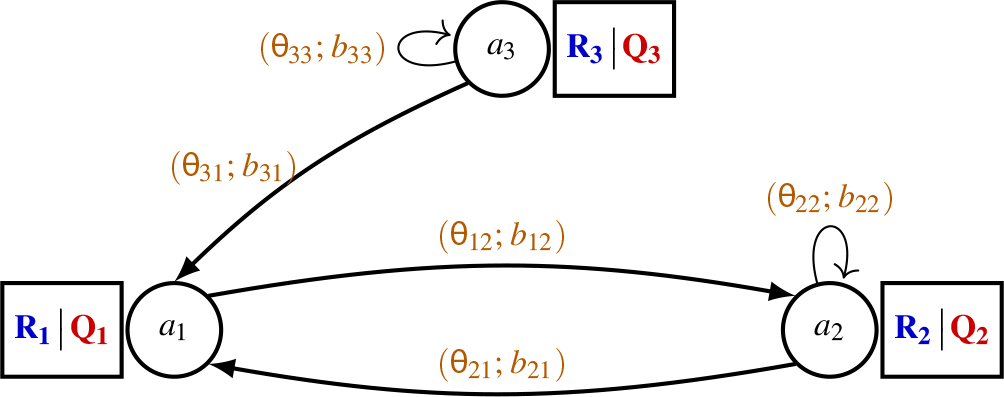
that scales down the effective incentives it can deliver ex post. The network is enhanced as follows: the labels of each node are the resources and the workload that the corresponding agency has, and the labels of the edges are the incentives that an agency offers to a specific agency to delegate a portion of its project, see Figure 1.
An interagency network.

The incentives actually transferred from i to j are defined piecewise by
 \begin{equation*}x_{ij} \;=\; \begin{cases}\theta_{ij}, & \text{if project } \textit{i} \text{ is completed,}\\[6pt]\displaystyle \beta\!\left(R_i+\sum_{k=1}^n x_{kj}\right)\!\frac{\theta_{ij}}{\sum_{k=1}^n \theta_{ik}}, & \text{if project } \textit{i} \text{ is not completed,}\end{cases}\end{equation*}
with the convention that the second branch applies only when
 $\sum_{k} \theta_{ik}>0$
. Given
 $\theta=(\theta_{ij})$
, the above defines
 $x=(x_{ij})$
as the solution of a well-posed linear system in the non-completion case. Noteworthy the
 $x_{ij}$
s are not necessarily unique. However, we focus on those that point-wise maximize all corresponding incentives. Such maximal incentives exist uniquely, and can be computed in polynomial time, see Rogers and Veraart (Reference Rogers and Veraart2013).
A pure strategy for agency i is a pair
 $s_i=(O_i,D_i)$
, where
 $O_i\subseteq\{j\in[n]:a_{ji}>0\}$
lists the agencies from which i accepts delegated work, and
 $D_i\subseteq\{j\in[n]:a_{ij}>0\}$
lists the agencies to which i delegates work; the strategy profile is
 $\mathbf{s}=(s_1,\dots,s_n)$
. Acceptance is binary, so for fixed fractions
 $a_{ij}$
, either the offer
 $i\leftarrow j$
is accepted (
 $j\in O_i$
) or rejected (
 $j\notin O_i$
). In case where an agency picks only one decision the it has a pure strategy. Otherwise, it it randomizes over its pure strategies, in has a mixed strategy. Here,
 $s_{-i}$
represents the pure strategy profile for all agencies except i.
For a given profile
 $\mathbf{s}$
, the amount of i’s project executed by itself equals
 $\left(1-\sum_{j\in D_i} a_{ij}\right)Q_i$
, which yields own-execution cost
 $f_{ii}\!\left(\left(1-\sum_{j\in D_i} a_{ij}\right)Q_i\right)$
. The total work of project i executed by partner
 $j\in D_i$
equals
 $a_{ij}Q_i$
and is costed by
 $f_{ij}(a_{ij}Q_i)$
on j’s side; incentives
 $\theta_{ij}$
(or
 $x_{ij}$
) are funded by i. Symmetrically, when i accepts from
 $j\in O_i$
a fraction
 $a_{ji}$
of j’s project, it executes
 $a_{ji}Q_j$
and bears cost
 $f_{ji}(a_{ji}Q_j)$
while receiving incentives
 $\theta_{ji}$
(or
 $x_{ji}$
) from j.
The utility of agency i under
 $\mathbf{s}$
is
 \begin{equation*}u_i(\mathbf{s}) \;=\; R_i\;-\; f_{ii}\!\left(\left(1-\!\!\sum_{j\in D_i}\! a_{ij}\right)Q_i\right)\;-\; \sum_{j\in D_i}\theta_{ij}\;+\; \sum_{j\in O_i}\theta_{ji}\;-\; \sum_{j\in O_i} f_{ji}(a_{ji}Q_j).\end{equation*}
We consider Nash equilibrium as our strategic solution concept for liquidation games. A Nash equilibrium is a strategy profile in which no agency has an incentive to unilaterally deviate, and therefore improve its utility. If such a profile is pure, we call it a pure-strategy Nash equilibrium. Formally, a pure-strategy Nash equilibrium is a profile
 $\mathbf{s}^\ast$
such that, for every
 $i\in[n]$
,
 $u_i(s_i^\ast,\mathbf{s}_{-i}^\ast)\;\ge\;u_i(s_i,\mathbf{s}_{-i}^\ast)$
for all admissible
 $s_i$
.
The individual rationality condition for accepting a specific offer
 $j\to i$
requires nonnegative net gain,
 $\theta_{ji}\;-\;f_{ji}(a_{ji}Q_j)\;\ge\;0$
, and, in a relaxed aggregate form, unconditional acceptance of all incoming offers by i is justified whenever
 $\sum_{j\in O_i}\theta_{ji}\;-\;\sum_{j\in O_i}f_{ji}(a_{ji}Q_j)\;\ge\;0$
.
Finally, writing
 $\Theta_i^{-}(\mathbf{s})=\sum_{j\in D_i}x_{ij}$
and
 $\Theta_i^{+}(\mathbf{s})=\sum_{j\in O_i}x_{ji}$
for the total incentives paid and received by i, one has the resource feasibility
 $\Theta_i^{-}(\mathbf{s})\;\le\; R_i$
in the completion case and
 $\Theta_i^{-}(\mathbf{s})\;\le\;\beta\Big(R_i+\sum_{k}x_{ki}\Big)$
in the non-completion case, both implied by the definition of x.
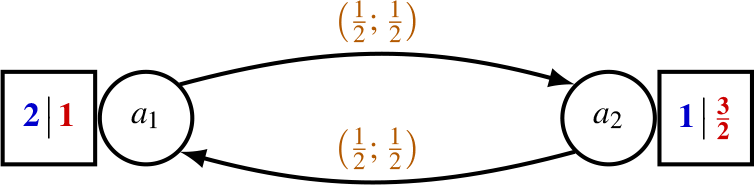
Illustrative example. Consider the interaction between two agencies
 $a_1$
,
 $a_2$
where
 $R_1 = 2$
,
 $R_2 = 1$
,
 $Q_1 = 1$
,
 $Q_2 = 3/2$
, and
 $\theta_{12} = \theta_{21} = b_{12} = b_{21} = 1/2$
. Furthermore,
 $\beta = 1$
and we also have
 $f_{ii}(x) = xQ_i + \varepsilon$
, with
 $\varepsilon > 0$
, and
 $f_{ij}(x) = xQ_i$
. The network is depicted in Figure 2.
Interagency network in the illustrative example.

Clearly, agency
 $a_2$
can not provide incentives, so it can only accept or abstain from the incentives. On the other hand, if
 $a_1$
decides to not provide incentives, that is
 $\mathbf{s} = (\emptyset, \emptyset)$
, then the utilities of agents become
 $u_{1}(\mathbf{s}) = R_1 - f_{11}(1) = 1 - \varepsilon, \quad u_{2}(\mathbf{s}) = R_2 - f_{22}(1) = -1/2 - \varepsilon$
. Else, if
 $a_1$
decides to provide incentives, that is
 $\mathbf{s} = (\{a_2\}, \emptyset)$
, then the utilities of agencies become
 $u_{1}(\mathbf{s}) = R_1 - f_{11}(1 - b_{12}) - \theta_{12} = 1, \quad u_{2}(\mathbf{s}) = R_2 - f_{22}(1) + \theta_{12} - f_{12}(b_{12}) = -1/2$
. Since
 $\varepsilon > 0$
, agency
 $a_1$
improves its utility if it provides incentives to agency
 $a_2$
, and
 $a_2$
has incentives to accept them.
3. Discussion and Research Directions
This work should be understood as a position paper. Rather than providing a complete analysis, our goal is to frame the problem of decentralized space logistics as a strategic interaction among self-interested agencies and to highlight the research opportunities that such a framing unlocks. Below, we outline several directions for future investigation.
Computational hardness of incentives. A natural extension is to study the complexity of computing incentives that maximize overall collaboration. Since agencies interact strategically through bilateral agreements, identifying globally optimal incentive schemes may be computationally intractable. Understanding the hardness landscape, e.g., whether approximate algorithms or heuristic methods can yield tractable solutions, is a promising research avenue.
Empirical analysis. Beyond theoretical modeling, empirical studies could provide valuable insights. For instance, experimental simulations or data from analogous domains (such as federated industrial networks or distributed research collaborations) could help quantify the extent to which strategic offloading improves or hinders systemic performance. Such empirical evidence would also guide the calibration of model parameters and validate the relevance of theoretical predictions.
Uncertainty and partial information. In practice, agencies face uncertainty regarding resource availability, project duration, and the reliability of partners. Incorporating uncertainty and partial information into the model raises fundamental questions about robust strategy design and information disclosure.
Broader game-theoretic and theoretical computer science perspectives. Finally, our setting invites the use of a broad set of tools from game theory and theoretical computer science. For example, related work on financial networks has investigated the strategic impact of prepayments Zhou et al. (Reference Zhou, Wang, Varsos, Bishop, Savani, Calinescu and Wooldridge2024), highlighting the parallels between interdependent financial and logistical systems. Developing cross-disciplinary techniques at this interface has the potential to enrich the study of strategic space logistics.
In summary, this paper advances a position that the strategic dimension of space logistics deserves systematic attention. By articulating the problem in game-theoretic terms, we hope to stimulate both theoretical and empirical research that bridges the gap between centralized optimization models and the realities of multi-actor, incentive-driven environments.

 Open access

