Of all the faculties of the human mind, it will, I presume, be admitted that Reason stands at the summit. Only a few persons now dispute that animals possess some power of reasoning. Animals may constantly be seen to pause, deliberate, and resolve. It is a significant fact, that the more the habits of any particular animal are studied by a naturalist, the more he attributes to reason and the less to unlearnt instincts. (Darwin, Reference Darwin1871, pp. 75).
It is no exaggeration to state that the publication of Intelligenzprüfungen an Menschenaffen (Köhler, Reference Köhler1921) was an important milestone in the psychological study of anthropoid apes. At the Anthropoid Station in Tenerife (1912–1920), Wolfgang Köhler made detailed observations about how a group of chimpanzees intelligently solved a series of problems where they had to attain some objective (a piece of fruit) beyond their immediate reach. This research paved the way for a multitude of later studies. In that sense, Köhler’s book could be considered a “classic.” However like any work, it was part of a specific era and scientific tradition, and must be analyzed within its historical context, that is, relative to the established animal psychology of his time. With that in mind, this article’s aim will be to explore the historical significance of this work and contextualize it in a tradition that sought to determine simian intellectual ability, one that began with Charles Darwin (1809–1882), was continued forward by Leonard T. Hobhouse (1864–1929), and that culminated in Robert M. Yerkes (1856–1976) and Wolfgang Köhler’s (1887–1967) research.
Wolfgang Köhler (1887–1967): Biographical Notes
Wolfgang Köhler was among the most influential German psychologists in the history of the discipline. When he was born, his family lived in Reval (present-day Tallin, Estonia), where they remained until 1893. After returning to Germany, Köhler completed his secondary education in Wolfenbüttel, and in 1905 began his higher education. His studies took him to various universities – Tubinga (1905/06), Bonn (1906/07), and Berlin (1907/09) – and spanned many disciplines (philosophy, history, natural science, and experimental psychology).
His first contact with the world of psychology was with Benno Erdmann (1851–1921) at the University of Bonn. Nonetheless, Köhler went on to complete his doctorate in experimental psychoacoustics under the supervision of Carl Stumpf (1848–1936), who was at the time director of the Berlin Psychological Institute. During his stay in Berlin, Köhler also had the opportunity to attend courses taught by philosopher of science Alois Riehl (1844–1924), physicist Max Planck (1858–1947), and chemist/physicist Walther H. Nernst (1864–1920).
When Köhler was appointed as professor of psychology and philosophy in 1911, he had spent a year assisting Friedrich Schumann at the Psychological Institute at the Frankfurt Academy (later the University of Frankfurt), where he remained until 1913. That period left a profound mark on the young psychologist. It was then that he met Kurt Koffka (1886–1941); and Max Wertheimer (1880–1943), who was beginning to investigate the apparent movement – or phi – phenomenon (Wertheimer, Reference Wertheimer1912). Over time, the three psychologists’ work forged a new school of psychology, Gestalt, that posed an alternative to the atomist, elementist views dominating the field of psychology in Europe and the U.S. in the late 19th and early 20th centuries (Ash, Reference Ash1995).
In 1913, Köhler’s life took an unexpected turn when Stumpf offered him the directorship of the Anthropoid Station that the Prussian Academy of Sciences had opened in Tenerife. Köhler and his family moved to Tenerife at the end of that year and, though Köhler was originally contracted as director for one year, the outbreak of World War I obliged them to remain on the island until 1920 Footnote 1 . Scientifically speaking, those were highly productive years, culminating in two important, but very different, publications. First, his book Intelligenzprüfungen an Menschenaffen (1917) Footnote 2 detailed his experimental research on intelligence in anthropoid apes, and made him an eminent figure in comparative psychology in those years. Second, his philosophical work Die Physischen Gestalten in Ruhe und im Stationaren Zustand. Eine natur-philosophische Untersuchung (1920) was a theoretical attempt to fuse the doctrine of holism and natural science, and to extend the concept of Gestalt from perception and action into the physical world. It was grounded in the physiological theory of “psychophysical isomorphism” between one’s psychological reality and the cerebral events that manifest that reality.
By 1920, the fighting that ravaged Europe had come to an end. Köhler returned to Germany and spent a brief stint at the University of Göttingen, serving as Georg Elias Müller’s successor (1850–1934) as head of the Psychology Department. Shortly thereafter, in 1922, he moved to Berlin permanently to replace Stumpf as head of the Berlin Psychological Institute. His return to Berlin reunited him with Wertheimer and marked the beginning of a period in which Köhler was an active, decisive participant in developing Gestalt psychology. With the Psychological Institute at his fingertips and a journal, Psychologische Forschung, allowing him to expand upon and disseminate his point of view, Köhler and his surrounding group of psychologists – Kurt Lewin (1890–1947), Hedwig von Restorff (1906–1962), and Karl Duncker (1903–1940) to name a few – transformed Gestalt into a bona fide school of psychology (Köhler, Reference Köhler1929).
However, Köhler and his collaborators’ scientific advances took place during a very turbulent period of German history. Early in 1933, the nazi party – led by Adolf Hitler – came to power and began to persecute and summarily fire Jewish professors and scientists, many of them close collaborators of Köhler. Köhler actively and publicly opposed that policy and was ultimately compeled to immigrate to the U.S. in 1935 (Henle, Reference Henle1978).
There, Köhler joined the faculty of Swarthmore College (Pennsylvania) as professor in 1935, gaining U.S. citizenship in 1946. During his time in America, Köhler continued working to spread awareness of Gestalt psychology (Köhler, Reference Köhler1938; Reference Köhler1940; Reference Köhler1947). His valuable contributions to psychology were recognized on numerous occasions. He was elected to become a member of the U.S. National Academy of Sciences in 1947, and president of the American Psychological Association (APA) in 1959. He received honorary doctorates from the University of Pennsylvania (1946), the University of Chicago (1951), Kenyon College (1953), the University of Freiburg (1957), Swarthmore College (1959), the University of Münster (1967), and Uppsala University (1967). He was awarded the Howard Crosby Warren medal by the Society of Experimental Psychologists (1947), and the APA’s Award for Distinguished Scientific Contributions (1956) and Gold Medal Award (1967). In addition, he was a founding member of the German Psychological Society (1952), and was named its honorary president in 1967. The German Psychological Society also also granted him the Wundt Medal (1962) and he was bestowed the Honorary Citizen Award by the Free University of Berlin (1962). Köhler died on June 11, 1967 in Einfeld, New Hampshire.
The Anthropoid Station in Tenerife (1912–1920)
The idea to found an institute for experimental research in large simians is attributed to the neurophysicist Max Rothmann (1868–1915) of Berlin. In a paper released in 1912, he reviewed anatomical, physiological, and psychological evidence for a close relationship between certain species and humans Footnote 3 . In it, Rothmann explained the reasons for establishing a scientific institute of this sort, and the conditions it should meet:
There seems to be an urgent need to establish a research station for anthropomorphic simian observation to which researchers could arrive without much difficulty, with favorable climate conditions for anthropoid apes, a guaranteed supply of the cheapest materials possible, and that allows, if feasible, for the joint study of Asian and African anthropoid apes, so that their mental lives and activities can be compared…To launch such a station, we must choose a site that is easily accessible from Europe, and that does not take the apes out their subtropical zone by bringing them further north…Of the Canary Islands, Orotava seems most apt given its climate conditions…Tenerife can be reached in six days from Europe; African anthropomorphs can be transported there without issue straight from Cameroun. Asian anthropomorphs can be transported there fairly easily via Tangier, where large German steamships dock en route to Asia. (Rothmann, Reference Rothmann1912, pp. 84–86) Footnote 4
In the spring of 1912, Rothmann reported from a visit to Tenerife that one chimpanzee was already on the island and that another important shipment of animals expected from Cameroun, Footnote 5 at that time a German colony. Undoubtedly, an endeavor like Rothmann’s would require institutional and financial support. The Royal Prussian Academy of Sciences (Berlin) granted institutional support, endorsing him to create the Station in 1912. It was financed by several entities: at first, by the Selenka Foundation and the Plaut Foundation; and consistently throughout by the Albert Samson-Stiftung Foundation at the Royal Prussian Academy. A neuroanatomist by the name of Heinrich Wilhelm Gottfried von Waldeyer-Hartz (1836–1921) was directing the latter, and he, together with psychologist Carl Stumpf, served on a committee established to get the Station up and running. Both men would play a prominent role in naming its various directors.
In regard to how a psychologist was chosen to direct the Station and why, bear in mind Rothmann’s priorities in setting out to study these species: “At first, I will prioritize psychological research in anthropomorphs; in the future, however, once their psychic functions are well-known, we shall also examine their neurophysiology” (Rothmann, Reference Rothmann1912, pp.87).
Toward that end, Stumpf considered one of his disciples, Wolfgang Köhler, but ruled him out for lack of experience in animal psychology research. Footnote 6 Instead, he decided on another of his assistants in Berlin, Oskar Pfungst (1874–1933), who was the most well-reputed comparative psychologist in Germany for his research on the horse Clever Hans. Footnote 7 In addition to being a rigorous experimental investigator, Pfungst had experience studying primates at the Berlin Zoo. However, Pfungst did not accept the directorship at the Station. That let-down, and the fact that one chimpanzee had already been in Tenerife since September, 1912, led Waldeyer to suggest that Stumpf name Eugen Teuber (1889–1958), Footnote 8 a young psychologist from Berlin whose mission it would be to relocate to the island immediately and set up the station. Though Stumpf was worried about Teuber’s inexperience – he had yet to publish a paper – Teuber set out for Tenerife in mid-January of 1913. Footnote 9
Teuber ruled out the possibility of purchasing land to set up the Station due to expense, instead proposing to the Academy that a country estate be rented that, in his estimation, was optimal for conducting research of this sort, and for boarding the animals. The estate, known as “La Costa,” belonged to Melchor Luz and Lima (1865–1958), Footnote 10 and on February 19, 1913, a seven-year rental agreement was signed. It was described in the Orotava Property Registry (1913) thusly:
A two-story country house surrounded by gardens, a chicken coop, and the adjacent land toward Naciente, as allocated in the estate’s specifications, flanked on all sides by adjacent estates, with the right to irrigation or water use from the Proprietor at the Academy’s expense. Footnote 11
The house became the director and his family’s home at the Station and on the adjacent grounds, a playground was built, as described in the footnote citing local property records. It spanned 1000 m2, enclosed by a fence and covered by wire mesh extending in all directions from a supporting center-pole with a height of 5m. Footnote 12 At least half the playground was covered in tall grasses and shrubs. At its center were two banana trees, another tree, and a jungle gym where the chimpanzees could play. Other modifications to the estate included building four cubicles to serve as ape house and bedroom to the chimpanzees, and a small photography laboratory beside the anthropoid apes’ dormitory to facilitate audiovisual recording of their behavior.
Immediately, in March of 1913, the chimpanzees were moved from the Martiánez Hotel in Puerto de la Cruz to their new home, and a local was contracted as their care-taker. Footnote 13 Teuber successfully got the Station up and running in no more than two months, but his success extended far beyond that. In 1913, he conducted an array of studies, examining several aspects of natural behavior in anthropoid apes, especially gestural language in chimpanzees as a precursor to human language. Footnote 14
In August, 1913, Rothmann visited Tenerife. He let it be known that he was satisfied with the research being conducted at the Station, and with the animals’ good health. In late December, 1913, toward the end of the time Teuber committed to spending at the Station, Wolfgang Köhler and his family arrived on the island. Almost immediately after arriving, he commenced his famous experiments on problem-solving, which we will explore further in the sections below. These experiments were carried out mostly during the first six months of Köhler’s stay in Tenerife. When World War 1 broke out, being of eligible age for military service and having been drafted, Köhler was obliged to try and return to Germany. However he could find no neutral transport by sea, so following the orders of the German consulate in Barcelona, he decided to remain on the island for as long as these new circumstances required (Teuber, Reference Teuber1994).
In June, 1916, the primate colony at the Station grew in number as well as species. The original group of chimpanzees was joined by two orangutans, Catalina and Felipe, but the latter died shortly after arrival. They reached Tenerife thanks to authorization from the Dutch government for the Prussian Academy of Sciences to capture and study animals of those species. Köhler’s studies with Catalina, which he intended to be a continuation of his book on chimpanzee intelligence, went unpublished in his lifetime, but in 1988, the German psychologist’s manuscript, completed in July of 1919, was finally published (Jaeger, Reference Jaeger1988). Footnote 15
With the war underway, Köhler continued his research and publications, but life at the Station was not unaffected by the hostilities of war. British citizens residing on the island denounced the research center as a front for espionage (Ley, Reference Ley1990). These accusations, while totally unjustified, took their toll. In July, 1918, the owner of the Casa Amarilla and the La Costa estate sold them to the British company Yeoward Brothers, Footnote 16 in effect unilaterally breaking the rental agreement he had signed with Teuber through 1920 (Más & Hernández, Reference Mas and Hernández2005). Köhler had no choice but to relocate the Station to a nearby estate known as El Ciprés. This new location was one of the four Teuber initially considered. After confirming the area’s appropriateness for the animals and the research activities at hand, a rental contract was signed through December, 1920. It took months to prepare the installations and the new location was not wholly operational until December, 1918 (Teuber, Reference Teuber1994).
Germany’s dire financial situation post-World War I made it impossible to maintain the Station and Köhler was instructed to return to Berlin. On May 28, 1920, he arrived in Germany with his family and in July of that same year, the administrative board of the Samson Foundation decided to close the Station. The question of what to do with the apes remained, as they were still in the care of Manuel “of the monkeys.” Finally, Köhler arranged for them to be moved to the Berlin Zoo, where they arrived in mid-October, 1920. Footnote 17 At that point, the Prussian Academy of Sciences officially closed the Anthropoid Station in Tenerife (Teuber, Reference Teuber1994). Footnote 18
“Aus der Anthropoidenstation auf Teneriffa…”[“From the Anthropoid Station in Tenerife…”]
Under that heading, Köhler published four papers about his simian studies, each with its own subtitle, in the journal Abhandlungen der Königlichen Akademie der Wissenschaften, based in Berlin. Footnote 19 In the articles, the German psychologist delved into perception (1915), intelligence (1917), relational learning (1918), and various aspects of chimpanzee psychology (1921). Footnote 20 Of the four, the most influential was without a doubt his paper on primate intelligence. It, along with his observations on chimpanzee psychology and relational learning in chimpanzees and chickens, was reprinted in a 1921 book under a new title: Intelligenzprüfungen an Menschenaffen [Simian Intelligence Tests] (Köhler, Reference Köhler1921). A second, revised edition of that work was later translated into English under the title The Mentality of Apes (Köhler, Reference Köhler1925).
Its gestation period, from 1913 to 1917, coincided with a time of great skepticism about non-human animals’ intellectual abilities, even though Charles Darwin’s (1809–1882) evolutionary notions had essentially sparked a comparative approach to psychology, for example, the work of George J. Romanes (1848–1894). Romanes argued that animals and human beings fall along a mental continuum, and that different species may exhibit similar cognitive processes. That being said, his tests of the veracity of those two assumptions were overly anecdotal, and were called into question in the new century as the first experimental studies of animals’ mental abilities were conducted (Boakes, Reference Boakes1984). Edward L. Thorndike’s (1874–1949) doctoral thesis, which explored trial and error learning, tried to “give the coup de grace to the despised theory that animals reason” (Thorndike, Reference Thorndike1898, pp. 39). Furthermore, Pfungst’s detailed analysis of Clever Hans’s supposed arithmetic ability attested to the horse’s good perceptual, attentional, and memory skills, though not his reasoning faculties:
Hans’s accomplishments are founded first upon a one-sided development of the power of perceiving the slightest movements of the questioner, secondly upon the intense and continued, but equally one-sided, power of attention, and lastly upon a rather limited memory, by means of which the animal is able to associate perceptions of movement with a small number of movements of its own which have become thoroughly habitual…And…if we ask what contributions does this case make toward a solution of the problem of animal consciousness, we may state the following: The proof which was expected by so many, that animals possess the power of thought, was not furnished by Hans. He has served to weaken, rather than strengthen, the position of these enthusiasts. (Pfungst, Reference Pfungst1911, pp. 240–241)
By the same token, Thorndike and Pfungst were also very critical of the possibility that simian behavior could include anything akin to intelectual ability. For example, Thorndike conducted experimental research in gibbons and macaques, observing several differences between them and cats (the primates learned in fewer trials, required much less solution time, and retained solutions longer than the felines). Yet that did not alter his associative view of learning: simians have larger brains than cats, allowing for greater speed, quantity, and complexity in learning stimulus-response (S-R) associations (Thorndike, Reference Thorndike1901). Pfungst, meanwhile, criticized Sokolowsky’s (Reference Sokolowsky1908) pioneering studies, which described certain behavioral patterns – some apparently intelligent – in three primate species (chimpanzee, gorilla, and orangutang) at the Hagenbeck Zoo in Hamburg-Stellingen. Pfungst’s conclusion was surprisingly consistent with Thorndike’s ideas: anthropoid apes can be considered intelligent considering that they learned faster, formed more complex associations, and retained those associations longer (Pfungst, Reference Pfungst and Schumann1912).
However, a British comparative psychologist by the name of Leonard T. Hobhouse (1864–1929) questioned this Thorndikean view, which reduced intelligence in any animal species to the number and complexity of S-R connections. Footnote 21 Hobhouse (Reference Hobhouse1901) invented several tasks that posed problems animals had to solve to obtain food. Footnote 22 Examining how subjects learned to solve tasks through imitation, he realized sudden transformations sometimes occur in animal behavior, such that from one trial to the next, the animal goes from behaving in totally chaotic fashion, to executing the correct response all at once. Hobhouse described one of these sudden “mutations” in an experiment where a rhesus monkey – Jimmy – had to complete two actions: remove a hook that was holding a bolt in place; and then move the bolt to unlock the box and take the food inside:
Jimmy at first failed to find out how to open this box, but one day appeared to learn it, as it were, in a flash…Though he had pulled off the hook before, and also pushed back the bolt, he had clearly never put two and two together. For some inscrutable reason, the movement of my hand seemed to bring the whole thing into his mind. He at once took off the hook, pulled back the bolt, opened the box, and did not fail again. (Hobhouse, Reference Hobhouse1901, pp. 244–246) Footnote 23
According to Hobhouse, the fact that animals, especially simians, can suddenly discover a problem’s solution from one trial to the next means there must be a form of learning more complex than, and distinct from, the progressive learning through S-R reinforcement that Thorndike described. Hobhouse called this rudimentary reasoning “practical judgment.” He believed it was a form of intentional action, more flexible than habit, and dependent on the ability to perceive relationship. Hobhouse described “perceptual relation” as follows:
In any articulate perception the relations contained contribute to the character of the whole as much as the elements that are related, and in that sense the relations must be said to be perceived. It does not follow that the character of any of the relations concerned is analysed out and distinguished from the terms which compose it. When I look at any complex object, as, e.g., the front of a house, I am aware of a whole with many distinct parts. These parts are in definite relations to one another. I may concentrate attention on any pair; e.g., a window to the right of the door. I then not merely see the door and window, but see them in their relation to one another. By an act of analysis I can go further, and make of the relation a distinct object of thought, independent of the terms which it connects in this particular case. But in so doing I pass from perception to conception. When I speak of a relation as perceptual, or even as ‘perceived,’ I mean that it is not thus distinguished, but is an element in a perceived whole (Hobhouse, Reference Hobhouse1901, pp. 169–170)
Despite Hobhouse’s important observations, his 1901 book Mind in Evolution already seemed dated upon release. That is because it did not fit with the methodological cannon Thorndike’s dissertation had imposed on animal psychology research since its 1898 publication: rigorous experimental methodology, a dependent variable measured quantitatively, a control group, and ample sample size. Hobhouse’s book fell short of those standards, so it might have gone unnoticed if not for how crucial his tasks, observations, and ideas were to young Köhler.
Describing Intelligent Behavior
In this climate of division and mistrust, Köhler set out for Tenerife to conduct his research, the goal being to answer the question: “whether [animals] do not behave with intelligence and insight under conditions which require such behaviour” (Köhler, Reference Köhler1925, pp. 1). To do so, Köhler designed a series of experiments with one feature in common: some obstacle had to be overcome (going around, utilizing a tool, etc.) to achieve a goal or attain an object, normally a piece of fruit, that was in the subject’s view, but beyond their reach. According to the German psychologist:
As experience shows, we do not speak of behaviour as being intelligent, when human beings or animals attain their objective by a direct unquestionable route which without doubt arises naturally out of their organization. But what seems to us ‘intelligent’ tends to be called into play when circumstances block a course which seems obvious to us, leaving open a roundabout path which the human being or animal takes, so meeting the situation (Köhler, Reference Köhler1925, pp. 3–4)
Köhler began his experiments by determining “the zone of diffficulty within which the testing of chimpanzees will be of any use” (Köhler, Reference Köhler1925, pp. 8). To do so, a problem was designed wherein a basket of fruit was tied to one end of a rope, the rope passed through a ring two meters off the ground, and the other end of the rope was hung from a tree branch with a knot. Of the chimpanzees, Sultan was chosen for this task. While he successfully solved it by pulling the rope such that the basket hit the ring and the fruit fell to the ground, he never got close to the best solution: to remove the knot from the branch and let the fruit basket fall. Köhler believed this experiment’s conditions were too complicated to ascertain what caused the observed behavior, so he went on to study more simple situations.
On some of his tasks, the chimpanzee overcame the obstacle blocking their direct path to an objective by making a move to bypass it. In others, the objective was suspended from the ceiling or lay on the other side of a fence the animal could not get around, so the chimpanzee had to use a tool (e.g. a box or boxes, walking stick, ladder, etc.) to bridge the gap between them and the piece of fruit. In more complicated variations, the simian had to achieve some intermediate goal before they could reach the final objective, for example, utilizing a short stick to reach a longer one, and then using the longer one to draw the food close. Finally, other problems required mastery of complex shapes. For instance, in one experiment, the objective was placed inside a box with a hole in it the shape of a right angle, and the animal had to utilize a board to open it, a cross-section of which replicated the opening on a smaller scale. At the end of this article, Table 1 summarizes the main tasks Köhler used. Footnote 24
Summary of Köhler’s Research Published in his Book on Chimpanzee Intelligence

In every situation he studied, Köhler observed two different types of solution, one he deemed “genuine,” or intelligent, and another more random and mechanical:
There is in general a rough difference in form between genuine achievement and the imitations of accident…The genuine achievement takes place as a single continuous occurrence, a unity, as it were, in space as well as in time…right up to the objective. A successful chance solution consists of an agglomeration of separate movements, which start, finish, start again, remain independent of one another in direction and speed. (Köhler, Reference Köhler1925, pp. 16–17, original italics)
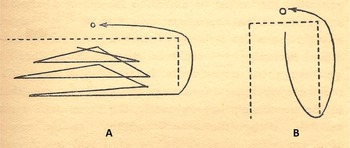
To illustrate this difference, we include one of Köhler’s own figures below, which reproduces the results of a detour experiment (see Figure 1). It distinguishes between the two types of solution: the left of the Figure shows back-and-forth, hesitant movements for a random solution, while the right side depicts the smooth, continuous movements characteristic of a genuine solution. Apart from these formal, or topographic, differences, Köhler also described certain features of intelligent solutions in detail:
In these [genuine solutions], the smooth, continuous course, sharply divided by an abrupt break from the preceding behaviour, is usually extremely characteristic. At the same time this process as a whole corresponds to the structure of the situation, to the relation of its parts to one another. (Kohler, Reference Köhler1925, pp. 198)
Detour experiment results. The animal had to go around a fence (dotted line) to reach the food (O). (A) shows the dubious, oscillating trajectory toward solution in a chicken; (B) depicts smooth, continuous movement toward an intelligent solution in a chimpanzee.

The last aspect Köhler points out in the quote above is that intelligent behavior depends on the structure of the situation bringing it about, that is, on the criterion established to discriminate a genuine solution from a chance solution:
We can from our experience, distinguish sharply between the kind of conduct which from the very beginning arises out of a consideration of the characteristics of a situation, and one that does not. Only in the former case do we speak of insight, and only that behavior of animals appears to us intelligent which takes account from the beginning of the lie of the land, and proceeds to deal with it in a smooth, continuous course. Hence follows this characteristic: to set up as the criterion of insight, the appearance of a complete solution with reference to the whole lay-out of the field. The contrast to the above theory is absolute: if there the ‘natural fractions’ were neither coherent with the structure of the situation, nor among themselves, then here a coherence of the ‘curve solution’ in itself, and with the optical situation, is absolutely required (Köhler, Reference Köhler1925, pp. 198–199, original italics)
To the range of aspects of intelligent behavior just described, we must add another that Köhler deemed especially meaningful: during the pause between any activity preceding the genuine solution, and the start of genuine solution, “chimpanzees…show by their careful looking around that they really begin with something very like an inventory of the situation. And this survey then gives rise to the behaviour required for the solution” (Köhler, Reference Köhler1925, pp. 198). Time and time again, the German psychologist emphasized the importance of this perceptual stage prior to genuine solution:
After many failures, [Tschego] finally sits down quietly. But her eyes wander and soon fix on the little tree, which she had left lying a little way behind her, and all of a sudden, she seizes it quickly and surely, breaks off a branch, and immediately pulls the objective to her with it. (Köhler, Reference Köhler1925, pp. 111–112)
Last, these genuine solutions were described as intelligent using the term einsichtig, the adjective form of einsicht, which Köhler utilized in his book as a synonym for intelligence in a non-technical sense of the word. Footnote 25 When the book was translated into English, the term insight was instead used. Though etymologically linked to the German word, its meanings do not include intelligence in the way Köhler used the word in his original text. Furthermore, adopting the term insight prompted an important shift by “masking” the German psychologist’s distinctly descriptive perspective and placing the reader in another dimension altogether: claiming that genuine solutions in chimpanzees can supposedly be explained on a theoretical level. In other words, the shift from einsicht to insight changed the focus from behavior to the hypothetical processes causing that behavior; this went beyond what Köhler originally proposed. Footnote 26
Interpreting Intelligent Behavior
While Köhler stated time and again in his book that the purpose of his studies was not theoretical Footnote 27 and that Intelligenzprüfungen an Menschenaffen had a primarily empirical goal, it is nevertheless true that in addressing whether or not chimpanzees exhibit intelligent behavior, two conceptual goals clearly coexisted with Köhler’s empirical aims: first of all, to point out the limitations of the principle of chance, a core element of Thorndike’s theory, in explaining intelligent behavior; and second, to “discuss the experiments only from the points of view which arise directly out of them” (Köhler, Reference Köhler1925, pp. 228, original italics). We will now shift our focus to analyze some conceptual outcomes of Köhler’s book.
First of all, Thorndike’s research on learning by trial and error in his famous “puzzle box” experiment was highly influential in his time. Köhler wrote a complex, in-depth analysis criticizing it from a methodological and epistemological standpoint. His critique sought to demonstrate that Thorndike’s theory did not apply to the intelligent behavior he had observed in chimpanzees. Footnote 28 In terms of methodology, Köhler believed the tasks Thorndike used in his studies had several shortcomings because they were based on information gleaned from anecdotal research: Footnote 29 first, they turned out to be too difficult for the species studied; second, they lacked an indispensable condition for finding intelligent solutions in that, as Köhler put it, “placed in cages,…from which a [visual] survey over the whole arrangement was not possible” (Köhler, Reference Köhler1925, pp. 23, original italics). Furthermore, because the “puzzle-box” design was based on the reductive strategy of anecdotal observation and deducing human behavior from such observation, it had the same issue the observations did: erroneous estimation of difficulty. That is to say, tasks that are simple for us may not have originally been so easy. Therefore, our perception of a problem’s difficulty or a behavior’s complexity, for humans, is not a valid point for comparison with other species. Rather than follow an “anecdotal” strategy, Köhler took a comparative approach in the strictest sense: “We can only judge what is originally easy, and originally difficult, by means of experimental tests with anthropoids and perhaps other apes, with children and primitive peoples (for more advanced problems), and perhaps also with imbeciles and mental defectives” (Köhler, Reference Köhler1925, pp. 68).
Regarding the epistemology of Thorndike’s theory, while Köhler explicitly acknowledged that perspective’s contributions to the study of animal psychology, he nonetheless believed his studies of chimpanzees contradicted the principle of chance, especially in demonstrating the existence of a type of intelligent behavior that depends on situational structure: “if [in Thorndike’s theory] the “natural fractions” were neither coherent with the structure of the situation, nor among themselves, then [Köhler’s experiments showed] a coherence of the “curve of solution” in itself, and with the optical situation” (Köhler, Reference Köhler1925, pp. 199).
Despite this evidence to the contrary, two laws were invoked to uphold Thorndike’s theory: a) the principle of parsimony in science, which states that a theory that was confirmed in the past will survive against new data to the contrary, and as new ideas are proposed; b) and consistent with the theory of chance, the notion that animal behavior is in no way influenced by the relationship between different situational elements, ergo the genuine solutions Köhler described “would be a miracle, which must be excluded a limine as contradictory to the foundations of scientific knowledge” (Köhler, Reference Köhler1925, pp. 218). Köhler did not believe the principle of parsimony applied here. His field within science was mere decades old, and therefore should not and could not be limited by a push to conserve as few theories as possible. Science, Köhler countered, tends to adhere to simple theoretical forms only as it develops and becomes more advanced:
One does not get nearer to the ideal state any faster by trying to force the shortest cut to the goal of strictest unity, by proclaiming meager beginnings as the final principles, and by economizing on facts what one does not wish to spend on theories. (Köhler, Reference Köhler1925, pp. 195–196)
Köhler also answered those that justified the theory of chance on the basis of its “harmony” with the laws of natural science. While he did not object to applying it in cases where success at a task could easily occur by chance, Footnote 30 he believed its tenets were not enough to explain his research findings in chimpanzees from the point of view of natural science. On the contrary, they contradicted very important principles, in this case, the second law of thermodynamics:
According to this law, neither physics nor theoretical chemistry allow of the fortuitous formation of a well-directed total movement in the course of the permutations of a large number of small chance movements, which are mutually independent, irregular and all of them equally posible. For instance, in the case of Brown’s molecular movement, it is imposible for a suspended particle, pushed hither and thither fortuitously and irregularly, to be suddenly projected one decimetre in a straight direction. If such a thing did happen, without a doubt a source of error would have entered, i.e. an influence not following the laws of probability. Now, whether it be a question of Brown’s molecular movement, or of the so-called chance impulses of a chimpanzee, makes no essential difference here; for the bases of the second law (according to Boltzmann) are of so general a nature and so obviously valid for more than thermo-dynamics (namely, for the whole domain of chance) that they are applicable also to our (alleged) subject-matter, the “impulses.” Anyone who reproaches us for playing with analogies must surely have misunderstood the fundamental thought of Boltzmann (and Planck). (Köhler, Reference Köhler1925, pp. 219, original italics).
The most important argument of all Köhler leveled against Thorndike’s theory took the form of countless contradictory data generated during his time in Tenerife. These stand out among his main findings: 1) chimpanzee behavior was never random in terms of field structure; when it seemed to be, it was due to some interference with their atttention to the objective; 2) the genuine solution was never “a disorder of blind impulses. It is one continuous, smooth action, which can be resolved into its parts only by the imagination of the onlookers; in reality they do not appear independently” Köhler (1925, pp. 200, original italics); 3) nor were the chimpanzees’ mistakes incoherent, random acts, but rather meaningful actions that either helped the genuine solution come about, resulted from completely misunderstanding the task conditions, or conversely, were a behavioral subproduct of genuine solution – repeating it mechanically and erroneously in situations other than the original one.
The German psychologist was particularly interested in that last type of error, because in that case, repeating or exercising intelligent behavior can not only cause improvement; it can set a degenerative process in motion that actually brings intelligent behavior “down” a level:
Every solution repeated often under the same circumstances, and adequate to them, changes somewhat in nature, and perhaps finally will not be so intelligent even in this, its original milieu, though still adequate. I must say that I like the behavior of the chimpanzees during their tenth or eleventh repetition of a solution less than in that in the first or second. Something is spoilt in the chimpanzee even when many different experiments follow each other in quick succession, but particularly when the same ones are repeated. (Köhler, Reference Köhler1925, pp. 216, original italics).
Mounting data that contradicted the theory of chance cast doubt on the validity of applying that principle, and by extension Thorndike’s theory, to the sort of intelligent behavior Köhler described. It was clear to him that in a dispute between ideas and observations, the latter would always prevail, inevitably requiring that the former be adjusted:
I should imagine that everybody must feel that we have here a very clear, though peculiar occurrence, and one which has nothing at all to do with the postulates of that theory. Are we to squeeze and force the facts to make them fit in with that theory, just to suit the so-called principle of scientific economy? In this case…attempts 1 and 2, appearing as wholes…are a direct result of a visual survey of the situation. A certain scientific attitude, which one might also formulate as a principle, the “principle of maximum scientific fertility,” would lead one to begin the theoretical considerations with this character of the observations, and not to eliminate it at whatever cost as the theory of chance does. (Köhler, Reference Köhler1925, pp. 211–212).
One important question remains about Köhler’s critique of the theory of chance: what conditions did he believe an associative explanation of intelligent behavior should meet? His position was that first and foremost, it must explain how one learns the connection between the properties of two things:
I will merely observe here that the first and essential conditions to a satisfactory associative explanation of intelligent behaviour would be the following achievement of the theory of association, to wit: what the grasp of material, inner relation of two things to each other means (more universally: the grasp of the structure of the situation) must strictly be derived from the principle of association; ‘relation’ here meaning an interconnexion based on the properties of these things themselves, not a type of ‘one-after-another or simultaneously-happening occurrences’. This problem is the first to be solved, because such ‘relations’ represent the most elementary function participating in specifically intelligent behaviour, and there is no doubt at all that these relations, among other factors, continually determine the chimpanzee’s behaviour… Either the association theory is capable of clearly explaining the ‘smaller than,’ ‘farther away than,’ ‘pointing straight towards,’ etc., according to their true meaning as mere associations from experience, and then all is well; or else the theory cannot be used for an explanation, as is the case if it cannot account for those factors primarily effective for the chimpanzees (as for man). In the latter case only a participation of the association-principle could be allowed, and at least that other class of processes, relations and not exterior connexions, should be recognized as an independent working principle as well (Köhler, Reference Köhler1925, pp. 228–229, original italics).
Köhler responded to other criticism his work incited as well: first, the potential role of past experience for chimpanzees who lived in the wild before their behavior was observed experimentally; and second, the possibility that while living at the Anthropoid Station, the chimpanzees may have seen humans execute similar solutions and have merely been imitating them. Those possibilities were ruled out, the first given knowledge of the animals’ pasts, Footnote 31 and the second because Köhler maintained that chimpanzees never imitate behaviors they find unfamiliar or do not understand. Footnote 32
Finally, as we stated at the beginning of this section, in addition to critiquing the theory of chance, the book Intelligenzprüfungen an Menschenaffen brought to light several conceptual observations that, short of constituting a formal theory of intelligent behavior, did give Köhler the opportunity to conjecture about his experiments “only from the points of view which arise directly out of them” (Köhler, Reference Köhler1925, pp. 242–243, original italics). We shall briefly describe some of his main observations.
On the whole, Köhler’s observations were part of the discovery that chimpanzees exhibit a form of genuinely intelligent activity, and discussed the implications of that in relation to human intelligence. According to Köhler, the intelligence of primates is more similar to ours than, say, lower apes, but as his research findings clearly showed, they lack several, hugely important features of human intelligence.
Of those features, the first has to do with the chimpanzee’s visual world. Köhler’s research in Tenerife supported a widely held idea in late nineteenth-century comparative psychology: the importance of visual perception in grasping a problem situation (Boakes, Reference Boakes1984). Similarly, his primates’ demonstrated problem-solving ability was not linked to complex cognitive processes, but rather the fact that that they perceived the world articulately. In other words, in their perceptual world, objects were more differentiated than, for example, chickens would perceive. This close relationship between intelligent behavior and the visual structure of a situation could also explain cases where a genuine solution does not emerge and the chimpanzee responds with guesswork. Such is the case when the structure and complexity of the field exceeds their visual abilities. Köhler, understandably, believed a theory of intelligent behavior should be preceded by a theory of spatial forms: “Gradually it becomes obvious that to understand the capacities and mistakes of chimpanzees in visually given situations is quite impossible without a theory of visual functions, especially of shapes in space” (Köhler, Reference Köhler1925, pp. 136).
The second factor concerns chimpanzees’ innate comprehension of the physics of objects used in problem-solving. Given the chimpanzee’s difficulty solving box-stacking problems, Köhler concluded that their notion of the basic physics of objects was ue los chimpancés tienen derelatively rudimentary. In particular, they lacked a natural conception of how to balance two or more boxes when stacking them. Therefore, chimpanzees lack an innate knowledge of objects’ stasis, or equilibrium, meaning that unlike human beings, they cannot solve such situations intelligently, only purely by chance. From a human point of view, what they built was totally unstable, yet they climbed easily by immediately compensating for any unexpected lean with movement. Here Köhler describes the role of the labyrinth/cerebellum in primates’ conceptions of stasis:
From this description it will be seen that the animals partly replace the missing (everyday) statics of human beings by a third kind – that of their own bodies, which is taken care of automatically by a special neuro-muscular machinery. In this respect, the chimpanzee, it seems to me, is even superior to man, and he obviously draws an advantage from this gift. (Köhler, Reference Köhler1925, pp. 157).
According to the German psychologist, the chimpanzee’s way of life definitely does not favor statics. While man’s head is always upright, allowing for a fixed, absolutely vertical orientation to develop in visual space, the chimpanzee lacks an absolute spacial orientation. They deviate from vertical in the positioning of their heads almost as often as not, which favors developed functioning in the labyrinth and cerebellum.
A third, obvious aspect of human intelligence the chimpanzee lacks is language. Though his experiments were not designed to study potential linguistic ability in primates, Köhler was convinced that these simians do not exhibit language akin to human language. He maintained that their utterances and gestures never designated objects in the world around them; they were mere shows of mood or emotion. It was Teuber, his predecessor as head of the Anthropoid Station, who investigated the emotional quality of chimpanzee utterances, facial expressions, and gestures. Teuber, surprised by their extensive development of proto-language, believed that teaching chimpanzees sign language would be the best way to study their linguistic abilities. He proposed that a visual, symbolic language be developed (Teuber, Reference Teuber1994, pp. 563–567).
Another aspect of intelligence that Köhler pointed out, displayed by humans and not chimpanzees, is their ability to plan for the future. The German psychologist wrote that “how far back and forward stretches the time ‘in which the chimpanzee lives’ is limited in past and future” (Köhler, Reference Köhler1925, pp. 292, original quotation marks), so they cannot anticipate future events to the same extent as humans. To exhibit that ability, the primate would have to engage in preparations for a future situation at a time when none of its conditions are in view. Köhler observed no such behavior in his chimpanzees. They seemed trapped in the present, their interest limited to the present moment of reward. They showed an unwillingness to shift their attention from some strong, momentary interest for the mere expectation of gaining some future advantage. He suggested one way to experimentally elicit this highly complex form of behavior:
An ape that has often used boxes to reach an objective, is kept in a room where there are boxes at his disposal, but no objective for which to use them. His ration is cut short, but after a while he is taken into another room where there is plenty of food – if only there were boxes with which to reach it. The way back into the first room is barred…After a while the hungry animal is let back into the first room, then again into the second, and so on, until a box in the first room might be seen as a tool for the situation in the second, and taken along for that purpose. (Köhler, Reference Köhler1925, pp. 283–284)
A final aspect of primate intelligence Köhler explored was the ability to recall past events; this was much easier to study. Toward that end, he conducted experiments in which Sultan was placed in a fenced-in enclosure with no stick. Köhler then buried a pear in the animal’s line of sight at a distance of 1.40m from the enclosure, and proceeded to erase any sign of excavation. Half an hour later, he placed a stick outside the fence within Sultan’s reach. A brief time elapsed where the chimpanzee did not seem to realize the change, and then:
When his glance again happens to fall on the stick, he springs up, pulls it in, runs quickly with it to the bars opposite the burrying-place, and scrapes the sand away at the exact spot, until the pear appears…From this test we deduce the keenness of his memory (considering the absolutely uniform surface). (Köhler, Reference Köhler1925, pp. 290, original italics) Footnote 33
More than emphasizing the role of factors absent during the test, Köhler’s work highlighted the importance of immediately comprehending the structure of the present situation in the process of functionally adaptating to it, downplaying the adaptive role that reproducing and synthesizing present and past experiences could play. Thus, even though Sultan and Grande showed that they possessed good memory ability, Köhler never proposed that primates live in any other timeframe than the immediate moment of reward.
Köhler’s Book in Context: Animal Psychology in His Time
After returning to Germany in 1920, Köhler did not continue his comparative psychology research in primates. Personal factors seem to have affected that decision, specifically the frustrating experience of having remained in isolation in Tenerife throughout World War I, so much more time than expected. Though he had practically finished his experiments by mid-1914, he was forced to remain on the island 6 years more, during which it was very difficult to stay abreast of scientific break-throughs relevant to his research. That misfortune was compounded by aggravating accusations brought against him from the English colony, alleging he took part in espionage during the war (Ley, Reference Ley1990). Köhler himself, on several occasions, expressed his ultimate disillusionment about working with chimpanzees: they became more aggressive with age and it became increasingly difficult to discover new, interesting behavior in them (Köhler, Reference Köhler and Benjamin1967). In his correspondence during that time, Köhler stated that after working with these animals every day for two consecutive years, he himself had become “chimpanzoid” (cited in Jaeger, Reference Jaeger1988, p. 58). Those issues, and an interest in returning his focus to developing Gestalt psychological theory, may have unfavorably influenced his attitude toward this period of his career and made him feel unmotivated to continue this line of research back in Germany. Footnote 34 Nevertheless, his work had widespread, international influence and the remainder of this section will analyze that impact.
Part of a Tradition: Simian Intelligence
To assess the impact of Köhler’s work at the Anthropoid Station in Tenerife on animal psychology in his time, particularly in the United States where animal research was well established, may be difficult. Against what backdrop would his work have been received?
From early on, the North American tradition in animal research was influenced by Thorndike’s objectivism, and his associative, trial-and-error explanation of learning. From the publication of his 1898 thesis (Animal Intelligence: An Experimental Study of the Associative Processes in Animals) onward, comparative psychologists in the U.S. gradually distanced themselves from the European research scene. This was motivated by its methodological shortcomings, and the concerns of authors like Romanes, Morgan, and Hobhouse that it was more interested in analyzing the evolution of intelligence and behavior, than in the experimental study of a single learning process. Footnote 35 That distancing was accelerated by John B. Watson’s (1878–1958) 1913 proclamation of behaviorism, which followed in Thorndike’s footprints by emphasizing objectivism and methodological rigor.
The same year Thorndike published The Mental Life of the Monkeys (1901), Hobhouse’s book Mind in Evolution was also released. Those two works helped delineate two general frameworks for conducting research in monkeys and simians for the immediate future: one in the tradition of the psychology of learning; and another following in the footsteps of European comparative psychologists. Learning theorists wanted to demonstrate that the behavior of every species – even higher, more human-like species – could be explained by a single learning process. Meanwhile, comparative psychologists argued that certain, more flexible types of behavior could not be explained without acknowledging that animals possess complex mechanisms to problem-solve in new situations, ones in which they have not been explicitly trained.
Thorndike classified learning into three categories: learning by trial and accidental success, learning by imitation, and learning by ideas. Footnote 36 The latter, responsible for advances in civilization, was therefore unique to man. Thorndike was highly skeptical of learning by imitation because his earlier studies yielded unfavorable results as far as mammals’ ability to learn this way (Thorndike, Reference Thorndike1898). Therefore, the American psychologist’s objective in The Mental Life of the Monkeys was to determine whether primates are more inclined to learn through imitation. In earlier work, he observed behavioral differences between his Cebus (capuchin) monkeys, and cats and dogs. His explanation, however, was that the monkeys did not succeed at the tasks faster because they were mentally superior or could think freely; rather, the differences were due to their better perceptual-visual ability and manual dexterity. This gave them an edge on tests where they had to manipulate various slides to open boxes containing food. Better perceptual equipment and manipulative ability definitively contributed to their “high degree of facility in the formation of associations of just the same kind as we found in the chicks, dogs, and cats” (Thorndike, Reference Thorndike1901, p.17).
Hobhouse reported favorable results on learning by imitation in monkeys in his 1901 work, which were contradicted by Thordike’s data. While greater experimental rigor in Thorndike’s studies may have detracted from Hobhouse’s less rigorous observations, many comparative psychologists of that time were reticent to accept that imitation was not an important factor in adapation processes. Along those lines, Kinnaman (Reference Kinnaman1902a, Reference Kinnaman1902b) conducted an extensive study that replicated Thorndike’s experiments in rhesus monkeys, and added a long battery of tests spanning memory, discrimination of shape, size, and color, learning in a complicated maze, numerical ability, and reasoning ability. Using apparatuses built to mimic the ones Thorndike used in his experiments, Kinnaman’s results yielded no evidence of reasoning. However, he did find data to support learning by imitation (in a rhesus monkey), use of general notions (concepts), and low-level reasoning.
Shortly thereafter, Watson conducted a series of studies on imitation in four monkeys (two rhesus, one baboon, and a capuchin). In them, either Watson himself or a monkey modeled some behavior another monkey had to imitate. His results were absolutely conclusive: “I unhesitatingly affirm that there was never the slightest evidence of inferential imitation manifested in the actions of any of these animals” (Watson, Reference Watson1910).
However, a trickle of studies out of Harvard seemed to demonstrate that these animals’ abilities surpassed what Thorndike and Watson’s research would suggest. The subject of imitation became a central question. C. S. Berry, under the direction of Robert M. Yerkes (1846–1956), conducted a study of cats, and criticized how quickly, and after what minimal observation, Thorndike had concluded that these animals did not imitate. In Berry’s opinion, certain types of voluntary imitation required animals to see the model execute the behavior several times before beginning to imitate it (Berry, Reference Berry1908; Yerkes, Reference Yerkes1909).
Also at Harvard, Melvin E. Haggerty replicated Thorndike’s research in monkeys. In the conclusions of his extensive study of Cebus capuchins and rhesus macaques, he showed that the animals exhibited different levels of imitation behavior (Haggerty, Reference Haggerty1909a, Reference Haggerty1909b). Though the central nucleus of Haggerty’s published works hinged on the question of imitation, under Yerkes’s supervision, he also conducted experiments in which animals successfully overcame tests similar to those Hobhouse proposed (Haggerty, Reference Haggerty1913).
It seemed clear that, under Yerkes’s influence, the Harvard Psychological Laboratory was more willing to move in a comparative direction, less anchored in the quest for a single mechanism to explain all types of behavior. Furthermore, in terms of epistemology, Yerkes appears to have been more permissive of less rigorous research practices than other Americans:
With extreme objectivism, as voiced during the early years of my career…I have never been able to sympathize unreservedly because it impressed me as dangerous in its restrictions and negations. On similar grounds I have rejected the more recent objectivism, or as he calls it, behaviorism, of Watson. (Yerkes, Reference Yerkes and Murchison1932, pp. 396).
Since the beginning of his career, Yerkes showed an interest in investigating the mental capacities of monkeys and primates, and to do so, he thought it necessary to build a center for the specialized study of those species (see Yerkes, Reference Yerkes1916a). It was predictable, then, that he would become more receptive than other American psychologists to other points of view, such as those represented in studies at the Anthropoid Station in Tenerife. Yerkes knew of Köhler’s work in the Canary Islands firsthand; the two had exchanged information and corresponded with one another. He even suggested visiting the Station in Tenerife, but the start of the War halted that possibility (Ash, Reference Ash1995).
In 1917, a few months after Köhler sent his first research report to the Prussian Academy of Sciences, Yerkes published The Mental Life of Monkeys and Apes: A Study of Ideational Behavior (1916b). In it, he acknowledged the Station in Tenerife and his interest in it. Footnote 37 Nevertheless, he neglected to mention that he had first-hand knowledge of Köhler’s experiments and their results:
Koehler [sic], working in the Canary Islands, has, according to information which I have received from him by letter, made certain experiments with orang-utans [sic] and chimpanzees similar to those of Hobhouse and Haggerty. His results I am unable to report as I have scanty information concerning them. (Yerkes Reference Yerkes1916b, pp. 129)
That is surprising, because Köhler and Yerkes were not only in contact via letter; they also sent each other reprint of their works. In fact, some material Köhler filmed in Tenerife was sent to the U.S. for processing thanks to Yerkes (Sokal, Reference Sokal1984). It stands to reason, then, that Yerkes’s silence about Köhler’s experiments damaged their friendship and scientific collaboration for a time.
After they reestablished contact in 1921, Yerkes’s attitude changed dramatically; he now took every oppportunity to praise and recognize Köhler’s work:
I may mention certain conspicuously important contributions to our knowledge of chimpanzee behavior. Most notable of all are the reports of investigations at the Canary Island anthropoid station…It is pertinent to remark that Koehler [sic] (now Professor of Psychology in the University of Berlin) and the writer, in touch since 1914, have been able to assist one another materially. They were simultaneously engaged in studies of insight of anthropoid apes, Koehler [sic] using chimpanzees at the Canary Island Station, the writer observing an orang-utan [sic] at the private laboratory of G.V. Hamilton in California. In the present investigation the writer has been able to profit by the report of Koehler and he herewith gladly acknowledges his obligations to that able and single-minded investigator. (Yerkes & Learned, Reference Yerkes and Learned1925, pp. 18–19)
That being said, this mutual recognition that their perspectives on intelligent behavior in apes aligned did not hide the fact that Yerkes’s theoretical ideas developed in the tradition of American animal psychology, a perspective far-removed from Köhler’s. Yerkes was unsatisfied with the behavior classifications of his time, Footnote 38 feeling that behavior – especially human behavior – was more complex. He made an effort to find signs of intelligence when conducting animal research. Both psychologists agreed on one essential aspect: intelligent behavior depended on perceiving the relationships among situational elements. The following quote from Yerkes conveys how the two arrived at the same conclusion: “in each case, the solution of the problem depends upon the perception of a certain constant relation among a series of objects to which the subject is required to attend and respond (Yerkes, Reference Yerkes1916b, pp. 10). He even made an effort to connect the term “ideational behavior” – which he proposed to refer to intelligent actions – to Köhler’s chosen term, einsicht. Nevertheless, this overlap in their work was more apparent than actual. The German psychologist was interested in intelligent solutions occuring prior to any sort of training, that is, naturally or spontaneously. Conversely, the “ideational behavior” Yerkes considered a sign of intelligence required numerous experimental trials. Footnote 39
Yerkes’s effort to set in motion an extensive research program on intelligence in non-human anthropoid apes ultimately paid off after he arrived at Yale University in 1924. After securing the necessary funding, he witnessed the launch of the first primate station in the United States, in Orange Park, Florida (Dewsbury, Reference Dewsbury2006).
Challenging a Different Tradition: The Problem with Intelligence
As described above, Köhler’s book was part of a series of comparative studies in simian intelligence. However, his impact stretched the limits of that tradition, challenging learning theorists wishing to interpret complex behavior using a set of basic, simple, working principles. Such was the case of Clark L. Hull (1884–1952), an American psychologist. Over the years, he came to be the foremost systematic theorist on learning and adaptive behavior of his era. Since the very start of his scientific career, he wanted to develop an experimental approach to study thought (Gondra, Reference Gondra2007). Perhaps this early interest in cognition piqued his interest in the Gestalt authors, but his favorable view of the German school of psychology had the paradoxical effect of “converting him” to behaviorism. Footnote 40 Many of the phenomena Köhler discovered in Tenerife were actually crucial to the development of Hull’s learning theory. Hull described Köhler’s book thusly: “It is a splendid piece of work. I liked especially his criticism of the association theory. I found that it bore especially on the mechanism of purpose” (Hull, 1925 cited in Gondra, Reference Gondra2007, pp. 119).
In an effort to explain Köhler’s observations of detour behavior with separate, intermediate objectives – Sultan using a short stick to reach a longer one, then using that to reach the food – Hull proposed that intelligent behavior may be the result of a process of transference. This process is mediated by the similarity between the proprioceptive stimuli involved in responding to the intermediate (grabbing the stick, either short or long, with their hand) and final objectives (grasping the fruit in their hand). That similarity could be the common element that makes it possible to generalize responses, on which problem situation resolution depends (Hull, Reference Hull1952b). What Köhler considered the greatest challenge to association theory remained to be addressed: to explain what perceiving a relationship between two things entails. Footnote 41 One of Hull’s disciples would take on that task.
Kenneth W. Spence (1907–1967), who would go on to become Hull’s protégé, was one of the most significant learning theorists of the 20th century, and owed much of his scientific reputation to having developed a theory of discrimination learning that stood up against Köhler’s challenges. Spence met Hull at Yale while completing his dissertation on visual acuity in chimpanzees, which he had studied under Yerkes’s direction at the laboratory in Florida. During his three-year stint in Florida, he made important contributions to comparative research in simians, examining: their sensory capacities (Spence, Reference Spence1934), maturation and growth processes in young chimpanzees (Spence & Yerkes, Reference Spence and Yerkes1937), and the chimpanzee’s ability to learn through imitation (Crawford & Spence, Reference Crawford and Spence1939). Footnote 42 Despite his close collaboration with Yerkes, Spence increasingly adopted Hull’s position, seeking to explain complex behavior through a set of simple, well-defined processes (Dewsbury, Reference Dewsbury2006).
During his stay at Yerkes’s laboratory in Florida, Spence pursued research on the “transposition” phenomenon in discrimination learning that Köhler described in Tenerife (Table 1). In Köhler’s original study, he trained two chimpanzees, Chica and Grande, to choose the largest of two rectangles differing only in size. Later, once they had learned to select the biggest rectangle, he conducted trials where in addition to the original stimulus, another, larger one was displayed that was not present during initial training. Köhler discovered that the chimpanzees, presented with this new pair of stimuli, tended to choose the larger rectangle even though it had not appeared during training. He argued that through this simple procedure, he had shown that in discrimination learning, structure is predominant, not the elements (Köhler, Reference Köhler1918).
Aware that his results could have been contaminated by attentional processes, – larger stimuli always attract more attention – he replicated his findings in Rana, an animal of particular ingenuity at these tasks. This time, Rana learned to discriminate the smaller of two rectangles. As in the earlier experiment with Chico and Grande, Rana responded according to the structure of the situation, choosing the smaller stimulus from new pairs 24 times out of 30. Footnote 43 Having ruled out the potential impact of stimulus size on attention, as far as Köhler was concerned, the “transposition” phenomenon demonstrated that animals’ responses are guided by the relationship between elements in a situation, not by the elements’ absolute values (Köhler, Reference Köhler1918).
This led Spence to answer Köhler’s challenge with an alternate interpretation. Based on the assumption that during discrimination learning, excitatory or inhibitory generalization gradients form around the pair of stimuli used in training (Spence, Reference Spence1936, Reference Spence1937), each gradient’s maximum would be one of the original stimuli from training – either excitatory or inhibitory. According to Spence’s theory, two simple mechanisms could explain the transposition phenomenon Köhler discovered: 1) training stimuli only varied in one dimension, so the two gradients partially overlapped; 2) how much effort it took to select a stimulus was the result of subtracting inhibitory tendency from excitatory tendency. Based on those two postulates, Spence (Reference Spence1936) was able to correctly predict the relational behavior of Köhler’s chimpanzees, given that during test trials, the original training stimuli did not make them more inclined to respond. Footnote 44
Spence’s ideas stoked controversy between two seemingly irreconcilable views: one relational and supposedly more cognitive, and the other elementary, based more on learning principles (see, e.g., Gulliksen & Wolfle, Reference Gulliksen and Wolfle1938; Honing, Reference Honig1962; Johnson & Zara, Reference Johnson and Zara1960; Kendler, Reference Kendler1950; Lawrence & DeRivera, Reference Lawrence and DeRivera1954; Riley, Reference Riley1958). What may be an even greater surprise is that the Köhler-Spence controversy continues today, with authors actively trying to ascertain the nature of the underlying processes (see, e.g., Lazarera, Miner, Wasserman, & Young, Reference Lazarera, Miner, Wasserman and Young2008; Lazarera, Wasserman, & Young, Reference Lazarera, Wasserman and Young2005; Pearce, Reference Pearce1994; Wills & Mackintosh, Reference Wills and Mackintosh1999).
Hybridizing Traditions: Intelligence in Rats
Köhler’s observations in Tenerife and ideas about intelligent behavior became, for Hull and Spence, a catalyst for developing their elementary theories of learning and behavior. Edward C. Tolman (1886–1959) was a different case. His theories were unmistakably imbued with Gestaltian concepts. Psychologists from that school held a place of honor even in the acknowledgements section of his autobiography: “Next, it should go to the Gestalt psychologists, but especially to Kurt Lewin whose ideas I have borrowed time and again and have absorbed into my very blood” (Tolman, Reference Tolman, Boring, Langfeld, Werner and Yerkes1952, pp. 339, we chose to italicize the expression here to emphasize its metaphorical quality).
His contact with the German psychologists began in 1912 when his professor at Harvard, Herbert S. Langfeld (1879–1958), who had recently arrived from Berlin after earning his doctorate with Carl Stumpf, advised him to spend some time with Koffka in Giessen. Years later, in 1923, the effects of World War I having subsided, Tolman returned to Giesssen with Koffka, with whom he remained in constant contact throughout his career (Sokal, Reference Sokal1984; Reference Sokal and Poggi1994; Tolman, Reference Tolman, Boring, Langfeld, Werner and Yerkes1952).
In Tolman’s work, the Gestalt influence was apparent from the outset in his maze tasks – blocking the direct path to the reward, he observed whether or not subjects would take an indirect path to reach it – as well as in his theoretical interpretations of spatial learning, which he considered the acquisition of knowledge about patterns of spatial relationships in a situation (i.e. cognitive maps):
Let us turn now to the second main school. This group (and I belong to them) may be called the field theorists. We believe that in the course of learning something like a field map of the environment gets established in the rat’s brain. We agree with the other school that the rat in running a maze is exposed to stimuli and is finally led as a result of these stimuli to the responses which actually occur. We feel, however, that the intervening brain processes are more complicated, more patterned and…more autonomous than do the stimulus-response psychologists…Secondly, we assert that the central office itself is far more like a map control room than it is like an old-fashioned telephone exchange. The stimuli, which are allowed in, are not connected by just simple one-to-one switches…Rather, the incoming impulses are usually worked over and elaborated in the central control room into a tentative, cognitive-like map of the environment. And it is this tentative map, indicating routes and paths and environmental relationships, which finally determine what responses, if any, the animal will finally release. (Tolman, Reference Tolman1948, pp. 192)
Tolman’s ideas became permeated with concepts that, while not identical to those of the Gestaltists, were clearly inspired by them, such as his molar conception of behavior and notions of sign-gestalts, means-ends expectancies, etc. Many of his published papers testify to that relationship (Tolman, Reference Tolman1925, Reference Tolman1932a, Reference Tolman1932b, Reference Tolman1933, Reference Tolman1948). Nevertheless, Köhler’s anthropoid intelligence research was not especially relevant to the American psychologist’s work, although Tolman made the concept of insight his own, reimagining it as “inventive ideation,” a neologism very similar to Yerkes’s: “Such inventive ideation was our name for that which has often been called insight learning. The essence of such inventive learning was found to lie in the organism’s ‘hitting upon’ some wholly new aspect of the field” (Tolman, Reference Tolman1932b, pp. 371, original italics).
While Tolman’s concept of “inventive ideation” departed considerably from the descriptive sense in which Köhler utilized the term Einsicht, and even though Köhler always considered Tolman’s theories part of behaviorism, the German psychologist, not surprisingly, mentioned Tolman’s work to U.S. audiences often when defending his own thesis:
Not all differences of opinion in psychology which spring from different cultural traditions should, because of this origin, simply be ignored. On the contrary, some such differences are clearly proper subjects of discussion, and ways of looking at mental life which now are mainly found in a certain local tradition may very much deserve the attention of psychologists with a different tradition. The same holds…for local differences as to scientific procedure. As a simple example, I should like to mention that probably all European psychologists who came to this country learned from their American colleagues to be much stricter about experimental proof than they had been before. In this respect, the American tradition had been superior. But Americans were also willing to learn from those who came from Europe. The great question of whether scientific psychology should be concerned with striving and purpose did not for long remain related to the difference between one kind of passport and another. Acually, it was a behaviorist, Professor Tolman of California, who first admitted that purpose must be given a central position among the concepts of psychology. He also convinced other behaviorists by showing that purpose can be subjected to exact experimental investigations. (Köhler, Reference Köhler and Henle1971, pp. 428)
Assuredly, Norman R. F. Maier (1900–1977) was not among the behaviorists Tolman convinced of the importance of purpose, but he made one of the most interesting attempts to hybridize theory from two different national traditions: comparative psychology in the U.S. and Germany. Footnote 45 Maier, who completed his dissertation with John F. Shepard (1882–1965) in Michigan, spent a time (1925–1926) in Berlin working with Köhler. There, he began to study questions of concern to Köhler (intelligent behavior) using the procedures (mazes) and species (rats) so characteristic of comparative psychology in the U.S. Maier’s experimental studies (1929) were very similar to the detour tests Köhler conducted in Tenerife. In them, he tried to show that rats display certain types of behavior that defy the traditional laws of association. Footnote 46 In the experiments, he established two separate patterns of behavior – overlapping neither in space nor time – in rats to see if their essential elements would spontaneously combine and form a new pattern of behavior that would solve a problem situation they had not encountered before. Maier’s data revealed that rats could combine two isolated experiences into an integrated pattern to reach a goal, that the laws of association cannot explain that combination, and that this integration of isolated patterns was characteristic of reasoning, a distinct process from conditioning. Accordingly, Maier distinguished between two ways of integrating experience: one, by combining isolated experiences, he called R; Footnote 47 and another, by mixing contiguous experiences, he called L:
There are two qualitatively different types of behavior patterns. The one made up of contiguous experiences is in harmony with the usual concepts of learning. It implies that previous repetitions of the relationships involved in the behavior pattern are necessary. It therefore seems that integrations of this sort characterize learned behavior…Integrations which are made up of two or more isolated experiences are qualitatively different, and must be indicated by a different term. They arise without previous repetitions… and consequently are new. They are not the product of trial and error… The term reasoning implies that something new has been brought about, and that in some way, past experiences have been manipulated. It therefore seems that behavior patterns made up of two isolated experiences characterize what is meant by behavior which is the product of reasoning. (Maier, Reference Maier1931, pp. 336)
Maier published several papers that aimed to elucidate the nature of these problem-solving processes, and the factors that encourage or interfere with them. He believed, much like Köhler, that reasoning involved a reorganization of perceptions and past experiences. However, his ideas had minimal impact on our understanding of animal reasoning because they contradicted the S-R principle, which was the bedrock of animal psychology in the U.S. in those days.
Final Reflections
The impact and historical relevance of Köhler’s Intelligenzprüfungen an Menschenaffen is utterly undeniable; it would be nearly impossible to track every single area of research that it inspired and stimulated. Some authors have suggested Köhler’s influence was limited in the U.S. relative to the attractiveness there of objectivity and the rigor of conditioning methodology (Boakes, Reference Boakes1984). It has also been suggested that behaviorism, the dominant school of psychology since the ’30s, overshadowed comparative psychology, whose past was associated with minimal scientific rigor. While that type of research did not die out entirely, it was marginalized from the prominent journals of the era. Add to that the fact that the structures of power in academia laid mainly with proponents of behaviorism, and it is easy to understand why people were suspicious of Köhler’s work. On the one hand, it violated the basic postulates on which conditioning theories were founded; and on the other, it used a patently comparative strategy at a time when that approach was simply not part of the methodological arsenal of learning theory – then very powerful. While comparative psychology never completely disappeared in the U.S., it had significantly less impact on psychological science at that time than if it had not lacked certain scientific and institutional conditions that would have guaranteed its full development (see Dewsbury, Reference Dewsbury2000, for a detailed analysis of that period).
Interwar Europe was not very receptive to comparative studies of anthropoid intelligence, so it stands to reason that the influence of Köhler’s work was, if possible, even more limited there than in the U.S. As described above, Pfungst’s brilliant analysis of the case of Clever Hans the horse incited a great deal of skepticism of research showing animals to possess any intellectual abilities at all. As if that were not enough, the Russian physiologist Ivan P. Pavlov (1849–1936) vehemently opposed the antiassociationism that followed from Köhler’s work. He replicated the German psychologist’s experiments, in chimpanzees named Rosa and Rafael (Windholz, Reference Windholz1984) and reported with his usual eloquence:
“This summer I devoted some time to the study of apes. We began with experiments concerning the analytical ability of apes. But these data are not new and are of no great interest. During the last month we reproduced Koehler’s experiments, for example, the superposition of boxes in order to take hold of suspended fruit, etc. Prior to this I had read very thoroughly, and as usual, not once but several times, Koehler’s article ‘Investigation of the Intellect of Anthropoids.’ Thus I was able to read about the experiments and to have the facts of the given experiments before my eyes. I must say that I am really amazed at the degree in which the human mind can differ. In my opinion, Koehler saw nothing of what was actually demonstrated by the apes. I say this without any exaggeration: he simply did not understand anything” (Pavlov, Reference Pavlov1955, pp. 558)
Pavlov maintained that the secret of anthropoid apes’ intelligence was their complex system of conditional motor reflexes, suggesting a close connection between intelligence and activity:
For it is the processes disregard by Koehler that are of the greatest importance. I grasped and realized this while observing the behavior of the ape. And I say that all this activity of the ape in trying now one, now another way of solving the task, is the intelligence, the reasoning in action, which you can see with your own eyes. This is a series of associations; some of them have been acquired in the past, other are formed before your eyes, and are either combined, united into a positive whole, or, on the contrary, are gradually inhibited and lead to failure (Pavlov, Reference Pavlov1955, pp. 559–560)
Matters being as they were, it is not unusual that as some authors suggest (Gómez, 1989), we had to leave the confines of animal psychology and move into child psychology to find a conceptual domain for Kohler’s work to be received enthusiastically, and that was thanks to Jean Piaget’s (1896–1980) high opinion of the German psychologist’s work. In fact, the practical intelligence and situational thinking tasks Köhler developed were frequently employed in studies of genetic psychology around that time, and played a decisive role in child intelligence research (Piaget, Reference Piaget1936). Footnote 48
Aside from animal psychology and child psychology in the ’30s, Köhler’s pioneering studies of anthropoid intelligence were foundational in the field of primatology, anticipating many subjects of research that have been, and continue to be, central to that field. Following his statement that “the time in which the chimpanzee lives is limited in past and future” (Köhler, Reference Köhler1925, pp. 292), a series of studies has analyzed similarities and differences between different species’ memory systems (e.g. Bischof, Reference Bischof and Stent1978; Bischof-Kohler, Reference Bischof-Kohler, Eckensberger and Lantermann1985; Clayton, Bussey, & Dickinson, Reference Clayton, Bussey and Dickinson2003; Paxton & Hampton, Reference Paxton and Hampton2009; Roberts, Reference Roberts2002; Tulving, Reference Tulving1983). Similarly, Köhler’s observation that the structures his animals built to reach food were unstable, which led him to assert that chimpanzees lack certain notions of physics that humans understand naturally, gave way to a fertile line of research on intuitive physics in simians and human beings (e.g. Cacchione & Krist, Reference Cacchione and Krist2004; Hood, Hauser, Anderson, & Santos, Reference Hood, Hauser, Anderson and Santos1999; Needham & Baillargeon, Reference Needham and Baillargeon1993; Povinelli, Reference Povinelli2000).
These contributions aside, the most enduring value of Köhler’s book, Intelligenzprüfungen an Menschenaffen, does not lay, in our opinion, in presenting a theory of intelligence, but rather in the excellent quality of his observations. They anticipated current studies by several decades and addressed topics of tremendous interest, such as the use of tools (Goodall, Reference Goodall1964; Sabater Pi, Reference Sabater Pi1978), primates’ social behavior and hierarchical relations (de Waal, Reference de Waal1993), expressive behavior (Riba, Reference Riba1992; Yerkes & Learned, Reference Yerkes and Learned1925), and reactions to their own reflection in a mirror (Gallup, Reference Gallup1970). These observations and more warrant another reading of this book.