Carbapenem-resistant Enterobacteriaceae (CRE) are multidrug-resistant bacteria with limited treatment options and high mortality rate that can spread within healthcare facilities.Reference Borer, Saidel-Odes and Riesenberg 1 – Reference Epstein, Hunter and Arwady 5 Risk factors for CRE colonization at the time of admission include previous antibacterial exposure, prior hospitalization, and transfer from high-risk post–acute-care facilities such as long-term acute-care hospitals (LTACHs).Reference Epstein, Hunter and Arwady 5 – Reference Prabaker, Lin and McNally 7
Awareness of patient CRE status at the time of admission may prevent patient-to-patient transmission of CRE by ensuring that such patients are cared for with appropriate infection control measures (eg, contact precautions or cohorting). 8 Strategies to improve awareness include active screening for CRE at the time of admissionReference Ben-David, Maor and Keller 9 – Reference Calfee and Jenkins 11 and interfacility communication of CRE status. 12 However, the feasibility and resource utilization of CRE screening in endemic settings is unclear, and the frequency of appropriate CRE documentation at time of transfer is unknown.
Rush University Medical Center (RUMC) is a tertiary-care hospital in Chicago, Illinois. In this geographic area, high endemic prevalence of CRE colonization in LTACHs and high-risk skilled nursing facilities (~30%) has been reported, with lower prevalence in short-stay hospital ICUs (3.3%).Reference Hayden, Lin and Lolans 13 – Reference Lin, Lyles-Banks and Lolans 15 In 2013, the RUMC Infection Control Department initiated active screening of high-risk patients for CRE at the time of admission in an attempt to identify CRE-colonized patients and to reduce the risk of nosocomial CRE transmission. We assessed the feasibility and outcomes of our active screening program, and we examined the frequency of interfacility CRE communication.
Methods
We performed a retrospective observational study at RUMC, a 676-bed tertiary-care university hospital. From February 2013 to October 2013 (period 1), the RUMC Infection Control Department implemented CRE rectal screening for all adult patients (≥18 years of age) admitted to an intensive care unit (ICU). For adult patients on a general ward, only patients transferred from an outside facility were screened. From November 2013 to January 2016 (period 2), to reduce the testing burden, the screening policy in the ICU was modified such that only patients transferred from outside facilities were screened.
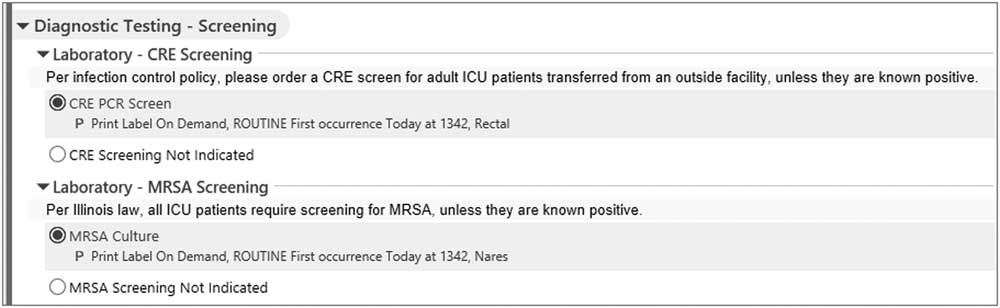
We analyzed all patient admissions involving ICUs and general wards in both periods and collected the following data: number of patients qualifying for CRE screening during each period, number of CRE screening orders placed, number of CRE culture samples obtained, and CRE screening result. Based on a standard point of origin billing code (UB-04), we identified whether patients were transferred from another acute-care hospital (including LTACHs and emergency departments), other healthcare facility (including nursing homes, skilled nursing facilities, intermediate care facilities, or hospices), or were not transferred (eg, admitted through RUMC emergency room, clinic, or from home).Reference Prabaker, Hayden, Weinstein and Lin 16 This transfer information also triggered a conditional admission order set to help healthcare providers place appropriate screening orders at the time of patient admission (Figure 1). We defined the number needed to screen (NNS) as the number of people needed to be screened to find 1 CRE carrier.Reference Witteck, Rettenmund and Schlegel 17
Automated admission screen order set based on transfer status.

Beginning in period 2, the Illinois XDRO registry (www.xdro.org) allowed hospitals to query whether a patient had ever been reported to the Illinois Department of Public Health as CRE positive.Reference Trick, Lin and Cheng-Leidig 18 For patients transferred to RUMC who tested positive for CRE on admission, we assessed the patient’s historical CRE status based on XDRO registry report. If the patient had a known history of CRE prior to transfer, we manually reviewed their transferring documents (including ambulance records and any transfer paperwork) to determine whether the documents contained information about the patient’s CRE status.
Laboratory methods
Rectal swab samples were screened for CRE using an ertapenem disk method.Reference Lolans, Calvert, Won, Clark and Hayden 19 Unique colony morphologies of presumptive CRE underwent identification to species and susceptibility testing using the MicroScan WalkAway plus System (Beckman Coulter, Indianapolis, IN). Carbapenem-nonsusceptible Enterobacteriaceae isolates were tested further using a multiplex PCR assay for bla-KPC/bla-NDM genes.Reference Mangold, Santiano and Broekman 20 – Reference Cole, Schuetz, Hill and Nolte 22
We collected electronic data from the RUMC clinical data warehouse, which included admission, discharge, transfer, and microbiology order and/or test results. Two investigators (T.S., J.K.) performed manual chart reviews of all transfer documents; discrepancies were adjudicated by a third investigator (M.Y.L.). We considered CRE to be appropriately documented in the transfer document if any of the following words or their acronyms appeared in the face (cover) sheet, discharge summary, history and physical assessment documentation, or ambulance record: carbapenem-resistant Enterobacteriaceae (CRE), Klebsiella pneumoniae carbapenemase (KPC), New Delhi metallo-β-lactamase (NDM). For patients with multiple transfers to RUMC, we reviewed documentation from the first transfer only.
Statistical methods
We used χ2 tests for statistical comparisons, and we considered P<.05 to be significant. All statistical analyses were performed using SPSS version 22.0 software (IBM, Armonk, NY). The RUMC Institutional Review Board reviewed and approved this study with a waiver of informed consent.
Results
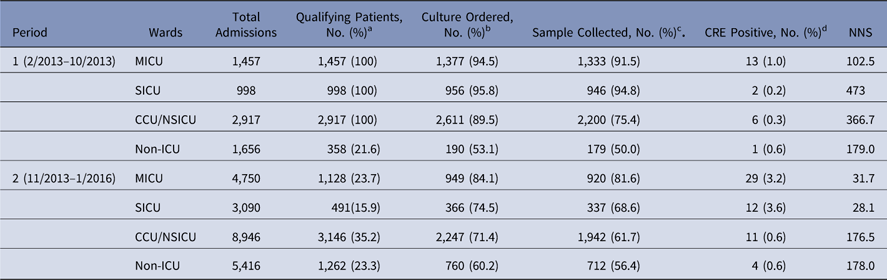
Among 29,230 admissions, a total of 11,757 patients (40.2%) qualified for CRE screening. Overall, 9,450 (80.3%) patients had CRE screening cultures ordered by providers appropriately, and 8,569 (72.9%) qualifying patients had CRE cultures collected. Adherence to ordering protocols and culture collection rates differed by ward and by period (Table 1). Overall adherence to CRE screening in ICUs, as measured by successful sample collection, was higher during universal screening (period 1, 83.4%) compared to transfer-only screening (period 2, 67.3%; P<0.001). This difference in overall ICU screening adherence was driven by differential ordering adherence between periods 1 (92.0%) and 2 (75.0%) (P<.001). In contrast, we observed no difference in collection adherence by nurses once the order was placed (period 1, 90.6%; period 2, 89.8%; P=0.23).
Implementation Rate and Results of CRE Screening

NOTE. CRE, carbapenem-resistant Enterobacteriaceae; NNS, number of patients needed to screen to find 1 carrier; MICU, medical intensive care unit; SICU, surgical intensive care unit; CCU, coronary care unit; NSICU, neurosurgical intensive care unit; ICU, intensive care unit.
a No. of patients who met criteria for CRE screening/Total admissions.
b No. of CRE cultures ordered/No. of patients who met criteria for CRE screening.
c No. of CRE cultures collected/No. of patients who met criteria for CRE screening.
d No. of positive CRE/No. of CRE culture collected.
The CRE culture positivity rate (positive CRE screening cultures divided by the total number of CRE screening cultures collected) was highest in the medical intensive care unit (MICU) and surgical intensive care unit (SICU) during period 2 (3.3% combined rate); this rate was higher than the aggregated MICU and SICU rate during period 1 (0.7% combined rate; P<.001) and was also higher than rates in other wards (ie, coronary care unit, neurosurgical intensive care unit, and non-ICU wards) during period 2 (0.6%; P<.001). We estimated that the NNS was 31.7 patients for the MICU and 28.1 patients for the SICU during period 2 targeted screening, compared to all other wards and periods that had NNSs>100 patients. However, targeted screening of transfer patients missed some CRE patients. When we analyzed the 21 CRE screen-positive patients in the ICU during universal screening in period 1, 10 patients (47.6%) were not directly transferred from an outside institution and would not have been screened using period 2 criteria. Furthermore, CRE culture positivity rates also differed by patient origin of transfer. Among ICU patients, patients transferred from short- or long-term acute-care hospitals had the highest CRE positivity rate (1.9%), while nontransferred patients had the lowest CRE positivity rate (0.5%; P<.001) (Table 2).
CRE Screening Result by Transfer Status in All ICU PatientsFootnote a

NOTE. CRE, carbapenem-resistant Enterobacteriaceae; ICU, intensive care unit, NNS, number of patients needed to screen to find 1 carrier.
a All screening results are from the entire study period (11/2013–1/2016) except nontransfer patient data, which were only available for the period 2/2013–10/2013.
b All patients transferred from short- or long-term acute-care hospitals.
c All patients transfer from nursing homes, skilled nursing facilities, intermediate care facilities, or hospices.
d All patients admitted through the emergency room, clinic, or from home.
Among 45 unique CRE-positive patients in period 2, 13 patients were previously known to other institutions as CRE positive based on a prior XDRO registry report, which occurred a median of 65 days (IQR, 20–176.5) prior to transfer to our institution. Of these 13 patients, 4 patients (30.8%) had documentation of CRE in the cover sheet, medical history record, discharge summary, or ambulance record. Among these patients, 12 (92.3%) were already on contact precautions because of previous known infection or colonization with another multidrug-resistant organism (MDRO).
Discussion
In our single-center experience, active CRE screening on admission is feasible, and hospitals implementing this policy should consider how CRE risk varies by origin of patient transfer and also by hospital ward. We found that targeting screening to patients transferred from outside facilities to our MICU and SICU resulted in the highest CRE positivity rate per test (NNS, ~30 patients), although as many as half of all CRE patients would be missed with targeted screening compared to universal screening. Admission CRE active screening may be useful because only one-third of transfer records appropriately documented CRE carrier status, even when the patient CRE status was previously known at an outside institution.
As with any diagnostic test, CRE screening involves a series of preanalytic steps before the specimen is analyzed at the laboratory. We quantified the cascade of patient participation (from admission to qualification, order placement, and specimen collection) to assess resource utilization and opportunities for improvement. During period 1, we screened all patients admitted to ICUs, but the screening was inefficient and resource intensive (NNS, 100–400 patients). Moving from a universal to a targeted screening approach resulted in more efficient screening, but we observed lower adherence with screening, primarily due to inadequate test ordering by providers, even though our electronic admission order set provided clinical decision support. These results highlight the importance of considering preanalytical factors, in addition to the performance characteristics of a test, when calculating the impact and overall sensitivity of active screening for CRE.
In our region, patients transferred from LTACHs and skilled nursing facilities that care for ventilated patients (vSNFs) are at highest risk of CRE carriage (ie, ~1 in 3 of these patients are CRE carriers).Reference Prabaker, Lin and McNally 7 Our hospital intended to specifically target these high-risk transferred patients, but we could not identify an electronic method to distinguish LTACHs from other hospitals or vSNFs from other skilled nursing facilities. Ultimately, we targeted all transferred patients to capture high-risk patients. Targeted screening could be further refined by excluding lower-risk ICUs such as the neurosurgical or coronary care ICU, where patients are often transferred from other hospitals because of acute stroke or myocardial infarction, respectively, rather than from long-term care facilities. Future strategies of identifying high-risk patients using regional hospital discharge databases could better target patients based on healthcare and antibiotic exposure history rather than transfer status alone.Reference Lin, Rezny and Ray 23
We assessed whether a patient’s CRE status was appropriately documented at time of transfer. In general, transfer documents in our region were not standardized across facilities, and there was not a reliable single location where CRE information could be recorded or found. Less than 50% of the transfer documents that we reviewed appropriately documented CRE status. Notably, while CRE-colonized patients were frequently cocolonized with other MDROs that also warranted contact isolation, CRE colonization status may be prioritized differently than other MDROs with regard to cohorting or discontinuation of contact precautions, particularly if such patients return to long-term care facilities.Reference Banach, Bearman and Barnden 24 Regions can consider adopting a standardized infection control transfer form, 12 though we have found that in our region, uptake of standardized forms has been poor, especially among healthcare facilities that use the electronic medical record to generate transfer records. Electronic methods of sharing MDRO information, such as the XDRO registry, may enhance the reliability of communicating CRE information between institutions.Reference Trick, Lin and Cheng-Leidig 18
This study has several limitations. First, we assessed an active screening program implemented in a region where CRE is highly endemic.Reference Lin, Lyles-Banks and Lolans 15 Thus, our findings are not generalizable to hospitals where CRE are uncommon. Second, we did not measure CRE incidence in our hospital using serial (eg, weekly or discharge) patient CRE screening, and we allowed other infection control efforts (eg, hand hygiene campaign and implementation of XDRO registry alerts) to occur concurrently during the study period. Thus, our study was not designed to compare the efficacy of universal versus targeted CRE active screening to prevent CRE transmission. Finally, further cost-benefit analysis of CRE testing is needed to better understand the economic impact of active screening.Reference Ho, Ng, Ip and You 25
In conclusion, CRE active screening is feasible, especially if it is targeted toward high-risk admissions and units. Because CRE status is inconsistently communicated between facilities via transfer documentation, strategies such as active screening or enhanced interfacility communication (eg, XDRO registry) are needed to identify CRE patients at the time of admission.
Acknowledgments
Financial support
This study was supported in part by the Centers for Disease Control and Prevention (Cooperative Agreement no. U54 CK000481).
Potential conflicts of interest
M.Y.L. has received research support in the form of contributed product from OpGen and Sage Products (now part of Stryker), and he has received an investigator-initiated grant from CareFusion Foundation (now part of Becton Dickinson). M.K.H. has received research support in the form of contributed product from Clorox, Medline, Mölnlycke, OpGen, and Sage Products, and she has received an investigator-initiated grant from Clorox. All other authors report no conflicts of interest relevant to this article.