1 Introduction
Real-life or life-like experiences in listening to native speakers of second languages can assist second language (L2) learners’ language development. Using authentic texts and audiences is an effective way to provide meaningful exposure to the target language and culture. Meaningful interaction also increases learners’ motivation levels (Helgesen, Reference Helgesen2003). Accessing native speakers to practise the target language can sometimes be difficult when living at a distance from the target culture (Jin & Erben, Reference Jin and Erben2007). In computer-assisted language learning (CALL) environments, a number of online tools can be used to overcome the difficulty (Son, Reference Son2011). This study explores two online tools that can be used for synchronous communication with native speakers of the target language: Second Life and Skype. Second Life (secondlife.com) is a multi-user virtual environment that caters for voice and text communication within a virtual environment with interlocutors appearing as avatars, this being their virtual representation. Skype (www.skype.com) is a video conferencing tool that provides text, voice and video communication (Kemp & Lingstone, Reference Kemp and Lingstone2006; Antonacci & Modaress, Reference Antonacci and Modaress2008; Wehner, Gump & Downey, Reference Wehner, Gump and Downey2011).
Many researchers have highlighted the need for empirical research in the area of computer-mediated communication (CMC) focusing on specific teaching methodologies and techniques that are effective for e-learning. For example, Eroz-Tuga and Sadler (Reference Eroz-Tuga and Sadler2009) expressed the need for research associated with video conferencing tools; Deutschmann, Panichi and Molka-Danielsen (Reference Deutschmann, Panichi and Molka-Danielsen2009), Hernández-Serrano, González-Sáanchez and Muñoz-Rodríguez (Reference Hernández-Serrano, González-Sánchez and Muñoz-Rodríguez2009) and Warburton (Reference Warburton2009) called for research relating to CMC, learning and the use of virtual worlds; and Jones and Plass (Reference Jones and Plass2002) identified the need for further research in this area relating to the development of listening comprehension. While Turner (Reference Turner2005) used the term “affordance” to discuss what an online tool can offer students for the purpose of learning, Chapelle (Reference Chapelle2001), Warschauer and Grimes (Reference Warschauer and Grimes2007), Kessler (Reference Kessler2010), Bueno Alastuey (Reference Bueno Alastuey2011), Chen and Brown (Reference Chen and Brown2011) and Jauregi, Canto, Graaff, Koenraad and Moonen (Reference Jauregi, Canto, Graaff, Koenraad and Moonen2011) have all expressed the importance of identifying the affordances of online tools as they may lead to the creation of teaching methodologies that effectively utilise these affordances. Lin, Wang, Grant, Chien and Lan (2014), in particular, assert that further research is needed into different language teaching formats, methods and strategies, which could improve language learning in multi-user virtual environments. Nevertheless, as Chen and Brown (Reference Chen and Brown2011) indicated, research on the use of CMC for task-based learning is limited. This study attempts to address these issues by investigating the use of Second Life and Skype for the development of L2 listening comprehension skills in Croatian as a second language (CSL) learners and English as a second language (ESL) learners.
2 Listening comprehension, Second Life and Skype
At the beginning of a conversation, listeners engage in top-down processing to establish the general meaning and purpose of the interaction (Nunan, Reference Nunan2002; Helgesen, Reference Helgesen2003). As the conversation continues, each response assists the creation of the next response and relates to the purpose of the conversation, which in turn assists in the creation of the next response and so forth. While listening, interlocutors relate information to their internal cognitive schema (Hedge, Reference Hedge2002). A schema contains information regarding what usually occurs in a situation and assists people to conform to cultural norms and to participate in day-to-day situations (Nishida, Reference Nishida1999). The internal cognitive schema helps them understand the conversation and what a typical appropriate cultural response could contain. Moyer (Reference Moyer2006) in her discussion on listening comprehension acknowledges the importance of sociolinguistic, discourse and strategic knowledge and ability for learners to be competent communicators. If listeners are unable to comprehend the purpose of the conversation and information provided by the other interlocutor or the appropriate cultural response, the conversation will not continue or may not have the desired outcome. Fischer, Kollar, Haake and Mandl (Reference Fischer, Kollar, Haake and Mandl2007) and Chang (Reference Chang2009) assert that teachers can utilise role-playing activities and related collaborative scripts to help learners in preparing to interact in the target culture. Such activities assist students in developing the internal cognitive schema related to the second language and culture. Ur (Reference Ur2007), Jones (Reference Jones2008) and Chen and Brown (Reference Chen and Brown2011) support the use of resources and circumstances that resemble real-life when including cultural content in lessons.
Learning to comprehend through listening requires a combination of listening skills such as identifying words and phrasal boundaries, pragmatic nuances and key words while considering social and referential meanings (Goh, Reference Goh2000; Lems, Miller & Soro, Reference Lems., Miller and Soro2010). Semantic and pragmatic processes are intertwined when comprehending spoken text (Sarandi, Reference Sarandi2010) and can also be interactive between individuals during conversations (Rost, Reference Rost2002; Flood, Reference Flood2003). Nunan (Reference Nunan2004) and Ellis (Reference Ellis2005) concur that learners need to develop different strategies and processes when interacting. Moyer (Reference Moyer2006) states that teachable strategies and techniques such as the use of advanced organisers; vocabulary brainstorming and development; and visual input can assist learners in comprehending at a higher level. Practice is important as listening requires learners to process information in the moment while possibly encountering speech errors, sounds in the environment, different accents and different cultural understandings (Vandergrift, Reference Vandergrift2006; Schroeders, Wilhelm & Bucholtz, Reference Schroeders, Wilhelm and Bucholtz2010).
Cziko (Reference Cziko2004) asserts that learning in a standard classroom lacks exposure and participation in authentic environments where language is used. As well as being able to communicate synchronously with native speakers, virtual worlds such as Second Life allow learners to interact with the virtual environment (e.g. buildings, signs, transport) that can reflect the real world allowing for exposure to a variety of situations with many forms of conversations (Schwarts, Lin & Holmes, Reference Schwarts, Lin and Holmes2003; Dieterle & Clarke, Reference Dieterle and Clarke2008: Deutschmann et al., Reference Deutschmann, Panichi and Molka-Danielsen2009). As well as supporting authentic learning experiences, learning tasks in Second Life can be student-centred and tailored to students’ needs (Lin et al., Reference Lin, Wang, Grant, Chein and Lan2014). Students can become immersed in the target culture and language (Burbles, Reference Burbles2006) and have the opportunity to personally find native speakers of their target language to communicate with as well as through designed educational tandem tasks, which incorporate native speakers of the target language (Kuriscak & Luke, Reference Kuriscak and Luke2009). The affordances of the environment, the tasks and the sociolinguistic aspects of communication influence learning experiences (Peterson, Reference Peterson2006). Liou (Reference Liou2011) investigated the effects that the affordances of using Second Life in a CALL course had on the achievement of the course aims as well as 25 learners’ perceptions of activities undertaken during the course. The participants reported that it was advantageous to be able to immerse in the environment and interact with other avatars. Liou recommends that the use of Second Life needs to be planned for with task selection aligning with clear pedagogical aims. Slow internet speed, however, was a source of frustration outside the classroom for 64% of the participants. Burbles (Reference Burbles2006) posits that, when students are immersed in a virtual world, the process of interacting with others and the environment can stimulate their imagination and interest. Pellas and Kazanidis (Reference Pellas and Kazanidis2014) emphasise that the virtual environment has an impact on learning success and warn that it should be appealing to learners and easy to use. L2 learners can meet using avatars (virtual representations of themselves) in the same virtual environment even though they are physically at great distance. The virtual environment becomes a shared space (Burbles, Reference Burbles2006) and an online community where learners can collaborate, co-construct knowledge and share their ideas. Learners can gain a sense of belonging to their group and can feel less isolated (Antonacci & Modaress, Reference Antonacci and Modaress2008; Cooke-Plagwitz, Reference Cooke-Plagwitz2008; Omale, Hung, Luetkehans & Cooke-Plagwitz, Reference Omale, Hung, Luetkehans and Cooke-Plagwitz2009). Alenezi and Shahi (Reference Alenezi and Shahi2014) found that learners gain a sense of presence when visiting a virtual university campus, which can provide distance students with the opportunity to immerse in learning.
Sykes (Reference Sykes.2005) identified the use of Second Life for learning as being less stressful than face-to-face communication for some learners, which Omale et al. (Reference Omale, Hung, Luetkehans and Cooke-Plagwitz2009) argue is especially beneficial for introverted learners as being able to communicate through an avatar provides a sense of security and concealment. In a study on the use of Second Life for learning Spanish in an undergraduate course, Wehner et al. (Reference Wehner, Gump and Downey2011) found that a decrease in anxiety led to an increase in motivation, which can have a positive effect on learning. Jauregi et al. (Reference Jauregi, Canto, Graaff, Koenraad and Moonen2011) found that, when the use of Second Life was compared with video conferencing, L2 learners felt that Second Life gave them more opportunities to communicate with others as well as the virtual environment engaging their imaginative thought. While one of the four participants in Jauregi et al.’s (2011) study viewed not being able to see their partner as a disadvantage, all participants reported that they preferred Second Life when compared with video conferencing. Stevens (Reference Stevens2006) agrees that virtual worlds may be able to provide new methods for education with immersion in authentic cultures providing unique experiences. Concurring with Jauregi et al. (Reference Jauregi, Canto, Graaff, Koenraad and Moonen2011), Stevens (Reference Stevens2006) and Henderson, Huang, Grant and Henderson (Reference Henderson, Huang, Grant and Henderson2009), Schwienhorst (Reference Schwienhorst2002) explains that learners are able to drive their own creative exploration and learning in a multimodal manner when using virtual worlds. Some barriers to using virtual worlds that have been identified include: time delays hindering listening ability; users who do not act appropriately; areas in virtual worlds that contain mature content (Antonacci & Modaress, Reference Antonacci and Modaress2008); users feeling less responsible for their actions when they feel anonymous (Burbles, Reference Burbles2006); virtual locations crashing or disappearing; the cost to own land (Cooke-Plagwitz, Reference Cooke-Plagwitz2008); and the time difference between interlocutors’ locations (Karpova, Correia & Baran, Reference Karpova, Correia and Baran2009; Liaw & Master, Reference Liaw and Master2010). Lin et al. (Reference Lin, Wang, Grant, Chein and Lan2014) investigated teachers’ perceptions of using Second Life for language learning and found that the teachers developed strategies to overcome issues in Second Life: for example, in order to overcome the issue of not seeing real facial expressions, the teachers used a gesture heads-up display to represent typical gestures such as waving and nodding in agreement. If some students became silent, the teacher used instant messages to check in with them and assist while not interrupting other learners. Students learnt quickly and began assisting one another.
Skype is viewed as being a reliable and affordable video conferencing tool that is easy to learn and use (Tian & Wang, Reference Tian and Wang2010). Lee (Reference Lee2007) investigated the use of video conferencing and task work to improve L2 skills with eighteen L2 learners. The learners were paired with a competent speaker, and learner reflections and interviews were used to collect data. It was reported that collaborative learning through video conferencing was suitable for facilitating the development of pragmatic and linguistic skills. Being able to access non-verbal visual cues was considered an advantage. Taillefer and Munroz-Luna (Reference Taillefer and Munroz-Luna2014) assert that non-verbal communication is important for beginner learners to assist with understanding. Jauregi, de Graaff, van den Bergh and Kriz (Reference Jauregi, de Graaff, van den Bergh and Kriz2012), in an investigation of the effect of using video conferencing on L2 learners’ motivation, found greater positive effects on lower ability students (CEFR A2 level) than on higher ability students (CEFR B1 level).
Tian and Wang (Reference Tian and Wang2010) compared the perspectives of ESL learners in China and learners of Mandarin in Australia on using eTandem Skype activities in their personal time to develop their cultural and communicative skills. The researchers’ findings demonstrated that the use of Skype was effective and that it was easy for the students to continue to meet one another. The learners reported improvements in their listening skills. Tian and Wang also found that the learners’ perspectives were influenced by their ability level when they were paired in mixed ability level groups. Higher ability level students viewed the task more positively than lower ability level students. Szedmina and Pinter’s (Reference Szedmina and Pinter2010) perspective supports Tian and Wang’s (Reference Tian and Wang2010) use of Skype as an activity outside the classroom as the activity provides learners with the opportunity to learn at their own pace. Carney (Reference Carney2008) found, in a study on the use of a variety of information and communications technologies (e.g. Skype, blogs, wikis, voice chats, and student-made DVD movies) for tandem learning with 24 ESL learners residing in Japan, that Skype video conferencing was their overall preferred online tool and environment. Carney claims that language programs should include a variety of online tools. In contrast, Hauck and Youngs (Reference Hauck and Youngs2008) found that, in a comparative study of the use of synchronous and asynchronous online tools with students of French paired with native speakers, their students’ preferred asynchronous online tools stating that they could interact more often asynchronously than synchronously.
3 Methodology
3.1 Research design
This study attempted to answer the following research questions: (1) What effects does the use of Second Life and Skype as part of a facilitation technique have on the development of L2 learners’ listening comprehension?; (2) What are the identified affordances of Second Life and Skype when being used for developing listening skills in an L2?; and (3) What are L2 learners’ perceptions of using Second Life and Skype for developing listening skills in their target language?
A total of 35 students participated in the study with eleven taking part in both Treatment Period 1 and Treatment Period 2. The students were of mixed gender and ages ranging from 18–30 years. The participants came from four universities: CSL learners from two universities in Australia, and ESL learners from a university in Croatia and another university in Bosnia-Herzegovina. Learning Croatian at the Australian universities entailed attending classes for two hours a week. At the two other universities, in Croatia and Bosnia-Herzegovina, English classes were offered as part of an Arts degree or as an elective subject of another degree. Permission to research was sought from each university involved as well as written consent from all participants. Participation was voluntary with the opportunity to withdraw without fear of negative consequences. Data was de-identified; each participant was provided with a code number.
The techniques utilised for facilitating the development of listening comprehension (to be referred to as “facilitation techniques”), which consisted of a group of tasks related to themes, were developed using Skype and Second Life. For the Second Life technique, the participants were provided with a two-hour training session prior to commencement. Training in using Skype was offered to the participants, yet all of them reported that they were already efficient users. Each facilitation technique contained eight communicative tasks based on themes used in the participants’ usual course of study. Three different content sets were created to cater for class curriculum. The participants were students from intact language classes. Treatments were segregated into three treatment periods. Each treatment period contained one group of ESL learners and one group of CSL learners. Each member of the ESL group was paired with a member of the CSL group. Group 1’s content focused on advanced legal English; Groups 2, 6 and 8 used Beginners Level 1 Croatian themes with the ESL participants; Group 3 used Beginners Level 2 Croatian; Group 4 used similar content themes in English at the students’ appropriate level in consultation with the lecturer; and Groups 5 and 7 used the same themes in the English language.
The facilitation techniques were designed based on the concept that language learning should emphasise language being used for real-life purposes and social action (Council of Europe, 2001). Script theory was used to assist organising tasks according to typical conversation scripts that may occur in the situations used in the tasks (Nishida, Reference Nishida1999). For example, the asking for directions task contained language structures that are typical for each language when asking a stranger for directions to a location. The tasks were developed on the assumption that listening is a receptive skill that often occurs while being an active participant in a conversation. Online media or specific virtual locations were selected based on the instructional aim of the activity. For the topic “At the Café”, for example, a virtual café was used in Second Life and links to online menus to real cafés were used during the Skype technique. The participants took turns playing the roles of the waiter and the patron.
Authentic resources that were rich in cultural knowledge were also used to assist students’ motivation and emotional connection to the content and task (Ur, Reference Ur2007; Chen & Brown, Reference Chen and Brown2011). For example, a virtual Zagreb was used in Second Life, which was created to closely resemble the real Zagreb. Tasks were designed to utilise the online tool’s affordances focusing on using the listening skill. The themes presented in the most used content set were: (a) Greetings and Introductions; (b) Following Directions; (c) Objects Hunt; (d) Describing Objects; (e) Shopping; (f) At the Café; (g) Media Session (weather and news report); and (h) Describing an Event. Most tasks were designed using the same language content but specific activities were created, which utilised the learning environment. The “Greetings and Introductions” task was designed for the participants to become familiar with each other and the learning environment. The participants were provided with a variety of typical questions to prepare for prior to the task. The task was similar for both Second Life and Skype. The “Following Directions” task contained the same language content, however, the manner in which the learning occurred was different; that is, in the Second Life technique, for example, the participants were expected to listen to directions and walk around and find a virtual location whereas in the Skype technique the participants used maps each showing the location of a different object. Each participant took turns leading the other participants through the use of directions to the location from the marked starting point. The Second Life activity contained virtual movement and changing scenery and environmental sounds as the participant walked around the virtual world. The Skype technique included the use of a map with the participants listening to directions and following them on a map. The “Shopping” and the “At the Café” tasks entailed the participants virtually visiting life-like replicas of locations in Second Life. For instance, in the shopping activity the participants visited a virtual shopping centre and looked at and discussed the clothes available; and for the café task they visited a virtual café and sat at a table there and ordered their drinks. For these two activities, authentic resources (e.g. snippets from a real shopping catalogue, a real menu) were used to facilitate conversation and learning via Skype. For the “Describing Objects” and “Describing an Event” tasks, the participants described virtual 3D representations in Second Life and 2D picture representations in the Skype version of the task. The media session was very similar for both online tools as the participants were required to view a website and discuss the news.
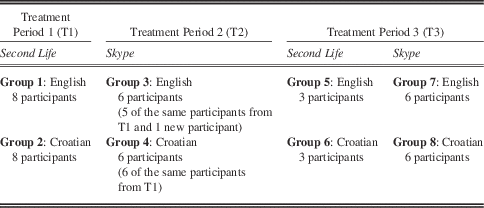
Table 1 shows participant groups in the three treatment periods. Treatment Period 1 lasted five weeks due to initial technical issues at each university. Treatment Periods 2 and 3 lasted eight weeks respectively as this was the number of weeks available when university semester dates were concurrent. Students from Australia participated in the evening, and students from Croatia and Bosnia-Herzegovina participated in the morning (due to an eight-hour time difference). Assignment to pair grouping was random, with the same pair working together on all tasks in a treatment period. Group meetings occurred once a week for the allocated five weeks for Treatment Period 1 and eight weeks for Treatment Periods 2 and 3, and lasted an hour with 30 minutes allocated to communicating in each language. The same intact classes participated in Treatment Periods 1 and 2. Different participants were recruited for Treatment Period 3 as this treatment period commenced at the beginning of the following academic year. The participants used the same content as that used during Treatment Period 1. Treatment Period 1 began by utilising the universities’ computer rooms, with the tasks for all treatment periods continuing as part of the students’ homework activities.
Participant groups in all treatment periods

Note: A total of 46 sets of data were collected from 35 actual participants.
3.2 Data collection
The mixed-methods design used in this study is based on a convergence model in which both qualitative data and quantitative data are collected together and compared. The process provided the researchers with rich information from multiple sources and perspectives leading to a more thorough understanding of the phenomena being studied (Creswell, Clark, Gutmann & Hanson, Reference Creswell, Clark, Gutmann and Hanson2003). More focus was given to the qualitative data set, which provided information regarding the perceived effectiveness and affordances of the techniques. A control group was not included because CSL students were not achieving verbal communicative competence by the end of their diploma indicating that maturation would not be an intervening variable.
The design incorporated pre-tests, treatment periods and post-tests, followed by in-depth interviews. Pre-tests and post-tests were incorporated into the design in equivalent forms to: ascertain the participants’ prior knowledge and ascertain the participants’ gains in listening comprehension development when compared with post-test results. The results were analysed to ascertain the students’ gains in listening comprehension development using both techniques. The participants’ entry level, as determined by the pre-tests, was an important consideration to ensure that tasks were relevant. The Common European Framework of Reference for Languages: Learning, Teaching, Assessment (CEFR) (Council of Europe, 2001) was used as a guide for test development. Throughout the creation, piloting and review of the tests, Croatian language experts from two universities were consulted to determine whether the tests measured the level they were designed to measure. The tests were created using Articulate Quizmaker (www.articulate.com), which is a software package that enables the creation of online and offline assessments using multiple choice, drag and drop, quizzes and other question formats. They were delivered through ‘Articulate Online’ (web location for delivery of online context) ensuring consistency in delivery of the tests. The participants were required to listen to discussions on the same themes that were used during the tasks and answer multiple choice questions on the discussions. The participants were given the opportunity to preview the test questions before listening as Yanagawa and Green (Reference Yanagawa and Green2008) assert that previewing test questions may provide listeners with the schemata to structure their listening. To assist this process the test questions were written in the target language. The participants answered the questions at the completion of each listening segment. The duration of each listening segment was between 40 seconds and 2 minutes. Tests reflected life-like conversations, which increased their validity (Fulcher, Reference Fulcher2000). Test items were constructed to ensure that a subsequent question item did not hold the answer to a previous question. To assist in consistency with speech rate (word per second) and accent, the same speakers were used on the pre-tests and post-tests.
The interview questions covered the themes of: the participants’ background knowledge, their opinion of their own skill, task preparation strategies, strategies used when meaning was lost during the task conversation, affordances of the learning environment, pitfalls, cross-cultural communication and improvements to the techniques. There was an extra question for participants who took part in both techniques asking them to compare the facilitation features. Due to feasibility and time constrains, just a small trial of a task and interviews took place as well as consultation with three lecturers of linguistics. Reliability was considered in regard to the replication of the interview process to ensure that the interview experience was as similar as possible for the participants (Flick, Reference Flick2007). One of the researchers and one lecturer conducted the interviews and a second rater was used to assist with the consistency of the interpretation of the data.
The data was collected, compared and contrasted in three stages. In Stage 1, the results from the pre-tests and post-tests administered to each group were analysed using paired t-test to ascertain whether significant gains in the participants’ listening comprehension development resulted from participating in the technique. In Stage 2, the four Skype treatment groups’ data was compared to ascertain whether there was any significant difference between the groups. The process was then undertaken for the Second Life groups. The scores between the Croatian and English groups using the same content (Groups 3 and 4 and then Groups 7 and 8) were compared, to investigate the differences between language and ability groups. In Stage 3, all data from the Skype groups was collated and t-tests were used to ascertain whether there was any significant gain. The same process was completed for the Second Life group. The t-test results from both techniques were compared to identify if there was any significant difference for the participants who took part in either technique. The three-stage analysis process was also used for the interviews. The responses given by each participant were coded with the participant’s number. The answers were then grouped according to the questions. Themes were identified and labelled and the labels became the basis of the descriptive coding – Nvivo 9 – that was used. Analysis of the themes followed and this led to the building of concepts around the themes in relation to the research questions (Richards & Morse, Reference Richards and Morse2007). The analysed data from each treatment group was then compared to gain a fuller picture of the influence of utilising each online tool and their affordances in relation to the participants’ listening comprehension development.
4 Results
Stage 1 results contain the expanded version of each group’s data. These results are collated and revisited during Stage 2 and Stage 3 comparisons. This article focuses on the data from Stages 2 and 3.
4.1 Stage 2 Analysis
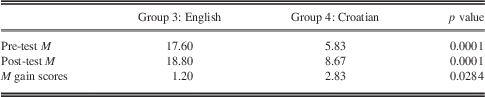
The quantitative data analysis from all Skype groups comparing pre-test and post-test scores using a paired t-test resulted in two-tailed p values are shown in Table 2. The p values for Groups 3, 4, 7 and 8 showed a statistically significant positive change in listening comprehension occurred. The qualitative data supported this trend with the participants valuing their experiences and viewing the process as effective with the benefit of learning about culture through cross-cultural interaction.
P values of all Skype groups comparing pre-test and post-test scores

A paired t-test statistical analysis was also used for each Second Life group’s pre-test and post-test results. The two-tailed p values from the Second Life groups are compared in Table 3. All p values demonstrated that statistically significant positive changes had occurred indicating that each group experienced improvement in listening comprehension. Second Life qualitative data supported this trend.
P values of all Second Life groups comparing pre-test and post-test scores

4.2 Stage 3 analysis
4.2.1 Quantitative analysis
Participants who received perfect scores in the pre-test did not have their data included in the quantitative analysis and were provided with suitable adjustments to their program to ensure that their tasks were meaningful for them. Initially, the amount of change (improvement in performance) that occurred in the results of 21 Skype data sets was compared with the results of 20 Second Life data sets. An unpaired t-test (t=0.6949, df=39, p<0.5) indicated no statistically significant change. One technique did not outperform the other. An analysis of whether ESL and CSL participants improved at a similar rate using Skype was also conducted. An unpaired t-test was used to analyse the gain scores, which demonstrated a statistically significant difference (t=3.0620, df=19, p<0.0065). This indicates greater gains for CSL than ESL participants who took part in in the Skype facilitation technique. The same comparison was made between the ESL and CSL participants who used the Second Life facilitation technique providing similar results (t=2.1582, df=18, p<0.045): the CSL participants were making greater improvement than the ESL participants. It was then decided to investigate whether the difference was influenced by lower learning ability or the language being learnt. Group 3 (ESL) and Group 4 (CSL) both participated in Treatment Period 2, which was the Skype facilitation technique. Group 7 (ESL) and Group 8 (CSL) also participated in the Skype facilitation technique using the same content. The data from Group 1 (ESL) and Group 2 (CSL) was not suitable due to different themes being used. The data from Group 5 (ESL) and Group 6 (CSL) was not suitable for comparison as two of the three participants in Group 5 achieved a pre-test score of 100%. Table 4 outlines the pre-test and post-test mean scores for Group 3 (ESL) and Group 4 (CSL) as well as the medium gain scores for both groups.
Skype facilitation technique Group 3 and Group 4 compared

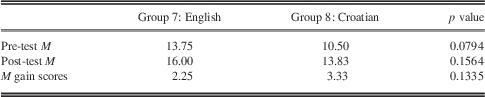
The pre-test and post-test results demonstrate that the CSL learners achieved lower scores than ESL learners on these tests. However, the amount of change between the scores showed that the CSL group made significantly greater gains than the ESL group. The same comparison was then made between Group 7 and Group 8 (see Table 5).
Skype facilitation technique: Groups 7 and 8 compared

These results are in the same direction, supporting the statistical significance demonstrated in the Group 3 and Group 4 comparison. In summary, (1) there was a statistically significant gain in the participants’ listening comprehension as a result of participating in either facilitation technique; (2) there was no statistically significant difference when comparing the use of either technique; and (3) the lower ability level groups which consisted of the CSL participants demonstrated a greater gain in listening comprehension development than the higher ability level groups which consisted of the ESL participants.
4.2.2 Qualitative analysis
Data relating to the interview questions which focused on the students’ comparisons of Second Life and Skype, the affordances of the learning environment, strategies used, and benefits and pitfalls of the techniques is presented in this section. Groups 3 and 4 participated in both facilitation techniques and were asked to compare their experiences. The five participants from Group 3 reported both techniques as being effective for developing listening comprehension. Participant 1 explained: “Second Life is good for activity [sic] that you have to do and talk. Skype is good for talking about things and knowing the person” (Participant 1). Participant 4 commented on the suitability of tasks to the affordances of the online tools: “Second Life, I think, is good for entertainment and for talking about other things around you. On Skype we used the questions, but if you can’t think of a theme to talk about then you are looking only at your partner” (Participant 4). Participant 4 also commented that the script was dominant in the Skype facilitation technique whereas Second Life had a context to also talk about. Participant 5 said that Skype was better for developing friendships, as stated by Participant 6: “I liked Skype, seeing my partner and talking with them together”.
Out of the six participants from Group 4, five participants reported that both online tools could be used effectively when the task was well matched with the beneficial features of the online tools. Participant 11 explained that Skype was preferred as there were no other distractions around and Participant 14 commented that Skype was best for learning grammar as activities could be focused on without other distractions. Participant 16 considered Skype “more personal and friendly” while commenting that Second Life was “more fun”. Participant 14 considered Second Life more suited to doing/role-playing learning tasks. Participant 13 commented that both should be used: “I liked both… maybe practise the words in Skype and then do the activity in Second Life” (Participant 13).
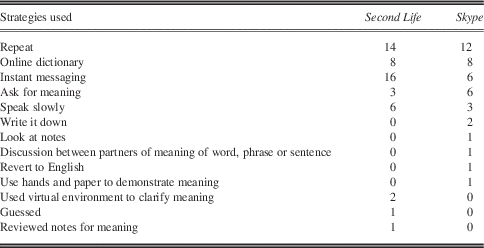
All participants viewed both techniques as effective for developing listening comprehension. The quantitative data supported their perceptions. Table 6 shows the strategies participants reported using and the number of participants who reported using these strategies when using Second Life and Skype. The most commonly used strategy was repeating words for both Second Life and Skype. Using an online dictionary featured as a popular choice. Although both online tools have the feature of instant messaging, it was more widely used during Second Life tasks than during Skype tasks. Interestingly, one participant used his/her hands to demonstrate meaning to their partner, which is possible in Skype as participants can see one another but is not possible in Second Life. The virtual environment was used by two participants for clues to help clarify meaning during conversations.
Comparison of participant-reported strategies and the number of participants who used the strategies during Second Life and Skype tasks

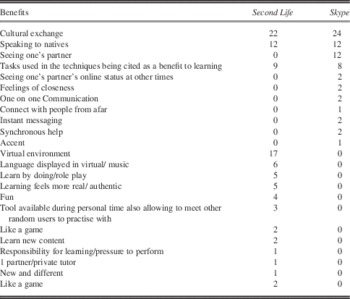
Table 7 outlines the participants’ perceived benefits of using Second Life and Skype and the number of participants who reported each perceived benefit. Cultural exchange featured as one of the main benefits of both techniques as the participants found having access to cultural information valuable and interesting. The participants gained exposure to cultural norms and scripts, which they were unable to gain exposure to from using a text book or discussions in the classroom. The next highly reported benefit, with seventeen responses, was the virtual environment for learning. The participants found being able to speak with a native speaker very beneficial as they learnt to deal with accents, new sentence structures and new information. This new cultural information added to their schema about what was acceptable and unacceptable during conversations as well as expanding their knowledge relating to the themes. Being able to see one’s partner also ranked highly, with twelve responses. The tasks themselves were seen by learners as benefiting learning.. The participants enjoyed listening to music and environmental sounds in Second Life. Accessing these sounds made the experience feel more authentic while providing random listening content.
Comparison between Second Life and Skype: Participant-reported benefits

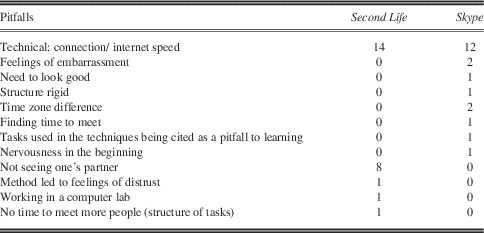
Table 8 demonstrates the participants’ perceived pitfalls of Second Life and Skype, and the number of participants who reported perceiving each pitfall. The greatest pitfall for both techniques was related to technical difficulties. Although the virtual environment was a benefit in Second Life, not being able to see one’s partner was viewed as a pitfall by eight participants.
Comparison between Second Life and Skype: Pitfalls

5 Discussion
The creation of the tasks was guided by schema and script theory, which indicates the importance of using culturally relevant scripts around themes and purposeful circumstances. The interview results indicate that the participants viewed structuring tasks around themes in this manner as being beneficial. When using Second Life, the participants were able to partake in life-like situations based on a content schema in a virtual representation of a real environment, which made them feel meaningful. The participants found their experiences positive and rewarding. The shopping task received ten comments with the environment making an impact as well as using a native speaker: “It was fun going shopping. I cannot go shopping with native English speaker [sic] in my classroom” (Participant 3).
The CSL participants had lower language abilities but were motivated to spend extra time preparing for task work: for example, “It put pressure on me to be able to speak for myself” (Participant 13). The finding supports Krashen’s (Reference Krashen1995) claim that strong motivation can positively influence preparation and performance. As the ESL participants began at a higher ability level, they did not need to prepare as much. From these results, it is logical to infer that the participants who had prior knowledge of the content did not prepare as much for task work as the participants with little prior knowledge. The ESL participants demonstrated motivation to participate by the extra help they offered their partner: “I met my partner before to improve his Croatian… I wanted to help him because he is learning for his family” (Participant 1). Eight Skype participants and nine Second Life participants reported that the tasks were beneficial: “In class we are responding to questions from the textbook, but this was about us” (Participant 13). The Second Life results demonstrated the impact of role-playing real circumstances as the participants reported that it was helpful in making the learning authentic. Native speakers and cultural exchange were viewed as valuable receiving 24 comments. The Second Life environment was considered as a suitable learning environment by 17 out of the 22 participants. The authenticity of the replications of the real locations as virtual locations was of interest as demonstrated in Participant 18’s comment: “It was bizarre walking around a world of Zagreb when I have never been there. It will be interesting to go there and see what it’s like in real life.” Skype provided a sense of authentic audience as a result of being able to see one’s partner, which also resulted in a pressure to perform.
Regarding communication breaking down, 33 comments were made explaining the use of a variety of meta-cognitive strategies (O’Malley & Chamot, Reference O’Malley and Chamot1990) demonstrating how the participants were problem solving by trialling different strategies and solutions. The strategies included: increasing their practice between tasks (29 participants); using repair strategies (26 participants); asking for meaning (9 participants); and using instant messaging (22 participants). Instant messaging was also used to clarify meaning: “You could then revert to typing because sometimes her reading skills were better than her listening skills” (Participant 36). Using text helped reduce learner frustration (Chen & Chang, Reference Chen and Chang2011). Fifteen participants utilised other online tools as part of their repair strategies such as an online dictionary. Using visual cues in Second Life was a repair strategy for two participants.
In Second Life, the participants were able to view messages and listen to conversations between other avatars in close proximity. Being able to assess non-verbal expressions using Skype was viewed as having positive and negative consequences. Participant 17 commented on how he knew when he had made errors by the expression on his partner’s face: “Well, I could see straight away if I said something stupid from my partner’s facial expression” (Participant 17). The participants acknowledged that both the Second Life and Skype facilitation techniques catered for a diverse range of ability levels and interests. The participants could interact visually and aurally in both techniques and also move and learn while in Second Life.
Stockwell (Reference Stockwell2007) suggests that teachers need to know the main online tools that are available and their affordances to inform their selection. Teachers can then select a combination of online tools to use based on their affordances and the pedagogical aims of the tasks. The aims of the “Greetings and Introductions” task (Task 1), in which the participants discussed themselves, appeared well aligned to the affordances of Skype with the added benefit of the participants being able to see each other. The second task focused on listening and following directions. In the Second Life facilitation technique, this was achieved by listening and walking the path of the directions to the desired location. In the Skype facilitation technique, the listener followed directions visually on a map. Both tasks utilised skills that are required in real life and therefore it appears beneficial to use both the Skype and Second Life variations of the task. The “Objects Hunt” (Task 3) appeared to better align with the affordances of Second Life as the participants needed to walk around and find objects. The task incorporated visual and oral information and movement. The affordance of interacting with the environment was effective using Second Life for both the “shopping” (Task 5) and the “At the Café” task (Task 6). The “Describing Objects” activity (Task 4) was suitable for use with either online tool as was Task 8, “describing an event”. The participants could, therefore, select their preferred tool for these tasks. Task 7, the “Media” session, required the participants to watch a weather report and a current news item streamed over the internet. Due to the technical requirement of setting up streaming in Second Life, Skype could be recommended for this task as students are able to talk while using Skype and watch the news item at the same time by simply using a web browser.
6 Conclusions and implications
The study found that the participants perceived both facilitation techniques to be effective for facilitating the development of their listening comprehension. All participants expressed the value of having the opportunity to interact with native speakers guided by tasks structured around a theme (schema), which reflected real-life purposes. Unanticipated results included the amount of cultural learning and the level of motivation to help each other. These results indicate the potential for Second Life to be used to assist learners in developing their intercultural schema and to reduce culture shock for learners visiting target cultures. This potential, and the strategies that pertain to virtual worlds and how they are used, such as using environmental cues, require further investigation.
Multiple strategies were utilised by all participants in the study to regain meaning when communication broke down. The participants were able to use other online tools such as an online dictionary. Skype provided access to facial expressions while Second Life provided a virtual environment to learn in. A number of strategies such as repeating, using online dictionaries, using instant messaging, asking for meaning, and speaking slowly were used by the participants in both online spaces. The results of the study indicate that both techniques assisted in facilitating the development of listening comprehension skills through purposeful interactions with native speakers guided by specific tasks.
The comparison of Second Life and Skype demonstrated that they shared many affordances for developing listening comprehension. The shared affordances included: access to native speakers; authentic cultural content; access to other online tools at the same time; instant messages pressure to perform; instant feedback; synchronous communication; individual learning styles catered for; and purposeful interactions facilitated through task work. The affordances of Second Life were that the participants were able to: overhear others’ conversations and view others’ text messages in the virtual world; meet random avatars; access and become familiar with virtual cultural locations; hear music and view print; participate in role-playing; and gain 24-hour access. Skype’s distinctive affordance was being able to see one’s partner. The affordances of online tools and how they are aligned with the pedagogical aims of tasks appeared to influence the effectiveness of the tasks. Skype is recommended when communication in tasks is one-on-one and based on information exchange not relating to an environment, such as introductions. When communication typically occurs in a particular environment, such as a shopping task, then using Second Life is recommended.
A limitation of the study was the use of externally owned virtual spaces as they can go offline at any time. If the virtual space goes offline, it could become potentially difficult to replicate the study and locate similar virtual locations. Internet services were sometimes an issue on campus resulting in slow internet speed hindering voice communication. Communication and graphics were sometimes delayed. A particular strength of the study was that the design was flexible enough to be altered so the participants could meet their partners in their personal time and complete the activities as part of their homework. Most students reported that they did not experience internet issues at home. Another factor which may have influenced the results was learner variables such as age, gender and general intelligence, which can influence a learner’s ability to learn (Moyer, Reference Moyer2006); however, they were not focused on in this study except for aspects of learners’ motivation and listening ability.
In summary, both facilitation techniques were effective in assisting learners in developing their L2 listening comprehension. It was found that both techniques resulted in positive gains. Based on the analysis of the interview data, an in-depth perspective on the affordances of each online tool could be developed. It would inform the creation of a new facilitation technique that utilises both tools based on their affordances. Different online tools offered different experiences for learners; these were influenced by the tasks and the affordances of the tools. It is recommended that the selection of tools should be carefully considered both in their affordances and their alignment with the task aims. The study demonstrates the value of incorporating carefully selected online tools into language programs. When online tools are aligned with pedagogical aims, learners are able to interact with content in interesting and meaningful ways. Further studies are needed to explore a variety of strategies available for learners when using different online tools for developing listening comprehension. It is also recommended that a language meta-cognitive planning tool be developed that can assist learners with the selection of online tools to enhance their learning based on their actual affordances.